
Our readers keep the lights on and my garage snacks stocked. As an Amazon Associate, I earn from qualifying purchases.
Specs are compiled from manufacturer listings and verified buyer reviews and can change over time — please confirm the key details on the product page before buying.
Swapping your heavy lead-acid battery for a Group 31 lithium one is the single best upgrade for an RV, trolling boat, or off-grid setup. You get nearly double the usable power at roughly a third of the weight, and it lasts for years instead of months. This guide breaks down the top Group 31 lithium batteries by what actually matters on the water and the road: capacity, cold-weather behavior, and real owner experience.
I’m Min Islam — the founder and writer behind Trending Car. This guide is built by comparing the manufacturers’ published specifications and the patterns across verified customer reviews, so you get each pick’s real strengths and trade-offs instead of marketing spin.
You need a battery that fits your rig and your power draw—this guide breaks down the best group 31 lithium battery options, from a 100Ah workhorse to a 165Ah powerhouse, so you can pick the right one for your setup.
Our Picks at a Glance
How To Choose The Best Group 31 Lithium Battery
Buying a lithium battery is a bigger decision than picking a lead-acid one, mostly because the upfront cost is higher. The payoff is a battery that weighs a third as much, charges faster, and lasts thousands of cycles instead of a few seasons. Knowing your amp-hour needs and how the battery protects itself in the cold will guide you to the right pick.
Understand Amp Hours (Ah) vs. Real Capacity
A 100Ah lithium battery delivers roughly 100 amp-hours of usable power, while a 100Ah lead-acid battery only gives you about half of that before it drops too low. That is why owners say a single 100Ah lithium battery replaces two traditional ones. If you run a trolling motor all day or dry camp for a weekend, consider stepping up to a 165Ah model like the Power Queen or Litime for extra headroom.
Check the BMS for Cold Weather and Safety
The Battery Management System (BMS) is the brain that protects the cells from overcharge, over-discharge, and short circuits. For cold climates, look for low-temperature cut-off protection, which stops charging below freezing to prevent permanent cell damage. Some models, like the VATRER POWER, add a self-heating function that warms the battery before allowing a charge in freezing conditions.
Quick Comparison
| Model | Best For | Capacity | Weight | BMS Rating | Amazon |
|---|---|---|---|---|---|
| Litime 100Ah★ Best Overall | Best Overall | 100Ah | 22.2 lbs | 100A | Amazon |
| Redodo 100AhProven Workhorse | Proven Workhorse | 100Ah | 22 lbs | 100A | Amazon |
| Power Queen 100Ah (TM)Trolling Motor King | Trolling Motors | 100Ah | 22 lbs | 100A | Amazon |
| Power Queen 100Ah (G31) | All-Around Value | 100Ah | 24 lbs | 100A | Amazon |
| VATRER POWER 100Ah | Extreme Cold | 100Ah | 24 lbs | 100A | Amazon |
| yeagulch 100Ah (2-Pack) | Twin-Pack Budget | 100Ah | 21.60 lbs | 100A | Amazon |
| GRNOE 100Ah (2-Pack) | Budget Duo | 100Ah | 22.5 lbs | 100A | Amazon |
| GRNOE 100Ah (Premium) | Certified Safety | 100Ah | 22.4 lbs | 100A | Amazon |
| Redodo 165Ah | Max Capacity | 165Ah | 32.2 lbs | 165A | Amazon |
| Litime 165Ah | Premium Power | 165Ah | 32.2 lbs | 165A | Amazon |
In‑Depth Reviews
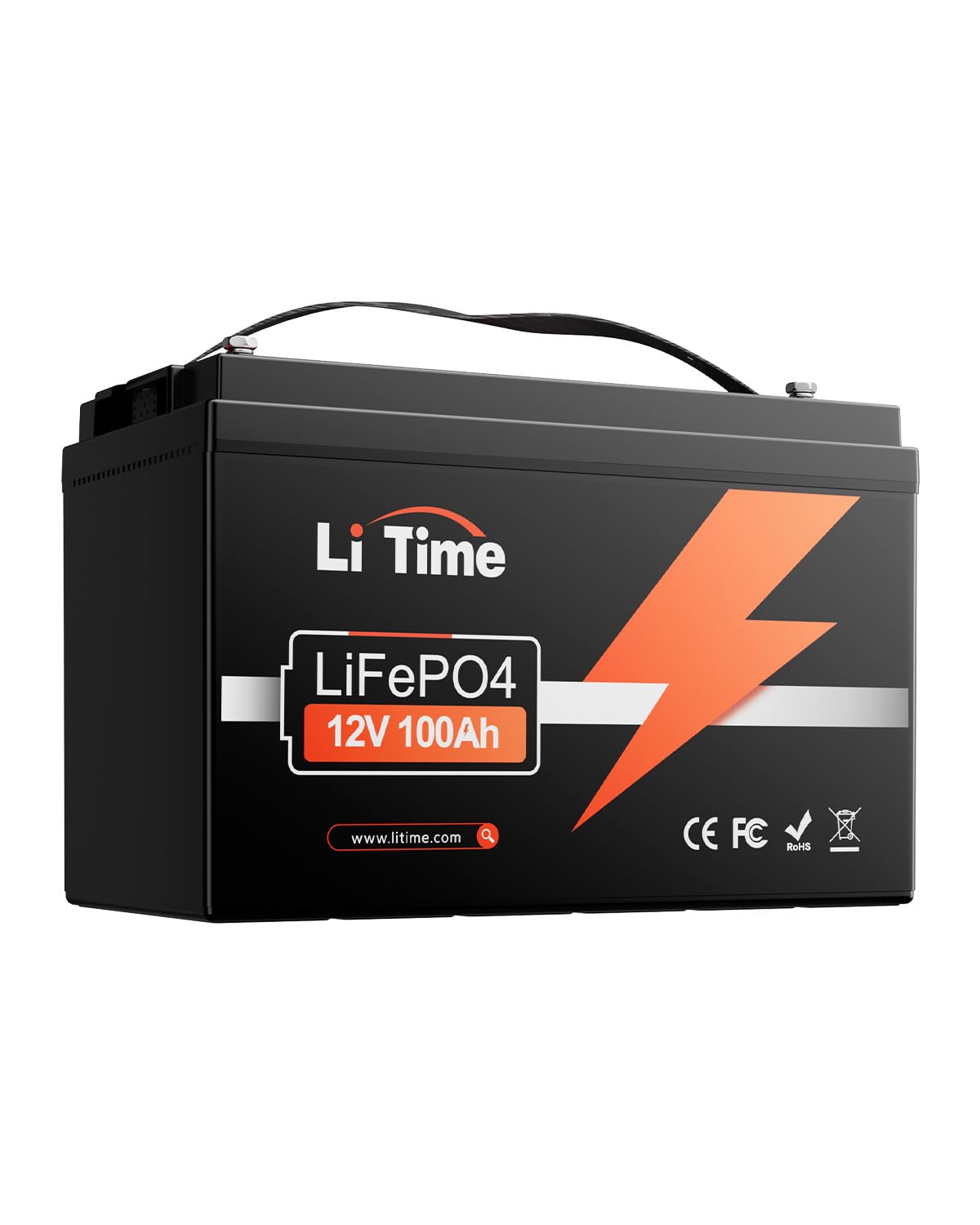
1. Litime 12V 100Ah LiFePO4 Battery
Our pick — over 4.5★ from 750+ verified ratings; the strongest balance of quality and price.
The crowd favorite that balances capacity, cold protection, and a Bluetooth app in one tidy box.
At 22.2 pounds, this battery weighs about a third of what a lead-acid equivalent does, so lifting it into a travel trailer or boat is genuinely easy. The 100Ah capacity means you get the full usable charge, unlike lead-acid which only gives you about half, so your fridge and lights run well past sundown. Owners call it a “reliable powerhouse” that has handled a travel trailer for a full year without issues.
The built-in Bluetooth app is the standout feature here — buyers report it tracks voltage, charge rate, and discharge rate clearly, though a few mention it can be finicky about reconnecting during charging. A 100A BMS keeps things safe with over 20 safeguards, and the IP65 waterproofing means it shrugs off splashes in marine setups. It expands up to 4P4S for a 51.2V 400Ah bank, so it grows with your power needs.
One honest caution: if you are converting an RV from lead-acid, the charging current can overwhelm an older trailer charger, so you may need a lithium-compatible charger. The battery itself is rated for up to 15,000 cycles at 60% depth of discharge, backed by a 5-year service promise. It is the most complete package for the money.
Why it leads the pack
- Bluetooth app shows live charge and discharge rates
- Weighs 22.2 lbs — about 1/3 of lead-acid
- IP65 waterproof and dustproof
What to watch
- May need a new charger for older RVs
- App can drop connection during charging
Your best bet for: RV owners and boaters who want monitoring, weather resistance, and proven reliability from a trusted brand.
Think twice if: your charging system is old lead-acid hardware and you do not want to upgrade it.
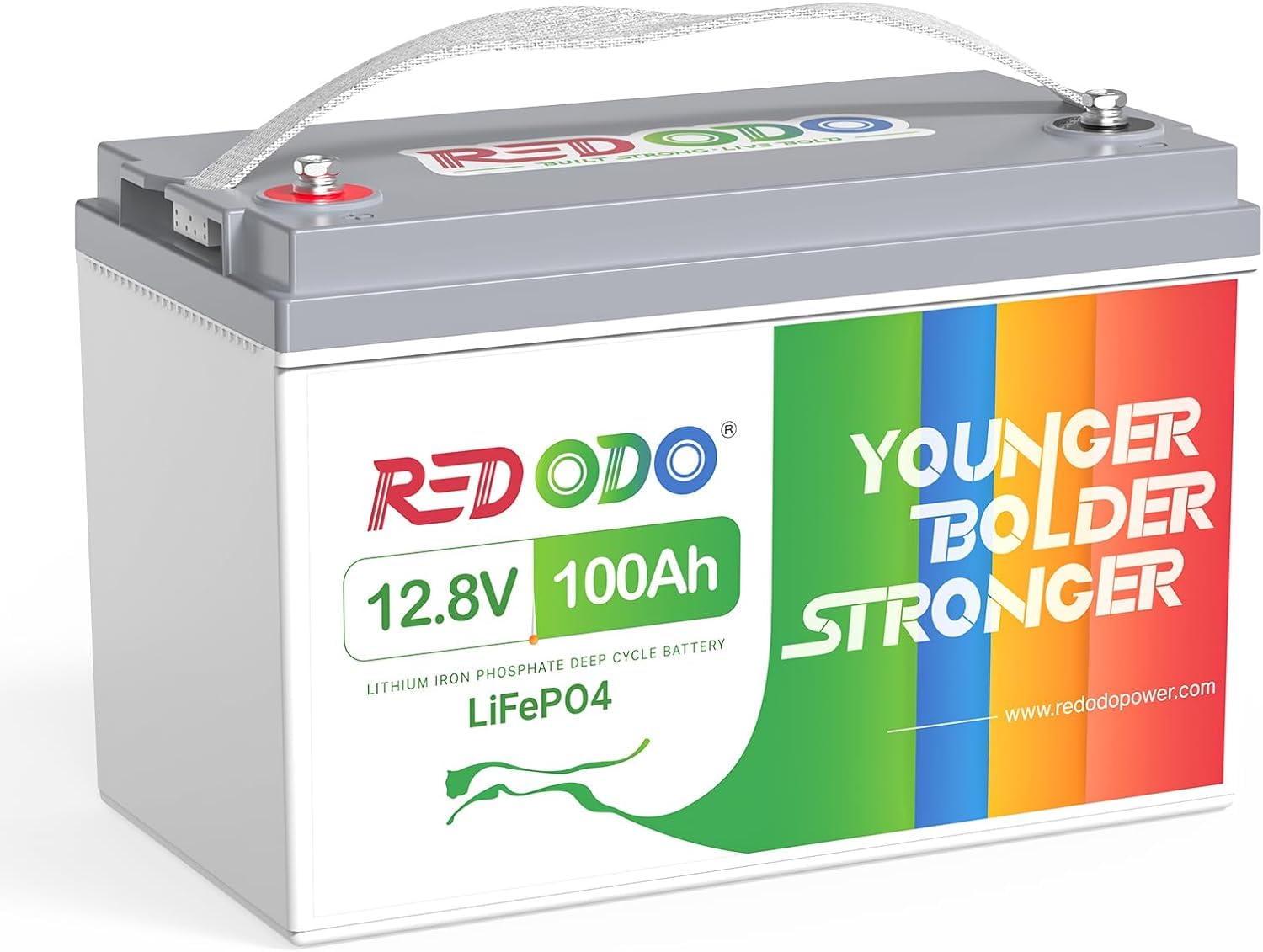
2. Redodo 12V 100Ah LiFePO4 Battery
The budget-friendly veteran that has powered mowers, boats, and off-grid cabins for years without drama.
This is the battery that keeps showing up in real-world success stories. Owners mention it saved an electric mower by replacing four lead-acid batteries — runtime jumped from 20 minutes to a full lawn plus a second mow at 90% charge. At 22 pounds it is 60% lighter than a comparable lead-acid unit, which is why pool cleaners and anglers alike rave about the weight savings.
The 100A BMS protects against overcharge, over-discharge, over-current, short circuits, and high temperatures, and it charges via solar, alternator, generator, or a dedicated LiFePO4 charger. With a low 3% self-discharge rate, it holds its charge for months on end. One user ran it 24/7 powering routers, desktops, and a freezer without it dropping below 80%, and then bought a second one.
The 4000-15,000 cycle life and 10-year lifespan make it a long-term investment, and the support team is a big part of the appeal — they replaced a unit under warranty after years of service. It measures 12.99 x 6.82 x 8.46 inches, essentially identical to the Litime above, so it fits standard Group 31 boxes perfectly. A few note it is not for starting engines or golf carts, so keep it as a deep-cycle energy source.
Built for the long haul: Proven in boats, mowers, and off-grid setups with excellent warranty support.
Who it fits: Anyone replacing multiple lead-acid batteries with one reliable drop-in lithium unit.
Reach for this if: you want a rugged, well-supported 100Ah battery that just works for years.
Look elsewhere if: you need Bluetooth monitoring or cold-weather self-heating.
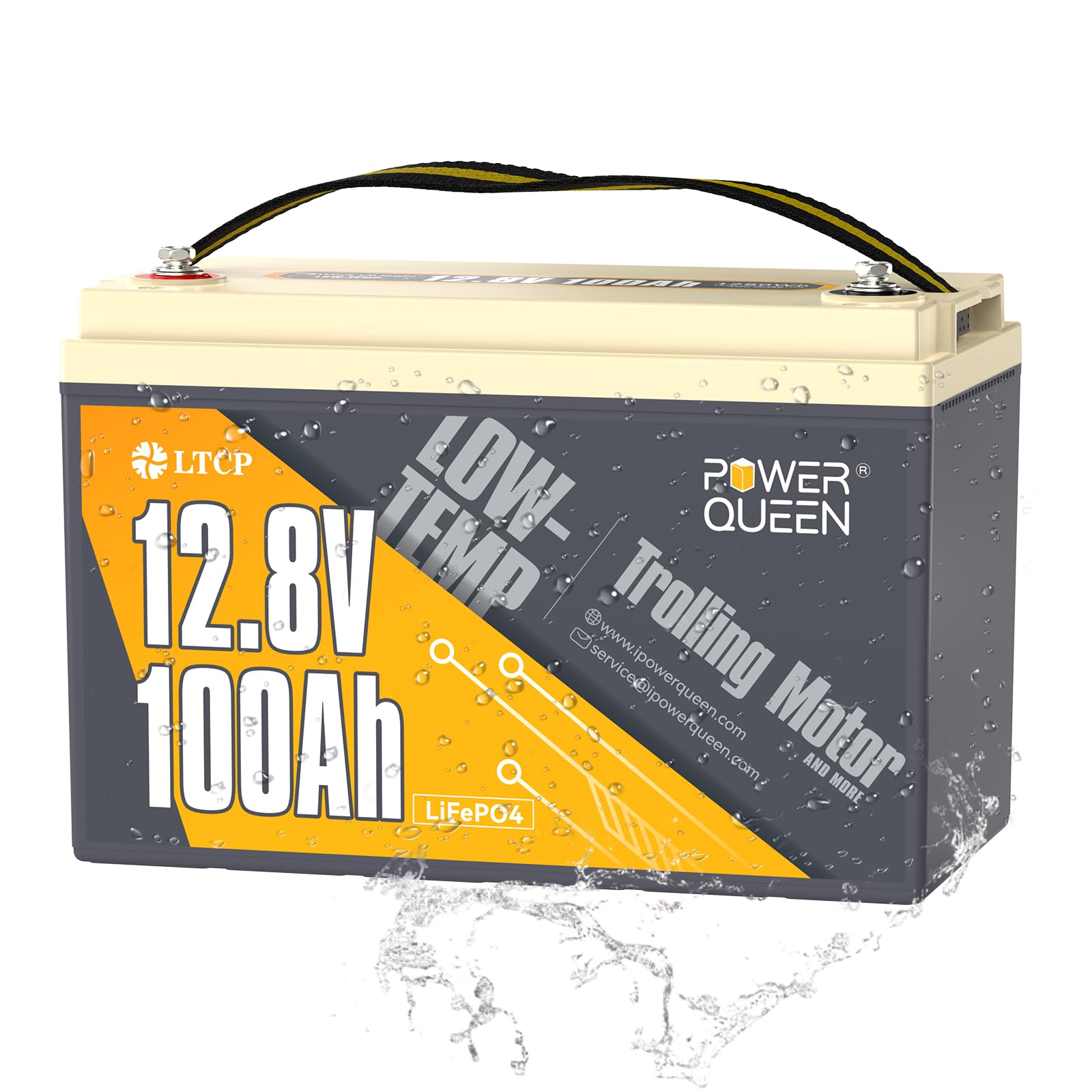
3. Power Queen 12.8V 100Ah LiFePO4 (Low-Temp)
A marine specialist with low-temp protection and a surge suppressor built for serious trolling setups.
This Power Queen is engineered specifically for trolling motors up to 120lb thrust, making it a favorite among bass boaters and kayak anglers. The built-in TVS surge protector blocks voltage spikes for 12V-36V motors, keeping output steady in rough water. Customers note 10+ trips of 4 hours each without the battery meter dropping, and some have run it three trips straight without draining.
The low-temperature protection is the key differentiator: it stops charging below 32°F and stops discharging below -4°F, which prevents cold-weather cell damage. It is also ABYC E-13 compliant for marine use, with a triple-protected BMS against dust, water, and salt spray. At 22.16 pounds, it is up to 64% lighter than a lead-acid equivalent, so it trims real weight off your boat.
Performance and quality are the two things owners praise most, with value-for-money close behind. It supports up to 4P4S expansion (51.2V 400Ah) and offers 4000+ cycles at 100% depth of discharge. One buyer ran four of these to power a travel trailer’s microwave, fridge, and mini-split solar array, calling them a great value versus far pricier brands.
Marine-focused: Surge protection and low-temp cut-off make it purpose-built for fishing boats.
The catch: It needs a lithium-capable charger, and some wished it were more compact.
Your pick if: you run a trolling motor in cold water and want surge protection as standard.
Pass if: you need Bluetooth monitoring, which this model lacks.
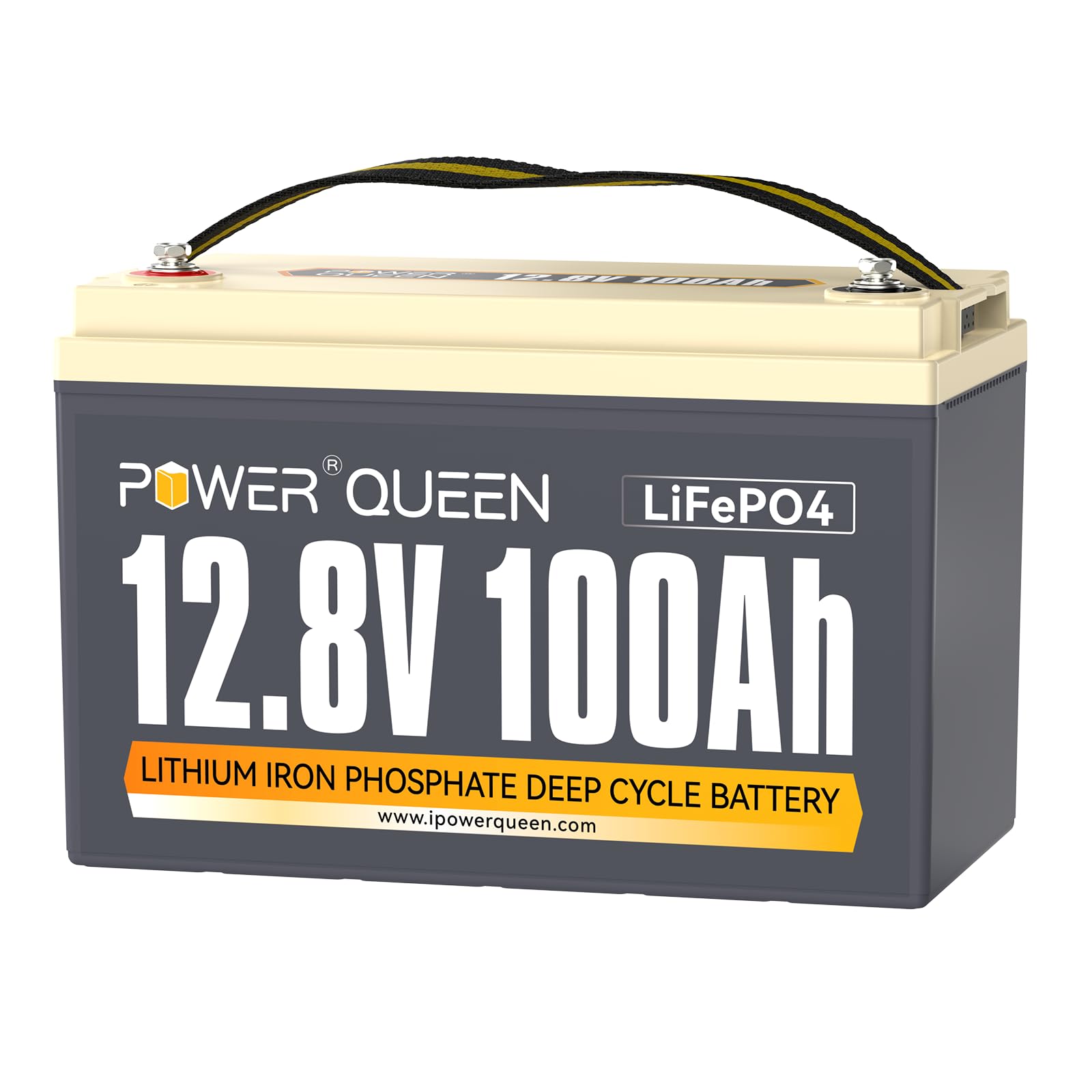
4. Power Queen 12V 100Ah LiFePO4 Group 31
The versatile 100Ah that runs campers, sailboats, and trolling motors with dependable ease.
Battery life is what wins people over here — reviewers point out it lasting up to 10 hours of constant use and powering a 12V camping refrigerator with room to spare. At 24 pounds, it is about a third of the weight of lead-acid, and one arthritis sufferer found it easy to lift and install. It is the all-rounder for RVs, sailboats, and 30-70lb trolling motors alike.
The Grade-A LiFePO4 cells deliver stable voltage and consistent power, while the 100A BMS guards against overcharge, over-discharge, short circuits, and overheating. It supports up to 4S4P for a 51.2V 400Ah system, so you can build out a full energy bank later. One sailor tested three of these at 102 Ah from a full charge, and another runs a trolling motor, Livescope, and two Garmin graphs for three full days.
The 13x more cycles than lead-acid and 3% low self-discharge rate make it a sound long-term buy. A few owners note the 6mm bolts can cross-thread if you are heavy-handed, so treat the terminals gently. It is the best balance of price, capacity, and brand trust in the mid-range.
What you get
- Runs a fridge and trolling motor for hours
- Easy to carry at 24 lbs
- Expandable to 51.2V 400Ah
Keep in mind
- Terminal bolts are easy to cross-thread
- No Bluetooth on this model
Best for: campers and cruisers who want a dependable 100Ah without paying premium prices.
Not for: anyone who wants remote monitoring via an app.
5. VATRER POWER 12.8V 100Ah (Self-Heating)
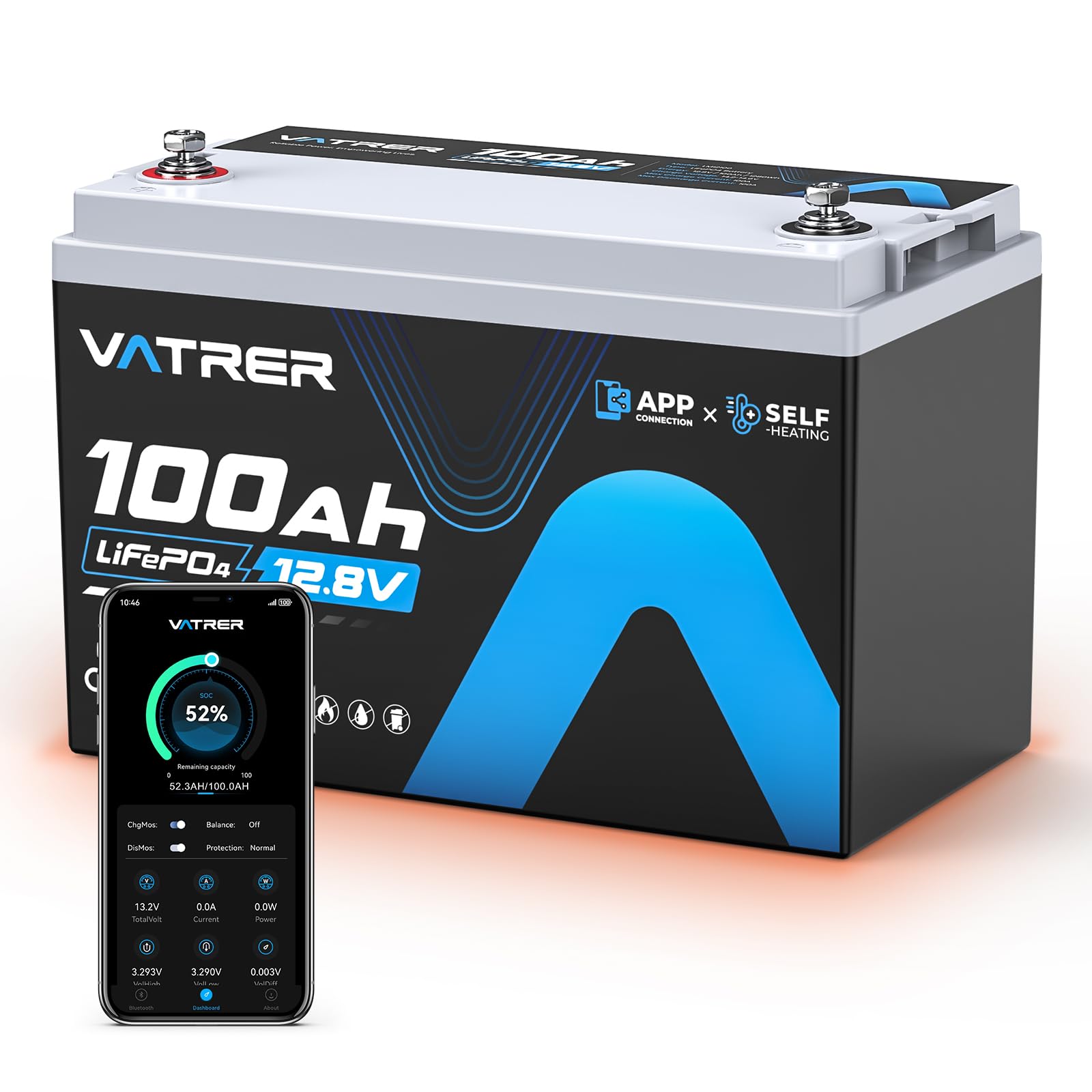
The rare Group 31 that warms itself up so you can charge below freezing without worry.
This is the battery for winter campers and cold-climate off-gridders. When connected to a charger below 32°F, the built-in heating pads activate automatically, warming the cells to 41°F before charging starts. That means you are not stuck waiting for a warm day to top up, and owners confirm the heated function “works well and faster than I anticipated.”
Beyond the heater, the app monitoring gives you real-time data on current, voltage, temperature, and cycles right on your phone. One buyer found the app readings within 1% of their Victron shunt, which is excellent accuracy. The cells come with UL Testing Reports, and the 100A BMS handles overcharge, over-discharge, over-current, and short circuits.
Battery life and build quality are the two things owners highlight, and the lightweight 24-pound design makes it easy to haul down a stairway to a boatlift. It charges fast on shore power — around 2 hours from empty — and runs a 12V TV, USB lights, and charging without breaking a sweat. One note: the self-heating version cannot be connected in series or parallel with a regular battery, so plan your bank accordingly.
Winter winner: Self-heating open up charging in sub-freezing temperatures, a rarity in this category.
Know this: It must be paired with another self-heating unit, not a standard battery.
Choose this if: you camp or live off-grid where temperatures drop below freezing.
skip it if: you never deal with cold weather and want to save a few dollars elsewhere.
6. yeagulch 2-Pack 12V 100Ah LiFePO4
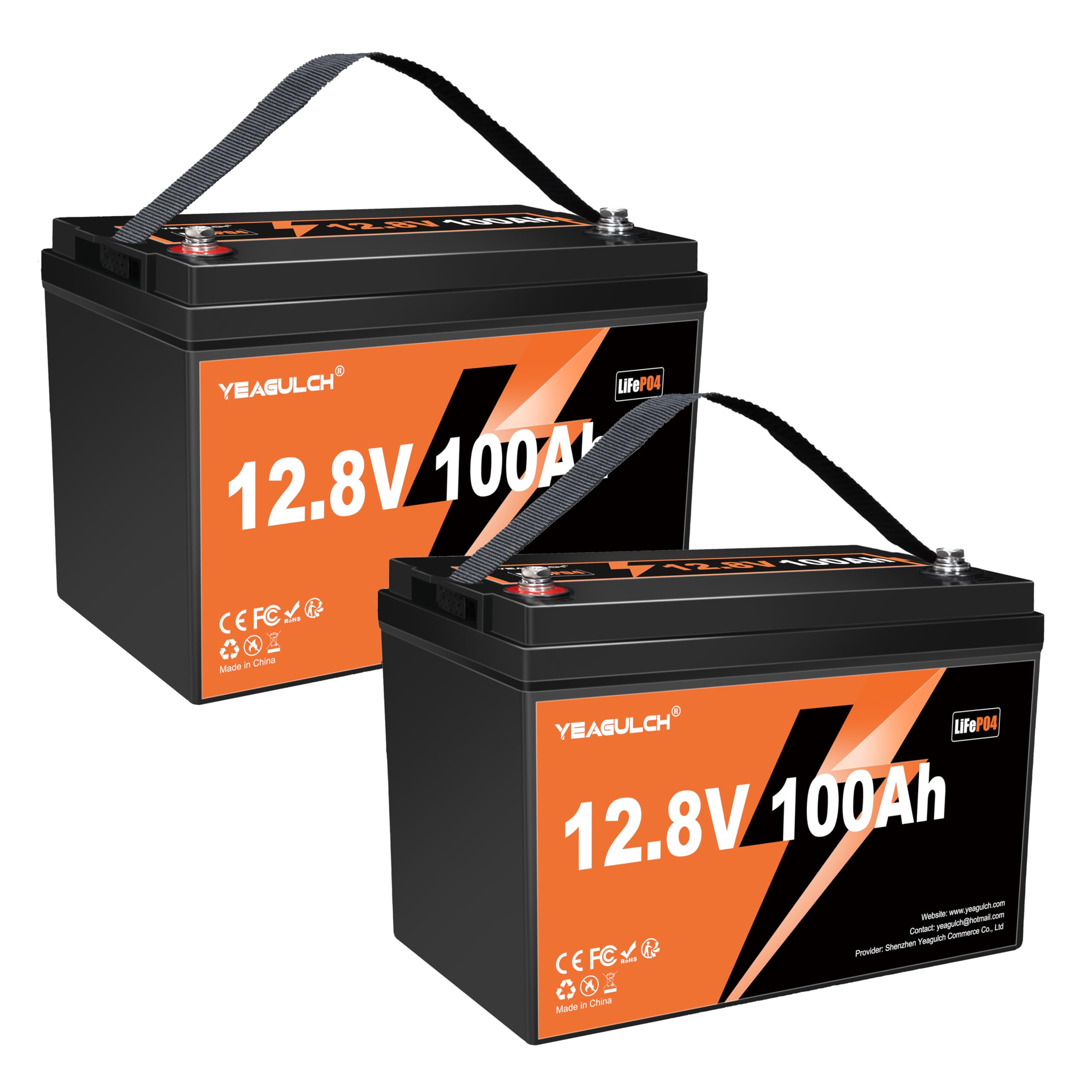
A two-pack that gives you serious runtime for trolling motors and riding mowers without the premium name.
If you need two batteries for a trolling motor, a riding mower, or a small solar setup, this 2-pack is a smart money move. Each unit weighs just 21.60 pounds and offers 95% capacity utilization, so you get nearly every amp-hour you paid for compared to lead-acid’s 50%. One owner reports a 3-day trolling trip where they never needed to charge, and another runs an 80lb motor on a pontoon for at least 4 outings without a recharge.
The flat discharge curve keeps voltage steady, so your trolling motor stays fast and consistent instead of bogging down as the battery drains. It is expandable up to 4P4S for a 48V system, and the no-memory-effect design means you can use it anytime after a full charge. At about a third of the weight of traditional deep-cycles, it is easy to haul around.
Fast charging and lightweight design are what owners mention most, with one calling it the “best battery for the money” and running a diesel heater off the second unit. There is one caveat: the maker recommends against using it with trolling motors over 700W, so check your motor’s draw before committing. It is a solid value play for twin-battery needs.
Two for the price of one: Ideal for motors, heaters, or small solar banks needing twin 100Ah units.
Fair warning: Not designed for high-power trolling motors above 700W.
Reach for this if: you need two batteries and want to boost bang for the buck.
Look elsewhere if: you run a high-thrust motor that draws more than 700W.
7. GRNOE 2-Pack 12V 100Ah LiFePO4
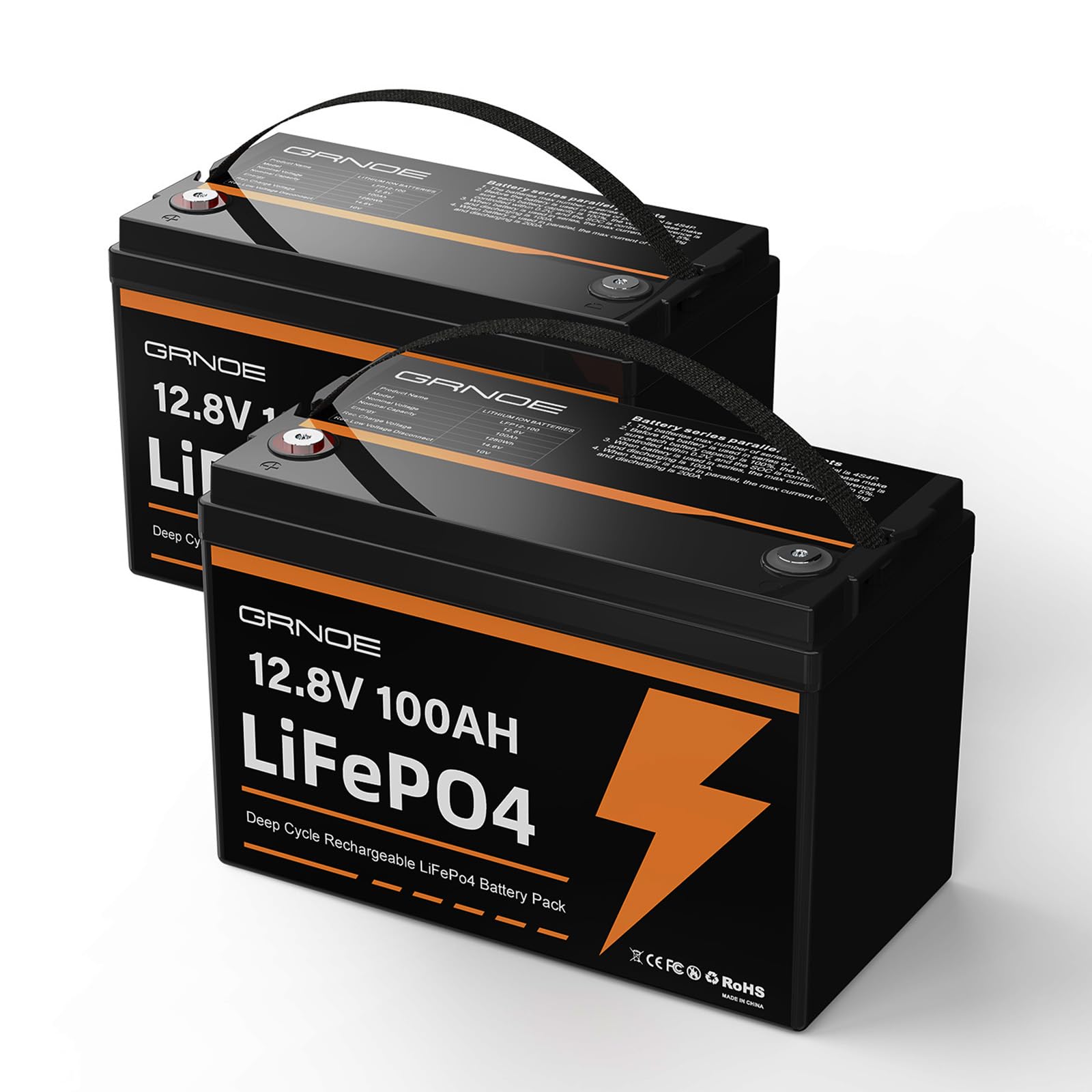
A dependable twin pack that replaces six-volt wet cells with clean, light lithium power.
This GRNOE 2-pack is a popular choice for RVers swapping out old 6-volt wet cell banks. Each battery weighs 22.48 pounds — only 33% of a lead-acid equivalent — and measures 12.9 x 6.7 x 8.6 inches, so it drops right into a Group 31 box. Owners who replaced four wet-cell batteries report a “great improvement” and say the added cost was worth it.
Each unit packs a 100A BMS and supports a 300A peak discharge for 3 seconds, which gives you a solid surge for starting a trolling motor or running a winch briefly. It is IP65 waterproof and handles 36-55lb trolling motors comfortably. The 15,000-cycle lifespan at 60% DOD means you are set for a decade of reliable service.
Quality is the thing owners praise most, with a few noting the charging performance is a mixed bag — some batteries arrive needing an initial 14.6V activation charge. That is a common lithium quirk, not a defect, and the 36-month replacement warranty covers genuine faults. It is a strong budget pick for RV and marine energy storage.
Solid value: Great drop-in replacement for 6V wet-cell banks at a friendly price.
Heads up: Needs a 14.6V lithium charger to activate; a 12V charger will not fully charge it.
Your pick if: you are converting an RV or golf cart from wet cells and want a budget-friendly pair.
Pass if: you want Bluetooth monitoring, which is not offered here.
8. GRNOE 12V 100Ah LiFePO4 (2-Pack Premium)
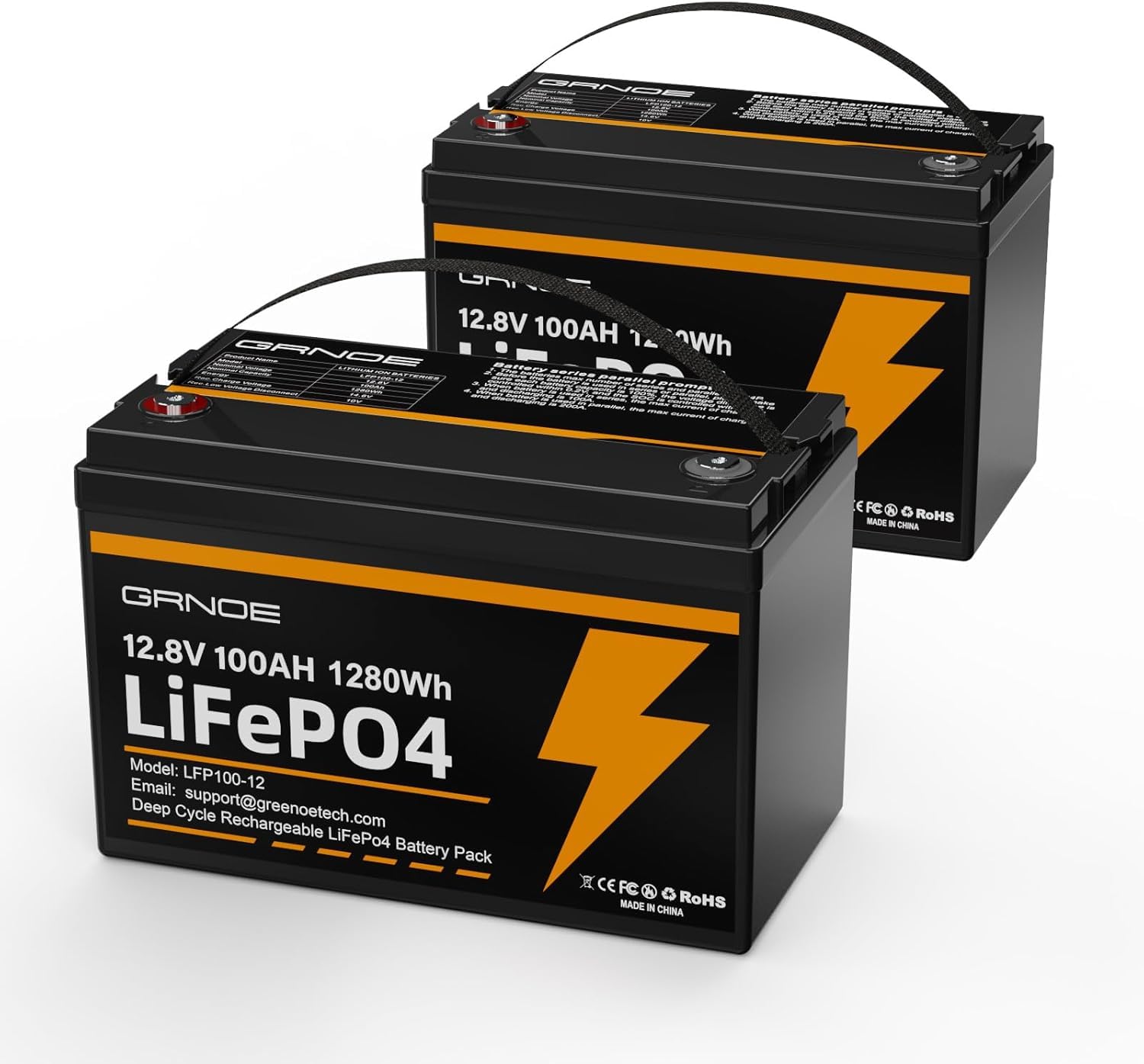
A certified-safe twin pack with low-temp cut-off, built for RVs and marine systems that demand durability.
Owners describe these as excellent-quality cells that are perfectly stable for months, and the build quality is backed by UL and UN38.3 certifications. At 22.4 pounds each, they replace roughly a 100-pound lead-acid pair, which is why one Catalina 34 sailboat owner swapped their AGM bank and never looked back. They are also ideal for travel trailers, with one owner running a 5-week trip including 3 nights of dry camping without worry.
The smart low-temperature cut-off stops charging below 32°F and allows discharge down to -4°F, protecting the cells in cold winter cabins and off-grid setups. A 100A BMS guards against overheating, overcurrent, overcharge, over-discharge, and short circuits. Each battery supports a 300A peak discharge for 3 seconds and is IP65 waterproof, making it suitable for 36-55lb trolling motors.
Battery quality is what owners praise most, with weight and value close behind. The honest caveat is that a few owners experienced BMS shutdowns with batteries wired in series, which is worth knowing if you are building a 36V bank. The 3-year replacement warranty and responsive support add confidence, and the low-temp protection is a genuine plus for northern climates.
Certified and capable: UL-rated cells with low-temp protection at a family-friendly price.
Real-world note: A minority saw BMS resets with series wiring — test your bank before relying on it.
Choose this if: you want certified safety and cold-weather protection in a twin pack.
Think twice if: you plan a complex series bank and need bulletproof performance.
9. Redodo 12V 165Ah LiFePO4 Bluetooth
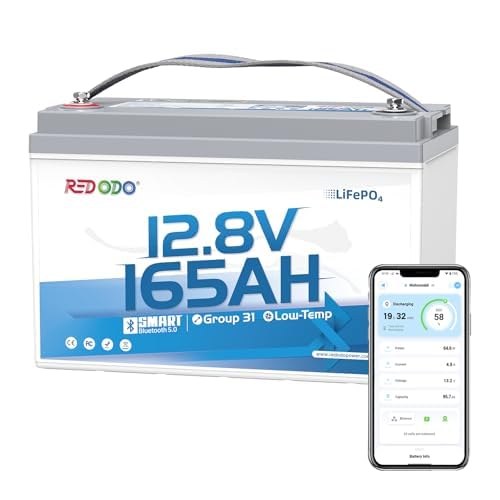
The capacity king that stuffs 165Ah into a standard Group 31 case for marathon off-grid runs.
If you keep running out of power, this battery gives you the headroom you need. A Casita trailer owner ran everything except the A/C with 200W of solar for 1-2 weeks off-grid, and a kayak angler used it for 12-15 hours on a trolling motor without it dropping below 99%.
The 165A BMS supports 2112W of continuous output, so it can handle air conditioners and coffee makers without breaking a sweat. Bluetooth 5.0 monitoring lets you track voltage, state of charge, and capacity on your phone, plus remote power control. One owner measured the actual capacity at 173Ah — more than promised — and runs three Redodo batteries without issues.
Battery life is what owners praise most, with functionality close behind, and the 32.2-pound weight is a fraction of the lead-acid bank it replaces. The honest downside is the app, which one user described as “horrible” with no instruction manual yet — the hardware is great, but the software needs work. It is UL 1973 tested and certified to FCC/CE/RoHS/UN38.3, backed by a 5-year warranty.
Why it is a powerhouse
- 165Ah capacity in a standard Group 31 footprint
- 2112W continuous output runs A/C and coffee makers
- Bluetooth monitors state of charge remotely
What to expect
- App is clunky with no instruction manual yet
- Weighs 32.2 lbs — heavier than 100Ah models
Reach for this if: you need maximum runtime and run high-draw devices like A/C units.
Look elsewhere if: a finicky app would drive you crazy and 100Ah is plenty.
10. Litime 12V 165Ah Group 31 LiFePO4
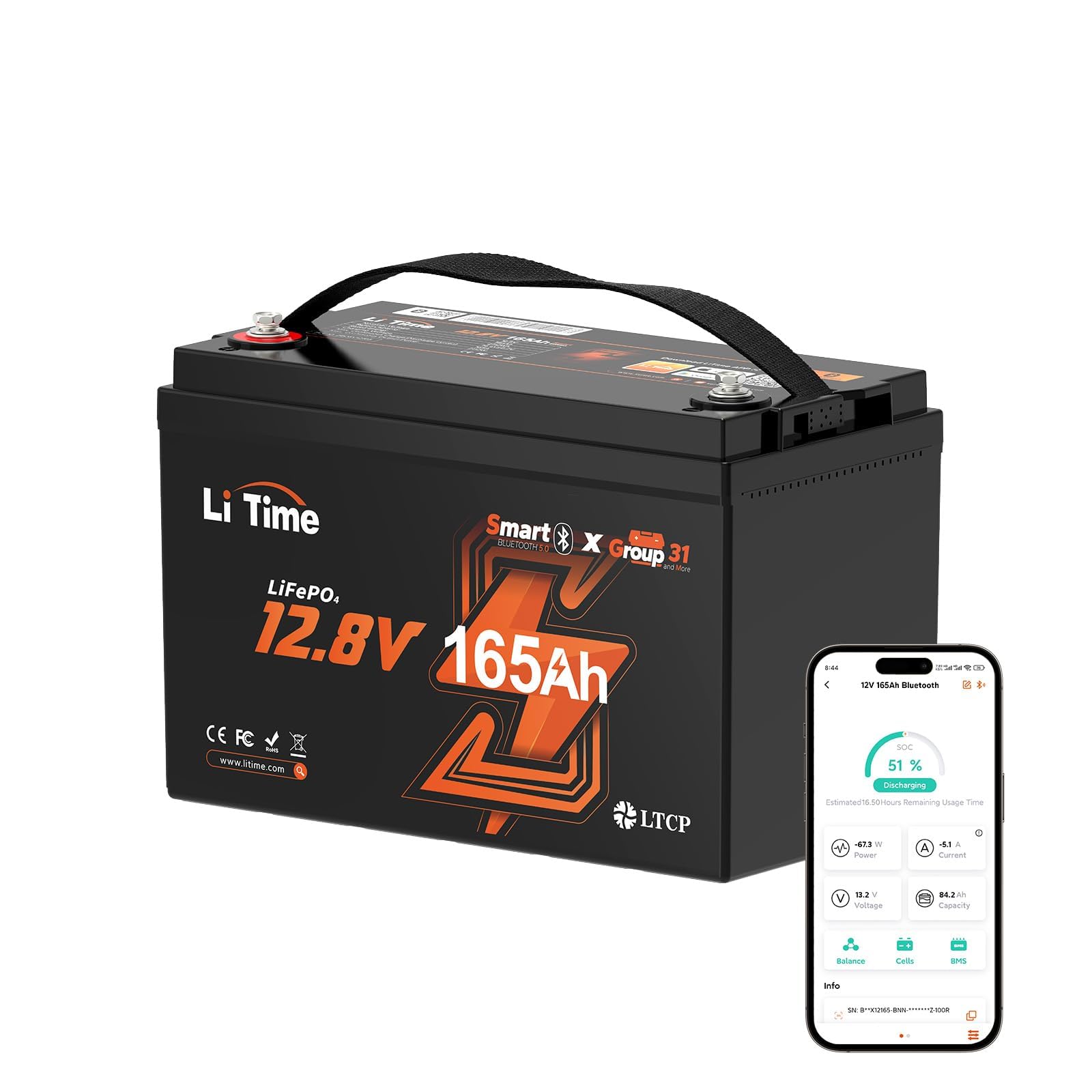
The premium 165Ah that runs a trolling motor all tournament day and still comes back for more.
If fishing tournaments are your thing, this is the battery owners swear by. One angler ran it for 8 hours of tournament fishing, drove a 45lb trolling motor, then got another 4 hours the next day after a mid-break recharge. It weighs 32.2 pounds — about a quarter of the lead-acid it replaced — and drops into a standard Group 31 box with plug-and-play ease.
The 2112Wh capacity is the real story, though: it takes roughly 8 hours to charge from 7% via Bluetooth app tracking, and it holds that charge for days. Battery life is what owners praise most by a wide margin, with quality close behind, and the app connects via Bluetooth 5.0 for real-time monitoring and discharge control. The low-temp protection cuts off charging below 32°F and discharging below -4°F, so northern winters are not a worry.
It is expandable to 4P4S for a 51.2V 660Ah system (33.79kWh), making it a serious home backup option too. One motorhome owner ran levelers, slides, and the fridge off two of these with a quick alternator recharge. The 20+ BMS safeguards, IP65 waterproofing, and salt-fog resistance make it durable in harsh conditions, backed by a 5-year warranty.
Tournament-grade power: 165Ah of clean, reliable energy that lasts all day and recharges in hours.
Worth noting: It is pricier than 100Ah models, so only step up if you truly need the range.
Your pick if: you want maximum runtime and do not mind paying for premium capacity.
Pass if: a 100Ah battery already covers your day and you prefer a lighter, cheaper unit.
Understanding the Specs
Amp Hours (Ah)
This tells you how much energy the battery stores. A 100Ah lithium battery delivers roughly 100 amp-hours of usable power, while a 100Ah lead-acid battery only gives you about 50Ah before the voltage drops too low to be useful. That is why a single 100Ah lithium battery replaces two traditional ones. If you run a trolling motor all day, a 165Ah model like the Redodo or Litime gives you nearly 70% more runtime.
BMS and Cold Weather
The Battery Management System (BMS)—the battery’s internal brain—protects the cells from overcharge, over-discharge, and short circuits. In cold climates, low-temperature cut-off is essential: it stops charging below freezing to prevent permanent cell damage. The VATRER POWER goes further with self-heating that warms the battery to 41°F before charging, so you can top up even in sub-zero conditions.
FAQ
What is the difference between 100Ah and 165Ah lithium batteries?
Will a Group 31 lithium battery fit in my existing battery box?
Can I charge a lithium battery with my existing RV or boat charger?
How long does a Group 31 lithium battery last?
Can I connect multiple lithium batteries in series or parallel?
Is a lithium battery better than lead-acid for a trolling motor?
What happens if I use the battery in freezing temperatures?
Do I need a special charger for a LiFePO4 battery?
Can a Group 31 lithium battery start my engine?
How much weight will I save switching from lead-acid to lithium?
Final Thoughts: The Verdict
For most people, the group 31 lithium battery winner is the Litime 12V 100Ah because it combines proven reliability, a useful Bluetooth app, and genuine weather resistance at a price that undercuts premium rivals. If you want maximum runtime for trolling or off-grid living, grab the Litime 12V 165Ah for nearly 65% more capacity. And for a budget-friendly twin pack, the yeagulch 2-Pack is the one to reach for, giving you two dependable 100Ah units without the premium name.
How We Picked
We do not accept paid placement. Every pick is matched to a real buyer and a real use-case; we do not hands-on test units.
Sources & Methodology
Specifications: manufacturer listings and product documentation. Review insights: verified customer reviews, as of August 2026. Pricing: not shown on this page (it changes often); check the current price via the retailer link.
As an Amazon Associate, Trending Car earns from qualifying purchases. This does not affect which products we feature.