
Our readers keep the lights on and my garage snacks stocked. As an Amazon Associate, I earn from qualifying purchases.
Specs are compiled from manufacturer listings and verified buyer reviews and can change over time — please confirm the key details on the product page before buying.
The biggest headache with a gravity feed paint sprayer isn’t spray patterns or cleanup — it’s picking one that can actually handle the paint you need to shoot. A 2.0mm nozzle handles thick primer without a fight, while a 1.3mm nozzle lays down clear coat like glass. The wrong choice means constant thinning, clogging, and finishes that look like orange peel.
I’m Min Islam — the founder and writer behind Trending Car. This guide is built by comparing the manufacturers’ published specifications and the patterns across verified customer reviews, so you get each pick’s real strengths and trade-offs instead of marketing spin.
Whether you are spraying lacquer on a cabinet or automotive clear on a restored fender, this breakdown of the best gravity feed paint sprayer options helps you match a gun to the job without wasting time or materials.
Our Picks at a Glance


How To Choose The Best Gravity Feed Paint Sprayer
The right gravity feed sprayer hinges on three things: what you are painting, how much air your compressor pushes, and how much time you want to spend cleaning.
Start with the Nozzle Size
This is the single most important spec. A smaller nozzle (1.3mm or 1.4mm) atomizes thin materials like base coat and clear coat into a finer mist — ideal for automotive work. A larger nozzle (1.8mm or 2.0mm) lets thicker paint like primer, latex, or high-build 2K flow through without needing heavy thinning. Many pro kits now include multiple tip sets so you swap between jobs without buying a second gun.
Match the Gun to Your Compressor
HVLP guns are efficient, but they still need a compressor that can keep up. Check the gun’s CFM (cubic feet per minute) requirement. A gun that needs 4.5 CFM will starve on a small 2-gallon pancake compressor. If you are buying your first sprayer, look at the working PSI — most gravity feed guns spray well between 10 and 29 PSI, so you do not need a massive industrial compressor.
Cup Capacity and Material
The cup sits on top of the gun, so a larger cup (1000ml or 1 liter) means fewer refills on big jobs but more weight on your wrist. Aluminum cups are standard — they clean well and resist solvents. Some kits now include an adapter for disposable plastic cups, which cuts cleanup time dramatically.
Quick Comparison
| Model | Best For | Nozzle Size | Cup Capacity | Body Material | Amazon |
|---|---|---|---|---|---|
| Fuji Spray 5175G T75G★ Best Overall | Pro-grade finish work | Standard (turbine system) | 600cc | Stainless Steel | Amazon |
| Master Elite PRO-44 KitTop Performer | Complete swap-ready tip system | 1.3 / 1.4 / 1.5 / 1.8mm | 1 Liter | Stainless Steel | Amazon |
| NEIKO 31214A (1.5mm)Best Value | Budget auto & household | 1.5 mm | 600 cc | All-steel / Brass | Amazon |
| NEIKO 31216A (2.0mm) | Thick primers & latex | 2.0 mm | 600 cc | All-steel / Brass | Amazon |
| Master Elite PRO-33 (2.0mm) | Mid-range heavy materials | 2.0 mm | 1 Liter | Stainless Steel | Amazon |
| BEETRO HVLP (1.4/1.8mm) | Versatile multi-nozzle use | 1.4mm + 1.8mm | 1000 ml | Stainless Steel | Amazon |
| Graco-Sharpe 288879 FX3000 | Quality auto paint on a budget | 1.3 mm | 600cc | Aluminum | Amazon |
| DeVilbiss StartingLine Kit | Entry-level two-gun set | Standard HVLP | 600cc | Composite / Metal | Amazon |
| DeVilbiss StartingLine 802343 Kit | Professional auto primer & clear | Standard HVLP | 2-gun set | Composite / Metal | Amazon |
In‑Depth Reviews
1. Fuji Spray 5175G – T75G Gravity Spray Gun
Our pick — over 4.5★ from 350+ verified ratings; the strongest balance of quality and price.
The pro-grade masterpiece that turns any 5-stage turbine into a finishing legend.
The T75G is the gun that keeps popping up in eight-year owner stories — one buyer reports using it for over 8 years on fiberglass repairs, saying the chrome coating withstands acetone and the whole thing disassembles in minutes for a deep clean. That kind of longevity is rare in a spray gun, and it starts with the build: 100% stainless steel fluid components, a high-efficiency air cap that cuts overspray, and a non-bleed design so it does not kick dust around your shop between pulls.
What wins people over is the quality — 131 owners single it out as the top reason to buy, followed closely by the performance (57). The gun weighs only 2 pounds, so your wrist does not fatigue on a long day of spraying lacquer or automotive base coat. At 6.7″W x 14.6″H, it is notably taller than budget picks like the NEIKO 31214A (5.83″W x 8.94″H). The crowd favorite, with a high rating across hundreds of owners, it is the pick professionals reach for and never put down.
The edge that lasts: Built with 100% stainless steel fluid components and a 2-year warranty, this gun is engineered to work as the dedicated spray head on a Fuji turbine system — it is not a standalone air gun for a pancake compressor.
The honest trade-off: It is designed for turbine systems, not standard air compressors, so it is the right choice only if you already own or plan to invest in a Fuji spray station.
Reach for this if: You want a single gravity-feed gun that can serve a professional shop or serious home workshop for a decade, with zero-compromise atomization on lacquers, enamels, and waterborne paints.
Look elsewhere if: You need a gun that attaches directly to a conventional air compressor hose — this works best with a dedicated turbine system.
2. Master Elite PRO-44 Ultimate Kit
The everything kit that swaps tips faster than you can clean a single nozzle.
The PRO-44 is the set that says “bring any coating you have.” It ships with a 1.3mm tip installed and three additional atomizing sets (1.4mm, 1.5mm, and 1.8mm) — each with its own matching needle, fluid nozzle, and air cap. That means you can spray thin automotive base coat in the morning and switch to thick 2K primer after lunch with a five-minute changeover. The kit also includes a high-flow air pressure regulator with gauge and an MPS adapter for disposable cups, which many owners use to skip cleanup on messy primer jobs.
Owners highlight the build quality (25 mentions) and performance (14 mentions) as the standout reasons to buy. One buyer who upgraded the air cap to a DeVilbiss TE20 cap reported that the gun then sprays “like a unit.” The 1-liter aluminum cup is generous, though some note the cup itself can feel bulky during detailed work. With a strong crowd rating, it is the kit that grows with your skill — you start with the 1.8mm for primer and work down to the 1.3mm for show-quality clear.
Four guns in one: The 1.3mm and 1.4mm tips handle base coats, clear coats, and single-stage paints. The 1.5mm and 1.8mm tips tackle primers, 2K surfacers, and high-viscosity materials.
The catch: The stock air pressure regulator is not the best — some owners swap it for an aftermarket unit to get a more stable reading.
Perfect for: The DIY enthusiast or semi-pro who paints everything from lacquer furniture to automotive clear coat and wants a single gun that adapts instantly.
skip it if: You only spray one type of paint — a dedicated single-tip gun costs less and gives the same results.
3. NEIKO 31214A Air Spray Paint Gun (1.5mm)
The budget workhorse that bets on all-steel build over plastic parts.
The 31214A is the gun that makes a case for spending under without feeling like you bought a toy. It has a one-piece all-steel gun body, a stainless-steel nozzle, and a solid brass cap — materials you usually have to double the price to find. The 1.5mm nozzle (color-coded green) sits in a balance: thin enough for base coat and clear coat, but wide enough for household enamels and primers.
What the crowd praises most is the performance (45 owners highlight it) and the overall quality (44 mentions) for the price. A recurring note from owners is that the metal cup neck can bend when you press the lid on, but it bends right back and the lid does not leak — just be gentle. It runs at 40 PSI operating pressure with 10 PSI working pressure and consumes 4.5 CFM, so it needs a compressor with decent output. This is the pick that gets beginners into HVLP without a big cash commitment and still delivers a pattern that impresses.
A metal body at a plastic price: The all-steel body, stainless nozzle, and brass cap resist rust and dents far better than the aluminum or composite guns at the same price point.
The caution: Disassembly for cleaning can be tight — some owners use a proper wrench rather than the included tool to avoid stripping threads.
Reach for this if: You are starting out in automotive or furniture painting and want a reliable, all-metal gun that works well with base coats, clear coats, and enamels.
Think twice if: You spray thick latex or high-build primer regularly — 1.5mm is too narrow for heavy materials without significant thinning.
4. Master Elite PRO-33 HVLP Spray Gun (2.0mm)

The 2.0mm gatecrasher for 2K primer, gel coat, and chip guard.
The PRO-33 is built for the materials other guns choke on. The 2.0mm fluid tip handles high-build 2K primers, polyester primers, thick enamels, thinned latex paints, chip guard, gel coats, and even glue — the kind of viscous stuff that would plug a 1.3mm nozzle on the first trigger pull. The gun ships with a 1-liter aluminum cup and a high-flow air pressure regulator with gauge, giving you enough volume to lay down a full primer coat on a car panel without refilling.
Owners praise the quality (20 mentions) and spray performance (15 mentions). As one buyer put it, “its no SATA, but for the money, it still performs really well.” The stainless steel components are 100% compatible with waterborne automotive paints, which matters as more body shops move away from solvent-based coatings. The trade-off is that the air cap holes can clog if the paint is not filtered properly — clearing them restores the pattern, but it is an extra step compared to higher-end guns.
Thick stuff specialist: The 2.0mm tip set-up is designed specifically for high-viscosity materials — 2K primer, polyester, gel coat, chip guard, thinned latex — so you are not fighting clogs every few minutes.
One caveat: Some owners found the 2.0mm preferred for most jobs and recommended skipping the multi-tip sets in favor of this dedicated big-nozzle gun.
Best for: The restorer or painter who lays down heavy primer, chip guard, or gel coat and needs a gun that does not gag on thick material.
Not for: Fine finish work — a 2.0mm tip is too wide for automotive clear coat or lacquer; you will get a coarser atomization.
5. BEETRO HVLP Air Spray Gun (1.4mm/1.8mm)
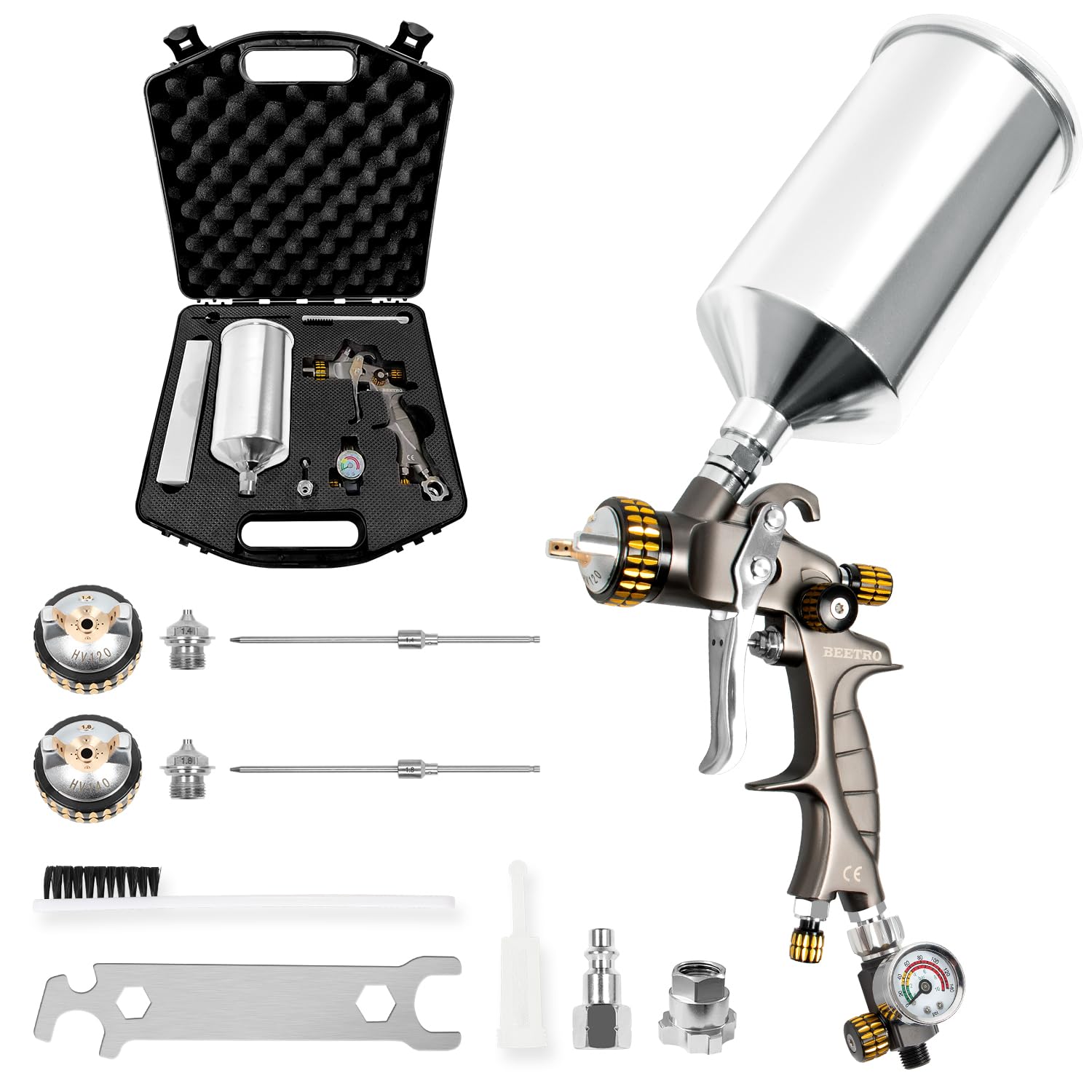
The storage-boxed two-nozzle kit that challenges guns costing three times as much.
The BEETRO is a surprise hitter in the mid-range — a professional-grade gun that ships with a protective storage box, a pre-installed 1.4mm nozzle for base coat, and a separate 1.8mm set for primer. The 1000ml aluminum cup (the largest single cup in this lineup, bigger than the NEIKO’s 600cc) means you can spray a full door or fender without stopping. The no-O-ring design makes chemical cleaning straightforward, and the press-fit aluminum cup with a plastic top reduces leaks — a smart detail that many owners highlight.
Owners consistently call out the quality (42 mentions) and performance (22 mentions) as the top reasons to buy. One professional painter said it atomizes paint as effectively as his DeVilbiss gun. The 14.3 CFM and 29-32 PSI working range mean it pairs well with a medium-sized compressor. The only recurring complaint is that the lid stability is mixed (8 mentions) — the press-fit lid works well but takes a bit of practice to seat properly. With high marks across the board, it is a strong contender for anyone looking to get professional-level atomization without the pro price.
No O-rings to replace: The cleaning process uses chemical agents and thinners without worrying about degrading rubber seals — a small but significant time-saver for frequent painters.
The adjustment trio: Fluid control, pattern control, and air adjustment knobs give you full command over the spray. The max working pressure is 43 PSI (3.0 bar); stay below that.
Reach for this if: You want a single gun with two nozzle sets that covers both automotive base/clear and primer duties, packed in a case that stores everything neatly.
pass on it if: You only spray one type of material — the extra nozzle set and storage box add cost you might not need.
6. Graco-Sharpe 288879 HVLP FX3000 (1.3mm)
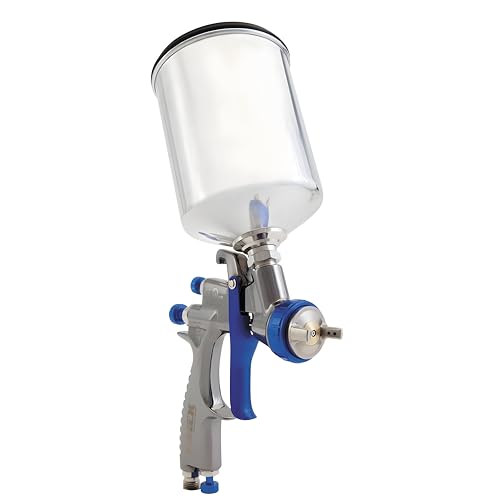
The lightweight auto gun that sprays metallic like a top-tier Iwata.
At just 1.1 pounds, the FX3000 is the lightest gun in this list — a real advantage when you are leaning over a fender for hours. The 1.3mm nozzle is tuned specifically for automotive base coat and clear coat, delivering a fine atomization that buyers compare to guns costing significantly more. One professional painter with a decade of experience using Iwata guns reported that the FX3000 sprays metallics and pearls as evenly as his Iwata, but at a fraction of the cost.
The body is compact and lightweight, designed for the auto painter who needs precision. It includes a 600cc aluminum cup, a wrench, and a cleaning brush. The gun runs well at 29 PSI — a setting that gives you good atomization without excessive overspray. A few owners noted that the fluid nozzle can be stubborn to remove for the first cleaning; using a 19mm socket with the trigger squeezed (to protect the needle) loosens it safely. It is a focused tool for a focused job: automotive finish painting.
Metallic-friendly atomization: The 1.3mm tip and air cap system lay down metallic and pearl coats evenly, preventing the mottled look that happens with poorly atomized guns.
The honest limit: Do not reach for this gun if you plan to spray primer or latex — the 1.3mm nozzle is too small and will clog repeatedly on thicker paints.
Best for: The auto refinisher spraying base coat and clear coat who wants a featherlight gun that delivers pro-level results without the pro price tag.
Think twice if: You need a general-purpose gun that handles primer, enamel, and house paints — look for a 1.8mm or 2.0mm option instead.
7. NEIKO 31216A Air Spray Paint Gun (2.0mm)

The 2.0mm budget beast that shoots latex without a fight.
Where its 1.5mm sibling (31214A) excels at automotive finish work, the 31216A with the 2.0mm red nozzle is built for the thicker stuff — primers, acrylic/latex paints, and water-based wood finishes. And the crowd has spoken loudly: 101 owners single out the spray performance as the top reason to buy, making it the most-praised aspect of any budget gun in this lineup. It uses the same all-steel body, stainless nozzle, and brass cap as the 1.5mm version, so the durability is identical — the only difference is the wider nozzle bore.
The 600cc aluminum cup is standard, and the gun operates at 40 PSI with a 10 PSI working pressure and 4.5 CFM consumption. Buyers report great results with DIY cabinet and baseboard painting — one buyer used it with INSL-X Cabinet Coat thinned just 15% and got a beautiful finish. The recurring note is that the fittings come very tight from the factory; an impact gun helps loosen them for the first disassembly. The build quality gets mixed feedback (20 owners mention it as mixed), so handle the threads with care during cleaning.
The latex-friendly nozzle: With a 2.0mm bore, this gun sprays acrylic and latex paints with minimal thinning — try that with a 1.3mm gun and you will be cleaning clogs all day.
The mix: Build quality is the most-discussed trade-off — the gun is durable for the price, but it is not a professional-grade tool. Treat the threads gently during assembly.
Reach for this if: You need an affordable gun for spraying primer, latex, or water-based wood finishes on furniture, cabinets, and baseboards.
Look elsewhere if: You are doing automotive clear coat or fine finish work — 2.0mm atomization is too coarse for show-quality paint.
8. DeVilbiss StartingLine HVLP Kit 802342

The DeVilbiss name makes a beginner-friendly splash without the pro price tag.
The StartingLine kit is DeVilbiss’s answer to the first-time HVLP buyer — a complete entry-level package that includes a full-size spray gun and a detail gun, letting you switch between broad panels and tight crevices without changing tips. The build leans more toward composite than metal, which keeps the weight down and the price accessible, but the performance punches above its class. Owners praise the quality (70 mentions) and performance (64 mentions), noting that the gun produces excellent spray patterns right from the start.
The full-size gun handles base coat, clear, and single-stage paints well at around 20 PSI with a 5.2-gallon compressor. According to the review pages, “it still performed really well” — with the caveat to pre-disassemble the gun before the first use to address any thread lock issues. The detail gun is a genuine bonus: a smaller, more precise tool for painting motorcycle parts, touch-ups, and tight corners. The trade-off is that some owners found the nozzle hard to remove for cleaning, and the plastic feel does not match all-metal guns in durability. It is a strong starting point, not a lifetime tool.
Two guns, one box: You get a full-size sprayer for body panels plus a detail gun for small parts — a combination that usually requires buying separate units.
The beginner’s choice: The gun works at 20 PSI on a modest compressor, so you do not need a massive air system to get started. The max pressure is 30 PSI.
Perfect for: The first-time auto painter who wants a reliable, name-brand two-gun set to learn on without spending on pro gear immediately.
it’s not for you if: You need a gun for daily professional use — the composite build and delicate tips are better suited to occasional projects than a full-time shop.
9. DeVilbiss StartingLine Complete Kit 802343

The two-gun kit that turns a DIY trunk repair into a pro-looking respray.
This is the bigger sibling to the 802342 kit — a complete auto painting and priming package that includes a gun tune for thick 2K primer and a second gun for base coat and clear coat. The value proposition is simple: one box, two dedicated guns, so you never have to swap a tip mid-job. Owners call out the quality (66 mentions) and functionality (46 mentions) as the top reasons to buy. One DIY owner who used it to repaint his car trunk said, “These guns spray super nice! High build 2K primer and then basecoat/clearcoat. It turned out great! Professional results.”
The kit weighs 7 pounds, reflecting two full-size guns plus accessories, and includes gravity feed HVLP technology for efficient paint transfer. The primer gun handles thick materials without complaint down to the last drop. The max pressure is around 30 PSI, which pairs well with a 5+ gallon compressor. Some owners note that the spray pattern can get inconsistent if you make frequent stops — plan to spray full panels in one pass for the best finish. At a strong crowd rating, this kit is the one to grab if you are serious about doing a full car job yourself.
Prime and paint without swapping: Having a dedicated primer gun and a dedicated topcoat gun means zero contamination between materials and no downtime changing nozzles mid-project.
The honest note: The metal cup connection on some units has been known to break if overtightened — treat the fitting gently and it will serve you well through multiple projects.
Reach for this if: You are tackling a full automotive repaint and want a dedicated primer gun plus a dedicated finish gun in one purchase, with no compromise on atomization.
Think twice if: You only need one gun for occasional touch-ups — the two-gun setup adds cost and storage that a single gun could handle.
Understanding the Specs
Nozzle Size (mm)
The nozzle diameter — measured in millimeters — is the single spec that determines what you can spray. A 1.3mm or 1.4mm nozzle atomizes thin materials like automotive base coat and clear coat into a fine, even mist that dries smooth. A 1.8mm or 2.0mm nozzle lets thicker materials like primer, latex, and 2K surfacer pass through without clogging. If you spray both thin and thick materials, look for a kit with interchangeable tip sets so you can switch in minutes.
Cup Capacity and Material
The paint cup sits on top of a gravity feed gun — that is what “gravity feed” means: paint flows down into the nozzle by gravity, not suction. Cups range from 600cc (about 20 ounces) to 1000ml (about 34 ounces). A 600cc cup is fine for a door or two; a 1000ml cup saves refills on large panels. Aluminum cups are standard and clean up well with solvents. Some guns now include adapters for disposable plastic cups, which cut cleanup time to zero — just toss the liner when you are done.
FAQ
What is the difference between a gravity feed and a siphon feed spray gun?
What size nozzle should I use for automotive paint?
Can I spray latex paint through a gravity feed sprayer?
What does HVLP mean and why does it matter?
Will a gravity feed gun work with my small compressor?
How do I clean a gravity feed spray gun properly?
What does the pattern control knob do?
Is a gravity feed sprayer suitable for a beginner?
Why do some spray guns come with multiple tips?
Final Thoughts: The Verdict
For most buyers, the gravity feed paint sprayer winner is the Fuji Spray 5175G T75G because it delivers pro-grade atomization and all-metal durability that owners trust for years of serious work. If you want maximum nozzle versatility with four tip sets in one purchase, grab the Master Elite PRO-44 Ultimate Kit. And for the budget-conscious painter who needs a solid 2.0mm gun for thick primers and latex, the NEIKO 31216A is the one to reach for.
How We Picked
We do not accept paid placement. Every pick is matched to a real buyer and a real use-case; we do not hands-on test units.
Sources & Methodology
Specifications: manufacturer listings and product documentation. Review insights: verified customer reviews, as of July 2026. Pricing: not shown on this page (it changes often); check the current price via the retailer link.
As an Amazon Associate, Trending Car earns from qualifying purchases. This does not affect which products we feature.