
Our readers keep the lights on and my garage snacks stocked. As an Amazon Associate, I earn from qualifying purchases.
Specs are compiled from manufacturer listings and verified buyer reviews and can change over time — please confirm the key details on the product page before buying.
You grab a gas can for long-term storage because you want fuel that actually starts your mower or generator months later — not a garage that smells like stale fumes or a can that has ballooned out of shape. A container built for this job must seal perfectly, resist UV rays and temperature swings, and keep the gasoline inside usable when you finally need it.
I’m Min Islam — the founder and writer behind Trending Car. This guide is built by comparing the manufacturers’ published specifications and the patterns across verified customer reviews, so you get each pick’s real strengths and trade-offs instead of marketing spin.
These seven fuel containers range from nearly indestructible steel to leak-proof plastic designs that keep your gasoline fresh through the seasons — the definitive list of the best gas can for long term storage.
Our Picks at a Glance
How To Choose The Best Gas Can for Long Term Storage
Not every red plastic jug from the hardware store is built for months of storage. If you plan to keep gasoline for a generator, a seasonal vehicle, or emergency prep, you need three things cheap jugs skip: an airtight seal, a material that does not react with the fuel, and a flame mitigation device (a safety component that prevents sparks from igniting vapors inside the can). Here is what to look for.
Metal vs. Plastic — the storage longevity debate
For truly long-term storage, galvanized steel (like the Eagle and Wavian picks on this list) wins. Steel does not swell, soften, or become porous over time like High-Density Polyethylene (HDPE) plastic, so the fuel stays sealed and the vapors stay inside the can. Plastic cans are lighter and cheaper, but they can deform under heat and some buyers report gasoline smells leaking through the walls after a few years. If “low-maintenance for a year” is your plan, lean toward metal.
Why a flame arrestor matters even in storage
A flame arrestor (also called a flame mitigation device or FMD) is a small metal mesh or perforated disc inside the spout that stops a fire from traveling back into the can. It is a safety feature required by many regulations (OSHA, UL, FM), but it also doubles as a filter to keep debris out of your fuel. Every can on this list has one — do not buy a can that lacks it.
CARB compliance and state legality
The California Air Resources Board (CARB) sets strict limits on how much fuel vapor a gas can is allowed to emit. Many states outside California have adopted CARB standards too. A can that is CARB compliant uses special barrier layers or valve designs to contain fumes, which also means the gasoline inside evaporates slower — directly helping with long-term storage. If you see “CARB compliant” in the specs, you can use that can anywhere in the US.
Quick Comparison
| Model | Best For | Capacity | Material | Weight | Amazon |
|---|---|---|---|---|---|
| Eagle UI50FS★ Best Overall | Overall durability & safety | 5 gallons | Galvanized Steel | 5.25 Pounds | Amazon |
| Justrite 7250220Pro Grade | Industrial precision pouring | 5 gallons | Galvanized Steel | 3.7 Kilograms | Amazon |
| Wavian JC0020BVS | Leak-proof travel & storage | 5 gallons (20L) | Alloy Steel | — | Amazon |
| Midwest Can 6610 | Largest capacity auto shut-off | 6 gallons | HDPE Plastic | — | Amazon |
| Fuelworx 47905 | Stackable garage organization | 5 gallons | HDPE Plastic | 1 Kilograms (2.2 lbs) | Amazon |
| Scepter FSCG552 | Everyday yard tool refueling | 5 gallons (18L) | Plastic | 2.5 Pounds | Amazon |
| VP Racing 3839 | Budget tall & slender fit | 5.5 gallons | HDPE Plastic | 2.9 Pounds | Amazon |
In‑Depth Reviews
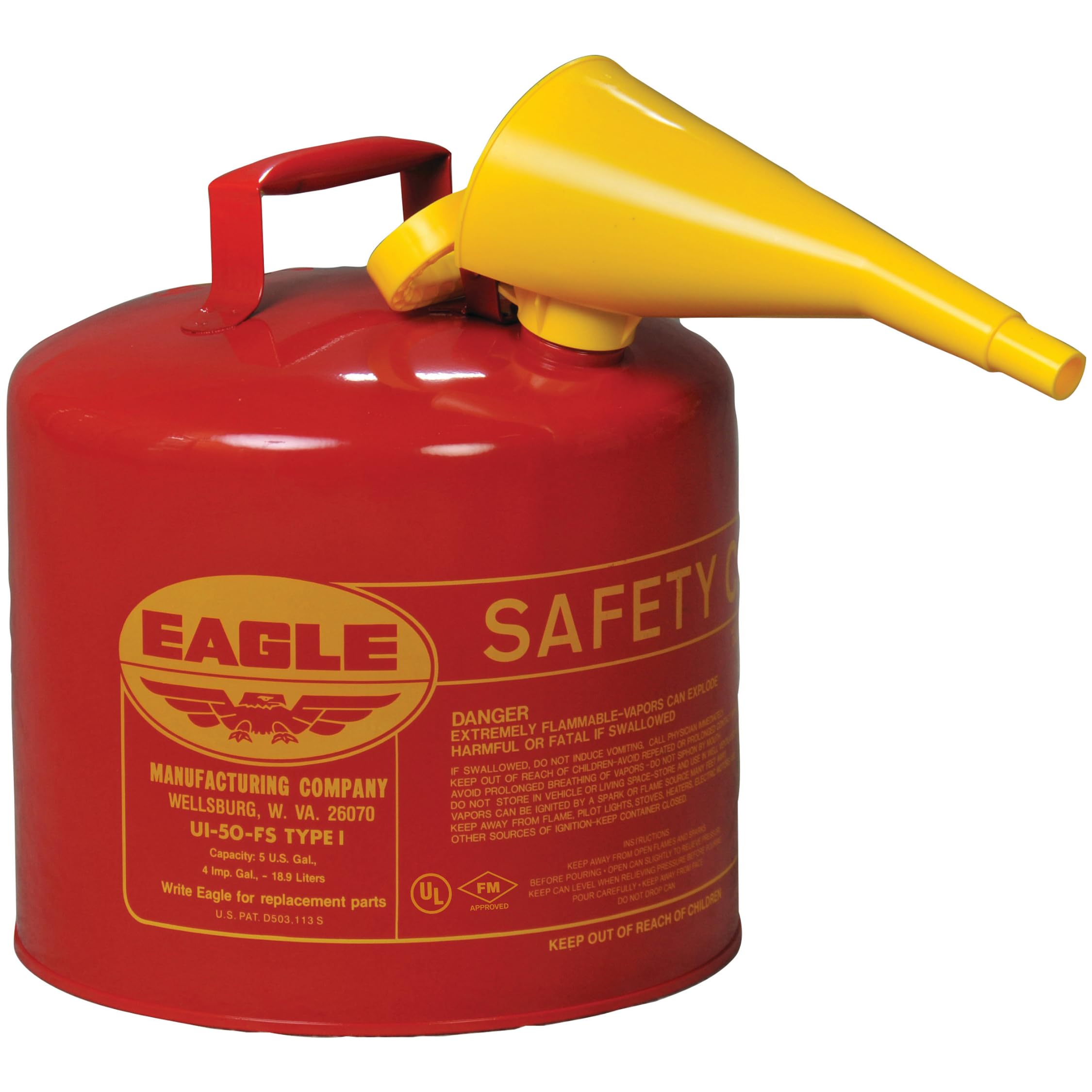
1. Eagle 5 Gallon Type I Red Safety Gas Can (UI50FS)
Our pick — over 4.5★ from 8,000+ verified ratings; the strongest balance of quality and price.
The steel workhorse that keeps gasoline fresh for seasons without a whiff of fumes.
If you want a can that stays airtight and structurally solid through years of storage, this Eagle is the pick. It is made from 24-gauge galvanized steel with a baked-on powder-coat finish that resists rust and scratches, so unlike a plastic jug it will not swell, soften, or start seeping hydrocarbons. At 5.25 pounds it weighs 5.25 pounds versus the Scepter plastic can at 2.5 pounds — that heft tells you this is dense, durable material, not a thin wall.
The included funnel makes filling manageable, though owners mention the funnel gasket (the rubber seal inside) is stiff at first. One reviewer summed it up: “You can have lots of gas, the can is made very well.” It carries FM (Factory Mutual), UL (Underwriters Laboratories), and ULC (Underwriters Laboratories of Canada) approvals, plus it meets OSHA Standard 1910.106 and NFPA code 30 — so you can legally store this in a commercial setting, not just a home garage.
The single opening design (Type I) means you pour through the same opening you fill from, and the self-closing gasketed cap automatically vents internal vapors. That self-sealing lid is the key to long-term storage: it keeps oxygen and moisture out, so the gasoline does not degrade as fast.
Built to Outlast
- Galvanized steel resists dents, rust, and chemical reactions that ruin plastic over years
- Self-closing gasketed lid creates an airtight seal for vapor-free storage
- Flame arrestor and triple safety certifications (FM, UL, ULC) give you real fire protection
The Fit and Finish Gripes
- At 5.25 pounds it is noticeably heavier than plastic cans — not a grab-and-go option
- The funnel design feels gimmicky to some buyers; removal and installation take practice
- Premium price vs. cheap hardware-store jugs
Who it serves: Anyone who wants to fill it once, park it in the shed, and have fuel that is still good six or twelve months later without smelling the garage every time the temperature rises.
One honest limit: If you pour frequently into tight equipment fuel ports, the included funnel is not as smooth as a flexible spout — budget for an aftermarket spout if daily refueling is your routine.
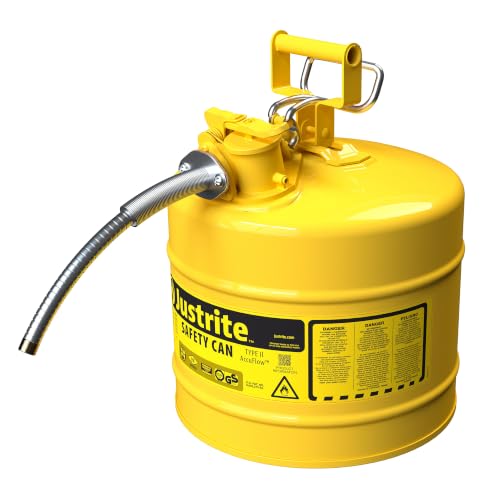
2. Justrite Type II Diesel Fuel Can (7250220)
The industrial-grade steel can with a trigger-operated spout that pours without glugging.
Where most cans make you tip and guess, the Justrite uses a Type II design — a separate fill opening and a flexible 9-inch metal hose with a Safe-Squeeze trigger for controlled dispensing. This is the can to reach for when you need to fuel a tractor or a diesel truck without spilling a drop. The patented manifold creates “glug-free” flow, which means no burping, no splashing, and a much steadier stream into a small filler neck.
The construction is pressure-tested galvanized steel (steel coated with a protective zinc layer) with a chemical-resistant powder-coat finish. Customers note it “does not leak” — one family used it to carry spare diesel on a trip to Alaska and back, and it was the third can they tried before finding one that actually held tight. It is FM Approved, UL/ULC Listed, and TÜV Certified (a German safety certification), so it meets the strictest industrial safety standards.
One caution from the reviews: the 9-inch nozzle is a bit short for larger equipment like a compact tractor. If you are fueling deep-fill ports, you may want to add a longer hose. Otherwise, this is the top-tier pick for someone who wants a last-forever can with military-grade certifications.
Precision Pouring
- Safe-Squeeze trigger and flexible metal hose give you glug-free flow control
- Self-closing, leak-tight lid plus a stainless steel flame arrestor for safe storage
- FM, UL/ULC, and TÜV certifications — the highest compliance bar
Consider Before Buying
- 9-inch hose is too short for some deep equipment fuel inlets
- At 3.7 kg (8.16 lbs) this is the heaviest can on the list — built for stationary use
- Designed for diesel (yellow color); red gasoline version available separately
Best for: Serious equipment owners, farm operators, or anyone who values OSHA/NFPA compliance and needs a can that the grandkids could still use.
Trade-off to note: The heft and the short spout make it less ideal for frequent mobile use — this is a workshop station can, not a carry-around in the truck bed container.
3. Fuelworx Made In The USA Red CARB Compliant 5 Gallon Gas Can (47905)
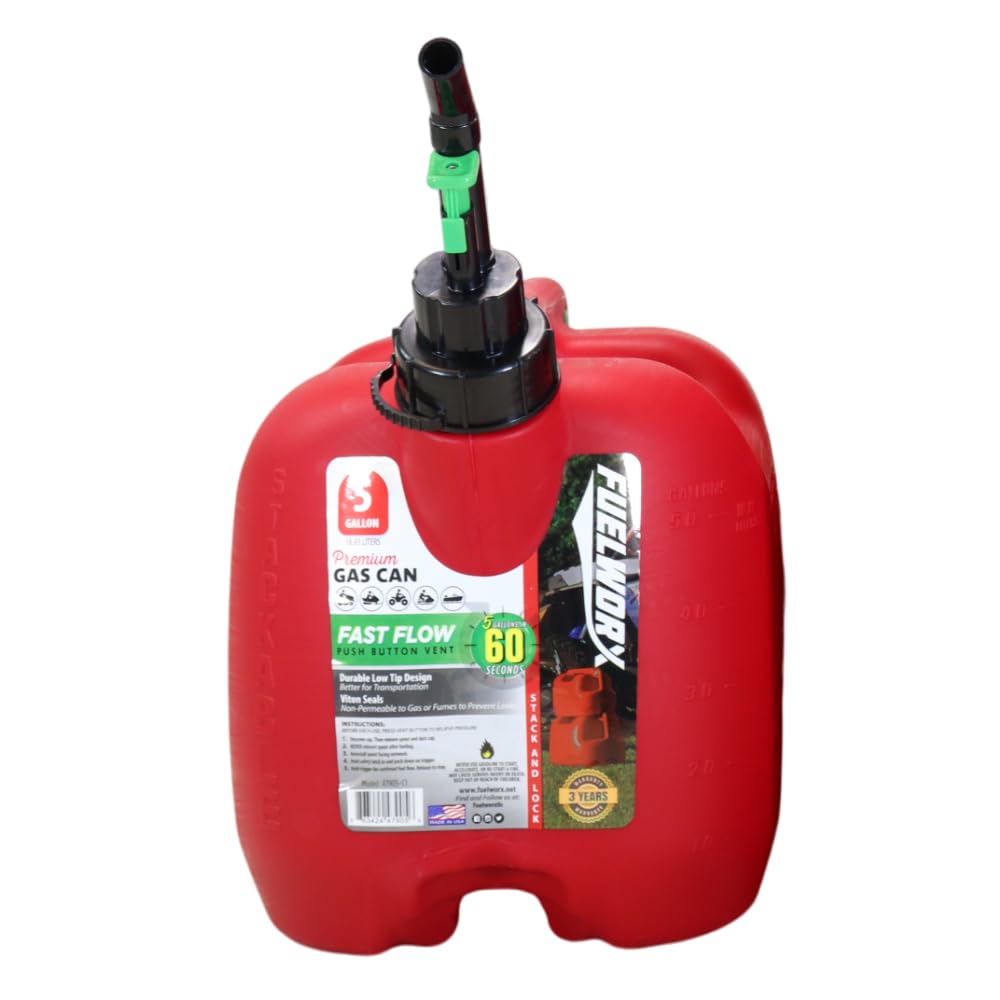
The plastic can that stacks vertically so you can park six gallons in the space of one.
If your garage floor is tight on real estate, the Fuelworx solves the problem with a completely flat top that allows any size cans to stack securely on one another. This is the only can on the list designed from the ground up for vertical stacking — reviewers point out it saves serious space when traveling with generators or storing multiple fuel containers. The car-park-worthy shape also includes two handles: one for carrying and one lower handle for pouring leverage.
The push-button “Non-Spill Fast Flow vent” empties a full 5-gallon can in less than 60 seconds, which is genuinely fast. The Quickflow Trigger swivels 360 degrees, so you can direct the nozzle into awkwardly angled equipment ports without twisting the whole can. Made from High-Density Polyethylene (HDPE) and CARB compliant, it meets the emissions standards that keep vapors sealed in.
Shoppers say two consistent quirks: the green spout cover tends to crack over time, and if you fill above the vent line (the marked maximum fill level) the can will leak from the vent hole — so stay at or below that line. One owner praised the thick, durable plastic and the fast dispensing, calling the cans “awesome” for trailer travel with generators.
Stack & Pack
- Fully stackable — flat top lets you pile cans without tipping
- Drains a full 5 gallons in under 60 seconds via the push-button vent
- Two-handle design makes carrying and pouring less awkward than single-handle plastic cans
Plastic Weak Points
- Green spout cover is brittle and cracks on many units
- Will leak from the vent if you fill above the specified fill line
- HDPE plastic can deform under sustained high heat in a shed
Reach for this if: You are storing multiple fuel cans for a generator backup or a road trip and need to stack them vertically to reclaim floor space.
Look elsewhere if: You need true airtight long-term storage — the plastic body and vent system are not as vapor-proof as a sealed steel can for multi-year storage.
4. Midwest Can 6610 Safe-Flo Auto Shut Off 6 Gallon Gas Can
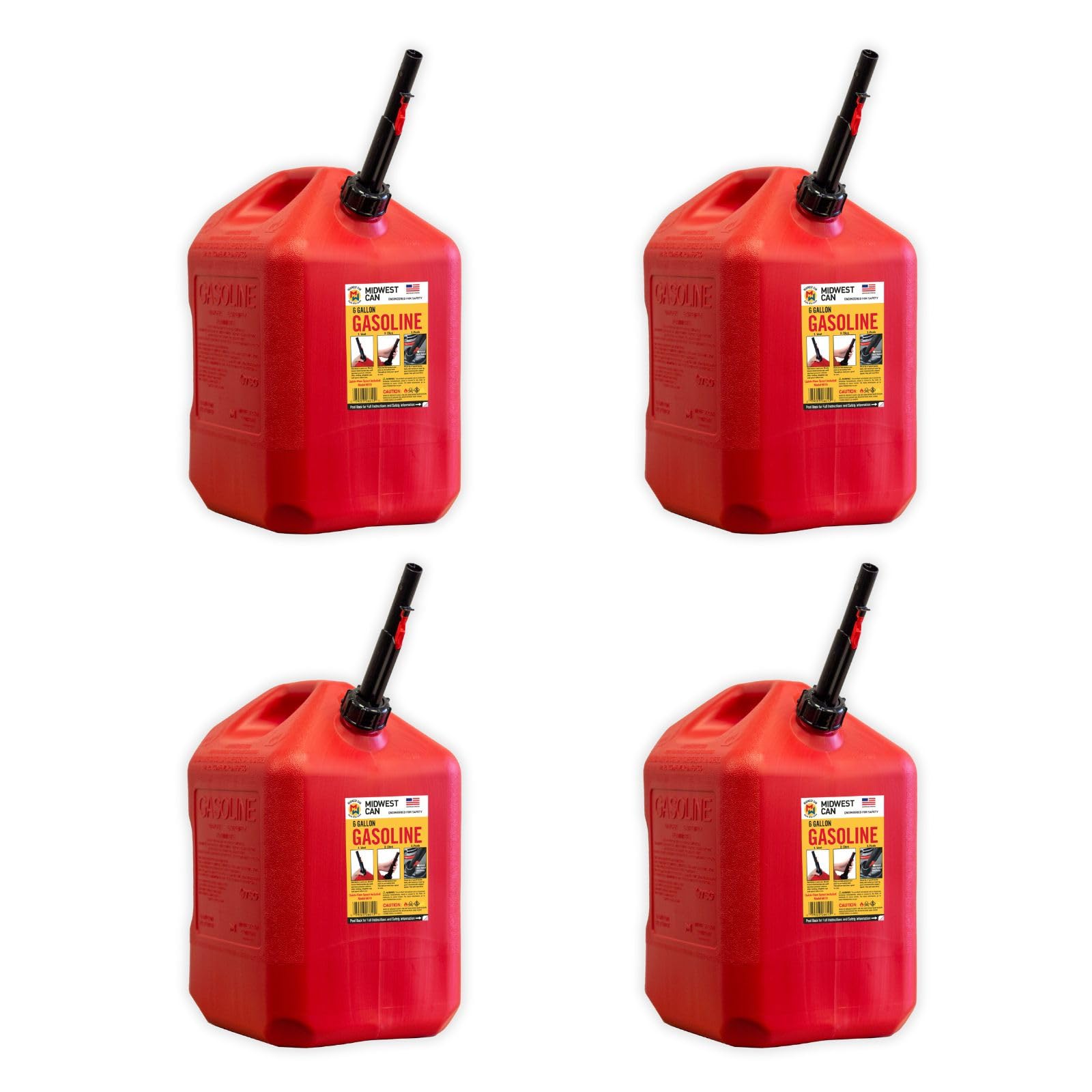
The largest single can here — 6 gallons with a spout that shuts itself off to stop overfills.
For power outages or generator standby that extra gallon can mean hours more runtime before a refill trip. The Quick-Flow Spout delivers a fast flow, and it has an auto-shutoff feature — when the tank is full, the nozzle clicks off automatically to prevent gasoline spewing everywhere.
Midwest Can built the 6610 with HDPE plastic and barrier materials that virtually eliminate hydrocarbon emissions, so the stored fuel stays stable for extended periods. It is engineered with the FlameShield Safety System — a two-piece setup with an internal flame mitigation device and a vapor-locking spout. Buyers call it “a must to keep at home” for generator backup, noting the steady flow and the fact that it does not leak.
One honest catch: the spout includes a pressed-in white fill neck filter that is not mentioned in the description. Buyers discovered they had to remove the filter (without damaging the can) to get the flow they expected. The wide base and low center of gravity reduce tipping, and the two ergonomic handles make lifting a full 6 gallons manageable — though at that capacity, it is heavy.
Extra Run Time
- 6-gallon capacity is the biggest option here — 20% more than the standard 5-gallon Eagle
- Auto shut-off spout prevents overfilling and spills during refueling
- FlameShield safety system with internal flame mitigation and vapor lock
Spout Surprises
- Hidden in-nozzle filter restricts flow and must be removed by the buyer
- HDPE plastic is not as vapor-impermeable as steel for multi-year storage
- Large capacity = heavy when full; plan for two-person handling
Who it fits: Homeowners who run a portable generator during outages and want the longest possible refuel interval from a single can.
Watch out for: The internal filter is a real gotcha — multiple reviews mention it, and removing it requires careful work so you do not break the can. Plan to take the five minutes to extract it before first use.
5. Wavian USA Authentic NATO Jerry Can (JC0020BVS)

The 0.9mm steel jerry can that is 100% airtight — no fumes, no leaks, even lying sideways.
This is the can that NATO forces actually use. Built from 0.9mm cold-rolled steel (steel rolled at room temperature for a tighter grain) with an anti-corrosive coating, the Wavian is absolutely sealed. One buyer tested it lying sideways in a hot car (140°F) for hours: “100% airtight, no fumes or leaks.” That seal is exactly what long-term fuel storage demands — oxygen and moisture cannot get in, so the gasoline stays usable far longer than it would in a plastic container that breathes.
The 5-gallon (20-liter) capacity comes with a bayonet-style quick-release nozzle and a safety lock. It is EPA and CARB compliant (EO number G-26-143, EPA SGVYPMETALJC-001-R01). Buyers consistently call the quality “excellent” and note that the Latvian-made steel is thicker than typical imported cans, with recessed weld seams that do not leak after rough off-road transport.
The honest trade-off: pouring is slow. Without a dedicated vent, the can takes 7 to 10 minutes to empty a full 5 gallons, and the included spout is short. Owners recommend buying the longer aftermarket spout separately. Also, because it seals so completely, temperature or altitude changes can pressurize the can — you are advised to open the spout slowly.
Fort Knox Seal
- 100% leak-proof and fume-proof — tested by buyers in extreme heat and rough truck beds
- 0.9mm cold-rolled steel with anti-corrosive coating, built to NATO-grade standards
- EPA and CARB compliant; legal in all 50 states for gasoline storage
Slow Flow Reality
- Pouring takes 7 to 10 minutes for a full 5 gallons — not a quick-refuel can
- Included spout is too short for most equipment; a longer spout is a separate purchase
- Can pressurize in temperature swings; you must vent it slowly before opening
Best for: Overlanders, off-roaders, and serious preppers who need a can that can survive being strapped to a roof rack or bouncing in a truck bed for years without a single fume escaping.
skip it if: You need to refuel a lawnmower or a car quickly — the slow pour will frustrate you. This is a marathon storage can, not a sprint refueling tool.
6. Scepter FSCG552 Fuel Container with Spill Proof Spout

The lightweight plastic can that makes everyday refueling fast without the heavy lifting.
At just 2.5 pounds (half the weight of the steel Eagle), the Scepter is the lightest full-size can on this list. That matters if you are regularly refilling lawnmowers, chainsaws, and ATVs — you do not want to lug a 5+ pound steel can around the yard every weekend. The SmartControl spout lets you squeeze less for a trickle or squeeze more for full flow, giving you real control over the pour without guesswork.
The 5-layer plastic construction is specifically designed to prevent vapor leaks and preserve gasoline longer — this is not a cheap single-wall jug. It is EPA/CARB compliant and includes a flame mitigation device for safety. The integrated air vent in the spout allows a flow rate of up to 3 gallons per minute, and the included funnel (with a storage ring on the can) makes refueling cars or ATVs easier.
Reviewers overall are very satisfied, calling it “well built and easy to use.” The honest note from a buyer: “It makes a small spill when filling up but nothing major. And when sealed, I can still smell the fumes so not completely sealed off.” That vapor permeability is the trade-off against steel — the plastic layers reduce emissions but cannot match a welded steel can for absolute airtightness.
Light and Nimble
- At 2.5 pounds it is the lightest 5-gallon option — easy to carry and pour
- SmartControl squeeze spout gives variable flow from trickle to full blast
- 5-layer barrier construction is CARB compliant and slows vapor loss for storage
Vapor Reality
- Some buyers report a faint gasoline smell even when sealed — not 100% airtight
- Assembly of the spout can be confusing if you skip the manual
- Plastic may wear over years; long-term durability unknown
Reach for this if: You are an average homeowner who fills the mower every week and wants a manageable can that will not make you grumble about the weight every Saturday.
Look elsewhere if: You need a can for multi-year fuel storage in a hot shed — the slight vapor permeability means fuel will degrade faster than in a steel can.
7. VP Racing 3839 Press ‘N Pour Gas Can, 5.5 Gallon
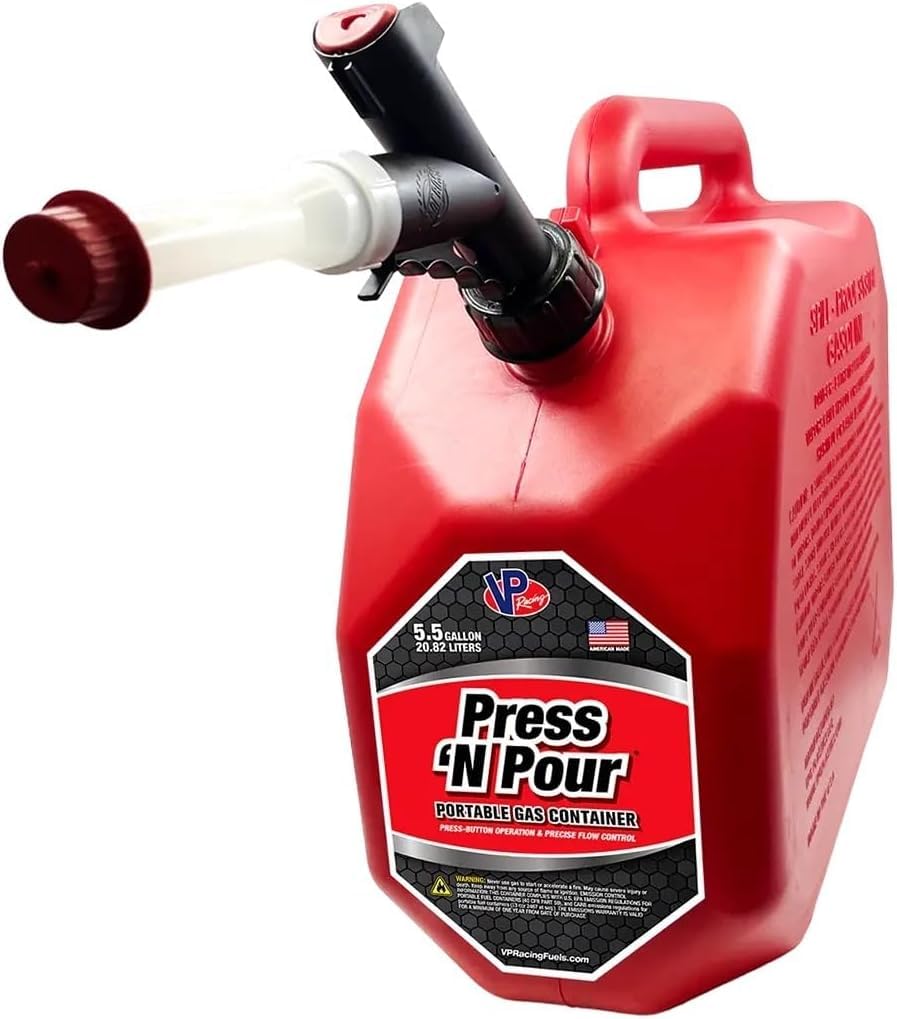
The tall, slender 5.5-gallon jug that slides into a truck bed corner without hogging space.
At 15.27 inches wide and 15.61 inches tall, the VP Racing can is noticeably slimmer than the broader Scepter (12 inches wide but 16 inches tall). That narrow shape makes it a great choice for slipping beside a toolbox in a pickup or packing into a tight corner of a garage. It holds 5.5 gallons, so you get a half-gallon extra over standard 5-gallon cans without the can itself feeling oversized.
The Press ‘N Pour design uses a button-operated flow control, and the FlexFMD flame mitigation device has over 100,000 perforations to prevent fire flashback without slowing fuel delivery. It is made from tough HDPE with barrier materials, meeting ASTM, EPA, and CARB standards. Owners mention it feels sturdy and “doesn’t feel flimsy” like cheaper plastic jugs.
The big caveat — and it is a serious one — is the pouring ergonomics. One reviewer called it “horrible design” and explained: “Requires lifting 40 lbs with no handle while pushing a stiff, awkward button.” The lack of a secondary lower handle for leverage means you heft the full weight of the can (about 40 pounds when loaded) with just the top grip while pressing the pour button. That is a genuine ergonomic flaw that multiple reviews flagged.
Garage-Friendly Dimensions
- Slim profile (15.27″W x 15.61″H) fits in tight truck bed and garage spots
- 5.5-gallon capacity gives you useful extra fuel without a bigger footprint
- FlexFMD flame mitigation device with over 100,000 perforations for safety
Pouring Pain Point
- No lower handle — you must lift the full weight with one hand while pressing a stiff button
- Pouring can be gulpy and cause spills if you do not angle the can just right
- Some customers note the need to install an aftermarket vent for smooth flow
Best for: Budget-conscious buyers who need a tall, space-efficient can that can fit in a vehicle for transport — the form factor is genuinely handy for tight spaces.
Trade-off to know: The single-handle pour is physically demanding when the can is full. If you are smaller-framed or have hand strength concerns, test this design before committing — the Scepter or Fuelworx will be far easier to pour.
Understanding the Specs
Flame Arrestor / Flame Mitigation Device (FMD)
A small metal mesh screen or perforated disc fitted inside the spout opening. Its job is to keep a spark or flash fire outside the can from traveling inward and igniting the fuel vapors inside. For long-term storage, an FMD also doubles as a debris filter. Every pick on this list has one, and cans sold in the US have been required to include them for several years. A can without an FMD is not worth buying — it is a safety hazard.
CARB Compliance and Barrier Layers
CARB (California Air Resources Board) sets limits on fuel vapor emissions from portable containers. A CARB-compliant can uses either a steel wall (which naturally blocks vapor) or a multi-layer HDPE plastic with barrier materials that slow hydrocarbon molecules from seeping through. The benefit for storage is direct: less vapor escaping means less fuel evaporating over months, so the gasoline stays usable longer. All modern compliant cans have a visible spout valve system that prevents vapor release when the spout is closed.
FAQ
How long does gasoline last in a gas can designed for long-term storage?
Will a plastic gas can leak fuel fumes over time?
What does a flame arrestor actually do and is it necessary?
Can I store diesel in a red gasoline can?
What is the difference between a Type I and Type II gas can?
How do I keep my stored gas from going bad?
Is it safe to carry a full gas can in my trunk or truck bed?
Why does my plastic gas can swell up or feel pressurized?
Why did my old gas can get banned and replaced with a CARB-compliant one?
Can I use a stabilizer with any of these cans?
Final Thoughts: The Verdict
If you want one dependable pick, the best gas can for long term storage winner is the Eagle UI50FS because it combines galvanized steel durability, a self-closing vapor-proof lid, and FM/UL/ULC safety certifications at a price that still leaves you change for a fuel stabilizer. If you need absolute leak-proof performance for off-road travel and storage, grab the Wavian NATO Jerry Can. And for easy weekend refueling without the weight, the Scepter FSCG552 gives you a light, CARB-compliant (California Air Resources Board approved) can that makes yard work far less of a chore.
How We Picked
We do not accept paid placement. Every pick is matched to a real buyer and a real use-case; we do not hands-on test units.
Sources & Methodology
Specifications: manufacturer listings and product documentation. Review insights: verified customer reviews, as of July 2026. Pricing: not shown on this page (it changes often); check the current price via the retailer link.
As an Amazon Associate, Trending Car earns from qualifying purchases. This does not affect which products we feature.