
Our readers keep the lights on and my garage snacks stocked. As an Amazon Associate, I earn from qualifying purchases.
Specs are compiled from manufacturer listings and verified buyer reviews and can change over time — please confirm the key details on the product page before buying.
You are miles from a wall outlet—on a framing job, a remote ranch, or a truck repair in the middle of nowhere. That is when a gas air compressor keeps your nail guns, impact wrenches (a tool that loosens and tightens lug nuts), and spray rigs running. The two numbers that matter most are tank size (measured in gallons) and airflow (CFM, or cubic feet per minute, at a given PSI, pounds per square inch). Those specs decide whether your tool keeps working or you stand around waiting for pressure to build.
I’m Min Islam — the founder and writer behind Trending Car. This guide is built by comparing the manufacturers’ published specifications and the patterns across verified customer reviews, so you get each pick’s real strengths and trade-offs instead of marketing spin.
The right gas air compressor balances tank capacity with real-world CFM to keep your day moving without a cord in sight—if you need a portable wheelbarrow unit for roofing or a stationary behemoth for a shop.
Our Picks at a Glance


How To Choose The Best Gas Air Compressor
Picking the right gas-powered compressor depends on matching the machine to the tools you actually run every day. A roofing crew needs high CFM at a moderate PSI to keep multiple nail guns firing, while a mobile mechanic might prioritize a bigger tank to blast lug nuts off heavy trucks. Here are the three specs that separate the winners from the headaches.
Tank Capacity and CFM — The Real Workhorses
Tank size (measured in gallons) stores compressed air, but the number that really tells you if a compressor can keep up is CFM—cubic feet per minute—at a given PSI. A tool like a framing nailer might need 2-3 CFM at 90 PSI; a 1/2-inch impact wrench can draw 4-5 CFM. If your compressor’s CFM rating falls short, the tool stalls mid-task. Look for a unit that delivers at least the combined CFM of the tools you plan to run simultaneously.
Engine Quality — Honda GX Sets the Bar
The engine is the heart of a gas compressor, and the Honda GX series is the gold standard for a reason. These overhead-valve engines start reliably in cold weather, run cleanly, and last for years under heavy use. Many premium models also include a low-oil shutdown feature that automatically kills the engine before low oil can damage the pump—a small feature that can save you a rebuild.
Portability vs. Stationary Power
Wheelbarrow-style compressors (twin pontoons or single vertical tanks on two wheels) are built for daily job-site mobility—you tip and roll them through mud and gravel. Horizontal tank units with four wheels are easier to tow or push across a flat shop floor but are heavier and bulkier for rough terrain. Consider where you’ll use it most: a roofer needs wheelbarrow agility; a shop owner can park a horizontal tank and not move it often.
Quick Comparison
| Model | Best For | Tank Size | Max PSI | CFM @ 90 PSI | Amazon |
|---|---|---|---|---|---|
| Metabo HPT EC2510E★ Best Overall | Professional job-site reliability | 8 gallons | 145 PSI | — (spec not listed) | Amazon |
| VEVOR 13.2 GalMost Capacity for the Budget | Budget-friendly large tank | 13.2 gallons | 115 PSI | 9 CFM | Amazon |
| Metabo HPT EC2610EA | Running multiple nail guns | 9 gallons | 145 PSI | 9.5 CFM | Amazon |
| Ingersoll-Rand SS3J5.5GH-WB | Continuous-duty auto body work | 8 gallons | 135 PSI | — (spec not listed) | Amazon |
| NorthStar 20-Gal | Stationary/portable hybrid shop use | 20 gallons | 90 PSI (regulated) | 13.7 CFM | Amazon |
| VEVOR 30 Gal | High-volume shop air supply | 30 gallons | 115 PSI | 33 CFM | Amazon |
| NorthStar 30-Gal GX390 | Heavy-truck repair and continuous spray | 30 gallons | 90 PSI (regulated) | 24.4 CFM | Amazon |
In‑Depth Reviews
1. Metabo HPT Gas Powered Wheeled Air Compressor, 8 Gallon, EC2510E
Our pick — over 4★ from 50+ verified ratings; the strongest balance of quality and price.
Honda GX power and cast-iron durability in a wheelbarrow frame that rolls onto any job site.
This 8-gallon compressor cycles between 116 PSI (the pressure at which it restarts) and 145 PSI (the max pressure before it shuts off), meaning it turns on well before your tools feel a drop-off. The professional-grade Honda GX engine is the same reliable small engine used on pumps and welders worldwide, and the cast iron cylinder keeps oil carryover low so your tools last longer. The baseplate-integrated control panel protects the gauge and regulator from job-site bumps, and the pre-installed 3/8-inch locking regulator saves you an accessory trip.
At 144 pounds it is heavy enough to stay planted but still rolls easily thanks to the wheelbarrow design. Buyers report it handles siding, finish, framing, and roofing nailers without hesitation. Unlike the 13.2-gallon VEVOR below which maxes out at 115 PSI, the Metabo HPT reaches 145 PSI, giving your tools more headroom on heavy draws.
One owner noted it sat unused for 10 months, then blew oil out on startup—a reminder to check the oil before first fire after long storage, especially since the warranty runs 30 days. For a pro who needs a compressor that starts every morning and pulls multiple nailers, this is the one.
Honda engine reliability: The GX engine starts reliably in cold weather, and the cast iron pump resists wear. The trade-off is the 30-day warranty period—inspect the unit thoroughly right away.
trusted motor: You are a professional framer, roofer, or siding contractor who needs a dependable, mid-size gas compressor that runs on Honda reliability and pushes 145 PSI.
needs lighter: You need a massive tank for continuous high-CFM tools like sandblasters, or you want a longer warranty safety net.
2. VEVOR 13.2 Gallon Gas Powered Air Compressor, 7HP
A 13.2-gallon tank that is 65% larger than the Metabo HPT 8-gallon, for less money.
The VEVOR packs a 7HP piston pump that pushes 9 CFM (cubic feet per minute) at 115 PSI, enough to run a nail gun and an impact wrench at the same time through its two air outlets. The 13.2-gallon tank gives you a longer run time between cycles than any 8-9 gallon competitor, so on a big spray job you get fewer compressor restarts. It has four smooth-rolling wheels and a push handle for easy transport, plus a low-oil auto shutdown that protects the pump.
The catch is the build quality. Multiple owners mention the pump failed after only 45 minutes of use or the unit never started at all. One reviewer noted the pull cord sits right in the way of a critical part, making it easy to snap the cable on startup. At 131.8 pounds it is substantially lighter than the 226-pound Ingersoll-Rand above, but that weight saving may come at the cost of long-term durability. If you need a big tank on a tight budget, this is the cheapest way to get 13.2 gallons—but keep your expectations realistic for the pump life.
Budget-friendly 7HP: The tank size-to-price ratio is class-leading. But several reviewers had reliability issues early on, so buy expecting possible tinkering or a short service life.
value pick: You need the biggest tank your budget can buy for intermittent weekend use and are comfortable performing minor repairs.
want premium: You rely on a compressor daily for income and cannot afford downtime—step up to the Metabo HPT or NorthStar.
3. Metabo HPT Air Compressor, THE TANK XL, 9-Gallon Gas Wheelbarrow, EC2610EA
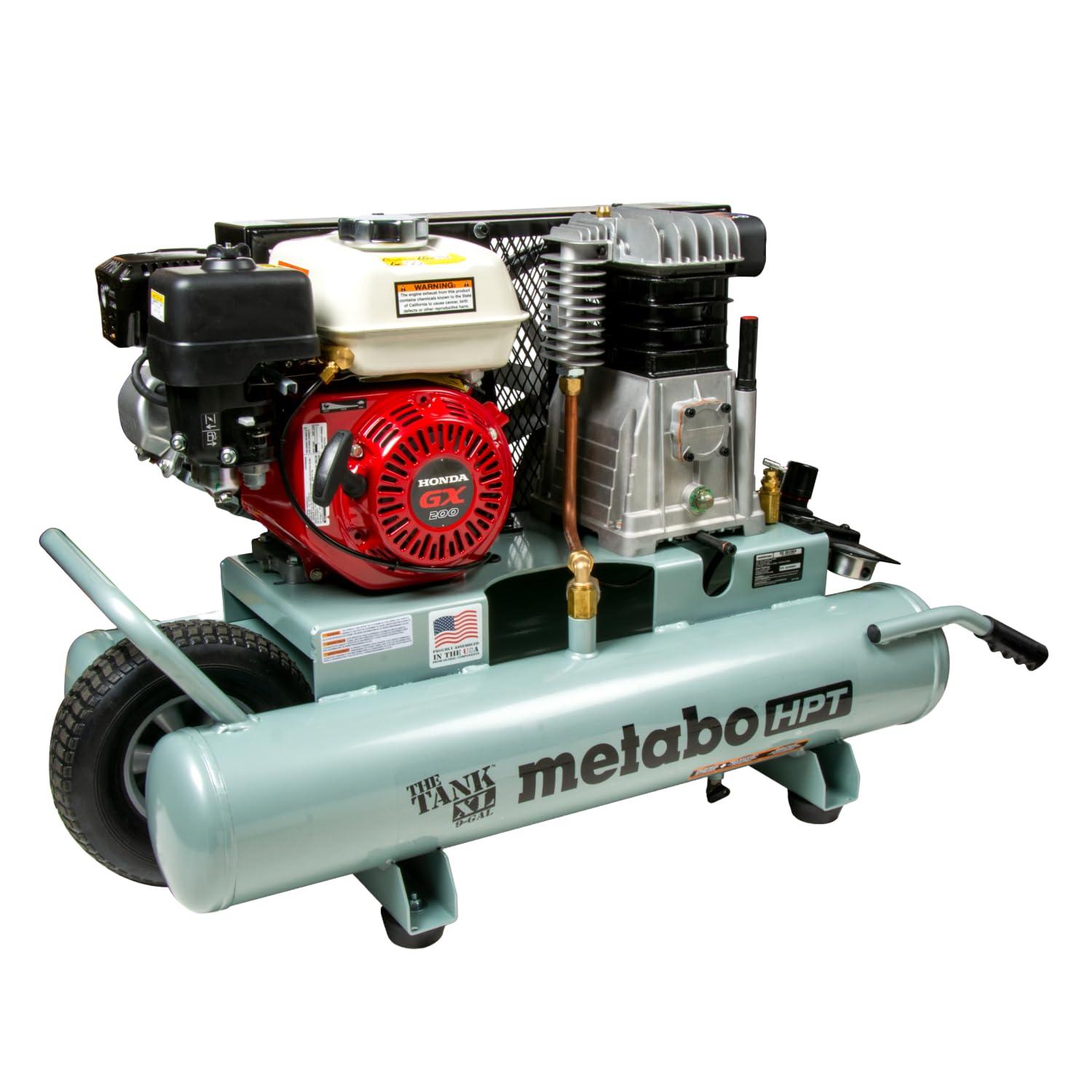
The only unit in this list that can run five framing nailers at once and still recover in seconds.
The TANK XL is powered by a Honda GX 200 engine and assembled in the USA, delivering 9.5 CFM at 90 PSI. The 9-gallon tank and oil-lubricated pump with an aftercooler (a component that cools the compressed air before it enters the tank) keep the compressed air cooler and drier for your tools. Metabo HPT says it can simultaneously drive five framing nailers, five roofing nailers, or five siding nailers without delay, and buyers confirm it: one reviewer reports running six roofing guns at once with no issue, even after 7 months of sitting idle.
The wheelbarrow design with a solid rubber tire rolls easily over rough terrain. Some users mention the engine has a hard-starting quirk and requires the choke to fire, but once running it recovers from empty in about 45 seconds and tops off pressure in roughly 15 seconds. At 159 pounds it is a bit heavier than the EC2510E but delivers substantially more CFM for crews running multiple tools simultaneously.
Crew-friendly 9 gallons: class-leading multi-nailer capacity and a Honda GX 200 engine. The only downside is the occasional hard start, which may be a minor annoyance on a cold morning.
team tool: You run a roofing, framing, or siding crew and need a compressor that keeps 5+ nail guns firing continuously without bogging down.
solo jobs: You work alone or only need one tool at a time—the 9.5 CFM capacity is overkill for a single user.
4. Ingersoll-Rand SS3J5.5GH-WB 5.5 Horsepower 8 Gallon Oiled Gas Twin Pontoon Compressor

A cast-iron twin-tank wheelbarrow built for 100% continuous duty and a 6-inch DA sander that never quits.
The Ingersoll-Rand uses a Honda 5.5 HP engine and a twin-pontoon design for stable rolling, with two quick-disconnect outlets so you can run a sander and a blow gun at the same time. It is rated for 100% continuous duty, meaning you can leave a high-draw tool like a 6-inch dual-action sander running all day without burning up the pump. The cast iron construction and oil-lubricated pump are built to industrial standards, and the 135 PSI max pressure keeps air tools responsive.
At 226 pounds it is the heaviest wheelbarrow compressor here (the VEVOR 13.2 gallon is 131.8 pounds). The dimensions are 48″L x 27″W x 33″H, so it takes up more truck bed space. A mobile auto body repairman reports his 6-inch DA sander runs continuously without the compressor struggling. However, one buyer who purchased two units had both fail within months—one with a regulator failure and the other with an air control valve issue. Ingersoll-Rand’s warranty fixed the first, but the pattern suggests occasional quality control misses.
Continuous-duty oiled: The only unit explicitly rated for 100% continuous operation, ideal for sanding and grinding. The trade-off is substantial weight and size, plus sporadic QC issues.
workhorse: You are a mobile auto body or restoration pro who needs a compressor that can run a DA sander or grinder for hours without stopping.
occasional use: You need to carry the compressor up stairs or load it into a truck bed daily—the 226-pound weight makes that a two-person job.
5. NorthStar Portable Gas-Powered Air Compressor 20-Gal Horizontal Tank 13.7 CFM @ 90 PSI

A 20-gallon tank and 13.7 CFM that delivers spray-ready air without the wheelbarrow wobble.
The NorthStar is powered by a Honda GX160 OHV engine with a low-oil shutdown that kills the engine automatically before the pump runs dry—a feature that can save you a costly rebuild. The full cast iron pump includes an FC35 Grade cast iron pump head and V-style cylinder design for superior cooling, plus floating-type Swedish steel valves that last longer than conventional valves. With 13.7 CFM at 90 PSI and 20 gallons of storage, this unit can run a sealcoat sprayer or a 1/2-inch impact without breaking a sweat.
At 217 pounds it is heavy but rides on a frame that can be moved around a shop or loaded onto a service truck. One buyer modified the base for truck service and found a fitting installed incorrectly from the factory, but after fixing it the unit ran 20 hours straight blowing out sprinklers without a hiccup. The Honda engine starts on the first pull, and users say it maintains 90 PSI steadily for spray work where a wheelbarrow compressor would cycle too often.
20-gallon horizontal tank: Bigger than any wheelbarrow unit, with enough CFM for continuous spray guns. The trade-off is a larger footprint and occasional factory assembly quirks that may need correction.
paint ready: You do sealcoating, painting, or heavy truck repair and want a stationary-friendly compressor with a huge tank and Honda reliability.
general tasks: You need daily job-site portability—the horizontal tank is harder to roll over rough ground than a wheelbarrow frame.
6. VEVOR 15HP Gas Powered Air Compressor, 30 Gallon Horizontal Tank

33 CFM from a 30-gallon tank—more airflow than the NorthStar GX390, at a fraction of the price.
The VEVOR 30-gallon is a beast on paper: 15HP, 33 CFM at 115 PSI, and a 30-gallon tank that provides prolonged air supply for two tools run simultaneously. The cast iron cylinder and frame promise stability, and the low-oil auto shutdown protects the pump. With dual air outlets, you can run a spray gun and an impact wrench at the same time without pressure drops. It rolls on four wheels, making it movable around a workshop.
The reviews are mixed. One buyer loves it for filling truck tires fast and running a spray gun, while another had the unit break down in under 5 months and found customer support impossible to reach. A third reviewer noted the pressure relief valve did not work, the outlet pressure gauge was inaccurate, and the quick-connect fittings were incompatible with standard US hose ends. If you are a hobbyist who can work around these quirks, the 33 CFM is genuinely impressive for the price. But for a pro shop, the quality control gap between this and the NorthStar 30-gallon is wide.
15HP high output: The 33 CFM rating is high for the price. The downside is inconsistent quality control and finicky fittings that may need aftermarket adapters.
power spec: You need massive airflow for spraying or multiple tools on a limited budget and are willing to sort out potential fit-and-finish issues.
tight spaces: Your compressor is a revenue-generating tool that must work every day without question—invest in the NorthStar GX390 instead.
7. NorthStar Portable Gas Powered Air Compressor – Honda GX390, 30-Gallon Horizontal Tank, 24.4 CFM

A 490-pound stationary monster with a Honda GX390 and electric start—built to outlast a whole fleet of smaller compressors.
The largest unit in this guide, the NorthStar GX390, is in a different class. It is powered by a Honda GX390 OHV engine with both electric start and a recoil backup, plus a 3-amp battery charging circuit (battery not included). The full cast iron pump features an FC35 Grade cast iron head, V-style cylinders for superior cooling, and floating-type Swedish steel valves. With 24.4 CFM at 90 PSI and a 30-gallon horizontal tank, it can run a 1/2-inch impact wrench on heavy truck repair jobs without ever running out of reserve air.
At 490 pounds it is a stationary machine—you mount it on a shop floor or a heavy service truck, not a daily roll-around. Buyers who own this unit report it starts every time and has quick recovery. One owner bought it for heavy truck repair and says it never runs out of air, even on massive lug nuts. Multiple users say it is their second or third NorthStar purchase, which is the strongest endorsement for long-term reliability. The main complaint is with Northern Tool’s shipping and customer service—the compressor itself gets five stars from owners.
Honda GX long life: This is the most expensive compressors here, but repeat buyers and 24.4 CFM make it the right choice for a shop that needs uninterrupted air for years. The 490-pound weight means you park it and profit.
investment: You run a busy shop or heavy-truck repair service and need non-stop, high-CFM air with Honda GX390 reliability and electric start convenience.
quick buy: You need portability—this unit barely leaves the shop floor. Also skip it if your tools demand less than 10 CFM; the capacity is overkill.
Understanding the Specs
CFM and PSI — The Real Tool-Feeding Numbers
CFM (cubic feet per minute) is how much air the pump moves. PSI (pounds per square inch) is how hard it pushes that air. Most pneumatic tools list their required CFM at a given PSI—say, 4 CFM at 90 PSI. Your compressor must match or exceed that CFM at that PSI, or the tool slows down and stops. A higher PSI ceiling (like 145 PSI) gives you a buffer so the compressor kicks on long before the tool feels a drop. Gas compressors usually have a wider PSI range than electric units, which helps on demanding tools.
Cast Iron vs. Aluminum Cylinders
Cast iron cylinders are heavier but much more durable than aluminum. They dissipate heat better, resist wear from continuous running, and keep oil from bypassing the rings into the air stream (low oil carryover). Most professional-grade gas compressors use cast iron for the pump head and cylinder. Aluminum pumps are lighter and cheaper but wear faster under continuous duty. If you plan to run a DA sander or a spray gun all day, a cast-iron pump is worth the weight.
FAQ
How often do I need to change the oil in a gas air compressor?
Can I run a paint sprayer with a gas air compressor?
What does CFM stand for and why does it matter?
How long does a gas air compressor last?
Is a gas air compressor louder than an electric one?
Can I use a gas air compressor indoors?
What size gas air compressor do I need for a roofing nailer?
How do I winterize a gas air compressor?
What is the difference between a wheelbarrow and a horizontal tank compressor?
Do I need a special hose for a gas air compressor?
Final Thoughts: The Verdict
For most buyers, the gas air compressor winner is the Metabo HPT EC2610EA because it balances 9.5 CFM with a Honda GX 200 engine and the proven ability to run five nailers at once. If you need a massive 30-gallon tank with electric start for a busy shop, grab the NorthStar GX390. And for a mobile continuous-duty unit that feeds a DA sander all day, the standout is the Ingersoll-Rand SS3J5.5GH-WB.
How We Picked
We do not accept paid placement. Every pick is matched to a real buyer and a real use-case; we do not hands-on test units.
Sources & Methodology
Specifications: manufacturer listings and product documentation. Review insights: verified customer reviews, as of July 2026. Pricing: not shown on this page (it changes often); check the current price via the retailer link.
As an Amazon Associate, Trending Car earns from qualifying purchases. This does not affect which products we feature.