
Our readers keep the lights on and my garage snacks stocked. As an Amazon Associate, I earn from qualifying purchases.
Specs are compiled from manufacturer listings and verified buyer reviews and can change over time — please confirm the key details on the product page before buying.
You roll into your garage, stop, get out, and realize the car’s too far forward or back. You shuffle, check the mirror, and repeat. A good parking laser system fixes that by putting a visual target on your dashboard so you nail the same exact spot every time without leaving the driver seat. There are three main approaches: a standalone motion-activated laser, a unit that pairs a laser with a built-in LED light, and a system that integrates directly into your garage door opener’s wiring.
I’m Min Islam — the founder and writer behind Trending Car. This guide is built by comparing the manufacturers’ published specifications and the patterns across verified customer reviews, so you get each pick’s real strengths and trade-offs instead of marketing spin.
The right garage laser parking system depends on how many cars you park, if you want motion sensing or opener integration, and how much beam visibility you need in daylight.
Our Picks at a Glance

How To Choose The Best Garage Laser Parking System
Most garage parking guides boil down to a red dot on your dashboard. But the way that dot gets there — and how reliably it appears — separates a tool you use every day from one you eventually ignore. Here is what to check.
Dual vs. Single Laser
If you park two cars, a dual-laser unit lets you set an independent aiming point for each vehicle. That saves you from buying two separate devices. However, some dual units have a narrow adjustment angle, which can make aligning both beams in a two-car garage tricky.
Power Source and Motion Detection
Most units plug into a standard wall outlet (110-volt AC) with a backup battery option. Motion sensors that detect you or the car from up to 15 feet away switch the laser on automatically and keep it active for 15-90 seconds. That convenience matters if you prefer not to push a button or open the garage door to get the beam to appear.
Opener Integration
Some laser parking systems wire directly into the photo-eye sensors of your existing garage door opener. That setup leaves no wall plug and no extra brackets, but it does tie you to a specific brand’s compatibility and can make aiming more difficult because you need a ladder to reach the opener’s terminals.
Quick Comparison
| Model | Best For | Weight | Motion Detection | Lasers | Amazon |
|---|---|---|---|---|---|
| ZONETECH Dual Laser GuideBudget Pick | Budget Choice — two-car setup | 15.5 ounces | Up to 10 feet | Dual, 360-degree adjustable | Amazon |
| Maxsa 37314 Park Right | Best Overall — daily family garage | 5 ounces | Up to 15 ft / 130-degree | Dual, 360-degree adjustable | Amazon |
| Liftmaster Chamberlain 975lm | Premium Pick — integrated with opener | 1.76 ounces | IR beam interruption (opener signal) | Single, Class 2 laser | Amazon |
In‑Depth Reviews
1. ZONETECH Garage Parking Assist Dual Laser Guide
A two-pack dual laser that runs on AC power with a motion sensor that detects movement up to 10 feet away.
This unit is built for the budget-conscious buyer who wants a dual-laser solution for a two-car garage. Each unit gives you two independently controlled red lasers with 360-degree adjustment, and the motion sensor turns them on when it detects movement up to 10 feet away. No wiring is required — you mount it with the included screws or double-sided tape and plug it into the wall. One buyer who previously used a tennis ball on a string said this was “ingenious” and a worthy replacement, calling it “inexpensive and equally functional.”
The notable trade-off here is weight and adjustability. At 15.5 ounces, this unit is significantly heavier than both the Maxsa (5 ounces) and the Liftmaster (1.76 ounces), so you will want a solid mounting surface. A real buyer reported that the “dual lasers have narrow adjustment angle; had to cut plastic for two cars.” That means if your two cars park in very different positions relative to the unit, you may struggle to aim both beams without modifying the housing. Some reviewers also mention that the laser dot is hard to see in daylight, which reduces effectiveness if your garage is bright.
Value angle: You get two independent lasers and AC power for a very accessible price — straightforward if your ceiling is level and both cars park in roughly the same lateral spot.
Heads-up: The laser visibility in daylight and the narrow adjustment angle on the dual beams are the main reasons for mixed ratings. If you need a wide spread between two parking positions, this may require some DIY modification.
Reach for this if: You park two similar-sized vehicles in a standard two-car garage and want a simple plug-and-play solution that avoids any wiring or opener compatibility concerns.
Look elsewhere if: Your garage gets strong daylight or your two parking spots are offset — the limited laser spread and beam visibility may frustrate you.
2. Maxsa 37314 Park Right Dual Laser Parking Guide

The all-in-one that pairs a laser guide with a motion-activated LED pathway light.
You get an aiming point for each car plus a lit path to walk around the vehicle, and you do not need to run any wiring to make it work. The dual adjustable lasers let you set a target for a compact car on one side and a tall SUV on the other — each one swivels a full 360 degrees so you can dial in the exact dashboard spot. The built-in LED light turns on automatically when motion is detected up to 15 feet away with a 130-degree field of view, staying lit for roughly 15 seconds after motion stops. One reviewer noted setting a laser so there was only about three inches of clearance between the garage door and the car, maximizing walk-around room at the front of the vehicle.
At 5 ounces, this is noticeably lighter than the ZONETECH dual laser at 15.5 ounces, making ceiling mounting less demanding on the hardware. The AC adapter cord is 9 feet long, and the unit includes an optional AA battery backup if the power cuts. One honest limitation buyers report: the motion sensor faces outward toward the garage door, so it may not always trigger when you walk in from the house side unless you position the unit carefully.
What stands out
- Dual 360-degree adjustable lasers handle two cars independently.
- Built-in LED safety light stays on for about 15 seconds — helpful walking to the car in a dark garage.
- Up to 15 feet / 130-degree motion coverage catches most garages.
The one catch
- Motion detection sensitivity can be finicky depending on mounting location; some users had to adjust placement to avoid false triggers or missed activations.
Go-to for most garages: If you park two cars and want a single device that provides both parking guidance and a lit walkway, this is the most complete package.
Watch the mounting spot: The motion sensor is directional — mount it where it sees the car entering, not just foot traffic from the house door.
3. Liftmaster Chamberlain 975lm Laser Parking Assist
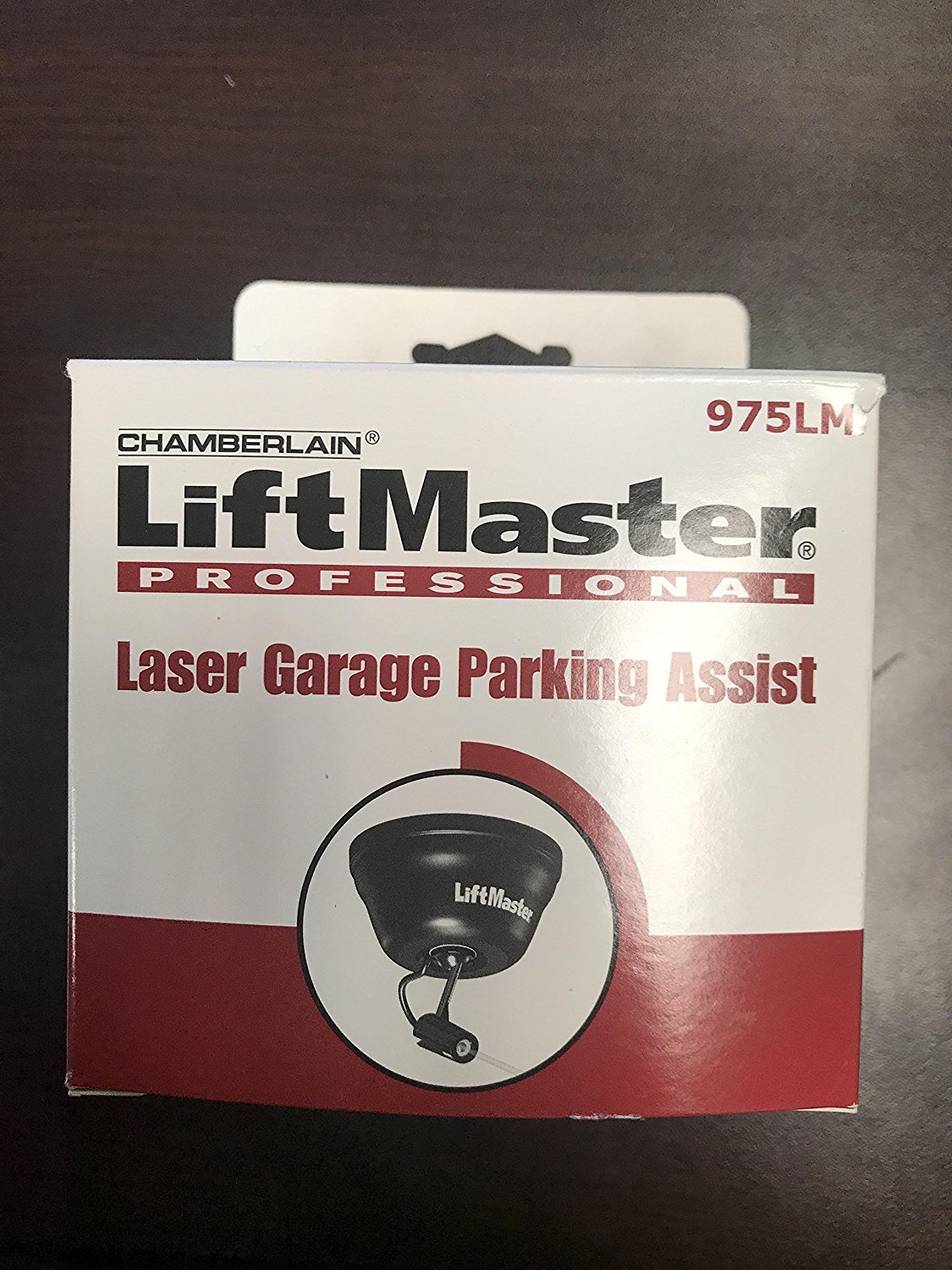
A featherweight laser that wires into your opener and fires a pulsing beam only when needed.
This is the lightest option of the three at 1.76 ounces (the Maxsa weighs 5 ounces, and the ZONETECH is 15.5 ounces), which makes a real difference when you are hanging it from the ceiling on a single screw. You avoid wall plugs and battery worries because the 975lm works specifically with LiftMaster (and compatible Chamberlain) garage door openers — it connects directly to the photo-eye IR safety beam terminals. When the car interrupts that infrared (IR) beam, the laser turns on for 90 seconds and projects a pulsing red Class 2 beam (a low-power laser rated safe because your blink reflex protects you). The laser is meant to hit a pre-targeted spot on your dashboard.
Owners mention that the aiming process is the hardest part because you need ladder access to the opener, and the beam can be hard to see until it actually hits the dashboard. The wiring is quite short, which can limit where you mount the unit. Some users also note that if the garage door is already open, the laser will not re-trigger until the beam is broken again. On the positive side, for a tight single-car garage where every inch of door clearance matters, one buyer mentioned it helps their wife park forward enough so the garage door closes without scraping the bumper. Two units can be installed per opener if you need dual-vehicle coverage.
The integrated advantage
- No wall plug or batteries to worry about — powers directly from the garage door opener.
- Pulsing 90-second timer conserves the laser and is tied exactly to when you drive in.
- Class 2 laser is rated safe for eyes.
The integration trade-off
- Only works with LiftMaster/Chamberlain openers that have photo-eye IR terminals — not universal.
- Aiming requires ladder work near the opener; the short wiring makes wall-mount placement difficult.
- Single laser — need two units for a two-car setup, and the beam does not re-trigger with the door already open.
Best for the brand-loyal DIY installer: If you already own a LiftMaster or Chamberlain opener and want the cleanest possible install with zero visible cords, this is the pick.
skip it if: You park a minivan or longer vehicle — the short wire and near-range limit caused one buyer to struggle aiming; you may prefer a standalone unit with more placement freedom.
Understanding the Specs
Laser Class and Visibility
Most garage parking lasers use Class 2 or Class IIIA red lasers. Class 2 is rated as safe for accidental eye exposure (the blink reflex protects you). The real issue is whether you can see the dot on your dashboard. Dark dashes absorb red light, so a dim laser may disappear entirely on a black dashboard in a bright garage. Customers note that units with a pulsing beam (like the Liftmaster 975lm) are more visible because the flicker catches your eye, even in a south-facing garage.
Motion Sensor vs. Opener Trigger
Standalone units like the Maxsa and ZONETECH use a passive infrared (PIR) motion sensor to detect movement up to 10-15 feet. They turn on the laser when a car or person enters the zone and shut off after 15-90 seconds of no motion. The Liftmaster uses a different approach: it connects to the garage door opener’s infrared safety beam. When the car breaks that beam, the laser activates for 90 seconds. Neither method is “better” — it depends on if you want the laser tied to the act of entering the garage (motion) or to the act of the garage door beam (opener integration).
FAQ
Will a garage laser parking system work with any garage door opener?
Can I use a dual-laser system for two cars?
How long do the lasers stay on?
Do these lasers damage my eyes or car paint?
Can I see the laser dot in a bright garage during the day?
How do I install and aim a garage parking laser?
What is the difference between a dual laser and a single laser unit?
Will the lasers trigger false alarms from pets or kids?
What happens if the power goes out?
Can I replace a tennis ball on a string with a laser parking guide?
Final Thoughts: The Verdict
Across the board, the garage laser parking system winner is the Maxsa 37314 Park Right because it gives you dual lasers for two cars plus a motion-activated LED safety light, all in a lightweight 5-ounce package that installs with no wiring. If you want smooth integration with your existing LiftMaster or Chamberlain opener, grab the Liftmaster Chamberlain 975lm. And for a straightforward budget-friendly two-car setup, the ZONETECH Dual Laser Guide gets the job done despite its heavier weight and narrower laser adjustment.
How We Picked
We do not accept paid placement. Every pick is matched to a real buyer and a real use-case; we do not hands-on test units.
Sources & Methodology
Specifications: manufacturer listings and product documentation. Review insights: verified customer reviews, as of July 2026. Pricing: not shown on this page (it changes often); check the current price via the retailer link.
As an Amazon Associate, Trending Car earns from qualifying purchases. This does not affect which products we feature.