
Our readers keep the lights on and my garage snacks stocked. As an Amazon Associate, I earn from qualifying purchases.
Specs are compiled from manufacturer listings and verified buyer reviews and can change over time — please confirm the key details on the product page before buying.
Buying the cheapest oil-free pancake compressor often ends in frustration: it stalls on a framing nailer and roars so loud you can’t think. The real question isn’t just tank size — it’s refill speed (CFM, or cubic feet per minute) and pressure capacity (PSI, or pounds per square inch). Match CFM and PSI to your tools’ requirements, and you’ll never wait for air again.
I’m Min Islam — the founder and writer behind Trending Car. This guide is built by comparing the manufacturers’ published specifications and the patterns across verified customer reviews, so you get each pick’s real strengths and trade-offs instead of marketing spin.
Quiet indoor trim work calls for a low-decibel model; continuous shop tools demand a large tank. The right garage air compressor matches CFM, PSI, and tank size to your daily tasks.
Our Picks at a Glance

How To Choose The Best Garage Air Compressor
Every garage compressor trades off three things: airflow (CFM), run time before rest (duty cycle), and footprint. Prioritizing the spec that matches your hardest-working tool prevents overpaying.
Match the CFM to your hardest-working tool
The airflow rating at 90 PSI is the number that tells you if a compressor can actually run your tools continuously. A brad nailer needs very little air, but a framing nailer or an impact wrench demands far more. If you plan to run a DA sander or a paint sprayer, check that tool’s CFM requirement against the compressor’s output before you buy — a mismatch means constant waiting.
Decide between oil-lubricated and oil-free pumps
Oil-free pumps are lighter, cheaper, and need no maintenance, but they tend to run hotter and louder, and they have a shorter lifespan under heavy use. Oil-lubricated cast iron pumps run cooler and quieter, last far longer, and are usually found on bigger, more expensive units — the classic choice for a daily-use shop where you need reliability over years.
Quick Comparison
| Model | Best For | Tank Size | Max PSI | CFM @ 90 PSI | Amazon |
|---|---|---|---|---|---|
| Makita MAC5200★ Best Overall | Heavy shop use, impact wrenches | 5.2 gal | — | 6.5 CFM | Amazon |
| Klutch 20-GallonBest Value | Big tank shop air, value | 20 gal | 175 PSI | 4.2 CFM | Amazon |
| DEWALT DWFP55130Quiet Operator | Quiet indoor trim work | 2.5 gal | 200 PSI | 3.0 CFM | Amazon |
| VEVOR 15-Gallon | Budget tire inflation, auto repair | 15 gal | 125 PSI | 5.3 CFM | Amazon |
| CRAFTSMAN 10-Gallon | Nailing, DIY jobs | 10 gal | 150 PSI | 4.0 CFM | Amazon |
| DEWALT D55146 | Portable jobsite power | 4.5 gal | 225 PSI | 5.0 CFM | Amazon |
| California Air Tools 4620AC | Ultra quiet, spray painting | 4.6 gal | — | 5.3 CFM | Amazon |
| Stealth 20-Gallon | Quiet big tank, car detailing | 20 gal | 150 PSI | 5.0 CFM | Amazon |
| Rolair VT25BIG | Pro-level trim and framing crews | 5.3 gal | 130 PSI | 6.5 CFM | Amazon |
| Ingersoll Rand SS3L3 | Whole-shop continuous duty | 60 gal | 135 PSI | 10.3 CFM | Amazon |
In-Depth Reviews
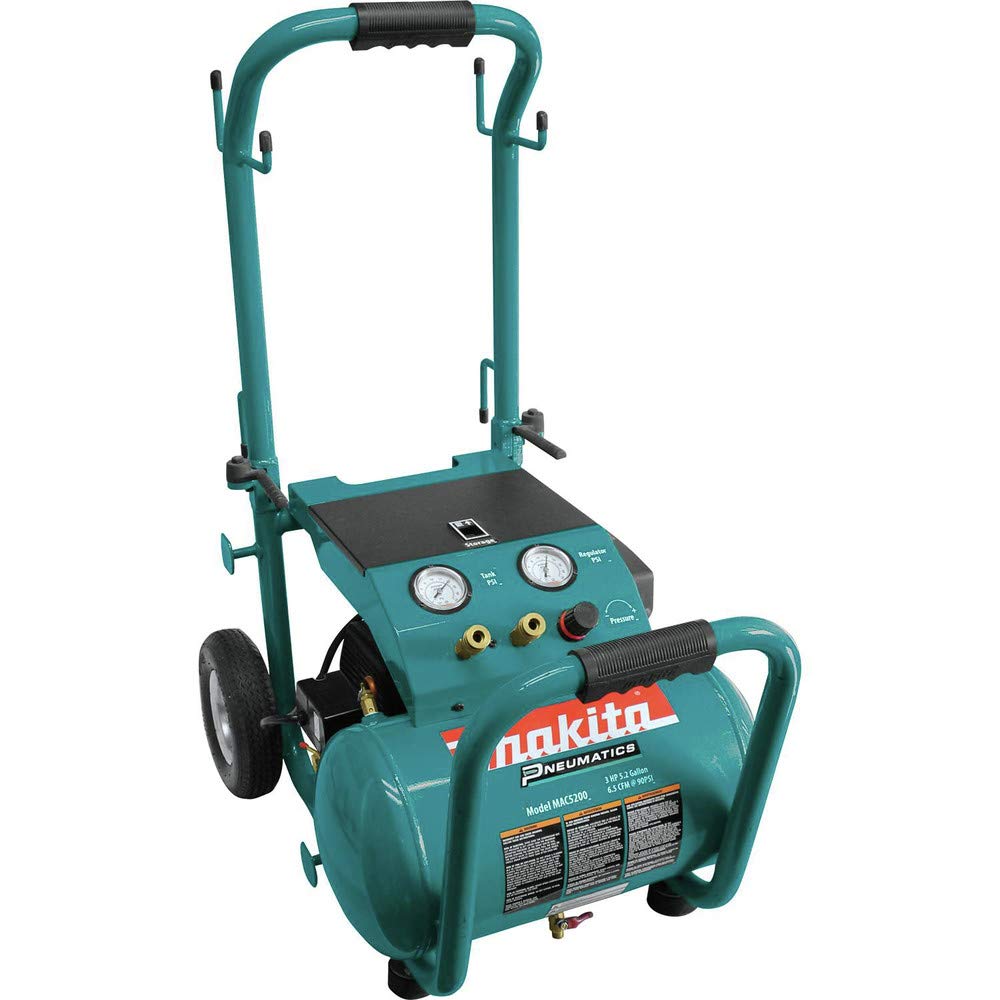
1. Makita MAC5200 3.0 HP Big Bore Air Compressor
Our pick — 4.5★ from 900+ verified ratings; the strongest balance of quality and price.
The 75-pound workhorse that shrugs off lug nuts and keeps your whole shop fed.
The defining feature here is the cast iron pump with the Big Bore cylinder — a design built to pump out 6.5 CFM at 90 PSI from a 5.2-gallon tank. That airflow is what lets this unit power an impact wrench that removes lug nuts from a car or SUV, something most portables simply can’t sustain. It refills so fast that in testing it goes from empty to 120 PSI in about a minute and a half.
The pump is oil-lubricated, which means cooler running temperatures and less wear over time, and you can remove the cylinder for easy maintenance. Buyers report it sounds quieter than oil-free models with a lower pitch, and it delivers 15 to 20 nail shots before the motor cycles back on. The trade-off is the weight — at 75 pounds it’s heavy, though the pneumatic wheels and folding handle make it manageable in a garage.
What wins people over is the build quality; it’s described as solid, not flimsy, and the fold-down handle with its low profile makes storage under a bench easy. The main complaint is the noise level, which gets mixed feedback — some find it quieter than expected, others say it’s as loud as cheaper models.
What Makes It Great
- 6.5 CFM at 90 PSI runs high-demand tools like impact wrenches and ratchets
- Oil-lubricated cast iron pump runs cooler and lasts longer
- Compact 29″L x 19.5″W x 19″H footprint stores easily with the handle folded
Consider This
- Heavy at 75 pounds despite the wheels
- Noise level earns mixed feedback from owners
- 5.2-gallon tank is small next to 20-gallon vertical units
The right pick for: anyone who needs real CFM for automotive work or heavy nailing in a small footprint.
Think twice if: you want a huge reserve tank for continuous tools — the 5.2-gallon tank refills fast but stores less air than big verticals.
2. Klutch 20-Gallon Air Compressor
A towering 41.5-inch vertical tank that delivers 8 times the air reserve of a compact trim unit.
This Klutch takes the opposite approach from the Makita above — instead of packing the airflow into a small frame, it stuffs 20 gallons into a space-saving vertical design that reaches 41.5 inches tall. That’s a full 8.0x more tank capacity than the DEWALT DWFP55130’s 2.5 gallons, which means far more nail or staple shots before the motor cycles on. It delivers 4.2 SCFM at 90 PSI, so it keeps up with impact guns and tire service.
The 2.0 HP oil-free pump means minimal maintenance, and the 175 PSI max pressure gives you plenty of cushion for shop tasks. Owners mention it’s “a great compressor for the money” — relatively quiet and holds air well. The honest catch is portability: “Don’t count on it being portable but the wheels help move it in the garage.” At 90 pounds with large rubber wheels, it’s a mover-with-effort, not a carry-around.
Quality is the most-praised aspect, with buyers noting it’s well-built and quieter than expected. A few mention the pressure buildup is slower to 70 PSI, and one found the pressure limit switch disconnected under the plastic cover — an easy fix but something to check on arrival.
Why Buyers Choose It
- 20-gallon tank holds 8x more air than a 2.5-gallon trim compressor
- 175 PSI max pressure for high-demand shop tools
- Oil-free pump with thermal overload protection for confidence
The Honest Trade-Off
- 90 pounds — the wheels help, but it’s not truly portable
- Pressure buildup runs slower to 70 PSI
- Occasional switch connection issues from the start
Reach for this if: you want maximum air storage per dollar for impact guns and tire work in one spot.
Look elsewhere if: you need to move a compressor between job sites — this one stays in the garage.
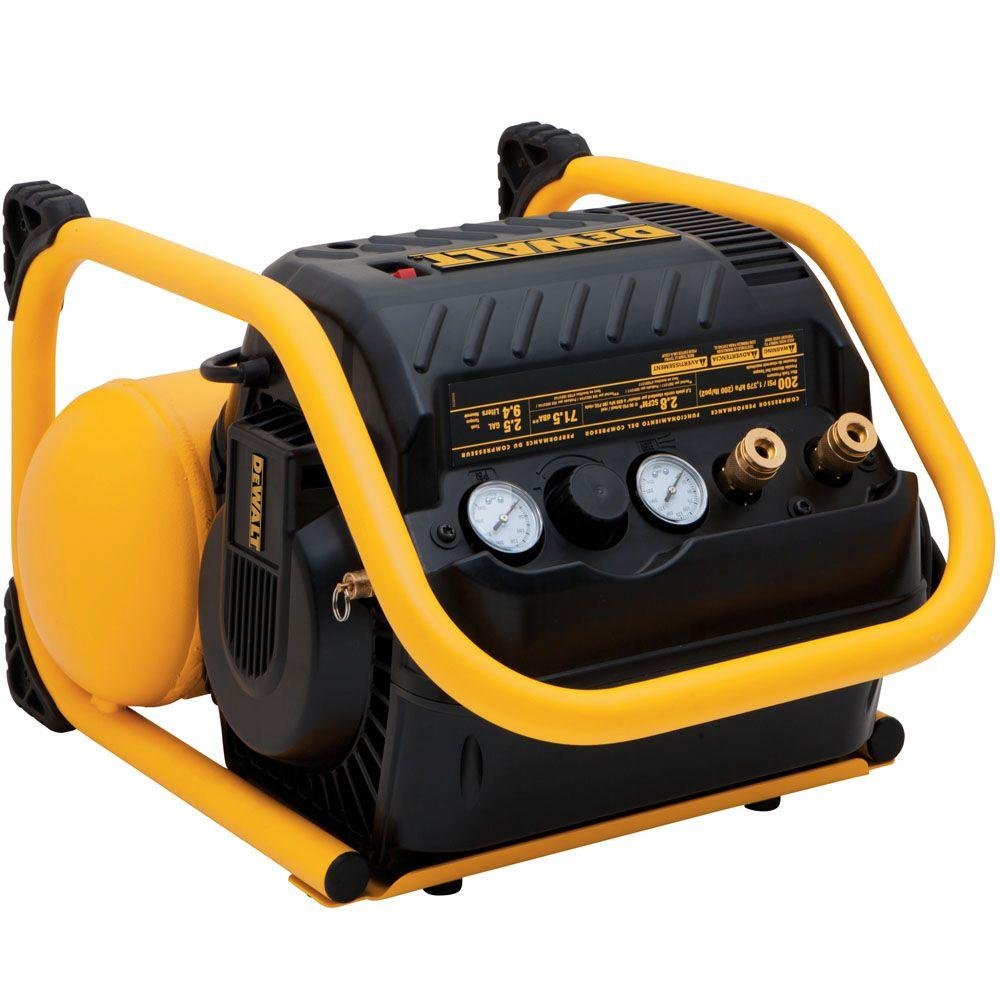
3. DEWALT Air Compressor for Trim (DWFP55130)
The 36-pound whisper-quiet unit so polite you can run it while the family sleeps above the garage.
This DEWALT is built for a very specific buyer: the trim carpenter or DIYer who needs to fire hundreds of 16 and 18-gauge nails indoors without driving everyone crazy. It hits only 71.5 dBA, which buyers describe as “espresso-machine level” quiet — one noted the old unit was 3x louder. The 2.5-gallon tank and 200 PSI max pressure mean a full tank fires a large number of nails before recovery.
At 36 pounds and 12.5 inches thin, it’s genuinely easy to carry up stairs, and the roll cage protects the key components during transport. The low 12-amp draw reduces breaker tripping, and you can operate it vertically or horizontally. Dual quick couplers let you run two nailers at once. The trade-off versus the bigger units above is airflow: 3.0 SCFM at 90 PSI means it’s not for continuous tools or running two high-demand tools simultaneously.
The standout feature owners rave about is the noise level — it’s the most-praised aspect by a wide margin. The recurring wisdom is to limit run time to 50% duty for longevity, since the oil-free pump isn’t designed for marathon sessions.
Perfect for indoor work: quiet enough for bedrooms-above-garage use and light enough for stairs.
The limits: oil-free pump means it can’t handle continuous tools, and there’s no wheel kit.
Grab this if: trim nailing, tire inflation, and stapling are your main jobs and noise matters.
skip it if: you plan to run a framing nailer all day or use air-hungry continuous tools.
4. VEVOR 15-Gallon Ultra Quiet Air Compressor

A surprisingly mighty little tank that fills in under a minute and stays quiet doing it.
The VEVOR proves you don’t need to spend premium money to get fast recovery. The 15-gallon tank fills in under a minute, and buyers describe it as “small but mighty” with a great power-to-size ratio. It delivers 5.3 CFM at 90 PSI from a 2 HP oil-free motor, which is strong airflow for a 15-gallon unit — enough for nail guns, impact wrenches, and tire inflation.
You can hold a conversation next to this unit: it runs at 78 dB (decibels, a measure of loudness), kept low by a three-layer silencer (a thickened muffler cover, rubber pipe, and filter cotton) that also blocks fine dust. The Q235B structural steel tank (a standard-grade steel) uses a 3-layer rust-resistant process and smooth welding, so customers note it holds air overnight without leaks. One reviewer noted “the cost for what you get, is very low” and praised the fast recovery.
The main complaints are practical: the 40-inch power cord is short, and one owner found extension cords cause shutdowns. The thermal overload protection shuts the motor down for 5 minutes when it gets hot, which can pause a work project.
What You Get
- 15-gallon tank fills in under a minute
- 5.3 CFM at 90 PSI rivals larger units
- 78 dB noise level with dust-filtering silencer
Watch Out For
- Short 40-inch power cord limits placement
- Thermal shutdown pauses work when hot
- Small wheels can cause tipping
Choose this for: budget-friendly tire inflation, auto repair, and spray painting with minimal noise.
Not ideal if: you need a long cord reach or continuous heavy use — the thermal cutoff will interrupt you.
5. CRAFTSMAN 10-Gallon Air Compressor (CMXECXA0331042)

A 10-gallon upright that slides under a workbench yet still runs a framing nailer.
If you want more air than a pancake compressor but lack floor space for a 20-gallon tower, the Craftsman fits under a workbench at just 15.3 inches deep, thanks to its vertical design and foldable handle. Its 10-gallon tank delivers 4.0 CFM at 90 PSI and a max of 150 PSI — enough to run an impact wrench, framing nailers, and HVLP (high-volume, low-pressure) painting. It’s a balance for garage DIYers.
The dual quick couplers let you run multiple nailers — the maker claims it can handle 2 roofing, 2 siding, 2 finish, or 2 brad nailers simultaneously. Reviewers point out it keeps up with air demand for impacts and nail guns even after years of use. The 68.9-pound weight with wheels makes it easy to move around the garage.
The trade-off is noise — it’s the aspect buyers discuss most, and it comes across as loud during operation. One owner noted it’s quieter than the Craftsman pancake compressor but still noisy. Another mentioned the wheels arrived damaged and needed replacement.
Solid mid-range value: reliable performance for impacts and nailers with a compact footprint.
The recurring gripes: it’s loud, and the stock wheels are a weak point — treat them gently.
Best for: home DIYers and small crews who want a wheeled 10-gallon unit that stores away.
Skip if: noise bothers you or you need a tank larger than 10 gallons for continuous tools.
6. DEWALT 4-1/2 Gallon Hand Carry Compressor (D55146)

The 225-PSI beast that fits in a sedan trunk and feeds five nail guns without losing pressure.
This DEWALT is the overachiever of the portable class. It stores a massive 225 PSI in the tank — the highest pressure in this lineup — which gives you “industry-leading usable air” per fill. That translates to roughly 10 nail gun shots before refill between 160 and 200 PSI, and one buyer ran it continuously feeding five guns without pressure loss. It delivers 5.0 CFM at 90 PSI.
Despite the 88-pound weight, the 10-inch non-flat pneumatic tires and telescopic handle make it genuinely mobile — one owner reported it “fits in my sedan car” and ran a framing nailer and other high-demand tools. The oil-free pump means maintenance-free operation, and the protective metal console guards the large 2-inch gauges.
Shoppers say it works even in extreme cold and delivers strong air pressure for its size. The main caveat is electrical draw — it needs a 15-amp circuit, and one long-term owner noted the regulator maxes out around 140 psi before the disc deforms.
The Strengths
- 225 PSI max pressure gives the most usable air per tank in its class
- 5.0 CFM at 90 PSI runs framing nailers and high-demand tools
- 10″ pneumatic tires roll smoothly over rough ground
The Costs
- 88 pounds — heavy to lift into a truck bed
- Needs a 15-amp circuit to avoid tripping breakers
- Requires a 45-degree tilt to drain the tank fully
Pick this if: you need a high-pressure portable that rides along in a car and powers serious tools.
Reconsider if: you’re on a shared 15-amp garage circuit with other tools running.
7. California Air Tools 4620AC Ultra Quiet Compressor

The 70-decibel dual-piston unit that runs two framing guns and you can still hold a conversation nearby.
If noise is your number one enemy, this is the compressor to beat. California Air Tools engineered it to run at just 70 dB — quiet enough that buyers report normal conversation at 5 feet and phone calls at 8 feet while it runs. The secret is the dual-piston oil-free pump turning at a slow 1680 RPM, which reduces noise and wear. It’s the most-praised aspect by far.
Despite the quiet operation, it’s no weakling. The 2.0 HP motor delivers 5.30 CFM at 90 PSI and 6.40 CFM at 40 PSI, and the 4.6-gallon aluminum twin tank refills in about 15 seconds after cycling. Owners mention it keeps up with two framing guns running full speed and a texture hopper nearly nonstop. At 64 pounds (though the spec sheet lists 68), it’s portable enough for a van bin.
The pump’s 3,000+ hour life cycle means long-term customers note it still runs strong after 4 to 6 years. The honest downsides: the pressure regulator jumps in large increments making fine adjustment tricky, and the 14-amp draw needs a proper circuit.
Why It Stands Out
- 70 dB noise level enables conversation while running
- 5.30 CFM at 90 PSI handles two framing guns
- 3000+ hour pump life cycle for long-term durability
What To Know
- Pressure regulator is hard to set precisely
- Heavy enough that mobility is limited without a cart
- Some finishing flaws like paint nicks reported
Buy it for: noise-sensitive garages, spray painting, and pro-grade framing without the roar.
Pass if: you need a huge tank reserve — the 4.6-gallon tank refills fast but stores less than a 20-gallon.
8. Stealth 20-Gallon Ultra Quiet Air Compressor

A 20-gallon tower that hits 68 decibels and fills to 150 PSI in about two minutes.
This Stealth answers the question “what if I want both a big tank and a quiet motor?” with a resounding both. It pairs a 20-gallon steel tank with a 68 dB noise level — the lowest in this entire lineup — and buyers confirm it reaches full 150 PSI pressure in about 2 minutes. The heavy-duty tank rides on 8-inch rubber wheels for mobility.
The 1.8 HP oil-free motor delivers 5.0 CFM at 90 PSI and 5.5 CFM at 40 PSI, with two quick couplers for switching tools fast. It’s a favorite for car detailing, with buyers reporting it keeps up with a Tornador while fitting in a van. The “ultra quiet” claim holds up — owners describe it as half the noise of typical compressors.
The trade-off is reliability feedback that’s genuinely mixed. While many report it’s sturdy and performs as advertised, others report units that stopped working after a day or arrived damaged. At 121.4 pounds, this is a stationary garage unit, not a carry-around — lifting it into a truck is tough.
The Big Wins
- 20-gallon tank with 68 dB operation — huge reserve, tiny noise
- Fills to 150 PSI in about 2 minutes
- 5.0 CFM at 90 PSI keeps up with detailing tools
The Risks
- Mixed durability reports — some units fail after light use
- 121.4 pounds is very heavy to move or lift
- Customer service for warranty can be hard to reach
Ideal for: car detailers and home shops wanting a big silent tank that stays put.
Think twice if: you need to move it regularly or want long-term reliability certainty.
9. Rolair VT25BIG 2.5 HP Air Compressor
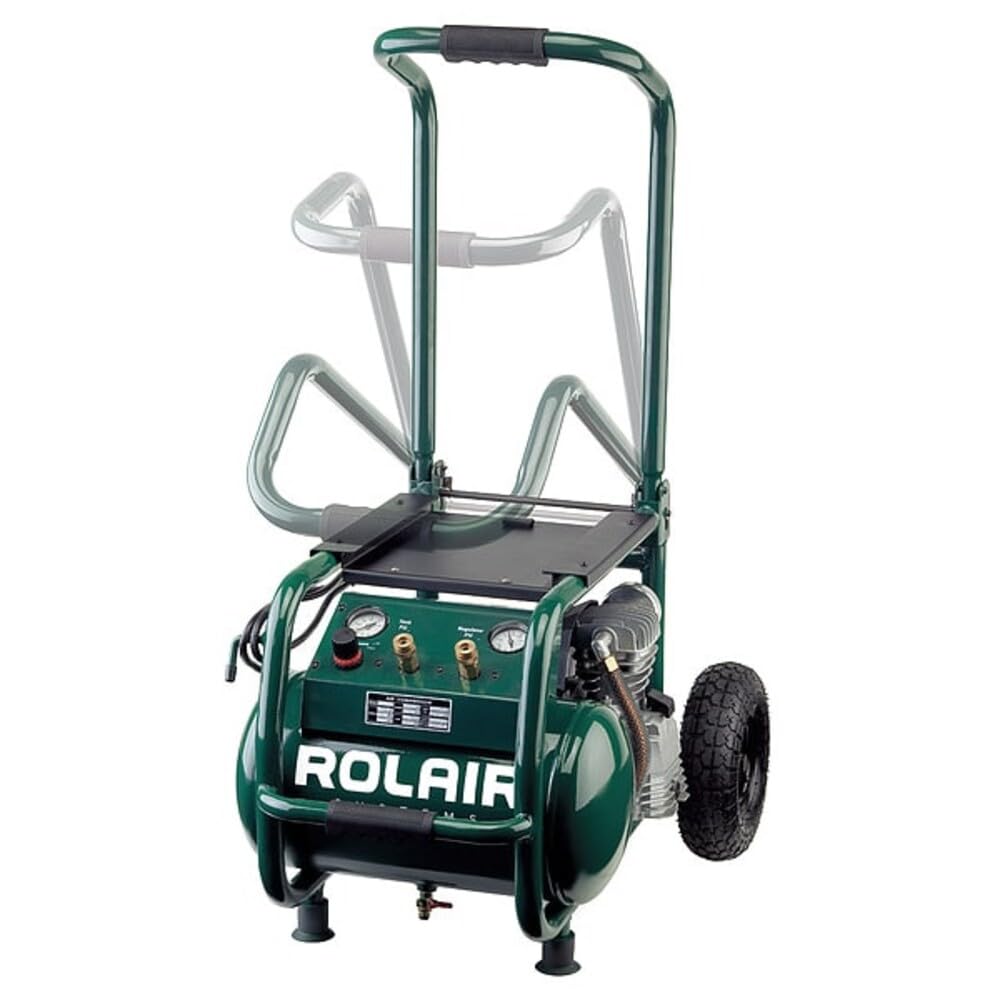
The 104-pound Taiwanese-built pro unit that powers a 1,000 ft/lb impact wrench all day.
The Rolair is built for working crews, not hobbyists. It’s a direct-drive cast iron unit that pushes 6.5 CFM of air (the same output as the Makita above) and hits 130 PSI max pressure from its 5.3-gallon tank. Reviewers point out it can power two framing guns and a 1,000 ft/lb impact wrench “all day” — a level of continuous capability that smaller oil-free units can’t match.
The cast iron construction is the durability story here. Long-term shoppers say 9 years of daily use with no service needed, holding pressure and starting instantly. It also handles paint spraying at 50 PSI and texture spraying. At 104 pounds with a dolly, it’s mobile for a pro but not casual.
The noise level is polarizing — some find it quieter than expected, while others describe it as obnoxiously loud (it’s a direct-drive design, not belt-driven). Buyers report it reaches 130-135 PSI in about 1 minute 13 seconds. The main weak point reported is the on/off switch, which some say fails over time.
Built like a tank: cast iron reliability that runs daily for years with no service.
The honest catch: it’s loud for a garage, and the occasional switch failure is a known weak point.
Choose this for: professional trim and framing crews who need all-day power in a portable frame.
pass on it if: you’re noise-sensitive or only need occasional hobby use — there are quieter options.
10. Ingersoll Rand SS3L3 3 HP Single-Stage Compressor

The 60-gallon cast iron monster that runs 100% continuous duty for the most demanding whole-shop work.
For a serious garage or small professional shop, the SS3L3 is the endgame. It pairs a 3 HP (horsepower) cast iron pump with a 60-gallon ASME receiver tank (a safety-certified pressure vessel) to deliver 10.3 CFM at 90 PSI — the highest airflow here, far above the Makita’s 6.5 CFM. It runs at 100% continuous duty, so it’s built to power tools all day without overheating.
The 5,000+ hour pump life and All Season Select synthetic lubricant (2,000 hours between changeouts, four times longer than petroleum oils) make this a long-term investment. Owners mention it handles sandblasting, nail guns, and air wrenches with ease, and it’s “very quiet for my shop” thanks to the belt-driven cast iron design.
The honest caveat: at 67 inches tall and shipped bolted to a pallet, it needs two people to unload and a dedicated spot. One buyer mentioned it can’t keep up with a DA sander during continuous use, and the intake filter melted during heavy work. This is a stationary, whole-shop solution, not a portable.
The Heavy Hitter
- 10.3 CFM at 90 PSI powers sandblasters and continuous tools
- 60-gallon ASME tank with 100% continuous duty rating
- Cast iron pump designed for over 5,000 hours of use
Before You Commit
- 67-inch tall unit needs dedicated floor space and 2 people to unload
- Intake filter can melt during continuous heavy use
- Overkill for occasional DIY tire inflation
Get this if: you run a serious shop with continuous air demands — sandblasting, DA sanding, multiple tools at once.
Don’t if: your garage work is occasional nailing and tire fills — the capacity will go unused.
Understanding the Specs
CFM at 90 PSI
Cubic feet per minute at 90 PSI is the single most important number on a compressor. It tells you how much air the pump can push out while maintaining pressure. A brad nailer needs about 1 CFM, a framing nailer needs 2-3, and an impact wrench can need 4-5. If your tool’s requirement exceeds the compressor’s CFM, you’ll wait for the tank to refill constantly.
Tank Size in Gallons
The tank is your air reserve — a bigger tank means more nail shots or more tool run-time before the motor kicks back on. A 2.5-gallon tank is fine for quick trim work, while a 20-gallon or 60-gallon tank supports continuous tools and multiple tools running at once. Tank size doesn’t increase airflow; it increases how long you can work between refills.
Max PSI and the Pressure Switch
PSI is the pressure the tank stores, and the compressor automatically shuts off when it reaches that max. Higher max PSI (like 200 or 225) means more usable air stored in the same size tank. The regulator dials down the pressure to match your tool’s requirement, which most pneumatic tools depend on being set correctly.
Duty Cycle
Duty cycle is how long a compressor can run before it needs to rest and cool down. Oil-free pumps typically run 50% (like 30 seconds on, 30 seconds off), while belt-driven cast iron units can run 100% continuous. If you use air-hungry tools for long stretches, a higher duty cycle matters more than tank size.
FAQ
What size air compressor do I need for a garage?
Is a higher PSI always better?
What’s the difference between oil-free and oil-lubricated pumps?
Can I run a paint sprayer with a small compressor?
How loud is a typical garage air compressor?
What does duty cycle mean and why does it matter?
Will a 120V compressor run on a standard garage outlet?
Is the Makita MAC5200 better than the Rolair VT25BIG?
Final Thoughts: The Verdict
For most buyers, the garage air compressor winner is the Makita MAC5200 because its 6.5 CFM at 90 PSI and oil-lubricated cast iron pump give you a strong balance of power, durability, and compact storage. If you want maximum quiet for indoor trim work, grab the DEWALT DWFP55130. And for a serious whole-shop setup with continuous-duty capability, the Ingersoll Rand SS3L3 is the one to reach for. The crowd favorite among these is the Makita — 4.5 stars from 900+ owners makes it the safest bet for most garages.
How We Picked
We do not accept paid placement. Every pick is matched to a real buyer and a real use-case; we do not hands-on test units.
Sources & Methodology
Specifications: manufacturer listings and product documentation. Review insights: verified customer reviews, as of August 2026. Pricing: not shown on this page (it changes often); check the current price via the retailer link.
As an Amazon Associate, Trending Car earns from qualifying purchases. This does not affect which products we feature.