
Our readers keep the lights on and my garage snacks stocked. As an Amazon Associate, I earn from qualifying purchases.
Specs are compiled from manufacturer listings and verified buyer reviews and can change over time — please confirm the key details on the product page before buying.
Your garage floor takes a beating—hot tires, dripping oil, dropped tools, and winter salt. Pick the wrong flooring and you face a weekend of messy chemical work or a surface that peels the first time you brake hard. You have three real paths: roll out a protective mat, snap together interlocking tiles, or commit to a permanent epoxy coating. Each solves a different problem, and each has trade-offs you need to see clearly before you spend.
I’m Min Islam — the founder and writer behind Trending Car. This guide is built by comparing the manufacturers’ published specifications and the patterns across verified customer reviews, so you get each pick’s real strengths and trade-offs instead of marketing spin.
Whether you park a daily driver or build weekend projects, these are the most reliable flooring for garage options that balance durability, installation effort, and long-term value.
Our Picks at a Glance


How To Choose The Best Flooring for Garage
Your garage’s workload determines the right flooring system. If you only park a car and sweep occasionally, a simple mat or tile floor handles the job with almost no effort. If you wrench on engines, drag jacks around, or park in a region with heavy snow and road salt, you need something that resists chemicals and won’t tear under shifting weight.
The Three Main Categories
Roll-out mats give you instant coverage—unroll, let it flatten, and you’re done. They protect the concrete underneath from stains and wear, but they sit on top of the floor and can shift or curl at the edges. Interlocking tiles raise the floor slightly and create a rigid surface that spreads weight, but they can buckle in extreme heat if you skip an expansion gap. Epoxy coatings create a permanent, smooth surface that looks like a showroom, but they demand serious prep work: cleaning, etching, patching cracks, and waiting days before you can park on them.
Thickness and Load Capacity
The single biggest spec difference is physical thickness. A PVC mat at 2.8mm offers basic protection from tire wear. A thick 0.53-inch interlocking tile can support up to 5500lbs, making it safe under a full-size SUV. If you plan to use jack stands or roll heavy equipment, you need the thicker material meant to distribute that concentrated weight, not a thin mat meant for a parked car.
Quick Comparison
| Model | Best For | Type | Thickness | Load Rating | Amazon |
|---|---|---|---|---|---|
| TUFFIOM 7.5×20 FT Mat★ Best Overall | Large vehicle coverage | PVC Roll | 0.08 inches | — | Amazon |
| KILZ Slip-Resistant CoatingBest Value Paint | Permanent stone look | Concrete Paint | Liquid | — | Amazon |
| VEVOR 12×12 TilesHeavy-Load Champ | Heavy truck support | Interlocking | 0.53 inches | 5500 lbs | Amazon |
| boldworks 12×12 Tiles | DIY heat-resistance | Interlocking | 0.5 inches | 40000 lbs | Amazon |
| Rust-Oleum RockSolid | Showroom metallic finish | Epoxy Coating | Liquid | — | Amazon |
| VersaTex 18×18 Tiles | Home gym protection | Interlocking | N/A | — | Amazon |
| Nitro Vented Tiles | Water and snow drainage | Interlocking | 0.38 inches | — | Amazon |
| Grandroad 8×20 FT Mat | Budget DIY coverage | PVC Rubber Roll | 2.8 mm | — | Amazon |
| ArmorPoxy Epoxy Kit | Heavy-duty professional finish | Epoxy Coating | Liquid | — | Amazon |
In‑Depth Reviews
1. TUFFIOM 7.5 x 20 FT Garage Floor Mat
Our pick — over 4★ from 800+ verified ratings; the strongest balance of quality and price.
The genuine best-seller that covers a large SUV without breaking your back.
The only product on this list designed specifically for big vehicles—SUVs, MPVs, pickup trucks, and RVs. The mat spans a massive 7.5 x 20 feet, so you get plenty of room to park a full-size truck while keeping oil drips and mud off your concrete. It weighs 80.8 pounds in the box, which honestly makes it a two-person job to position, but that heft speaks to the thickened PVC construction that resists deformation under prolonged pressure from trailers and heavy trucks.
What wins people over is the quality feel. Nearly a hundred owners single out build quality as the standout trait, with value for money a close second. The diamond-pattern surface provides max grip at the entry and exit points, and the waterproof PVC shrugs off dirt, mud, automotive fluids, and commercial chemicals with a simple vacuum, broom, or wet cloth. One owner measured his satisfaction in months: “I’ve had this for about 9 months and it’s excellent.”
The honest trade-off is the curl. It ships rolled up, so the edges tend to curl until the mat relaxes—owners recommend letting it sit in the sun for a week before final placement. Durability is the most-discussed topic, and it’s mixed: most find it tough, but a few report it tears if you drag sharp tools across it. That makes it a smart pick for parking and light workshop use, not for heavy engine work with metal jacks.
What Owners Rave About
- Diamond pattern delivers serious grip for safe entry and exit
- Waterproof PVC resists oil, mud, and commercial chemicals
- Trims easily with scissors or a utility knife for a custom fit
What To Know First
- Edges curl until the mat relaxes—give it time or sun
- Heavy 80.8 lb roll needs two people to move
- Thin material can tear if you drag sharp metal across it
Reach for this if: you park a large SUV or truck and want maximum spill protection with zero chemical prep work.
Look elsewhere if: your garage doubles as a workshop where you drag jacks, engine stands, or sharp tools around.
2. KILZ Decorative Slip-Resistant Concrete Coating
A budget-friendly paint that transforms ugly concrete into a protective stone-like surface.
If your concrete is stained but otherwise fine, this is the cheapest way to make it look intentional. The coating dries to a durable, stone-like speckled texture that adds depth to patios, walkways, and pool decks as well as garages. It works on indoor and outdoor horizontal surfaces including porous concrete, masonry, brick, and stone pavers—as long as the concrete stays protected from standing water.
The standout story here is longevity. The review pages describe a porch that held up for 5+ years with no fading, chipping, or scratching, and bird droppings that wash right off. That kind of track record explains why appearance is the most-praised aspect—it genuinely looks fresh years later. It dries to the touch in 1 hour and accepts a recoat in 3–4 hours, with light foot traffic after 24 hours and a full cure in 72 hours.
The catch is the application curve. It’s the most-discussed topic, and it’s genuinely mixed: some find it easy and self-leveling, while others struggle. The manufacturer insists on a 1/4″ adhesive roller to build the intended texture, and owners stress that surface prep—clean, etched, and completely dry concrete—is non-negotiable. Coverage is roughly 40 to 60 sq. ft. per gallon, so a 2-car garage will need multiple gallons. This is a weekend project with a learning curve, not a zero-skill roll-on.
Owner consensus: The stone-like look and multi-year durability win people over, but plan for a fussy application that rewards careful prep.
Who it fits: DIY homeowners who want a permanent, budget-conscious refresh and can spend a weekend on prep.
3. VEVOR Garage Floor Tiles 12 x 12 x 0.53 inch
The interlocking tile that takes a 5500lbs truck without flinching—and goes down in minutes.
Interlocking tiles and roll-out mats solve the same problem in completely different ways. Where the TUFFIOM mat sits on top of the floor, these VEVOR tiles lock together into a rigid 12 x 12 inch grid that lifts your car off the concrete. Each tile measures 0.53 inch thick—roughly seven times thicker than the TUFFIOM mat—and that depth is what lets the floor handle up to 5500lbs without damage, even under a large truck.
Installation is genuinely tool-free. The upgraded interlocking system uses 6 loops per tile so they snap together by hand in minutes—no glue, no nails, no extra manpower. Owners describe a “tap-tap assembly” that’s faster and cheaper than epoxy, with cuts handled by a handsaw or circular saw (a utility knife won’t cut through this hard plastic). The 3D diamond-textured surface resists slipping, and the rhombic grid bottom makes mopping and vacuuming straightforward.
The honest caveat is thermal movement. These tiles expand and lift in direct sunlight—buyers report up to 2-3 inches of expansion that can become a trip hazard without expansion cuts. And the interlocking is the most-discussed topic for a reason: while most find it solid, a few report tiles breaking or sliding when rear wheels pull the floor forward. This is hard plastic, not rubber, so it sounds hollow underfoot and demands a saw for fitting.
Where It Shines
- 0.53-inch thickness supports up to 5500lbs, safe for large trucks
- 6 interlocking loops snap together in minutes, no tools needed
- Cheaper and easier than an epoxy coating job
Where It Struggles
- Expands in sunlight—plan expansion cuts to avoid tripping
- Hard plastic sounds hollow and needs a saw to cut
- A few owners mention tiles breaking under turning wheels
Grab it if: you want a fast, tool-free floor that genuinely supports a heavy vehicle without permanent chemical installation.
Think twice if: your garage bakes in direct sun and you won’t want to manage expansion gaps.
4. boldworks Garage Floor Tiles 12×12 Interlocking

The tile that fixes the classic buckling complaint with a UV coating most rivals skip.
These tiles take a direct swing at the biggest weakness of interlocking garage flooring: buckling in the sun. A UV coating and 6 interlocking loops work together to prevent the warping that plagues cheaper tiles with only 4 loops, and the polypropylene material is rated to handle rolling loads over 40000 lbs. That’s the highest load claim on this list by a wide margin—the VEVOR tiles above top out at 5500lbs.
The design details matter for daily use. A BRICK PATTERN on top provides slip resistance that holds up when wet, and the non-toxic, impact-resistant polypropylene shrugs off oil, stains, and water with regular mopping or vacuuming. Setup is a snap-lock mechanism with no tools, glues, or extra hands—owners describe a full garage bay done in about an hour. One owner called it “a fantastic solution for DIY garage upgrades,” noting it ran far cheaper than a professional epoxy job.
The recurring advice from owners is to leave an expansion gap of about 1 inch from the walls, especially in hot climates like Texas, to prevent buckling. The most-discussed topic is real-world performance: tiles can shift or drag under hard braking, with one owner reporting a truck pulling tiles out of place despite a smooth design. Best used with a rubber mallet during install, since hand-pounding can break the tabs.
Buyer consensus: An attractive, easy-to-clean floor that covers an ugly slab fast, with UV protection that gives it an edge over rivals in hot weather.
The fit note: Hot-climate garages should leave wall gaps; high-traffic braking zones may need the tiles secured down.
5. Rust-Oleum RockSolid Metallic Brilliant Blue

The crowd-favorite showpiece that turns a plain slab into a shimmery metallic statement.
The self-leveling polycuramine coating is marketed as 20X stronger than epoxy, with a low-odor, low-VOC formula in a two-part burst pouch. The extreme high-gloss metallic finish resists cracking, peeling, chemical spills, and hot tire pick-up, which is exactly what a garage floor faces daily.
The logistics are the real selling point if you hate waiting. The coating is walk-on ready in 8-10 hours and vehicle ready within 24 hours—far quicker than the 72-hour cure of the ArmorPoxy kit below. Each kit covers up to 125 sq. ft. depending on porosity, so a typical single-car garage needs 1-2 kits. Appearance is the most-praised aspect by a wide margin, with quality a strong second.
The honest reality is that coverage runs lower than advertised—owners consistently budget 80-85 sq. ft. per kit rather than the claimed 125. The consistency is the most-discussed negative, with some owners calling it clumpy and noting the included roller sheds lint (a premium roller is the recommended fix). Durability is mixed: it looks stunning, but a handful of customers note it scratches more easily than they’d like.
The Highlights
- Shimmery metallic gloss delivers a showroom-quality 1-coat finish
- Walk-on ready in 8-10 hours, vehicle ready within 24 hours
- Self-leveling formula resists cracking, peeling, and hot tire pick-up
The Fine Print
- Coverage runs closer to 80-85 sq. ft. per kit than the advertised 125
- Consistency can be clumpy—expect to swap in a premium roller
- Metallic finish may scratch easier than a matte coating
Your pick if: you want the most dramatic, head-turning finish and can follow the prep instructions exactly.
Not for you if: you want maximum durability over looks, or you’re not willing to invest in careful surface preparation.
6. VersaTex Garage Floor 18 x 18 inch Interlocking Tiles

The multi-room tile that protects a gym floor, a shed, or a workshop with recycled rubber density.
If your garage shares space with exercise equipment, this tile earns its keep differently than the car-focused picks. Made from recycled rubber—not foam or bare plastic—it’s impact-resistant, non-porous, and waterproof, so it won’t absorb sweat or liquid spills. That makes it safe on top of wood, laminate, tile, vinyl, or cement, and it won’t dent, puncture, tear, or pull apart the way EVA foam mats do under heavy machines.
The coverage math is generous: a 24-pack creates 54 square feet of flooring with 18 x 18 inch tiles, which means fewer seams and faster install than 12-inch options. Assembly is the most-praised aspect, with owners describing a thumb-snap fit that one greenhouse owner finished in 20 minutes with no cutting required. The tiles are heat-resistant and puncture-proof, labeled safe to drive over with cars, trucks, or mowers, and resistant to household chemicals, oils, and brake fluids.
The most-discussed topic is durability, and it’s a mixed bag. Most owners praise the dense, quality feel—”made in the USA” comes up repeatedly—but a few note the tiles can start to come apart and that they’re foam-like rather than hard plastic. Cutting is legitimately hard work: the 4mm recycled rubber resists a utility knife, so owners recommend tin snips or a portable table saw. These are best for an interior or covered space, since water and salt can get underneath in a sunny, snowy garage.
The read: A versatile, easy-snap tile that excels in gyms, craft rooms, and covered garages—just budget for real cutting tools and avoid outdoor exposure.
Watch: Durability impressions vary, and the material cuts like a hockey puck.
7. Nitro Tiles Vented by FlooringInc 12″ x 12″
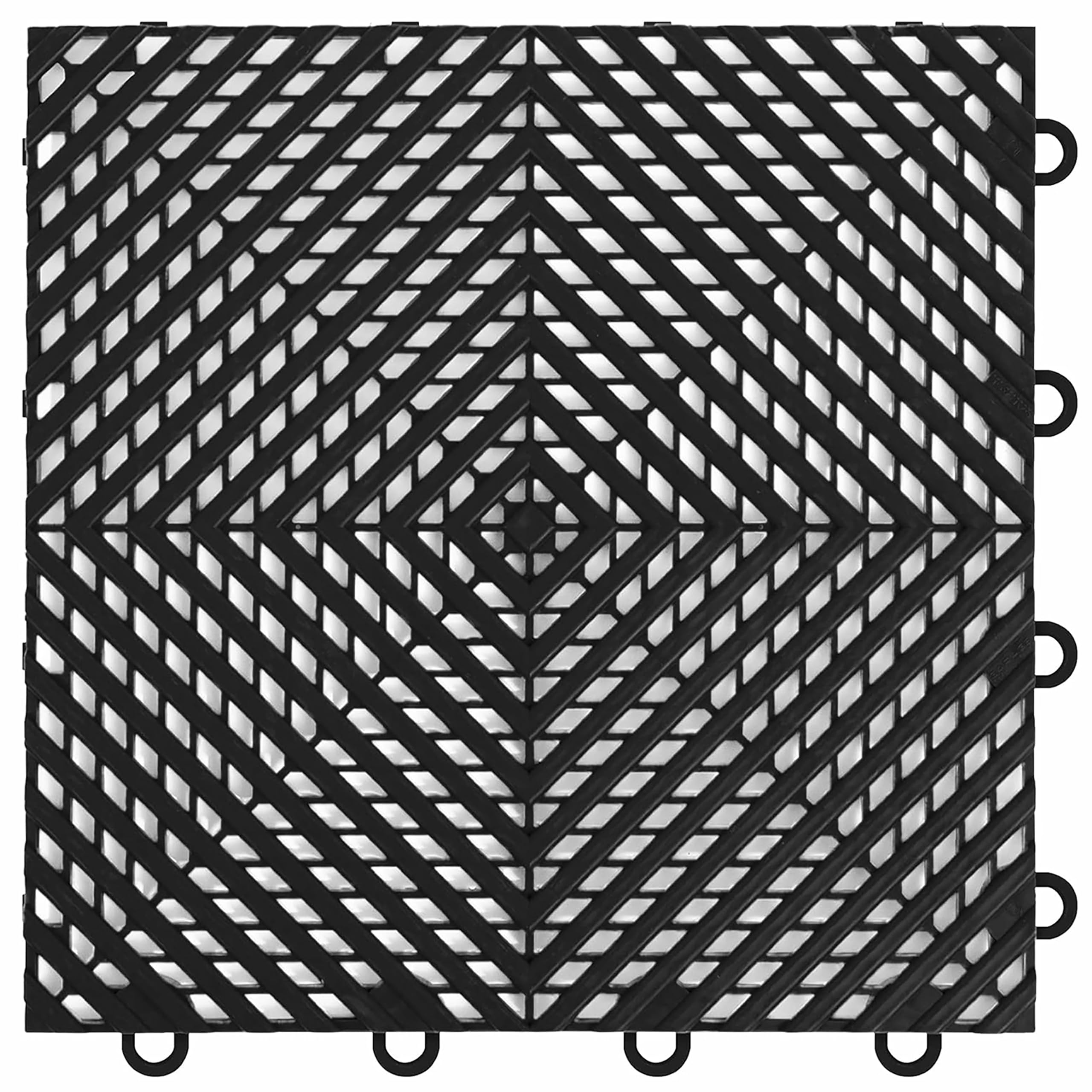
The one garage floor that lets water, snow, and oil drain straight through instead of pooling.
Every other floor on this list creates a barrier between your car and the slab. These vented tiles do the opposite: an open-grid design lets water, snow, oil drips, and vehicle fluid spills flow through and disappear beneath the surface. That makes them ideal for garage entrances, pool decks, dog kennels, and any covered area exposed to rain or snow, where standing moisture would rot a solid mat.
Build quality leads the praise here, with easy installation a strong second. The heavy-duty polypropylene (a tough plastic) resists chemicals and stains, so it handles parked vehicles, rolling tool chests, and daily traffic without flexing or cracking. The floating floor system clicks together with no tools, no glue, and no mess—one owner completed a garage installation in about 30 minutes without a mallet, describing the tiles as pre-assembled 2×2 ft sections that are easy to split. A Limited Lifetime Warranty from FlooringInc backs the whole system.
The grip is the most-discussed trade-off, and it’s genuinely mixed: some owners find it non-slip even when wet, while others report it gets slippery with water. One deck owner found it “slightly slippery when wet” but noted the diagonal grooves help. The 0.38-inch thickness is modest compared to the 0.53-inch VEVOR tiles, making this a drainage-first solution rather than a heavy-load monster. For a wet-climate garage or a wash bay, though, nothing else on this list handles water better.
Why Owners Choose It
- Open-grid design drains water, snow, and oil instead of pooling
- Snap-together install in about 30 minutes with zero tools
- Backed by a Limited Lifetime Warranty
Before You Buy
- Grip impressions split—some find it slippery when wet
- Thinner at 0.38 inches than heavy-load tile rivals
- Edge guards for borders sell separately and add up
Choose this if: your garage sees standing water, melting snow, or vehicle leaks and you want it gone instead of trapped.
Pass if: you need maximum load support or a solid, continuous surface underfoot.
8. Grandroad Auto 8×20 FT Garage Floor Mat

The entry-level roll that gives you 160 square feet of coverage without emptying your wallet.
This is the budget-friendly take on the TUFFIOM mat concept—a roll-out PVC rubber floor that protects your slab from daily wear. The defining stat is coverage: a generous 8×20 feet totals 160 square feet, so a full 2-car garage is within reach with a single roll. That wide footprint is exactly why owners talk about it as an immediate improvement to a garage or shed floor.
Quality is the most-praised aspect here, with floor protection a close second. The diamond plate texture gives you slip resistance for both foot traffic and parked vehicles, even in damp conditions, and the 2.8mm thickened material stays stable under heavy-duty use. Owners repeatedly describe it as easy to install, easy to clean, and a great value—one called it “an immediate improvement to my garage.” The included 20 pieces of double-sided tape let you secure all four sides if the mat tries to shift.
The recurring gripe is thickness, and it’s the one thing to weigh carefully. The 2.8mm PVC rubber is thinner than the TUFFIOM’s 0.08 inches, and one owner who installed on a Friday already had a tear by Sunday after moving jacks over it. That makes this a covering for a parked car and light foot traffic, not a workshop floor. Note the manufacturer’s tip: low temperatures affect laying, so let a slightly bulged mat sit at room temperature for a few days.
The bottom line: Massive coverage at an entry-level price, with quality and floor protection praised by owners who park rather than wrench.
Know this: The thin 2.8mm material demands care—it tears under jacks or rough gear.
9. ArmorPoxy Garage Epoxy Floor Kit – 100% Solids
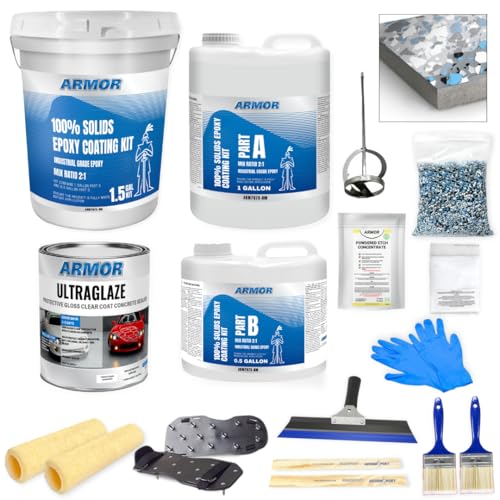
The permanent, showroom-grade answer for owners who want a one-time fix and don’t mind a weekend of work.
This is the closest thing on the list to a professional garage floor you can install yourself. The 100% solids epoxy bonds permanently to concrete, marketed as 10x stronger than steel, and resists cracking, peeling, and hot tire pickup. That means no more stains or tire marks, ever, on a surface that handles oil, solvents, and chemical spills without flinching. The textured finish provides slip resistance even when wet, making it a favorite for workshops and basements as well as garages.
The kit is genuinely complete: etching solution, decorative flake mix, non-slip additive, roller, and squeegee all come in the 17-piece package sized for 300 sq ft. The instructions and instructional video get constant praise, with owners describing a professional-looking finish at a fraction of contractor cost. The cure time is the headline number—24 hours to dry, 72 hours until vehicle-ready—which beats cheaper water-based epoxies by a wide margin.
The most-discussed topic is durability, and it’s mixed. Most reviewers point out the surface remains solid, but a few describe peeling on new concrete even with proper prep. The recurring advice is to apply it thick, follow the instructions exactly, and sand oily concrete first. Some owners note the mixing ratio is hard to measure, the included squeegee is flimsy, and the 1 lb flake bag runs short for full coverage. This is the best-looking result on the list, but it demands the most careful work of any product here.
The Payoff
- 100% solids epoxy bonds permanently, resisting cracks and hot tire pickup
- 17-piece kit includes everything for a 300 sq ft professional finish
- 24-hour dry time with vehicle-ready in 72 hours
The Effort
- Most-discussed issue is durability—a few report peeling on new concrete
- Mixing ratio is hard to measure; flimsy squeegee in the kit
- Demands a full weekend of prep: cleaning, etching, and patching cracks
Committing to it: You get the most durable, professional-looking permanent floor of any product here if you follow the prep steps precisely.
Hesitant? If you’d rather not risk a peeling finish or spend a weekend on surface prep, a mat or tile floor is the safer DIY bet.
Understanding the Specs
Thickness and Load Capacity
Thickness is the single most important number for garage flooring because it determines what the surface can handle. A thin PVC mat at 2.8mm protects against stains and tire wear but tears under jacks and sharp tools. A 0.53-inch interlocking tile spreads weight across a rigid grid, letting it support up to 5500lbs. If you plan to park a heavy truck or work under the car, prioritize thickness over everything else.
Slip Resistance and Surface Texture
Grip matters the moment you step out of your car onto a floor that might be wet. Diamond plate patterns and textured finishes provide max traction for safe entry and exit. Some interlocking tiles use a 3D diamond texture on top with a different pattern underneath, giving you two surfaces to choose from. Epoxy coatings often include a non-slip additive that you mix in, which keeps the surface safe even when wet.
FAQ
Can you park a car on interlocking garage floor tiles?
How long does a garage epoxy coating take to cure?
Why do my garage floor tiles buckle in the sun?
Is a diamond plate garage floor mat slippery when wet?
What’s the difference between PVC and polypropylene garage flooring?
How do I stop the edges of my garage floor mat from curling?
Can garage flooring tiles be cut to fit the edges of a room?
Is a vented or solid garage tile better for wet climates?
How much area does a garage epoxy kit cover?
Final Thoughts: The Verdict
If you park a large vehicle and want the fastest, most reliable coverage, the TUFFIOM 7.5 x 20 FT Garage Floor Mat is the crowd-approved pick—the value and quality consistently win owners over, and it protects a full-size truck without a drop of chemical prep. If you want a permanent, professional-looking surface and can commit to a weekend of prep, the ArmorPoxy Epoxy Kit delivers the most durable showroom-grade result of anything here. And for garages that see standing water or melting snow, the Nitro Vented Tiles stand alone with a self-draining design that keeps moisture off your floor entirely.
How We Picked
We do not accept paid placement. Every pick is matched to a real buyer and a real use-case; we do not hands-on test units.
Sources & Methodology
Specifications: manufacturer listings and product documentation. Review insights: verified customer reviews, as of August 2026. Pricing: not shown on this page (it changes often); check the current price via the retailer link.
As an Amazon Associate, Trending Car earns from qualifying purchases. This does not affect which products we feature.