
Our readers keep the lights on and my garage snacks stocked. As an Amazon Associate, I earn from qualifying purchases.
Specs are compiled from manufacturer listings and verified buyer reviews and can change over time — please confirm the key details on the product page before buying.
Your fleet is your most expensive asset, yet once the keys leave your hand, you are essentially blind. Do you know if a driver is speeding to make a delivery, idling away paid hours, or taking the long way home? A fleet gps tracker solves that by beaming the real-time location, driving behavior, and even engine health of every vehicle straight to your phone or desktop. The challenge is that the monthly fees, installation difficulty, and battery life vary wildly between models — pick the wrong one and you will either bleed cash on subscriptions or discover a dead tracker when it matters most.
I’m Min Islam — the founder and writer behind Trending Car. This guide is built by comparing the manufacturers’ published specifications and the patterns across verified customer reviews, so you get each pick’s real strengths and trade-offs instead of marketing spin.
Below are the four most capable fleet trackers that actually deliver on their promises, ranked by real-world owner feedback so you can confidently choose the right one for your business or family.
Our Picks at a Glance

How To Choose The Best Fleet GPS Tracker
Choosing a fleet tracker means deciding on three things before you buy: how often you need a location update, whether you can wire it in yourself, and what monthly subscription you can afford. Get these wrong, and you will either pay for a plan you do not use or end up with a tracker that stops reporting when you need it most.
Update Frequency & Real-Time Tracking
The update interval is the single biggest influence on how useful the tracker feels. A device that updates every 15 seconds lets you see a speeding car turn a corner instantly. A tracker that pings every two minutes leaves you guessing where the vehicle is in between. For fleets, a fast refresh catches harsh braking and rapid acceleration as it happens. For family use, a slower interval may be fine — just expect a slight delay in seeing location changes on the map.
Installation: Plug-and-Play vs. Hardwired
OBD2 trackers (which plug into a car’s diagnostic port) install in seconds — pull up to any vehicle built after 1996, push the connector in, and you are live. Hardwired trackers require tapping into a vehicle’s power and ground wires, which often means a professional installer. The trade-off is that a hardwired unit can be hidden completely, making it invisible to a thief who might unplug an OBD device. If you manage rental cars or worry about theft, the extra installation effort pays off.
Subscription Costs & Contract Flexibility
The monthly fee is the real cost of ownership over time. Some trackers charge modest monthly fees with no contract, while premium units with added features like a kill switch may cost more. A few trackers come with a prepaid SIM and no monthly fee at all, but those usually rely on a backup battery that needs recharging. Always check what countries the coverage includes — North America-only plans are cheaper, but if you operate vehicles in Mexico or Canada, confirm the plan covers those regions without roaming fees.
Extra Features: Kill Switch, Geofence, & Engine Diagnostics
A kill switch lets you remotely disable a vehicle that has been stolen — it stops the engine from restarting after the driver turns it off. Geofencing draws a virtual boundary on the map; you get an alert the moment a vehicle enters or leaves that zone. Engine diagnostics (checking battery voltage, fuel level, and trouble codes) help you catch a failing alternator before it strands a driver. Not every tracker needs every feature, so match the extras to your biggest risk: theft, unauthorized personal use, or maintenance costs.
Quick Comparison
| Model | Best For | Update Rate | Installation | Monthly Fee | Amazon |
|---|---|---|---|---|---|
| Bouncie GPS Tracker★ Best Overall | All-around fleet & family | 15 seconds | Plug-in (OBD2) | /mo | Amazon |
| Trackhawk VL03 | Anti-theft & kill switch | Real-time | Hardwired | /yr or /mo | Amazon |
| Moto Watchdog | No monthly fees | Real-time | Plug-in (OBD2) | /mo | Amazon |
| LoneStar Tracking Oyster3 | Covert trailer & asset tracking | Configurable (5-min to daily) | Wire-free (screws/ties) | /mo or /yr | Amazon |
In‑Depth Reviews
1. Bouncie GPS Tracker for Vehicles
Our pick — over 4.5★ from 6,500+ verified ratings; the strongest balance of quality and price.
The plug-and-play tracker that sends a location ping every 15 seconds — you practically see the car turn before the driver changes lanes.
This is the crowd-favorite pick for a simple reason: it just works, and it works fast. The Bouncie plugs into the OBD2 port (that is the diagnostic slot under the steering column), so you are live in under a minute. Once connected, the device streams 15-second real-time updates to the app — a snappy refresh rate that catches hard braking, rapid acceleration, and speeding the moment they happen. The reliability here is legendary among owners, with the most-discussed aspect being that the tracker holds a solid signal even in rural areas where other devices drop off.
Beyond location, Bouncie reads your vehicle’s diagnostic data continuously. You get engine health alerts when the check-engine light pops, fuel level readings, and even battery voltage — which saves you from a breakdown before it happens. The geofencing triggers instant notifications when a vehicle crosses a boundary you set, and the built-in accident detection sends SMS alerts immediately after an impact. All of this costs a flat monthly fee that is among the lowest in the category, with no activation fees and no long-term contract.
Why Owners Swear by It
- Industry-leading 15-second update rate means you catch bad driving habits in real time.
- Plugs directly into the OBD2 port — no tools, no wiring, no professional installer needed.
- Monitors engine diagnostics, fuel level, and battery health so you spot maintenance issues early.
- Geofencing and accident alerts work reliably; buyers report the SMS notifications arrive within seconds.
The Honest Trade-Off
- The OBD2 plug sits low under the dash — a few owners mention it can feel slightly loose and recommend a small cable tie to secure it.
- Very occasional sync delay with the app after initial setup; a quick re-sync fixes it.
Reach for this if: you manage a small to medium fleet or want to keep tabs on a teen driver and need the fastest refresh rate available without wiring anything.
Look elsewhere if: you need a hidden tracker that a thief cannot unplug or you operate vehicles that are parked for weeks at a time without driving.
2. Trackhawk VL03 GPS Tracker with Kill-Switch
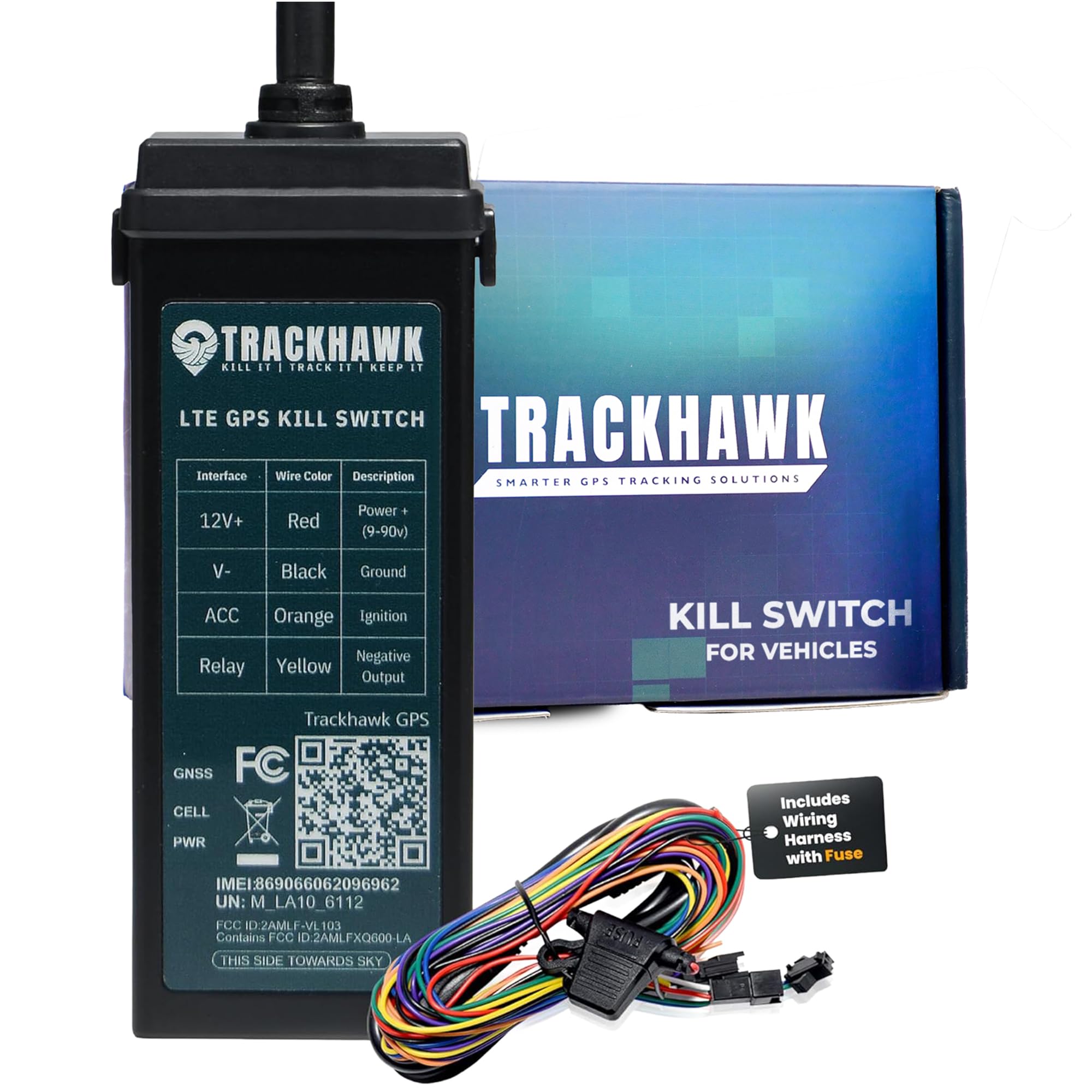
The tracker that can stop a stolen car dead in its tracks — a kill switch that works remotely.
Where other trackers only watch, the Trackhawk VL03 acts. The integrated kill switch lets you send a command from the app that prevents the engine from restarting after the driver turns it off. This turns a stolen vehicle into a stationary one, making recovery straightforward. Owners who have tested it in both the US and Mexico report the GPS and kill switch function reliably across borders — a rare capability for a device at this price point. The unit uses 4G LTE with a fallback to 3G and 2G, so it keeps a connection in areas where newer bands are weak.
Installation is where this tracker demands more from you than the plug-in models. It is a hardwired unit that requires connecting to the vehicle’s power and ground wires, plus installing a relay and a manual override switch. Some buyers find the included instructions sparse and turn to YouTube for step-by-step guidance; others opt for a professional installer. Once wired up, the driver behavior monitoring — harsh braking, rapid acceleration, sharp turns — feeds back to the Trackhawk Fleet app or website. The backup battery keeps the tracker running if someone cuts the main power, so the kill switch stays available even during a theft attempt.
What Makes It Stand Out
- Remote kill switch that disables the engine after it stops — a tangible anti-theft tool, not just an alert.
- 4G LTE with 3G/2G fallback plus coverage in US, Canada, and Mexico for cross-border fleets.
- Backup battery ensures the tracker keeps reporting even if main power is cut.
- Lifetime warranty from the manufacturer adds long-term confidence.
Know Before You Buy
- Hardwired installation requires basic electrical knowledge or a paid installer — not a 5-minute job like an OBD2 plug.
- The app interface is functional but not the most polished; some settings are tucked away.
- An occasional unit has reported failure before the one-year mark — though the lifetime warranty covers replacement.
Best for: fleet managers dealing with high-theft areas or rental car operators who need the ability to immobilize a vehicle remotely.
skip it if: you want a simple plug-and-play setup or you only track family cars and do not need a kill switch.
3. Moto Watchdog GPS Tracker (No Monthly Fee)
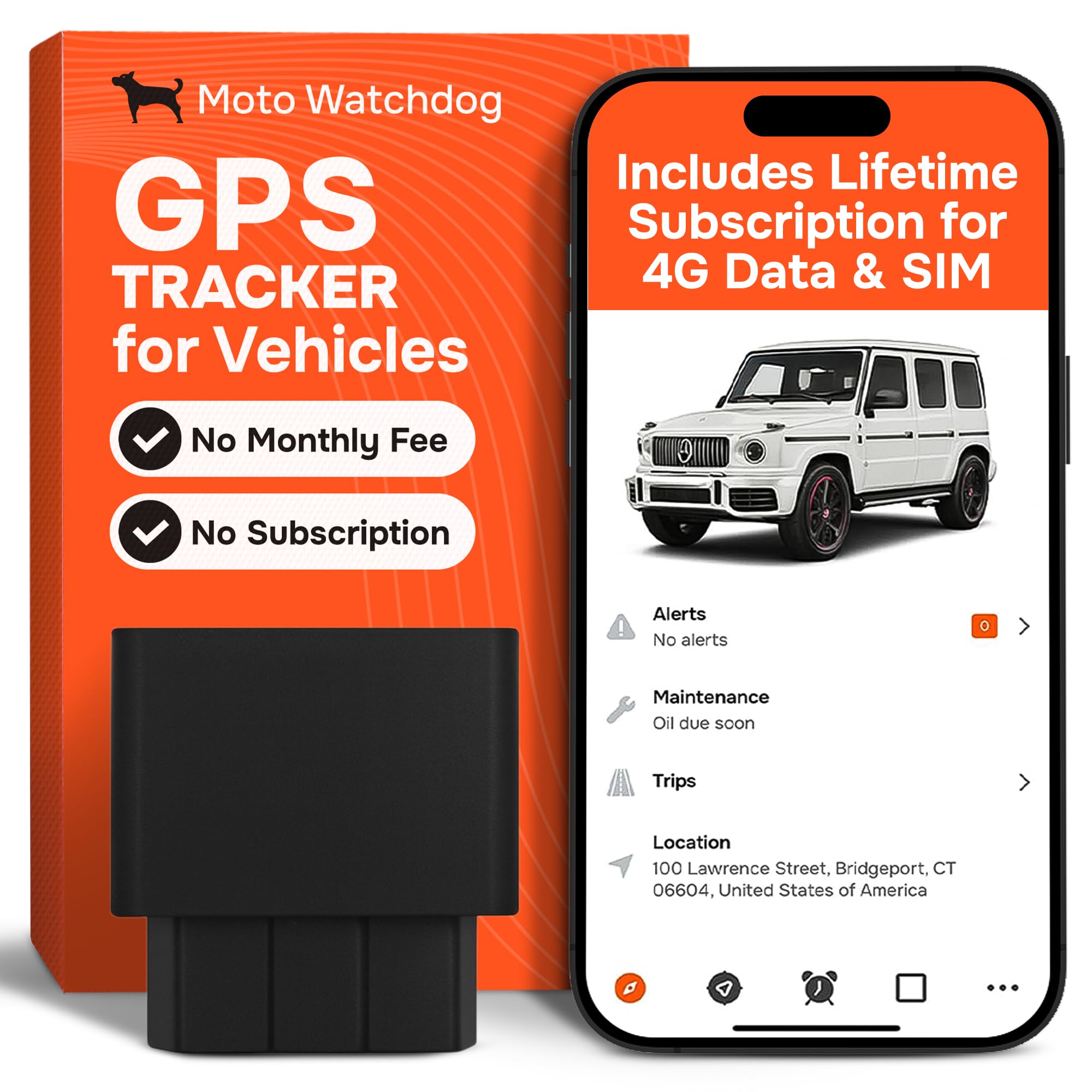
The only tracker on this list that asks for zero dollars a month — and still delivers real-time location and geofencing.
Every other fleet tracker locks you into a recurring subscription. The Moto Watchdog flips that model by including a pre-installed SIM card and a lifetime data plan with the purchase price. You pay once for the device, and that is it. The tracker is a simple OBD2 plug-in that installs in roughly three minutes. Once active, it streams real-time location, speed, and route history to the mobile app. The geofencing lets you draw zones on the map and get alerts when a vehicle enters or leaves those areas — all without an ongoing bill.
The trade-off shows up in two places. First, the device has a small internal battery (200 mAh) that lasts about a day, so it relies on being plugged into the OBD2 port for continuous power. If the tracker is unplugged or the vehicle sits for an extended period, the battery drains fast. Second, the coverage works in 170 countries including the US, Canada, and Mexico, but some owners note that location updates can occasionally lag by a minute or two. For the price of a zero-monthly-fee unit, this is a strong trade-off for budget-conscious fleet owners who are okay with a slight delay in exchange for no recurring cost.
The Big Win
- No subscription, no monthly fee, no hidden charges — a pre-installed SIM covers the tracker’s cellular data for life.
- Simple OBD2 plug-in installs in minutes and can be moved between vehicles without any fee.
- Real-time location, speed alerts, geofencing, and route history all available from the mobile app.
- Owners praise the responsive customer support team, which helps resolve setup and app issues quickly.
The Catch
- Small backup battery (200 mAh) means the tracker stops reporting soon after being unplugged — not suitable for theft recovery if the device is discovered and removed.
- Occasional location lag or a brief drop in accuracy reported by a few owners; not ideal for catching a speeding vehicle in the exact moment.
Choose this when: your priority is cutting ongoing expenses and you need a basic, reliable tracker for monitoring routes and geofence alerts without a recurring bill.
Choose something else if: you need a tracker that stays live even when the vehicle is parked for weeks, or you require sub-minute update speed for behavioral monitoring.
4. LoneStar Tracking Oyster3 Hidden GPS Tracker
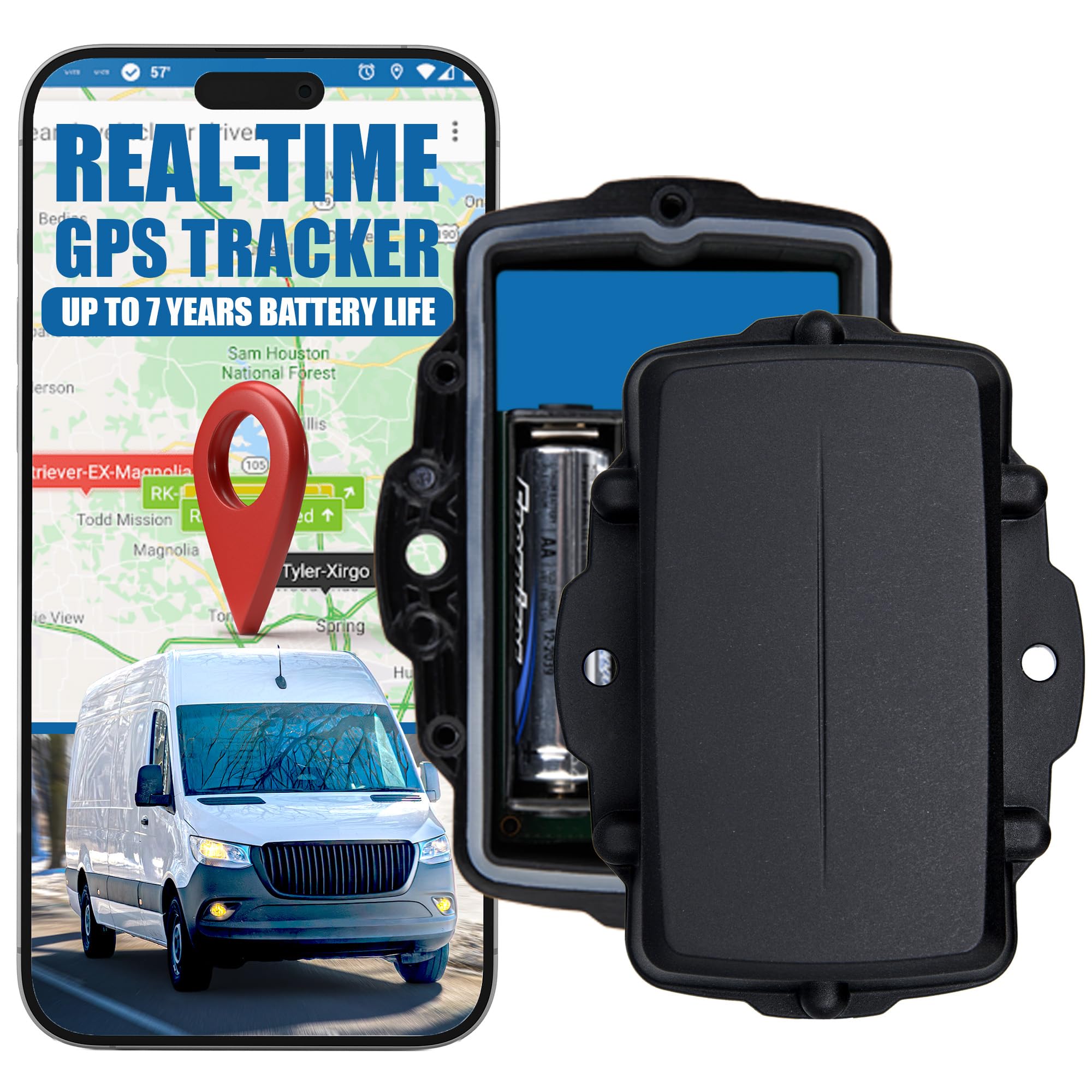
A battery-powered tracker that hides anywhere on a trailer or vehicle and keeps reporting for up to two years of daily driving.
This tracker is built for assets without an OBD2 port (the standard diagnostic plug in most cars) — think trailers, boats, RVs, or heavy equipment. The Oyster3 runs on three AA lithium batteries that come in the box. Its adaptive tracking mode can stretch battery life to up to 10 years if it pings once per day, roughly 7 years if it only reports when movement is detected, and around 2.8 years if the vehicle drives two hours daily. That is far longer than any rechargeable tracker. The unit is IP67 waterproof (can survive being submerged in 1 meter of water for 30 minutes) and compact enough to hide inside a trailer cabinet or under a chassis using screws, bolts, or zip ties — no wiring, no external antenna needed.
For accuracy, the Oyster3 uses multi-GNSS (Global Navigation Satellite System), which pulls from GPS, GLONASS, Galileo, and BeiDou satellites so it stays accurate in remote or wooded areas. It runs on the AT&T Cat-M1 and NB-IoT networks (cellular standards for low-power devices) in the US and supports LTE-M globally. You set up geofencing (virtual boundaries) and update intervals on the app, and the device sends alerts via text, email, or in-app for movement, fence breaches, or tampering. If the vehicle or trailer is stolen, you can switch to theft recovery mode, which shortens the update interval to 30 seconds for active pursuit. Owners who have used the device for two years in a rental fleet report that the battery lasts about 9 to 10 months with 5-minute updates during driving, and customer support is fast to respond when issues come up.
Standout Advantages
- Battery life measured in years on three AA lithium cells — no need to hardwire power to the vehicle.
- IP67 waterproof rating and compact size make it ideal for hiding on trailers, boats, and outdoor equipment.
- Multi-GNSS satellite tracking (GPS, GLONASS, Galileo, BeiDou) gives better fix accuracy than single-system trackers.
- Theft recovery mode switches to 30-second updates so you can actively track a stolen asset.
What to Watch
- Accuracy is reported as mixed by some owners — the device can show a slightly different location when parked or in areas with dense tree cover.
- The companion apps (iOS, Android, web) have a learning curve; some buyers find the interface confusing across different devices.
- Monthly subscription is higher than Bouncie and covers US, Canada, and Mexico on AT&T’s LTE-M network only.
Reach for this if: you need to track trailers, boats, or construction equipment that sit idle for long stretches and have no cigarette lighter or OBD2 port to power a plug-in tracker.
pass on it if: you want a simple, app-friendly interface and do not want to learn a more complex app dashboard, or if you want sub-minute updates for active fleet driving.
Understanding the Specs
Update Interval (Refresh Rate)
This is the time between each location ping the tracker sends to your phone. A 15-second interval means you can watch a vehicle turn a corner in near real time. A 2-minute interval means two minutes of silence before you see the new position. For catching speeding or harsh driving, a faster refresh is worth paying for. For simple route history, a slower rate is fine and saves battery life.
Kill Switch vs. Alarm
A kill switch is a relay that physically stops the engine from restarting after it has been turned off. An alarm only alerts you that theft is happening. The kill switch adds a layer of recovery: you can leave a stolen vehicle stranded. It requires a hardwired installation because the relay must connect to the starter or ignition circuit, which is why plug-in OBD2 trackers almost never include a kill switch.
FAQ
What is the difference between an OBD2 plug-in tracker and a hardwired tracker?
How do tracker subscription plans work and what do they typically cost?
Will a GPS tracker drain my car’s battery if left plugged in overnight?
Can I use a US-purchased tracker in Canada or Mexico?
How long does a battery-powered tracker (like the Oyster3) actually last?
What does a kill switch actually do to a stolen vehicle?
Do I need a separate SIM card for a fleet GPS tracker?
How accurate is the location data from a consumer GPS tracker?
Can I track multiple vehicles from one app with one subscription?
What happens if the tracker is unplugged or loses cellular signal?
Final Thoughts: The Verdict
For most buyers, the best Fleet GPS Tracker is the Bouncie because it combines the fastest 15-second update rate with easy OBD2 installation and a low monthly fee that almost any fleet budget can absorb. If you need the power to stop a stolen vehicle physically, grab the Trackhawk VL03. And for trailers or equipment that need a covert, battery-powered tracker with years of life, the LoneStar Oyster3 is the one to reach for.
How We Picked
We do not accept paid placement. Every pick is matched to a real buyer and a real use-case; we do not hands-on test units.
Sources & Methodology
Specifications: manufacturer listings and product documentation. Review insights: verified customer reviews, as of July 2026. Pricing: not shown on this page (it changes often); check the current price via the retailer link.
As an Amazon Associate, Trending Car earns from qualifying purchases. This does not affect which products we feature.