
Our readers keep the lights on and my garage snacks stocked. As an Amazon Associate, I earn from qualifying purchases.
Specs are compiled from manufacturer listings and verified buyer reviews and can change over time — please confirm the key details on the product page before buying.
Plugging your EV into a standard wall outlet delivers only a few miles of range per hour, which means you wake up with a nearly empty battery. A dedicated Level 2 (240-volt) home charger fixes that, adding roughly 25 to 46 miles of range for every hour it is plugged in, so your car is topped off and ready each morning. The real decision is if you want a plug-in model for a simple install or a hardwired unit for the fastest possible speed, and how much smart-app control you actually need.
I’m Min Islam — the founder and writer behind Trending Car. This guide is built by comparing the manufacturers’ published specifications and the patterns across verified customer reviews, so you get each pick’s real strengths and trade-offs instead of marketing spin.
Whether you drive a Tesla or a J1772-compatible EV, the best ev charger for home balances charging speed, cable reach, and installation effort for your specific garage setup.
Our Picks at a Glance

How To Choose The Best EV Charger for Home
Picking a home charger depends on three things: how fast you need to refill, how your garage is wired, and how much remote control you want. Start by matching the charger’s amperage to your home’s electrical service, because that single number decides both speed and safety.
Match the Amperage to Your Breaker
A 40-amp charger pulls the maximum allowed from a 50-amp breaker, while a 48-amp unit needs a 60-amp breaker to run at full speed. If your panel only has room for a 50-amp circuit, a 48-amp charger will still work but only deliver 40 amps of current. Check what your electrician recommends before you buy, since the breaker size limits the charger’s real output.
Decide Between Plug-In and Hardwired
A plug-in charger connects to an existing NEMA 14-50 outlet (the same receptacle used by large appliances), so installation can take minutes and the unit can travel with you if you move. A hardwired unit connects directly to the breaker panel, which open up faster 48-amp speeds but requires a licensed electrician and leaves the charger fixed to your wall. For most homes with an available outlet, plug-in is the simpler path; for maximum speed, hardwired wins.
Check Your Connector Type
Tesla vehicles use the NACS port, while most other EVs use the J1772 standard. Some chargers ship with one connector and an adapter for the other, while others are native to a single type. If you own a Tesla, a native NACS charger removes the need for an adapter entirely, but a J1772 unit with an included adapter also works fine.
Quick Comparison
| Model | Best For | Amperage | Connector | Cable Length | Amazon |
|---|---|---|---|---|---|
| EVIQO NACS 48A★ Best Overall | Tesla Owners | 48 A | NACS | 25 ft | Amazon |
| VEIPHLOX 40ABest Value | Simple Plug-in Value | 40 A | J1772 | 25 ft | Amazon |
| NexCyber 48ASmart Display | Touchscreen Convenience | 48 A | J1772 | 25 ft | Amazon |
| Lectron 40A | Portable Travel | 40 A | J1772 | 16 ft | Amazon |
| WOLFBOX 40A | RFID & Voice Control | 40 A | J1772 | 25 ft | Amazon |
| ApexCharger MACH 1 | Two-Car Flexibility | 40 A | J1772 + NACS | 30 ft | Amazon |
| WOLFBOX 48A | Hardwired Speed | 48 A | J1772 | 25 ft | Amazon |
| Autel MaxiCharger 40A | Polished Design | 40 A | J1772 | 25 ft | Amazon |
| EMPORIA 48A | Energy Tracking | 48 A | J1772 | 25 ft | Amazon |
| ChargePoint HomeFlex | Network Access | 50 A | NACS | 25 ft | Amazon |
| Autel AC Elite 50A | Top-Speed Hardwire | 50 A | J1772 | 25 ft | Amazon |
In‑Depth Reviews
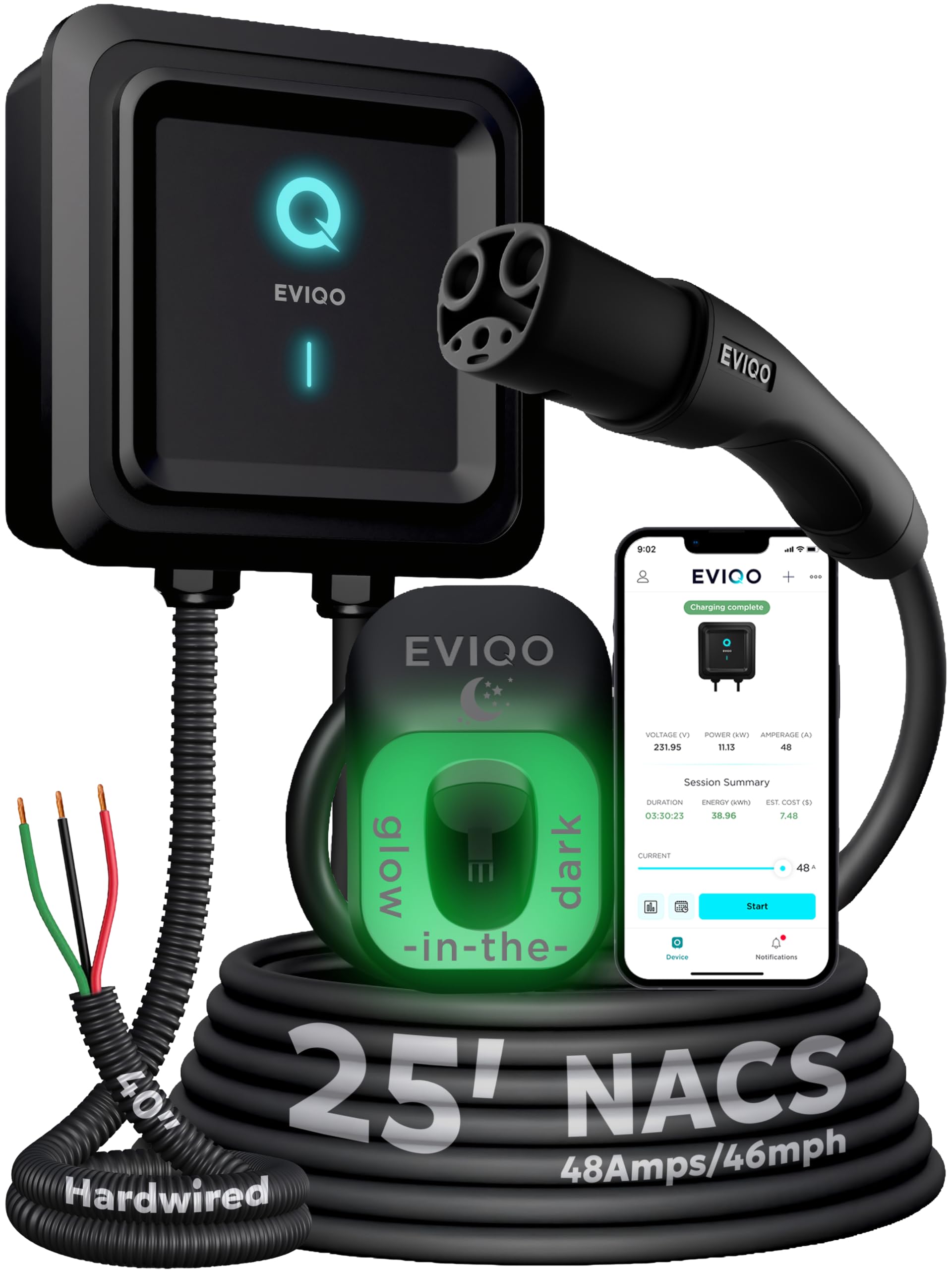
1. EVIQO Level 2 EV Charger NACS 48A
Our pick — over 4.5★ from 300+ verified ratings; the strongest balance of quality and price.
The Tesla-friendly hardwired unit that fills a VW ID4 in 5-7 hours overnight.
For Tesla owners, this is the rare charger that speaks NACS natively, so there is no adapter dangling between the cable and your car’s port. The built-in button on the connector even pops open your Tesla charge port, which makes the nightly plug-in feel easy. Charging is genuinely fast at 48 amps, and the crowd consensus is that it delivers on that promise — buyers report it brings a VW ID4 from empty to full in 5-7 hours on a typical overnight session.
The smart features hold up in real garages too, since the enhanced 2.4 GHz WiFi antenna keeps the unit online even in a basement, letting you start or stop charging, set the current anywhere from 6 to 48 amps, and track consumption and cost in the app. Everything lives inside an IP66/NEMA-4 weatherproof enclosure with UL, ETL, FCC, and Energy Star certifications, so rain, snow, and dust are not concerns. A fluorescent holster that glows after just 10 minutes of light exposure is a small touch that makes late-night plug-ins far easier.
The main thing to know is that a 48-amp hardwired charger needs a 60-amp breaker and 6-gauge wire, which means electrician involvement. The recurring gripe is the soft plastic plug, which scratches easily. Weighing 18.86 pounds, it is noticeably heavier than the 15-pound VEIPHLOX below, but that heft reflects a well-built, heavy-duty cable and mainboard steel shielding that protects the internals for long-term use.
NACS native speed
- Native NACS connector works with all Tesla models with no adapter needed
- Delivers the full 48 amps for fast overnight charging
- Weatherproof IP66/NEMA-4 build stands up to any outdoor install
- App tracks cost and consumption with adjustable amperage
bulky cable
- Hardwired install requires an electrician and a 60-amp breaker
- Soft plastic plug scratches easily, owners mention
- Heavier than many rivals at 18.86 pounds
fast native: you drive a Tesla and want the fastest, most smooth home charging without adapter fuss.
cable bulk: you only have a 50-amp circuit available — this unit’s 48-amp speed needs 60 amps to shine.
2. VEIPHLOX J1772 Level 2 EV Charger 40A
The no-app, plug-and-charge 40A workhorse that keeps its NEMA 14-50 plug cool.
If you want maximum simplicity for the lowest entry cost, this is the unit. There is no WiFi, no app, and no configuration — you mount it, plug the NEMA 14-50 power cord into an existing 240-volt outlet, and charge. Customers note the NEMA 14-50 plug stays cool even after 3 hours of Level 2 charging, which is the exact reassurance you want from a device pulling 40 amps continuously. Status is handled by color-coded lights: red for an emergency stop, blue for ready, flashing green while charging, and solid green when done.
At 9.6 kW, it delivers the full 40 amps most homes can support, and the 25-foot cable reaches across a typical two-car garage without re-parking. The internal cord-holding design stores the cable and connector right inside the enclosure, so you do not need a separate holster bolted to the wall. It is universally compatible with J1772 EVs and PHEVs, including Ford, Chevy, Hyundai, Kia, VW, and Rivian, though Teslas need an adapter you supply yourself.
The honest trade-off is the lack of any smart scheduling or cost tracking — if you want to charge only during off-peak utility hours automatically, you will be doing that math in your head or with the car’s own timer. It is certified UL for the cable and connector, ETL/UL for the plug, and rated IP65/NEMA 5 for weather, so outdoor mounting is fine. The recurring theme in reviews: this is the reliable backup or primary unit that simply works.
J1772 broad fit: budget-conscious owners with an existing 14-50 outlet who want dependable 40A charging with zero setup fuss.
mid amperage: you give up app control and off-peak scheduling to get that simplicity.
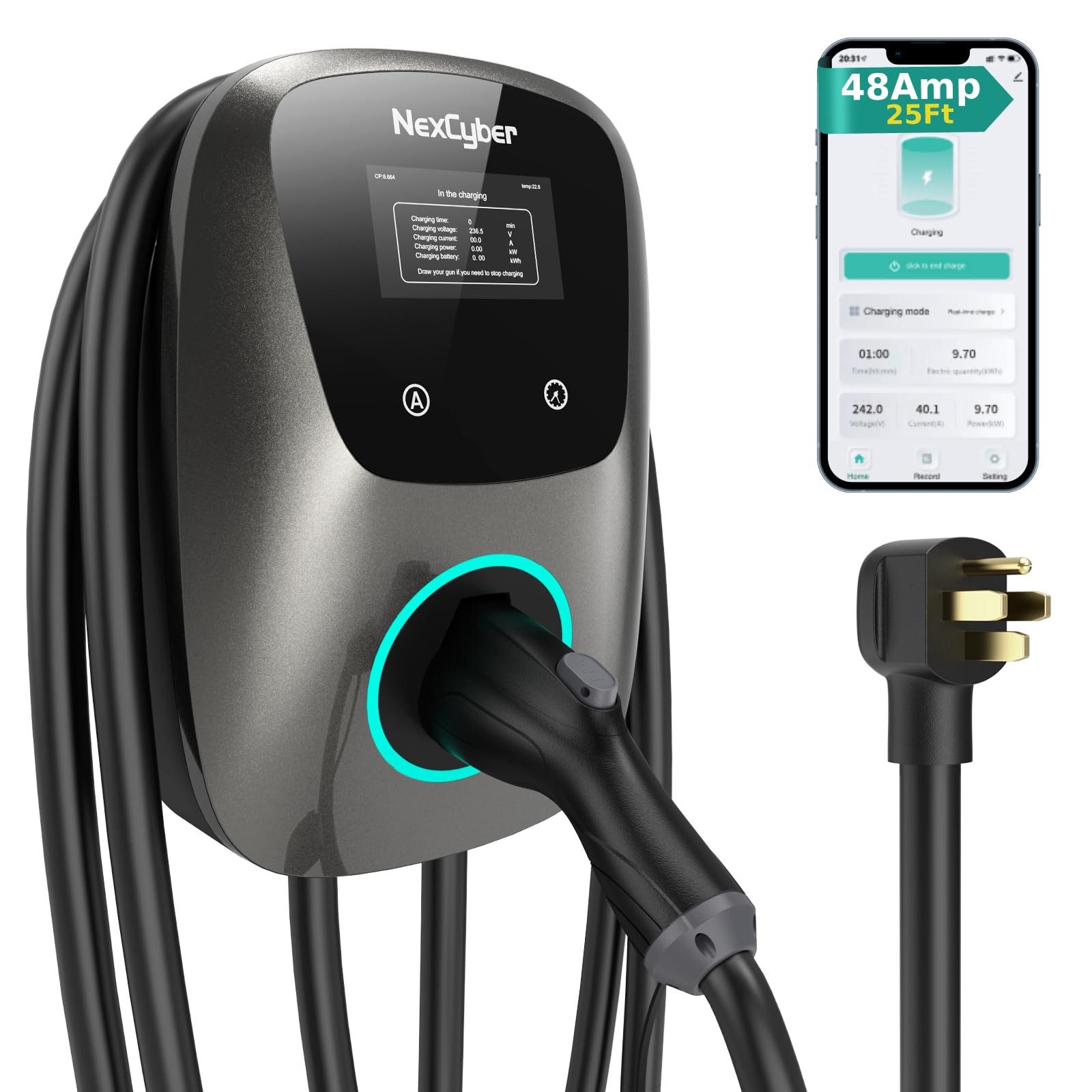
3. NexCyber Level 2 EV Charger 48A
A 48A smart charger with a touchscreen that shows live amperage, voltage, and speed.
Most chargers hide their stats inside an app, but this one puts a smart touchscreen right on the front so you can see the charging amperage, charging speed, input voltage, and any delay time at a glance. It runs in plug-and-play mode from the start, no app required, yet still lets you long-press the buttons to adjust amperage from 16A to 48A or set a delayed start time right on the device. The app adds wireless cost tracking, charging history, fully-charged notifications, and off-peak scheduling.
On speed, it offers up to 46 miles/hour via a hardwired connection at 48 amps, or up to 38 miles/hour through the NEMA 14-50 plug at 40 amps. That is a 20% amperage advantage over a fixed 40A charger when you hardwire it. The 25-foot cable is described as military-grade, with a drop-resistant plug rated for over 10,000 insertions, and NEMA Type 3 approval with an IP65 water-resistance level. ETL, FCC, and Energy Star certifications cover the safety side, backed by a 3-year warranty.
The recurring theme is that owners love the build quality and find it performs as well as more expensive models, with one noting it completes a charge in 2.5 hours. The app itself earns mixed marks — functional but not the most polished, and some found the instructions light. Tesla owners will need a J1772-to-NACS adapter, since the connector is J1772 native.
48A punch: the on-device display and straightforward touchscreen control that work even without a phone.
newcomer: put up with a so-so app and plan for an adapter if you drive a Tesla.
4. Lectron Level 2 EV Charger 40A

The no-frills portable 40A that took an Ioniq 5 from 60% to full in about 3 hours.
When you want Level 2 speed that you can throw in the trunk for a road trip, this portable unit fits the bill. It pulls up to 240V and 40 amps for a 9.6 kW charge rate, so an Ioniq 5 owner reports going from 60% to 100% in about 3 hours. The 16-foot cable is shorter than the 25-foot cords on the wall-mounted rivals above, but the whole point is that this charger travels with you and fits most driveways or garages without forcing you to park right up against the outlet.
It is FCC and ETL certified to the UL2594 standard, with overvoltage, overcurrent, and short-circuit protection, plus an IP65 rating for dust and water resistance and Energy Star certification. The NEMA 14-50 plug means no hardwiring at all — just plug into a 240V outlet and go. The J1772 connector works across Mercedes, BMW, Ford, Honda, Hyundai, Kia, Porsche, Nissan, and Chevy models, though Teslas need an adapter.
Reviews describe it as solidly built and substantial, and the value is a recurring compliment. The durability picture is mixed, though — one owner found the prongs oxidized after sitting unused for a few months, and another noted there is no built-in spot to store the plug when it is not in use. Think of it as the grab-and-go companion rather than a permanent wall fixture.
space saver: RV trips, second homes, or as a travel charger that delivers near-wall-unit speed.
40A only: the shorter cable and occasional plug-prong oxidation make it less ideal as a permanent garage install.
5. WOLFBOX Level 2 EV Charger 40A

A 40A wall unit with RFID card control and a 4.3-inch LCD screen for live stats.
This charger turns your charging session into something you can lock down with an RFID card, which is handy if you share a driveway or want to stop neighbors from helping themselves. The built-in Google account login and Alexa/Google Assistant voice control make it one of the more hands-free options here. A 4.3-inch LCD screen shows the charging rate, time, voltage, and charged amount, so the display on the unit itself tells you everything without opening an app.
At 40 amps it delivers 9.6 kW and roughly 38 miles of range per hour of charging, which is about 7 times faster than a standard Level 1 outlet. The charging schedule can be set during off-peak hours to lower your electric bill, and the CSA certification with UL2594 standard compliance plus NEMA 4X waterproof housing means outdoor installs are safe in any weather. The 25-foot cable reaches across a garage, and the unit weighs 13.49 pounds, making it lighter and easier to mount than heavier hardwired rivals.
The positives in reviews: flawless operation, an intuitive app, and a plug-in version that makes swapping units easy. The honest caveats: WiFi setup was tricky initially for some, the RFID card stays active after a session until swiped off (a security consideration in shared spaces), and the time-of-use scheduling only works if the car stays plugged in before the window starts. One owner cut their PHEV charge time from 12 hours to 3.5 hours with this unit.
rugged build: households that want RFID-restricted access and voice control, with a bright display for at-a-glance status.
hefty unit: the time-of-use window and RFID behavior take some getting used to.
6. ApexCharger MACH 1 48A
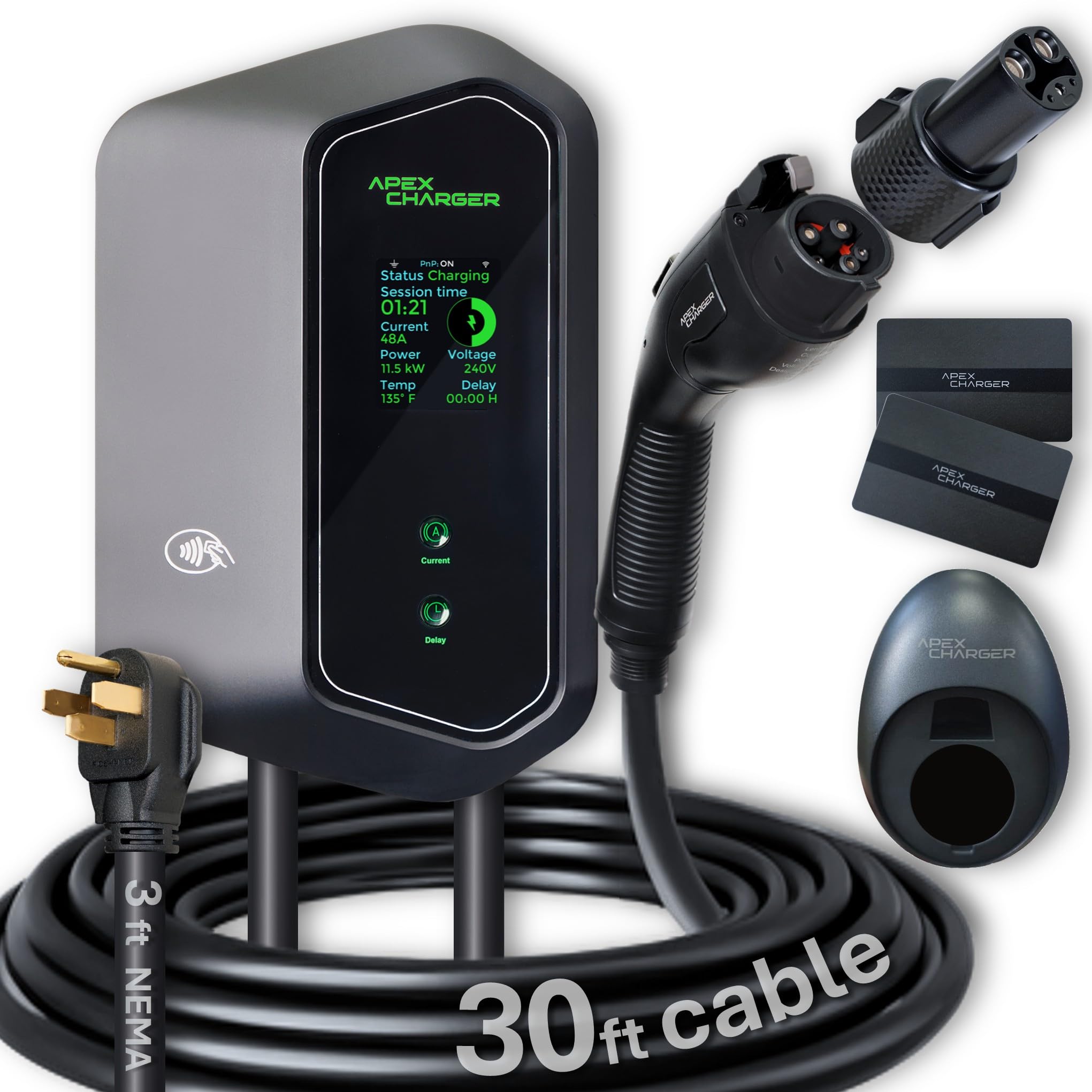
The turnkey charger that includes both a J1772 connector and a Tesla NACS adapter.
This is the rare charger that genuinely fits every EV in America from the start, because it ships with a J1772 connector AND the exclusive PRO 1 NACS adapter for Teslas. For a two-car household with mixed ports, that removes the adapter juggling entirely. The cable is the longest in this lineup at 30 feet, which means you can park in the spot that suits you rather than the one that reaches the outlet, and it comes with a remote connector holster plus an anti-theft bolt to keep the hardware in place.
It runs at up to 48 amps when hardwired on a 60-amp breaker, or 40 amps through the NEMA 14-50 plug on a 50-amp breaker, with an adjustable range down to 24 amps for older 30-amp outlets. Bluetooth and WiFi connectivity, two RFID cards, a true plug-and-play function, and a 2.4-inch LED display round out the feature set. On a 30-amp circuit, one owner ran it flawlessly at 24A, showing how flexible the amperage dial really is.
Owners praise the build quality and the 24/7 support team, with one noting support responded within the hour on a Sunday night to fix an overheating error caused by a storm. A firmware update fixed a Tesla scheduling bug and a relay error on unplug. The one limitation: time-of-day settings still lack individual day selection, which is a minor annoyance for strict schedulers.
premium feel: mixed-fleet households where one car is a Tesla and the other is J1772, or anyone who wants a 30-foot reach.
costly: the scheduling lacks per-day granularity, so flexible off-peak setups are limited.
7. WOLFBOX Level 2 EV Charger 48A

The hardwired 48A sibling that adds 46 miles of range per hour of charging.
This is the hardwired version of the WOLFBOX above, and the jump from 40A to 48A is exactly what it sounds like: faster. At 11.5 kW it delivers roughly 46 miles of range per hour, about 9 times faster than a standard wall outlet, so even a big-battery SUV like a 2025 Equinox EV picks up 38 miles per hour of charging. A 60-amp breaker is required to open up the full 48-amp output.
It carries the same smart DNA as its sibling — CSA certified, NEMA 4X waterproof housing, Google account login, Alexa/Google Assistant voice control, and a 4.3-inch LCD that shows charging rate, time, voltage, and charged amount. The 25-foot cable and RFID card control carry over too. One owner replaced a JuiceBox with this unit and set it to 40A via the DIP switches, reporting lower temperatures than their previous charger.
The recurring praise focuses on the on-device display, which shows all the charging details that many other chargers hide. WiFi connectivity and cable length draw the most mixed feedback: the app pairing sometimes requires a breaker reset to fix, and the hardwired whip cable is on the short side. For a Rivian owner, setup was simple once the correct breaker gauge was in place, and the value-for-money verdict was strong.
dual voltage: max 48A hardwired speed with a bright screen and voice control, at a price below premium rivals.
setup fuss: a possible app-pairing hiccup and a short hardwire whip when positioning the unit.
8. Autel MaxiCharger Level 2 EV Charger 40A

A polished 40A plug-in that adjusts in single-amp increments for precise draw control.
Autel built its name on automotive diagnostic gear, and that engineering polish shows in this MaxiCharger. Unusual in this category, it lets you set the amperage in 1-amp increments from 16A to 40A, which means you can dial in exactly 32A for a 40-amp circuit or whatever your panel safely supports — a precision most rivals cannot match. The 25-foot cable is designed to stay flexible in the cold, which matters if your garage is unheated through winter.
The app handles scheduling so you can shift charging into off-peak utility hours, and optional RFID card functionality prevents unauthorized use if the charger is in a shared space. It is NEMA 4X-rated, meaning dust-tight and water-tight against windblown dust, rain, splashing water, and hose-directed water, so an outdoor install is completely safe. The 5-minute install onto an existing NEMA 14-50 receptacle needs no electrician.
Owners consistently call it a quality unit, with one self-described 7-EV veteran naming it the best home Level 2 charger they have ever used, praising the app and the auto-max charging that tapers near the end to avoid overheating. The recurring friction points: it takes multiple covers to adjust below 50 amps, and the app feels less refined than some, with scheduled charging that can conflict with the vehicle’s own schedule. It comes with a 3-year warranty and 24/7 phone support.
app control: precise amperage tuning and a clean, weatherproof design from a trusted automotive brand.
network need: the amp adjustment is buried under multiple covers, so set it once and leave it.
9. EMPORIA Level 2 EV Charger 48A
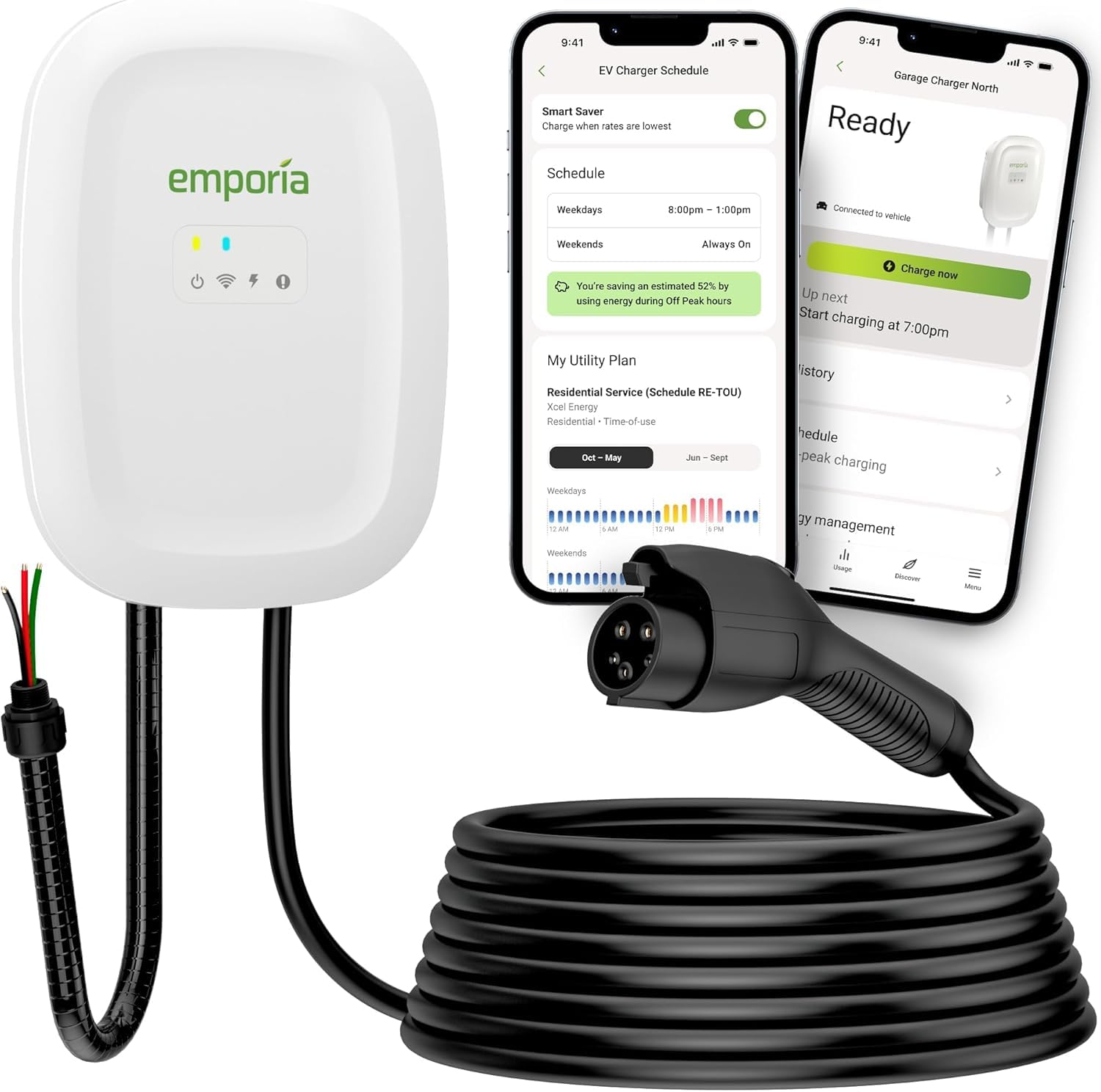
The 48A hardwired unit that pairs with the Emporia Vue to track every kWh and dollar.
If you nerd out over energy data, this is the charger for you. It connects over 2.4 GHz WiFi to the Emporia app, and when paired with the Emporia Vue home energy monitor, it enables solar-only charging, demand limiting, and load control — features one professional installer with over a decade of EVSE experience calls the reason they prefer Emporia over Tesla, Rivian, Bosch, and JuiceBox. You can see kWh and dollars spent per charge and per month, all in the app.
At 48 amps hardwired, it delivers up to 46 miles/hour of charging, and the included whip makes the connection to your breaker panel straightforward. It is UL listed and ENERGY STAR certified to NEC 625, SAE J1772, UL 817, UL 991, UL 2231, UL 2251, and UL 2594 standards. A 2026 Subaru Solterra owner reports a full charge in 4-5 hours, and an Ioniq 5 hits full in the same window while a Sportage PHEV finishes in about an hour.
The reviews paint a picture of easy installation, an intuitive app, and strong value as an affordable home solution. It is preconfigured for hardwired install at up to 48A, so you will need an electrician — but the 25-foot cable means you can often avoid backing your car in to reach the unit. One expert installer says it saved them tens of thousands in demand fees through the app’s smart features, though advanced setups do require a licensed electrician.
energy monitor: deep energy tracking, solar integration, and a proven app backed by rave expert reviews.
no NACS: it is hardwired only for full 48A speed, and Tesla owners need to buy a separate NACS cable.
10. ChargePoint HomeFlex Level 2 EV Charger

A hardwired NACS station from the brand behind over 274,000 public charging points.
ChargePoint is the name you see on public chargers everywhere, and the HomeFlex brings that same ecosystem into your garage. It uses a native NACS connector, so it plugs straight into Tesla vehicles including the long-range Model Y, which one owner says it handles effectively. The hardwired design delivers up to 50 amps of current — the highest raw rating in this lineup — so charging speed is never the bottleneck.
The ChargePoint mobile app controls the charger, manages reminders, connects to smart home devices, and finds stations across the network of 274,000+ ChargePoint locations plus 565,000+ roaming partner stations in North America and Europe. A cold-resistant cable means winter garages are not a problem, and the UL certification covers the safety side. LED status colors keep things simple: green for ready, blue blinking while charging, solid blue when done.
The consistency story is where this unit earns its premium reputation, but it is not without friction. The most-discussed issue is WiFi connectivity — some reviewers point out older stock units dropping WiFi after a couple of weeks, though charging still works without it, and newer revisions fixed the problem. Quality and app functionality draw mixed feedback, with some praising the app and others finding it frustrating. It is a solid pick for brand-loyal Tesla owners who want the reassurance of a nationwide charging network behind their home unit.
trusted name: you trust the ChargePoint network and want a Tesla-native hardwire at 50 amps.
spendy: WiFi reliability on older stock — make sure you get a current revision.
11. Autel MaxiCharger AC Elite 50A
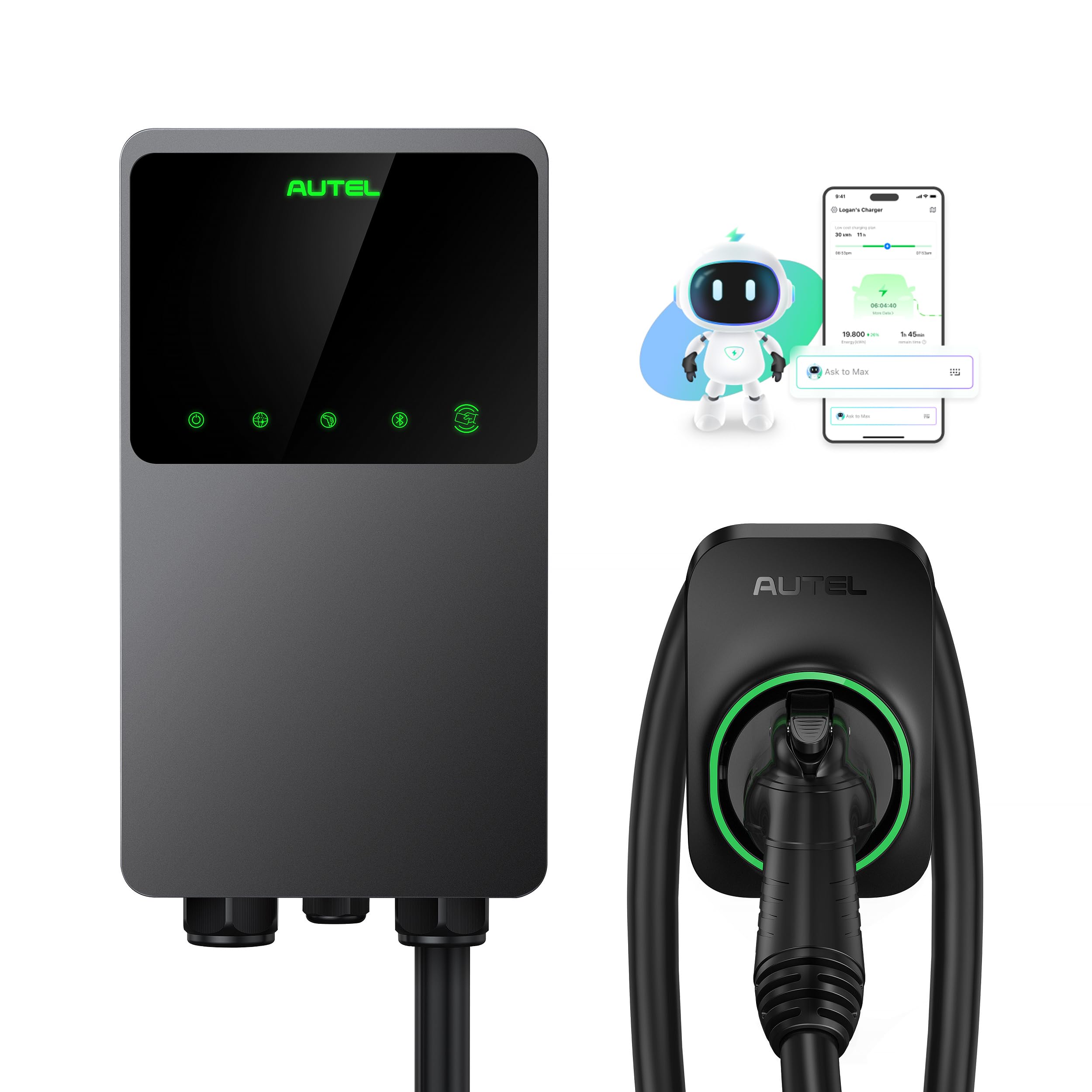
The 50A hardwired heavyweight that adds 37 miles per charging hour at 12 kW.
At the top of the speed ladder sits this Autel AC Elite, which delivers 12 kW at up to 50 amps — the fastest sustained output in this whole lineup. It adds about 37 miles of range per charging hour, so even a depleted battery is road-ready after a single overnight session. The 25-foot cable is built to stay flexible down to -40 degrees Celsius, so bitter winter garages will not turn it into a stiff rod.
It is CSA certified with NEMA Type 4 protection against snow, rain, hail, and sleet, plus fire-resistant, over-current, over-voltage, and over-temperature protection. The Autel Charge app manages charge times, schedules off-peak charging, and tracks your electricity costs, while Bluetooth, WiFi, and Ethernet connections keep automatic over-the-air firmware updates flowing. The unit arrives completely pre-assembled, and installers note the physical amperage selector lets you set it for a 32A or 40A breaker, with 50A requiring a 60A breaker.
The reviews are emphatic about build quality and support. One owner chose it over the Grizzl-E for combination of price and features, another says it solved a Chevy Bolt draw issue by adjusting through the app, and a third praises the exceptional tech support that sent a replacement within 2 days under warranty. The only consistent con: it is slightly heavy. Coming completely pre-assembled, it is the least hassle of any hardwired unit here.
max power: the fastest home charging available and a rugged, pre-assembled build that handles brutal winters.
no plug: it needs a 60-amp circuit to hit its 50A peak, and it is on the heavier side to mount.
Understanding the Specs
Amperage and Breaker Size
The amperage rating (40A vs 48A vs 50A) is the single biggest factor in real-world speed. A 40-amp charger draws the maximum from a 50-amp breaker, while a 48-amp unit needs a 60-amp breaker to run at full speed. If you only have a 50-amp circuit, a 48-amp charger will still work but cap out at 40 amps, so match the unit to your panel before you buy.
Connector Types: NACS vs J1772
Tesla vehicles use the NACS port, while nearly every other EV uses the J1772 standard. A native NACS charger plugs straight into a Tesla with no adapter, and a J1772 unit can charge a Tesla with a separate adapter. For mixed-fleet households, a charger that ships with both connectors (like the ApexCharger MACH 1) removes the juggling entirely.
FAQ
What size breaker do I need for a 48-amp EV charger?
Can I use a NEMA 14-50 plug-in charger instead of hardwiring?
Will a J1772 charger work with my Tesla?
How many miles of range do I get per hour of Level 2 charging?
Is it safe to install an EV charger outdoors?
What does the RFID card feature do on a home charger?
How long does it take to fully charge an EV at home?
Do I need the smart app features on an EV charger?
Why does charging stop suddenly mid-session?
Final Thoughts: The Verdict
The ev charger for home winner is the EVIQO NACS 48A because it pairs native Tesla compatibility with full 48-amp speed and a weatherproof build that the crowd endorses with confidence. If you want smart energy tracking and solar integration, grab the EMPORIA 48A. And for the fastest raw output on a rugged pre-assembled frame, the
How We Picked
We do not accept paid placement. Every pick is matched to a real buyer and a real use-case; we do not hands-on test units.
Sources & Methodology
Specifications: manufacturer listings and product documentation. Review insights: verified customer reviews, as of August 2026. Pricing: not shown on this page (it changes often); check the current price via the retailer link.
As an Amazon Associate, Trending Car earns from qualifying purchases. This does not affect which products we feature.