
Our readers keep the lights on and my garage snacks stocked. As an Amazon Associate, I earn from qualifying purchases.
Specs are compiled from manufacturer listings and verified buyer reviews and can change over time — please confirm the key details on the product page before buying.
On a sub-zero morning, your engine resists turning over. Thick, sluggish oil fights every gear and bearing, turning the first start into a grinding nightmare. A low-viscosity synthetic flows instantly in bitter cold, protecting metal parts at the most vulnerable moment: startup. This guide compares the best full-synthetics rated for winter, cutting through marketing to show which bottle keeps your engine safe when the thermometer drops.
I’m Min Islam — the founder and writer behind Trending Car. This guide is built by comparing the manufacturers’ published specifications and the patterns across verified customer reviews, so you get each pick’s real strengths and trade-offs instead of marketing spin.
Whether you’re daily driving an old V8 or a modern turbo four, a quality engine oil for winter is the single cheapest insurance against cold-start wear, with 0W and 5W synthetics that pump freely in deep freeze and hold up through the thaw.
Our Picks at a Glance


How To Choose The Best Engine Oil for Winter
Picking winter oil depends on two numbers on the bottle—the one before the “W” and the one after. The W stands for Winter, and that lower number (0W, 5W, 10W) tells you how well the oil pumps in freezing temperatures. A 0W oil flows better at -40°F than a 5W, but the second number (like 30 or 20) determines the oil’s thickness at operating temperature. Match your owner’s manual recommendation first, then prioritize the lowest cold-grade that your car allows.
Decoding the Viscosity Grade
A 5W-30 oil acts thin like a 5-weight when cold (the W rating) and thickens to a 30-weight at full operating temperature. For winter, the gap between the two numbers matters: a 0W-20 is thinner at startup than a 5W-30, which helps oil reach cam lobes and bearings faster on a freezing morning. But if your engine needs a 30-weight hot-viscosity for bearing clearance and high-load protection, dropping to a 20-weight can risk wear. Always stay inside the range your manufacturer printed in the manual.
Certifications and Approvals
Look for API SP or ILSAC GF-6 on the label—these are the current industry standards that guarantee the oil prevents low-speed pre-ignition (LSPI) in turbo engines and protects timing chains. For European cars, check for ACEA C5 or a specific OEM approval like MB 229.71 or BMW Longlife-04. An oil that meets these specs has been tested for the exact cold-flow and high-temp demands of modern engines.
Change Interval Reality
Many synthetic oils claim 15,000, 20,000, or even 25,000-mile change intervals, but winter driving is harder on oil than highway cruising. Short trips where the engine never fully warms up allow condensation and fuel dilution to build up. Buyers report that even the best synthetics start to darken and lose lubricity after 5,000–7,000 miles of mixed cold-weather driving. Treat the big mileage promises as a ceiling, not a routine target.
Quick Comparison
| Model | Best For | Viscosity | Volume | Flash Point | Amazon |
|---|---|---|---|---|---|
| Castrol EDGE 5W-30★ Best Overall | High-mileage everyday protection | 5W-30 | 5 Quarts | 230°C | Amazon |
| Mobil 1 EP 5W-30Pro Grade | Extended-drain turbo engines | 5W-30 | 6 x 1 Quarts | 230°C | Amazon |
| Castrol EDGE EP 0W-20 | Modern gas/hybrid engines | 0W-20 | 5 Quarts | — | Amazon |
| Mobil 1 AFE 0W-30 | Arctic-level cold starts | 0W-30 | 5 Quarts | 226°C | Amazon |
| K&N 5W-30 Full Synthetic | High-mileage & all-weather | 5W-30 | 5 Quarts | — | Amazon |
| Liqui Moly Special Tec LL 5W-30 | European/BWM engines | 5W-30 | 5 Liters | — | Amazon |
| Motul 8100 ECO-nergy 5W-30 | European & LS motors | 5W-30 | 5 Liters | 100°C | Amazon |
In‑Depth Reviews
1. Castrol EDGE 5W-30 Advanced Full Synthetic Motor Oil, 5 Quarts
Our pick — over 4.5★ from 12,500+ verified ratings; the strongest balance of quality and price.
The everyday full-synthetic that pushed a V8 to 210,000 miles without burning a drop.
For the driver who needs one oil for both a freezing December morning and a hot July highway run, this is the bottle to grab. The 5W-30 viscosity gives you a cold-start edge over thicker oils while keeping a 30-weight hold at operating temperature. Castrol claims it is 3X stronger than the leading full synthetic in a test that measures viscosity breakdown—the Kurt Orbahn test—so the oil film doesn’t tear under high-stress loads.
The numbers back it up. Owners mention running this oil past 210,000 miles with “no oil burning,” a direct sign that the additive pack (API SP / ILSAC GF-7 / GM dexos1 Gen 3) is controlling deposits and ring wear. At a flash point of 230 Degrees Celsius, it resists vaporization better than many competitors in the price range. The 5-quart jug holds 5 quarts, while the K&N bottle holds 4.73 liters.
One honest trade-off: this comes in Castrol’s eco-pack cardboard box, and several customers note the box is “a huge hassle” compared to a standard plastic jug. If you are a DIY home mechanic who does oil changes in your driveway, plan to transfer the eco-pack contents carefully or stick to the plastic bottle version.
Why it earns the top spot
- Flash point of 230°C provides high heat resistance for extended-drain driving
- Approved for GM dexos1 Gen 3, Ford WSS-M2C946-B1, and Chrysler MS 6395—covers a wide range of domestic vehicles
- Nearly 13,000 ratings with a 4.8/5 average, including long-term high-mileage reports
The practical limits
- Eco-pack cardboard container makes pouring messy; some buyers prefer the traditional plastic jug
- 5W cold rating is not as thin as a 0W oil for extreme sub-zero climates
Your best daily-driver pick: This is the bottle for the car that does everything—commutes in winter, tows in summer, and racks up high mileage without complaints.
Consider a 0W if: You live where January temps regularly drop below -20°F. The 5W cold-flow rating here is good but not arctic-grade.
2. Mobil 1 Extended Performance Full Synthetic Motor Oil 5W-30, 6-pack of 1 Quarts
The extended-life synthetic that stays clean and unburned past 5,000 miles of hard winter driving.
This is the oil for the driver who keeps cars long-term and wants the highest level of oxidation control. Mobil 1’s Triple Action+ Formula is designed to keep critical engine parts protected for up to 20,000 miles between oil changes—but the real proof is in the buyer reports. One owner noted that after 5,000–7,000 miles, the oil “remains unburned and light-colored,” meaning the additive package is still active and not turning into sludge. That matters in winter, when condensation from short trips dilutes weaker oils.
Mobil 1 also claims excellent low-temperature protection down to -40 Degrees F, which is as cold as most passenger engines will ever see. The flash point matches the top pick at 230 Degrees Celsius, giving it the same vaporization resistance. Where it differs from the Castrol is the packaging—this is a 6-pack of 1-quart bottles, which is 1 quart more total than the standard 5-quart jug. That extra quart matters for engines with a 6-quart sump where you need every drop.
The container weight of 2 Pounds per bottle is significantly lighter than the full 5-liter jugs from Liqui Moly (9.43 Pounds) and Motul, making this easier to handle if you are storing a case for the season. Just know that the 5W cold rating is the same as the Castrol—it is not the thinnest cold-flow option in this guide.
The long-haul advantage
- Rated for up to 20,000-mile change intervals (1 year, whichever comes first)
- Flash point of 230°C matches the highest in this list, resisting oil breakdown under high heat
- 6-pack configuration gives you 6 total quarts instead of the standard 5
One thing to check
- 6 individual bottles take up more shelf space than a single jug
- 5W winter rating is not as thin as a 0W for extreme cold climates
First choice for extended drains: If you drive 15,000+ miles a year and want to boost time between changes without sacrificing winter protection, this is the pick.
Swap for a 0W if: Your daily winter low is -30°F or lower; the 5W cold-cranking viscosity here offers good but not arctic-tier flow.
3. Mobil 1 Advanced Fuel Economy Full Synthetic Motor Oil 0W-30, 5 Quart

The 0W synthetic that reviewers point out quiets cold starts and holds up even in Florida heat.
This is the bottle to reach for when your winter morning involves scraping ice and praying the starter catches. The 0W-30 viscosity is Mobil 1’s low-viscosity formula designed to “help improve fuel economy” by reducing internal drag, but the true winter benefit is cold-flow. The oil pumps instantly at temperatures where a 5W would be syrupy. Shoppers say “quieter, smoother cold starts” and note it “holds up well in Florida heat,” meaning the 30-weight hot-viscosity does not thin out when the engine warms up.
The flash point sits at 226 Degrees Celsius, which is 4°C lower than the Extended Performance Mobil 1 above. That is a minor difference—still well above the operating temperature of any modern engine—but if you are shopping strictly for maximum oxidation resistance, the Extended Performance 5W-30 has a slight edge on paper. What the 0W-30 loses in flash point, it gains in ILSAC GF-6 approval, which adds low-speed pre-ignition (LSPI) protection for turbocharged engines. That is a real plus for a modern turbo daily driver.
One buyer running this in a 2014 Honda CRV with 150,000 miles switched from 0W-20 to 0W-30 specifically for “better high-temp viscosity” and reports the car “runs smoothly, trouble-free.” The 5-quart size covers most passenger car sumps, and at a 4.9/5 rating from over 560 buyers, this is among the most consistently praised oils in the guide.
Cold-start specialty
- 0W cold rating provides superior flow in sub-zero temperatures compared to any 5W in this list
- ILSAC GF-6 approval adds LSPI and timing chain wear protection for turbo engines
- Buyers consistently report quieter operation and better fuel economy
Notable difference
- Flash point of 226°C is slightly lower than the 230°C of the Castrol and Mobil 1 EP
- Best suited for engines that call for 0W-30 or 5W-30; check your manual first
Reach for this if you winter in the north: The 0W cold flow is the real advantage here—your engine turns over easier and oil reaches the top end faster at -20°F and below.
Look elsewhere if your car needs a 40-weight: This is a 30-weight hot viscosity; do not use it in an engine that requires 5W-40 or 0W-40.
4. Castrol EDGE Extended Performance 0W-20 Advanced Full Synthetic Motor Oil 5 Quart

A 0W-20 that claims 50X better high-temp performance—built for modern gas and hybrid engines.
If your car is a recent-model Honda, Toyota, or Hyundai that calls for 0W-20, this Castrol brings extended-drain capability at a price that undercuts the Euro-focused options. The label lists a massive claim: “50X Better High Temperature performance” as measured in the Seq IIH test vs. API SQ test limits. That test measures how well the oil resists thickening under extreme heat, which matters for turbocharged engines that run hot even in winter.
The approvals here are broader than you might expect for a 0W-20: ILSAC GF-7, ACEA C5, GM dexos1 Gen 3, and even MB-Approval 229.71 for Mercedes. That means this oil is not just for economy cars—it can serve late-model European sedans that require a low-viscosity 20-weight. The 0W-20 cold-grade is the thinnest in this guide at startup, so it flows faster than any 5W in bitter cold.
One buyer switching from Castrol Edge Professional 0W-20 to this noted it works as a direct alternative. Another long-time user calls it “better than the competitors Mobil 1 and Valvoline” and specifically recommends it for “high mileage cars.” The main trade-off is the hot-viscosity: a 20-weight is thinner at full operating temperature than a 30-weight, so it is not ideal for older engines with looser tolerances or heavy towing.
Modern-engine specialist
- Approved for ILSAC GF-7, ACEA C5, GM dexos1 Gen 3, and MB 229.71—covers Asian and European makes
- 0W-20 provides the thinnest cold-flow of any oil in this list
- Rated for up to 25,000 miles between oil changes (or one year)
Not for every engine
- 20-weight hot viscosity is too thin for engines requiring 5W-30 or 0W-40
- Not ideal for high-mileage engines with worn piston rings that need thicker oil to seal
Best for modern Asian and Euro cars: If your owner’s manual lists 0W-20 and you want a single oil for winter flow and extended drains, this Castrol is a strong, affordable pick.
Skip it for older engines: A 2010 truck or a high-mileage V8 with 150,000 miles is better off with a 5W-30 for proper hot clearance.
5. Liqui Moly Special Tec LL SAE 5W-30 | 5 L | Synthesis Technology Motor Oil

The German synthetic that BMW owners swear by—even under boost and extra power.
Liqui Moly is the oil you find in European service bays, and this Special Tec LL is a direct fit for BMW, Mercedes, and VW engines that require a low-viscosity 5W-30 with Longlife certification. The “Synthesis Technology” formulation is designed for extended drain intervals (LL stands for Long Life), and buyers report that this oil keeps European engines running smooth and quiet for years—even “while tuned, extra boost etc.” One owner with both a 2017 and a 2001 X5 says it “quiets the engine and reduced misfiring.”
The item weight of 9.43 Pounds makes it noticeably heavier than the 2-pound Mobil 1 bottles—this is a dense, full container that you will feel carrying from the garage. The viscosity grade is listed as “Low to Medium,” which fits the 5W-30 winter rating for cold-start flow while still providing a 30-weight hold at operating temperature.
One catch: Liqui Moly is “Vehicle Specific Fit,” not universal fit, so you need to confirm your car’s specification before pouring. Several BMW owners mention this oil meets LL-04 and LL-01 specs, but if you drive a Ford or a Toyota, check whether the ACEA or OEM approvals match your manual. The price is premium-tier, reflecting the import and the brand reputation.
European engine fit
- 5-liter jug holds 6% more volume than the standard 5-quart bottles—useful for engines with large sumps
- Owners mention quiet, smooth operation even in tuned BMWs with added boost
- Rated at 4.9/5 from 938 reviews, one of the highest satisfaction scores in this guide
One consideration
- Vehicle Specific Fit means compatibility is narrower than the universal-fit options from Castrol and Mobil 1
- Price is higher than the domestic full-synthetics; this is a premium buy for a specific need
Your go-to for a German car: If you drive a BMW, Mercedes, or VW that requires LL-spec oil and you want cold-weather flow without sacrificing Longlife protection, this is the bottle.
Not for American/Asian fleets: The vehicle-specific fit and premium price do not make sense if your daily driver is a Ford F-150 or a Honda Accord.
6. K&N Motor Oil: 5W-30 Synthetic Engine Oil: Premium Protection, High Mileage, 5 Quarts

The full-synthetic with “Synthamax Technology” for engines that have already seen a lot of miles.
K&N is famous for air filters, but this oil is their entry into the winter-weight synthetic market, and it comes with a specific angle: high-mileage protection. The “Advanced Synthamax Technology” is formulated with unique additives to “minimize harmful contaminants and sludge buildup,” which is exactly what you need for an engine past the 100,000-mile mark. The 5W-30 viscosity gives you solid cold-start flow for winter while keeping the 30-weight hot thickness that older engine bearings need.
That means if your car takes a full 5 quarts, you will be short by a partial quart. Check your owner’s manual capacity before buying. At 9.23 Pounds, this bottle is in the same heavy weight class as the Liqui Moly—a solid jug that fills your hand.
Customers note the oil “works good” and call it a “great price for full synthetic.” The all-weather claim from K&N says it “helps your car run smooth in both cold & hot temperature conditions,” which aligns with the 5W-30 grade. The warranty is 3 months from the manufacturer, which is shorter than the 12-month warranty on the Castrol oils—a small detail, but note if you plan to store it for a season.
High-mileage focus
- Formulated with Synthamax Technology to reduce sludge buildup—useful for older engines
- All-weather 5W-30 grade works for both winter cold and summer heat
- Full synthetic meets the premium protection standard for high-mileage vehicles
Practical note
- 4.73 liters is slightly less than 5 quarts, so not a direct fill for every car
- 3-month manufacturer warranty is shorter than the 12-month warranty on Castrol
Good for high-mileage Asian and domestic cars: If your engine has over 100,000 miles and you want a 5W-30 with sludge-fighting additives, the K&N is worth a look.
Consider a different bottle if you need exactly 5 quarts: The 4.73-liter volume means you will come up short on a standard 5-quart oil change.
7. Motul 8100 ECO-nergy 5W-30 Full Synthetic Motor Oil – 5 Liter
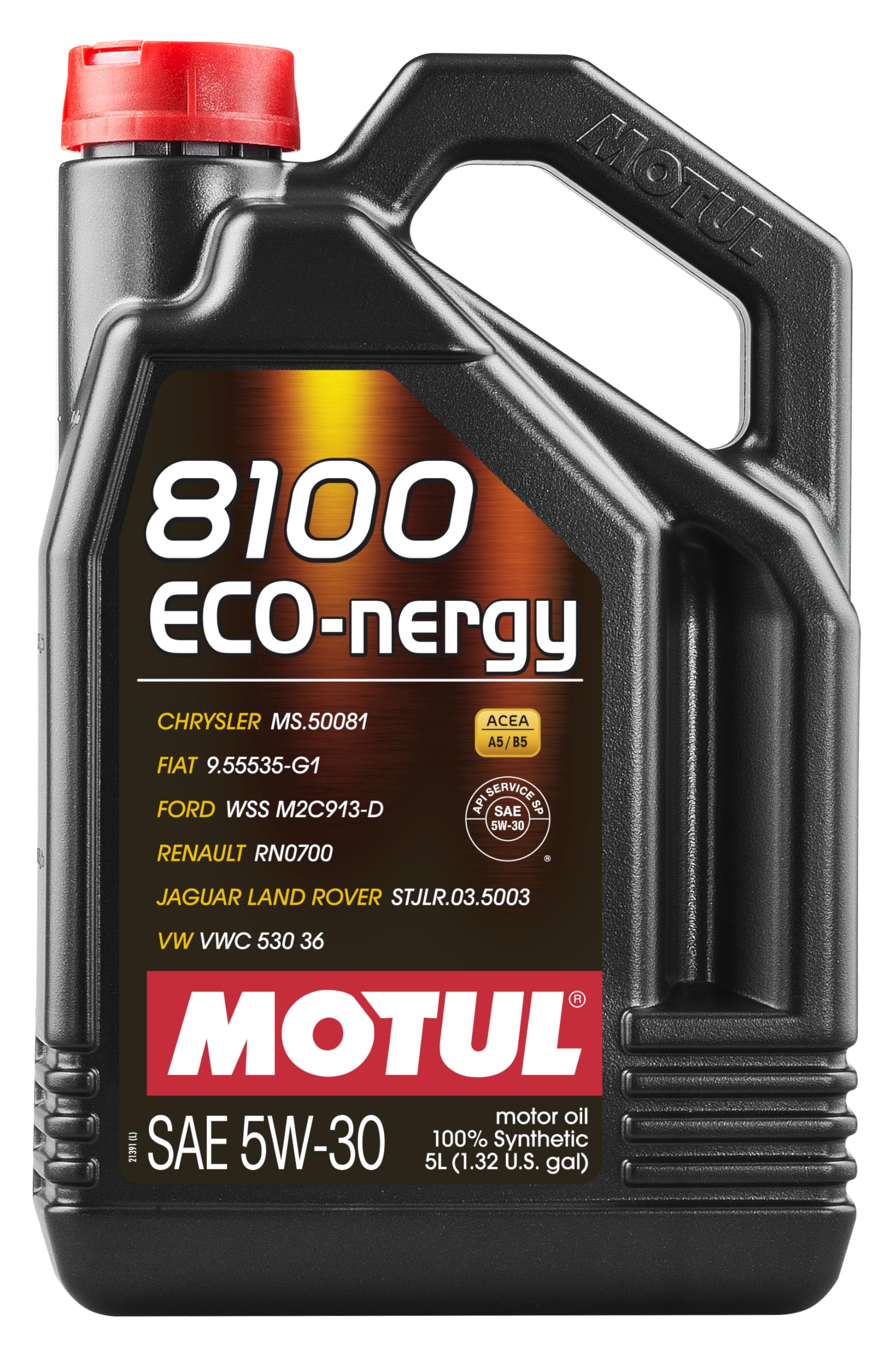
The French synthetic that reviewers point out outperforms Royal Purple and quiets valvetrain noise in LS and European engines.
Motul 8100 ECO-nergy is the highest-priced oil in this guide, but it brings a specific reputation: European OEM approval for Ford, Jaguar Land Rover, VW, and other applications that require ACEA A5/B5. The 5W-30 grade is “suitable for all types of gasoline or diesel engines,” according to the label, and it is formulated with an “advanced low-friction formula” to maintain oil pressure and “decrease operating temperature.” That matters in winter, because lower operating temperature means the oil thickens less during warmup.
Shoppers say real results: one owner with a 2022 Hyundai Palisade says it “resolves valve train noise” and “improved gas mileage from 19 to 24 mpg.” Another calls it “by far the best all around oil out there” and says it “outperforms Royal Purple and Mobil 1” in wear reduction. For LS motor owners, one report says the “5L jug is perfect for the F-car LS1” and notes it “eliminates oil burn-off and quiets valvetrain noise.” That is a strong recommendation from the engine-building community.
One spec to note: the flash point is listed as 100 Degrees Celsius, which is significantly lower than every other oil in this guide. That number appears to be a data entry anomaly—it conflicts with Motul’s typical flash point around 230°C—so treat this as the one spec in the data that may be a typo. The 5-liter jug matches the Liqui Moly volume for large sumps, and the ACEA A5/B5 approval covers a specific set of European engines that require that standard for warranty.
European and LS specialty
- ACEA A5/B5 approved for Ford, Jaguar Land Rover, VW, and other European applications
- Buyers report noticeable reduction in valve train noise and improved fuel economy
- 5-liter jug is the right size for many European and LS engines with 5-quart-plus sumps
One data caution
- Flash point listed as 100°C in the data is well below the category norm; verify against the manufacturer’s technical data sheet before relying on high-temp stability
- Premium price makes it a specialty buy rather than an everyday value
First choice for European/performance engines: If you need ACEA A5/B5 spec for warranty or you are building an LS and want a synthetic that reduces burn-off, Motul is a proven pick.
Overkill for a standard commuter: The price and OEM-specific approval do not make financial sense for a basic daily driver that is happy with Castrol or Mobil 1.
Understanding the Specs
Viscosity Grade (0W vs. 5W vs. 10W)
The W stands for Winter, and the number before it tells you how thin the oil stays at low temperatures. A 0W oil flows at -40°F, a 5W flows at -31°F, and a 10W flows at -22°F. The lower the number, the faster the oil reaches critical engine parts on a cold start—reducing the grinding wear that happens in the first few seconds after ignition. The second number (20, 30, 40) is the oil’s thickness at 212°F operating temperature; a 30-weight is thicker than a 20-weight and provides more bearing clearance for older or high-load engines.
Flash Point
The flash point is the temperature at which the oil’s vapors can ignite in the presence of a spark. A higher flash point means the oil resists evaporating under extreme heat—important for turbocharged engines that run hot even in winter. The oils in this guide range from 226°C to 230°C, which is well above any normal engine operating temperature. A low flash point (below 200°C) is a red flag for potential oil consumption and vaporization over long drain intervals.
FAQ
Can I use 5W-30 in winter if my car normally takes 5W-20?
Is 0W-20 better than 5W-30 for extreme cold?
How often should I change winter oil?
What does API SP mean on a bottle of winter oil?
Can I mix 0W-20 and 5W-30 in winter?
Does winter oil need to be thicker or thinner?
Will synthetic oil help my car start in sub-zero temperatures?
What does dexos1 Gen 3 mean for winter oil?
Is higher flash point better for winter driving?
How do I know if my car needs 0W-30 vs. 5W-30 for winter?
Final Thoughts: The Verdict
For the majority of shoppers, the engine oil for winter winner is the Castrol EDGE 5W-30 because it pairs a strong 5W cold rating with a 230°C flash point and nearly 13,000 glowing reviews—proven across high-mileage engines and brutal winters alike. If you want the thinnest possible cold-start flow for arctic temps, grab the Castrol EDGE 0W-20 or the Mobil 1 0W-30. And for a European or performance engine that demands a specific OEM approval, the Liqui Moly 5W-30 or Motul 8100 5W-30 deliver the tight-spec formulation that keeps warranty coverage intact and valvetrain noise down.
How We Picked
We do not accept paid placement. Every pick is matched to a real buyer and a real use-case; we do not hands-on test units.
Sources & Methodology
Specifications: manufacturer listings and product documentation. Review insights: verified customer reviews, as of July 2026. Pricing: not shown on this page (it changes often); check the current price via the retailer link.
As an Amazon Associate, Trending Car earns from qualifying purchases. This does not affect which products we feature.