
Our readers keep the lights on and my garage snacks stocked. As an Amazon Associate, I earn from qualifying purchases.
Specs are compiled from manufacturer listings and verified buyer reviews and can change over time — please confirm the key details on the product page before buying.
Choosing the right lubricant for a heavy-duty diesel engine is about protecting a very expensive investment, and most truck owners stick with one brand out of habit rather than research. This guide compares the top-performing oils by their published specifications—viscosity grades, API service categories, and real owner experiences—so you can match the oil to how you actually use your truck, whether that’s daily commuting, towing, or off-road work.
I’m Min Islam — the founder and writer behind Trending Car. This guide is built by comparing the manufacturers’ published specifications and the patterns across verified customer reviews, so you get each pick’s real strengths and trade-offs instead of marketing spin.
We break down the best engine oil for diesel trucks by matching each formula to a specific driving need, from budget conventional blends to premium synthetics that extend drain intervals.
Our Picks at a Glance


How To Choose The Best Engine Oil for Diesel Trucks
Diesel engines run hotter, produce more soot, and put far more stress on lubricant than gasoline engines do. That means you cannot just grab any jug off the shelf—the oil must be built to handle high combustion pressures, keep soot suspended so it doesn’t turn into sludge, and protect the turbocharger that spins at extreme speeds. The three factors below decide whether your engine stays clean and quiet or slowly wears itself out.
Viscosity Grade: The Climate Match
The “15W-40” or “5W-40” printed on the jug is the oil’s viscosity grade, which tells you how thick it is. The first number with the “W” (for winter) is how well it flows in cold weather—a lower number like 5W means it stays thinner when the engine is cold, so it pumps faster on a freezing morning start. The second number (40) is the thickness at full operating temperature. If you live somewhere with harsh winters, a 5W-40 synthetic makes cold starts dramatically easier; in warmer climates, the classic 15W-40 is the go-to workhorse.
API Service Category: The Emissions Match
The API (American Petroleum Institute) rating is a letter-and-number code that tells you which engines the oil is designed for. For modern diesel trucks with DPF (diesel particulate filters) and EGR systems, you need CK-4 or CJ-4 rated oil—these are “low-ash” formulas that won’t clog the emissions equipment. Older engines without those systems can safely use backward-compatible oils, but if your truck is newer than about 2010, CK-4 is the safe, correct choice to keep your emissions system working and your warranty intact.
Conventional vs. Full Synthetic
The base stock the oil is made from changes how it behaves under stress. Conventional oil is refined from crude and is perfectly fine for older, lower-stress engines on standard change intervals. Full synthetic oil is engineered in a lab to resist breaking down at high temperatures, flow better in the cold, and hold its viscosity for far longer. If you tow heavy loads, run long highway miles, or want to extend the miles between oil changes, the higher cost of a synthetic pays off in protection and confidence.
Quick Comparison
| Model | Best For | Viscosity | Type | API Rating | Amazon |
|---|---|---|---|---|---|
| Schaeffer SynShield 15W-40★ Best Overall | Quieting noisy engines | 15W-40 | Conventional | CK-4 | Amazon |
| Shell Rotella T4 10W-30Best Value | Budget-friendly workhorses | 10W-30 | Conventional | CK-4 | Amazon |
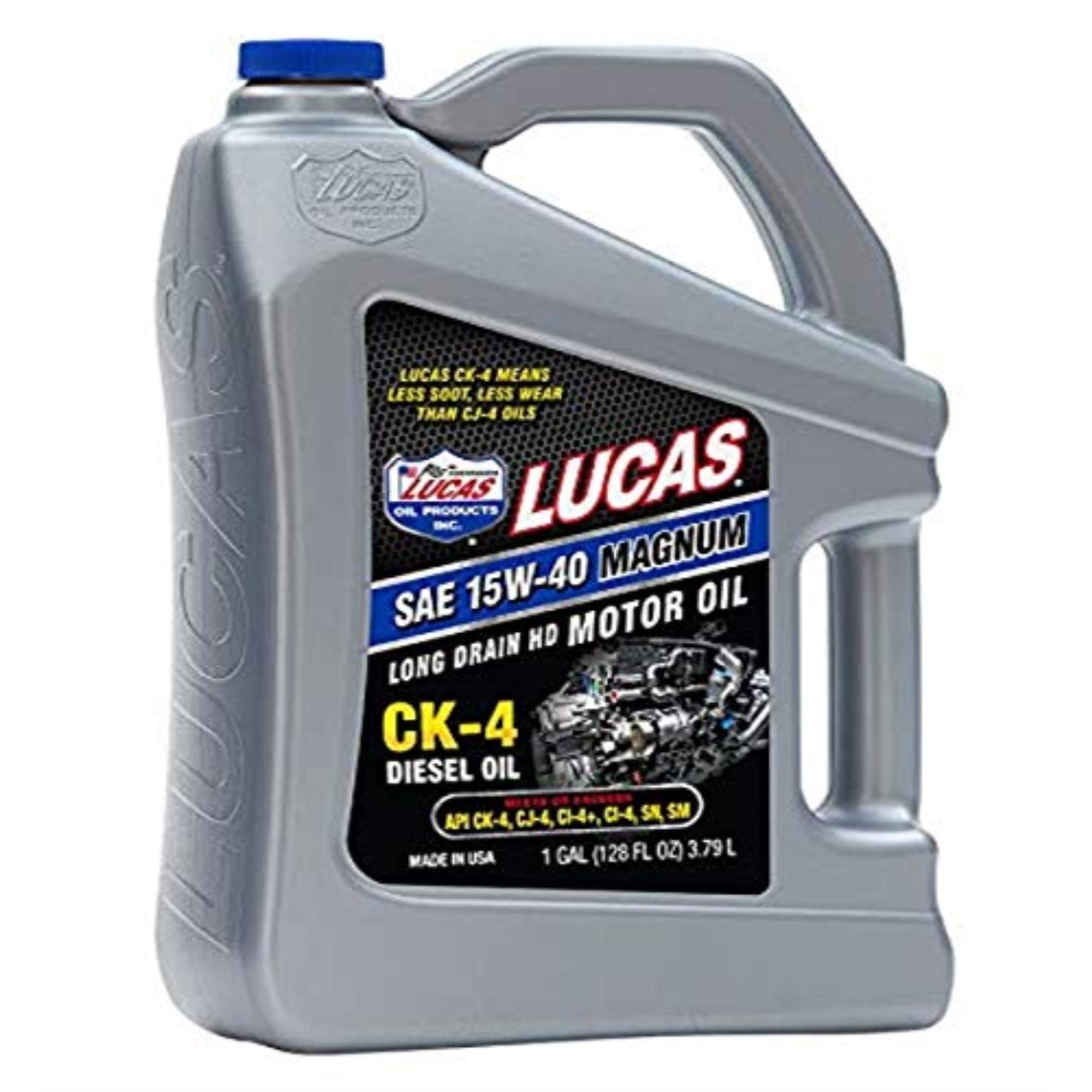
| Lucas Oil 15W-40 CK-4Classic Choice | Older diesel engines | 15W-40 | Conventional | CK-4 | Amazon |
| Mobil 1 Turbo Diesel 5W-40 | Modern truck full synthetic | 5W-40 | Full Synthetic | — | Amazon |
| Delo 400 XSP 5W-40 | Sub-zero cold starts | 5W-40 | Full Synthetic | — | Amazon |
| Triax Fleet Supreme 15W-40 | Extended drain intervals | 15W-40 | Full Synthetic | CK-4 | Amazon |
| ULTRA 1PLUS 15W-40 | Mixed fleet versatility | 15W-40 | Full Synthetic | CK-4/SN | Amazon |
| Hot Shot’s Secret Green Diamond 15W-40 | High-mileage wear protection | 15W-40 | Full Synthetic | CK-4 | Amazon |
| Schaeffer SynShield OTR Plus 5W-40 | Long-haul highway miles | 5W-40 | Full Synthetic | CK-4 | Amazon |
In‑Depth Reviews
1. Schaeffer SynShield Durability Advantage 15W-40
Our pick — over 4.5★ from 400+ verified ratings; the strongest balance of quality and price.
The 4.9-star-rated CK-4 formula that owners credit with quieting diesel tick and injector rattle on high-mileage Duramax and Power Stroke engines.
This is the oil that owners of high-mileage Duramax and Power Stroke engines swear by, and the 4.9-star rating across 400+ owners makes it the highest-rated pick here. What wins people over is its friction-modified formula with micron moly (a solid lubricant additive) that tackles the infamous diesel “tick” and injector rattle. One owner with a 2002 Duramax at 145,000 miles reported the rattle gone entirely and a 5 psi gain in idle oil pressure—proof that the additive package is doing real work.
It’s not just about noise. The CK-4 rated formula delivers strong oxidation and viscosity control with less oil consumption, plus superior soot-busting capability that keeps deposits from forming. That translates to what buyers report: one driver of a 2001 7.3L Power Stroke at 220,000 miles found the engine ran smoother, started easier, and even sounded better on the turbo. “Been running this for about 700 miles and its great. The engine runs quieter and gets around 2 more mpg,” as owners put it.
The standout spec is the 128 fluid ounce bottle (a full gallon) giving you enough for one complete oil change on most light-duty diesel trucks. At this quality tier it sits above the entry-level Lucas and Rotella options—you are paying for the additive technology and the longevity it buys, and the value-for-money sentiment is consistently positive among owners.
What Owners Rave About
- Noticeably quieter idle and reduced diesel tick on high-mileage engines
- Strong soot control keeps engines cleaner between changes
- Reported fuel economy gains of around 2 mpg
Who Should Pass
- Premium price means budget-conscious buyers may find cheaper CK-4 options
- Best results come with more frequent 4,000-mile changes rather than extended intervals
Reach for this if: you want the quietest, smoothest-running diesel and value additive technology over the lowest price.
Look elsewhere if: you’re on a strict budget and just need a reliable CK-4 oil for standard drain intervals.
2. Shell Rotella T4 Triple Protection 10W-30
The CK-4 10W-30 conventional that delivers heavy-duty protection and a slight fuel-economy edge at a budget-friendly price.
Shell Rotella is a name every diesel owner recognizes, and the T4 Triple Protection formula lives up to that reputation. The 10W-30 viscosity is the standout here—it’s thinner than a 15W-40, which means less resistance in the engine and better fuel economy, while still meeting the demanding CK-4 and CJ-4 specifications for modern emissions systems. This makes it a smart pick if you want the protection of a heavy-duty diesel oil with slightly better efficiency.
The Triple Protection technology guards against wear, deposits, and oil breakdown simultaneously, and the advanced low-ash formulation helps keep particulate filters from clogging. Owners put it through extremes: one reported it survived two weeks of continuous generator use with no metal flakes in the splash engine and no oil burn, calling it trusted for emergencies. Another noted lower engine temperature and noise running it in a Kohler 650cc engine, saying it outlasted Castrol.
At a price point well below the premium synthetics, this delivers genuine diesel-grade protection for farm equipment, construction machinery, and daily-driver trucks alike. Owners consistently mention the value, with one saying it’s “the best quality oil you can find” for their two diesel trucks, ordered through subscription because it’s cheaper than the stores.
Solid and dependable: This is the no-nonsense choice for owners who want a proven CK-4 oil without paying synthetic prices, and the thinner 10W-30 grade adds a small fuel economy edge.
The trade-off: It won’t deliver the long-drain or cold-start advantages of a full synthetic 5W-40.
3. Lucas Oil 10287 SAE 15W-40 API CK-4
The CK-4 15W-40 conventional that owners say quiets and smooths older diesel engines without the synthetic price tag.
Lucas has built its reputation on additives and fuel treatments, and this CK-4 rated 15W-40 heavy-duty motor oil brings that same trust to your crankcase. The value proposition is simple: longer engine life, extended oil changes, and less filter maintenance, all from a brand owners already know. On a 45-year-old diesel motor in a truck, one owner reported it “makes the 45 year diesel motor in my truck sound quieter and run smoother. No placebo, just daily driving it.”
The 128 fluid ounce gallon jug is the standard size for a full change on most pickups, and the CK-4 rating means it’s safe for modern emissions-equipped trucks while remaining backward-compatible with older engines. Owners run it in everything from John Deere walk-behind mowers to backhoes, praising the quality at a fair price point that sits near the budget end of this list.
One thoughtful owner added a note worth heeding: while it’s compatible with their equipment, they advised checking your own manual since not every engine calls for the same oil. It’s honest advice, and the universal compatibility across bus, car, and truck applications makes this a safe bet for mixed fleets.
Proven and priced right: A quality CK-4 oil that silences older diesels while staying affordable, backed by a name owners already trust.
Keep expectations measured: It’s a conventional oil, so don’t expect the extended drain intervals of a premium synthetic.
4. Mobil 1 Turbo Diesel Truck 5W-40 Full Synthetic

The full synthetic 5W-40 that delivers instant cold-weather starts and resists high-temperature breakdown for heavy towing.
Mobil 1 is the benchmark for synthetic motor oil, and this Turbo Diesel Truck formula is purpose-built for modern diesel engines. The 5W-40 viscosity is the key spec—that low winter number means the oil stays fluid enough to pump quickly on a cold morning, while the 40-grade thickness protects at full operating temperature. On a diesel van driven about 3,000 miles a week, one owner reported it “fires right up without hesitation” in very cold weather, a common pain point for diesel owners.
The full synthetic formula delivers long drain capability and exceptional performance for super high-performance diesel applications, including low-emission engines. It helps engines last longer by reducing low-temperature sludge buildup and high-temperature deposits, and the flash point of 234 °C (the temperature at which the oil vapor can ignite) shows real thermal stability. Owners of a 2011 Powerstroke report excellent wear protection in extreme conditions, with the oil resisting breakdown at high temperatures and minimizing sludge.
While the 3,800 ml jug (just over a gallon) is slightly unconventional, the protection profile is top-tier. It’s regularly called a “go to diesel oil” and a top-tier pick by owners who drive hard and work their trucks. Compared to the conventional 15W-40 options above, this is the clear step up for cold climates and heavy loads.
Why It Stands Out
- Exceptional cold-start performance in freezing temperatures
- Resists high-temperature breakdown for heavy towing and hauling
- Reduces sludge and deposits for a cleaner engine over time
Fair Caveats
- Full synthetic cost is higher than conventional blends
- The 3,800 ml jug is slightly less than a full gallon for some trucks
Grab this for: cold-climate drivers and anyone running a modern diesel hard who wants instant starts and maximum sludge protection.
Think twice if: your truck is an older model with simple needs and you prefer paying less per gallon.
5. Delo 400 XSP 5W-40 Full Synthetic

The Chevron full synthetic 5W-40 that owners mention delivers reliable sub-zero starts and smooth operation across diesel and gas engines.
Delo is a heavy-duty name from Chevron, and this XSP 5W-40 synthetic is engineered for the worst conditions a diesel can face. The headline spec is its promotion of consistent cold engine starting in sub-zero temperatures—a claim owners back up. One with a 10HP generator reported a 30°F drop in operating temperature, quieter and smoother running, and cleaner spark plugs with first-pull starts. On a 7.3L engine, it was the oil that made winter starts finally reliable.
The 5W-40 grade gives this the same cold-flow advantage as the Mobil 1 above, but Delo sets itself apart with versatility. Customers note it works beautifully in motorcycles—one describing buttery-smooth clutch engagement and crisp take-up on a 15,000 rpm sport bike, with the oil lasting longer before shearing than Rotella T. It’s also been used in a Mazda CX-5 turbo in place of a 5W-30 with zero oil consumption over 7,500 miles.
The 1-gallon jug is straightforward, and the U.S.-made formula earns frequent praise for quality. The single honest criticism in the data is the price—one owner simply called it “expensive.” If you need reliable cold starts and don’t mind paying for a premium brand, this is a top contender.
Versatile and capable: A premium synthetic that excels in sub-zero starts and crosses over into motorcycle and gas-turbo applications without complaint.
The honest catch: It’s one of the pricier gallons here, and owners note it needs warmer temps for optimal flow.
6. Triax Fleet Supreme 15W-40 Full Synthetic
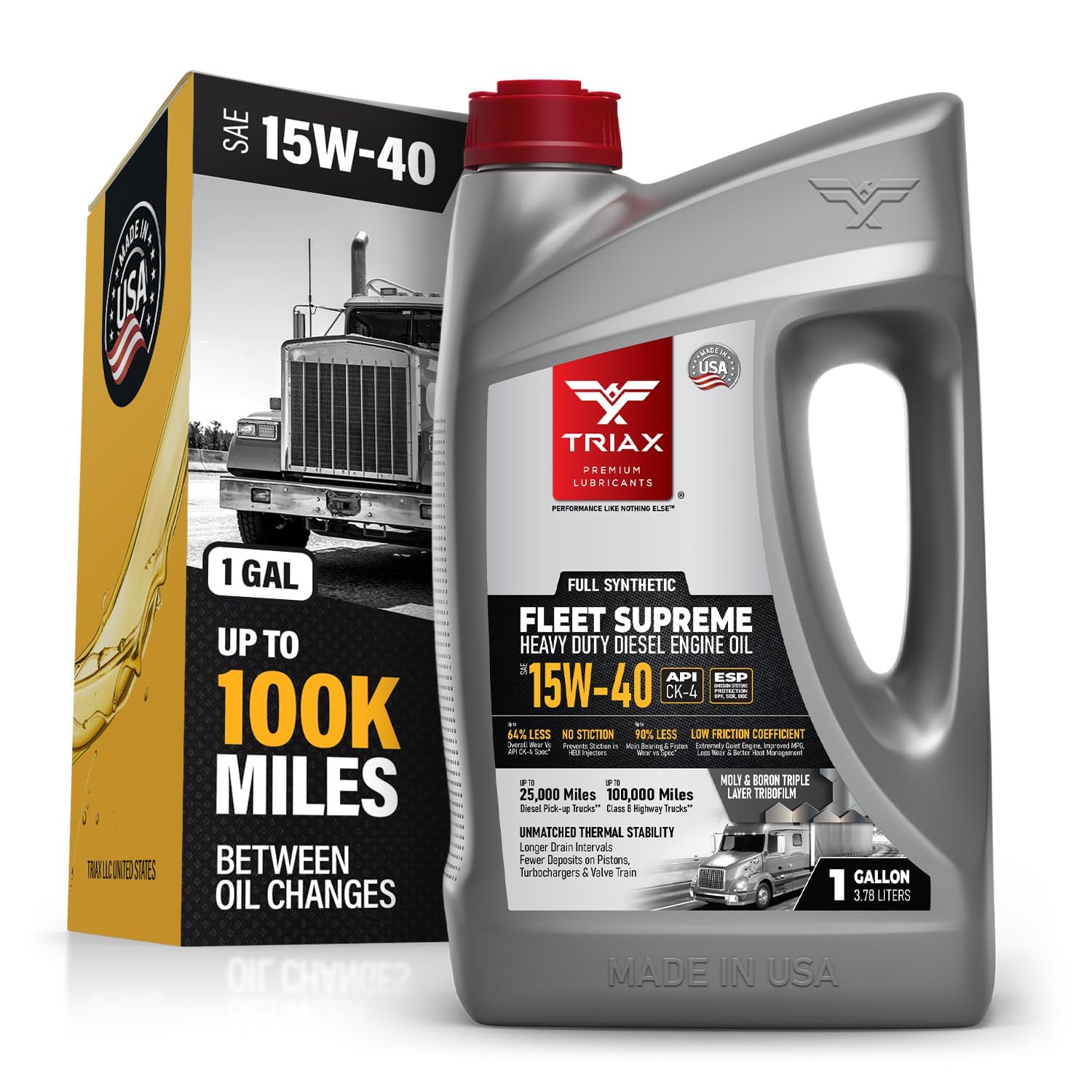
The CK-4 full synthetic 15W-40 that supports verified drain intervals up to 30,000 miles in pickups and starts reliably down to -45°F.
Triax built this CK-4 synthetic with the over-the-road trucker in mind, and the specs back it up with claims of drain intervals exceeding 100,000 miles for highway semis and 30,000 miles for Super Duty pickups. The formula is boosted with Nano-Boron and Moly friction modifiers for wear protection, with the manufacturer claiming up to 48% lower wear than industry standards thanks to a friction coefficient 50% lower than the competition. These are marketing claims, but the owner testing supports the direction.
Real-world analysis is where this oil shines. One owner ran an oil analysis at 15,250 miles showing the oil still “green” with additive depletion under 15-20%, and semis in their fleet running 75-90k mile drains with TBN (the oil’s reserve alkalinity to fight acid) staying stable and viscosity in spec. Another owner in Texas has used it for five years in a 2020 F250 6.7L across a tractor and mower, calling it top-shelf quality.
The cold-start spec is exceptional down to -45°F, which one owner verified with an instant startup at -20°F. Priced between the budget picks and the premium Schaeffer options, it offers full synthetic protection and long-drain capability at a mid-range cost. If you track your oil with analysis and want to stretch intervals, this is the pick that delivers.
The Big Wins
- Verified long-drain performance with stable oil analysis results
- Exceptional cold-start properties down to -45°F
- Moly and boron friction modifiers for strong wear protection
Reality Check
- Full synthetic pricing is higher than conventional options
- The extreme 100,000-mile drain claim suits highway semis, not daily pickup use
Choose this for: owners who run oil analysis and want to safely extend drain intervals on pickups and light fleet trucks.
skip it if: you change oil on a fixed schedule and don’t need long-drain capability.
7. ULTRA 1PLUS 15W-40 Full Synthetic

The CK-4/SN dual-rated full synthetic 15W-40 that covers diesel trucks, tractors, and gas engines with one formula.
This ULTRA 1PLUS formula is the most versatile oil on the list because of its dual rating. The API CK-4/SN certification covers both modern 2020+ on-highway trucks and Tier 4 non-road diesel engines, while also being backward compatible with all previous four-stroke diesels—and even suitable for gasoline heavy-duty applications. That “one oil for your entire fleet” promise is real, and it’s why owners with multiple machines appreciate it.
The flash point of 220 °C signals solid thermal stability, meaning the oil resists breaking down under heat and heavy loads. It’s engineered to protect against wear, piston deposits, soot thickening, oxidation, shear loss, and aeration, while minimizing oil burn-off and protecting DPF and EGR systems. On a Kubota BX2230 tractor, one owner noted it runs cool and keeps the engine clean after converting from conventional oil.
At a mid-range price for a full synthetic, this delivers strong value. Owners confirm it stays clean in the engine for a while with no leakage or sealing issues, and the American-made formula earns loyalty. It’s a smart pick if you have a mix of diesel trucks, tractors, and equipment and want one oil to simplify your shelf.
One oil, many machines: The CK-4/SN dual rating makes this a genuinely versatile synthetic for mixed fleets of trucks, tractors, and gas engines.
Notable trade-off: It’s a 15W-40, so cold-weather starts won’t match a 5W-40 synthetic.
8. Hot Shot’s Secret Green Diamond 15W-40

The CK-4 full synthetic 15W-40 with patented FR3 nanotechnology that owners say reduces wear and improves fuel economy on high-mileage engines.
Hot Shot’s Secret is famous in the diesel community for its additives, and Green Diamond brings that expertise into a full synthetic CK-4 oil. The defining tech is patented FR3 nanotechnology, which the maker claims gets into the fine crevices of your engine to create smooth, slick surfaces that minimize metal-on-metal contact. Compared to CJ-4 spec oils, the manufacturer claims a 71 percent reduction in wear and tear—a bold number, but owners of high-mileage trucks report real results.
The most compelling owner story is a 2002 Silverado 2500HD at 395,000 miles that’s run exclusively on this oil for two years, holding up to towing and extended intervals. Another with an LLY Duramax at 265,000 miles reported MPG improving from 18 to 22 at 70 mph on 33-inch tires, plus a quieter engine and better throttle response after switching from Rotella T6 with an additive. The Group III base oil blend is also claimed to improve fuel economy by up to 3 percent.
One owner of a 2017 Cummins 6.7 noted a similar sound to Amsoil with higher oil pressure and quieter idle after hot cycles, though a pungent exhaust smell suggested the high-zinc additive could be hard on catalytic converters—note if you run an emissions-equipped truck with a cat. At 128 fluid ounces per gallon, it’s priced as a premium synthetic for those who want maximum wear protection on high-mileage engines.
What It Delivers
- Strong wear protection on very high-mileage engines (395k mile Silverado)
- Reported fuel economy gains in real-world highway driving
- Quieter operation and better throttle response after switch
Consider This
- Gallon jug needs extra containers compared to a 5-quart bottle
- High-zinc additive may not suit trucks with catalytic converters
Best for: owners of high-mileage diesels who want aggressive wear protection and don’t mind a premium price.
pass on it if: your emissions-equipped truck still has a catalytic converter you want to protect.
9. Schaeffer SynShield OTR Plus 5W-40 Full Synthetic

The premium 5W-40 that oil-analysis fans run to 20,000 miles with confidence.
Schaeffer’s OTR Plus is the synthetic sibling to our top pick, and it’s engineered for the long-haul driver who racks up serious miles. The 5W-40 grade delivers superior cold-weather startability while maintaining fuel economy without sacrificing engine durability, and the full synthetic formula withstands a higher heat range than conventional oils. The keep-clean performance with superior soot-busting and deposit-dispersing capability is the same DNA as the 15W-40 winner.
This is the oil for the 50,000-miles-a-year driver. One owner running it in a 2024 6.7 Cummins reported better engine performance and smoother operation. The most striking proof comes from oil analysis: one owner runs it to 20,000 miles and it still tests good with 10,000-mile oil filter changes. Another confirms oil analysis at 5,000 miles shows no change needed, making it ideal for long drain intervals despite the premium price.
The highest EP (extreme pressure) additive molybdenum content found in any oil tested is a standout detail for wear protection. Owners of L5P engines and 6.0 Power Strokes report excellent performance with zero issues, and one saw start time halved after switching. The 128 fluid ounce bottle is the standard gallon size. It’s the priciest pick here, and value-for-money sentiment is genuinely mixed—some find it worth every mile, others note it’s cheaper at local shops.
The long-haul champion: Verified 20,000-mile drain capability with stable oil analysis makes this the pick for highway drivers who hate frequent changes.
The price reality: It’s the most expensive gallon here, and owners openly note you can find it cheaper locally.
Understanding the Specs
Viscosity Grade (SAE)
The “15W-40” or “5W-40” number tells you how the oil flows. The first number with a “W” (for winter) is the cold-flow rating—lower means it stays thinner when cold, so it reaches engine parts faster on a freezing start. The second number is the thickness at operating temperature; “40” is the standard for heavy-duty diesels. Pick a lower winter number like 5W if you face cold winters, or stick with 15W for general use.
API Service Category
The API (American Petroleum Institute) rating like CK-4 or CJ-4 tells you which engines the oil suits. CK-4 is the current standard for modern diesel engines with DPF and EGR emissions systems, and it’s backward-compatible with older engines. These are “low-ash” formulas that won’t clog your particulate filter. If your truck is newer than about 2010, CK-4 is the safe choice to protect both the engine and the emissions equipment.
Oil Analysis and TBN
Oil analysis is a lab test that measures the oil’s condition and lets you safely extend drain intervals. TBN (Total Base Number) is the oil’s reserve of alkalinity that fights acid buildup from combustion—a stable TBN means the oil is still protecting. Owners who run long intervals rely on these tests to prove the oil is still “green” before changing it.
Flash Point
The flash point is the temperature at which oil vapor can ignite, measured in °C. A higher flash point (like 234 °C on the Mobil 1) means the oil resists burning off and breaking down under extreme heat. It’s a useful indicator of thermal stability for trucks that tow heavy loads or run hot in summer.
FAQ
What is the difference between CK-4 and CJ-4 diesel oil?
Can I use 15W-40 instead of 5W-40 in my diesel truck?
How often should I change diesel engine oil?
Is full synthetic diesel oil worth the higher price?
Will the wrong oil damage my diesel engine?
What does the “W” mean in 15W-40?
Can one oil work for both my diesel truck and gas car?
Does diesel oil reduce engine noise and improve fuel economy?
What is TBN and why does it matter?
Is it okay to mix different brands of diesel oil?
Final Thoughts: The Verdict
For most people, the engine oil for diesel trucks winner is the Schaeffer SynShield 15W-40 because it delivers the quietest operation and strongest soot control at a 4.9-star crowd-pleasing rating. If you want instant cold starts and a full synthetic for a modern truck, grab the Mobil 1 Turbo Diesel 5W-40. And for budget-friendly heavy-duty protection that survives brutal conditions, the Shell Rotella T4 10W-30 is the one to reach for—it’s the entry-level pick with the most owner trust per dollar.
How We Picked
We do not accept paid placement. Every pick is matched to a real buyer and a real use-case; we do not hands-on test units.
Sources & Methodology
Specifications: manufacturer listings and product documentation. Review insights: verified customer reviews, as of August 2026. Pricing: not shown on this page (it changes often); check the current price via the retailer link.
As an Amazon Associate, Trending Car earns from qualifying purchases. This does not affect which products we feature.