
Our readers keep the lights on and my garage snacks stocked. As an Amazon Associate, I earn from qualifying purchases.
Specs are compiled from manufacturer listings and verified buyer reviews and can change over time — please confirm the key details on the product page before buying.
You’re loading up for a road trip or a weekend off-grid, and the last thing you want is soggy sandwiches from melted ice or lukewarm drinks halfway through day two. An electric travel cooler solves that: it plugs into your car’s 12V outlet or a household wall socket and actively chills food and drinks to whatever temperature you set, so everything stays fresh from the first mile to the last.
I’m Min Islam — the founder and writer behind Trending Car. This guide is built by comparing the manufacturers’ published specifications and the patterns across verified customer reviews, so you get each pick’s real strengths and trade-offs instead of marketing spin.
This roundup of the best electric travel cooler options covers seven popular portable electric coolers, so you can find the right match without wasting time on research.
Our Picks at a Glance

How To Choose The Best Electric Travel Cooler
Electric travel coolers fall into two main types: compressor-powered models (think of them as mini fridges with a freezer) and thermoelectric models (they use a chip to move heat, like a laptop cooler). Compressor units are heavier on the wallet but chill much colder, hold a steady temperature, and can freeze food. Thermoelectric units are lighter and cheaper, but they only cool about 30–35°F below the outside air temperature, so they won’t freeze anything on a hot day.
Cooling Method and Temperature Range
The cooling method is the single biggest factor in performance. A compressor cooler can drop to -4°F, which means it works as a freezer for ice cream and meat, and it maintains that temperature no matter how hot it is outside. A thermoelectric cooler, like the Igloo Iceless, cools to about 38°F below the ambient temperature — so when it is 95°F outside, you are looking at about 57°F inside, which keeps drinks cool but not ice-cold, and definitely won’t freeze anything.
Capacity and Size
Capacity is measured in quarts or liters, and it determines how much food and drink you can bring. A 10-quart (9-liter) unit is about the size of a small lunch box — good for a day trip for one or two people. A 23-quart (22-liter) unit can hold 12 soda cans plus a 3-quart Instant Pot, as Megiu buyers report, making it ideal for a weekend trip. A 35-quart model can fit 40 cans, suitable for longer family outings. Match the size to your real use: a cooler that is too big wastes space and power; one that is too small forces you to buy ice anyway.
Battery Protection
When you plug a cooler into your car’s 12V outlet (often called a cigarette lighter), it draws power from your vehicle’s starter battery. If you leave the cooler running while the engine is off, it could drain the battery enough that your car won’t start. A good cooler has a battery protection system with three levels: Low, Medium, and High. At the High setting, the compressor shuts off earlier, leaving plenty of juice for starting your engine. Most models on this list include this feature.
Power Consumption
How much electricity a cooler uses matters if you run it on a portable power station (like a Jackery or EcoFlow) or on solar. Compressor coolers typically draw 28 to 45 watts when running, which is about the same as a small laptop charger. Some models, like the Setpower RF20, use as little as 28W in ECO mode, consuming less than 1 kWh per day. Thermoelectric units often use more power — around 45-60W — for less cooling performance. If you are running off a battery, choose a compressor model with an ECO mode for the best efficiency.
Quick Comparison
| Model | Best For | Capacity | Cooling Method | Power Consumption | Amazon |
|---|---|---|---|---|---|
| Megiu 23 Quart★ Best Overall | Overall performance & value | 23 quarts | Compressor | 45W avg | Amazon |
| Setpower 21 QuartLong-Range Champ | Long off-grid trips | 21 quarts | Compressor | 28W (ECO) | Amazon |
| Alpicool MG15 16 Quart | Reliable everyday use | 16 quarts | Compressor | — | Amazon |
| VEVOR 10 Quart | Best value & app control | 9 liters | Compressor | — | Amazon |
| Alpicool C9PT 10 Quart | Ultra-compact budget pick | 9.09 liters | Compressor | — | Amazon |
| AooDen 35 Quart | Large family road trips | 33 liters | Thermoelectric | 45W (DC) | Amazon |
| Igloo Iceless 40 Quart | Warming function & rollability | 40 liters | Thermoelectric | — | Amazon |
In‑Depth Reviews
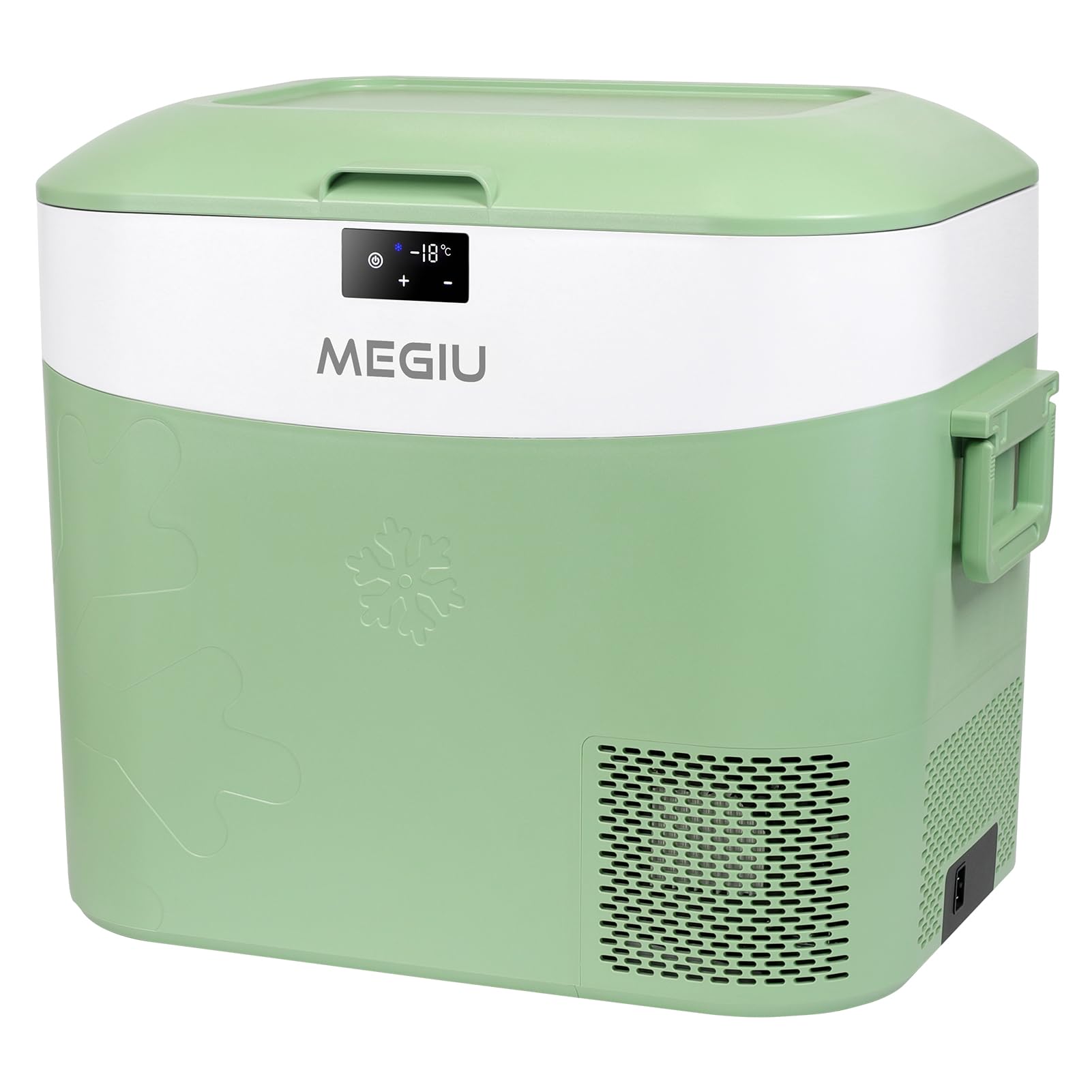
1. Megiu Car Fridge Portable 12 Volt Refrigerator 23 Quart
Our pick — 4.5★ from 850+ verified ratings; the strongest balance of quality and price.
The 23-quart mid-size that balances capacity, power use, and price better than anything else here.
This Megiu is a compressor-driven cooler that can hit 32°F in just 15 minutes and reach -0.4°F within 40 minutes, which means you can actually freeze ice cream and keep meat solid on a weekend trip. The average draw is only 45W, so it uses less than 1 kWh per day — light enough that owners mention boondocking off-grid for three days with a 618Wh power station. It runs at under 40 decibels, quieter than most traditional compressors, and includes three levels of battery protection to keep your car from being stranded.
Buyers also note that it fits 12 soda cans plus a 3-quart Instant Pot, and the 18.5lb weight makes it manageable to shift from trunk to campsite. Some reviews mention a slight temperature display offset — one unit showed 32°F when the actual interior was 45°F — and the plastic can carry a strong smell when new. But most owners praise its quiet operation and energy efficiency, especially compared to passive ice coolers.
Why It Earns the Top Spot
- Rapid cooling: 15 minutes to 32°F, 40 minutes to -0.4°F
- Low power consumption: 45W average, under 1 kWh/day
- Includes AC and DC cables for home and vehicle use
- 3-year compressor warranty adds confidence
Honest Caveats
- Some units show a temperature reading that is off by a few degrees
- Strong plastic odor reported upon first use
- Minimal insulation means it warms up quickly when unplugged
Reach for this if: you want a dependable compressor cooler with fast chilling, low power draw, and enough room for two people on a weekend trip.
Look elsewhere if: you need a zero-compromise, military-grade build or an integrated ice pack for extended power outages — the Setpower below handles that scenario better.
2. Setpower 12V Refrigerator 21 Quart Portable Freezer
The Setpower keeps food cold for 50 hours after you lose power — a genuine safety net for off-grid living.
The set-apart feature here is the built-in ice pack that acts as both a divider and a thermal battery: if the power cuts out, the cooler stays at safe temperatures for up to 50 hours. That is a rare spec in this category. The compressor draws only 28W in ECO mode, so you can easily run it from a small portable power station for days. It cools from 77°F to 32°F in 15 minutes, and down to -4°F in 45 minutes, matching the Megiu for speed but adding that backup cooling margin.
One thing the Megiu does not offer: both zones can act as a freezer or a fridge independently, rated as a true dual-zone compressor cooler. Weighing 22.1lbs, it is noticeably heavier than the 18.5lb Megiu — about a 3.6lb difference — so it is less ideal if you are moving it in and out of a car constantly. Buyers also mention that 21 quarts is slightly large for a small trunk, but the sturdy build and excellent seal earn high marks.
Why It Stands Out
- 50-hour backup cooling with built-in ice pack
- Ultra-low 28W ECO mode for extended battery life
- True dual-zone capability for flexible storage
- App control for temperature monitoring from your phone
Trade-offs to Consider
- Heavier than the competition at 22.1 lbs
- May be too large for compact car trunks
Best suited for: van-lifers, RV owners, or anyone who camps off-grid and needs a cooler that handles power cuts gracefully.
skip it if: weight is your primary concern or you only need a cooler for short day trips — the Megiu is lighter and cheaper.
3. Alpicool MG15 Mini Portable Freezer, 16 Quart
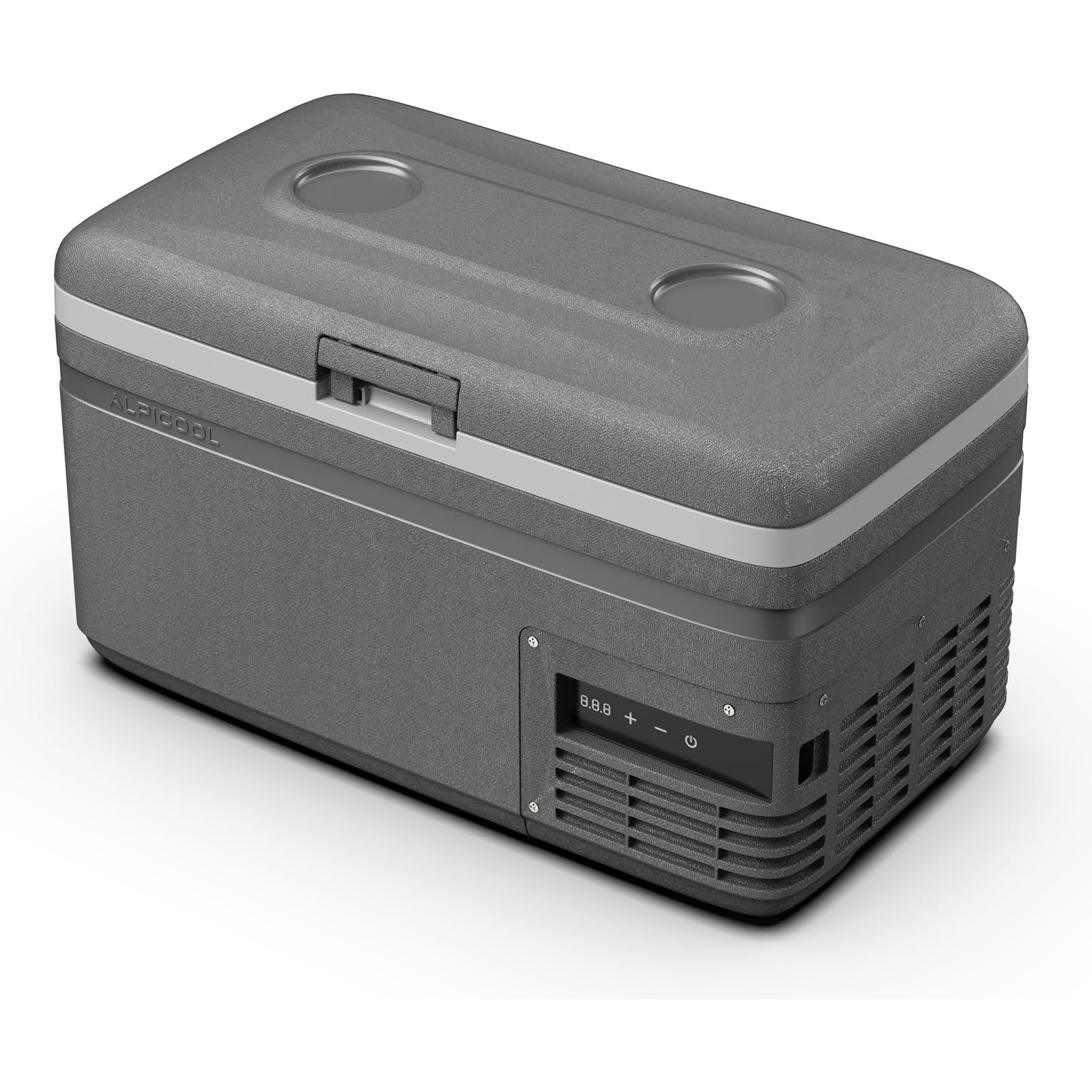
An everyday compressor cooler that is large enough for a week’s food for two without being a trunk hog.
The MG15 holds 16 quarts, which translates to 12 bottles of 18oz water or 16 standard soda cans — enough for a weekly grocery run or a long camping trip. At 16.3lbs and with external dimensions of 16.3 x 10.6 x 11.7 inches, it is compact enough to sit on a passenger floorboard. It uses a compressor that can drop to -4°F, covering the same freezer range as the pricier Megiu and Setpower. The temperature memory function remembers your setting after a power cycle, and the three-level battery protection (Low, Med, High) keeps your vehicle battery safe.
One weak point buyers point out: the handles feel fragile and the top compartment is nearly useless for storage. Some report needing to set the temperature about 4°F lower than what you actually want because the displayed reading runs high. But most owners say it works great for 1-2 person trips and the Bluetooth app is convenient.
What Works Well
- 16-quart capacity fits a week’s food for two people
- Lightweight at 16.3 lbs for everyday use
- Bluetooth app for convenient temperature adjustments
What Could Be Better
- Handles are not built for rough handling
- Temperature display may need a 4°F offset
- Slight condensation reported in some units
A solid choice for: daily commuters, campers, and anyone who wants a reliable mid-size cooler without spending on premium features.
Not for you if: you need the smallest possible profile — the VEVOR 10-quart or Alpicool C9PT are more compact — or you require heavy-duty handles for frequent transport.
4. VEVOR 12V Car Refrigerator 10 Quart
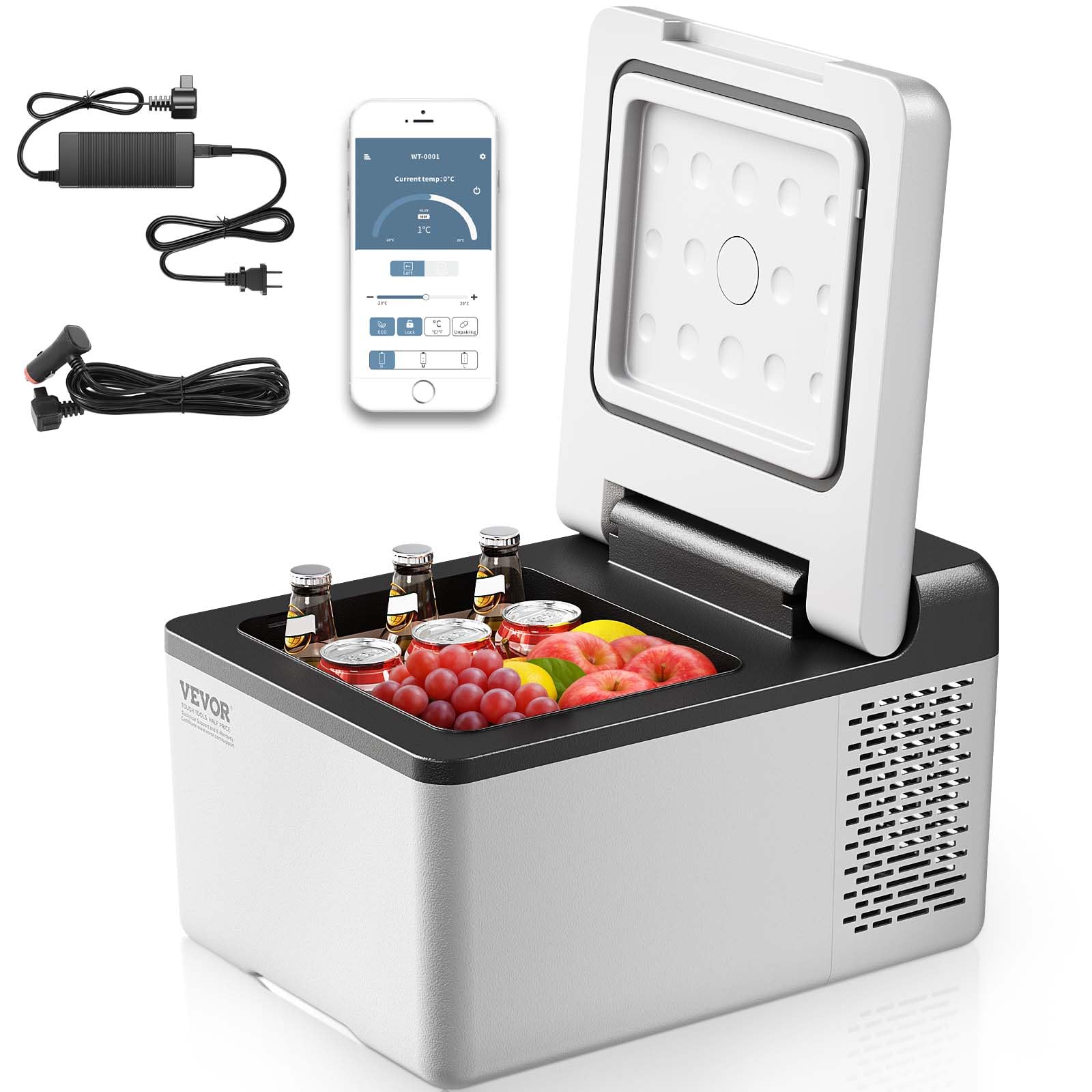
A tiny, app-connected compressor cooler that can chill from 94°F to 36°F in about 15 minutes — remarkable for the size.
At just 9 liters (about 10 quarts), the VEVOR is the smallest compressor cooler on this list, but it packs a punch. The compressor drops the interior temperature from 94°F to 36°F in roughly 15 minutes, according to buyer reports, making it ideal for grabbing groceries on a hot day and keeping them cold during the drive home. The Bluetooth app lets you adjust temperature, cooling aggressiveness, and battery protection levels without opening the lid. The annual energy consumption is only 45 kWh, which is roughly a third of the 130 kWh that the Alpicool C9PT and MG15 use — a huge efficiency advantage.
On the downside, the 9-liter interior is tight: Guinness cans barely fit upright, and longnecks need to lie sideways, as a reviewer notes. The unit lacks an exterior latch and had only indent handles instead of carry handles. Still, for a lunch-box-sized cooler that can freeze solid, it is a strong value. One owner said it ran for three days on a 300W battery in hot Texas heat without a break, keeping drinks and medication at 36°F.
What Makes It a Winner
- Very low energy use at 45 kWh per year
- Fast cooling from hot ambient temps
- Bluetooth app provides flexible control
- Three-level battery protection built in
What to Watch For
- Small interior limits can-size and bottle orientation
- No exterior latch or lock loop
- Indent handles make carrying awkward when full
Go for this if: you want the most energy-efficient compressor cooler for a personal car, office, or small-day trips where space is tight.
Pass if: you need to pack large bottles or multiple days of food for more than one person — the Alpicool MG15 or Megiu offers much more room for a modest bump in size.
5. Alpicool C9PT Portable Car Freezer Cooler, 10 Quart

The C9PT is the cheapest compressor cooler here — but it still freezes down to -4°F and runs on a whisper.
This 10-quart (9.09-liter) unit from Alpicool is the entry-level compressor cooler that still does real freezing work. It fits 8 bottles of 18oz water or 12 cans of 12oz soda, making it a personal cooler for one person on a day trip. At 14.8lbs, it is the lightest of the compressor coolers on this list, and it is 1.5lbs lighter than the Alpicool MG15, so carrying it around is genuinely easy. It includes both MAX and ECO modes, and the three-level battery protection system that Alpicool uses across its lineup.
The trade-off: some customers note the temperature fluctuates 4-5°F before the compressor kicks back on, and it makes a soft high-pitched noise during that cycle. The ventilation grilles on three sides limit where you can place it — it needs airflow all around. Also, the annual energy consumption of 130 kWh is much higher than the VEVOR’s 45 kWh. Still, reviewers point out it is quiet, efficient, and a bargain at this price point, with no drips and no ice to deal with.
What You Get for the Money
- True compressor freezing power at a low entry price
- Lightest in class at 14.8 lbs
- MAX and ECO modes for faster cooling or energy saving
What You Compromise
- Temperature swings of 4-5°F before the compressor cycles on
- Three-sided ventilation limits placement options
- Higher energy consumption than comparable small units
Ideal for: a budget-conscious single traveler, truck driver, or office worker who just needs a personal fridge that can also freeze items.
Not for: anyone who needs stable, low-maintenance temperatures for sensitive items like medication or gourmet foods — the VEVOR or Megiu hold tighter temps.
6. Electric Car Cooler and Warmer 35 Quart with Draw Bar and Wheels

A 35-quart thermoelectric cooler with a telescopic handle and wheels — think of it as a rolling cooler that also warms.
This AooDen unit is one of the largest electric coolers here at 35 quarts (33 liters), capable of holding up to 40 cans of 12oz soda. It runs on thermoelectric technology, meaning it cools 30-35°F below the outdoor temperature and can warm contents up to 140-145°F — which makes it useful both for chilling drinks and for keeping a hot meal warm during a road trip. The built-in wheels and draw bar make it easy to pull across parking lots or campsites, and the removable divider helps organize snacks and drinks.
Because it is thermoelectric, not compressor-based, it will not freeze anything and its cooling power declines as outdoor temperatures rise. One reviewer noted that the handle attachment points feel a bit chintzy, and another reported the unit stopped working within one year. Also, the rest time between switching from cool to warm mode is 30 minutes, which is a quirk of the thermoelectric design. For large-group road trips where you just need drinks cold and don’t need a freezer, this rolling cooler is convenient and affordable.
The Big Advantages
- Large 35-quart capacity with wheels for easy transport
- Dual-mode: cools 30-35°F below ambient or warms to 140-145°F
- Includes both 12V DC and 110V AC power cables
Where It Falls Short
- Cannot freeze; chilling power drops in hot weather
- Handle build quality raises durability concerns
- Must wait 30 minutes before switching between cool and warm
Best for: large families, tailgaters, or anyone who hates carrying a heavy cooler — the wheels are a genuine convenience for hauling from car to picnic spot.
pass on it if: you need freezing capability or a cooler that can handle 100°F+ days confidently — stick with a compressor model from this list.
7. Igloo Iceless Thermoelectric Cooler 40 Quart

An iconic Igloo with a thermoelectric heart — it keeps drinks 38°F cooler than the air around them, no ice needed.
This classic Igloo is the biggest cooler by capacity here at 40 quarts (40 liters), and it runs on a thermoelectric system that uses a fan to circulate cold air. It cools to 38°F below the ambient temperature, so on a 75°F day you get about 37°F interior, but on a 95°F day you get around 57°F. You can use it upright like a mini-fridge or lay it on its side like an ice chest, thanks to the adjustable shelf/divider. It is powered by a 12V DC auto plug adapter, so it runs from your car’s cigarette lighter.
Being a thermoelectric unit, this Igloo cannot freeze food, and it relies on ambient temperature for its cooling delta. Some owners mention that the power cord can be a weak point — one buyer mentioned the plug burned out within a month — and the lid does not stay up on its own. The benefit here is that there is no compressor noise or vibration, and you never have to deal with melting ice or water cleanup. For road trips and hotel rooms where you just want chilled drinks and snacks, this is a simple, familiar option.
Pro Points
- Very large 40-liter capacity for bulk storage
- Can be used horizontally or vertically
- No messy ice or water drainage needed
Con Points
- Cannot freeze; performance drops in high ambient heat
- Some reports of power cord durability issues
- Lid does not stay open on its own
Best for: casual road-trippers who want a large, quiet cooler for cold drinks and snacks without the complexity of a compressor unit.
Not for: anyone who needs freezer-level temps or reliable cold performance in desert heat — a compressor cooler like the VEVOR or Alpicool C9PT is a better fit.
Understanding the Specs
Compressor vs Thermoelectric
A compressor cooler works like a mini fridge, using a pump and refrigerant to create temperatures as low as -4°F. It runs regardless of outside heat, so your drinks stay ice-cold even when the car is parked in direct sun. A thermoelectric cooler uses a Peltier chip to move heat from the inside to the outside. It is cheaper and quieter, but it only cools about 30-38°F below the outside air temperature. For freezing or hot-weather use, choose a compressor model.
Battery Protection Levels
Most compressor coolers offer three battery protection settings: Low (H1), Medium (H2), and High (H3). When set to High, the cooler shuts off its compressor earlier to leave more charge in your car battery — this is the safe choice for overnight parking. Low allows the compressor to run longer, which is fine while the engine is running but risky when off. Always use the High setting if you are running the cooler from your vehicle’s starter battery without the engine on.
Annual Energy Consumption
This number, listed in kilowatt-hours per year, tells you how much electricity a cooler uses over a full year if it ran continuously. The VEVOR 10-quart uses 45 kWh per year, while the Alpicool C9PT uses 130 kWh — nearly three times as much. If you power a cooler from a portable power station or solar panel, a lower annual figure is better. For occasional car use, the difference is less important; for constant off-grid living, it matters a lot.
Weight and Portability
Compressor coolers are heavier than passive or thermoelectric units because they contain a motor and refrigerant. The lightest compressor model here is the Alpicool C9PT at 14.8lbs, while the largest compressor, the Setpower, is 22.1lbs. For a cooler you move between car and campsite frequently, lighter is better. For one that lives in a trunk or an RV, weight matters less. The thermoelectric AooDen with wheels is heavy (though exact weight is not given) but rolls easily, making it a good trade-off for some buyers.
FAQ
Will an electric travel cooler drain my car battery?
Can an electric travel cooler freeze food?
How long does an electric cooler take to get cold?
What is the difference between a compressor and a thermoelectric cooler?
Can I use an electric travel cooler at home on AC power?
How much power does an electric travel cooler use?
Will a 12V cooler work with a portable power station?
How do I clean and maintain an electric travel cooler?
Final Thoughts: The Verdict
For most people, the best electric travel cooler winner is the Megiu 23 Quart because it strikes an ideal balance of capacity, cooling speed, power consumption, and price — handling everything from day trips to weekend camping without overspending. If you want the ultimate off-grid safety net with 50-hour backup cooling, grab the Setpower 21 Quart. And for a compact, ultra-efficient personal cooler that sips power and chills fast, the standout is the VEVOR 10 Quart.
How We Picked
We do not accept paid placement. Every pick is matched to a real buyer and a real use-case; we do not hands-on test units.
Sources & Methodology
Specifications: manufacturer listings and product documentation. Review insights: verified customer reviews, as of July 2026. Pricing: not shown on this page (it changes often); check the current price via the retailer link.
As an Amazon Associate, Trending Car earns from qualifying purchases. This does not affect which products we feature.