
Our readers keep the lights on and my garage snacks stocked. As an Amazon Associate, I earn from qualifying purchases.
Specs are compiled from manufacturer listings and verified buyer reviews and can change over time — please confirm the key details on the product page before buying.
A freezing garage turns every job into a battle—stiff fingers, slow battery tools, and a car that groans instead of starts. The right heater changes all of that, but the wrong one just runs up your electric bill without making a dent in the cold. This guide cuts through the noise to find the electric space heater for garage that actually fits your space, your power setup, and your budget.
I’m Min Islam — the founder and writer behind Trending Car. This guide is built by comparing the manufacturers’ published specifications and the patterns across verified customer reviews, so you get each pick’s real strengths and trade-offs instead of marketing spin.
The picks below cover everything from a compact 1500W unit for a workbench to a 7500W monster that can heat a 1250-square-foot shop, all to help you choose the right electric space heater for garage.
Our Picks at a Glance

How To Choose The Best Electric Space Heater For Garage
Picking a garage heater boils down to three things: how big your space is, what kind of electrical outlet you have, and how fast you want it to get warm. Miss one of these and you end up with either a heater that trips the breaker or one that runs all day without catching up to the cold.
Match Wattage to Square Footage
A rough rule of thumb is roughly 10 watts per square foot for a well-insulated garage (an uninsulated space needs more). So a 1500-watt heater is good for just one or two workstations, while the big 4800-to-7500-watt units can handle an entire shop of 500 to 1250 square feet. The heating coverage spec on each product’s data sheet is your real guide: stay inside that number or the heater never stops running.
Check Your Power (120V, 240V, or Hardwired)
Most standard home outlets are 120V and max out around 1500 watts. If you want more heat power, you need a 240V outlet (the same kind your dryer or oven uses) or a hardwired installation done by an electrician. The amperage spec tells you the rest: a 12.5-amp heater plugs into a typical circuit, but a 30-amp heater needs a dedicated breaker. Ignore this, and the unit is useless before you even unbox it.
Forced Air vs. Radiant Heat
Fan-forced heaters blow hot air across the whole room—they warm the air, not you directly—so they are best for heating an entire garage evenly. Radiant (or infrared) heaters warm people and objects in their line of sight, which means you feel heat immediately but the air stays cooler; this works well if you stand in one spot at a workbench. You will also see ceramic and quartz elements—these just change how the heat is generated, but the method (forced air or radiant) is the bigger decision.
Quick Comparison
| Model | Best For | Heat Output | Heating Coverage | Power / Amperage | Amazon |
|---|---|---|---|---|---|
| Dura Heat EUH1465★ Best Overall | Small workbench area | 5,120 BTU | 250 sq ft | 1,500W / 12.5 Amps | Amazon |
| Comfort Zone 4,800WAlso Great | Large shop coverage | 17,065 BTU | 1,000 sq. ft. | 4,800W / 30 Amps | Amazon |
| Riseon 7500W | Maximum power, remote control | 25,590 BTU | 1,250 sq. ft. | 7,500W / Hardwired | Amazon |
| GiveBest UPH310M | Smart features, wall mount | 1,500 Watts | — | 1,500W / standard 120V | Amazon |
| Dura Heat EUH4000 240V | Permanent shop installation | 12,800 BTU | 500 sq. ft. | 3,750W / 20 Amps (240V) | Amazon |
| Shinic 2-Pack Radiant | Targeted heat with work light | 1,500W per unit | 400-600 sq. ft. (total) | 1,500W per unit / 12.5 Amps | Amazon |
| DR. INFRARED HEATER DR218 | Greenhouse and small spaces | 1,500 Watts | 150 Sq. ft | 1,500W / 12.5 Amps | Amazon |
In‑Depth Reviews
1. Dura Heat EUH1465 Electric Forced Air Heater
Our pick — over 4★ from 800+ verified ratings; the strongest balance of quality and price.
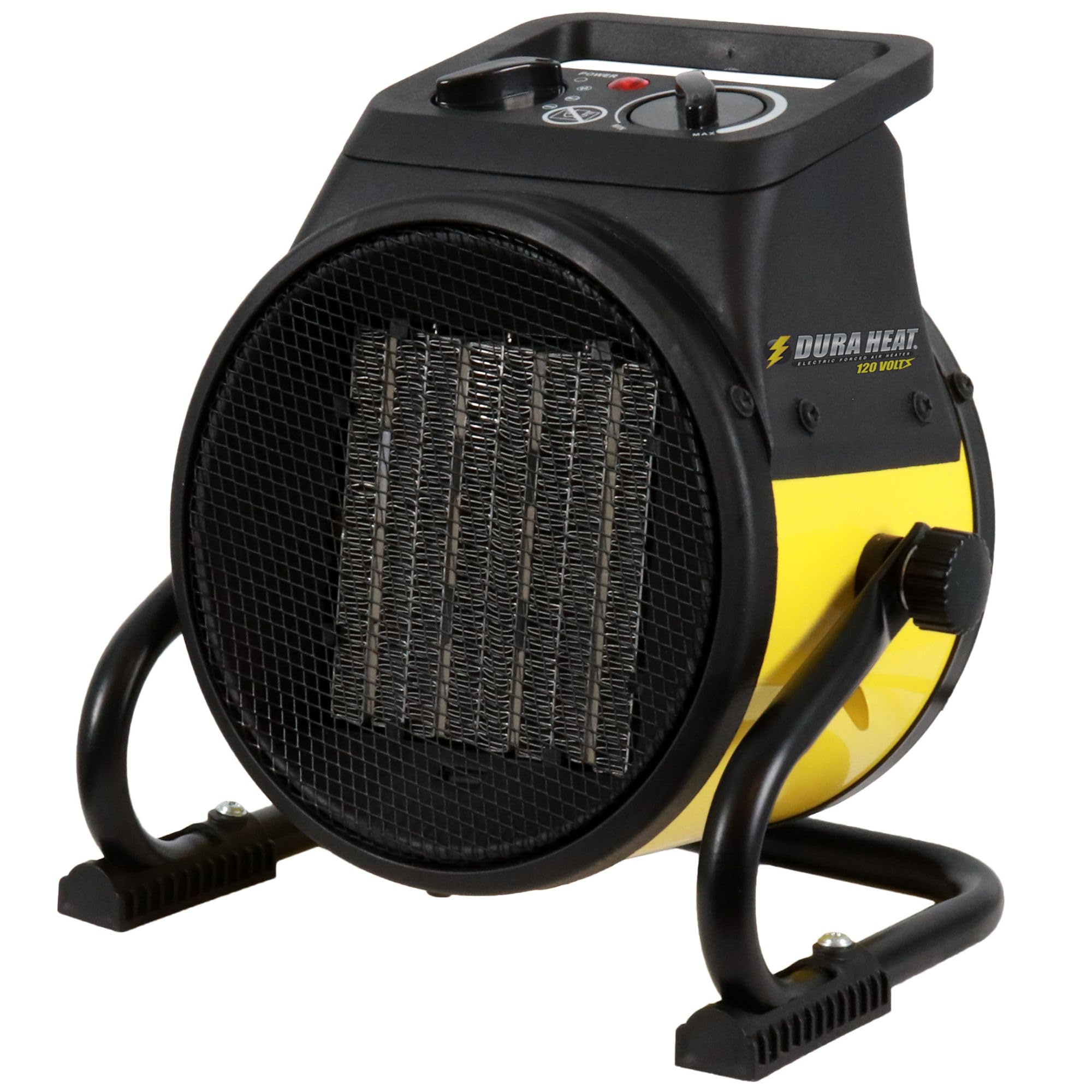
A rugged 5,120-BTU mini heater that hides on a workbench and warms a small area fast.
This yellow and black metal cabinet is the smallest and most affordable option here, but do not call it a toy. It delivers 5120 British Thermal Units from a 1500-watt PTC ceramic element—a type of heating element that self-regulates temperature better than a simple coil. It covers 250 square feet, which is a noticeable step up from 150-square-foot units, though the heating coverage spec still makes it best as a personal space heater for a single workbench or a 6×13 ft porch.
Buyers have mixed long-term reports: one used it for three years with zero maintenance in a 6×6 metal building, while another said that after one year left outside the heat and fan output dropped to half. The size is genuinely compact—just 6.5 inches deep, 8 inches wide, and 8.5 inches high—which means it tucks under a shelf easily. It is also the smallest heater here by volume, which helps explain why it is less capable than larger units.
Small space specialist: The lowest-cost entry into powered garage heat. The steel body feels more durable than a plastic fan heater. For a large garage, the 250-square-foot limit means it will be running full time without keeping up on a freezing day.
Best for: a small insulated workshop, a foot-warming spot next to a workbench, or taking the chill off a tiny space.
2. Comfort Zone 4,800W Electric Fan-Forced Industrial Space Heater
The 4800-watt brute that blankets a 1000-square-foot shop in heat.
If you have serious floor space to warm, this red metal cabinet is where you start. It pumps 17,065 British Thermal Units (the standard measure of heat energy) into the room, which is more than three times the output of a standard 1500-watt heater. The fan-forced air design spreads that warmth evenly without relying on line-of-sight, so tools and workbenches across a 30-by-32-foot space all get the same treatment.
The catch is the plug: it requires a NEMA 6-30P (a special 30-amp, 240-volt outlet like a heavy appliance uses), so a standard wall outlet is useless here. Buyers report that one owner wall-mounted it in his garage with a wifi thermostat and used roughly 1000 kWh by mid-February, keeping his shop at 40°F in central Indiana—which cost about plus tax. At 30 Amps, it draws more than double the power of a typical 12.5-amp heater, getting you rapid, powerful heat that the smaller units cannot match.
Raw power trade-off: For maximum heat across a large uninsulated or well-insulated shop, nothing else on this list delivers more BTU per dollar. The trade-off is the 30-amp circuit requirement—plan for an electrician visit before you buy.
Reach for this if: you have a big garage (500-1000 sq ft) and a 240V 30-amp outlet, or are willing to install one.
Look elsewhere if: you only have standard 120V outlets—this heater will be a paperweight without the right circuit.
3. Riseon 7500W Electric Garage Heater with Remote
The only 7,500-watt unit here with a remote control and ECO mode.
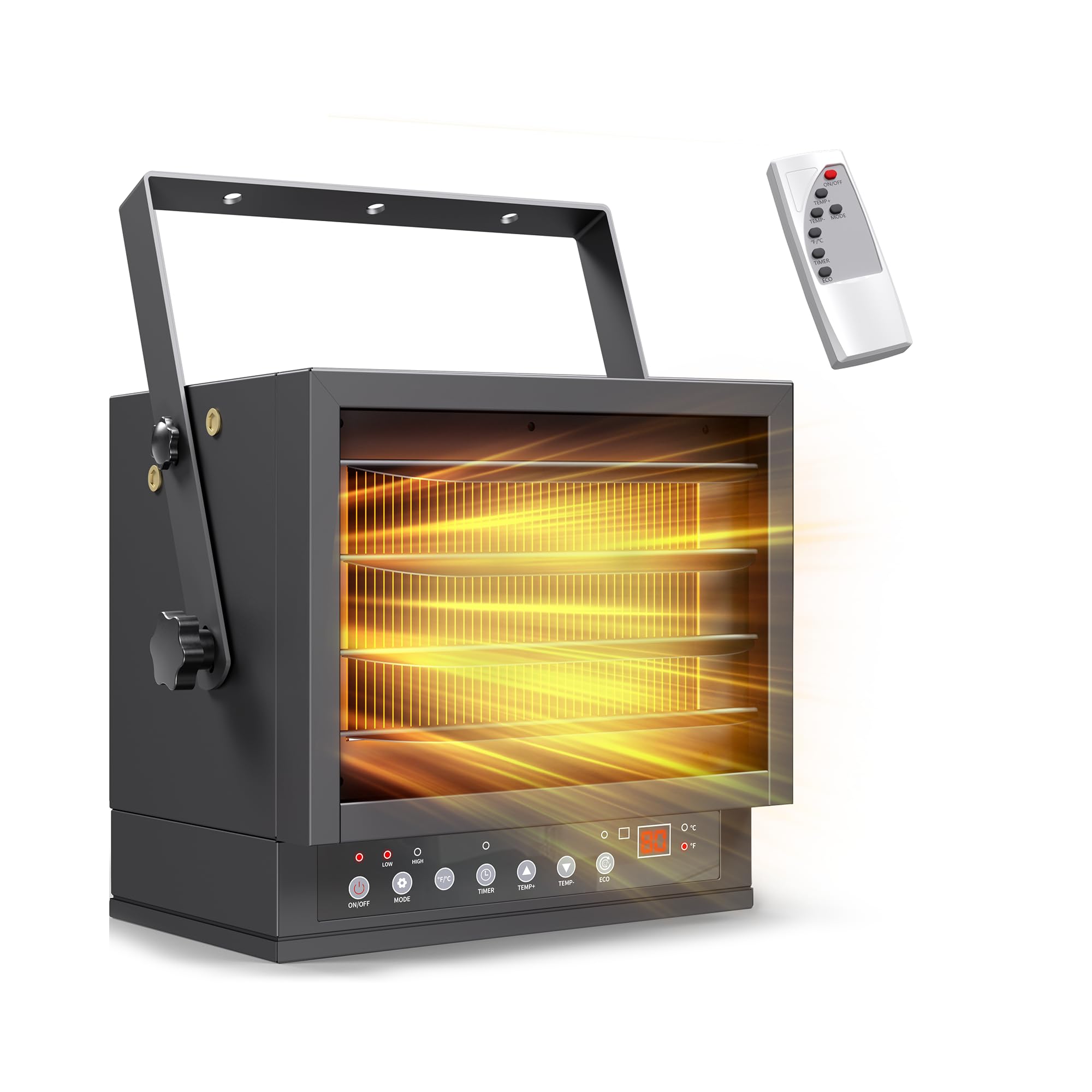
This is the most powerful heater you will find in this roundup, designed to cover up to 1250 square feet with a maximum output of 25,590 BTU. It surpasses the Comfort Zone above by a wide margin. It also brings modern controls—an LED touch screen, a remote, and an ECO mode that uses a temperature sensor to adjust the power automatically so it does not blast full heat when the garage is already warm.
The installation is harder though: it is a hardwired 240-volt unit that needs a qualified electrician to connect it to a properly sized breaker—it does not come with a power cord. A buyer reported it heated a 1500-square-foot shop well enough that he rarely needed his mini splits. Another user in New England noted it took a couple hours to take the chill off a two-car garage.
Why it stands out
- Highest BTU in this list at 25,590 for big or uninsulated spaces
- Remote and ECO mode help manage energy use better than simpler units
- Adjustable louvers for directing airflow
The catch
- Hardwired installation requires an electrician—no plugging in
- Reports of units failing after short use (stuck fan speed, thermostat issues)
Best for: big shops, warehouses, and gyms where you want the power of a commercial heater with the convenience of a remote.
4. GiveBest Electric Wall Mounted Heater UPH310M

A 1500-watt smart heater that mounts on the wall and takes voice commands.
Do not let the wattage fool you—this grey wall-mounted unit cannot heat a four-car garage, but for a well-insulated workshop, a basement nook, or a small office above the garage it brings a feature set the heavy-duty units lack. It has five heating modes: ECO, three power levels (1500W, 1000W, 600W), and a fan-only setting. You can control it via touch, a remote, a WiFi app, or by telling Alexa to turn it up—which is perfect if you are under a car and do not want to walk over.
The adjustable thermostat lets you set the room temperature between 41°F and 95°F in 1-degree increments, and the ECO mode cuts power once the room hits your target. Owners mention it heats fast and is quiet enough for a bedroom. While the heating coverage spec is not listed directly, a 1500-watt unit is typically good for roughly 150 square feet for primary heat or up to 250 square feet for supplemental warmth.
Versatile but limited: If your garage is finished, insulated, and you want low-noise heat with app/voice control, this is the easiest pick. For a large, drafty garage you need something with more raw wattage.
Best for: attached or finished garages, home offices, and anyone who wants smart controls without rewiring.
5. Dura Heat 240V Electric Space Heater for Garage EUH4000
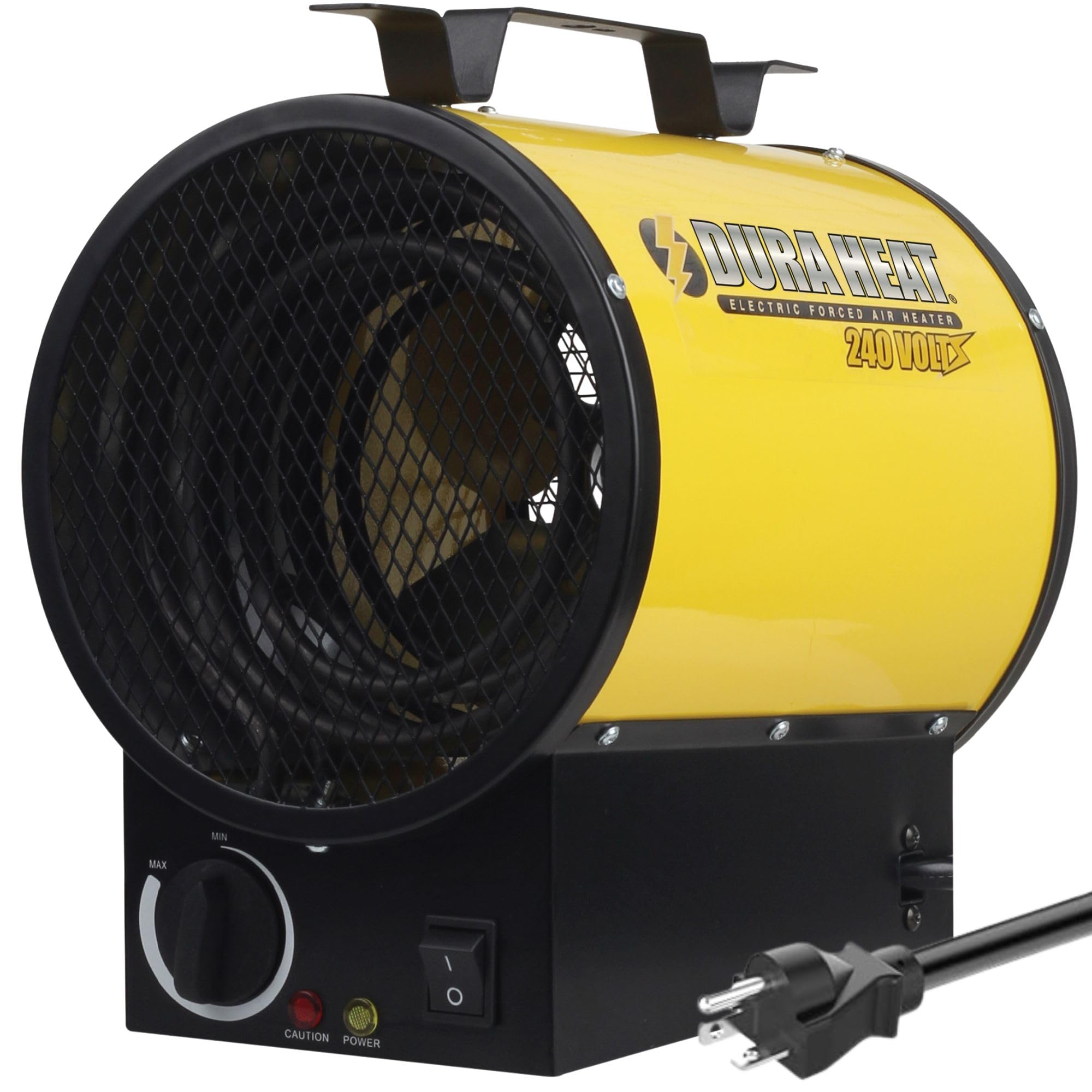
A 3750-watt yellow box that can take a 50°F shop to 66°F in two hours.
If you have a 240-volt 20-amp circuit available (or can install one), this Dura Heat unit is a solid middle ground between the small 1500-watt plug-in heaters and the huge 30-amp monsters. It produces 12,800 British Thermal Units, which is two-and-a-half times the output of a standard 1500-watt unit, and buyers confirm it works: one owner heated an 850-square-foot shop with a 10-foot ceiling from 50°F to 66°F in two hours when it was 40°F outside.
It requires a dedicated 240V 20A breaker and a 6-20P plug—this is not something you plug into a wall. The catch is the fan runs constantly as long as the unit is powered, and the thermostat only controls the heating coil, so it blows alternating warm and cool air, which some buyers found wasteful. The heater itself also measured 11 inches deep, 9 inches wide, and 12 inches high—making it 69% larger in dimensions than the compact Dura Heat EUH1465.
Sturdy heating workhorse
- Proven real-world performance: 850 sq ft heated 16°F in 2 hours at 40°F outside
- Comes with ceiling/wall mounting bracket for permanent installation
- Solid steel body, built to last
Efficiency drawbacks
- Fan runs constantly, wasting a little power
- No thermostat control over the fan, only the heating coil
- Some units failed after a few months (coil burnout, burning smell)
Best for: medium-sized shops (up to 500 sq ft) with a 240V 20A circuit already in place.
6. Shinic 2 Packs Electric Garage Heaters with Halogen Light

Two ceiling-mounted radiant heaters that warm you directly and light up a workbench.
If you do woodworking or work on cars at a single spot, radiant heat is more efficient than warming the whole space. These black units use dual quartz tubes—the type that turns on instantly and glows red—to heat people and objects in front of them. This is different from fan-forced heaters: you feel warmth immediately, but the air may stay cool. Each unit has 1500 watts, giving you 3000 watts total across the pair, covering an total area of 400 to 600 square feet.
They mount on the ceiling and rotate 90° so you aim the heat exactly where you stand. A bonus: the built-in halogen work light makes seeing fine details easier on a dark workbench. The 5-mode pull-string switch lets you choose low heat (750W), high heat (1500W with both quartz tubes), or either with the light on. A buyer said they used these to keep their 12×12 gazebo toasty at night.
Targeted heat, not room heat: Great for a mechanic or woodworker who stands in one place. The light automatically comes on with the high heat settings, which annoyed one buyer during movies. The pull-string switch is simple but can break over time.
Best for: workshops where you work in a focused area—you feel warm without heating the whole garage.
7. DR. INFRARED HEATER DR218-1500W Greenhouse Garage Workshop Infrared Heater

A 1500-watt radiant heater that survived two New England winters in a 50-by-13-foot garage.
This green cabinet heater is built specifically for greenhouses and damp spaces—it has an IPX4 rating (meaning it is protected against water splashing from any direction), which you rarely see on a plug-in garage heater. It uses a forced-air method combined with a radiant heating element, so it both circulates warm air and warms objects in front of it. It heats up to 150 square feet, making it one of the smallest coverage units here—compare that to the 1000 square feet of the Comfort Zone and the gap is huge.
Buyers confirm its toughness: one user notes it kept his garage at 50s-60s°F with the thermostat set at 15-30% on high fan through two freeze-thaw winters. Another found it safe for a 6×8 ft greenhouse because it blows warm (not scorching) air that does not burn leaves. On the downside, it has only one heat setting—1500W—and some units have had reliability issues with the internal thermostat wiring.
Where it excels
- IPX4 splash-proof for moist greenhouses or garages
- Proven durability through harsh winters
- Gentle warmth safe for plant overwintering
Where it falls short
- Only 150 sq ft coverage—too small for large spaces
- No multiple power settings (one fixed 1500W level)
- Thermostat does not always shut the unit off at the set temperature
Best for: greenhouses, small unheated garages, and damp spaces where you need splash protection.
Understanding the Specs
BTU & Wattage
British Thermal Units measure raw heat output, while watts measure electrical power consumed. The relationship is rough but consistent: one watt equals roughly 3.41 BTU. That means a 1500-watt heater generates about 5,115 BTU, while a 4800-watt unit generates about 16,368 BTU. When you compare heaters, BTU tells you how much heat you will actually feel—wattage tells you what electrical load it will put on your circuit.
Heating Coverage
This is the manufacturer’s estimate of how large a single room the heater can warm up, usually assuming average insulation and a standard 8-foot ceiling. Going way over this number means the heater runs non-stop without ever catching up. Going under it means the unit cycles on and off efficiently. Use coverage spec as a hard limit, not a suggestion: a heater rated for 150 sq ft will not warm a 400 sq ft garage.
Amperage & Voltage (120V vs 240V)
Standard household outlets in North America are 120 volts and are typically on a 15-amp circuit (or sometimes 20-amp). The total wattage is volts x amps, so a 120V 15A circuit can deliver at most 1800 watts, safely leaving room for about 1500 watts. Anything above 1500 watts, like 3750W or 4800W, needs a 240-volt circuit (like a dryer or oven plug) or hardwired professional installation. Always check the heater’s amperage spec and your breaker panel before buying.
Forced Air vs. Radiant (Infrared)
Forced air heaters use a fan to blow air over a heating element, then push that warm air into the room. They heat the entire space but can also stir up dust and create noise. Radiant or infrared heaters warm objects directly without heating the air first—you feel the heat instantly when you stand in front of them. In a garage, forced air is better for whole-shop heat, while radiant is better if you plan to stand in one spot at a workbench.
FAQ
Will a 1500-watt heater heat my two-car garage?
Can I plug a 240-volt garage heater into a standard outlet?
Is an infrared heater better than a fan-forced heater for a garage?
What does the IPX4 rating on a heater mean?
How many amps does a garage heater need?
Why does my heater keep shutting off?
Can I leave a garage heater on overnight?
What is the difference between a ceramic heater and a coil heater?
How do I choose the right size heater for my garage?
Can I install a ceiling-mounted garage heater myself?
Final Thoughts: The Verdict
If you want one dependable pick, the electric space heater for garage winner is the Comfort Zone 4,800W because it blasts 17,065 BTU across a full 1,000 square feet and does not waste time with guesswork—just raw, fan-forced heat. If you want the most powerful option with modern smart controls, grab the Riseon 7500W for its remote and ECO mode. And for a finished or attached garage where you want Alexa control and silent operation, the standout is the GiveBest Wall Mounted Heater.
How We Picked
We do not accept paid placement. Every pick is matched to a real buyer and a real use-case; we do not hands-on test units.
Sources & Methodology
Specifications: manufacturer listings and product documentation. Review insights: verified customer reviews, as of July 2026. Pricing: not shown on this page (it changes often); check the current price via the retailer link.
As an Amazon Associate, Trending Car earns from qualifying purchases. This does not affect which products we feature.