
Our readers keep the lights on and my garage snacks stocked. As an Amazon Associate, I earn from qualifying purchases.
Specs are compiled from manufacturer listings and verified buyer reviews and can change over time — please confirm the key details on the product page before buying.
Standing in a freezing garage, waiting for a space heater to do something — anything — is a uniquely frustrating feeling. Most small plug-in units just sit there blowing barely-warm air at your ankles, while the rest of the shop stays cold. The right electric shop heater changes that: it actually pushes enough heat to make your workspace usable, whether you are wrenching on a car, running a table saw, or just storing gear that should not freeze.
I’m Min Islam — the founder and writer behind Trending Car. This guide is built by comparing the manufacturers’ published specifications and the patterns across verified customer reviews, so you get each pick’s real strengths and trade-offs instead of marketing spin.
If you are looking for a reliable best electric shop heater, the real difference depends on wattage, mounting style, and how far that heat actually travels before feeling like a warm breath versus a distant whisper.
Our Picks at a Glance

How To Choose The Best Electric Shop Heater
Shop heaters are simple machines — a heating element and a fan or reflector — but the installation and circuit requirements vary wildly. A 1,500-watt unit plugs into any wall outlet, while a 6,000-watt unit needs a dedicated 240-volt circuit with a 35-amp breaker. Know your shop’s electrical capacity before you fall in love with a heater that needs power you do not have.
Wattage and Voltage
For a shop heater, wattage directly predicts how much heat it produces. Standard 120-volt outlets max out at 1,500 watts (12.5 amps). For anything above that — 3,000 watts, 5,000 watts, 7,500 watts — you need a 240-volt circuit and hardwiring. If you are renting or cannot add a circuit, stick with a plug-in 1,500-watt model and accept its limitations. If you own the space, a hardwired 240-volt unit transforms the shop.
Forced Air vs. Radiant (Infrared)
A forced-air heater uses a fan to blow air across a hot element and push that warmth around the room. This warms the air itself, so it works well in an enclosed, insulated space. A radiant (infrared) heater does not heat the air — it warms objects and people directly in its line of sight. This makes radiant heaters excellent for uninsulated garages or drafty workshops where heated air would just leak out, but they will not warm tools stored behind a shelf.
Mounting and Placement
Ceiling-mounted and wall-mounted heaters keep the floor clear, which is crucial in a workshop where you need room for tools and projects. Floor-standing heaters are portable but take up space and are easier to knock over. If you mount a forced-air heater on the ceiling, angle the louvers downward so the hot air does not just pool at the ceiling while your feet stay cold.
Quick Comparison
| Model | Best For | Watts | Coverage | Mount | Amazon |
|---|---|---|---|---|---|
| Comfort Zone CZ285 1500W★ Best Overall | Small home workspaces & mild climates | 1500W | — | Floor (pivot base) | Amazon |
| VEVOR 5000WAlso Great | Medium-large insulated shops | 5000W (17,064 BTU) | 50 sq.m. | Wall/Ceiling | Amazon |
| TEMPWARE 7500W | Very large garages & warehouses | 7500W (25,590 BTU) | 1,250 sq ft | Ceiling | Amazon |
| DR. INFRARED DR966 6000W | Large commercial shops & 3-car garages | 3000W/6000W (20,520 BTU) | 600 sq ft | Wall/Ceiling | Amazon |
| DR. INFRARED DR218 3000W | Greenhouses & small insulated shops | 3000W | 600 sq ft | Floor (tower) | Amazon |
| Shinic 2-Pack 1500W | Small shops that need radiant warmth | 750W / 1500W each | 400-600 sq ft | Ceiling | Amazon |
| shinic 120V Ceiling Mount | Tiny garages on a tight budget | — | 200-300 sq ft | Ceiling | Amazon |
In‑Depth Reviews
1. Comfort Zone 1,500W Ceramic Heater CZ285
Our pick — over 4★ from 900+ verified ratings; the strongest balance of quality and price.
A lightweight ceramic heater that disappears into a corner but does not disappear the cold.
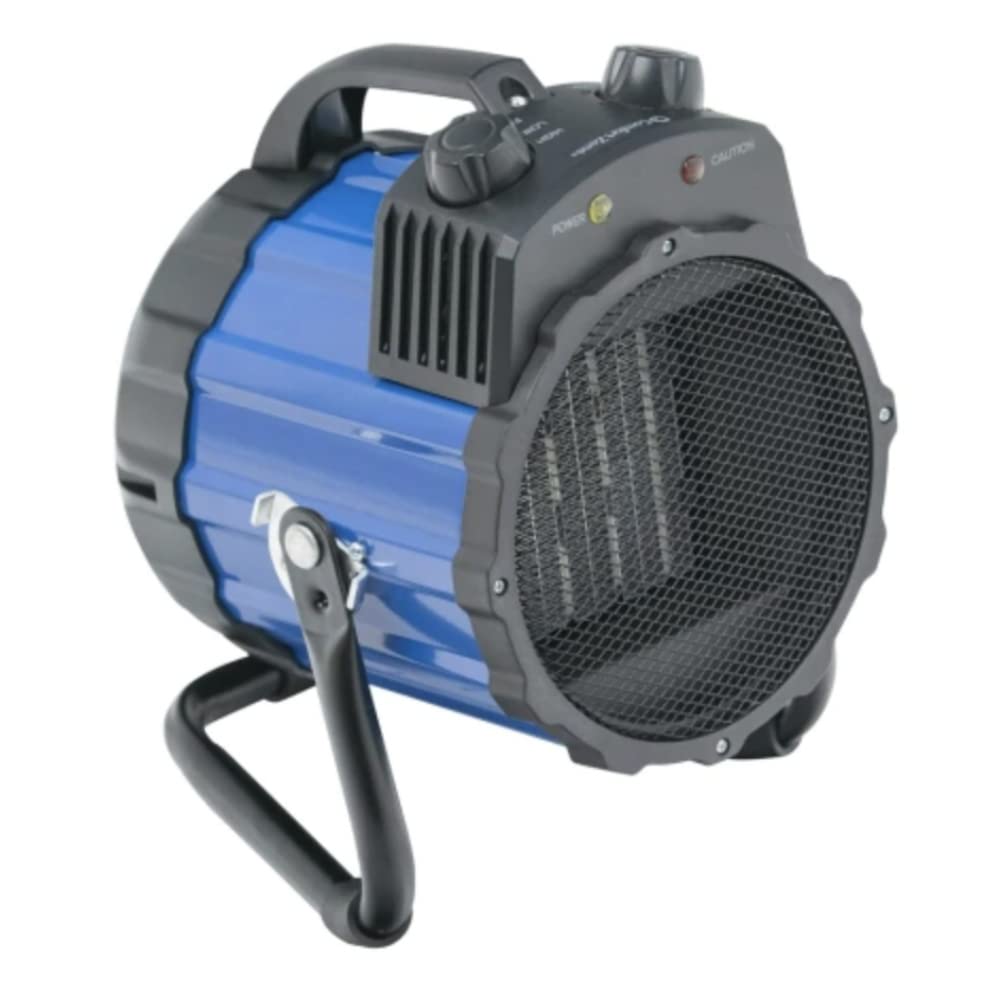
The Comfort Zone CZ285 is the smallest heater on this list, weighing just 3.8 pounds compared to the VEVOR’s 20 pounds. It runs on a standard 120-volt outlet at 1,500 watts, which means you can plug it in anywhere without an electrician. The ceramic heating element (a type of heating core made from a ceramic block that heats up fast and stays warm) kicks out heat quickly, and the fan-forced design pushes air across a small room. One reviewer noted it heated a huge bedroom in 3 minutes, and others call it quiet with a sturdy anti-tip base.
The pivot cradle base lets you tilt the heater to aim the airflow, which is handy for a desk or workbench. Safety features include an overheat sensor and tip-over cutoff switch. However, the “advertised 1,000 sq ft claim is false,” according to buyers — in a poorly insulated 450 sq ft shop, even two units struggled. This is the fundamental limit of any 1,500-watt plug-in heater: it cannot produce enough heat for a real shop. At 1,500 watts, that is 1,500 watts, while the DR218-3000W is 3,000 watts, and the coverage reflects that. Use it for a small home workshop, a mudroom, or a desk space, not a full garage.
Honest trade-off: This is not a shop heater for a real shop — it is a home space heater that happens to have a metal frame and a carry handle. If your workspace is under 200 sq ft and well insulated, it works. For anything larger, you will be disappointed.
Good for small rooms: one buyer mentioned the “advertised 1,000 sqft claim false; great for home use (quiet, lightweight, adjustable).” Keep expectations in check.
Underpowered for shops: even two units could not handle a 450 sq ft poorly insulated shop, per the same buyer. For real workshop heating, move up to a 240V unit.
Pick this if: you need a quiet, portable heater for a small home office, bedroom, or tiny well-insulated hobby room, and you want to plug it into a standard wall outlet.
Do not buy for: an actual garage, workshop, or any space over 200 sq ft where you expect real warmth.
2. VEVOR Electric Garage Heater, 5000 Watt
A wall-mounted brute that actually throws heat you can feel across the room.
What you need from a shop heater is heat that reaches you, not just warms the ceiling. The VEVOR 5000W delivers exactly that — a forced-air design that buyers report puts out heat “you can feel 10 feet away.” In terms of raw power, this unit produces 17,064 British Thermal Units (BTU — a standard measure of heat output, like comparing furnace sizes), which is more than enough to take the bite out of a 2-car garage or a small workshop. The unit weighs 20 pounds but that heft comes from an SPCC cold-rolled steel shell that resists denting and deformation during long use.
It runs on a 240-volt circuit at 20.83 amps and hardwires directly (no plug), so you will need an electrician unless you are comfortable with NEMA 6-30P wiring. The payoff is a precise digital thermostat that holds temperatures to within 2°F of your set point, plus a 9-hour timer and a remote control that actually works. Owners mention the fan is quiet for its size, and the automatic cool-down cycle prevents the unit from cooking itself after shutdown. The only real complaint: the controls can feel unintuitive at first, and the default “energy saver” mode sometimes kicks in too early, cycling the fan on and off around the target temp.
Honest trade-off: This is not a plug-and-play heater — hardwiring means installation cost and a dedicated circuit. But if you have 240V access in your shop, this is the most balanced performer between power, quiet operation, and build quality in this lineup.
Why it leads
- 5000W output (17,064 BTU) heats medium-large shops fast
- ETL certified with overheat auto-shutoff and tip-over safety
- Remote control and 9-hour timer add real convenience
- Reviews call it quiet and vibration-free at high fan speeds
The catch
- Requires hardwiring to a 240V/20.83A circuit (needs an electrician)
- Energy-saver mode cycles the fan near set temp, which some find noisy
- At 20 pounds, much heavier than plug-in competitors
Reach for this if: you have 240V in your shop, need real heat that reaches a 2-car garage, and want thermostat control rather than just on/off.
Look elsewhere if: you need a simple plug-in heater or only have standard 120V outlets available.
3. TEMPWARE 7500W Electric Garage Heater
A 7,500-watt monster designed to heat a warehouse, not a closet.
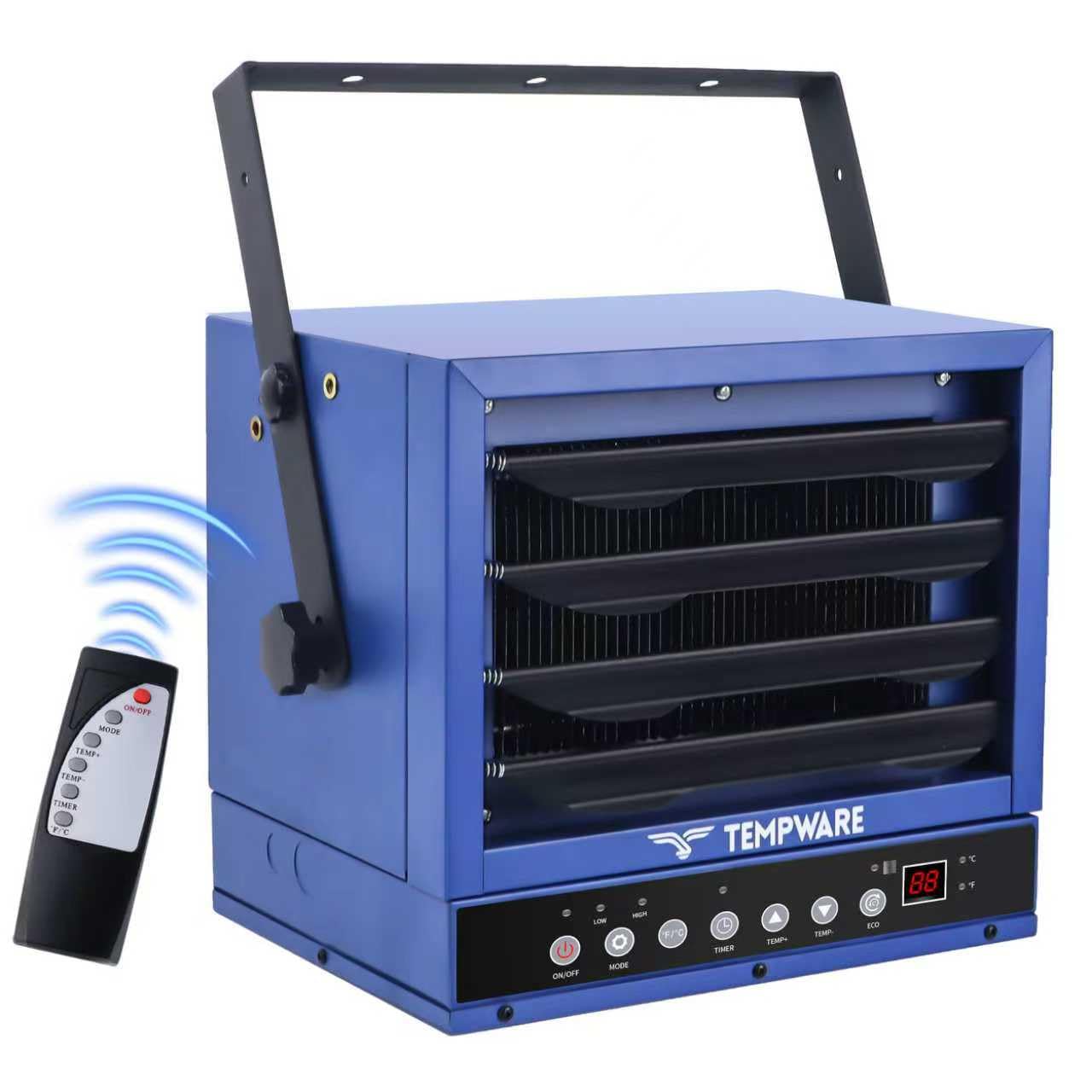
The TEMPWARE 7500W is the biggest heater on this list in terms of raw heating capacity, delivering 25,590 BTU and claiming coverage up to 1,250 square feet. That is 1,250 sq ft, while the DR. INFRARED DR966 claims 600 sq ft despite the wattage gap being smaller (7,500W vs 6,000W). It runs on a 240-volt circuit at 31 amps, which requires a 40-amp breaker and 8 AWG copper wire — serious electrical work that absolutely requires a licensed electrician. One reviewer running it in a 3-car garage reported it maintained 45°F even during a polar vortex, which is a strong real-world signal.
The adjustable louvers and variable mounting angle let you aim the forced air where you need it, and the digital thermostat ranges from 45°F to 95°F so you can keep tools from freezing without wasting power on full blast. The 12-hour timer helps cut down on electricity use if you tend to forget the heater overnight. However, one reviewer in a well-insulated 400 sq ft garage noted it took 5 hours to climb from 53°F to 76°F (outside 46°F), suggesting that the 1,250 sq ft claim works best in a tightly sealed space, not a drafty shop with open bay doors. The heater is ETL certified and uses a heavy-duty steel body, but several reviewers mention the remote lacks a legend and the seller offers zero customer support after purchase.
Honest trade-off: This heater is overkill for anything smaller than a 2-car garage, and the installation cost (electrician + 31-amp circuit) adds up. It is a premium tool for a premium shop, not a budget fix.
Best for big spaces: If you have a 2-car or 3-car garage, a warehouse bay, or a large workshop with a dedicated 240V/30A circuit, this is the most powerful plug-and-mount option here.
Not for small shops: In a 12×12 or 1-car garage, this unit will cycle on and off constantly and leave the floor cold while the ceiling bakes. You are better off with a lower-wattage unit.
Who it fits: owners of large insulated garages or workshops who already have (or can install) a 240V/30A circuit and want a single heater to handle the whole space.
Who should pass: anyone renting, anyone on a 120V-only system, or anyone heating less than 400 sq ft.
4. DR. INFRARED HEATER DR966 240-volt

A commercial-grade heavy hitter with two power modes for big garages.
The DR966 is the largest unit from DR. INFRARED HEATER, pushing up to 6,000 watts (20,520 BTU) in high mode and a more manageable 3,000 watts in low mode. This dual-power flexibility is a practical feature most shop heaters lack — you can run low to maintain a chill above freezing, then kick high when you are actually working. The unit weighs 25 pounds, while the VEVOR 5000W weighs 20 pounds, and its all-steel cabinet feels built for a commercial shop floor. It is UL/CUL listed (a safety certification from Underwriters Laboratories), meaning it has passed independent testing for electrical and fire safety.
It hardwires to a 240-volt circuit at 25 amps and requires 8 AWG copper wire (included bracket works for wall or ceiling mounting). One reviewer in Idaho reported it handled deep-freeze conditions in a 3-car garage with no complaints, calling the noise level “audible but not overly loud.” The 8-inch fan distributes warmth with less turbulence than many smaller forced-air units, though at 25 pounds and 14.5 inches deep, it is a bulky box that dominates the ceiling or wall where it mounts. A few customers note that the included instructions are clear, which is more than can be said for some of the cheaper imports on this list.
Honest trade-off: This heater is larger, heavier, and more expensive than the VEVOR while offering only 6,000W versus the TEMPWARE’s 7,500W. If you need the intermediate power flexibility (3,000W mid-setting), it justifies its price. If not, the VEVOR gives you more heat per pound.
Why it stands out
- Two power settings (3000W / 6000W) let you match heat to conditions
- UL/CUL listed for safety compliance
- Large 8-inch fan pushes heat with lower turbulence than smaller fans
- Positive reviews from multi-year use in harsh climates
Why it is niche
- At 25 pounds, it is the heaviest unit here — mounting is a two-person job
- Rated coverage is only 600 sq ft despite 6000W (less efficient per watt than forced-air designs)
- Requires a dedicated 240V/25A circuit with 8 AWG wire
Pick this if: you need two heat levels — one for frost protection, one for active work — and have a shop that can accommodate a large cabinet-style heater on the wall or ceiling.
skip it if: your shop is under 400 sq ft or you want the highest possible wattage in a smaller package — the VEVOR or TEMPWARE delivers more per cubic foot.
5. DR. INFRARED HEATER DR218-3000W

The radiant heater that keeps fragile plants alive through a deep freeze.
Where most shop heaters use a fan to blow hot air, the DR218 uses infrared radiant heat — it warms objects and people directly without relying on moving air. This makes it perfect for a greenhouse or an uninsulated shop where heated air would leak out before it helped. The 3,000-watt output is 3,000 watts, compared to the Comfort Zone’s 1,500 watts, yet the unit is compact at just 10 inches wide and 13 inches tall. One buyer who ran it through a second New England winter in a 50×13-foot garage said it held low-to-mid 60s with the thermostat set at 15% to 25%, calling it quiet and steady.
It runs on a 240-volt, 20-amp outlet (NEMA 6-20 style) — not a standard household wall plug — so you will need the right receptacle or an adapter. The IPX4 rating means it is protected against water splashes, which is rare for a shop heater and essential in a greenhouse where watering creates humidity. Reviewers in Houston used it in a 6×8 greenhouse during a 22°F freeze and kept temperatures at 42-48°F, saving their plumeria plants. The catch? Two separate owners reported units that caught fire due to burnt thermostat wiring — the company replaced the first one, but the second also failed. That pattern means you should mount this heater where it cannot ignite nearby flammables, and keep an eye on the wiring annually.
Honest trade-off: The fire reports are concerning, though isolated. If you need a radiant heater that can handle damp environments, this is the only IPX4 option here. If you want forced air with a better safety track record, choose the VEVOR instead.
Unique strengths
- IPX4 splash protection — safe for greenhouses and damp garages
- Infrared heating warms objects, not air — ideal for drafty spaces
- Compact footprint (10″x10″x13″) stores easily
- Quiet operation with no forced-air fan noise
Known risks
- Multiple reviews report units catching fire due to thermostat wiring
- Requires a 240V/20A outlet (not standard 120V)
- Does not always shut off when reaching set temperature
Best for: greenhouse owners and anyone with a damp uninsulated shop who needs frost protection without blowing cold drafts around.
Not for: buyers nervous about fire risk or anyone without a 240V/20A outlet.
6. Shinic 2 Packs Electric Garage Heaters, 1500W

Two radiant heaters with built-in work lights for a warm, bright ceiling setup.
The Shinic 2-pack gives you two ceiling-mounted radiant heaters, each capable of 750W or 1,500W, plus a halogen work light that turns on with the high settings — a 2-in-1 solution for a dark, cold garage. The radiant quartz tubes (glass tubes that glow red-orange and warm up in seconds) heat people and objects directly rather than the air, which works well if you are standing near them doing woodworking or other bench tasks. Each unit can rotate 90 degrees, so you can aim the warmth toward your work area. The estimated coverage for the pair is 400 to 600 square feet.
Installation is straightforward: the included bracket mounts to the ceiling, and each heater plugs into a standard 120-volt outlet at 12.5 amps (1,500W each). The pull-string switch lets you toggle between low heat (750W, one bulb), high heat (1,500W, both bulbs), and heat-plus-light modes. However, reviewers point out that the light cannot be turned off independently when you are on the high settings — if you want heat without a blinding halogen glow, you are stuck with low heat. Also, several reviewers report the pull string breaking after a few months, leaving the heater stuck on or off with no way to change settings. The single-unit shinic model (product 7) had a buyer say it “lasted only 5 months then stopped working,” which suggests quality control is inconsistent across the brand.
Honest trade-off: The built-in light is a clever space-saver, but reliability worries (broken pull strings, short lifespan reports) make this a gamble. If you only need heat for occasional use and the light feature appeals, the 2-pack price is competitive. For daily winter use, invest in a forced-air unit instead.
What you gain
- Two heaters included — can zone-heat different workstations
- Built-in halogen light saves ceiling space (separate light fixture not needed)
- Radiant heat works immediately with no warm-up
- Pulls only 12.5A per unit — runs on normal 120V circuit
What you risk
- Halogen light is stuck on with high heat — cannot dim or turn off independently
- Pull-string switch breaks frequently, making the unit unusable
- Brand reliability is inconsistent — some units die within months
Who wants this: woodworkers or hobbyists who work at a bench under the heater and need both light and spot-heating without a separate fixture.
Who should avoid: anyone needing reliable daily heat in a large space, or anyone who does not want a bright work light tied to their heat setting.
7. shinic Electric Garage Heating Product

The most affordable way to get a heater off the floor and onto the ceiling.
The single-unit shinic ceiling mount heater is the entry-level option for anyone who wants a shop heater that does not take up floor space. It plugs into a standard 120-volt outlet (no electrician needed) and mounts to the ceiling via the included tilting bracket, keeping it out of the way. At 11 inches deep, 24 inches wide, and 15 inches high, it is a long, narrow unit that shoppers say “heats a garage quickly” and is “easily adjustable to mount in the direction you would like.” The advertised coverage is 200 to 300 square feet, which is honest — it is enough for a single-car garage or a small workshop bay, not a full 2-car space.
The heater uses radiant heat, so it warms objects rather than the air. That means if you stand under it, you will feel the warmth quickly, but tools on a shelf 15 feet away stay cold. The built-in work light is a practical touch for a dim garage. However, the reliability concerns are hard to ignore: one owner reported it “lasted only 5 months then stopped working,” and the lights faded before the heat died. Another reviewer wished the mount was heavier duty.
Honest trade-off: This is the cheapest ceiling-mounted option, and it shows in the build quality. If you need a heater for a tiny space on a tight budget and you are comfortable with the possibility of replacing it in a year, it gets the job done. If you want something that lasts multiple winters, spend more on the VEVOR.
Works for tiny shops: one customer observed it “heated a garage 11×22 easily and takes the chill out of the air.” For a small space, it does the job.
Reliability gamble: another owner confirmed it “lasted only 5 months then stopped working.” For daily use, the low price comes with a real risk.
For the minimalist: if your shop is 11×22 or smaller and you want a plug-in ceiling mount on a shoestring budget, this works as a stopgap.
Not for heavy use: if you plan to run a heater daily through a northern winter, the failure rate is too high — invest in the VEVOR or a larger forced-air unit.
Understanding the Specs
Watts and BTU
The wattage tells you how much electricity the heater uses, which directly determines how hot it gets. A 1,500-watt heater is the maximum a standard 120-volt household circuit can handle. For real shop heating, you need 3,000 to 7,500 watts, which requires 240-volt circuits and hardwiring. BTU (British Thermal Units) is another way to measure heat output — 1 watt equals about 3.41 BTU, so a 5,000W heater produces roughly 17,000 BTU. More watts means more heat, but also means more expensive electrical work.
Forced Air vs. Radiant
Forced-air heaters blow air across a hot element and push it around the room. They warm the air itself, so they work best in enclosed, insulated spaces where that warm air stays put. Radiant (infrared) heaters warm objects and people directly — the air stays cool, but anything in the line of sight feels warm. Radiant heaters are better for drafty, uninsulated shops or greenhouses, because they do not rely on the air holding the heat.
Voltage and Circuit Requirements
120-volt plug-in heaters max out at 1,500 watts (12.5 amps). Beyond that, you need 240-volt circuits. A 3,000-watt heater typically needs a 240V/20A circuit, a 5,000W unit needs 240V/25A, and a 7,500W unit needs 240V/30A or 35A — always check the amperage rating on the heater’s specs and match it to your breaker. Hardwired units do not come with a power cord; you supply the wiring and the electrician. Plug-in units with 240V (like the DR218) use a NEMA 6-20 or 6-30 plug, which is different from a standard household outlet.
Safety Certifications
ETL and UL/CUL listings mean the heater has been tested by an independent safety lab (Intertek for ETL, Underwriters Laboratories for UL/CUL) for electrical and fire safety. These certifications are a basic requirement for any heater you leave unattended or run overnight. Look for at least one of these labels on the product page or the unit itself. Overheat auto-shutoff and tip-over switches are standard safety features on most models above entry level.
FAQ
What size electric shop heater do I need for a 2-car garage?
Can I plug a shop heater into a standard wall outlet?
Is a radiant or forced-air heater better for an uninsulated garage?
How many watts does it take to heat a workshop?
Are shop heaters safe to leave on overnight?
Do electric shop heaters need ventilation?
What is the difference between ETL and UL certification?
Can a 1,500-watt heater actually heat a garage?
Final Thoughts: The Verdict
For the majority of shoppers, the best electric shop heater winner is the VEVOR 5000W because it delivers the best balance of real heat, quiet forced-air operation, precise thermostat control, and build quality at a mid-range price. If you need raw power for a very large or uninsulated space, grab the TEMPWARE 7500W. And for an uninsulated greenhouse or damp workshop where radiant heat and splash protection matter most, the DR. INFRARED DR218-3000W is the specialist choice.
How We Picked
We do not accept paid placement. Every pick is matched to a real buyer and a real use-case; we do not hands-on test units.
Sources & Methodology
Specifications: manufacturer listings and product documentation. Review insights: verified customer reviews, as of July 2026. Pricing: not shown on this page (it changes often); check the current price via the retailer link.
As an Amazon Associate, Trending Car earns from qualifying purchases. This does not affect which products we feature.