
Our readers keep the lights on and my garage snacks stocked. As an Amazon Associate, I earn from qualifying purchases.
Specs are compiled from manufacturer listings and verified buyer reviews and can change over time — please confirm the key details on the product page before buying.
Riding an e-bike when the roads turn white and slick is a different game — you need tires that dig into snow instead of skating over it, a battery that still delivers range when the temperature drops, and brakes you can trust on ice. Most e-bikes are built for sunny pavement, but the models here are spec’d for the cold, with fat tires that float on powder, motors with enough torque (twisting force) to push through slush, and weather-sealed batteries that keep going when the mercury falls.
I’m Min Islam — the founder and writer behind Trending Car. This guide is built by comparing the manufacturers’ published specifications and the patterns across verified customer reviews, so you get each pick’s real strengths and trade-offs instead of marketing spin.
if you need to commute through a snowstorm or explore frozen trails, this breakdown of the best e bike for winter helps you match the right motor, battery, and tire setup to the conditions you actually ride in.
Our Picks at a Glance
How To Choose The Best E Bike for Winter
Picking a winter e-bike depends on how well the bike handles the three things that fail in cold weather: traction, battery endurance, and braking. A bike that rides fine in summer can become useless on snow if the tires are too narrow or the battery loses half its range at freezing. Focus on these specs first.
Fat Tires for Snow and Ice Grip
A tire width of at least 3.8 inches — and ideally 4.0 inches or wider — creates a larger contact patch that floats on top of snow rather than sinking in. The deep tread pattern on the 26″x4″ or 20″x4.0″ tires common on winter-ready e-bikes helps you find grip on packed snow and slush. Without this width, you risk sliding out on corners or getting stuck in deeper powder.
Battery Capacity and Weather Sealing
Cold temperatures reduce the usable energy in any lithium battery — expect a 20% to 30% range drop below freezing. That is why a larger battery capacity measured in watt-hours (Wh) (the total energy stored) matters. A 720Wh battery gives you more buffer than a smaller one. An IPX4 waterproof rating (protection against splashing water) and a removable battery so you can charge it indoors also keep you riding through winter.
Motor Torque for Slush and Hills
Torque, measured in newton-meters (Nm) (the twisting force from the motor), tells you how hard the motor can push through thick slush or up an icy incline. Look for at least 85Nm of torque. Higher torque means the motor does not stall when you roll through heavy snow or start from a stop on a slippery slope.
Quick Comparison
In‑Depth Reviews
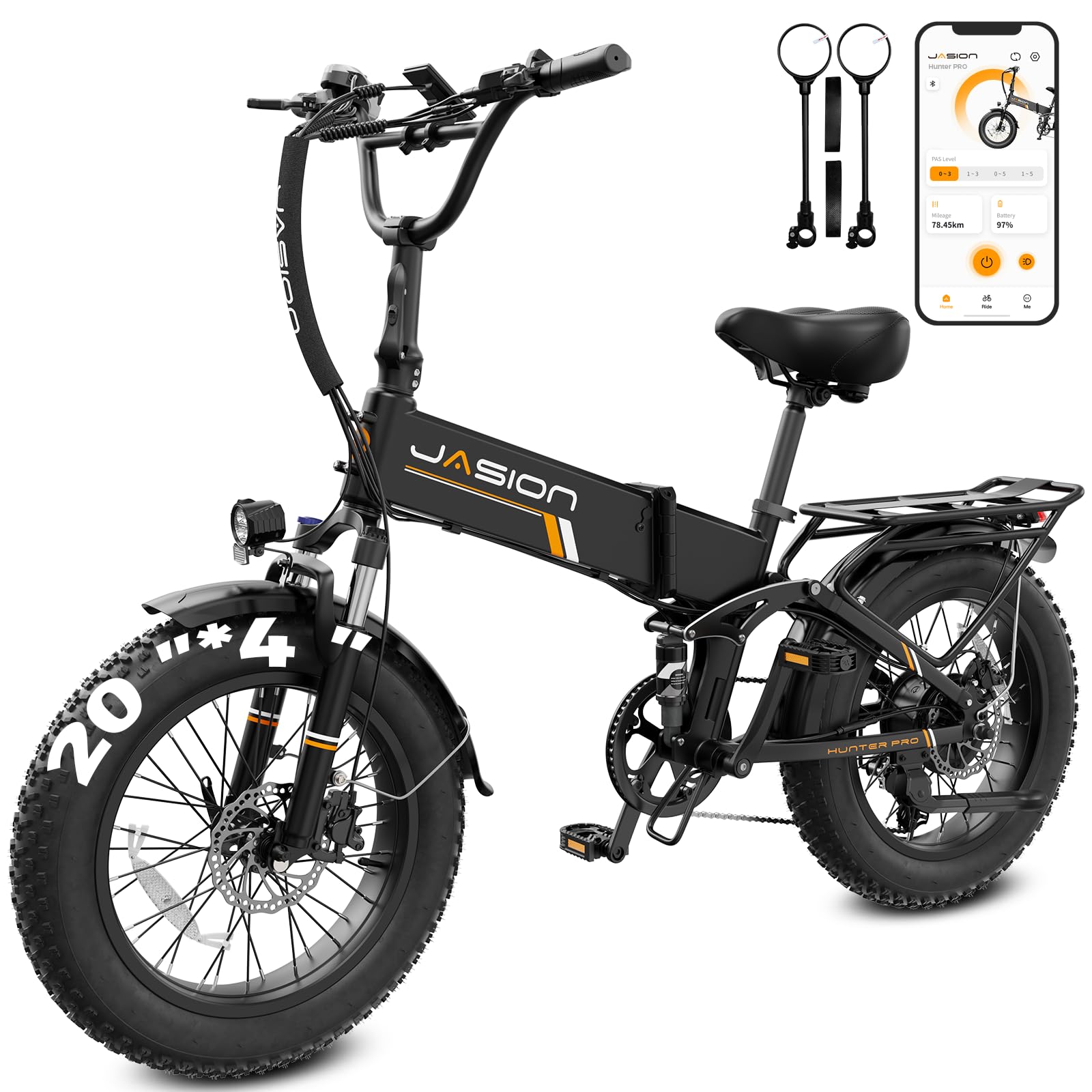
1. Jasion X Hunter PRO/ST Electric Bike
Our pick — over 4★ from 100+ verified ratings; the strongest balance of quality and price.
If you need an e-bike that stores in a car trunk, subway locker, or small apartment after your winter ride, this is the only folding option here with fat tires. The 20″x4.0″ tires are 20 inches in diameter compared to the 26 inches on the Jasion Thunder models, so the X Hunter folds into a much more compact shape. The trade-off is that smaller wheels ride differently over deep snow — they have a shorter lever arm to roll over ruts — but the 4.0-inch width still gives you the flotation you need on packed snow.
Peak motor power reaches 1800W with 85Nm of torque. Top speed is 28MPH, while the Thunder PRO/ST reaches 35MPH — which is fine for winter commuting but less useful for open-road cruising. The 720Wh battery is 720Wh, while the Thunder PRO/ST’s battery is 1040Wh. Real-world feedback from a buyer who rode 15 miles in windy conditions said the battery still had over 50% remaining, which suggests the range estimate of 80 miles in pedal assist is reachable in moderate conditions.
Full suspension (front fork and 4-bar rear) handles bumpy winter roads well. One experienced buyer with 800 miles on two Hunter Pros noted the bike works well in sandy and rough terrain in Florida, calling it very good value. Short riders around 5’5″ may find the high step-over frame tricky — they recommend leaning the bike to dismount, or considering a lower-step frame.
Why it stands out: It folds down small enough for trunk storage while still running 4-inch fat tires — the only truly portable winter e-bike here.
The compromise: Smaller 20-inch wheels mean less roll-over ability in deep snow compared to the 26-inch models, and the 720Wh battery gives you the least cold-weather range buffer.
Get this if: You need a winter e-bike that folds for transport or indoor storage and you stick to packed snow or plowed roads rather than deep powder.
Skip it for: Long winter journeys or deep off-road snow where the 26-inch tires and bigger batteries of the Thunder models will serve you better.
2. Jasion Thunder PRO/ST Electric Bike
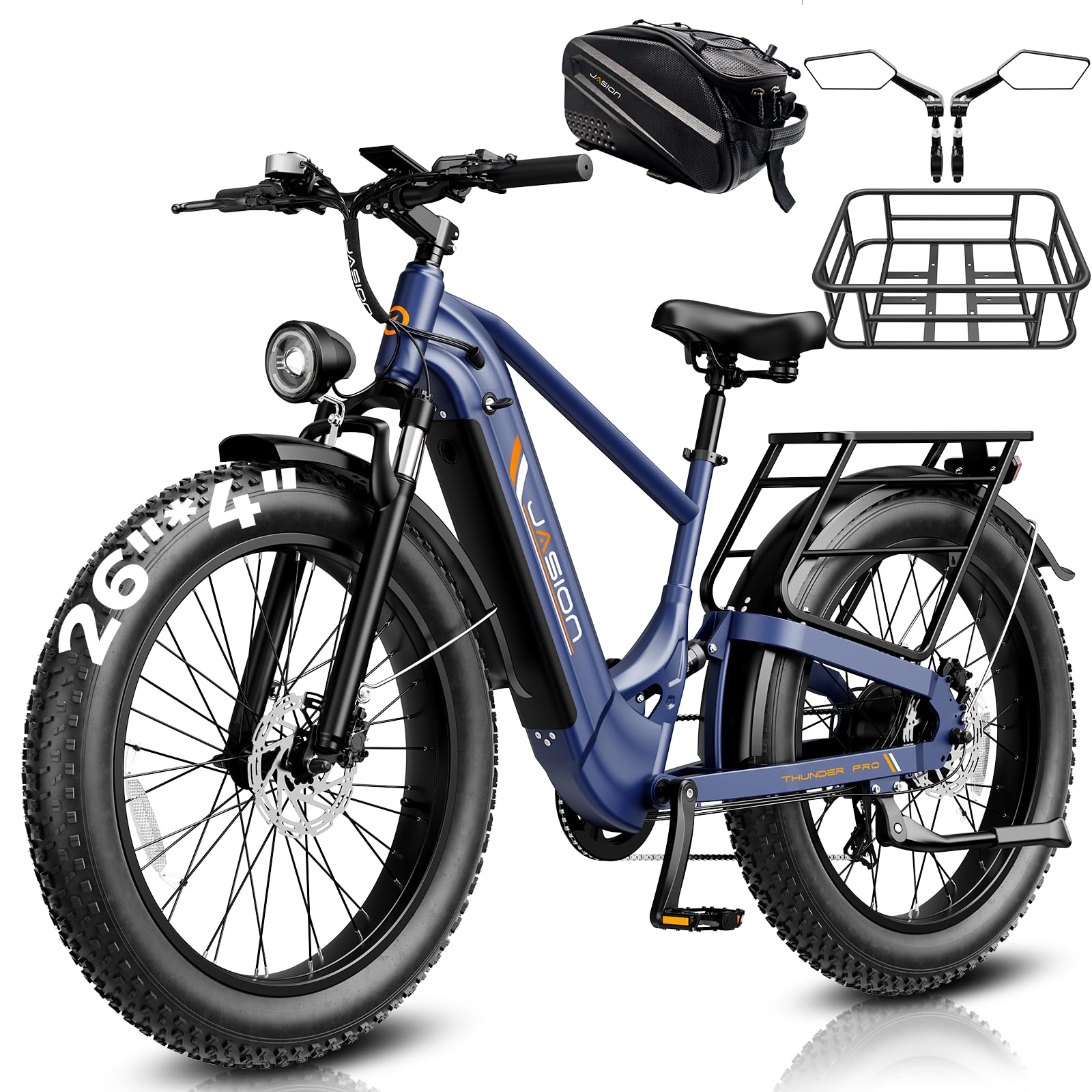
You get the biggest battery in this lineup — a 52V 20Ah pack that delivers 1040Wh of stored energy. On paper that means up to 90 miles in pedal-assist mode and 35 miles on pure throttle. In practice, when winter temperatures drain lithium batteries faster, that extra capacity means you still have usable range after the cold takes its cut. The motor peaks at 2000W and delivers 115Nm of torque, so pushing through thick snow or climbing an icy hill does not leave you pedaling dead weight.
The 26″x4″ fat tires and full suspension soak up rough, frozen ground. These are 26″x4″ tires, with a 26-inch diameter compared to the Jasion X Hunter’s 20-inch diameter, which helps you roll over uneven snow ruts without bottoming out. Buyers report the bike can get scary fast on higher assist levels, which makes the hydraulic disc brakes (with a 2-second stop capability) a genuine safety feature on slick roads. It is also certified by UL2849 (a safety standard for e-bike electrical systems), which matters if you charge indoors in winter.
That matters if you strap on a heavy winter backpack or carry gear over snow. The folding frame fits riders from 5.5′ to 7.2′, though some owners mention folding is challenging but doable.
What Carries It Through Winter
- Largest battery capacity here at 1040Wh — best cold-weather range buffer
- 2000W peak motor with 115Nm torque for plowing through snow
- 500-pound load capacity for heavy winter gear
- Hydraulic disc brakes and UL2849 certification
- Smart security lock and app monitoring
Where It Slips Up
- Assembly takes 3-4 hours according to buyers
- Folding mechanism is challenging despite the foldable frame design
Best for the rider who faces real snow: If your winter commute involves deep powder, steep hills, or sub-freezing temps that kill smaller batteries, this is the one that goes the distance.
The honest trade-off: Assembly time and a tricky fold are the price you pay for this power and range — not a grab-and-go bike from the start.
3. Sepado MF02 2000W Electric Bike

At first glance this looks like a deal — a 2000W peak motor and 864Wh battery at a noticeably lower price than the Jasion Thunder. The 48V 18.5Ah battery gives you an estimated range of 40 to 80 miles depending on assist level, with a full charge in 5 hours using the included 3A charger. One reviewer noted covering 50 miles on the MF002 with excellent battery life using pedal-assist. The motor uses a hub drive system (the motor is in the wheel hub), which is simpler but offers less torque at low speeds on steep hills than the Jasion’s mid-style motors.
On winter streets, the dual suspension (front and rear) smooths out frost-heaved pavement. The fat tires come in either 24-inch or 26-inch options — the 24-inch size rolls a bit smaller than the standard Thunder’s 26-inch wheels, which may affect deep-snow performance. The entry-level position shows in some build-quality complaints: customers note scratched cargo racks, mismatched brake pads that cost to replace, and assembly instructions that lack pictures. One rider had the LCD display (liquid crystal display, the screen that shows speed and battery) unreadable in direct sunlight — a problem if you ride into a low winter sun.
The 2000W peak power matches the Thunder PRO on paper, but the 48V 750W continuous-rated motor is less torquey than Jasion’s higher-voltage systems. The disc brakes provide good stopping power in wet conditions, but they are mechanical disc brakes (cable-activated), not hydraulic (fluid-activated), so they require more hand strength on the lever — noticeable when your fingers are cold in winter gloves.
The Upside for Your Wallet
- 864Wh battery at a budget-friendly price level
- 2000W peak motor for speed on pavement
- Full dual suspension for rough winter roads
- Bright 10W LED headlight for dark winter mornings
The Downside for Winter Riding
- Mechanical disc brakes need more lever effort in cold hands
- Reviewers point out scratched parts and assembly issues from the start
- LCD display hard to read in sunlight
- Smaller 24-inch tire option rolls less easily through deep snow
Buy this if: Your winter commute is short, plowed, and paved, and you want the highest peak power and battery capacity at the most accessible price point.
Pass if: You need a bike that can handle deeper snow, require hydraulic brakes for cold-weather stopping confidence, or want the cleaner out-of-box experience the Jasion models deliver.
Understanding the Specs
Watt-Hours (Wh) and Cold Range
Watt-hours (Wh) tell you how much energy the battery stores — think of it as your fuel tank size. In winter, lithium batteries lose 20% to 30% of their usable capacity because cold slows the chemical reactions inside. That is why a 1040Wh battery gives you more real-world range at 30°F than a 720Wh battery. The bigger the Wh number, the more buffer you have against cold-range loss.
Torque (Nm)
Newton-meters (Nm) measure the motor’s twisting force. Higher torque means the motor pushes harder from a standstill or up a hill — which matters when you accelerate on a slick road or climb through slush. Look for at least 85Nm for confident winter power. The Jasion Thunder PRO’s 115Nm is the highest in this group and gives you noticeable extra push through deep snow.
Fat Tire Size: Diameter vs Width
Both matter for winter riding. Width (4.0 inches minimum) floats you on top of snow. Diameter (20 inches vs 26 inches) determines how easily you roll over ruts, ice chunks, and uneven terrain. A 26-inch wheel has a longer contact patch (the area of tire touching the ground) and a shallower angle of attack, so it climbs over obstacles more smoothly than a 20-inch wheel. But 20-inch fat tires fold smaller for storage.
Hydraulic vs Mechanical Disc Brakes
Hydraulic disc brakes (fluid-activated) use fluid to transfer lever force to the brake pads, giving you more stopping power with less hand effort. Mechanical disc brakes (cable-activated) use a cable. When your fingers are cold and your grip is weaker, hydraulic brakes are safer on ice and snow because you do not need to squeeze as hard to get the same stopping force.
FAQ
How much cold does it take to drain an e-bike battery?
Can I ride these e-bikes on icy roads?
What does the IPX4 waterproof rating mean for winter riding?
Should I get a 20-inch or 26-inch fat tire e-bike for snow?
How long does it take to fully charge one of these winter e-bikes?
What is the 64-signal precision sensor on the Jasion Thunder PRO?
Can I ride a winter e-bike in salt and road brine?
Which e-bike here has the highest total load capacity for a rider plus winter gear?
Final Thoughts: The Verdict
For most riders looking for an e bike for winter, the winner is the Jasion Thunder PRO/ST because its 1040Wh battery gives you the best cold-weather range buffer, the 2000W motor with 115Nm torque pushes through snow reliably, and the hydraulic disc brakes stop you safely on ice. If you need a folding design for trunk storage or tight spaces, grab the Jasion X Hunter PRO/ST. And for a budget-friendly option that still delivers a 2000W peak motor and 864Wh battery, the standout is the Sepado MF02 for short winter commutes on plowed streets.
How We Picked
We do not accept paid placement. Every pick is matched to a real buyer and a real use-case; we do not hands-on test units.
Sources & Methodology
Specifications: manufacturer listings and product documentation. Review insights: verified customer reviews, as of July 2026. Pricing: not shown on this page (it changes often); check the current price via the retailer link.
As an Amazon Associate, Trending Car earns from qualifying purchases. This does not affect which products we feature.