
Our readers keep the lights on and my garage snacks stocked. As an Amazon Associate, I earn from qualifying purchases.
Specs are compiled from manufacturer listings and verified buyer reviews and can change over time — please confirm the key details on the product page before buying.
A dual-purpose bicycle needs to handle two completely different worlds — smooth pavement and loose dirt — without feeling out of place in either. The best ones blend a lightweight frame that does not wear you out on the road with tires that still grip when you cut onto a gravel path or a packed trail. This guide breaks down seven of the most balanced options out there, using real buyer feedback and manufacturer specs to help you pick the one that fits your actual mix of riding.
I’m Min Islam — the founder and writer behind Trending Car. This guide is built by comparing the manufacturers’ published specifications and the patterns across verified customer reviews, so you get each pick’s real strengths and trade-offs instead of marketing spin.
By the time you finish reading, you will know exactly which dual purpose bicycle matches your riding style, budget, and willingness to turn a wrench after it arrives.
Our Picks at a Glance


How To Choose The Best Dual Purpose Bicycle
Buying a dual-purpose bike is different from buying a dedicated road or mountain bike — you are looking for a compromise that works well on both surfaces. Here are the three specs that make or break that balance.
Frame Material: Aluminum vs Steel vs Carbon
Aluminum is the balance for a dual-purpose bike. It keeps the bike light enough to pedal uphill on pavement without leaving you worn out, but it is stiff enough to handle the bumps of a gravel trail. Steel is heavier and more durable, but it will turn a quick ride into a workout. Carbon is expensive and fragile for off-road use, so most hybrids skip it.
Brake Type: Linear-Pull vs Disc
If you ride in dry weather only, linear-pull (also called V-brakes) are fine — they are simple to adjust and light. But the moment you hit wet pavement or a muddy trail, disc brakes give you consistent stopping power because they do not rely on the wheel rim to slow you down. Mechanical disc brakes are more common at this price range, and they are a big step up in all-weather control.
Number of Speeds: 7-speed vs 21-speed
More gears do not automatically mean a better bike — it depends on your terrain. A 7-speed is simpler, lighter, and requires less maintenance, which works well for flat city streets and gentle paths. A 21-speed gives you a wider range for steep hills and varied terrain, but it adds complexity in shifting and more points of potential adjustment. Pick the one that matches the hills you actually ride.
Quick Comparison
| Model | Best For | Speeds | Brake Type | Frame Material | Amazon |
|---|---|---|---|---|---|
| Schwinn Network 3.5★ Best Overall | Versatile all-road riding with comfort | 21-speed | Linear Pull | Aluminum | Amazon |
| Schwinn GTX ComfortTrail Ready | Off-road capable hybrid with disc stops | 21-speed | Mechanical Disc | Aluminum | Amazon |
| sixthreezero EVRYjourney | Upright comfort cruising with included rack | 7-speed | Hand | Aluminum | Amazon |
| Tommaso La Forma | Premium lightweight with carbon fork | 21-speed | Disc | Aluminum & Carbon | Amazon |
| AVASTA Jupiter 700C | 21-speed Shimano shifting on a budget | 21-speed | Disc | Aluminum | Amazon |
| VIRIBUS Hybrid 28 inch | Retro style with high weight capacity | 7-speed | Disc | Aluminum | Amazon |
| HILAND 700C Hybrid | Entry-level low-step commuter | 7-speed | Dual Disc | Aluminum | Amazon |
In‑Depth Reviews
1. Schwinn Network 3.5
Our pick — over 4★ from 400+ verified ratings; the strongest balance of quality and price.
With a 21-speed drivetrain, a suspension fork, and an aluminum frame, this Schwinn handles pavement and gravel without breaking your budget.
You get a suspension fork that absorbs bumps on light trails, an aluminum frame that keeps the bike light enough for road climbing, and 21-speed twist shifters that deliver quick gear changes when you hit a sudden incline. Schwinn designed it to fit riders from 5’5″ to 6’0″ tall, so it covers a broad height range. One reviewer noted riding it “2 miles each time with some uphill/downhill portions” over a dozen rides without major issues.
Compared to the AVASTA Jupiter, which uses Shimano EF500 shifters, the Schwinn uses twist-grip shifters — some riders find them more intuitive, others less precise on the trail. Assembly is manageable if you have put a bike together before, but expect a couple of hours tuning the brakes and derailleur. The included manual is generic and does not cover this specific model’s adjustments. The alloy linear pull brakes (which clamp onto the wheel rim to stop you) work well on dry pavement but are a step below the disc brakes on the Schwinn GTX in wet weather. A few buyers report the bike had trouble staying in 4th or 5th gear after about 20 miles.
The Strengths
- Suspension fork soaks up bumps on unpaved paths
- 21-speed range handles steep hills better than a 7-speed
- Lightweight aluminum frame makes pedaling feel easy
The Trade-offs
- Generic assembly manual makes setup frustrating for beginners
- Linear pull brakes are weaker than disc brakes in rain
- Some units develop gear slipping after 20 miles of riding
Reach for this if: You want a value-packed 21-speed hybrid that mixes comfort features with real trail capability from a trusted name.
Look elsewhere if: You ride in the rain or need disc brakes for confidence on steep wet descents.
2. Schwinn GTX Comfort Hybrid
Mechanical disc brakes give you stopping power on wet trails, a clear upgrade over the Network 3.5’s linear-pull brakes.
Where the Network 3.5 is built for mixed pavement and packed gravel, the GTX steps further into dual-sport territory. Its mechanical disc brakes use a rotor near the wheel hub, so rain and mud do not reduce their stopping power. The 21-speed gearing with trigger shifters gives you a wide range for climbing, and the multi-terrain tires add traction that the Network’s smoother tires cannot match on dirt. It fits riders from 5’7″ to 6’2″, so taller riders will find more room here.
Owners mention that shifting works “perfect out-of-box” on many units, according to one reviewer, but the bike often needs brake and derailleur adjustments before it is truly ride-ready. Another experienced rider found the front derailleur’s limit screws overtightened. Unlike the Tommaso La Forma, which uses a carbon fork to save weight, the GTX uses a suspension fork that adds weight but soaks up trail bumps better. Reviewers also mention that the seat is uncomfortable for long rides and the included tools are minimal. Packaging complaints are common — some units arrive with scratched frames or bent rotors.
What Works
- Mechanical disc brakes provide reliable wet-weather stopping power
- Multi-terrain tires grip well on gravel and hardpack trails
- 21-speed trigger shifters feel crisp and precise
What to Know
- Frequent need for derailleur and brake tuning after arrival
- Packaging is inconsistent — some arrive damaged
- Non-adjustable seatpost angles the saddle rearward
Pick it for: The buyer who wants disc-brake confidence on trails and is okay spending an hour tuning the bike after unboxing.
Skip it for: Anyone who expects a perfect, damage-free arrival and does not own basic bike tools.
3. sixthreezero EVRYjourney

A foot-forward cruiser with a 7-speed drivetrain that trades hill-climbing range for the most comfortable upright ride you can buy.
This bike is built for relaxed cruising on paved roads and hard-packed surfaces. Its foot-forward geometry lets you plant your feet flat at stops, and the cushioned foam saddle plus swept-back handlebars put your back at a natural upright angle. It supports riders up to 300 lbs and fits heights from 5 feet to 6 foot 4 — an unusually wide fit range.
Unlike the 21-speed Schwinn Network, the EVRYjourney uses a 7-speed drivetrain — simpler, with fewer parts to maintain, but with a narrower gear range that makes steep hills harder. It comes with aluminum fenders to block road spray and a rear rack ready for a basket or panniers. Customers note assembly takes under two hours if you have metric wrenches, and one buyer mentioned the bike “exceeded my expectations” compared to department store bikes. The front and rear handbrakes are adequate for slow-speed cruising but lack the stopping bite of disc brakes. For neighborhood loops and paved bike paths, this bike prioritizes comfort above all else.
Comfort Highlights
- Foot-forward geometry reduces back and neck strain during long rides
- Rear rack and fenders included — no extra purchase needed
- Wide height range fits riders from 5′ to 6’4″
Comfort Trade-offs
- 7-speed range is limited on steep hills
- Hand brakes are weaker than disc brakes in wet conditions
- 26-inch wheels roll slower than 700c wheels on pavement
Ideal for: Anyone who values an upright, no-strain ride for paved paths and short commutes over speed and agility on trails.
Not right for: Riders who need to tackle extended climbs or want aggressive trail capability from their hybrid.
4. Tommaso La Forma

A carbon fork drops the weight to around 25 pounds, giving you road-bike speed without the aggressive riding position.
Tommaso’s La Forma uses an aluminum frame paired with a carbon fork (a fork made of carbon fiber, which is lighter and absorbs road vibration better than aluminum or steel). Disc brakes provide stopping power that matches the bike’s quicker pace. The 21-speed drivetrain gives you the range to keep up with group rides on the road. The bike arrives nearly fully assembled — just the front wheel, handlebar, and seat need installation.
Buyers consistently highlight the smooth gear changes and balanced braking right from the start. One reviewer described it as “fabulous value” and noted it appeared on multiple top-ten commuter hybrid lists. Compared to the Schwinn GTX, the Tommaso’s carbon fork reduces weight significantly but trades away the suspension that helps on rougher trails — this is a bike for pavement and hardpack, not rocky descents. Another buyer, who upgraded parts after 400 miles, called it a “dependable, solid ride.” The assembly manual has some “unorthodox” steps, and the saddle is notably uncomfortable for longer rides.
Performance Highlights
- Carbon fork saves weight and dampens road vibration
- Disc brakes give reliable stopping in all conditions
- 21-speed drivetrain offers a wide gear range for varied terrain
Performance Notes
- Assembly manual has unclear steps that can slow down setup
- Saddle is uncomfortable and should be replaced for longer rides
- Not built for off-road trails — stick to pavement and gravel
Go for it if: You want a lightweight, fast hybrid that feels more like a road bike but still handles light gravel with disc brakes.
Choose another if: Your riding involves significant off-road trails or you want a plush suspension fork for bumpy paths.
5. AVASTA Jupiter 700C
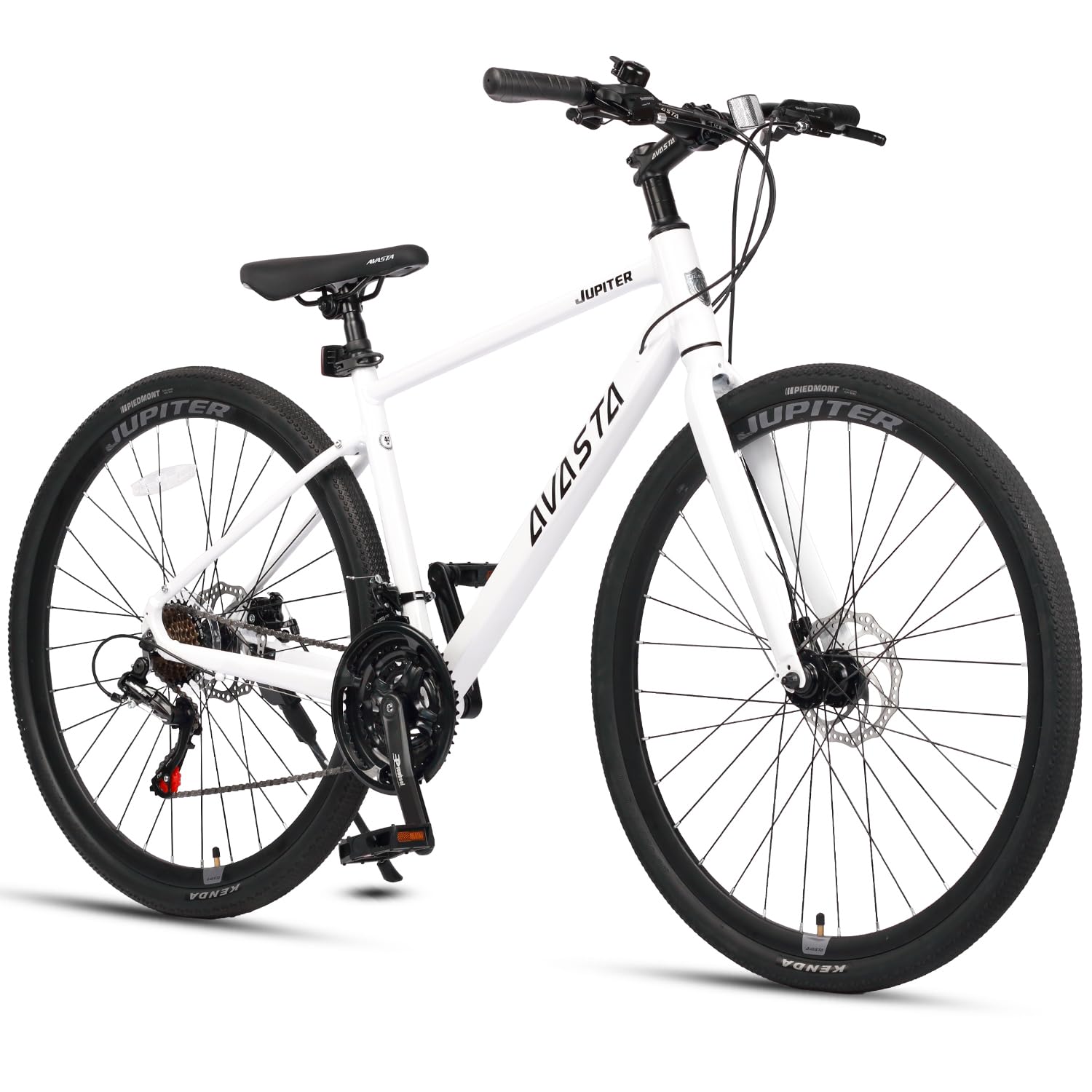
A 21-speed Shimano EF500 shifting system — the same component brand found on bikes costing twice as much — makes this a budget bike that does not feel like one.
The Jupiter uses a Shimano EF500 Easyfire shifting system (Shimano is the brand; EF500 is the model of shift levers, designed for easy, intuitive gear changes) and pairs it with mechanical disc brakes and an aluminum frame that keeps weight manageable. It offers 21 speeds, matching the Schwinn Network and GTX, but at a lower entry price. Multiple mounting points let you add a water bottle holder, mudguards, or a rear rack without drilling.
Reviewers point out impressive longevity for this price range. One reviewer logged over 500 miles on the Jupiter and called it “solid and dependable” on pavement, gravel, and even horse paths. Another owner who also owns a higher-end Schwinn GTX Elite said the Jupiter is “comparable but lighter.” Unlike the VIRIBUS, which needed derailleur adjustment and wheel truing from the start, most Jupiter units arrive with proper tuning. The stock saddle is uncomfortable after a few miles, a common issue at this price. Plan for a replacement saddle if your rides exceed 10 miles. The front disc brake may need a minor adjustment after assembly, a five-minute fix with an Allen key.
Why It Wins on Value
- Shimano EF500 shifters deliver smooth, precise gear changes
- Multiple mounting points for racks and fenders right from the box
- Proven durability — shoppers say 500+ miles with no issues
Where It Cuts Corners
- Stock saddle is uncomfortable on rides longer than 10 miles
- Front disc brake often needs a quick adjustment after assembly
- Limited color options compared to other brands
Grab it for: The budget-minded rider who wants 21-speed range and reliable disc brakes without sacrificing component quality.
Pass if: You need a comfortable stock saddle for long recreational rides and do not want to replace it.
6. VIRIBUS Hybrid 28 inch
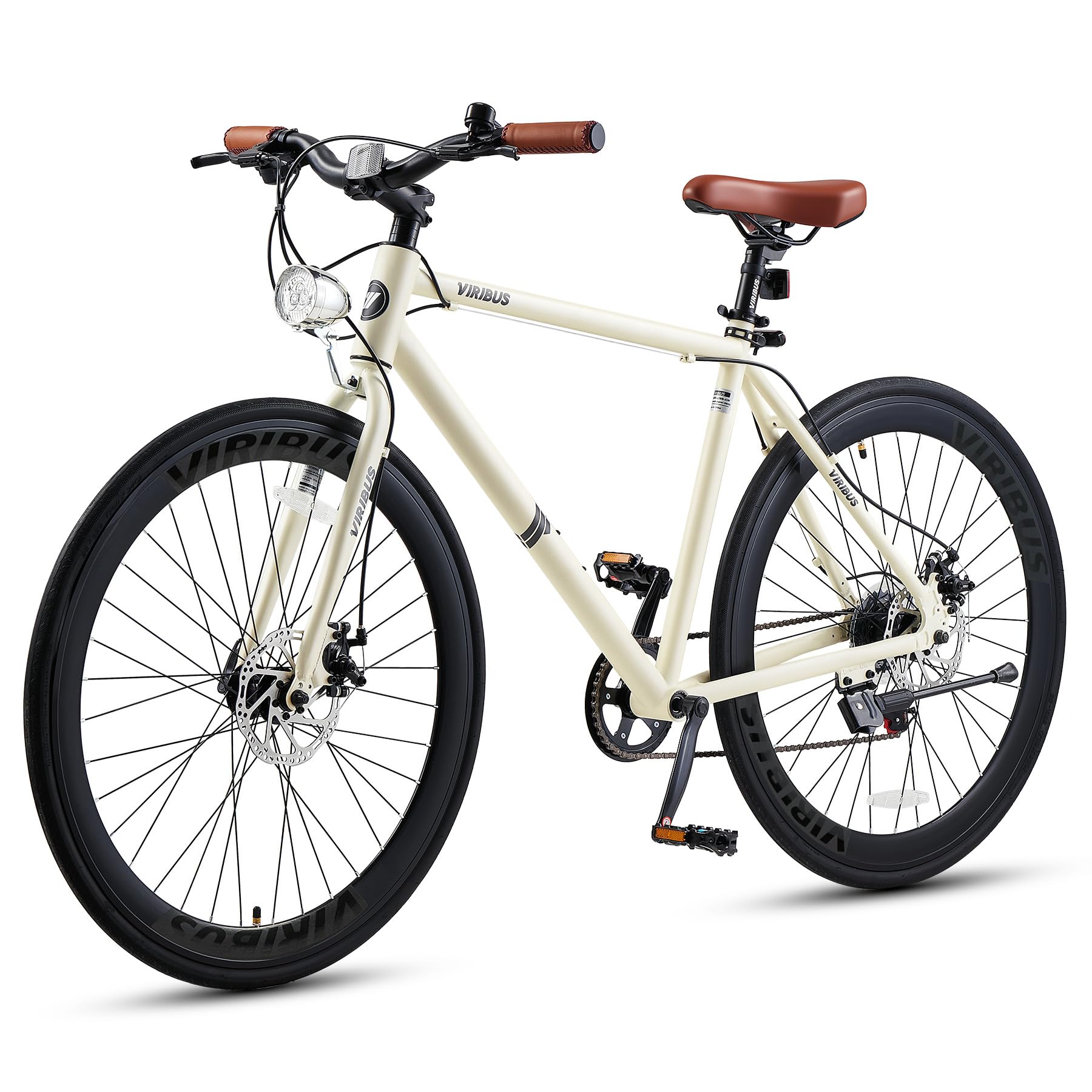
A 330-pound weight capacity and IPX4-rated lights make this retro-styled hybrid a practical choice for heavier riders and dusk commutes.
The VIRIBUS stands out visually with its retro cream color and classic styling. It rolls on 700c wheels with disc brakes front and rear. It includes IPX4-rated (IPX4 means it is splash-resistant from any direction) front and rear lights right from the start, so you can ride safely at dusk without buying extra accessories.
However, buyers report the bike needs mechanical patience. One owner reported the “derailleur requires some adjustment from the start and both wheels needed truing” due to loose spokes. Another owner described it as “one of the poorest pieces of engineering” they had seen, citing an impossible-to-align front disc brake. Compare that to the AVASTA Jupiter, which consistently arrives better tuned. On the positive side, owners who spent time on adjustments report good performance. A 74-year-old rider who bought it for daily fitness rides called it “just right” after tuning. The 7-speed thumb shifter is simple and reliable once adjusted. The included tool kit has everything you need for basic maintenance.
Standout Features
- 330-pound weight capacity accommodates heavier riders
- Includes IPX4-rated front and rear lights for riding at dusk
- Retro cream paint finish is unique and eye-catching
What to Expect
- Requires derailleur adjustment and wheel truing from the start
- Front disc brake alignment is difficult on some units
- 7-speed range is narrow for hilly terrain
Buy it because: You want a stylish hybrid with high weight capacity and do not mind tuning the derailleur and wheels yourself.
Avoid it if: You are a new rider who wants a low-maintenance unboxing-and-ride experience.
7. HILAND 700C Hybrid

A 6061 aluminum low-step frame and dual disc brakes at the lowest entry price, but quality control is a gamble.
At this price point, the HILAND delivers features that usually cost more: a 6061 aluminum low-step frame (6061 is a specific alloy of aluminum that is strong and light) for easy mounting, dual disc brakes for wet-weather stopping, and a 7-speed trigger shifter for clean gear changes. It is available in two sizes — Medium fits 5’9″ to 6’1″, Large fits 6’1″ to 6’5″ — which covers taller riders better than many budget options. The bike arrives 85% assembled with free installation tools.
The quality control split is wide. Some buyers receive the bike perfectly dialed in — one described it as “an excellent, beautiful bicycle” that arrived in perfect condition. Others get a lemon: one customer observed that the “chain railer shattered literally the first shift change,” which points to a serious manufacturing defect on some units. The disc brakes and trigger shift feel premium when they work properly. Customer service from HILAND gets positive marks — one buyer received a full replacement after the frame was damaged in shipment. The 7-speed drivetrain is simple and works well for flat to gently rolling terrain, but it limits you on steep hills compared to the 21-speed options from AVASTA or Schwinn.
What Stands Out
- Low-step aluminum frame makes mounting and dismounting easy
- Dual disc brakes provide reliable stopping in all weather
- Customer service is responsive and replaces defective units
The Risk
- Quality control is inconsistent — some arrive with major defects
- 7-speed gearing is not suited for steep or extended climbs
- Assembly instructions are sparse and assume prior bike experience
It fits if: You are on a tight budget and want disc brakes on a low-step frame for flat urban commuting.
Think twice if: You cannot afford to deal with a potential lemon or need a bike that is ready to ride immediately.
Understanding the Specs
Speeds: 7 vs 21
The number of speeds determines how wide your gear range is. A 7-speed drivetrain (like on the HILAND or VIRIBUS) is simpler, lighter, and easier to maintain, but you will run out of low gears on steep climbs. A 21-speed drivetrain (like on the Schwinn Network or AVASTA Jupiter) gives you both a low granny gear for climbing and a high gear for faster descents. Pick 7-speed for flat terrain and 21-speed for hills.
Brakes: Linear Pull vs Disc
Linear pull brakes clamp onto the wheel rim to stop you. They are lightweight and cheap, but lose significant stopping power when the rim is wet. Disc brakes use a rotor near the wheel hub, so rain and mud do not affect them. Mechanical disc brakes (found on the Schwinn GTX and AVASTA) are the standard at this price — they need occasional cable adjustment but work well in all conditions.
Frame: Step-Over vs Step-Through
A step-over frame (traditional diamond shape) is stiffer and more efficient for pedaling, transferring more of your energy into forward motion. A step-through frame (low-step) lets you mount and dismount without swinging your leg high, which is easier for shorter riders or those with limited flexibility. For a dual-purpose bike that sees trail use, step-over frames are generally preferred for better stability.
Fork: Rigid vs Suspension
A rigid fork (like on the Tommaso La Forma) is lighter and more efficient for road riding, but every bump travels straight to your hands and shoulders. A suspension fork (like on the Schwinn Network) absorbs trail chatter and makes unpaved paths more comfortable, but adds a few pounds and saps some pedaling efficiency on pavement. For true dual-purpose use, a suspension fork with a lockout feature offers the best of both worlds.
FAQ
What is the difference between a hybrid bike and a dual-purpose bicycle?
Will a 7-speed bike work for hilly terrain?
How do I know what frame size fits me?
Are disc brakes really better than linear pull brakes?
How long does it take to assemble a dual-purpose bike?
Can I add a child seat or trailer to a dual-purpose bike?
Which dual-purpose bike is best for a heavier rider?
Do I need a suspension fork for trail riding?
What tools do I need to assemble a dual-purpose bike?
Is a dual-purpose bike good for daily commuting?
Final Thoughts: The Verdict
Across the board, the dual purpose bicycle winner is the Schwinn Network 3.5 because it blends 21-speed range with a suspension fork and an aluminum frame at a price that undercuts true premium options. If you want mechanical disc brakes and light trail capability, grab the Schwinn GTX Comfort. And for budget-minded buyers who still want 21-speed Shimano shifting and reliable disc brakes, the standout is the AVASTA Jupiter 700C.
How We Picked
We do not accept paid placement. Every pick is matched to a real buyer and a real use-case; we do not hands-on test units.
Sources & Methodology
Specifications: manufacturer listings and product documentation. Review insights: verified customer reviews, as of July 2026. Pricing: not shown on this page (it changes often); check the current price via the retailer link.
As an Amazon Associate, Trending Car earns from qualifying purchases. This does not affect which products we feature.