
Our readers keep the lights on and my garage snacks stocked. As an Amazon Associate, I earn from qualifying purchases.
Specs are compiled from manufacturer listings and verified buyer reviews and can change over time — please confirm the key details on the product page before buying.
A tire pressure gauge is a small tool that solves a big problem: keeping your tires exactly where they need to be, so your car handles right and your fuel bill stays low. The trouble is most analog gauges are hard to read and lose accuracy over time, while the cheap digital ones sometimes give you a different reading each time you press it on the valve. This guide cuts through the noise to find the digital gauges that give you a fast, reliable number every single time.
I’m Min Islam — the founder and writer behind Trending Car. This guide is built by comparing the manufacturers’ published specifications and the patterns across verified customer reviews, so you get each pick’s real strengths and trade-offs instead of marketing spin.
After digging through the specs and hundreds of owner experiences, we have narrowed it down to the six models that define the digital tire pressure gauge category right now, from a heavy-duty workhorse that survives being run over to a lightweight pocket pick for daily commuters.
Our Picks at a Glance

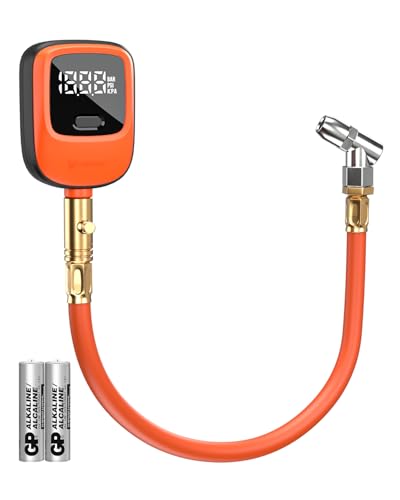
How To Choose The Best Digital Tire Pressure Gauge
A digital tire pressure gauge is a straightforward tool, but the specs on the box can be confusing if you don’t know what to look for. Here are the three most important factors that separate a gauge you will use for years from one that lives in the glove compartment collecting dust.
PSI Range and Accuracy Grade
The pressure range (measured in PSI) tells you the maximum reading the gauge can handle. A passenger car typically needs 30-40 PSI, so a gauge that goes up to 150 PSI is plenty. If you own a heavy truck or an RV, you will want a gauge that reads up to 230 or 250 PSI. Accuracy is measured by an ANSI grade — Grade 2A means the gauge is calibrated to be within 1 PSI of the true pressure. Higher-end gauges achieve ±0.5%, which matters if you run high-performance tires that need very precise pressure.
Form Factor and Chuck Type
The chuck is the part that presses onto your tire’s valve stem. A straight chuck works fine on most cars, but a 360-degree swivel or dual-head chuck is a lifesaver on trucks and RVs where the valve stem is tucked behind the wheel or positioned at an awkward angle. A flexible rubber hose is also helpful because it lets you attach the gauge to the valve without holding the heavy body of the gauge steady.
Bleed Valve and Extra Features
A bleed valve is a small button that lets you release air while the gauge is still pressed onto the valve. Instead of guessing, pressing, checking again, and repeating, you just bleed air until the reading on the screen drops to exactly the number you want. A backlit display and an LED flashlight around the nozzle are helpful if you check pressure at night or in a dim garage.
Quick Comparison
| Model | Best For | PSI Range | Accuracy | Chuck Type | Amazon |
|---|---|---|---|---|---|
| SAFELIFE 2-pack★ Best Overall | Budget twin-pack for two vehicles | 0–150 PSI | — | Straight nozzle (Schrader only) | Amazon |
| ETENWOLF T600Precision Pick | Precision & premium feel | 0–250 PSI | ±0.5% (ANSI B40.7 Grade 2A) | 360° rotating, 1/4″ NPT compatible | Amazon |
| AstroAI T1 | All-in-one inflation & checking | 3–250 PSI | ±1 PSI (ANSI B40.7 Grade 2A) | Quick-connect coupler (¼” & ½” NPT) | Amazon |
| EXELAIR EX516DIG | Heavy-duty & shop use | 5–100 PSI | — | 360° dual-head swivel | Amazon |
| GERCHWAY | Brass durability & compact storage | 0–200 PSI | ±1% | 360° swivel chuck | Amazon |
| Number-one | Dual-head range for RV/truck inner tires | 0–230 PSI | — | Bi-directional push-pull dual head | Amazon |
In‑Depth Reviews
1. SAFELIFE Digital Tire Pressure Gauge 150 PSI (2-pack)
Our pick — over 4★ from 850+ verified ratings; the strongest balance of quality and price.
A two-gauge bundle so you can keep one in each vehicle without spending twice.
The SAFELIFE gauge is the lightest and most compact option here — it weighs just 1.6 ounces and measures 4.25 x 1 x 1.77 inches, compared to the EXELAIR’s 9.28 ounces and 13.38-inch length. You can toss it in a glove compartment, a motorcycle saddlebag, or a center console and forget it is there until you need it. The 0–150 PSI range is enough for any passenger car, SUV, motorcycle, or bicycle (as long as you have Schrader valves — it is not compatible with Presta stems). It reads in four units: PSI, BAR, Kgf/cm², and KPA, with 0.1 PSI increments.
Reviewers point out one important quirk: you need to hold the nozzle on the valve for 2 to 3 seconds to get a stable reading — pressing and releasing too fast gives an inaccurate number (the same behavior as the EXELAIR, though the ETENWOLF and AstroAI lock the reading immediately). The backlit LCD and the lighted nozzle are helpful in dim conditions, and the batteries (a CR2032 and three AG13 cells) come pre-installed, so it works straight out of the package. The 30-second auto shut-off or a 2-second long-press manual off saves the battery.
The plastic body does not feel as solid as the brass or metal gauges, but you get two units for the price of a single premium gauge. As one buyer put it, “nice to have one for each of my vehicles.” If you have two cars and just want something that works without thinking, the two-pack is the easy move over a single premium unit.
Why it makes sense
- Two gauges for the price of one — one for each car
- Ultra-light 1.6 ounces disappears in any storage pocket
- Backlit LCD and lighted nozzle for dark use
- Batteries pre-installed, ready to go
Limits to know
- Needs a 3-second hold — not an instant reading
- 150 PSI max is fine for cars but not heavy trucks
- Plastic build less durable than metal or brass alternatives
Ideal for: the two-car household that wants a functional digital gauge in each vehicle without spending more than the cost of a single premium unit.
2. ETENWOLF T600 Digital Tire Pressure Gauge 0-250 PSI
The gauge that matches your truck’s onboard tire pressure monitor, reading for reading, every time.
The T600 is manually calibrated to the ANSI B40.7 Grade 2A standard — that is a published benchmark meaning the gauge is accurate within 1 PSI of the true pressure — and it delivers an impressive accuracy of ±0.5%, while the AstroAI T1 below offers ±1 PSI. That kind of precision matters if you run tires that need to be within a pound or two of a target. Reviewers confirm the readings matched their OEM TPMS numbers exactly (38 PSI front, 42 PSI rear on a 2025 Tacoma). The 0–250 PSI range covers everything from a bicycle to a heavy truck, so you are never left guessing.
The rubber hose and the 360-degree rotating nozzle mean you can attach the gauge to a tight valve stem without bending the metal connector at a bad angle. If the pressure is too high, the bleed button lets air out while the gauge stays locked on the valve — you watch the digital number drop and stop exactly when you hit the right PSI. It runs on two replaceable AA batteries, and the single power button handles on/off, zero reset, and unit switching all in one press. One note: at 9.6 ounces it weighs about the same as the EXELAIR (9.28 ounces) — both are noticeably heavier than the 1.6-ounce SAFELIFE, so this is not a glove-compartment-toss gauge.
The 2-year warranty that comes with it is a rarity in this category. So the ETENWOLF T600 is the pick if you want lab-grade repeatability and the flexibility of a hose-and-swivel setup without paying professional-tool prices. You would skip it if you need the lightest possible gauge to keep in a motorcycle jacket or a tiny glove box.
What puts it ahead
- Accuracy of ±0.5% PSI — best in this lineup
- Rubber hose makes awkward valve angles easy
- Real-time bleed button shows pressure drop as you release air
- 2-year warranty is unusually generous for a sub-$ gauge
One thing to know
- At 9.6 ounces it is a stout tool, not a pocket trinket
Grab this if: you want the most accurate readout money can buy under $ and the flexibility of a hose for tight spots.
Look elsewhere if: you need the lightest possible gauge to keep in a motorcycle jacket or a tiny glove box.
3. AstroAI T1 Digital Tire Pressure Gauge with Inflator
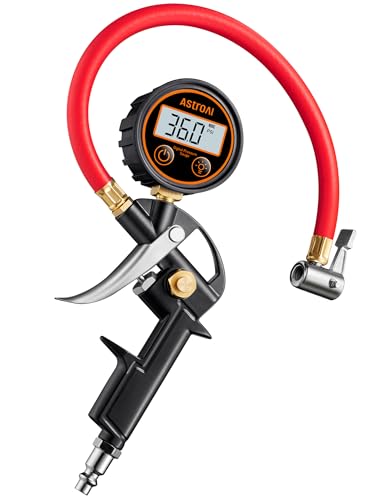
A gauge, inflator, bleed valve, and hose in one brass-bodied package that clips onto your air compressor.
This is the Swiss Army knife of the category. The AstroAI T1 combines a calibrated gauge with a deflation valve and an air hose that connects to any standard ¼” or ½” NPT compressor. It is manually calibrated to ANSI B40.7 Grade 2A and reads within ±1 PSI, which is the same Grade 2A standard the ETENWOLF T600 meets — the difference is the T600’s ±0.5% is a step tighter, but for most drivers ±1 PSI is more than enough to keep tires safe and even. The range spans 3–250 PSI, a wider gap than the GERCHWAY’s 200 PSI ceiling, so you can use it on a bicycle tire all the way up to a commercial truck tire.
Buyers report that the all-in-one design works smoothly: clip the quick-connect coupler onto the compressor, set your target pressure on the digital display, inflate, and use the bleed button to let out any extra air in seconds. The brass construction feels durable compared to the plastic-bodied SAFELIFE below. One reviewer wished it had its own dedicated pressure release button, though the bleed valve on the unit does the same job. At 0.36 kilograms (about 12.7 ounces), compared to the Number-one gauge’s 0.23 kilograms (8.1 ounces) — so it stays by the compressor rather than in a pocket.
If you already own an air compressor and want one tool that checks, inflates, and deflates without swapping attachments, the T1 is the most capable setup for the money. It is the pick for the home mechanic who wants to check and fill tires from one tool without bending over to read a dial. You would pass on it if you need a lightweight gauge to carry in a backpack.
Why it stands out
- All-in-one gauge, inflator, bleed valve, and hose
- ±1 PSI accuracy with ANSI Grade 2A certification
- Works with ¼” and ½” NPT compressors
- Durable brass and stainless steel build
Trade-off to know
- Heavier than standalone gauges because of the integrated hose
Who it fits: the home mechanic with an air compressor who wants to check and fill tires from one tool without bending over to read a dial.
4. EXELAIR EX516DIG by Milton Digital Dual Head Tire Gauge

The metal-body gauge that one buyer says survived being run over by a truck tire and still reads accurate.
The EXELAIR EX516DIG is built like a tool for a professional shop, not a gadget for the glove box. It has a full metal body wrapped in a non-slip rubber grip, and the dual-head chuck swivels a full 360 degrees so you can press it onto a rear dual valve or a tightly tucked inner tire without twisting your wrist. It reads in PSI (5–100), kPa, and BAR, and the backlit LED screen is paired with a small LED flashlight at the base that shines directly onto the valve stem for dark readings.
Owners mention that this gauge is not instant — you have to hold it on the valve for a couple of seconds to get a stable reading. But that patience is rewarded by durability: one owner put it, the gauge “survived being run over by a truck tire; still accurate due to heavy metal build.” The same reviewer noted the only weak point is the plastic power button, which is cosmetic. At 9.28 ounces, it is heavier than the SAFELIFE’s 1.6 ounces, and its dimensions (13.38 x 1.7 x 0.98 inches) make it longer than the SAFELIFE’s 4.25 inches, so it belongs in a toolbox or hung on a shop wall, not in a pocket.
The PSI range tops out at 100, which is lower than every other gauge here — fine for passenger cars, SUVs, and light trucks, but it will not read the 110+ PSI you sometimes find on heavy-duty RV or commercial truck tires. For daily driving and shop work where you need a tough gauge that can take a beating, this is the one. You would it’s not for you if you drive a heavy truck or RV that needs a reading over 100 PSI.
The strong points
- Metal body and rubber grip are built for abuse
- 360-degree dual-head swivel reaches any valve angle
- Built-in LED flashlight illuminates the valve in the dark
- Switches between PSI, kPa, and BAR
The catch
- 100 PSI max means no heavy truck or high-pressure use
- Needs a few seconds on the valve before it stabilizes
Best for: anyone who drops tools or works in a busy garage where plastic gauges break — the metal build is the real selling point.
5. GERCHWAY Digital Tire Pressure Gauge 200 PSI

A solid brass gauge wrapped in rubber that fits in a glove box but handles like a shop tool.
The GERCHWAY uses a solid brass internal body surrounded by a protective rubber case, so it has the heft and corrosion resistance of a premium tool without being as long as the EXELAIR. The 360-degree swivel chuck makes it easy to reach valves at different angles, and the built-in air bleeder valve lets you fine-tune downward without removing the gauge. One reviewer noted they bought two — one for the garage and one for the camper — because the compact size (5.49 x 3 x 1.49 inches) tucks away easily. Unlike the EXELAIR’s 100 PSI ceiling, the GERCHWAY’s 200 PSI range covers everything up to heavy-duty RV tires, though it falls short of the AstroAI T1’s 250 PSI top end. The included storage bag keeps the gauge from rattling around in a tool drawer.
The 6-month warranty is shorter than the ETENWOLF’s 2 years, but the brass build means this gauge is unlikely to fail from normal use. It also lacks a backlit display — you read the large digital screen in daylight or with your phone’s flashlight at night. For the price of less than a 12-pack of soda, you get a brass-core gauge that hits 200 PSI and fits in a camper or glove box.
What we like
- Brass body with rubber armor is durable and rust-resistant
- 200 PSI range covers cars, SUVs, and RVs
- Swivel chuck and bleed valve add real utility
- Includes a soft storage bag
What it skips
- No backlight — you need ambient light to read the screen
- Shorter warranty than some competitors
Reach for this if: you want a brass-core gauge that hits 200 PSI, fits in a camper or glove box, and costs less than a 12-pack of soda.
6. Number-one Digital Tire Pressure Gauge 230 PSI

The dual-head gauge built for reaching the inner tire on a dually truck without crawling underneath.
The Number-one gauge solves a very specific problem: how to check the pressure on the inside tire of a dual-rear-wheel (dually) truck or RV. Its bi-directional push-pull dual head goes straight through the wheel cutout, and the 360-degree rotatable valve head angles itself to meet the stem. A built-in LED flashlight and LCD backlight make the process possible in the dark, which is exactly when most drivers realize they have a low tire. The 0–230 PSI range is the second-highest in this lineup (the AstroAI and ETENWOLF both top out at 250 PSI), so it handles truck and RV pressures with headroom to spare.
Customers note that the tool has good reach and separates into pieces for storage. However, the power button is a minor annoyance because the screen turns off quickly and you have to press it repeatedly while checking multiple tires. One reviewer suggested the gauge should turn on automatically when you press it to a valve. At 0.23 kilograms (8.1 ounces), versus the AstroAI T1’s 0.36 kilograms, making it noticeably easier to handle when you are reaching through a wheel to find the inner stem. The ABS handle is less premium than the brass body of the GERCHWAY or the metal build of the EXELAIR, but for the specific job of checking dual rear wheels, this gauge is purpose-built. Dually truck and RV owners who cannot reach the inner tire valve without contorting will find the bi-directional head is the exact fix.
What it does best
- Bi-directional head makes inner dually tires accessible
- High 230 PSI range covers trucks and RVs
- LED flashlight and LCD backlight for night use
- Lightweight at 0.23 kg — easy to maneuver
Annoyances
- Power button times out fast, needs frequent pressing
- ABS handle feels less durable than metal-body gauges
Who really needs this: dually truck and RV owners who cannot reach the inner tire valve without contorting — the bi-directional head is the exact fix for that pain.
Understanding the Specs
PSI Range
PSI stands for pounds per square inch, the most common unit for measuring tire pressure. A passenger car typically runs between 30 and 40 PSI. A gauge that reads up to 150 PSI is more than enough for that. But if you drive a heavy truck, an RV, or a commercial vehicle, you need a gauge that goes to 200, 230, or even 250 PSI — otherwise the gauge simply cannot read your tires. A higher range does not hurt accuracy on low-pressure tires, so buying a 250 PSI gauge for a car is not a mistake.
Accuracy Grade (ANSI B40.7)
The ANSI B40.7 standard is a published accuracy benchmark that gauge manufacturers voluntarily meet. Grade 2A means the gauge is accurate within 1 PSI of the true value. Some gauges, like the ETENWOLF T600, go a step further to ±0.5%. That tighter tolerance matters for high-performance tires or when you just want to know that the reading drifting is not your gauge. A Grade 2A gauge is plenty for daily driving — the difference between 0.5 PSI and 1 PSI is not going to leave you stranded.
FAQ
Can I use a digital tire pressure gauge on Presta valves?
How do I know if my digital tire pressure gauge is accurate?
What does the bleed valve button do?
Will a 150 PSI gauge work for my truck tires?
How long do the batteries last in a digital tire gauge?
Is a dual-head gauge better than a single-head gauge?
What does auto shut-off mean on a tire pressure gauge?
Can I use a digital tire pressure gauge on a motorcycle?
Final Thoughts: The Verdict
For most drivers, the best digital tire pressure gauge is the ETENWOLF T600 because it combines ±0.5% accuracy, a flexible rubber hose, a real-time bleed valve, and a 2-year warranty at a price that undercuts premium competition. If you need an all-in-one tool that checks and fills tires directly from a compressor, grab the AstroAI T1. And for dually truck owners fighting inner-valve access, the Number-one with its bi-directional dual head is the purpose-built solution that no other gauge here fully replaces.
How We Picked
We do not accept paid placement. Every pick is matched to a real buyer and a real use-case; we do not hands-on test units.
Sources & Methodology
Specifications: manufacturer listings and product documentation. Review insights: verified customer reviews, as of July 2026. Pricing: not shown on this page (it changes often); check the current price via the retailer link.
As an Amazon Associate, Trending Car earns from qualifying purchases. This does not affect which products we feature.