
Our readers keep the lights on and my garage snacks stocked. As an Amazon Associate, I earn from qualifying purchases.
Specs are compiled from manufacturer listings and verified buyer reviews and can change over time — please confirm the key details on the product page before buying.
If your speedometer is lying to you — or your car is old enough that it never had a good one — a digital unit pulls its data straight from GPS satellites or your car’s own computer, so you finally see the speed you’re actually doing. That means no more squinting at a broken dial, no more guessing in construction zones, and no more relying on a needle that lags behind reality. This guide sorts through the GPS-only units, the OBD2 plug-ins, and the hybrid systems to find the one that fits how you drive.
I’m Min Islam — the founder and writer behind Trending Car. This guide is built by comparing the manufacturers’ published specifications and the patterns across verified customer reviews, so you get each pick’s real strengths and trade-offs instead of marketing spin.
Whether you drive a modern SUV or a classic truck, the right digital speedometer for cars removes the guesswork from your dash and gives you a clear, accurate read on every mile.
Our Picks at a Glance

How To Choose The Best Digital Speedometer for Cars
The first choice is between an OBD2 unit that reads your car’s computer or a GPS unit that tracks satellites. Each delivers a digital readout, but they differ in compatibility and update speed.
GPS vs OBD2: Know Your Data Source
A GPS speedometer calculates your speed from satellite signals, so it works on absolutely any vehicle — including golf carts, boats, and classic cars with dead dashboards. An OBD2 unit plugs into your car’s diagnostic port (a standard socket under the dash) and reads the speed straight from the engine computer, which often gives you faster updates and extra data like RPM and coolant temperature. The catch is compatibility: OBD2 units only work on cars from roughly 2008 onward, and even then, some models don’t broadcast all the data these displays want.
Readability and Mounting: Where Does It Live?
Large, bright digits let you check speed with a quick glance, keeping your eyes on the road. Some units sit on top of the dash with a non-slip mat, some clamp to a vent or windshield with a suction cup, and others are designed to be tucked into an existing gauge hole. Also check the backlight: a screen that looks great in your living room can wash out completely in direct summer sun, and one that’s too bright can glare at night.
Extra Alerts: Speed Warnings and Fatigue Reminders
Many digital speedometers bundle in an overspeed alarm that beeps when you cross a set limit — a lifesaver in construction zones. Some also track your driving time and nudge you to take a break after a few hours behind the wheel. These extras don’t alter the core function, but they often tip buyers toward a feature-rich model.
Quick Comparison
| Model | Best For | Data Source | Screen Size | Key Feature | Amazon |
|---|---|---|---|---|---|
| ELING 2″ GPS Gauge★ Best Overall | Boats, RVs & classic dashboards | GPS | 2 inches | Waterproof & anti-fog | Amazon |
| KUOWEIHUD F2 HUDBest Value | Budget plug-and-play | GPS + BDS | Compact | 6+ display interfaces | Amazon |
| KUOWEIHUD F16 OBD2Top Performer | Modern gasoline cars | OBD2 + GPS | 3.5 inches | Turbo gauge & fault codes | Amazon |
| wiiyii G10 HUD | Big-screen GPS fans | GPS | 5.5 inches | Altitude & compass | Amazon |
| AOMOSUR X98 Solar | Off-road & cable-free | GPS | Compact LCD | Solar + USB charging | Amazon |
| OinDoDi C3010 HUD | Compass + speed combo | GPS | 4.2 inches | 7-in-1 driving computer | Amazon |
| wiiyii P8 HUD | OBD2 data enthusiasts | OBD2 + GPS | 1.8 inches | Boost & voltage gauges | Amazon |
| Kingneed Truck GPS | Trucks & big rigs | GPS | 6.2 inches | Huge green display | Amazon |
| KONNWEI KW206 OBD2 | Full diagnostic power | OBD2 | 3.5 inches | Reads & clears fault codes | Amazon |
In‑Depth Reviews
1. ELING 2″ Digital GPS Speedometer
Our pick — over 4★ from 350+ verified ratings; the strongest balance of quality and price.
The drop-in gauge that finally tells a boat or classic dash the truth
The defining trait here is that it’s a real gauge, not a dash-top box — you cut a 52mm (2 1/16″) hole in your panel and it becomes part of the dash. That’s why it’s the go-to for replacing broken factory speedometers on ski boats and jet skis, where water exposure is a constant threat. It’s 100% waterproof with anti-fogging protection, so it shrugs off spray that would kill an ordinary plastic HUD.
Data comes from a GPS antenna you mount flat, black side up, with a clear view of the sky. The first lock takes about 30 seconds, but after that it re-connects in under 3 seconds. It reads Current Speed and ODO, and a back button flips between KM/H, MPH, and knots — handy if you split time between road and water. Owners on a Nautique 2001 Ski Boat called the install “flawless,” and it took about 10 minutes on another boat, replacing a water-pressure speedometer that couldn’t keep up.
The ELING wins fans for its functionality and accuracy, with owners reporting precision to tenths of a mile per hour at low speeds. The trade-off: digits can wash out in bright sunlight, and one jet-boat owner questioned accuracy without a GPS reference. It runs on 9-32VDC, so it works on 12V or 24V vehicles and boats alike.
Built for the Rough Stuff
- 100% waterproof and anti-fog, rated for open water
- Fits a standard 52mm gauge hole for a factory look
- Reconnects to satellites in under 3 seconds after first lock
What to Weigh First
- Daylight glare makes digits tough to read in strong sun
- Needs a clear sky view for the antenna to work well
Reach for this if: you want a permanent, weatherproof speedo for a boat, RV, or classic dash and don’t mind a little cutting.
Think twice if: you want a portable unit you can move between cars — this one is meant to be installed and stay.
2. KUOWEIHUD F2 GPS HUD
A 3-step plug-in that turns your dash into a multi-screen data hub
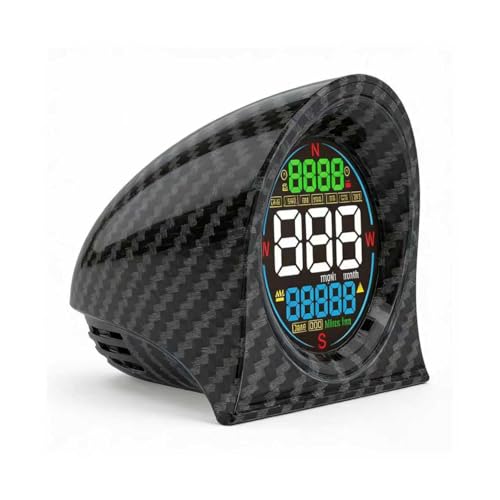
This one is for the driver who wants all the info without touching a single wire. It pulls from GPS+BDS dual satellites — the Chinese Beidou system plus the US GPS network — supporting 32 satellites at once, which gives you faster positioning and a steadier readout than a single-system unit. You just plug the USB cable into your car’s port and it works, no vehicle modification needed.
The real selling point is the 6+ display interfaces. Scroll a side button to flip between speed+time, speed+driving time, speed+odometer, or speed+altitude, and set it to whatever you glance at most. It’s a carbon-fiber textured compact body that won’t block your view, and a built-in light sensor dims it at night and brightens it in strong sun — no manual fiddling. It also bundles an overspeed alarm and a fatigue alert that pings you to take a break after 4 hours of continuous driving.
Golf cart owners love it for navigating RV park speed limits, and the consensus is it “works great, plug and play.” The recurring gripe: sometimes it takes a few minutes to link up and start displaying after you turn it on, which is normal GPS behavior but worth knowing. The build quality gets steady praise, with owners noting it’s “well made and has more functions that I thought” for the price.
Perfect starter pick: the easiest entry into digital speed for any car, truck, or cart.
Look elsewhere if: you can’t tolerate a slow satellite lock on cold starts — give it a few minutes and it settles in.
3. KUOWEIHUD F16 OBD2+GPS Dual Mode
The hybrid that keeps reading your speed even if your car’s computer blinks
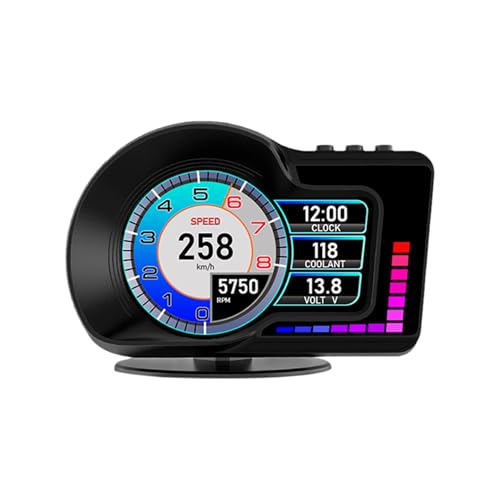
This unit is built for gasoline cars from 2008 to 2025, and its a neat extra is the automatic OBD2+GPS switching. If the car’s computer fails or drops a signal, it smoothly jumps to GPS so the speed never stops displaying — a safety net most single-source units don’t have. You get a 3.5″ IPS screen with 5 themes, 6 alerts, and 8 color ambient lights to match your dash vibe.
The 1.6-ounce body is small enough to tuck almost anywhere, and it doubles as a turbo gauge for boost-ready drivers, plus it reads and clears fault codes. One owner’s daughter lost her factory dashboard entirely, and this became her primary speed display — it “works great for her.” The shift light is smooth, and the OBD2-USB-C hookup is described as simple to use.
Owner feedback on functionality is mixed. The RPM and shift light are accurate, but some report slow sampling and “hanging” gauge readings, and the boost refresh in psi is sluggish at around 15 seconds. The main downside is battery drain when off, fixed by using the OBD2 power switch. The sleek look gets strong praise, but treat this as a capable speed display with diagnostic extras, not a precision instrument.
Sleek but specific: the IPS screen and ambient lighting make it the best-looking option on this list.
Know the catch: use the power switch to avoid battery drain, and don’t rely on it for real-time boost readings.
4. wiiyii G10 HUD 5.5″

A 5.5-inch window into speed, altitude, and direction, for any ride
If you want the biggest readout without going full truck-gauge, the G10’s 5.5″ screen is the standout. It runs purely on GPS — no OBD2 needed — so it’s universal for every model, and it layers in satellite timing, altitude, latitude/longitude, and a GPS compass for extra confidence. Owners call the speed accurate within 1 mph of their phone’s GPS app, and it works great on golf carts too.
The package comes with a rotary suction cup holder and a non-slip mat, so you can stick it above your original speedometer or on the windshield. For cars whose factory speedo is dead or buried, this is the cheap digital dash replacement. It auto-adjusts brightness to the light, includes a three-stage overspeed alarm, and an eight-hour fatigue driving reminder. wiiyii backs it with a 12-month warranty and 24-hour after-sales support.
The review pages sum it up: “Had it for 6 months now still works great.” The recurring trade-offs are a startup GPS delay before the speed appears, and one owner found the screen unreadable in direct sunlight — though most report the auto-brightness handles it fine. The trip meter resets on start for some, and the instructions are cryptic, so plan a few minutes to figure out the menu.
Grab this for: a large, colorful, portable GPS display that fits any vehicle and shows altitude and direction.
skip it if: you want instant speed the second you start the car — this one needs a moment to lock satellites.
5. AOMOSUR X98 Solar GPS Speedometer
A solar-powered speedo that shakes off wiring for trucks, mowers, and off-road runs
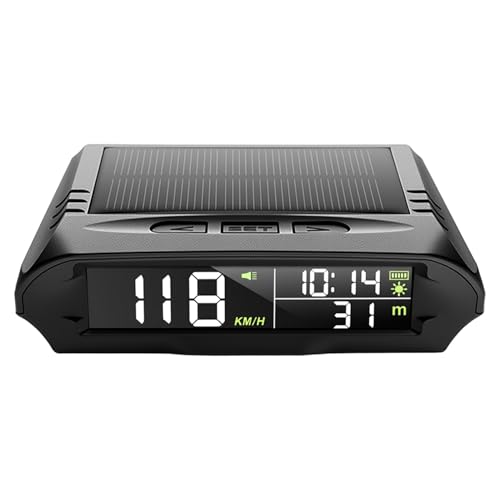
This is the untethered option — no USB cable snaking across your dash, no OBD2 port hunt. It’s powered by an internal battery (1000mAh) that recharges two ways: a solar panel on top for short daily drives, and USB-C for long trips. The auto time sync and GPS-calibrated speed come in at ±1% accuracy, which is notably tighter than most units in this class.
It’s ruggedized and shock-resistant, built for off-road, motorbike, and daily use. Drivers put it in a Toyota Highlander one day and on a lawnmower the next, and it shows speed, elevation, temperature, and time, with overspeed warnings and fatigue reminders. The display auto-adjusts brightness, and owners say the digits are clear in daylight and bright at night.
What wins people over is the simplicity — one owner called it “so simple a Senior can figure it out,” with a readable manual and a 3-button metric/US switch. The honest caveats: in a dark garage, solar charging grinds to a halt and you’ll rely on USB, and one owner found the display too dim in blazing sun. The overspeed chirp fires at 4 and 8 mph over your set limit, which is a handy early warning.
Freedom first: genuinely cable-free for short trips, with solar stretching the runtime.
Know the limit: park in shade too long and you’ll need the USB cable, and direct sun can wash out the screen.
6. OinDoDi C3010 HUD 7-in-1
The rare GPS unit with a compass that actually points the right way
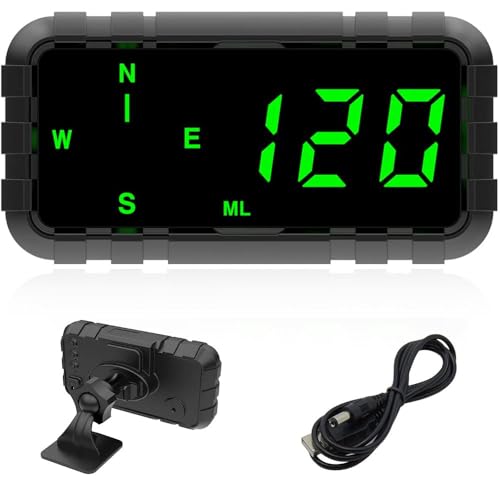
Most digital compasses in this category are notoriously 180 degrees off — that’s why this one stands out. Multiple owners confirm it’s “one of the few car compasses that actually accurately shows your driving direction at a glance,” and a Nissan Versa driver switched from an old rotating ball to this because the digitals just work. It connects via GPS, shows your driving direction in motion, and pairs it with a high-def 4.2″ LED screen.
It’s a genuine 7-in-1: driving speed, compass direction, driving time, mileage, over-speed alarm, fatigue warning, and free KM/Mile switching. The big green fonts are easier on the eyes than white, especially for long hauls, and the light sensor auto-adjusts brightness for day and night. Power comes from a simple USB cable — plug in, and it turns on with the car and off with the car, no professional install.
The build is ABS+PC high-temperature resistant material with no built-in battery, which means no explosion or burning hazard in a hot car. The one asterisk: the compass only works while the vehicle is moving and needs successful GPS positioning first — it won’t show direction sitting in your driveway. Owners say setup is easy, accuracy is “pretty darn accurate,” and it’s a worthwhile upgrade for any car, truck, or golf cart.
Why It Wins Fans
- Accurate live compass — rare in this category
- 7-in-1 driving data on a clear 4.2″ LED
- No battery means no heat risk in summer
The Fine Print
- Compass needs motion plus GPS lock to show direction
- You can’t disable the speedometer if you only wanted the compass
Choose this for: a safe, battery-free display that nails direction and speed in one glance.
Pass if: you need a compass while parked — this one only orients in motion.
7. wiiyii P8 OBD2+GPS HUD

A pillar-mounted data stream for anyone who wants boost, voltage, and temps on screen
This is the first model that can be installed on your A-pillar trim — the interior post beside the windshield — so you don’t need to look down at all. It reads raw OBD data plus GPS, and the 8 display interfaces let you flip through speed, clock, RPM, voltage, water temperature, and more. For tuned cars, it’s a favorite boost gauge; an AMG owner called it “ideal for boost monitoring” and reported a year of use with zero issues.
Setup is genuinely easy — connect to USB power and it locks onto a satellite in about half a mile of driving. The speed is accurate to within ±1 mph once you set the compensation offset. The 1.8-inch LED screen (320×240 native resolution) is small but unobtrusive, and the auto-brightness handles most lighting. It ships with Velcro, 3M tape, and a crowbar for trim installation.
Owners praise it as “best bang for your buck” and a great value for base-model cars that lack factory boost or temperature gauges. The honest trade-offs: the included Velcro is inadequate — bring heavy-duty strips — and the fuel economy readout is locked to km/l, not US mi/g. A few note the screen is too bright at night even at the lowest setting, and the top 4 display fields are locked (time/distance fixed), limiting customization.
Serious data, small size: the most feature-dense unit here for the money.
Plan for quirks: expect to swap the Velcro, live with km/l fuel economy, and unplug it if you park for days.
8. Kingneed Truck GPS Speedometer 6.2″

A 6.2-inch wall of green digits made for big rigs and tired eyes
If you spend hours in a truck, the Kingneed’s 6.2-inch screen with big green fonts is the most comfortable read on this list — green light is easier on the eyes than white for long-distance hauling. It’s a pure GPS unit, so it’s 100% compatible with everything including cars, trucks, SUVs, scooters, trains, motorcycles, boats, and pickups. It doesn’t touch your engine at all, which also means no compatibility worries across brands.
Beyond speed, it displays single driving time, single driving mileage, total mileage, altitude, and local time. The overspeed and fatigue driving alarms keep you honest on long hauls. Power comes through the cigarette outlet jack — plug and play, no professional installation required. A Subaru Forester owner heading through construction zones every day uses it to keep eyes on the road and speed limit at once.
What wins people over is the sheer readability — “big, easy-to-read numbers” and a display that stays bright even in max sun. Some buyers report accuracy right from the start, with a GPS lock in about a minute. The honest caveats: one owner measured it consistently reading about 3% slow against multiple GPS sources and radar signs, and another noted an 8-10 mph lag on hard acceleration. Durability is mixed, with one report of the display screen coming apart too easily.
Built for the highway: the biggest, easiest-to-scan digits for long-haul drivers.
Check the math: verify against a phone GPS first if you need pinpoint accuracy, and treat the mount gently.
9. KONNWEI KW206 OBD2 HUD

The speedometer that doubles as a full diagnostic scanner and code clearer
This is the most capable box in the lineup — a 3.5-inch color LCD that reads your speed, RPM, water coolant temperature, and fuel consumption from your car’s computer, but also reads and clears engine fault codes. That means a check engine light you can investigate without a separate scanner. On a 2008 Prius that lacked gauges entirely, it became a full custom display for battery, RPM, and temp with overheating alarms.
It works on all 2003 or newer OBDII-certified gas and diesel cars, SUVs, and light trucks, covering J1850, CAN, and EOBD protocols. Just plug into the OBDII port and it powers on automatically. Four parameter alarms — RPM, VSS speed, engine coolant temp, and voltage — can be set to reduce over-speed risk. It supports a 0-100 speed-up test and lifetime software updates, and it auto-enters sleep mode when the engine is off to avoid draining your battery.
Owners call it “amazing value in a single device” with a “super clear” display that’s extremely easy to see. On a 2011 Crown Vic Interceptor, it worked flawlessly, reading intake air temp and scanning codes. The honest caveats: the stand’s tape is weak and may need a stronger holder, and one owner found it couldn’t detect a pending code that another reader caught. After 18 months, one report noted random reboots, though it stayed reliable for RPM, speed, temp, and voltage.
Go with this if: you want speed plus the ability to read and clear your own engine codes without extra tools.
Consider another if: you need a rock-solid diagnostic reader — treat this as a superb gauge with scanning as a bonus.
Understanding the Specs
Data Source: GPS vs OBD2 vs Hybrid
GPS units calculate speed from satellite signals, so they work on anything and never touch your car’s wiring. OBD2 units plug into the diagnostic port and read the engine’s own data, which updates faster and adds extras like RPM and coolant temp. Hybrid units switch between the two automatically, giving you GPS as a backup if the car’s computer stumbles.
Brightness and Readability
The screen has to stay legible in two extreme situations: blinding midday sun and pitch-dark night drives. Look for a built-in light sensor that auto-adjusts — it brightens in daylight and dims at night so you’re not squinting or being blinded. Also consider the font color: green is generally easier on the eyes for long-distance driving than white.
FAQ
Will a GPS speedometer work in my car if it has metallic window tint?
Why does my digital speedometer take a minute to show speed at startup?
What’s the difference between OBD2 and GPS speedometers?
Can I use a car digital speedometer on a golf cart, boat, or motorcycle?
Will an OBD2 speedometer drain my car battery when it’s off?
How accurate are digital GPS speedometers compared to my factory dial?
Does an OBD2 HUD show anything besides speed?
What is a fatigue driving reminder?
Are there safety concerns with a speedometer that has a built-in battery?
Final Thoughts: The Verdict
If you want one dependable pick, the digital speedometer for cars winner is the ELING 2″ GPS gauge because it’s the most trusted, waterproof, and permanently mounted option — the crowd favorite at 4.4 stars out of 5 with over 300 owners behind it. If you want a portable dash-top display with compass and no battery risk, grab the Oin