
Our readers keep the lights on and my garage snacks stocked. As an Amazon Associate, I earn from qualifying purchases.
Specs are compiled from manufacturer listings and verified buyer reviews and can change over time — please confirm the key details on the product page before buying.
Out on the trail, the difference between a great day and a bad situation often depends on whether you can actually reach someone when the pavement ends. A radio that drops the call on the far side of a hill or fizzles at the edge of a canyon isn’t just frustrating — it is a genuine safety gap. That is exactly what this guide cuts through: which digital radio actually delivers the clear, reliable reach your rig needs when the terrain gets rough and you are miles from the nearest signal.
I’m Min Islam — the founder and writer behind Trending Car. This guide is built by comparing the manufacturers’ published specifications and the patterns across verified customer reviews, so you get each pick’s real strengths and trade-offs instead of marketing spin.
If you lead a convoy through the desert or just need a steady link to base camp, you want a digital radio for off roading that balances power, ruggedness, and ease of setup. You stay connected when the road ends — these three picks do exactly that.
Our Picks at a Glance
How To Choose The Best Digital Radio for Off Roading
Picking a radio for the trail means looking past the wattage sticker. You want a unit that survives dust, stays readable in direct sun, and can hit a repeater when you are tucked behind a ridge. Here are the factors that separate a reliable off-road companion from a radio that stays quiet when you need it most.
Transmit Power and Real-World Range
Power is measured in watts, and more watts generally mean a stronger signal that can push through trees and over hills. For a group of vehicles within a few miles of each other, 15 to 20 watts is often plenty. If you need to reach a base camp or a far-off repeater, you will want 40 or 50 watts to punch through the obstacles the terrain throws at you.
Repeater Compatibility
A repeater is a stationary antenna on a high point that catches your signal and retransmits it much farther. Radios that are “repeater capable” can talk to these towers, which can stretch your range from a few miles to dozens of miles. If you travel in areas with known repeater coverage, this feature is worth prioritizing over raw wattage.
Ease of Mounting and Display Visibility
In a bouncing vehicle, a big, bright display helps you change channels without squinting. Look for a screen that is readable in strong sunlight and has a backlight for night driving. The radio body should be compact enough to mount on the console or under the dash without blocking your legs or vents.
Programming and Channel Flexibility
Some radios come pre-programmed, but the best off-road picks let you customize channels to match your local repeaters and group frequencies. Support for CHIRP, a free open-source programming tool, makes it easy to tweak settings from a laptop. A radio that offers 150 or more channels gives you room to store all the frequencies you might encounter on a long trip.
Audio Quality in a Noisy Cabin
A loud engine and rough tires create a lot of background noise. A radio with a powerful internal speaker and a microphone gain control lets you boost the audio so you can hear calls without turning down the music or stopping the vehicle. Some radios also accept an external speaker, which you can place closer to your ear for even clearer sound.
Quick Comparison
In‑Depth Reviews
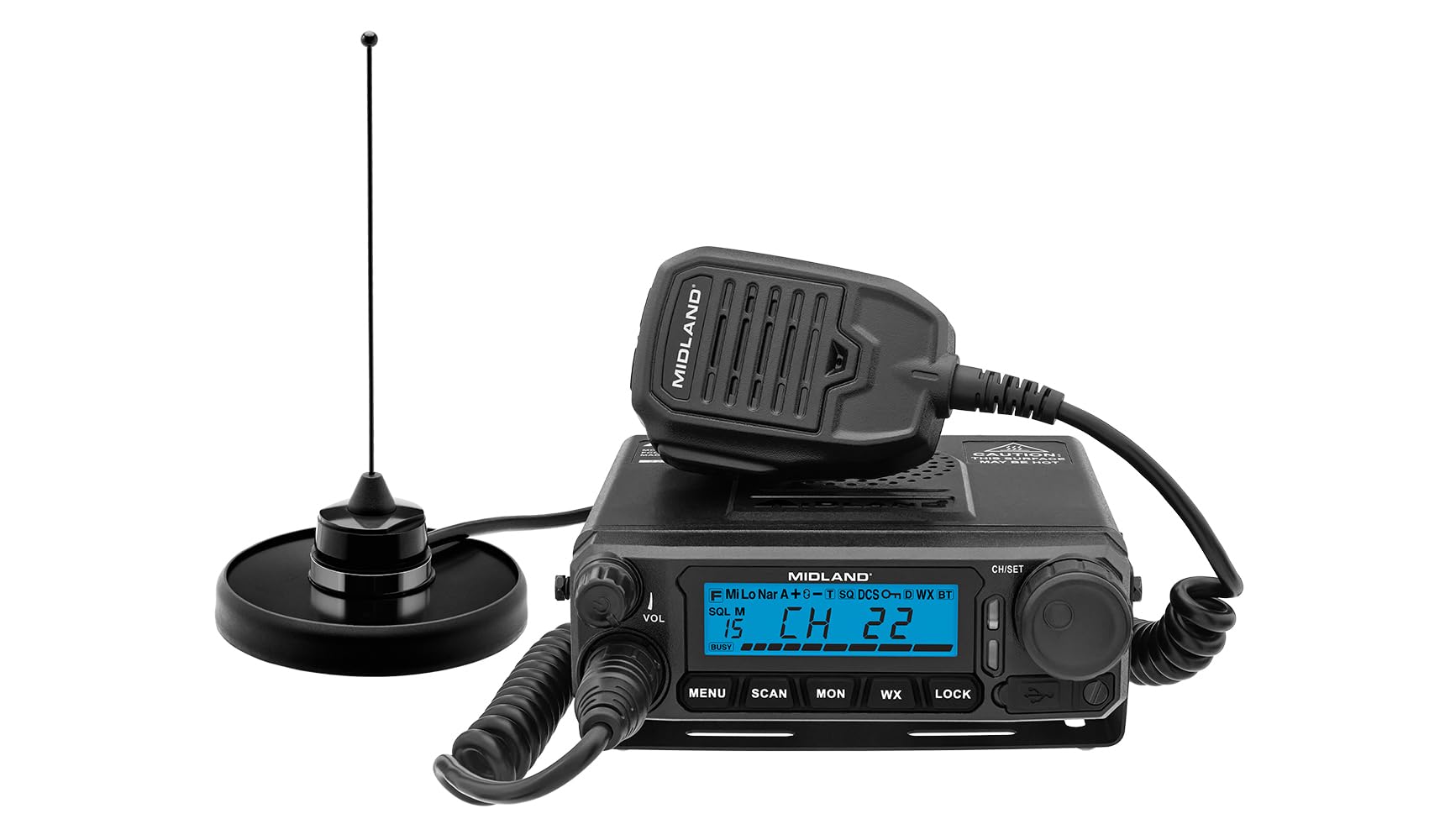
1. Midland MXT500 50-Watt GMRS Mobile Radio
Our pick — 4.5★ from 150+ verified ratings; the strongest balance of quality and price.
The 50-watt powerhouse built to keep a whole convoy talking over the next ridge.
When the trail drops into a valley and the group starts to spread out, raw power becomes your best friend. This Midland delivers 50 watts of transmit power on the GMRS band, which the review pages consistently call “excellent range and clear communication.” The signal punches through thick tree cover and rolling hills better than nearly any other radio in this class. Buyers report that pairing it with a quality external antenna like the MXTA26 only widens its already impressive reach.
The unit is built for the dash of a truck or the center console of a 4×4, with a compact chassis that measures just 1.75 inches deep by 5.5 inches wide. That shallow depth means it mounts flush under the dash without eating into legroom. The backlit display and digital volume control make it easy to read and adjust when you are bouncing through a washboard section. It also covers NOAA weather alerts, so you do not have to rely on your phone for storm warnings when cell service is gone.
A few owners note that the internal speaker is on the weaker side and recommend an external Midland speaker for a noisy cabin — that modest investment turns the audio into something you can actually hear with the windows down.
What wins people over
- 50 watts of transmit power for maximum trail range
- Clear, reliable audio that cuts through cabin noise (with an external speaker)
- Easy repeater and privacy code programming from the front panel
The honest trade-off
- Internal speaker is quiet at speed — budget for an external speaker
- A few owners measured slightly under the full 50-watt output
- Limited to GMRS only, no VHF ham band support
Grab this if: you lead group runs in remote terrain and need the strongest legal GMRS signal you can mount in a vehicle.
Think twice if: you need dual-band VHF/UHF capability or prefer a lighter radio under 3 pounds.
2. Retevis RT95 Dual Band Mobile Radio
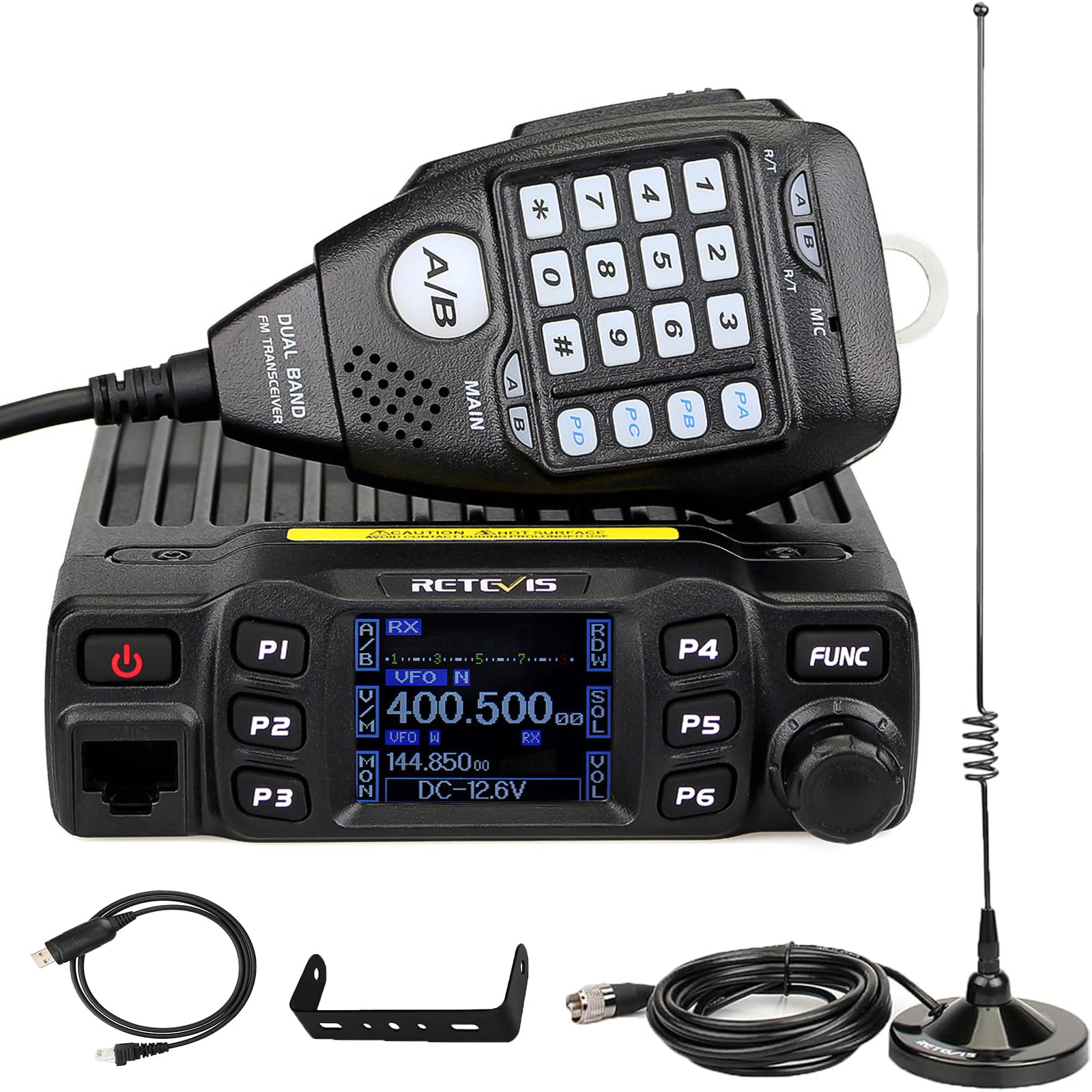
A pint-sized dual-band rig that squeezes ham and GMRS reach into the tightest cab spaces.
If your off-road vehicle is a smaller SUV, a side-by-side, or a Jeep with precious little real estate, the RT95 is the radio to beat on size. At just 4.88 inches deep by 1.54 inches tall, it is significantly shallower than the Midland — a 2.8x difference in depth — and weighs only 645 grams (about 1.4 pounds). That slim profile lets you mount it against the roof console or tuck it beside the shifter without crowding the cabin.
This is a dual-band transceiver that covers both the 2-meter VHF band (very high frequency, around 150 MHz) and the 70-centimeter UHF band (ultra high frequency, around 460 MHz), so it works with ham repeaters and, with a simple frequency open up described by owners, it also works on GMRS frequencies. The 180-degree rotatable TFT color screen means you can angle the display toward your eyes no matter where you mount the body, and the illuminated front panel buttons make night operation easy. Owners mention that it “hits repeaters 25 miles with the included antenna” and the scan speed is a steady 3-4 channels per second — adequate for trail scanning but not the fastest on the market.
The standout feature for radio tinkerers is full CHIRP compatibility (CHIRP is a free, open-source program that lets you load all your channels from a laptop). You can program all 200 memory channels from a laptop with a few clicks, loading local repeater frequencies and group channels before you leave the driveway. The built-in dual-speaker design delivers loud, full audio that owners praise as the most positive aspect of the radio. The manual is a bit dense, but as customers note, a quick YouTube tutorial fills the gaps. The RT95 also includes a magnet-mount antenna in the box, so you get a complete starter kit right out of the package.
Why owners love it
- Ultra-compact chassis fits tight vehicle spaces easily
- Dual-band VHF/UHF with unlockable GMRS operation
- CHIRP programming and 200 memory channels for trip-specific setups
The catch
- Dual-watch function is a slow scanner, not true dual-receiver
- Some reviewers point out lower-than-expected mic audio from the handset
- Manual is confusing; learning curve via YouTube or forums
Reach for this if: you want a versatile dual-band radio that does not hog space and you enjoy programming your own channels via CHIRP.
Look elsewhere if: you need a true simultaneous dual-receiver or prefer a fully pre-configured out-of-box experience.
3. Radioddity DB40-G GMRS Mobile Radio

40 watts of GMRS muscle with a dual display that keeps two channels in your line of sight.
This radio sits in the balance of the GMRS category — enough power to reach far repeaters without jumping to the top price tier. The DB40-G pushes up to 40 watts and comes with 169 fully customizable channels that include GMRS repeater channels and UHF receive-only frequencies. Shoppers say hitting repeaters 40 miles out on just 5 watts, and during a band opening, reaching out 200 miles. The crowd across nearly 180 reviews agrees: the power output and solid build are the main reasons to choose this over pricier alternatives.
The dual display and dual watch feature let you monitor two channels at the same time, which is useful for keeping an ear on an emergency channel while the rest of the group chats on the main trail frequency. The hand mic has VOX (voice-operated transmission — it starts broadcasting when you speak without pressing a button) so you can talk without pressing the push-to-talk button — a handy feature when you are gripping the steering wheel through a technical section. At 2.2 pounds, the DB40-G is 1.6 pounds lighter than the Midland MXT500, making it easier to mount without reinforcing your bracket.
The biggest complaint from the owner community is the instruction manual, which several buyers describe as “totally pathetic.” You will want to download the free CHIRP programming software from Radioddity’s website or use a friend’s configuration file to get the radio dialed in. A few owners also mention that the display can be faint in direct sunlight and that the radio does not include a 12V power adapter (so check your vehicle’s wiring before you start the install). Once set up correctly, however, owners call it a “perfect radio for a newcomer” and a genuine bargain for the power.
Strengths at a glance
- 40-watt transmit power with proven 40+ mile repeater reach
- Dual display lets you monitor two channels simultaneously
- Substantially lighter than the 50-watt Midland (2.2 lbs vs 3.8 lbs)
What to watch for
- Instruction manual is nearly useless — plan on CHIRP or YouTube setup
- Display struggles in bright daylight; no 12V adapter included
- One factory frequency (Channel 23) shipped with incorrect tone from the factory
Best suited for: budget-conscious overlanders who want strong GMRS power and don’t mind wrestling with software once to set it up right.
Pass if: you need a drop-in, fully-tuned radio straight from the start or prefer a heavier chassis that feels more substantial on the mount.
Understanding the Specs
Transmit Power (Watts)
This is the strength of the signal your radio sends out. More watts generally mean you can talk farther and push through obstacles like hills and trees. For trail convoys within a couple of miles, 15 to 20 watts is enough. For reaching distant repeaters or base camps, 40 to 50 watts gives you the headroom you need.
Repeater Capability
A repeater is a receiver-transmitter station placed on a high tower or mountain peak. When your signal reaches it, the repeater blasts it out again much farther — sometimes 50 or 100 miles. Radios that list “repeater channels” are designed to talk to these stations, which is the single biggest range extender you can get without buying a bigger antenna.
Frequency Band (VHF vs UHF)
VHF (very high frequency, around 150 MHz) waves travel well over open ground and through light trees. UHF (ultra high frequency, around 460 MHz) waves bounce better off buildings and handle dense forest. GMRS sits in the UHF range. A dual-band radio covers both bands, giving you more flexibility depending on where you drive.
CHIRP Programming
CHIRP is a free, open-source software tool that lets you program your radio’s channels from a laptop using a USB cable. Instead of punching in frequencies one at a time by hand, you load a file with all the repeaters and group channels for your trip. CHIRP compatibility saves serious time when you travel to new areas with different frequency setups.
FAQ
Do I need a license to use a GMRS radio off road?
Can a ham radio be used for off roading without a license?
How far can a 40 watt or 50 watt radio actually reach on the trail?
What is the difference between GMRS and CB radio for off roading?
Will these radios work with my existing off road group radios?
Can I use a digital radio for off roading as a base station at home?
What antenna should I pair with my off road radio?
Why does the weight of the radio matter for off road use?
Can I mount these radios in a side by side or UTV that gets dusty and wet?
Which is easier to program: the Midland MXT500 or the Radioddity DB40-G?
Final Thoughts: The Verdict
Across the board, the digital radio for off roading winner is the Midland MXT500 because its 50-watt output gives you the longest reach and most reliable connection in the toughest terrain, backed by a huge owner community that confirms its clear audio and easy repeater setup. If you want a compact dual-band radio that fits tight spaces and loves CHIRP programming, grab the Retevis RT95. And for strong 40-watt GMRS performance at a lighter weight and lower investment, the Radioddity DB40-G is the one to reach for — just set aside an hour to conquer the manual.
How We Picked
We do not accept paid placement. Every pick is matched to a real buyer and a real use-case; we do not hands-on test units.
Sources & Methodology
Specifications: manufacturer listings and product documentation. Review insights: verified customer reviews, as of July 2026. Pricing: not shown on this page (it changes often); check the current price via the retailer link.
As an Amazon Associate, Trending Car earns from qualifying purchases. This does not affect which products we feature.