
Our readers keep the lights on and my garage snacks stocked. As an Amazon Associate, I earn from qualifying purchases.
Specs are compiled from manufacturer listings and verified buyer reviews and can change over time — please confirm the key details on the product page before buying.
Does your diesel pickup crank slowly on a cold morning, or does it feel rougher than it should when you’re towing a load? The right oil fixes both problems — but the wrong one can cost you an engine. This guide compares seven top diesel oils so you can pick the one that matches your driving, your climate, and your budget.
I’m Min Islam — the founder and writer behind Trending Car. This guide is built by comparing the manufacturers’ published specifications and the patterns across verified customer reviews, so you get each pick’s real strengths and trade-offs instead of marketing spin.
For anyone who tows, hauls, or simply drives a heavy-duty truck daily, choosing the right lubricant is the single most important decision you can make for engine longevity, and this guide to the diesel oil landscape is designed to steer you straight to the best option for your specific rig.
Our Picks at a Glance

How To Choose The Best Diesel Oil
Buying diesel oil isn’t as simple as grabbing a bottle off the shelf. The wrong viscosity can leave you with sluggish cold starts, while the wrong API rating can actually harm the emissions systems in newer trucks. Here is what to look for.
Viscosity: 15W-40 vs 5W-40
The first number (the “W” stands for Winter) tells you how the oil flows when the engine is cold — a 5W-40 flows much better at low temperatures than a 15W-40, meaning easier starts on bitter mornings. The second number (40) tells you the oil’s thickness at normal operating temperature; both 15W-40 and 5W-40 protect equally well once the engine is hot. If you live where the thermometer regularly drops below freezing, a 5W-40 is the smarter choice. In warmer climates, a 15W-40 is perfectly fine and often more affordable.
API Service Category: CK-4 and Older Standards
The American Petroleum Institute (API) sets the performance standards for diesel oils. For modern trucks with exhaust after-treatment systems (like a Diesel Particulate Filter or DPF), you need an oil that says API CK-4 or API CJ-4 on the bottle. CK-4 is the latest standard, formulated to protect low-emission engines while still being backward-compatible with older engines. Oils marked only CH-4 or CI-4 lack the proper additive packages for today’s emissions hardware and can cause clogged filters and expensive repairs.
Synthetic vs Conventional
Full synthetic oils, like the ones in this list, are chemically engineered for better high-temperature stability and low-temperature flow. They resist breaking down under extreme heat (great for towing) and pour easily in subzero weather. The trade-off? They cost more per quart. Conventional diesel oils are cheaper upfront but degrade faster; if you run a high-mileage older engine with no emissions gear, a conventional or synthetic-blend oil is often all you need. For anyone with a pickup that sees hard use, a full synthetic is the better long-term value.
Quick Comparison
| Model | Best For | Viscosity | Weight | API Rating | Amazon |
|---|---|---|---|---|---|
| Royal Purple 04154 15W-40★ Best Overall | Fuel Economy | 15W-40 | 7.7 lbs | — | Amazon |
| Triax Fleet Supreme 15W-40Also Great | Extended Drain Intervals | 15W-40 | 7.6 lbs | CK-4 | Amazon |
| Mobil 1 Turbo Diesel 5W-40 | Cold Weather Starts | 5W-40 | — | — | Amazon |
| Schaeffer SynShield 5W-40 | Wear Protection & Analysis | 5W-40 | — | CK-4 | Amazon |
| Delo 400 XSP 5W-40 | Heat Reduction | 5W-40 | — | — | Amazon |
| Valvoline Full Synthetic 15W-40 | Value & Versatility | 15W-40 | — | CK-4 | Amazon |
| Lucas Oil 10287 15W-40 | Older Engines | 15W-40 | 3.55 kg | CK-4 | Amazon |
In‑Depth Reviews
1. Royal Purple 04154 15W40 Oil, 1 Gallon
Our pick — over 4.5★ from 750+ verified ratings; the strongest balance of quality and price.
The proven performer that some say pays for itself in fuel savings.
With 797 reviews and a 4.8-star average, the Royal Purple 04154 has the strongest buyer backing here. Its claim to fame is better wear protection and increased fuel efficiency. One reviewer noted a 3 MPG improvement after using it since 2012. That kind of real-world result is difficult to ignore if you drive a lot of miles annually.
The formula is 15W-40, so it is a conventional viscosity — not as cold-friendly as a 5W-40 — but perfect for warmer climates and older or moderately-used engines. The maker also highlights superior corrosion protection and better compatibility with ethanol-blended fuels, which is a plus for trucks that sit for periods. Multiple long-term users call it “the best oil” for their Yanmar tractors and diesel trucks, and a buyer simply wrote, “Just the best.”
The catch is that it lacks the latest API CK-4 rating explicitly in its specs, so for newer trucks with complex emissions systems, you will want to double-check compatibility. For older iron, it is a champion. If you own an early-2000s diesel without a DPF, this is the fuel-economy specialist.
Real-World Results
- Customers note improved fuel mileage by 3 MPG
- Strong 4.8/5 rating from nearly 800 reviews
- Superior corrosion protection for infrequent use
Missing Certification
- No explicit API CK-4 rating listed, check for newer trucks
- 15W-40 viscosity is less ideal for very cold climates
Who should pick it: The driver with an older diesel or moderate mileage who wants a fuel-economy boost and proven wear protection.
One limitation: Owners of late-model low-emission trucks should verify CK-4 compatibility before buying.
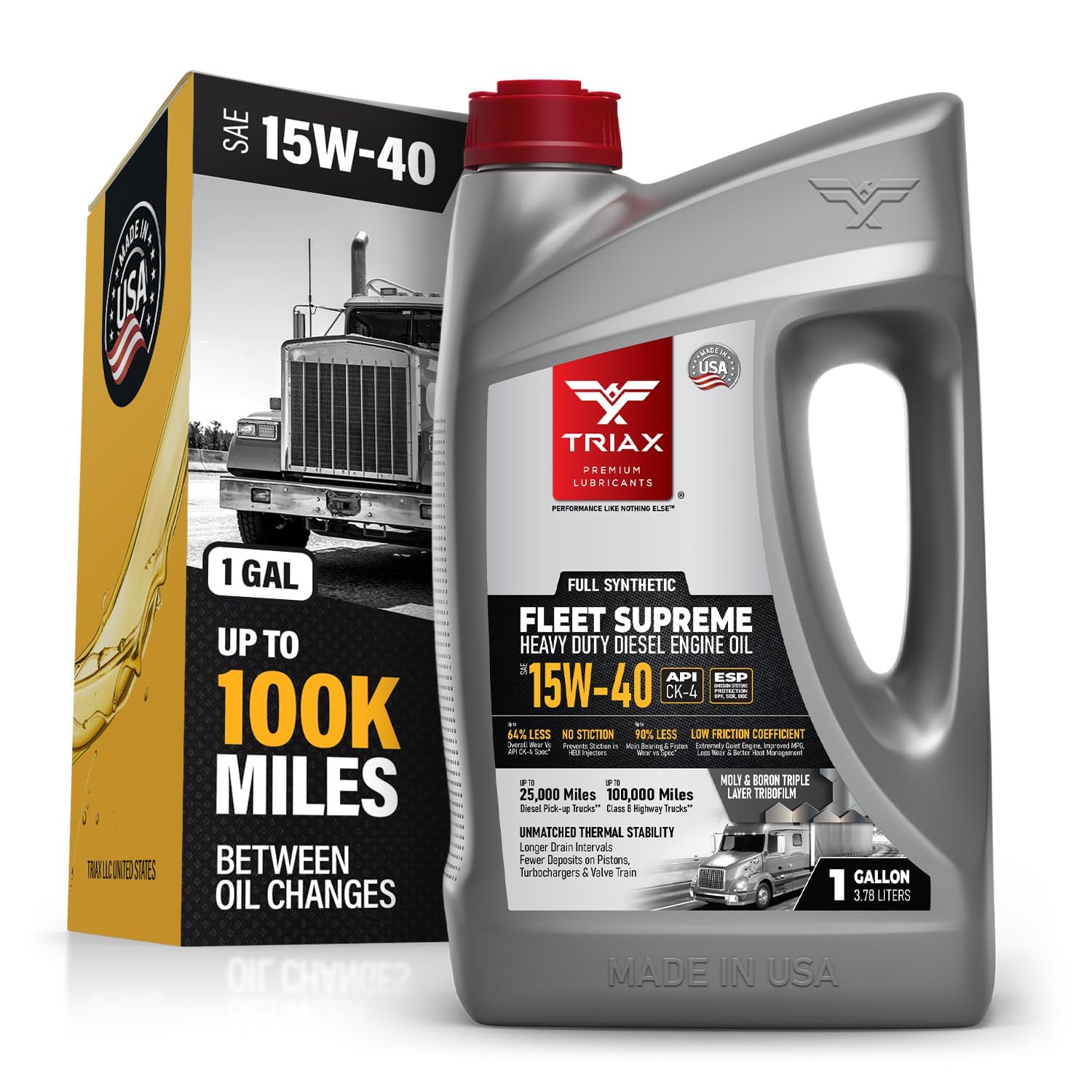
2. Triax Fleet Supreme 15W-40 API CK-4 Full Synthetic Heavy Duty Diesel Engine Oil
The extended-drain champion that comes with its own lab-verified report card.
If you want to stretch oil changes well past the 5,000-mile mark, the Triax Fleet Supreme 15W-40 is the pick. It is boosted with Nano-Boron and Moly friction modifiers (additives that reduce friction metal-to-metal) for noticeably quieter engine operation and lower wear. The maker claims a 4-6% MPG improvement and faster, smoother turbo spooling. An oil analysis at 15,000 miles showed less than 15-20% additive depletion, with the oil staying “green across the board” on the lab report. In semis, buyers report safe drain intervals reach 70,000 miles while TBN (total base number — a measure of remaining wear-fighting ability) and viscosity hold steady without stabilizers.
It is a 15W-40 formula, so it is ideal for warmer climates and strong at high temperatures. The maker says the company is USA-based in Houston, TX, and many users note it is superior to both Rotella and Royal Purple. Unlike the Royal Purple, which leans on fuel-economy claims, the Triax delivers hard data via oil analysis.
The catch is the premium cost — it sits among the higher-priced options here. But if you want one oil for your pickup, farm tractor, and lawn mower, as long-term owners mention using it, the value shows up in the longer drain intervals and the data. You are paying for documented proof, not hype.
Lab‑Grade Proof
- Pending Oil analysis at 15k miles showed <15-20% additive depletion
- Maker claims 4-6% MPG improvement
- Friction-modified with Nano-Boron and Moly for reduced wear
The Upfront Cost
- Higher per-gallon price than many 15W-40s
- 15W-40 is less ideal for extreme subzero climates vs a 5W-40
Reach for this if: You want a full synthetic with verified long-drain capability and the confidence that comes from documented oil analysis results.
Look elsewhere if: you live where winter temps regularly dip below -20°F, as a 5W-40 formula will flow much better on those starts.
3. Mobil 1 Turbo Diesel Truck Full Synthetic Motor Oil 5W-40

The famous Mobil 1 that transforms a cold diesel into a reliable daily starter.
Mobil 1 Turbo Diesel Truck is a staple among diesel owners for one simple reason: it works. This is a 5W-40 full synthetic, meaning it flows much more easily than a 15W-40 when the mercury drops. One reviewer who drives about 3,000 miles a week noted that his van, which used to struggle in cold weather, “fires right up without hesitation” on this oil. Another buyer switched from Amsoil and reported his turbo diesel ran “much quieter” and “much smoother” with the Mobil 1, adding that it feels better than the competitor at a cheaper price.
The formula is designed for modern diesel truck engines, delivering long-drain capability and potential fuel economy benefits. It meets the demanding specs of major truck manufacturers and is recommended for all super-high-performance diesel applications, including low-emission engines. It works to reduce low-temperature sludge build-up and high-temperature deposits, keeping your engine clean internally. Its flash point is 234 degrees Celsius (a measure of how hot the oil can get before it vaporizes, so it stays stable under extreme heat).
The catch? It is a 5W-40, so while it is fantastic for cold starts, some traditional diesel owners prefer the thicker feel of a 15W-40 for heavy towing in high heat, though this is largely a matter of personal preference. It also does not list an explicit API CK-4 rating, so check your owner’s manual for compatibility with emissions gear.
Instant Fires
- 5W-40 flows better for reliable cold-weather starts
- Reviewers point out it quiets noisy engines and smooths idle
- High flash point of 234°C for heat stability
Viscosity Preference
- 5W-40 may feel too thin for some who prefer 15W-40’s hot film strength
- No explicit API CK-4 rating listed on the specs
This one is for you if: You face freezing winters and want the most reliable cold-start oil from among the most recognized brands in the world.
skip it if: You are comfortable using a 15W-40 and want to save a little per gallon, as the price sits in the mid-range.
4. Schaeffer Manufacturing Co. SynShield OTR Plus Full Synthetic Diesel Engine Oil 5W-40

The premium oil that shows off its worth in a used oil analysis.
The Schaeffer SynShield is the most expensive option in this list, but for the high-mileage driver, it represents a solid long-term value. A reviewer running this in a 2024 6.7 Cummins at 50,000 miles per year says “my engine performance is better with Schaeffer’s.” The oil analysis crowd loves this one — another user tested it at 5,000 miles and found the oil was “still very good” with no need to change, and another runs it to 20,000 miles with 10,000-mile oil filter changes, calling it the “best oil” for its high Extreme Pressure (EP) additive molybdenum content.
It is a 5W-40 full synthetic, giving it superior cold-weather startability and operating characteristics. The maker highlights its “keep-clean performance” for busting soot and dispersing deposits. It is CK-4 rated, so it is safe for the latest low-emission engines and older models alike. A 6.0 Powerstroke owner reported start time cut in half after just 100 miles on Schaeffer.
The catch is the price — at the top of the budget range, it is not the oil for a casual buyer. But for those who do oil analysis and want to stretch drain intervals safely, the per-mile cost is very competitive. Think of it as the specialist for the data-driven owner.
Data-Driven
- Shoppers say lab-tested 20,000-mile drain intervals
- High EP additive molybdenum content for wear protection
- 5W-40 for excellent cold starts
Sticker Shock
- Highest per-gallon price in this lineup
- Overkill for low-mileage or seasonal vehicles
Who should pick it: The data-obsessed owner who logs oil analysis and wants the highest molybdenum content to push safe drain intervals well beyond the norm.
One limitation: The upfront cost is hard to justify if you change oil every 3,000 miles and don’t use lab analysis to extend your intervals.
5. Delo 400 XSP SAE Heavy Duty Synthetic Diesel Engine Oil 5W-40

The oil that some users say drops engine temperatures by 30°F at idle.
Delo 400 XSP is a 5W-40 heavy-duty synthetic that stands out for one specific claim: extreme heat reduction. A reviewer reported 30°F cooler crankcase temperatures with MOS2, plus a quieter, smoother idle. MOS2 (molybdenum disulfide) is a solid lubricant that can reduce friction, which lowers heat. The same buyer said the oil “stays thick unlike Mobil 1/Castrol,” suggesting it resists viscosity breakdown under high heat better than some competitors.
It is made by Chevron (a major name in diesel lubrication) and comes from the United States. The formula promotes consistent cold engine starting for gasoline and diesel engines operating in sub-zero temperatures, a claim backed by its 5W-40 viscosity rating. Motorcycle owners also praise it — one buyer mentioned it causes no clutch slip on motorcycles, with crisp take-up and buttery shifts. Another user ran it in a Mazda CX-5 turbo and reported zero oil consumption over 7,500 miles.
The catch is summed up by one word from a reviewer: “Expensive.” It sits at the higher end of the price range here, though for the heat-reduction benefit, some heavy towers will consider it a bargain. If your truck idles for long periods or pulls heavy loads in hot weather, the Delo is purpose-built.
Cooling Advantage
- Buyers report 30°F cooler crankcase temps with MOS2
- 5W-40 for sub-zero starting
- Works well in motorcycles and turbo gasoline engines
Cost Factor
- Premium pricing among 5W-40 options
- Some users say it needs more warm-up to flow smoothly vs Rotella
Who should pick it: Anyone whose engine runs hot from heavy towing or high-idle conditions and wants documented heat-reduction benefits.
pass on it if: Your engine runs cool and you don’t need the extra expense of MOS2 additives.
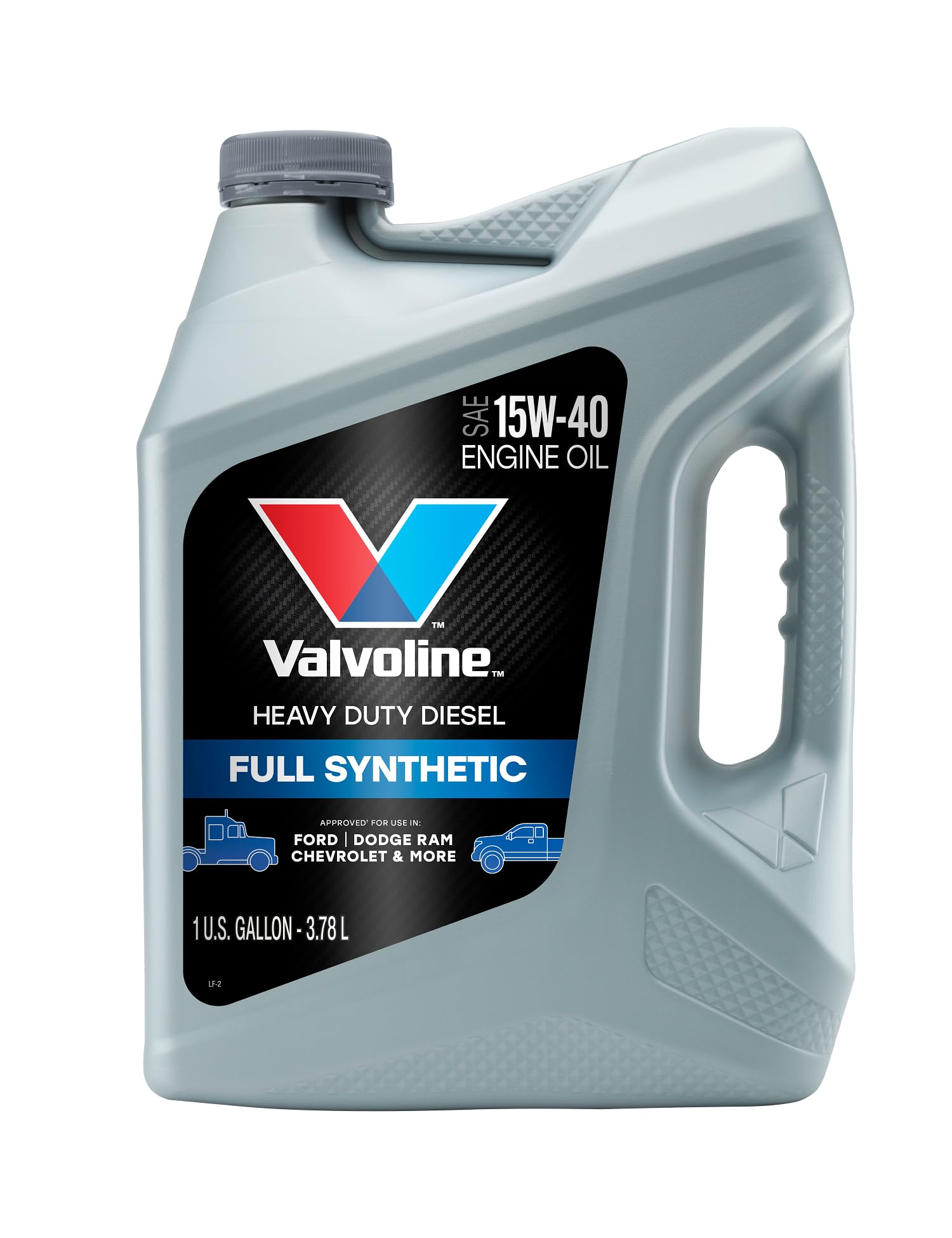
6. Valvoline Heavy Duty Full Synthetic 15W-40 Diesel Engine Oil 1 Gallon
The budget-friendly full synthetic that punches well above its price tag.
Valvoline Heavy Duty Full Synthetic 15W-40 is a rare find: a full synthetic diesel oil at a price point that competes with many conventional blends. The maker reports a 35% reduction in valve train wear (Cummins ISB test) and up to 28% longer oil life (Volvo T-13 test) versus industry standards. It carries the API CK-4 rating, so it is fully compatible with modern low-emission diesel engines.
The formula is designed to boost diesel engine life by controlling wear, deposits, and oil breakdown. Its flash point is 437 degrees Fahrenheit (a good safety margin against vaporizing in extreme heat). One buyer simply said it is “perfect for a 5.9 Cummins,” while others call it “great value” and “quality oil.” It comes from Valvoline, an established name in heavy-duty lubrication. Unlike the Royal Purple, which lacks explicit CK-4 certification, the Valvoline has it right on the bottle, making it a safer choice for newer trucks. It is a stronger value-for-money pick than the Lucas Oil if you want full synthetic protection, and it is cheaper than the Triax while still carrying the CK-4 badge.
The catch is that it is a 15W-40, so it is less ideal for extremely cold winters than the 5W-40 options (Mobil 1, Delo, Schaeffer). For moderate climates and everyday towing, it is a fantastic deal.
Value Proposition
- Full synthetic at a price near conventional oils
- API CK-4 certified for modern emissions systems
- Lab-tested 35% less valve train wear
Viscosity Ceiling
- 15W-40 not ideal for subzero climates
- Does not have the extreme cold-flow of a 5W-40
Reach for this if: You want a full synthetic CK-4 oil for your modern truck without paying premium prices.
Look elsewhere if: You live where -20°F starts are the norm — a 5W-40 will serve you better.
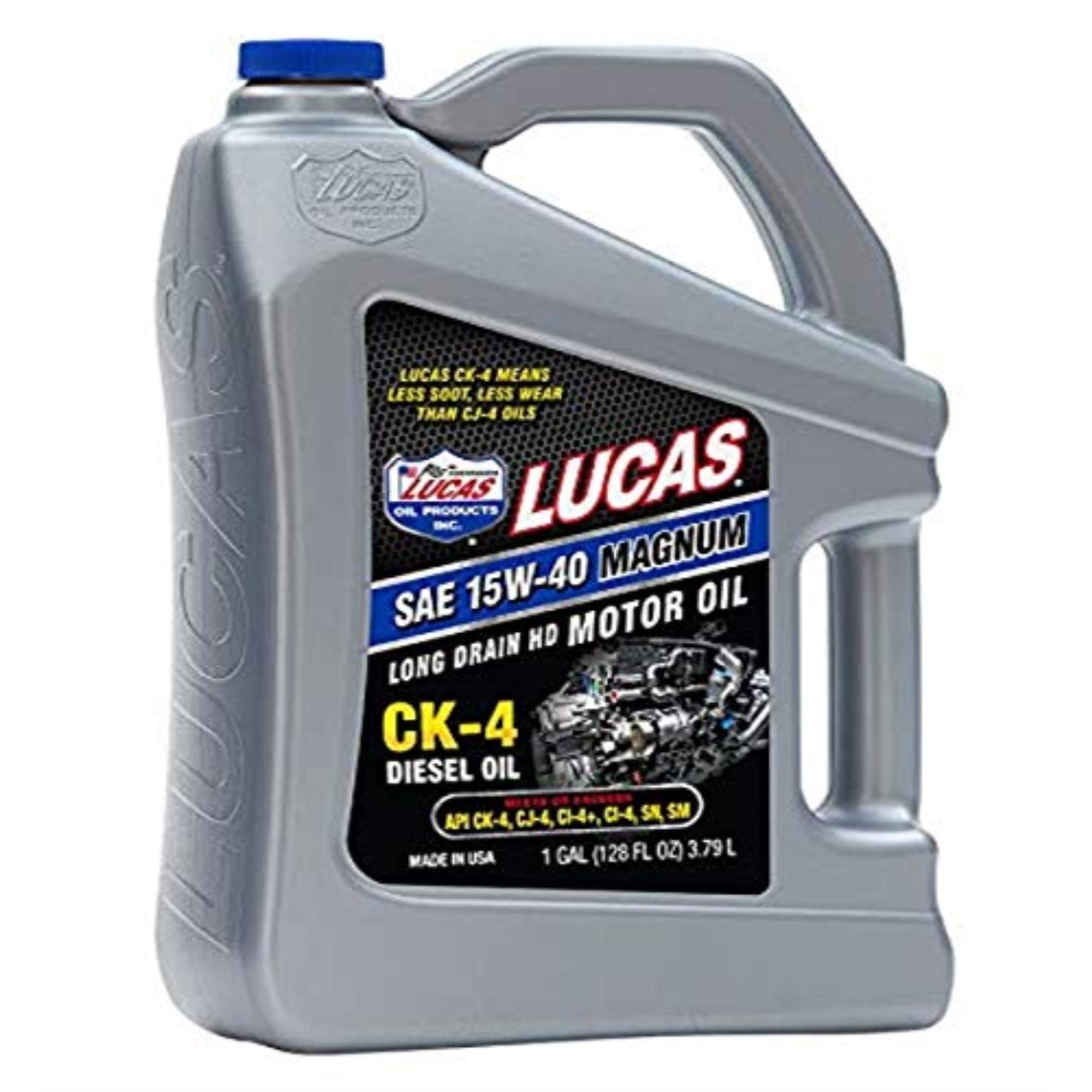
7. Lucas Oil 10287 SAE 15W-40 API CK-4 Heavy Duty Motor Oil – 1 Gallon
The low-cost pick that silenced a 45-year-old diesel into smooth operation.
Lucas Oil is a familiar name in the additive world, and their 15W-40 CK-4 heavy-duty motor oil delivers on that reputation for engine quieting. A reviewer noted it “makes the 45 year diesel motor in my truck sound quieter and run smoother,” calling it a daily-driver difference, not a placebo. Users also run it in John Deere walk-behind mowers, backhoes, and Dixie Chopper mowers, showing its versatility across a wide range of equipment.
It carries the API CK-4 rating, so it is safe for modern emissions systems, and the maker promises longer engine life, extended oil changes, and less filter maintenance. It weighs 3.55 kilograms (about 7.8 pounds) per gallon, and is one of the more budget-friendly options in the lineup. For anyone with a classic diesel pickup or a fleet of farm equipment, this is a versatile and affordable choice. It is the go-to for anyone who wants CK-4 protection on a tight budget, but unlike the Valvoline, it is not a full synthetic, so it will not last as long under heavy load.
The catch is that it is a conventional or synthetic-blend formula, not a full synthetic like the Valvoline or Triax above. That means it will not offer the same extreme high-temperature stability or long-drain capability as the full synthetics. It is perfect for older engines that do not push high miles annually.
Engine Quieting
- Owners mention it makes loud diesels quieter and smoother
- API CK-4 rated, works in modern and classic engines
- Budget-friendly price for a trusted name
Not Full Synthetic
- Does not offer the extreme heat resistance of full synthetics
- Not ideal for the longest drain intervals
This one is for you if: You have an older diesel engine, a farm machine, or a low-mileage pickup where noise reduction and reliability matter more than max drain intervals.
it’s not for you if: You are pushing a modern high-output engine to its limits with heavy towing and want the maximum protection of a full synthetic.
Understanding the Specs
15W-40 vs 5W-40 Viscosity
The first number (like “15” or “5”) followed by a “W” (for Winter) tells you how the oil behaves when the engine is cold. A 5W-40 oil flows much more freely in subzero temperatures than a 15W-40, which means faster oil circulation on a cold start and less wear on bearings and turbochargers. The second number (40) is the same across both — it describes the oil’s thickness when the engine is hot. Choosing between them is mostly about climate: if it dips below freezing where you live, a 5W-40 is the smarter pick; in warmer climates, a 15W-40 is fine and often cheaper.
API CK-4 and CJ-4 Ratings
The American Petroleum Institute (API) sets the performance standards for diesel engine oils. CK-4 is the current highest standard, designed for modern low-emission diesel engines that use exhaust after-treatment like a Diesel Particulate Filter (DPF) or Selective Catalytic Reduction (SCR). CK-4 oils have lower ash content and advanced additive packages that protect the engine without poisoning the emissions system. CJ-4 is the previous generation; it is still safe for most modern engines but CK-4 offers improved oxidation resistance and aeration control. Oils without either rating (like simple CH-4) should never be used in a truck with emissions gear.
FAQ
Can I use a 5W-40 oil in a motor that calls for 15W-40?
How often should I change my diesel oil?
Is full synthetic worth the extra cost for my diesel pickup?
What does the API CK-4 rating mean for my engine?
Will using the wrong viscosity damage my turbo diesel?
Can I use diesel oil in a gasoline engine?
How do I know if my oil is still good without sending it to a lab?
What is the difference between CK-4 and FA-4 diesel oils?
Final Thoughts: The Verdict
If you want one dependable pick, the best diesel oil winner is the Triax Fleet Supreme 15W-40 because it combines lab-verified long-drain capability with friction-modifying additives for quieter operation and lower wear. If you want a budget-friendly full synthetic for a modern truck, grab the Valvoline 15W-40. And for subzero winter starts and proven cold-flow performance, the standout is the classic Mobil 1 Turbo Diesel 5W-40.
How We Picked
We do not accept paid placement. Every pick is matched to a real buyer and a real use-case; we do not hands-on test units.
Sources & Methodology
Specifications: manufacturer listings and product documentation. Review insights: verified customer reviews, as of July 2026. Pricing: not shown on this page (it changes often); check the current price via the retailer link.
As an Amazon Associate, Trending Car earns from qualifying purchases. This does not affect which products we feature.