
Our readers keep the lights on and my garage snacks stocked. As an Amazon Associate, I earn from qualifying purchases.
Specs are compiled from manufacturer listings and verified buyer reviews and can change over time — please confirm the key details on the product page before buying.
Leaving a diesel vehicle or generator sitting for months without a stabilizer is a slow-motion disaster, as gum, varnish, microbial growth, and lost lubricity turn your valuable fuel into engine-killing soup. The right additive keeps diesel fresh and ready to fire up when you need it, and this guide picks five proven options based on real specs and verified customer experiences.
I’m Min Islam — the founder and writer behind Trending Car. This guide is built by comparing the manufacturers’ published specifications and the patterns across verified customer reviews, so you get each pick’s real strengths and trade-offs instead of marketing spin.
Whether you are protecting a pickup truck, a tractor, or a backup generator, the aim is to cut through the noise and find the right diesel fuel stabilizer for storage that matches your specific fuel volume and storage duration.
Our Picks at a Glance


How To Choose The Best Diesel Fuel Stabilizer for Storage
The right stabilizer does more than just preserve fuel — it fights water, boosts lubricity for high-pressure injection pumps, and keeps injectors clean so the engine starts smoothly after months of sitting. Here are the three specs that separate a good stabilizer from a storage solution that lets you down.
Water Management: Demulsifier vs. Dispersant
Water in diesel fuel breeds microbes and causes corrosion during storage. Some stabilizers emulsify (disperse) water into tiny droplets that burn off during combustion, while others demulsify (separate) water so you can drain it from the fuel-water separator. If you store fuel long-term and want to physically remove water, a demulsifying formula like Howes Meaner Power Kleaner gives you that option — and it avoids alcohol-based solvents that can harm fuel systems.
Lubricity & Cetane: The Two Numbers That Matter
Ultra-low-sulfur diesel (ULSD) has poor natural lubricity, which wears out fuel injectors and pumps over time. Look for a stabilizer that explicitly adds lubricity back into the fuel, and ideally one that boosts cetane — a measure of ignition quality. Higher cetane means quicker, smoother cold starts and less knock, which is especially important when you fire up equipment after months of storage.
Treatment Ratio & Storage Duration
A gallon of stabilizer can treat anywhere from 256 to 2,000 gallons of diesel, so matching the bottle size to your typical storage volume saves money over time. Most premium stabilizers claim to preserve fuel for up to two years, but the treatment rate (ounces per gallon of fuel) and the additive’s ability to prevent gum and varnish are what determine real-world shelf life. Check the manufacturer’s specified ratio, not just the bottle size.
Quick Comparison
| Model | Best For | Bottle Size | Fuel Protection | Water Handling | Amazon |
|---|---|---|---|---|---|
| Sea Foam Motor Treatment (4-pack)★ Best Overall | All-around maintenance & storage | 16 oz (x4) | Up to 2 years | Dispersant (burns through) | Amazon |
| Howes Meaner Power KleanerWinter Warrior | Extreme cold & water-removal | 32 oz | Stabilizes stored fuel | Demulsifier (drains out) | Amazon |
| Star Tron Enzyme Diesel Formula | Enzyme-based protection & efficiency | 8 oz | Up to 2 years | Dispersant (burns through) | Amazon |
| Opti-Lube XPD (Gallon) | High-mileage fleets & heavy use | 1 Gallon | 2x standard storage life | Demulsifier (drains out) | Amazon |
| PRI-D (Gallon) | Large-volume & long-term storage | 1 Gallon | Long layup periods | — | Amazon |
In‑Depth Reviews
1. Sea Foam Motor Treatment (16 oz, 4-Pack)
Our pick — over 4.5★ from 30,500+ verified ratings; the strongest balance of quality and price.
The all-purpose fuel-system cleaner that also doubles as a two-year storage stabilizer for gas and diesel.
Sea Foam is a jack-of-all-trades you can pour into the fuel tank, the crankcase oil, or the fuel stabilizer role. The maker claims it keeps gas or diesel fresh for up to 2 years by resisting evaporation, preserving ignition vapors, and preventing gum and varnish formation. Buyers report consistent results — one owner mentioned using it for over five years in a 2015 Ford F-150 and said it smooths the engine as preventive maintenance. Another reviewer noted that a mechanic recommends Sea Foam and calls it “best gas treatment for all engines.”
Unlike some stabilizers that focus only on storage, Sea Foam also cleans fuel injectors, carburetors, and chamber areas during normal driving, recovering lost power and smoothing out rough idle. The 4-pack (each bottle 16 oz) gives you enough stabilizer for multiple vehicles or several treatment cycles. The trade-off is that Sea Foam uses a dispersant approach to water — it mixes water into the fuel so it burns through, rather than separating it for draining. That works fine for engines you run regularly, but for long-term storage where water drains are essential, a demulsifying formula may suit you better.
Everything-Engine Utility
- Works as stabilizer, fuel-system cleaner, and oil-treatment additive in one bottle
- Compatible with all gas and diesel blends, including E10 and E85
- Rated 4.8 out of 5 stars from over 30,000 verified buyers
Storage-Only Trade-Off
- Water-handling method disperses rather than demulsifies, so you cannot drain separated water
- 4-pack may be more stabilizer than a single vehicle owner needs for one storage season
Grab It For: The driver who wants one additive that stabilizes stored fuel, cleans the whole fuel system, and treats crankcase oil — all with a massive 30,000+ review history backing its reliability.
Look Elsewhere If: You need a demulsifying stabilizer that lets you drain water physically; Sea Foam mixes water into the fuel rather than separating it.
2. Howes Meaner Power Kleaner (32 oz)
A cold-weather diesel stabilizer that demulsifies water so you can drain it, tested to -33°F.
Howes Meaner Power Kleaner is built for the dual challenge of storage and extreme cold. It uses an IDX4 Detergent to clean injectors and stabilize stored fuel by eliminating sediment. The key differentiator is its demulsifying approach to water — instead of mixing water into the fuel with alcohol-based solvents, it pushes water out of the fuel so you can drain it safely, making it warranty-safe for all diesel emission systems. Owners mention that it increases cetane, cleans fuel systems, reduces regen events, and prevents cold-weather issues, with testing documented at -33°F.
The additive also adds lubricity back into ULSD fuel, protecting injectors, pumps, and upper cylinders from wear. One reviewer noted it stops surging idle in semis and prevents algae growth from biodiesel, calling it their “go to product.” The main drawback is that the fuel stabilizer and cold-flow properties are combined into a single additive, so you cannot separately tune anti-gel dosage for extreme Arctic conditions.
Cold-Climate Specialist
- Demulsifier removes water so you can drain it physically, not burn through it
- No alcohol or harmful solvents — safe for all diesel emission systems and particulate filters
- Backed by a tow guarantee, according to buyers
Single-Role Limitation
- Combines storage stabilization and anti-gel in one dose, so you cannot adjust cold-flow separately
- Rated 4.5 out of 5 from 332 reviews, which is a smaller sample than some competitors
Reach For It If: You store diesel in a cold climate and want a demulsifying stabilizer that lets you drain water, plus proven cold-start performance down to -33°F.
Skip It For: All-season driving where you need a separate anti-gel treatment — this single-bottle solution combines both functions.
3. Star Tron Enzyme Fuel Treatment – Concentrated Diesel Formula (8 oz)
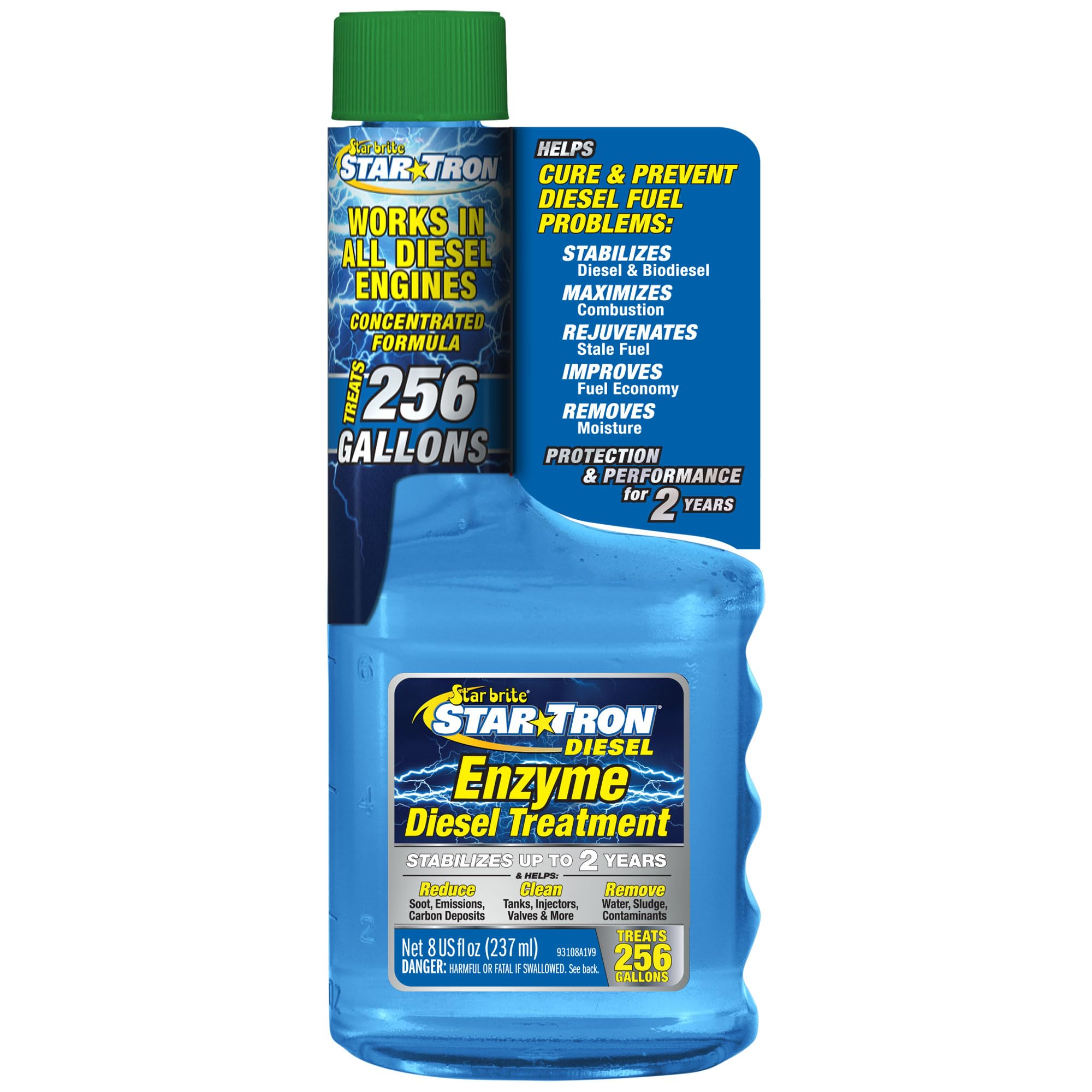
The enzyme-based stabilizer that preserves diesel quality for two years while boosting fuel economy.
Star Tron takes a different approach than traditional chemical stabilizers — it uses enzymes to break down water into submicron-sized droplets that are eliminated during engine operation, rather than adding alcohols or solvents. The maker claims it preserves diesel fuel quality for up to two years, preventing gum and solid formation that can clog injectors. At 8.48 ounces, it is heavier than the 6-ounce Howes bottle, though the concentrated formula means each ounce treats more fuel than a typical non-concentrated additive.
Beyond storage, Star Tron helps boost fuel efficiency by cleaning the fuel delivery system and ensuring uniform combustion. It also reduces carbon build-up from burners, injectors, and exhaust components, making it suitable for everyday use as well as seasonal storage. One buyer mentioned using it for over 15 years and said they recovered many engine fuel systems without needing carburetor repair or replacement. The concentrated diesel formula is specifically designed for boats, cars, RVs, and other diesel vehicles, and a reviewer noted it can even rejuvenate old, sub-spec fuel.
Enzyme Chemistry Advantage
- Enzymes disperse water without alcohol-based solvents, reducing emissions and particulate smoke
- Preserves diesel up to two years and can rejuvenate old fuel
- Rated 4.7 out of 5 from 732 reviews
Concentrated Caution
- Small 8 oz bottle may be easy to misplace during seasonal layup
- Enzyme treatment requires consistent dosing; missing a tank can leave fuel unprotected
Best Fit: Boat owners, RV users, and seasonal equipment operators who want a gentle enzyme-based stabilizer that can rejuvenate old fuel and keep diesel fresh for two years.
Not For: Those who need a demulsifier to physically drain water — Star Tron disperses water into the fuel instead of separating it.
4. Opti-Lube XPD All-Season Diesel Fuel Additive (1 Gallon)
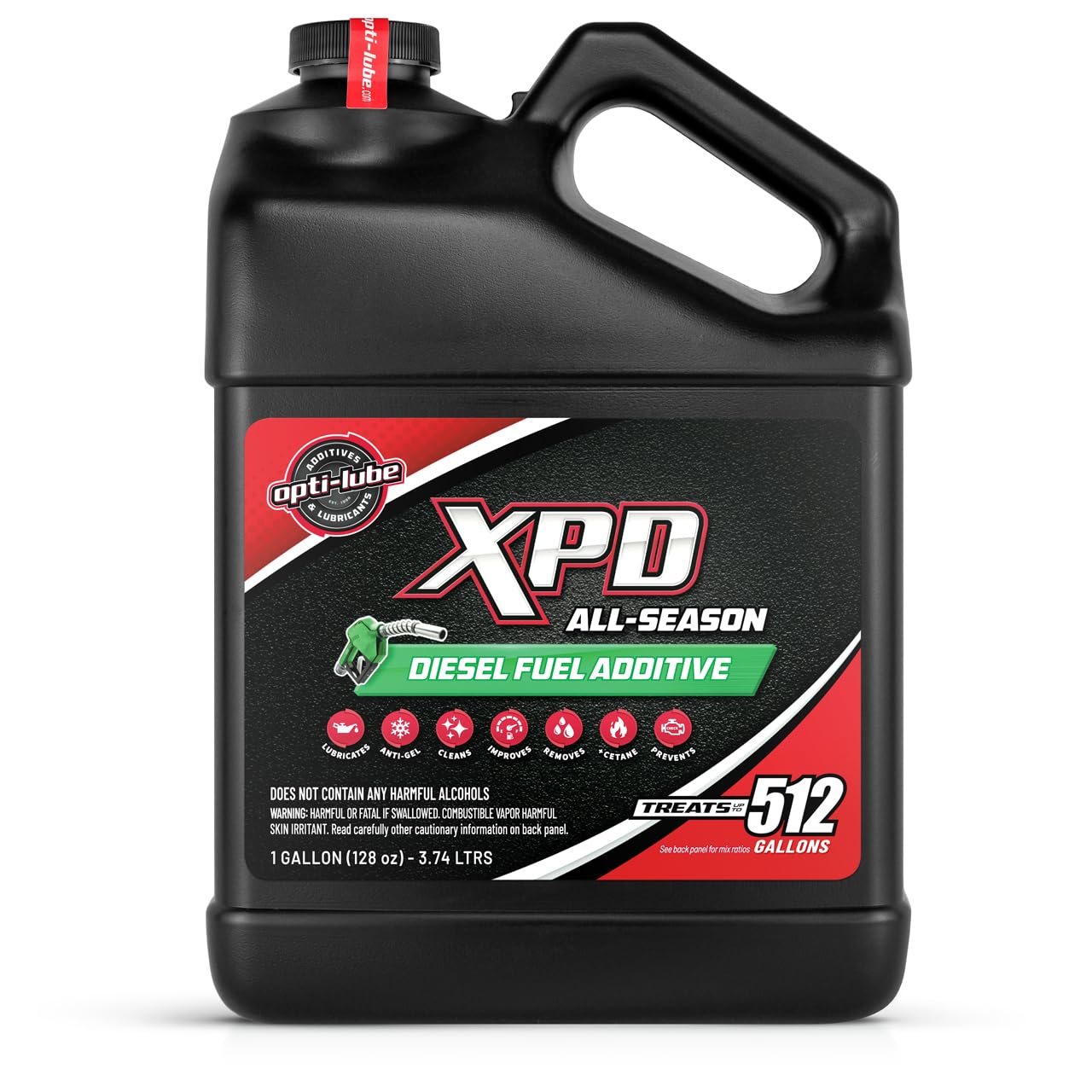
The gallon-jug stabilizer that more than doubles standard fuel storage life and reportedly improves MPG by 4.
Opti-Lube XPD is built for high-mileage drivers and fleet operators who go through diesel in large volumes. At a treatment rate up to 512 gallons per gallon jug, it costs pennies per treated gallon according to the maker. The additive increases lubricity for ULSD fuel, cleans injectors while preventing future build-up, and acts as rust and corrosion protection. Customers note a quieter, cooler operation with less knock across the RPM range, and one verified owner noted a 4 mpg improvement in a two-month test on a 2003 Silverado 2500 HD.
For storage specifically, the maker claims Opti-Lube XPD more than doubles the standard storage life of diesel fuel and includes enough anti-gel to keep fuel flowing down to -10°F. The gallon size weighs 7.5 pounds, making it substantially heavier than the 8.48-ounce Star Tron or the 6-ounce Howes bottle — physical size matters when you need to store it alongside your fuel cans. The demulsifying chemistry separates water from diesel so you can drain it, similar to the Howes approach but in bulk.
Volume King
- Treats up to 512 gallons per jug, delivering low cost per treated gallon
- Demulsifier separates water for draining, plus rust and corrosion prevention
- Reported 4 MPG improvement in a real-world two-month test
Bulk Commitment
- Gallon jug at 7.5 pounds is large and heavy for casual storage users who treat only one vehicle
- Antigel protection only down to -10°F — may not suffice for extreme Arctic conditions
Ideal For: Fleet owners, farmers, and high-mileage diesel drivers who want a bulk stabilizer that cleans injectors, boosts MPG, and separates water for draining — all in one jug.
Pass On It If: You only need to stabilize one vehicle’s fuel for a season; the gallon jug will outlast your usage and take up storage space.
5. PRI-D Fuel Stabilizer (1 Gallon)

The heavy-hitter stabilizer that keeps diesel fresh during long layup periods and treats up to 2,000 gallons.
PRI-D is engineered for large-scale storage where fuel sits for years, not months. With a treatment ratio of one gallon treating up to 2,000 gallons of fuel, it is the most concentrated option on this list — ideal for farm tanks, backup generator systems, and boat diesel tanks that get filled once a season. The formula enhances ignition quality and dramatically cuts diesel smoke and soot, prevents damaging deposits in fuel systems, and enhances lubricity for reduced injector pump wear. Reviewers point out it keeps fuel fresh during long layup periods and even restores bad fuel.
At 7.5 pounds per gallon jug, the PRI-D is physically identical in weight to the Opti-Lube XPD gallon, but the PRI-D treats 2,000 gallons of fuel compared to the Opti-Lube XPD’s 512 gallons. One owner mentioned they used PRI-G (the gasoline version) to start a commercial pressure cleaner after 1-2 years of storage, and PRI-D fixed a 33-year-old Mercedes’ sticking fuel indicator — proof of the formula’s ability to clean old deposits. The material composition includes aliphatic esters (30-50%) and organic dispersants (10-25%), which give it the cleaning and stabilizing power.
Maximum Range
- One gallon treats up to 2,000 gallons of diesel — lowest cost per gallon treated
- Enhances ignition quality and cuts diesel smoke and soot significantly
- Proven to restore old, degraded fuel and clean decades-old deposits
Entry Barrier
- High upfront cost for the jug makes it uneconomical for single-vehicle use
- Rated 4.7 out of 5 from only 190 reviews, so the sample size is smaller
Choose This When: You need to stabilize thousands of gallons of diesel across multiple tanks, generators, or farm equipment, and want the most concentrated formula that also restores old fuel.
Skip It For: A single pickup truck that goes through 30 gallons per fill-up — you would never use the full jug before the next season.
Understanding the Specs
Water Management: Demulsifier vs. Dispersant
A demulsifier forces water out of the fuel so it collects at the bottom of the tank and can be drained away through a water separator — ideal for long storage where you periodically drain water. A dispersant, or emulsifier, breaks water into microscopic droplets that get burned off during engine operation; this works well if you run the engine regularly but leaves water in the fuel during storage. Howes Meaner Power Kleaner and Opti-Lube XPD use demulsifiers; Star Tron uses an enzyme-based dispersant; Sea Foam uses a chemical dispersant.
Treatment Ratio
The treatment ratio tells you how many gallons of diesel one unit (ounce or gallon) of additive treats. A higher ratio means less additive per tank, which lowers the long-term cost per gallon of treated fuel. For example, the PRI-D gallon jug treats 2,000 gallons of fuel, while the Opti-Lube XPD gallon treats 512 gallons. For occasional storage of a single vehicle, a smaller bottle like the 8-ounce Star Tron is more practical; for farm tanks holding hundreds of gallons, the concentrate ratios save significant money.
FAQ
How long does diesel fuel stabilizer keep diesel fresh?
Can I use a diesel stabilizer in gasoline engines too?
What is the difference between a demulsifier and a dispersant in diesel stabilizers?
Will a diesel stabilizer help with cold-weather starting?
How much diesel stabilizer do I need per gallon of fuel?
Can a stabilizer clean my injectors and fuel system?
Is it safe to use a stabilizer in modern diesel emission systems?
Should I treat the fuel before or after filling the tank?
Final Thoughts: The Verdict
Across the board, the diesel fuel stabilizer for storage winner is the Sea Foam Motor Treatment because it covers storage, fuel-system cleaning, and oil treatment in one bottle, backed by 30,000+ reviews and a two-year storage claim. If you need demulsifying water removal for cold climates, grab the Howes Meaner Power Kleaner. And for large-volume storage where one jug needs to treat thousands of gallons, the standout is the PRI-D with its 2,000-gallon treatment range.
How We Picked
We do not accept paid placement. Every pick is matched to a real buyer and a real use-case; we do not hands-on test units.
Sources & Methodology
Specifications: manufacturer listings and product documentation. Review insights: verified customer reviews, as of July 2026. Pricing: not shown on this page (it changes often); check the current price via the retailer link.
As an Amazon Associate, Trending Car earns from qualifying purchases. This does not affect which products we feature.