
Our readers keep the lights on and my garage snacks stocked. As an Amazon Associate, I earn from qualifying purchases.
Specs are compiled from manufacturer listings and verified buyer reviews and can change over time — please confirm the key details on the product page before buying.
Most diesel owners pick 15W-40 by habit — the same jug their father used, the same brand the shop stocks. But the gap between a decent oil and one that actually saves fuel, quiets the valvetrain, and survives a -20°F morning start is measured in real numbers, not brand loyalty. This guide breaks down seven 15W-40s by published specs and owner experiences, so you spend money on protection, not marketing.
This guide compares manufacturers’ published specifications and patterns across verified customer reviews to highlight each pick’s real strengths and trade-offs.
Whether you drive a Cummins, a Power Stroke, a Duramax, or a farm tractor, the right diesel engine oil 15w40 directly cuts wear, fuel consumption, and cold-start struggles — here is what the data actually says about each contender.
Our Picks at a Glance

How To Choose The Best Diesel Engine Oil 15W40
Buying 15W-40 requires matching the oil’s chemistry to your engine’s emission system, driving habits, and climate. You need to match the oil’s chemistry to your engine’s emission system, your driving habits, and your climate. Here are the three factors that separate a smart buy from an expensive mistake.
API CK-4 vs CJ-4 — the spec that affects wear limits
CK-4 is the current industry standard for diesel engines. It handles higher soot loads, resists oxidation longer, and protects the catalytic converter. Older CJ-4 oils are still fine for pre-2017 trucks, but if your engine calls for CK-4, do not step down — you risk clogged filters and faster valve-train wear.
Friction modifiers — moly and boron are not marketing fluff
Molybdenum (moly) and boron create a low-friction film on metal surfaces. Oils that contain these additives produce measurably quieter engines and often improve fuel economy by several percent. Look for oils that explicitly list “friction modified” or name these compounds in the description.
Cold-start ratings — the number that matters in winter
15W-40 is designed to flow at winter temperatures, but not all formulas handle extreme cold equally. Some oils in this list start cleanly down to -20°F or even -45°F. If your truck sits overnight in a freezing garage or outside, prioritize an oil with a documented low-temperature performance claim from owners who have actually tested it.
Quick Comparison
| Model | Best For | Item Weight | API Spec | Friction Modified | Amazon |
|---|---|---|---|---|---|
| Royal Purple 04154★ Best Overall | Wear Protection & MPG | 7.7 lb | CI-4+ | No | Amazon |
| Triax Fleet SupremeAlso Great | Best Overall / Cold Starts | 7.6 lb | CK-4 | Yes (Nano-Boron & Moly) | Amazon |
| Hot Shot’s Secret Green Diamond | Fuel Economy Boost | — | CK-4 | Yes (FR3 Nanotech) | Amazon |
| Valvoline Full Synthetic | Best Value Fully Synthetic | — | CK-4 | No | Amazon |
| Schaeffer SynShield | Older / High-Mileage Diesels | — | CK-4 | Yes (Micron Moly) | Amazon |
| Lucas Magnum High TBN | Older Gas & Diesel Engines | 3538.02 g | CI-4 | No | Amazon |
| Mobil DELVAC | High-Mileage Semi-Truck Proven | — | — | No | Amazon |
In‑Depth Reviews
1. Royal Purple 04154 15W-40 Oil (1 Gallon)
Our pick — over 4.5★ from 750+ verified ratings; the strongest balance of quality and price.
The mechanic-recommended 15W-40 that has held the same formula since 2012.
Royal Purple does not chase CK-4 or fancy friction modifiers — it sticks with its CI-4+ formulation and a reputation built over decades. The 7.7-pound gallon is slightly heavier than the Triax (7.6 pounds), and the core promise is better wear protection plus increased fuel efficiency. One reviewer noted that a mechanic recommended it and the user saw +3 MPG after the switch, having used it since 2012. That kind of long-term loyalty is rare in the oil aisle.
The downside is the API spec: CI-4+ is a generation behind CK-4. That means it lacks the higher soot-handling and oxidation resistance required for modern low-emission engines with DPFs and EGR systems. For a pre-2007 diesel or a tractor, it is a strong pick. For a 2020 pickup that specifies CK-4, you risk clogged filters over time.
Where the Valvoline and Triax below it offer full synthetic CK-4 protection at similar or lower cost, Royal Purple is the sentimental favorite — a proven commodity for older engines that has the owner stories to back it up. Just match it to the right machine.
Why people buy it
- Decade-plus track record with verified +3 MPG owner feedback
- Universal fit for older car and diesel engines
- 4.8-star average from nearly 800 ratings
Why to double-check
- CI-4+ spec is outdated for modern CK-4 engines
- No friction modifiers like moly or boron
- 7.7 lb makes it the heaviest gallon on this list
Grab this for: A pre-2007 diesel pickup, tractor, or off-road equipment where CI-4+ spec is acceptable and you value a formula unchanged since 2012.
Pass on this for: Any 2017+ diesel requiring CK-4 to protect the DPF and keep the EGR clean.
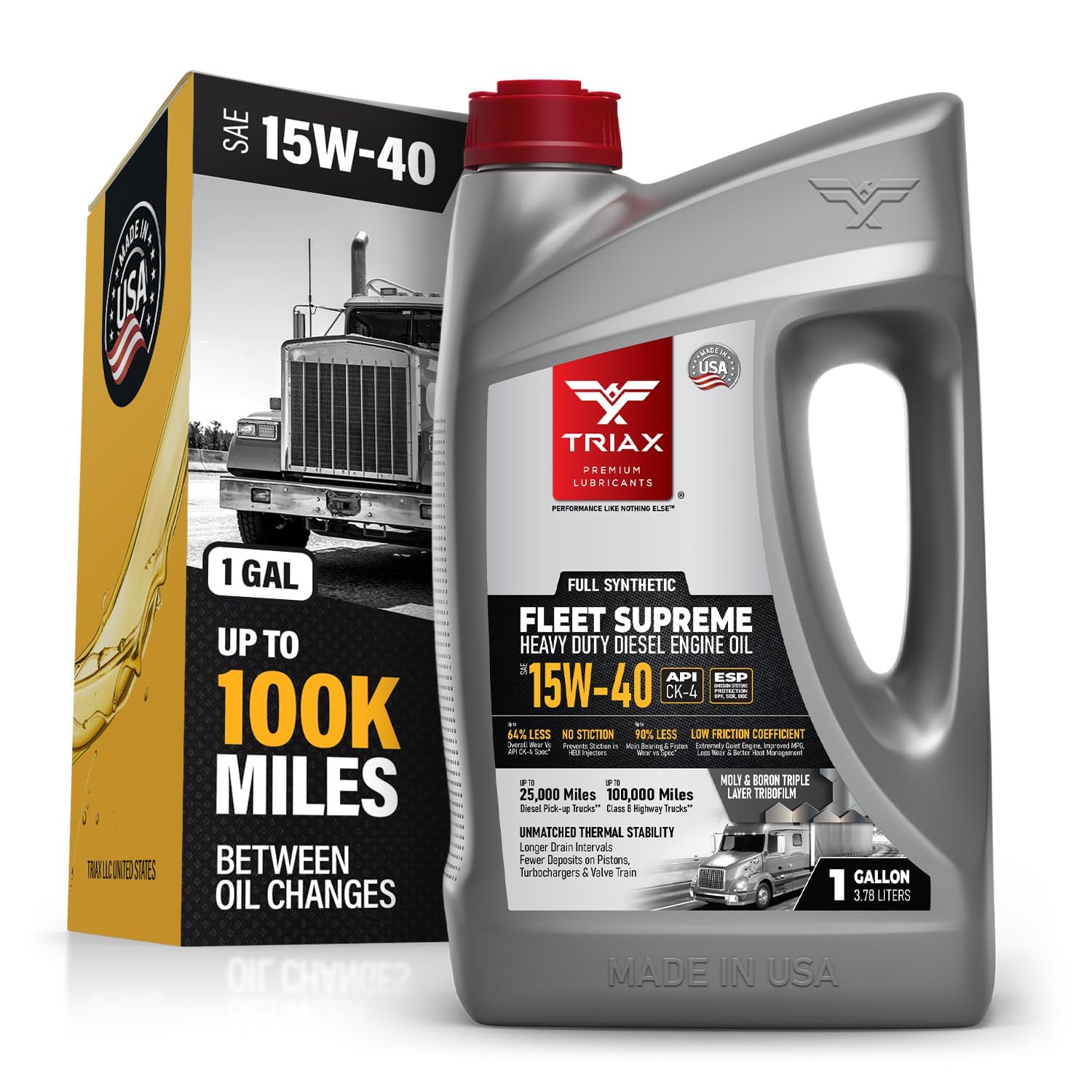
2. Triax Fleet Supreme 15W-40 API CK-4 Full Synthetic
The friction-modified synthetic that starts at -45°F and quiets a diesel idle immediately.
You get quieter engine operation, a lower operating temperature, and a factory-claimed 4-6% MPG improvement with this one. Triax boosts the formula with Nano-Boron and Moly friction modifiers — those are the additives that create a slick film on metal surfaces — so wear drops by up to 48% compared to standard OEM oil. In real terms, a buyer with an F250 and eight semi trucks reported an excellent cold start at -20°F and oil analysis at 15,000 miles showed less than 20% additive depletion, meaning you could push to 20,000 or 25,000 miles on a pickup.
At 7.6 pounds per gallon, it is a hair lighter than the Royal Purple (7.7 pounds), which is a minor detail but reflects a slightly different base-oil density. The maker claims drain intervals exceeding 100,000 miles for highway semis and 30,000 miles for Super Duty pickups. Buyers report it drops oil temperature by 8 to 10 degrees Fahrenheit compared to their previous oil and smooths out cold starts noticeably.
Unlike the Royal Purple, which uses an older CI-4+ spec, Triax meets the latest CK-4 standard, so it is the safer choice for newer trucks with DPFs and SCR catalysts. If you tow heavy or live somewhere winters bite hard, this is the one.
Why it wins
- Friction-modified (Nano-Boron + Moly) for quieter idle and less wear
- Documented cold-start performance down to -45°F
- Up to 48% lower wear than industry standards
What to know
- Premium pricing narrows the value gap if you change oil every 5,000 miles
- Overkill for engines that never see heavy load or extreme cold
Reach for this if: You want the quietest, coldest-starting, longest-draining synthetic for a modern CK-4 diesel that tows or hauls.
Look elsewhere if: You change oil every 5,000 miles on a light-duty work truck and do not need the extended-drain or friction-modifier advantage.
3. Hot Shot’s Secret Green Diamond 15W-40

The synthetic that turned a 265k-mile Duramax from 18 into 22 MPG at 70 mph.
Where most 15W-40s focus on protection alone, Green Diamond aims directly at fuel economy with a claimed 3% MPG improvement over conventional blends. One owner running a 265k-mile Duramax LLY on 33-inch tires reported MPG improved from 18 to 22 at 70 mph, along with a quieter engine, better throttle response, and easier cold starts. That is a 22% measured gain, but the spec sheet says 3% — take the higher number as a best-case anecdote, not a guarantee.
The oil works through patented FR3 nanotechnology, which the manufacturer says gets into fine engine crevices to reduce metal-on-metal contact. Compared to older CJ-4 spec oils, Hot Shot’s claims a 71% reduction in wear on engine components. A separate buyer testing it in a 2017 Cummins 6.7 noted higher oil pressure, a slightly quieter idle after hot cycles, and what smelled like a high-zinc additive package — common in oils that protect flat-tappet camshafts in older engines.
Unlike the Triax above, which uses moly and boron, Green Diamond relies on its own FR3 nanotech additive. Both work, but the Hot Shot’s edges ahead on straight fuel-economy improvement claims, especially if you have a modified or high-mileage truck that needs every drop of efficiency.
Standout strengths
- FR3 nanotechnology reduces wear by 71% vs CJ-4 oils
- Real owner data shows +4 MPG in a heavy Duramax
- Maintains viscosity and additive package past 14,000 miles
Watch out for
- The gallon jug may need extra containers for storage (per owner note)
- Premium cost per quart vs conventional Rotella T6
Pick this for: A high-mileage diesel where every extra MPG matters and you want the strongest anti-wear numbers on paper.
Skip this if: Your engine is stock, low-mileage, and already getting good fuel economy — the premium cost may not return measurable savings.
4. Valvoline Heavy Duty Full Synthetic 15W-40 (1 Gallon)
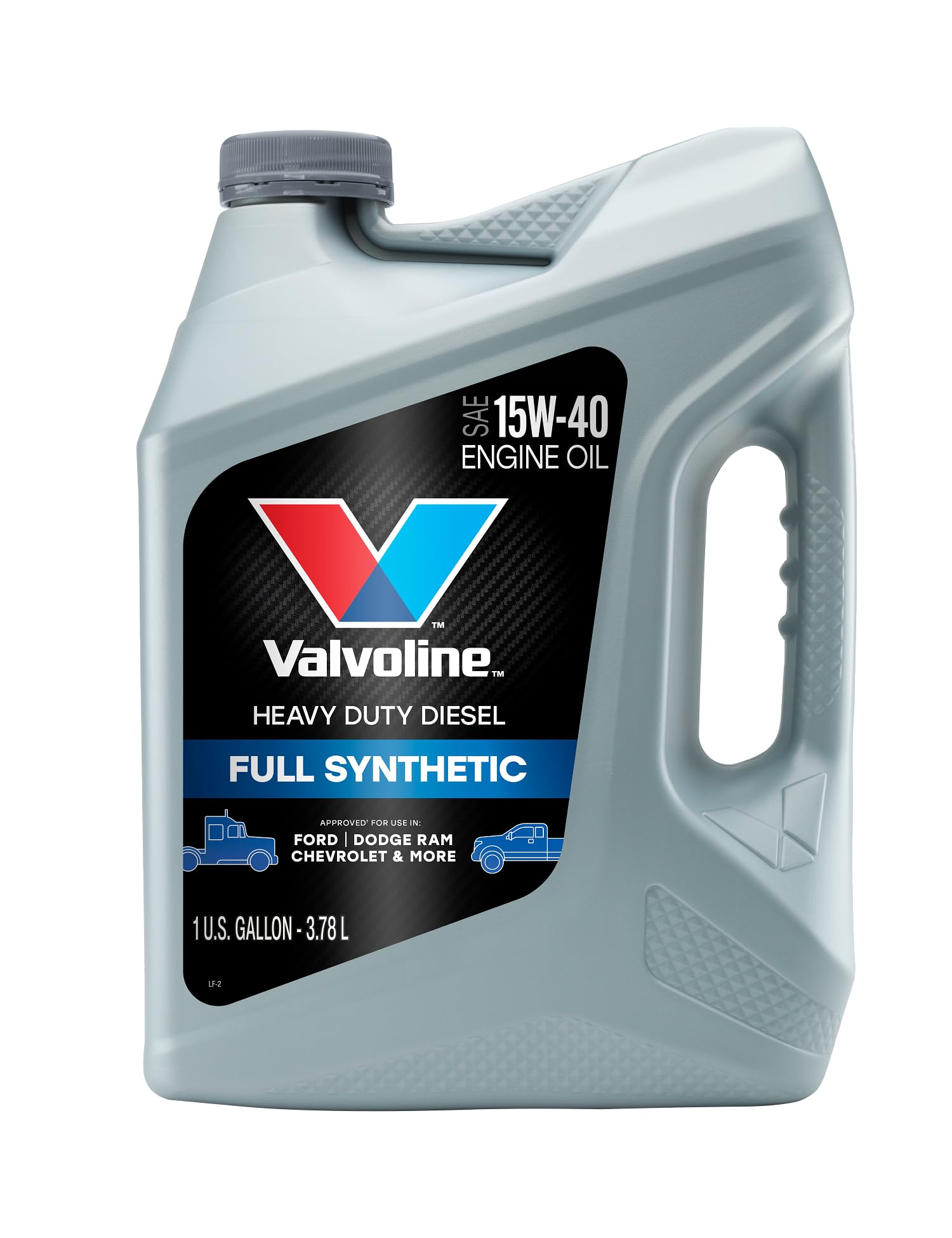
Full-synthetic CK-4 protection that undercuts premium competitors by a wide margin.
Valvoline skips the gimmicks — no nanotech, no moly marketing — and delivers a straightforward CK-4 full synthetic at entry-level pricing. The spec sheet is impressive on its own: a 35% reduction in valve-train wear vs industry standards (tested on the Cummins ISB engine) and up to 28% longer oil life vs standards (Volvo T-13 engine test). It also has a flash point of 437 degrees Fahrenheit, meaning it resists burning off under extreme heat.
Owners mention it is “great oil at a good price” and “perfect for a 5.9 Cummins”. At this price tier, you are getting the same CK-4 base oil protection that premium brands charge more for — you just lose the friction-modifier advantage. That means you won’t get the measurable MPG bump or quieter idle that Triax or Hot Shot’s deliver, but for a stock daily driver that sees moderate duty, you pay significantly less per gallon.
Compared to the Lucas Magnum below (CI-4, conventional blend), Valvoline is the smarter modern choice: full synthetic, CK-4 rated, and priced only slightly more than conventional blends. If you are on a tight budget but need CK-4, stop here.
Why it is smart
- CK-4 full synthetic at a price near conventional blends
- 35% less valve-train wear vs industry standards
- Universal fit for trucks
The trade-off
- No friction modifiers — you lose MPG and quiet-idle benefits
- Lower owner review count (183) vs premium alternatives
Buy this if: You need CK-4 full synthetic for a modern diesel and want to spend less — it protects just as well as premium oils without the extras.
Upgrade if: You drive a modified, high-mileage, or heavily towing truck where every additional MPG and every degree of wear reduction pays for itself.
5. Schaeffer Manufacturing SynShield 15W-40 (1 Gallon)

The friction-moly blend that silenced a Duramax diesel tick in under 700 miles.
Schaeffer positions SynShield as a durability oil, and the owner reports back that claim hard. One buyer running a 2002 Duramax with 145,000 miles reported a noticeably quieter engine and near elimination of the diesel tick/rattle, plus an oil pressure increase of about 5 PSI at idle. Another owner with a 2001 Ford Power Stroke 7.3L at 220,000 miles said the engine runs smoother, starts easier, and the turbo sounds better — improvements that continued after 2,000 miles.
The secret is micron moly — a friction modifier that creates a low-friction coating on metal surfaces. That is why older, higher-mileage diesels respond so well: the oil fills in worn tolerances and reduces the metal-on-metal chatter that sounds like a sewing machine. A separate buyer even reported getting around 2 more MPG after switching.
Unlike the Triax and Hot Shot’s choices above, Schaeffer is a smaller brand with a narrower distribution network, which often means a higher per-gallon price and less retail availability. But for owners who have crossed 200,000 miles and want to keep their engine quiet and smooth, the premium is justified by the owner feedback. The manufacturer also recommends changing the oil and filter every 4,000 miles (not the manual’s 10,000) to reach over 500,000 miles — a detail note if you are a high-mileage keeper.
Why it wins for old engines
- Micron moly eliminates diesel tick and rattle in high-mileage engines
- Owner reports of +2 MPG and smoother idle
- Strong oxidation and contamination control
What holds it back
- Premium price with no major retail discount
- Short recommended interval (4,000 miles) if you want 500k+ miles
- Limited distribution vs Mobil or Valvoline
Reach for this if: Your diesel has over 150,000 miles and you want the quietest, smoothest-running oil available for that age.
Skip this if: Your engine is low-mileage and under warranty — the moly advantage is wasted on tight tolerances.
6. Lucas Oil 10076 SAE 15W-40 Magnum High TBN CI-4 (1 Gallon)

The conventional 15W-40 built for older engines that need high TBN to neutralize sulfur.
Lucas Magnum is not a synthetic, and it is not CK-4. It is a conventional CI-4 blend with a high TBN (Total Base Number) — that means it can neutralize more acidic byproducts from combustion, which is exactly what older diesel engines burning higher-sulfur fuel require. The maker claims it holds up to twice as much contamination in suspension without losing lubrication quality, and resists breakdown from diesel fuel better than regular 15W-40 blends.
This is the oil for a different era of engine. Customers note using it in their Dixie Chopper mowers (for the hydrostatic drive and engine) and older farm tractors. One owner switching from a standard blend noted “keeps engine and hydraulics working like new”. At 3538.02 grams per gallon (roughly 7.8 pounds), it is the heaviest on the list, which hints at a denser base oil with more additive package.
If you compare it to the Valvoline or Triax above, Lucas is a generation behind in API spec and uses conventional base stock, not synthetic. That means shorter drain intervals and less cold-flow performance. But for a pre-2000 engine, a lawn tractor, or any machine that does not require CK-4, the High TBN advantage is a real benefit — it keeps the inside of the engine cleaner between changes.
Where it fits
- High TBN for older engines burning higher-sulfur fuel
- Holds up to 2x more contaminants in suspension
- Works in both gas and diesel engines
Limitations
- CI-4 spec, not CK-4 — not for modern emission-controlled engines
- Conventional (not synthetic) blend — shorter change intervals
- Heaviest gallon at ~7.8 lb
Best for: Vintage diesels, farm equipment, and old-school mowers where high TBN and contamination capacity matter more than cold-flow or modern specs.
Not for: Any 2010+ diesel pickup that specifies CK-4 — use the Valvoline or Triax instead.
7. Mobil DELVAC 15W-40 (12520) — 5 Gallon
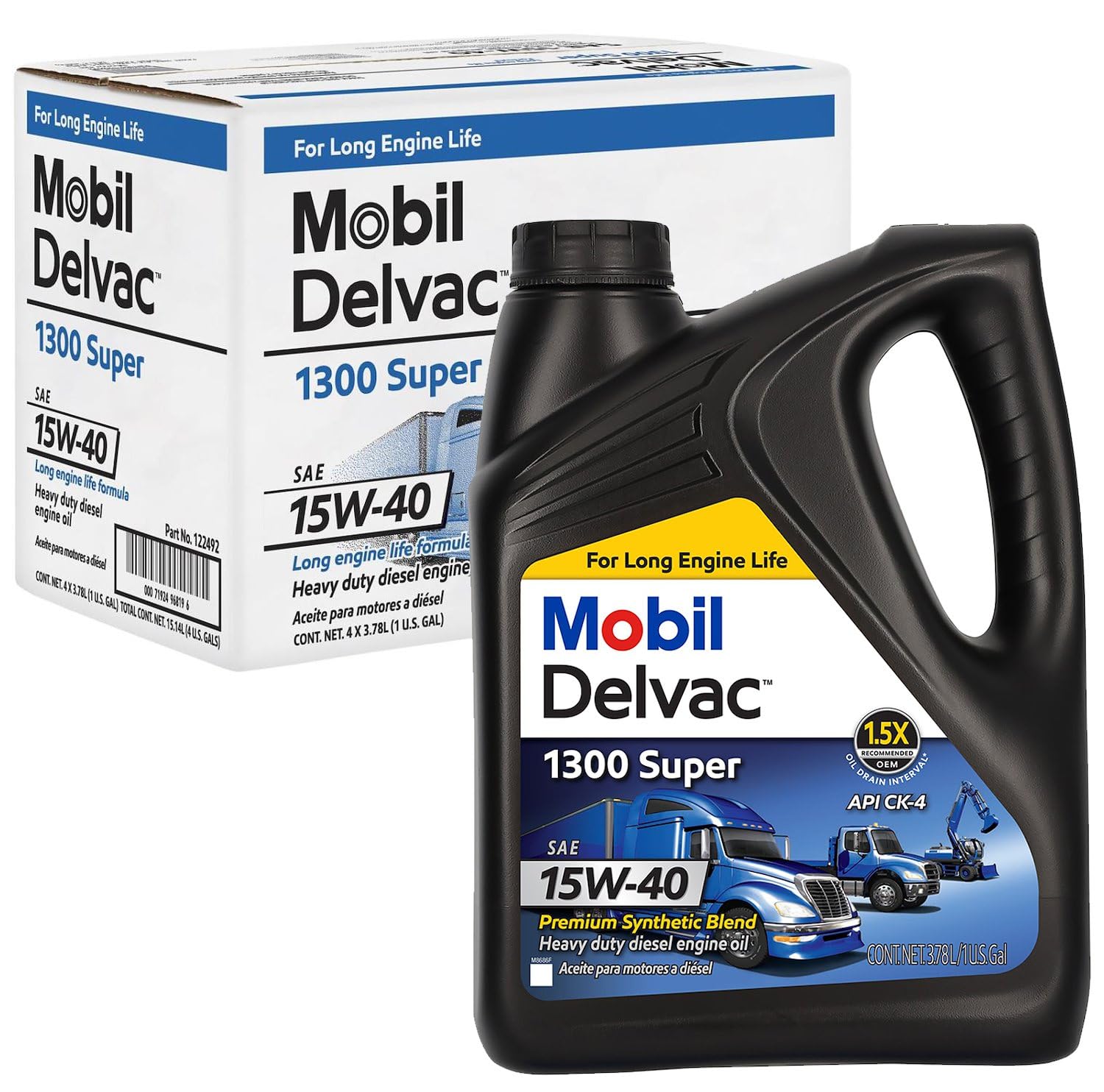
The million-mile semi-truck oil that has run a Freightliner without a rebuild.
Mobil DELVAC is the name you find in every truck stop for a reason: it is a budget-friendly conventional blend that has logged more miles under heavy loads than almost any other oil on the shelf. One owner putting it in a 2009 Freightliner semi reported over 1 million miles with no rebuild. That kind of longevity is not a guarantee, but it reflects the oil’s ability to keep a big-bore diesel running clean for the long haul.
The product page is sparse — it lists only 15W-40 as the viscosity grade and calls itself “AFFORDABLE SOLUTIONS.” There is no API spec stamp on the Amazon listing (CK-4 or CJ-4 is not declared), no friction modifiers, and no cold-start rating. What you get is a simple, proven 15W-40 that works best in high-volume fleet applications where cost per quart matters more than additive-pack complexity.
Compared to the Schaeffer or Triax picks above, DELVAC is the opposite end of the spectrum: no performance claims, no owner-detailed analysis, just a workhorse oil that has been running trucks for decades. It also comes as a 5-gallon pail in this listing — not a single gallon — so it is ideal for someone who burns through oil quickly or maintains multiple vehicles. If all you need is a reliable 15W-40 for a semi or heavy equipment, this is the no-nonsense choice.
What works
- Million-mile track record from owner feedback
- Simple, proven formula — no gimmicks
- 5-gallon pail suits high-volume users and fleets
What is missing
- No API spec (CK-4 / CJ-4) listed on the page
- No friction modifiers or cold-start claims
- Limited owner review depth vs other picks
Perfect for: A fleet operator or semi driver who needs a cheap, reliable 15W-40 with a half-century of real-world use behind it.
Not for: A late-model pickup owner who needs spec-guaranteed CK-4 protection or wants friction-modifier fuel savings.
Understanding the Specs
API CK-4 vs CJ-4 — the spec that sets your engine’s ceiling
CK-4 is the current highest standard for diesel engine oil. It handles more soot, resists oxidation longer, and keeps the DPF (diesel particulate filter) and EGR (exhaust gas recirculation) system clean. CJ-4 is the previous generation — still fine for pre-2017 trucks but not recommended for newer engines that call for CK-4. If your owner’s manual says CK-4, use CK-4. Dropping to CJ-4 saves money but can shorten DPF life and increase engine wear over time.
Friction modifiers — moly vs boron vs nanotech
Molybdenum (moly) and boron are solid lubricants that bond to metal surfaces and create a low-friction film. They reduce valvetrain noise, lower operating temperatures, and often improve fuel economy by 2-6%. “Nanotech” oils use microscopic particles to achieve the same effect. Oils without these modifiers still protect the engine, but they do not deliver the same quiet idle or measurable MPG gain — those come only from friction-modified formulas.
FAQ
Can I use 15W-40 in a gas engine?
What does 15W-40 actually mean?
How often should I change 15W-40 in my pickup?
Will 15W-40 work in a -20°F winter?
What is the difference between CI-4 and CK-4?
Does the brand of 15W-40 really matter for fuel economy?
Can I mix synthetic 15W-40 with conventional 15W-40?
Is it safe to switch from 5W-40 to 15W-40?
Final Thoughts: The Verdict
Across the board, the diesel engine oil 15w40 winner is the Triax Fleet Supreme because it combines friction-modified chemistry, verified cold-start performance, and CK-4 protection in one gallon. If you want the biggest fuel-economy improvement and strongest anti-wear numbers on paper, grab the Hot Shot’s Secret Green Diamond. And for a budget-friendly CK-4 full synthetic that protects just as well as premium oils without the extras, the standout is the Valvoline Heavy Duty Full Synthetic.
How We Picked
We do not accept paid placement. Every pick is matched to a real buyer and a real use-case; we do not hands-on test units.
Sources & Methodology
Specifications: manufacturer listings and product documentation. Review insights: verified customer reviews, as of July 2026. Pricing: not shown on this page (it changes often); check the current price via the retailer link.
As an Amazon Associate, Trending Car earns from qualifying purchases. This does not affect which products we feature.