
Our readers keep the lights on and my garage snacks stocked. As an Amazon Associate, I earn from qualifying purchases.
Specs are compiled from manufacturer listings and verified buyer reviews and can change over time — please confirm the key details on the product page before buying.
A detailing vacuum has one job: pull every grain of sand, pet hair, and french fry crumb out of your car’s carpet and crevices without leaving you fighting a dying battery or a clogged filter. The problem is that most handheld vacuums are built for light kitchen spills, not the caked-on mess that lives under seat rails and inside cupholders. This guide walks through the seven models that can actually handle a full interior detail — from budget-friendly options to premium picks — so you know exactly which one matches the mess you are dealing with.
I’m Min Islam — the founder and writer behind Trending Car. This guide is built by comparing the manufacturers’ published specifications and the patterns across verified customer reviews, so you get each pick’s real strengths and trade-offs instead of marketing spin.
if you need a cordless model with enough suction for deep-pile floor mats or a compact unit that fits in a glovebox, these are the top contenders for the best detailing vacuum you can buy right now.
Our Picks at a Glance
How To Choose The Best Detailing Vacuum
A detailing vacuum is a specialized tool. You are not sweeping a kitchen floor; you are extracting grit from ribbed rubber mats and dog hair from woven fabric. Three specs determine whether a model finishes the job or leaves you frustrated: suction power, runtime, and dust cup size. Ignore the marketing adjectives and focus on the numbers.
Suction power measured in Pascals
Suction is measured in Pascals (Pa). A number between 10,000 and 17,000 Pa handles casual crumbs and light dust from seats. Once you cross 20,000 Pa, you start pulling embedded debris from carpet fibers. The strongest option here hits 50,000 Pa, which is essentially shop-vac territory in a handheld body — it rips out sand and gravel that a lower-powered unit would leave behind. Matching the Pa rating to your typical mess level prevents buying too little suction or paying for power you do not need.
Battery runtime and swap flexibility
A full car detail takes longer than a quick spot clean. A vacuum that runs 11 to 15 minutes is fine for a dash-and-door-panel wipe-down, but you need 30 to 60 minutes to do floor mats, seats, cargo area, and crevices without stopping to recharge. Two battery features matter: the raw runtime in minutes and whether the battery detaches. A model with two swappable batteries lets you keep cleaning while the spare charges, effectively doubling your work window. A built-in battery that takes four hours to recharge kills a detailing session if it dies halfway through.
Dust cup capacity and emptying design
Every time you stop to empty the cup, you lose momentum. Larger cups — 350 ml (about 12 oz) and up — allow you to clean an entire car interior before dumping. Small cups around 130 ml fill up fast, especially if you are vacuuming pet hair or sandy floor mats. The emptying mechanism matters just as much. A one-click bottom-release door lets you drop debris into a trash can without touching the mess. A twist-off cup forces you to handle the filter ring, which collects fine dust and is harder to clean without puffing particles back into the air.
Filter type and maintenance frequency
HEPA (high-efficiency particulate air) filters trap 99.97% of particles down to 0.3 microns — the fine dust that standard foam filters pass straight through. For a detailing vacuum, a HEPA filter is not a luxury; it prevents you from blowing allergy-triggering dust back into the cabin while you clean. Washable HEPA filters save money on replacements but must be dried completely before reuse or they lose suction. A metal pre-filter paired with a HEPA layer extends the life of both, catching larger debris first so the fine filter does not clog as fast. Cleaning the filter after every full use is not optional — it keeps suction consistent across the vacuum’s life.
Quick Comparison
| Model | Best For | Suction (Pa) | Battery Runtime | Dust Cup Capacity | Amazon |
|---|---|---|---|---|---|
| Black+Decker Dustbuster AdvancedClean★ Best Overall | Home + car dual use | 16 V (motor) | 11 min | 605 ml | Amazon |
| ZARIMI X12-UltraPower Pick | Professional-level power | 50,000 Pa | 60 min (2 batteries) | 240 ml | Amazon |
| ONAVOT SV18 | Longest uninterrupted runtime | 35,000 Pa | 60 min (2 batteries) | 350 ml | Amazon |
| Saker HL133 | Foldable portability | 17,000 Pa | 40 min | 0.2 liters | Amazon |
| Fanttik Fold V10 APEX | Articulated reach | 17,000 Pa | 13 min | 16.9 oz | Amazon |
| WEBOLLY 16000PA | Budget multi-function | 16,000 Pa | 26 min | 0.13 liters | Amazon |
| REWONDER 22000Pa | Blower + vacuum combo | 22,000 Pa | — | 0.2 liters | Amazon |
In‑Depth Reviews
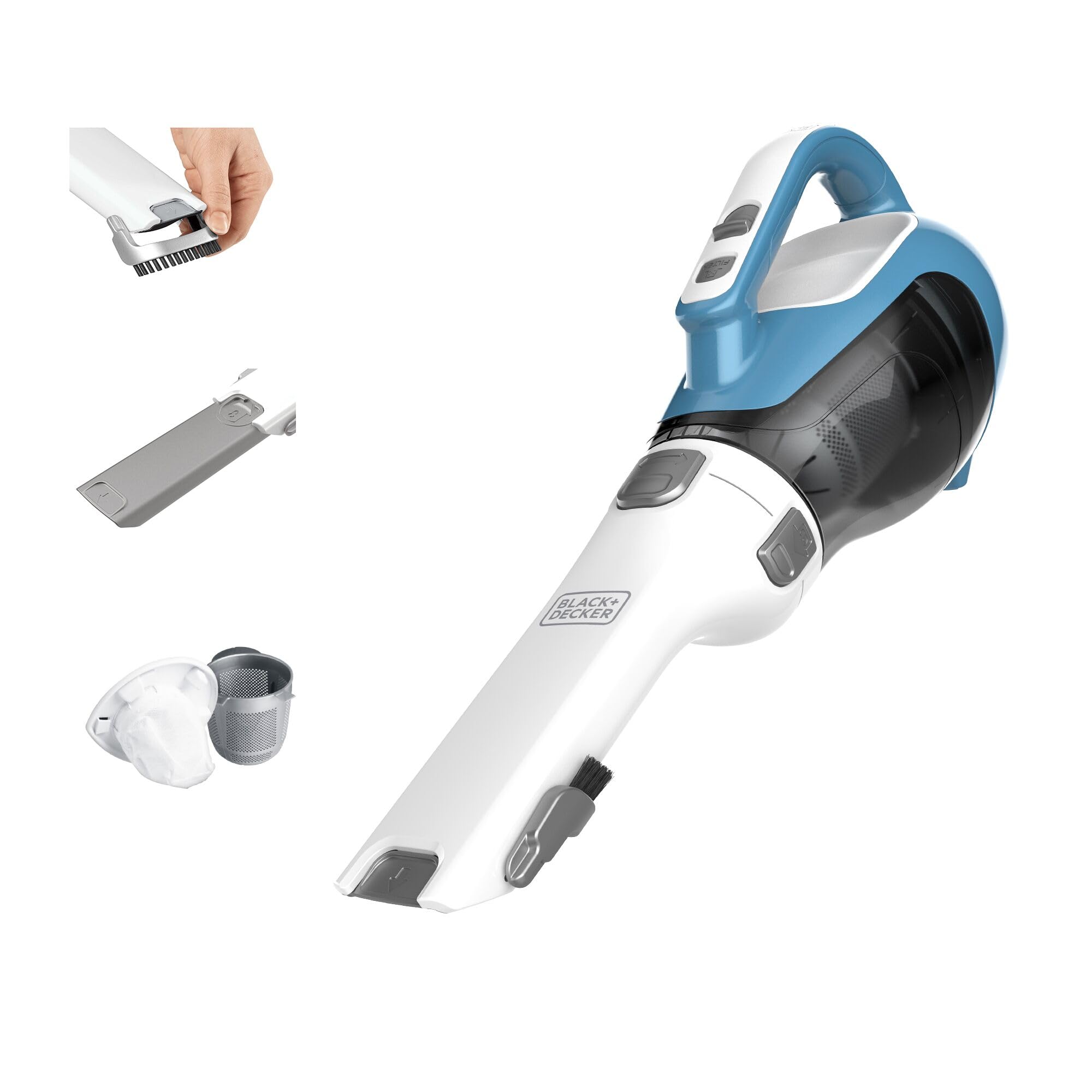
1. Black+Decker Dustbuster AdvancedClean
Our pick — over 4★ from 110,500+ verified ratings; the strongest balance of quality and price.
The iconic Dustbuster with a 605 ml cup — empties less often but charges for four hours.
Black+Decker’s Dustbuster AdvancedClean is the household name of handheld vacuums, and it earns its spot on a detailing list for one big reason: the 605 ml (roughly 20 oz) dirt bowl is the largest here by a wide margin. Its 605 ml cup is larger than the ZARIMI’s 240 ml and the ONAVOT’s 350 ml, so you will empty it less often, which matters if you vacuum multiple cars or a messy home. The rotating slim nozzle and pull-out crevice tool cover seat gaps and shelf edges, and the cyclonic action spins debris away from the filter to maintain suction longer than a non-cyclonic design.
The major limitation is the battery. At 11 minutes of runtime with a 240-minute (4-hour) charge time, this vacuum is best for quick spot cleans, not a full detail session. The 16-volt MAX lithium-ion battery provides adequate suction for surface dirt and pet hair, but it cannot match the 35,000 or 50,000 Pa of the mid-range and premium picks. Reviewers consistently praise its ease of use and brand reliability — it is the #1 brand in hand vacs — but note that the 11-minute battery requires discipline to work quickly. The bagless, washable dirt bowl makes emptying clean and simple.
Where it wins
- 605 ml dust bowl holds 605 ml — compared to 240 ml for ZARIMI and 350 ml for ONAVOT — fewer stops
- Cyclonic action keeps the filter cleaner, extending suction between washes
- Pull-out crevice tool and rotating slim nozzle reach typical detailing gaps
- Trusted brand with 110,000+ ratings and a 4.4-star average
The battery penalty
- 11-minute runtime is the second-shortest here, behind the Fanttik
- 240-minute charge is the longest — the vacuum is unusable for hours after a quick clean
- Suction strength is not listed in Pa, making it harder to compare directly
Get this if: You want a vacuum for quick car touch-ups and daily home use, and the large dust bowl means less frequent emptying.
Avoid for full details: The 11-minute battery and 4-hour charge make it impractical for a complete interior detail in one session.
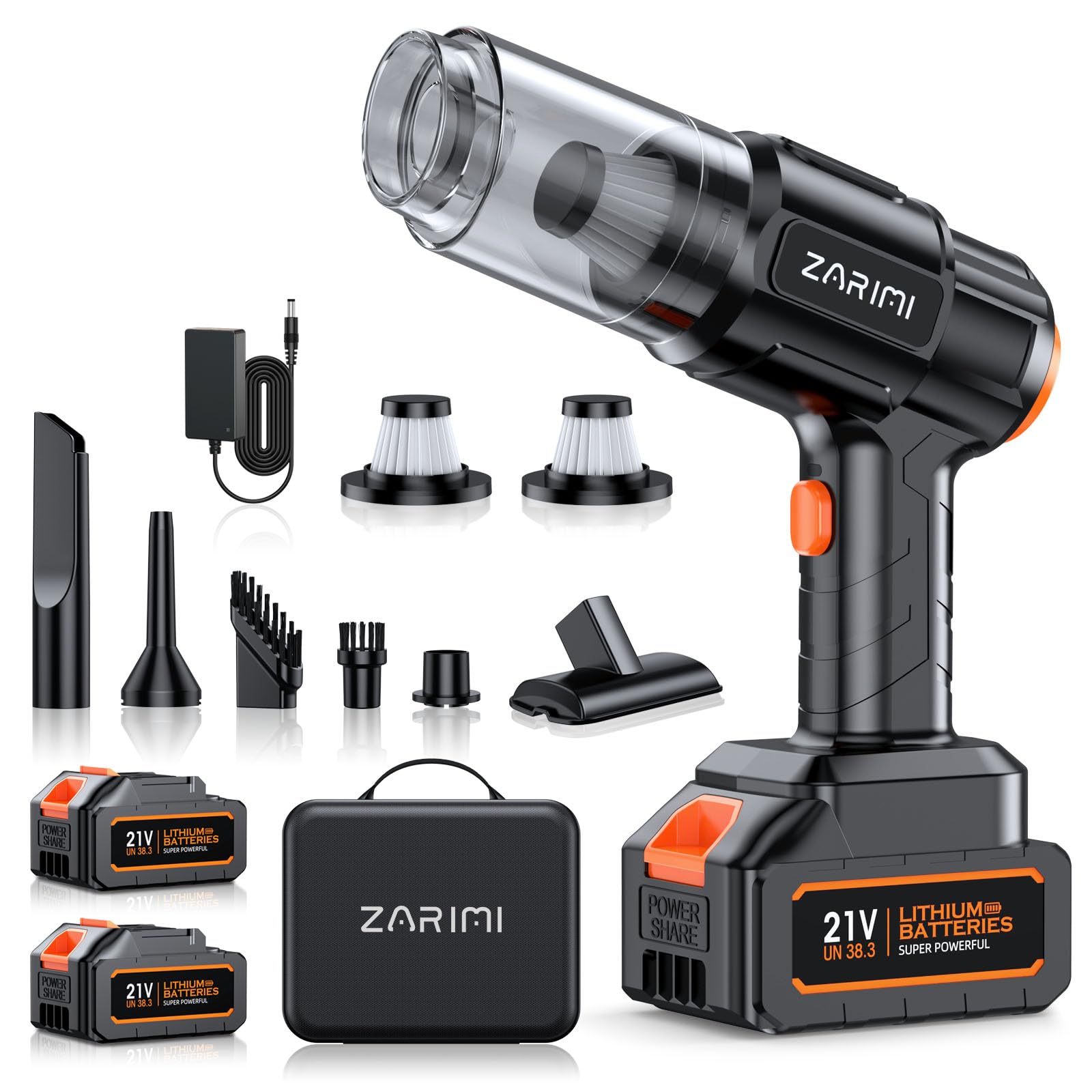
2. ZARIMI X12-Ultra
The 50,000 Pa monster that turns a handheld into a shop vac for your car.
This is the vacuum you reach for when the floor mats look like a sandbox. The ZARIMI X12-Ultra delivers 50,000 Pa of suction through a brushless motor — that is nearly three times the pull of typical mid-range models, enough to yank gravel out of deep carpet fibers without a second pass. You get two batteries that together provide 60 minutes of runtime, and they swap quickly so you never pause mid-detail. The package includes six nozzles, a storage bag, and two HEPA filters, which means you have spares ready while the first set dries after washing.
At 1.9 pounds, this cordless handheld is light enough to carry around a full SUV interior without fatigue. The washable dustbin and filters lower the long-term cost, though the 240 ml (about 8 oz) cup fills faster than the 350 ml ONAVOT listed below — especially at this extreme suction level. Buyers report that the vacuum handles pet hair on upholstery easily, and the 4.9-star rating across 510 reviews backs up the performance claims.
Why this one leads
- 50,000 Pa suction — the highest in this lineup, pulls embedded debris from carpet
- Two swappable batteries deliver 60 minutes of cleaning with no downtime
- Six accessory nozzles cover every crevice, seat gap, and flat surface
- HEPA filter traps fine dust, preventing it from recirculating into the cabin
The trade-off
- Dust cup at 240 ml requires more frequent emptying than the 350 ml ONAVOT
- Premium price reflects the highest suction in the category
Who it works for: Anyone who details cars regularly and wants the most powerful handheld available — this pulls dirt that entry-level vacuums leave behind.
Who should check the ONAVOT instead: If you clean larger vehicles (trucks, vans) and hate stopping to dump the cup, the 350 ml ONAVOT holds more debris between empties.
3. ONAVOT SV18
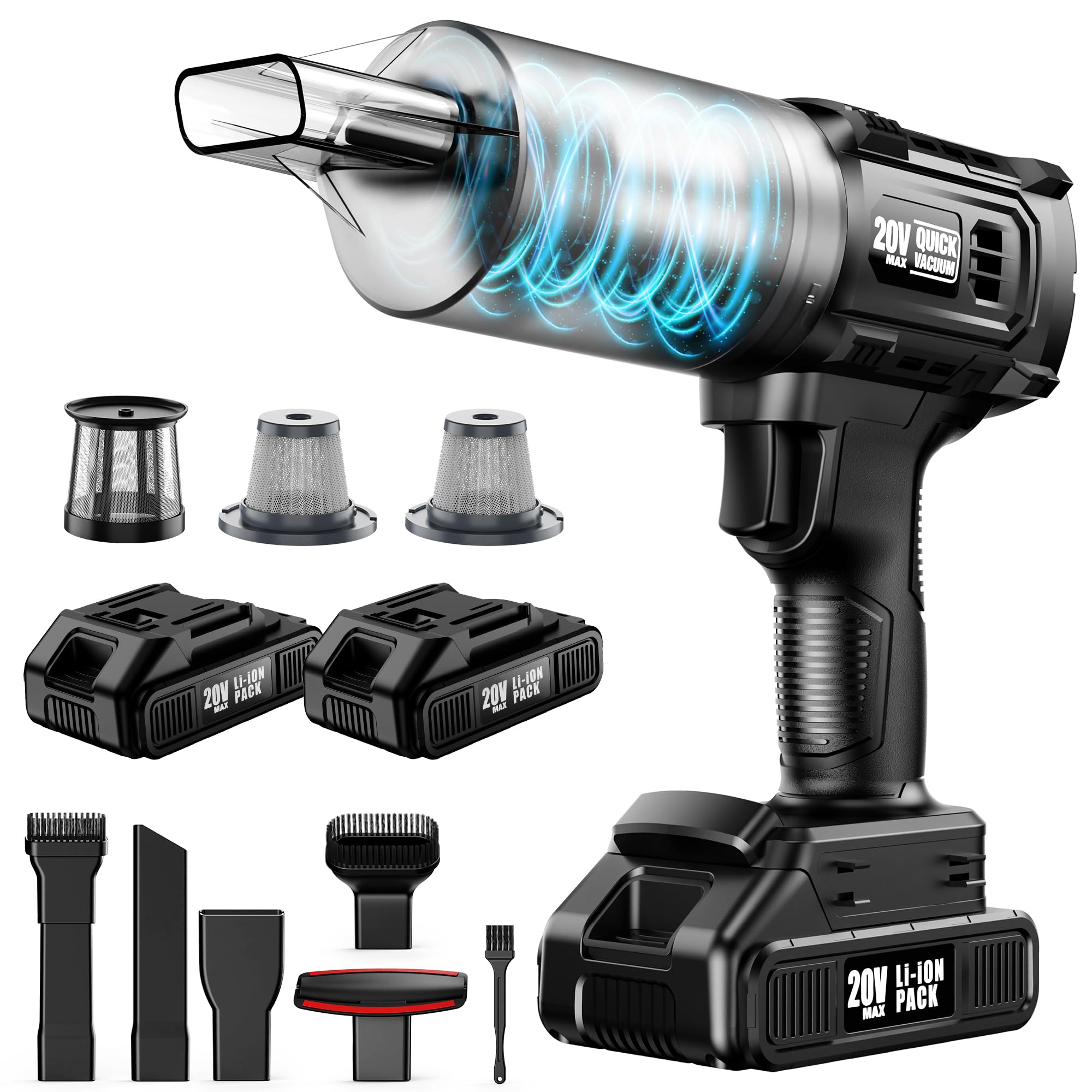
Sixty minutes of cleaning and a 350 ml cup — the one that finishes the whole car.
The ONAVOT SV18 hits the balance where power, capacity, and runtime converge. With 35,000 Pa of suction from a 150,000 RPM brushless motor, it lifts pet hair and ground-in dirt without needing the extreme 50,000 Pa of the ZARIMI. The real headline is the 350 ml XL dust cup — the second-largest in this review — paired with two detachable batteries that give you 60 minutes of continuous runtime. You can clean a full sedan interior, including floor mats and the trunk, without once stopping to empty the bin.
Owners mention that the three attachments (crevice tool, soft brush, dedicated pet hair nozzle) cover the common detailing scenarios well, and the dual filtration — a washable HEPA filter plus a steel pre-filter — traps 99.97% of fine particles. Weighing 1.76 pounds, it is noticeably lighter than the ZARIMI, making overhead cleaning of headliners easier. The catch is that the included batteries are the only way to power it; there is no option to run it plugged in if both batteries die, so keeping the spare charged during a long detail is essential.
What makes it the best overall
- 350 ml dust cup is the second-largest among all picks — fewer interruptions during a full detail
- Two batteries provide 60 minutes of runtime, matching the ZARIMI but with a bigger bin
- 35,000 Pa suction handles deep carpet debris and pet hair effectively
- Dual HEPA + steel filtration keeps fine dust trapped and maintains consistent suction
The limitation
- No pass-through charging — you must swap batteries and charge separately
- Suction is 15,000 Pa lower than the ZARIMI, relevant for extremely caked-on mud
Grab this if: You want the best combination of raw power, huge dust capacity, and long runtime for a single pass through a full car interior.
Skip it for the ZARIMI if: You deal with heavy debris (gravel, construction dust) and need every Pa of suction to extract it from deep carpet.
4. Saker HL133

Folds down to palm size yet runs 40 minutes — the travel-friendly detailing kit.
The Saker HL133 solves a different problem than the high-power picks above: storage. It folds into a shape roughly the size of your palm, weighing just 380 grams (about 13.4 oz), making it the most portable vacuum here. Despite the compact body, it delivers 17,000 Pa of suction from a brushless motor with three adjustable speeds (7 kPa to 15 kPa), so you can dial down for delicate dashboard dusting or crank up for carpet crumbs. The three 2,500 mAh batteries provide a 40-minute runtime, which covers a reasonable detail session for a smaller car.
The 0.2-liter dust cup matches the REWONDER’s capacity and holds a moderate amount of debris before needing a dump. The included accessories — flat nozzle, floor brush, inflator nozzle, and a brush sleeve — support vacuuming, blowing, and inflating tasks. One practical detail: the HEPA filter is rated for 2-3 months of use, and the fine steel filter can last over a year with washing. The trade-off is the 17,000 Pa suction ceiling; it handles daily crumbs and light dust well but struggles with deeply embedded sand compared to the 35,000 or 50,000 Pa units.
Best for portability
- Folds to the size of a palm — fits in a glovebox or desk drawer
- Weighs 380 grams, the lightest pick in this lineup
- 40-minute runtime covers a full detail for smaller vehicles
- HEPA filter plus washable steel filter extends service life beyond one year
Where it falls short
- 17,000 Pa suction versus the ZARIMI’s 50,000 Pa — not for heavy debris
- No detachable battery means the vacuum is down when charging for 3 hours
Reach for this if: You need a vacuum that disappears into a glovebox and still runs long enough for a full interior wipe-down.
Look elsewhere if: Your car sees regular off-road trips or you vacuum caked-on mud from floor mats — you want 35,000 Pa or more.
5. Fanttik Fold V10 APEX

A pivoting head that snakes into seat rails and under pedals without bending your wrist.
The Fanttik Fold V10 APEX stands out for its 210° rotating head that locks into seven different angles. This is a genuine advantage for car detailing because it lets you reach under the front seats, into the gap between the center console and the seat rail, and along the bottom of the dash without contorting your arm. The included flexible hose and pet brush expand that reach further, making it the most maneuverable option here. Powered by an 80,000 RPM brushless motor, it produces 17,000 Pa of suction — competitive with the Saker but much lower than the ONAVOT or ZARIMI.
The 16.9-ounce translucent dust bowl (about 500 ml) has a side door for emptying, which is more convenient than twisting off a full cup. However, the 13-minute battery runtime is the second-shortest among all seven picks. Customers note that for a quick vacuum of the front seats and floor mats, 13 minutes is enough, but a full interior detail requires a recharge break. The 2.5-hour charge time via USB-C is reasonable, but you cannot swap batteries mid-session. The manufacturer notes that blocked filters and low battery both reduce suction, so regular cleaning is essential.
Why the pivot matters
- 210° rotating head with 7 lock angles cleans under seats and in tight gaps
- Flexible hose and pet brush attachments reach where rigid nozzles cannot
- Side-door dust bowl emptying avoids touching the debris
- Translucent bowl lets you see when it is full without guessing
The short battery reality
- 13-minute runtime is the second-shortest — not for full vehicle details
- Battery is built-in, so you must wait for a recharge before continuing
- Suction at 17,000 Pa matches the Saker but is well below the ONAVOT and ZARIMI
Best for: Quick spot cleans and reaching awkward angles — the pivoting head genuinely helps inside a car cabin.
Not ideal for: A full weekend detail or large vehicles; the 13-minute battery and moderate suction limit it to fast touch-ups.
6. WEBOLLY 16000PA
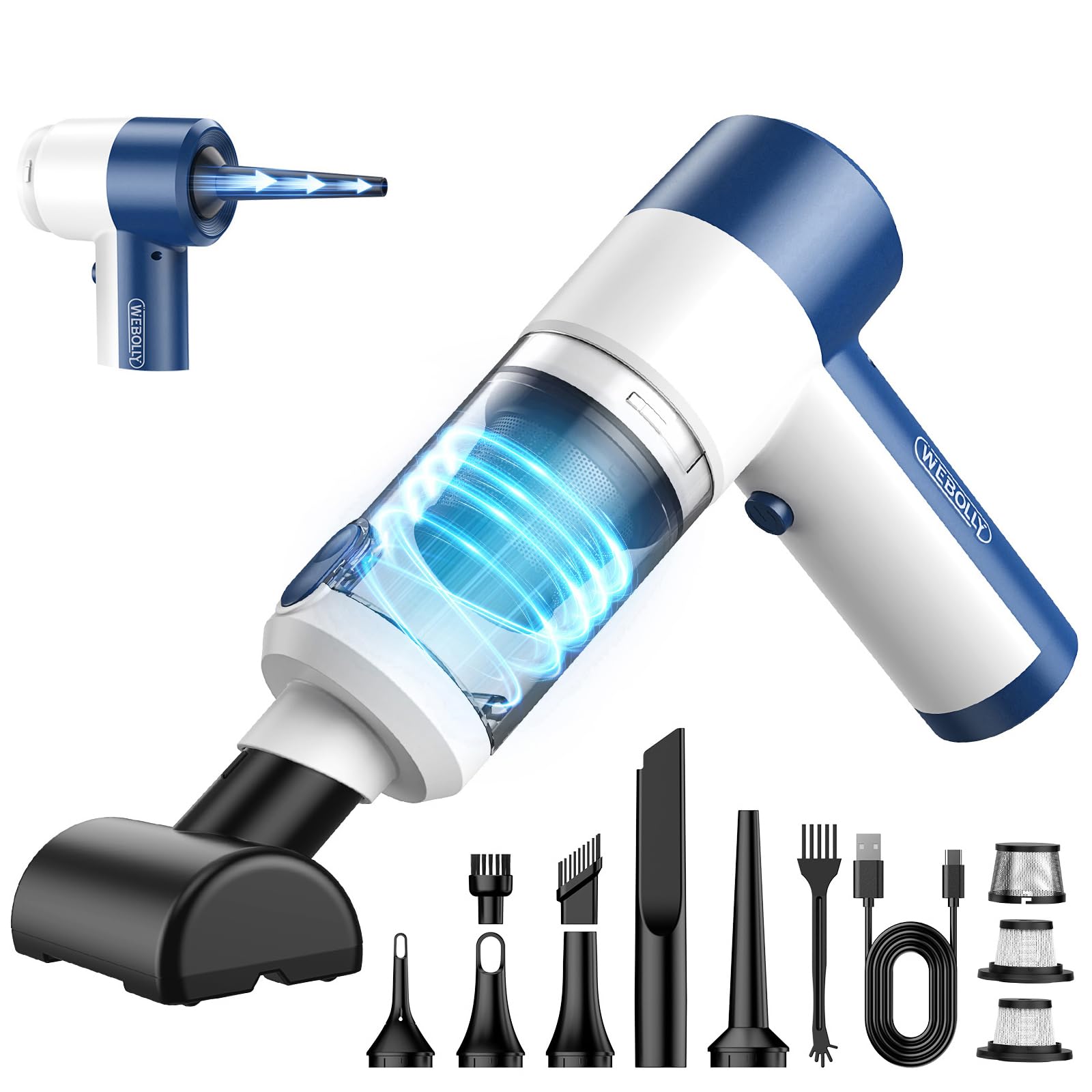
A 4-in-1 vacuum, duster, blower, and pump that charges faster than the rest.
The WEBOLLY 16000PA is the most versatile budget pick, doing double duty as a vacuum, air duster, blower, and pump. The 2.5-hour USB-C charge is faster than the REWONDER’s 4-hour charge — and the 26-minute runtime in ECO mode covers a decent light detail. With 16,000 Pa of suction, it handles crumbs, dust, and surface pet hair without struggling, though it lacks the grunt for deep-pile carpet extraction that the ONAVOT or ZARIMI provide. The 0.13-liter dust cup is the smallest here (compared to the REWONDER’s 0.2 liters), so expect frequent stops to empty it.
The dual filtration system (HEPA plus metal filter) and two washable HEPA filters mean you can keep one drying while the other is in use. At 0.96 pounds, it is the second-lightest vacuum after the Saker, making one-handed operation easy. The comprehensive accessory kit — six nozzles, two suction brushes, a small brush — covers most detailing scenarios. Buyers give it a 4.8-star rating from 84 reviews, and the one-click empty mechanism prevents any contact with debris. The manufacturer explicitly recommends dry debris only, so this is not for wet spills.
Why the speed matters
- 2.5-hour charge time versus the REWONDER’s 4-hour charge time
- 4-in-1 functionality: vacuum, duster, blower, and pump in one device
- 0.96 lb weight makes it easy to handle for longer cleaning sessions
- Two washable HEPA filters included — swap while one dries
Where it cuts corners
- 0.13-liter cup fills fast — you will empty it several times during a full detail
- 16,000 Pa suction is the lowest among the mid-range competitors
- Dry debris only — cannot handle wet spills in the car
Choose this if: You need a fast-charging, ultra-light vacuum that also blows dust out of vents and inflates air mattresses for road trips.
Skip for deep detailing: The small cup and moderate suction mean frequent interruptions during heavy cleaning — go for the ONAVOT or ZARIMI instead.
7. REWONDER Handheld Car Vacuum
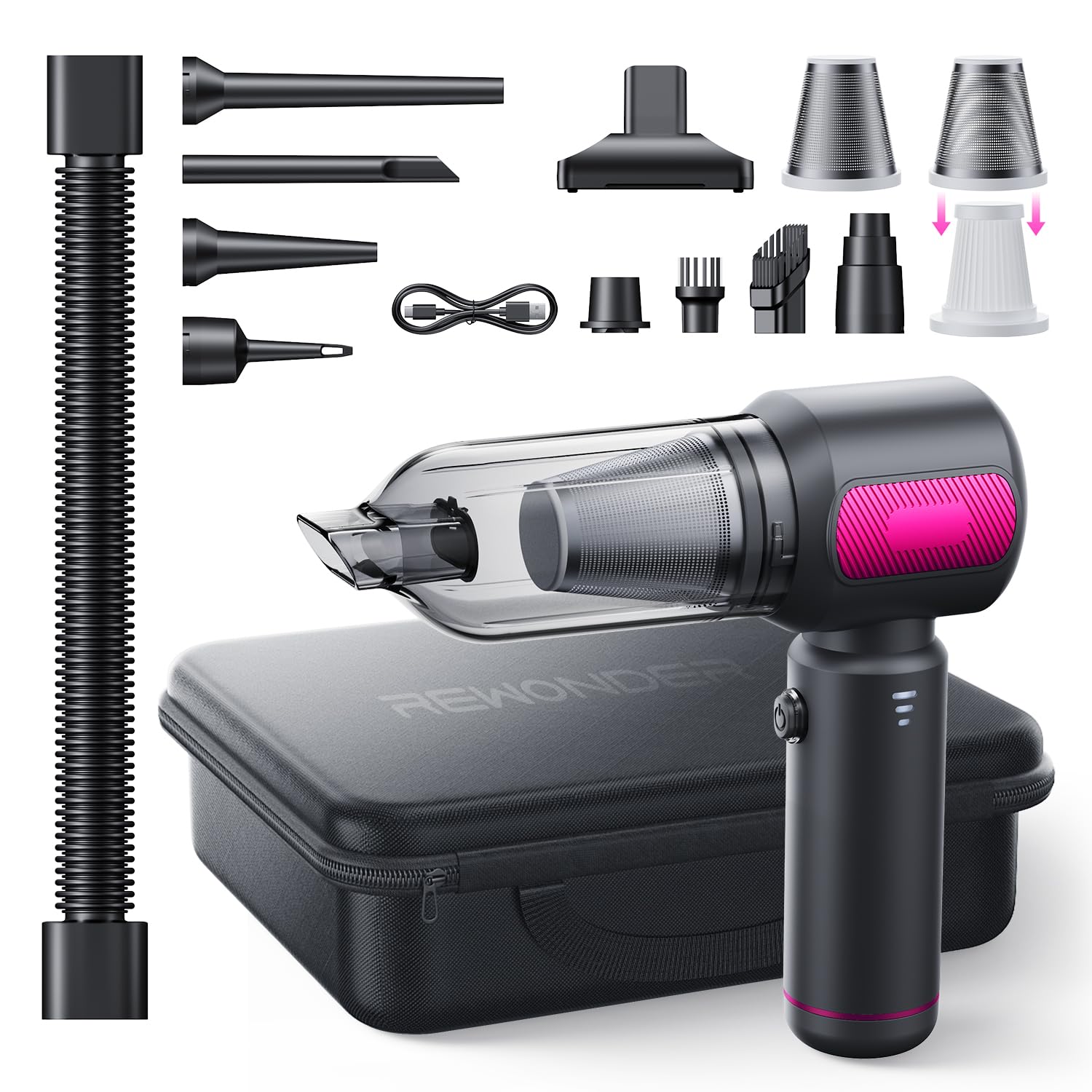
22,000 Pa of suction in a 0.99-pound body that blows dust and inflates toys.
It also functions as a 110,000 RPM high-speed electric air duster for blowing dust out of vents and keyboards, and it can inflate pool toys or air mattresses. The 7,800 mAh battery is high-capacity, but the 4-hour charge time is the longest here (the WEBOLLY charges in 2.5 hours). The 0.2-liter dust cup sits in the middle of the pack — larger than the WEBOLLY’s 0.13 liters but smaller than the ONAVOT’s 350 ml.
At 0.99 pounds, it is almost as light as the WEBOLLY and shares a similar accessory kit with multiple nozzles, a crevice tool, a brush, and a storage bag. The washable HEPA filter makes maintenance straightforward. The 3-speed suction adjustment lets you choose between light dusting and deeper cleaning. However, reviewers point out that the 4-hour charge is an inconvenience if you forget to plug it in before a detail session. The relatively new product has 129 ratings at 4.1 stars, with some users pointing out that the blower function is surprisingly useful for drying washed floor mats quickly.
What stands out
- 22,000 Pa suction is stronger than the WEBOLLY and Saker, better for carpets
- 2-in-1 vacuum and blower with a 110,000 RPM motor for dusting and inflating
- Lightweight at 0.99 pounds for fatigue-free one-handed use
- Three adjustable power modes tailor suction to the mess
The long charge penalty
- 4-hour charge time compared to the WEBOLLY’s 2.5-hour charge
- 0.2-liter cup is small — expect to empty it mid-detail on larger vehicles
- 4.1-star rating is the lowest in this lineup; some early reliability concerns
Good pick if: You want the strongest suction on a budget and also need a blower for drying car mats or inflating camping gear.
Better options exist for: Faster charging (the WEBOLLY) or longer runtime (the ONAVOT) — the REWONDER’s 4-hour charge is a real bottleneck.
Understanding the Specs
Suction power in Pascals
Pascals (Pa) measure the vacuum’s ability to lift debris from a surface. Think of it as the pulling force behind the nozzle. A vacuum rated at 10,000-17,000 Pa handles loose dust, crumbs, and surface hair from seats and dashboards. Between 20,000 and 35,000 Pa, you start extracting embedded dirt from carpet fibers and fabric upholstery — the kind that builds up under floor mats over weeks. At 50,000 Pa, you are in shop-vac territory, capable of pulling out gravel and sand that has worked deep into the carpet backing. Matching Pa to your typical mess level prevents overspending on power you never use or underspending and fighting a vacuum that just pushes dirt around.
Battery capacity and charge time
A detailing vacuum’s battery determines how much you can clean in one session. Runtime is listed in minutes, but charge time — how long you wait before it can run again — is equally critical. A vacuum with 11-15 minutes of runtime is fine for a quick dash-and-center-console wipe. Thirty to forty minutes covers a full interior of a compact car. Sixty minutes with two swappable batteries lets you do trucks, vans, or multiple vehicles back to back. Charge times range from 2.5 hours (quick) to 4 hours (slow). A model with detachable batteries is ideal because you can charge one while using the other, effectively eliminating downtime during a long detail.
Dust cup capacity
The dust cup holds everything you suck up until you empty it. Measured in milliliters (ml) or ounces (oz), a larger cup means fewer interruptions. Small cups around 130-200 ml fill up fast when vacuuming sandy floor mats or pet hair — you might stop three or four times during a full detail. Mid-range cups around 240-350 ml allow you to finish most of a sedan before dumping. The largest cup here at 605 ml (the Black+Decker) lets you vacuum an entire car and still have room. Beyond size, the emptying mechanism matters: a one-click bottom door lets you drop debris directly into the trash without touching anything, while a twist-off cup requires handling the filter area, which collects fine dust.
Brushless motors and filter types
A brushless motor generates suction without internal brushes that wear down over time. This means higher efficiency, longer motor life, and less heat buildup during extended use. All seven picks here use brushless motors, which is a sign the category has matured. The filter type is equally important. HEPA (high-efficiency particulate air) filters trap 99.97% of particles down to 0.3 microns — the fine dust that standard foam filters blow right back into the car. A washable HEPA filter saves replacement cost but must be fully dried before reuse to avoid suction loss. Some models add a metal pre-filter that catches larger debris first, which keeps the HEPA layer from clogging as quickly. Cleaning the filter after every full use is mandatory to maintain the vacuum’s performance.
FAQ
How much suction in Pascals do I need for car detailing?
Will a detailing vacuum work on wet spills in the car?
How long should the battery run to detail a full car?
Is a HEPA filter necessary in a car vacuum?
What is the difference between a detailing vacuum and a regular handheld vacuum?
Can I use a detailing vacuum for home cleaning too?
How often should I clean the filter on my detailing vacuum?
Why does my car vacuum lose suction after a few minutes?
Are brushless motors worth the extra cost in a detailing vacuum?
What attachments do I need for a complete car detail?
Final Thoughts: The Verdict
For most buyers, the best detailing vacuum winner is the ONAVOT SV18 because it combines 35,000 Pa of suction with an enormous 350 ml dust cup and 60 minutes of swappable battery runtime — enough power and capacity to finish a full interior detail without a single interruption. If you want the absolute strongest suction available and regularly deal with heavily embedded debris, grab the ZARIMI X12-Ultra with its 50,000 Pa and professional-level pull. And for quick spot cleans and a vacuum that folds small enough to store in a glovebox, the standout is the Saker HL133.
How We Picked
We do not accept paid placement. Every pick is matched to a real buyer and a real use-case; we do not hands-on test units.
Sources & Methodology
Specifications: manufacturer listings and product documentation. Review insights: verified customer reviews, as of July 2026. Pricing: not shown on this page (it changes often); check the current price via the retailer link.
As an Amazon Associate, Trending Car earns from qualifying purchases. This does not affect which products we feature.