
Our readers keep the lights on and my garage snacks stocked. As an Amazon Associate, I earn from qualifying purchases.
Specs are compiled from manufacturer listings and verified buyer reviews and can change over time — please confirm the key details on the product page before buying.
You woke up cold because the furnace blower died before dawn. Or you had to skip the coffee maker to save power. That single problem changes the moment you swap the battery under the step. A standard lead-acid RV battery runs out of usable juice at 50% depth of discharge (the point where the battery is drained enough that it cannot deliver power reliably). That forces you to run a generator or cut your trip short. A modern lithium iron phosphate (LiFePO4) deep cycle battery for RV use gives you up to 100Ah usable energy from a 100Ah lithium battery versus about 50Ah from a lead-acid AGM battery of the same physical size. It also weighs about 24.25 pounds compared to about 63.9 pounds for a lead-acid AGM battery—so your camper sits lighter and your weekend stays longer.
I’m Min Islam — the founder and writer behind Trending Car. This guide is built by comparing the manufacturers’ published specifications and the patterns across verified customer reviews, so you get each pick’s real strengths and trade-offs instead of marketing spin.
Before you buy, you need to know which battery chemistry (lithium vs. lead-acid) fits your power demands, how many amp-hours (Ah) your fridge and lights actually need, and why a battery management system (BMS) is non-negotiable. Read on for the seven best options that define a reliable deep cycle battery for rv use today.
Our Picks at a Glance
How To Choose The Best Deep Cycle Battery for RV
Switching to a lithium deep cycle battery for your RV is not just about more power—it is about changing how you camp. You stop worrying about draining the battery past the “safe” halfway mark, and you stop lifting 60-pound slabs of lead every time you swap a unit. Here are the three specs that matter most.
Amp-Hours (Ah) and Usable Capacity
Your RV’s refrigerator, furnace fan, lights, and water pump all draw current continuously. A 100Ah lithium battery gives you roughly 100 amp-hours of usable energy, whereas a 100Ah lead-acid AGM (Absorbent Glass Mat) battery only gives you about 50Ah before the voltage sags and the battery is considered “flat.” That is the core reason lithium doubles your run time out of the same physical tray. If you plan to run a residential-sized fridge or a microwave through an inverter (a device that turns 12V battery power into 120V household power), consider moving up to 150Ah or more.
Built-in BMS (Battery Management System)
Every lithium battery on this list includes an integrated BMS that protects against overcharging, over-discharging, short circuits, and overheating. Some models also include low-temperature charging protection, which automatically shuts off charging below about 32°F to prevent permanent damage to the cells. If you camp in freezing weather, low-temp protection is a must-have.
Physical Size: Group 31 vs Group 24
Most aftermarket RV battery trays are sized for Group 31 (roughly 13 x 6.8 x 8.8 inches) or Group 24 (roughly 10.2 x 6.6 x 8.3 inches). A Group 31 battery holds more capacity for the same footprint. Before buying, measure your tray and verify the terminal orientation (top-post vs threaded bolts) so you do not have to re-wire your harness.
Quick Comparison
| Model | Best For | Capacity | Weight | Dimensions | Amazon |
|---|---|---|---|---|---|
| Litime 12V 100Ah Group 31★ Best Overall | Long-term value & ruggedness | 100 Ah | 24.25 lbs | 13 x 6.77 x 8.5 in | Amazon |
| HumsiENK 12V 150Ah LiFePO4Also Great | High-capacity boondocking | 150 Ah | 28.7 lbs | 13.07 x 6.89 x 8.74 in | Amazon |
| Power Queen 12V 100Ah Group 31 | Reliable drop-in replacement | 100 Ah | 24.25 lbs | 13 x 6.77 x 8.5 in | Amazon |
| LiTime 12V 100Ah Group 24 (Bluetooth) | Compact & cold-weather savvy | 100 Ah | 21.9 lbs | 10.24 x 6.61 x 8.3 in | Amazon |
| ECO-WORTHY 12V 314Ah LiFePO4 | Maximum runtime & expansion | 314 Ah | 60.4 lbs | 16.3 x 8.5 x 10.2 in | Amazon |
| GRNOE 2-Pack 12V 100Ah | Value dual-bank setup | 100 Ah each | 22.48 lbs each | 12.9 x 6.7 x 8.6 in each | Amazon |
| DUMFUME 12V 100Ah LiFePO4 | Budget entry into lithium | 100 Ah | 22.05 lbs | 13 x 6.69 x 8.62 in | Amazon |
In‑Depth Reviews
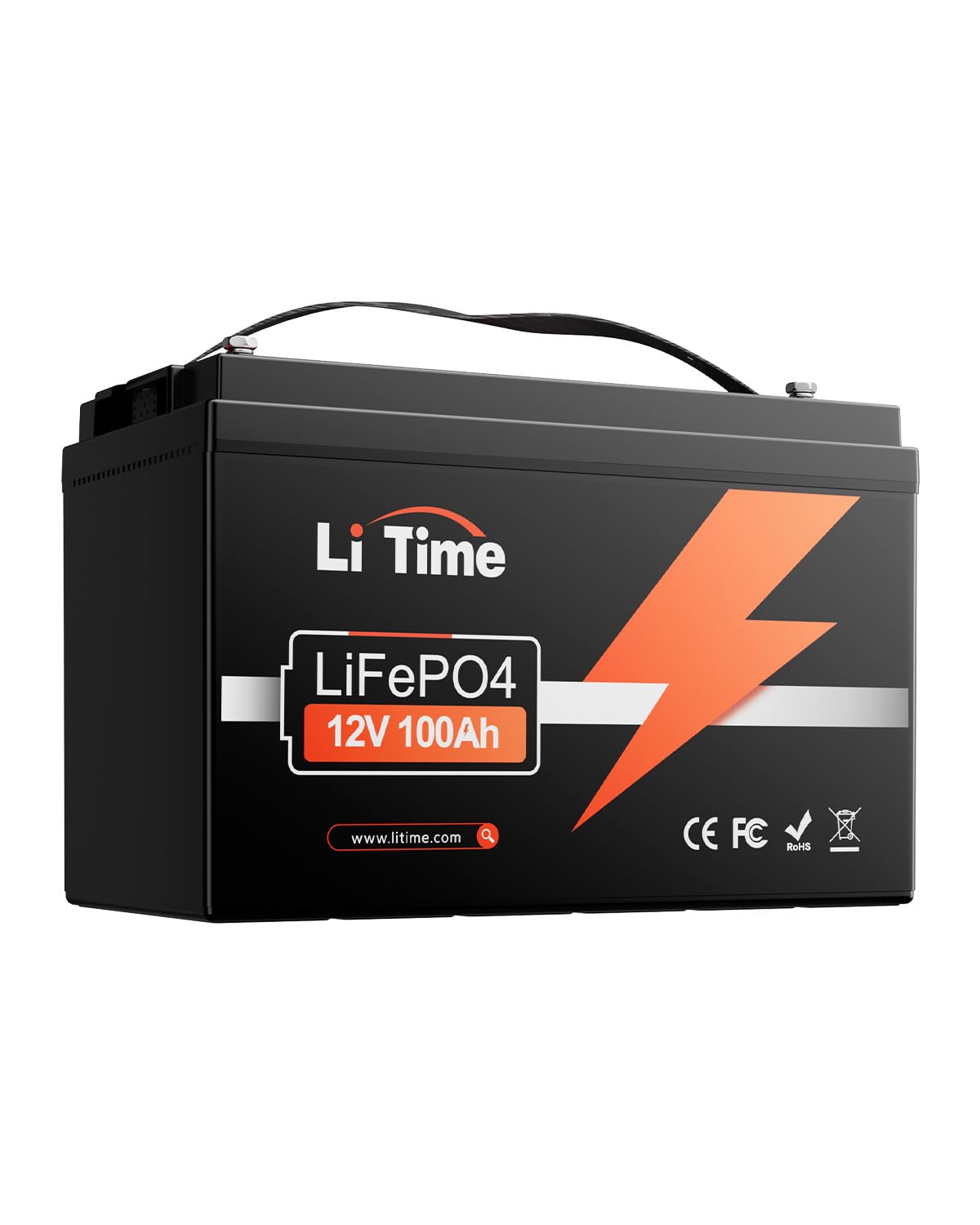
1. Litime 12V 100Ah Lithium Battery, Group 31 LiFePO4 Battery with 100A BMS
Our pick — over 4.5★ from 750+ verified ratings; the strongest balance of quality and price.
With over 750 ratings and a 4.6-star average, the Litime 100Ah is the crowd-favorite for proven reliability.
The Litime 100Ah Group 31 battery uses automotive-grade A+ cells and weighs 24.25 pounds—compared to about 63.9 pounds for a comparable lead-acid AGM battery. Its 100A BMS provides 20+ safeguards, and the numbers for longevity are impressive: 4,000+ cycles at 100% depth of discharge (DOD), 6,000 cycles at 80% DOD, and 15,000 cycles at 60% DOD. That flexibility means you can discharge it harder on a heavy-power weekend and still get many years of service. The battery is also expandable to a 4P4S config for a full 51.2V 400Ah system (20.48kWh), suitable for larger off-grid setups or 30-70lb trolling motors.
Reviewers point out the Litime has been “durable after 2 years in a truck bed powering a fridge/compressor (34 cycles)” and that it handles a 30A draw without issue. The Bluetooth app provides charge level and rates, though a few reviewers mention the app can glitch during charging and fails to update status without a reconnect. It also works with an RV’s stock charger (up to 99% charge), but if your RV has a very old converter, you may need a lithium-compatible upgrade to get a full charge.
The upside
- Proven track record with 751 ratings and a 4.6-star average
- Very low self-discharge, holds charge well over months of storage
- Bluetooth app is genuinely useful for monitoring charge/discharge rates
The downside
- Bluetooth app can be glitchy during active charging
- Some RV converters may struggle to fully charge it without a lithium-compatible upgrade
Grab this if: you want the safest choice with a huge user base backing its reliability, and you are okay with the occasional Bluetooth glitch.
Choose a competitor if: you need low-temperature charging protection—the LiTime Group 24 above offers that, while this Group 31 model does not specifically advertise it.
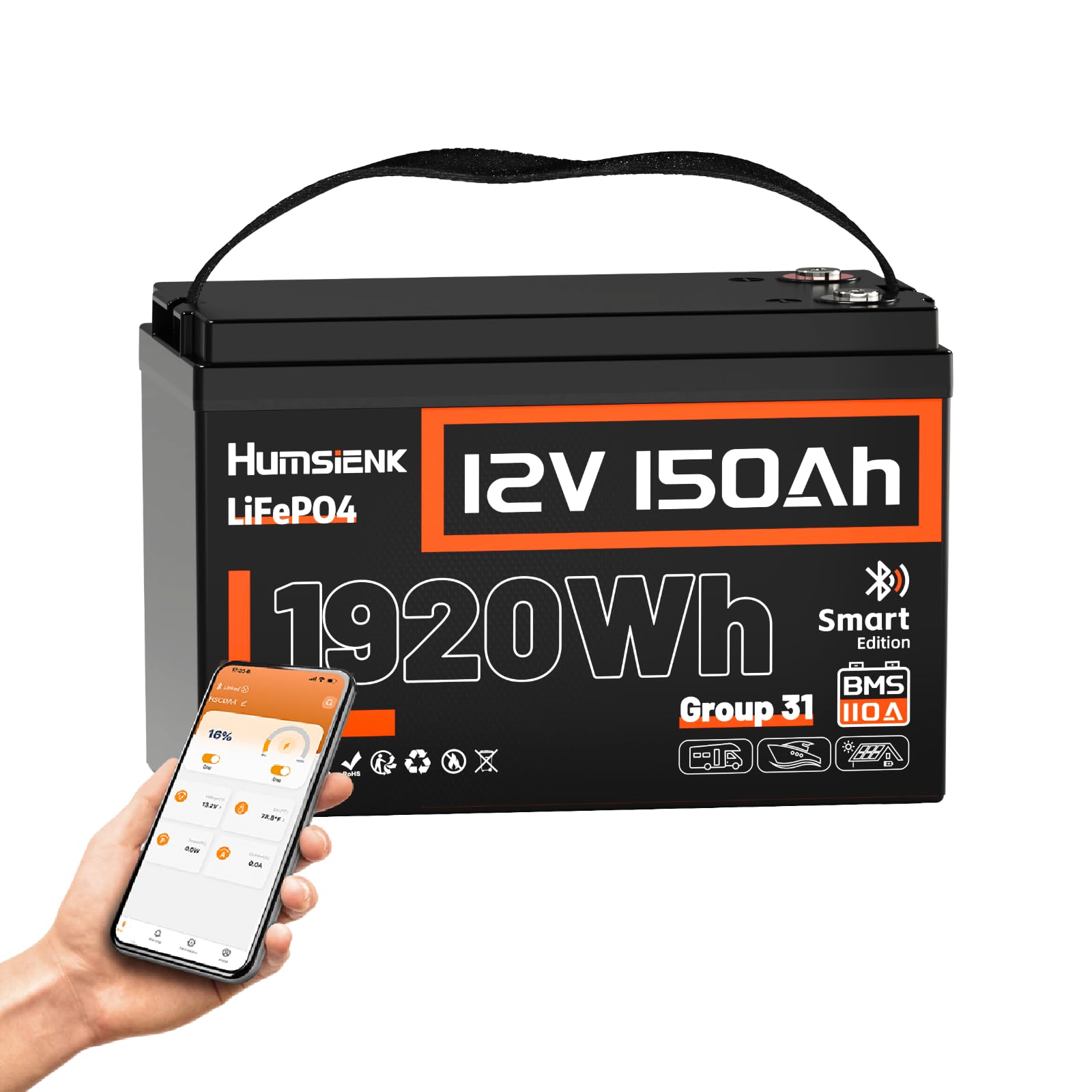
2. HumsiENK 12V 150Ah LiFePO4 Lithium Battery BCI Group31 Bluetooth
The HumsiENK 150Ah delivers 50% more usable capacity than a standard 100Ah battery, extending dry camping by two days without a generator.
The HumsiENK delivers 150 amp-hours of usable energy—that is 50% more capacity than the 100Ah Litime below, and all in a Group 31 footprint that weighs only 28.7 pounds. You get a built-in 110A BMS (battery management system) that guards against overcharging and overheating, plus Bluetooth 5.0 so you can check your voltage and state of charge (SOC) from your phone. The dedicated HumsiENK Smart App displays real-time data including current, remaining capacity, and cycle life, so you are never guessing whether you have enough juice for another night.
Buyers report it works great with a 55lb trolling motor on a 12ft jon boat, with 6-hour trips using only 20-30% of the battery and 8-hour trips topping out at 50%. The 5-year manufacturer warranty adds confidence. One limitation noted by a reviewer is the Bluetooth connection range—about 5 feet according to one owner, which can be inconvenient if the battery is mounted in a locked compartment you have to duck under to reach the app.
Run-time advantage: At 150Ah it holds 150Ah of stored energy compared to 100Ah in the 100Ah Litime Group 31, but it is only 18% heavier (28.7 lbs vs 24.25 lbs), meaning you get far more bang for your lifting effort. The catch is the modest Bluetooth range—you may need to stand close to the battery to refresh the app. If your RV setup demands long boondocking intervals (staying off-grid without hookups) and you prefer smartphone monitoring, this is the battery that pairs high capacity with modern convenience.
Reach for this if: you want the biggest usable capacity in a standard Group 31 tray without jumping to a 200Ah behemoth, and you like checking battery status from your phone.
Look elsewhere if: you need low-temperature charging protection (this model does not specifically advertise a low-temp cutoff) or you plan to mount the battery far from your seating area where Bluetooth range becomes a problem.
3. Power Queen LiFePO4 Battery 12V 100Ah Group 31
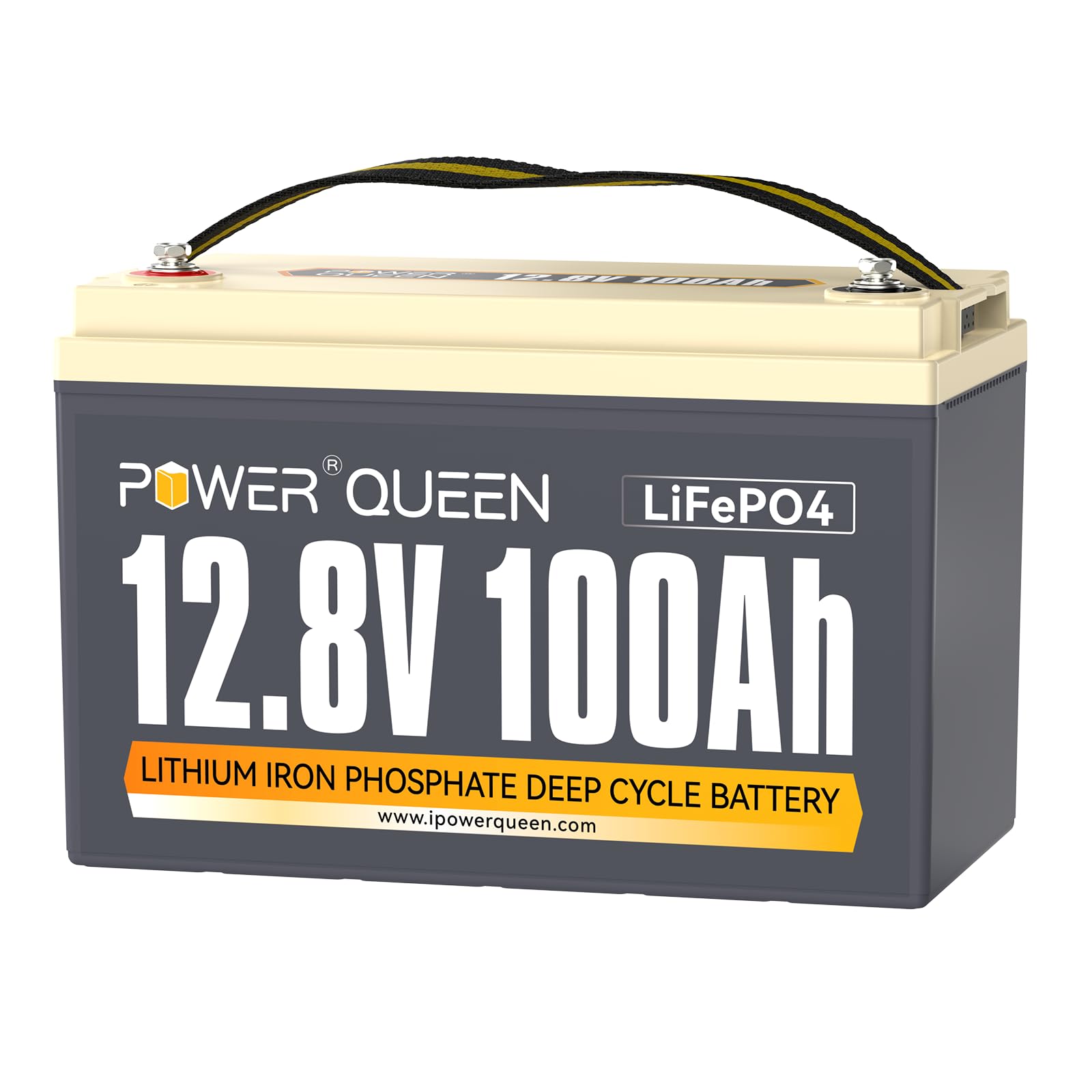
The Power Queen 100Ah is a trusted drop-in replacement with consistent build quality and a 5-year warranty.
The Power Queen 100Ah battery fits the standard Group 31 footprint (13 x 6.77 x 8.5 inches) and weighs just 24.25 pounds—compared to about 63.9 pounds for a lead-acid equivalent. Its smart BMS with 20+ protections guards against overcharge, over-discharge, over-current, and short circuits, and it delivers 4,000 cycles at 100% depth of discharge (DOD — how much of the battery’s capacity you use before recharging). That means at full use, you get roughly 10 years of daily cycling before you need to replace it. The battery is expandable up to 4P4S config (51.2V 400Ah / 20.48kWh), so you can build a substantial power bank as your setup grows.
Owners mention that the company stands behind the product with a 5-year warranty and even provides pre-paid FedEx return labels—one owner recounted that the return process was “way above what was expected.” The only trade-off is that it does not include Bluetooth monitoring, so you will need a separate shunt or battery monitor to track your state of charge.
What owners value
- Reliable build quality with 4,000 cycles at full depth of discharge
- Light at 24.25 lbs, making installation a one-person job
- 5-year warranty and responsive customer support
The one downside
- No built-in Bluetooth—buy an external monitor if you want app-based tracking
- Some RVs with 8-gauge wiring may need an upgrade to 6-gauge to handle charging current
Buy this for: a no-fuss replacement of a dead Group 31 lead-acid, especially if you already have a separate battery monitor installed.
skip it if: you insist on Bluetooth monitoring in the battery itself—the HumsiENK or LiTime Bluetooth models are better fits.
4. LiTime 12V 100Ah Group 24 LiFePO4 Battery (Bluetooth)
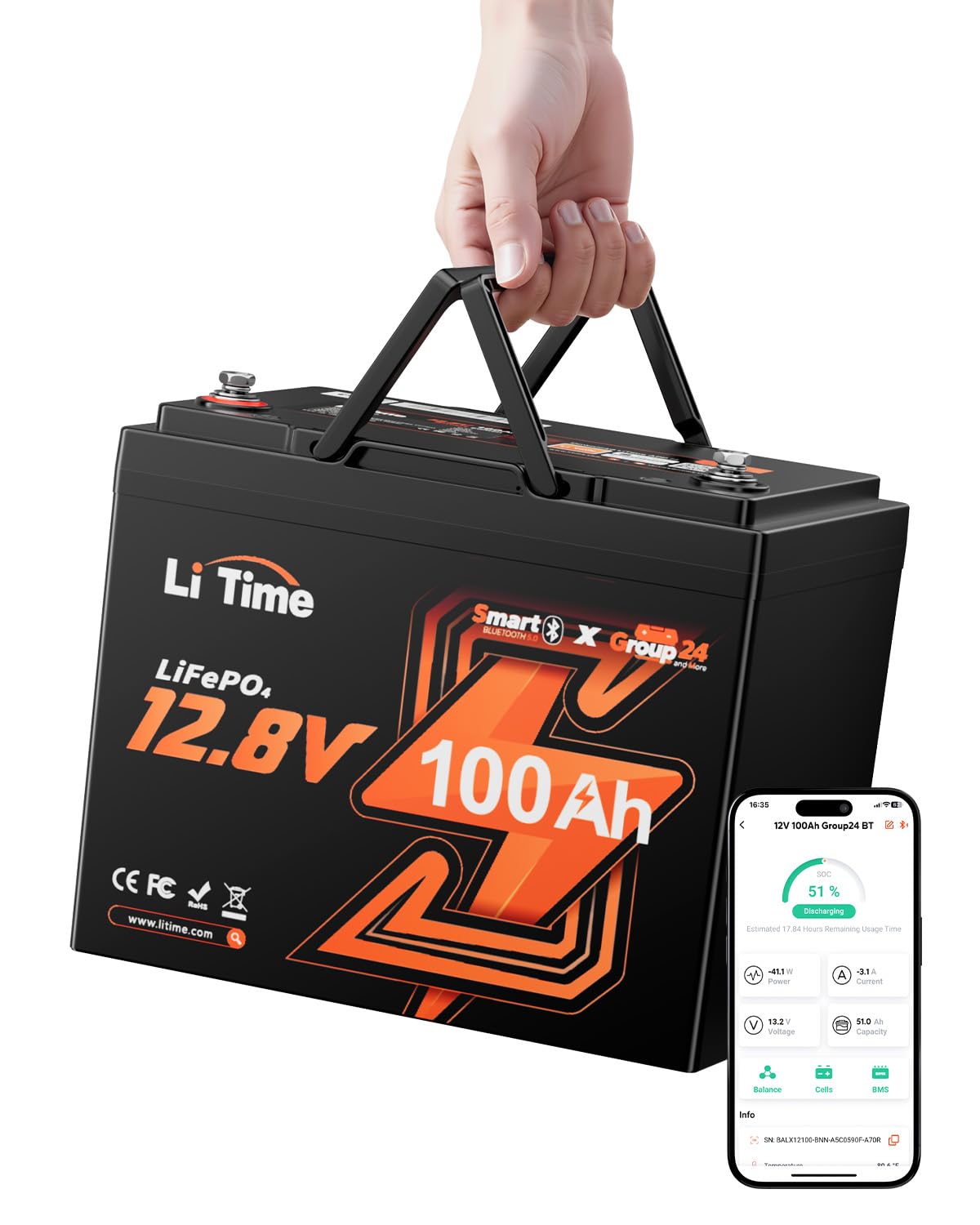
At 21.9 pounds, the LiTime Group 24 is the lightest 100Ah lithium here, with low-temp cutoff for year-round camping.
Weighing just 21.9 pounds, the LiTime Group 24 fits into battery boxes designed for Group 24, 27, or 31 sizes—so you are not locked into one tray. It delivers 1,280Wh (watt-hours) of usable energy, compared to about 50Ah from a lead-acid battery of the same physical size. The built-in Bluetooth app shows state of charge (SOC), voltage, and charging status from your phone, meaning no more lifting a hatch to check a meter. Most importantly, it includes all-weather cold protection: the BMS stops charging below 32°F and stops discharging below -4°F, which keeps the cells from being damaged in freezing temperatures.
Customers note it holds a charge perfectly when stored at half charge for emergency backup, and one reviewer ran a 60-inch TV and a powerful stereo for over five hours without draining the battery. The 5-year warranty and compliance with CE (Conformité Européenne) and RoHS (Restriction of Hazardous Substances) standards give you safety certification. The only catch is that its Group 24 form factor is physically smaller than a Group 31, so if you need the maximum possible capacity in a single battery bay, the Group 31 models above offer more room for expansion.
Smartest fit for winter RVers: the combination of low-temp cutoff (both charge and discharge) and Bluetooth monitoring makes this the most user-friendly option for cold-climate camping. If you want a second battery for a summer-only setup, you can save money by choosing a unit without low-temp protection. But for year-round use, this is the safest bet.
Perfect for: full-time van dwellers who camp in cold climates and want to protect their battery investment without buying an external heating pad.
Not ideal if: you already have a Group 31 tray and want the maximum single-battery capacity—the HumsiENK gives you 50% more Ah.
5. ECO-WORTHY 12V 314Ah LiFePO4 Lithium Battery Bluetooth
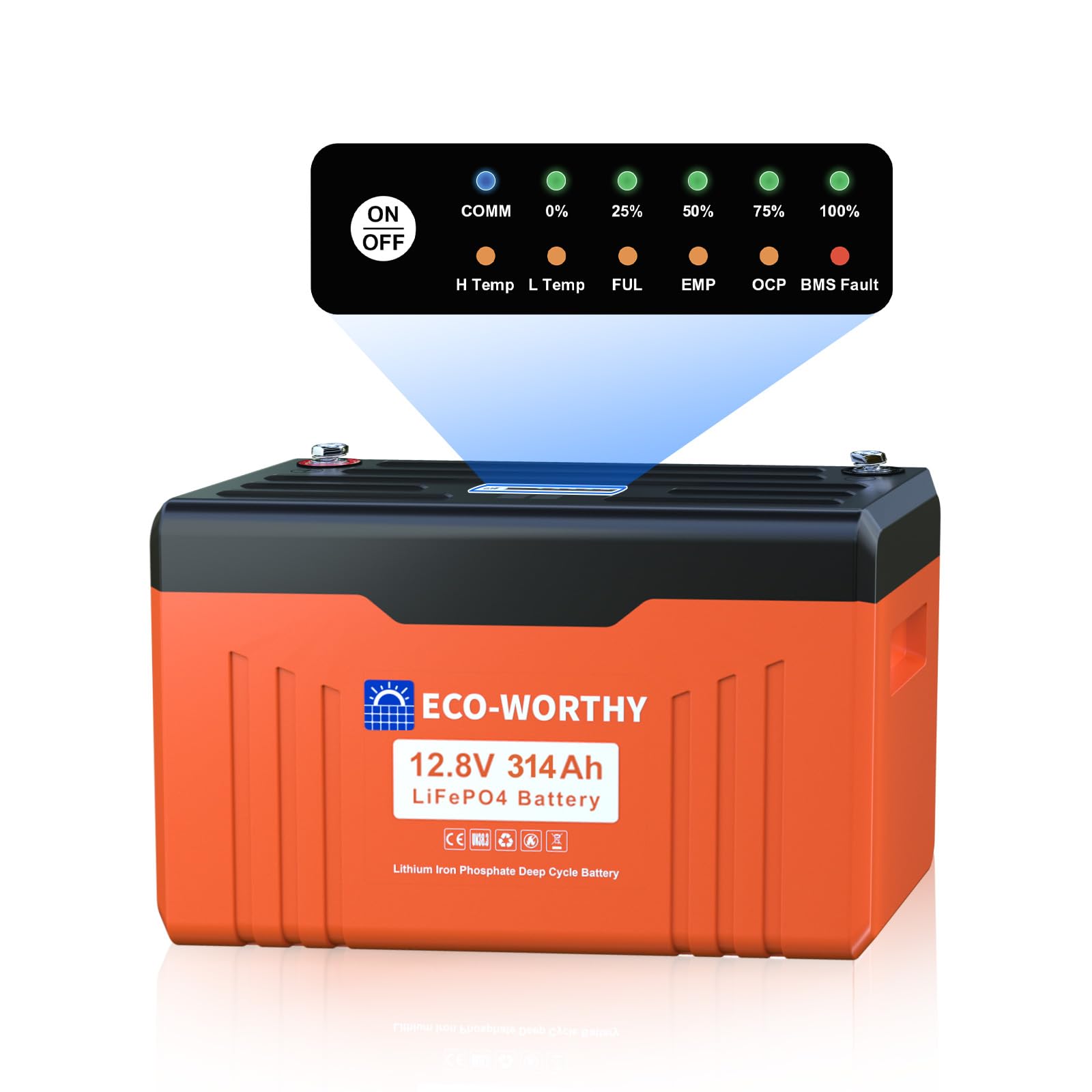
The ECO-WORTHY 314Ah stores 4,019.2Wh for extended off-grid living, weighing 60.4 pounds.
This ECO-WORTHY unit stores 4,019.2Wh (watt-hours) of energy (314Ah at 12.8V) and supports flexible expansion up to 4P2S or 2P4S for a total capacity of 30.7kWh. That is enough to run a residential fridge, lights, water pump, and a small air conditioner for a full weekend without breaking a sweat. The 200A BMS provides comprehensive high/low voltage, overload, and high/low temperature protection. It cuts off charging when the temperature drops below 19.4°F (-7°C), protecting the cells from cold damage.
The built-in Bluetooth works with the ECO-WORTHY App for remote monitoring, and an onboard buzzer alerts you to battery faults so you can troubleshoot quickly. SOC and status LED indicators on the battery itself give you a quick glance at remaining capacity without needing the app. Shoppers say “no issues so far” after 6 months of van use, and one owner says they run three of these units together and can run “days and days without running out of power.” The primary trade-off is size and weight: at 60.4 pounds and measuring 16.3 x 8.5 x 10.2 inches, it is substantially larger than a standard Group 31 battery, so you will need to verify your battery compartment can physically fit it.
Real talk on capacity: If you have ever wished for a single battery that eliminates range anxiety, this 314Ah unit delivers. The 200A BMS handles heavy loads like an inverter pulling 2,000W easily. The catch is that at 60.4 lbs, it is still lighter than a comparable lead-acid bank, but it is more of a two-person lift than the sub-30 pound lithium units.
Best for: large Class A motorhomes or dedicated off-grid cabins where a single massive battery simplifies wiring and you have the physical space.
Not for: anyone who needs to frequently remove the battery from a tight compartment—the weight and size make that a chore.
6. GRNOE 2-Pack 12V 100Ah LiFePO4 Lithium Battery Group 31
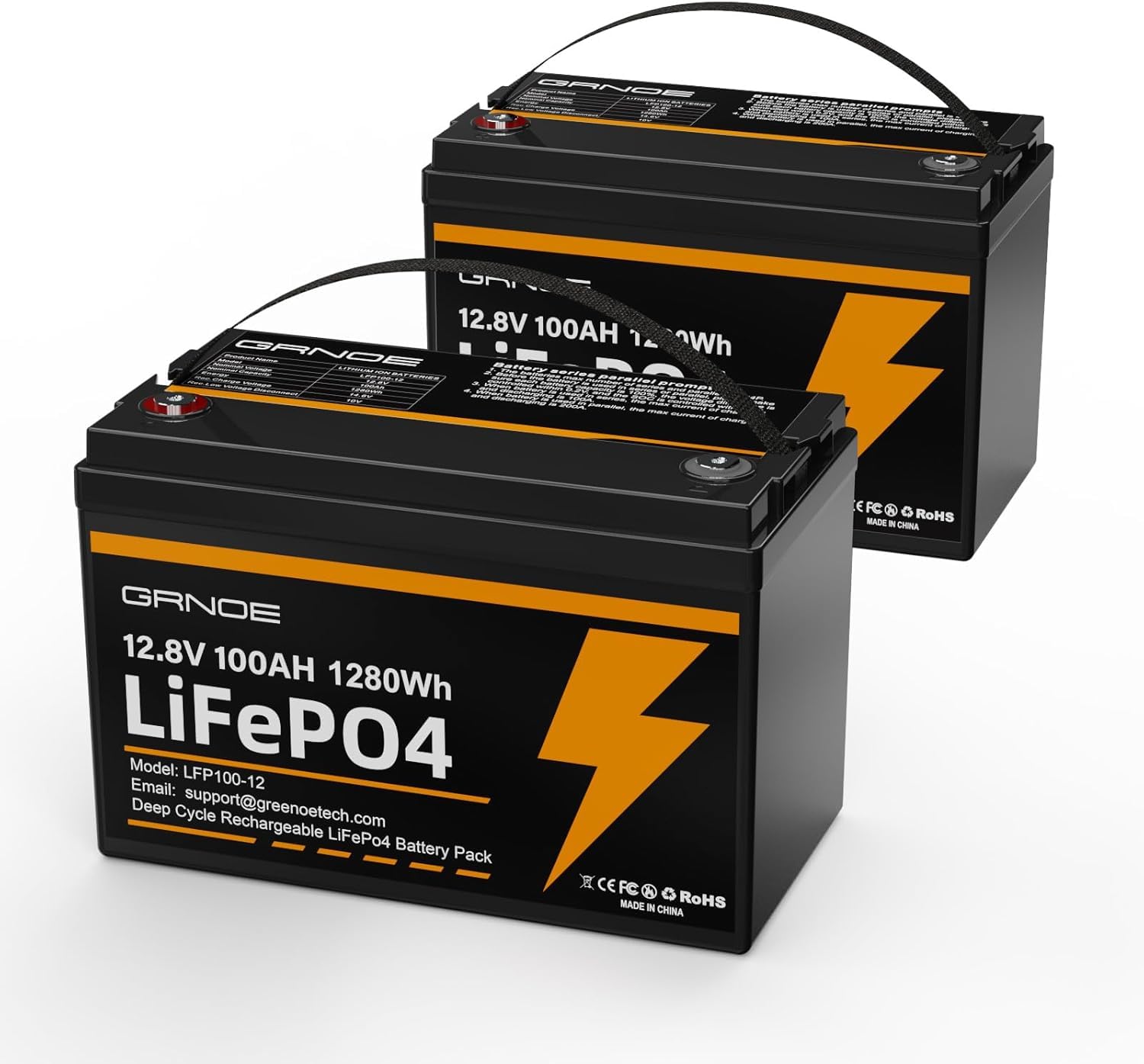
The GRNOE 2-pack gives you two 22.48-pound batteries that each weigh 22.48 lbs, so a pair totals 44.96 lbs, while a comparable lead-acid 100Ah battery weighs about 63.9 lbs.
The GRNOE 2-pack gives you two 12V 100Ah batteries with a 100A BMS each, plus low-temperature protection that cuts off charging below 32°F and allows discharge down to -4°F. Each battery measures 12.9 x 6.7 x 8.6 inches and uses A+ grade LiFePO4 cells, certified UL/UN38.3 (safety certifications for lithium batteries). The batteries support a max discharge current of 300A for 3 seconds, which is enough to start a 36-55lb trolling motor or run a large inverter for a few seconds. The pack also carries an IP65 waterproof rating, adding a layer of protection for marine or outdoor mounting.
Buyers on sailboats report these are “great value for 12v LifePO4 batteries” and note that they last “more than 5x of a deep-cycle AGM or flooded battery in terms of useful life AND in length of time power is supplied between charges.” However, one reviewer noted that one of their units failed after 1-5 uses and the manufacturer did not respond to support emails. The 3-year warranty from GRNOE covers human-caused failures, but support responsiveness appears to be a weak point.
Why you would buy this
- Two batteries give you 200Ah total, with the flexibility to split loads
- Low-temp charging protection (cutoff at 32°F) and IP65 water resistance
- Each battery is only 22.48 lbs, making installation manageable
The risk
- Mixed reviews on customer support responsiveness for warranty claims
- You need to manage two batteries instead of one—more wiring and space
Consider this if: you are building a 200Ah bank from scratch and want to split the weight for easier handling, plus you value IP65 protection for a boat or open-tray mount.
Look elsewhere if: you prefer a single battery for simplicity or if responsive customer support matters more to you than the lower upfront cost.
7. DUMFUME 12V 100Ah LiFePO4 Lithium Battery, Built-in 100A BMS Group 31

The DUMFUME 100Ah undercuts the market on price while keeping essential specs like a 100A BMS.
The DUMFUME 100Ah battery delivers 1,280Wh of energy in a size-reduced package (13 x 6.69 x 8.62 inches) that measures 13 x 6.69 x 8.62 inches, compared to typical Group 31 dimensions of 13 x 6.77 x 8.5 inches. It weighs 22.05 pounds—while a conventional 100Ah AGM battery weighs around 63.9 lbs. The built-in 100A BMS covers overcharging, over-discharging, short circuits, overheating, and overcurrent. The casing is made from high-strength, impact-resistant, heat-resistant ABS plastic, and the battery is dustproof and weather-resistant (though not waterproof). It supports series and parallel connections up to 4S4P for a 51.2V 400Ah system.
Buyers report that “it works great” as a low-price LiFePO4 battery, with one reviewer using four 100Ah units in a 48V solar setup to run mini-split air conditioners. However, one negative review notes a failure after three months of use (purchased in March 2026, failed by June 2026) with unhelpful seller support, so it is wise to check recent reviews before buying. The battery also requires a temperature of 5°C (41°F) or higher for charging, and the manufacturer does not cover return shipping for low-temperature charging issues.
The budget trade-off: DUMFUME brings the lowest entry price for a LiFePO4 battery with a 100A BMS, and the ABS casing feels durable. The risk is that quality control may vary, and the lack of low-temp protection (below 41°F) limits its use to warmer climates or heated compartments. For a summer-only RV or a solar setup in mild weather, it is a functional choice that frees up budget for other upgrades.
Buy this if: you are on a strict budget and camp only in mild seasons, or you need a test battery to learn the lithium ecosystem before investing in premium units.
Avoid it if: you need reliable winter performance or if you want a brand with a proven support track record—the reviews are split on long-term reliability.
Understanding the Specs
Amp-Hours (Ah)
This is the size of your energy tank. A 100Ah battery can theoretically deliver 100 amps for one hour, or 1 amp for 100 hours. In real life, your RV fridge draws about 2-5 amps per hour, your lights about 0.5-2 amps each, and a furnace fan about 4-8 amps. A 100Ah lithium battery gives you roughly 100Ah of usable energy, while a lead-acid of the same rating only gives you about 50Ah before voltage drops too low.
BMS (Battery Management System)
Think of the BMS as a smart bodyguard inside the battery that prevents you from destroying it by accident. It cuts off charging if the voltage goes too high (overcharge protection), stops discharging if the voltage gets too low (over-discharge protection), and shuts the battery down if it gets too hot or draws too much current. Some BMS units also include low-temperature charging protection, which is critical if you store your RV in sub-freezing conditions.
FAQ
How many amp-hours do I need for my RV?
Can I replace my lead-acid RV battery with a LiFePO4 directly?
What does “100A BMS” mean for my RV?
How long will a LiFePO4 RV battery last?
Is it safe to leave a LiFePO4 battery charging in freezing weather?
What is the difference between Group 24 and Group 31 batteries?
Can I connect two LiFePO4 batteries in parallel for more capacity?
Does the Bluetooth app really make a difference?
What does “15000+ cycles at 60% DOD” actually mean?
Will a 100Ah lithium battery run my RV air conditioner?
Final Thoughts: The Verdict
If you want one dependable pick, the deep cycle battery for rv winner is the HumsiENK 12V 150Ah because it packs 50% more usable capacity than a standard 100Ah unit in the same Group 31 footprint, plus Bluetooth monitoring for confidence. If you want the most reliable and proven 100Ah lithium