
Our readers keep the lights on and my garage snacks stocked. As an Amazon Associate, I earn from qualifying purchases.
Specs are compiled from manufacturer listings and verified buyer reviews and can change over time — please confirm the key details on the product page before buying.
Buying a dash cam should not mean signing up for another monthly bill. But many cameras lock recording features behind a subscription fee. The cameras on this page all record full-time with zero monthly charges. You pay once, and you own it.
I’m Min Islam, the writer behind Trending Car. This guide uses manufacturer specs and verified customer reviews. Every pick shows real strengths and trade-offs.
Whether you drive for a rideshare service, park on a busy street, or just want a silent witness on every commute, you need a dash cam without subscription that saves footage to a memory card you control and gives you a free app for wireless playback.
Our Picks at a Glance
How To Choose The Best Dash Cam Without Subscription
A subscription-free dash cam saves you from monthly bills, but the real work is finding one that records crisp footage in the moments that matter — day, night, parked, and on the highway. Here is what matters most when you compare them.
Resolution and the chip that powers it
A 4K front camera captures more detail — license plates, road signs — than a 1080p (standard high-definition) camera can from the same distance. But the sensor behind the lens matters even more. Sony STARVIS 2 sensors (like the IMX678 or IMX675) handle low light far better than generic sensors, keeping footage usable at dusk and in tunnels where cheaper cameras wash out.
Parking mode — what it takes to make it work
Most dash cams advertise 24-hour parking monitoring, but they need a hardwire kit (sold separately) to keep running after the car turns off. Without it, the camera shuts down with the engine. Time-lapse parking mode draws less power than constant recording, so your car battery does not drain overnight. If you park on the street, this feature is worth the extra install effort.
Storage and loop recording
Every camera here relies on a microSD card — no cloud, no monthly fee. Loop recording automatically overwrites the oldest clips when the card fills up, so you never have to manually delete. A G-sensor (a tiny motion sensor that detects a bump) locks the current clip so a collision or hard brake does not get erased. A bigger included card, like 64GB or 128GB, saves you the hassle and cost of buying one separately.
Quick Comparison
| Model | Best For | Front Resolution | Included Card | Field of View | Amazon |
|---|---|---|---|---|---|
| FAIMEE 4K+2K★ Best Overall | Budget Value & GPS | 4K | 64GB | 170° | Amazon |
| ROVE R2-4K Dual PROPremium Performer | Ultimate Clarity & Speed | 4K @30fps | 128GB | 150° Front | Amazon |
| AZDOME M550 Max | Full Triple Coverage | 4K | 64GB | 150° | Amazon |
| Coolcrazy 4K STARVIS | Smooth & Speedy 60fps | 4K @60fps | 128GB | 170° | Amazon |
| Yonvim 2.5K | Quick Install & Easy Use | 2.5K | 64GB | 160° | Amazon |
| 70mai T800E | Rideshare Driver Monitor | 4K HDR | 64GB | 166° | Amazon |
In‑Depth Reviews
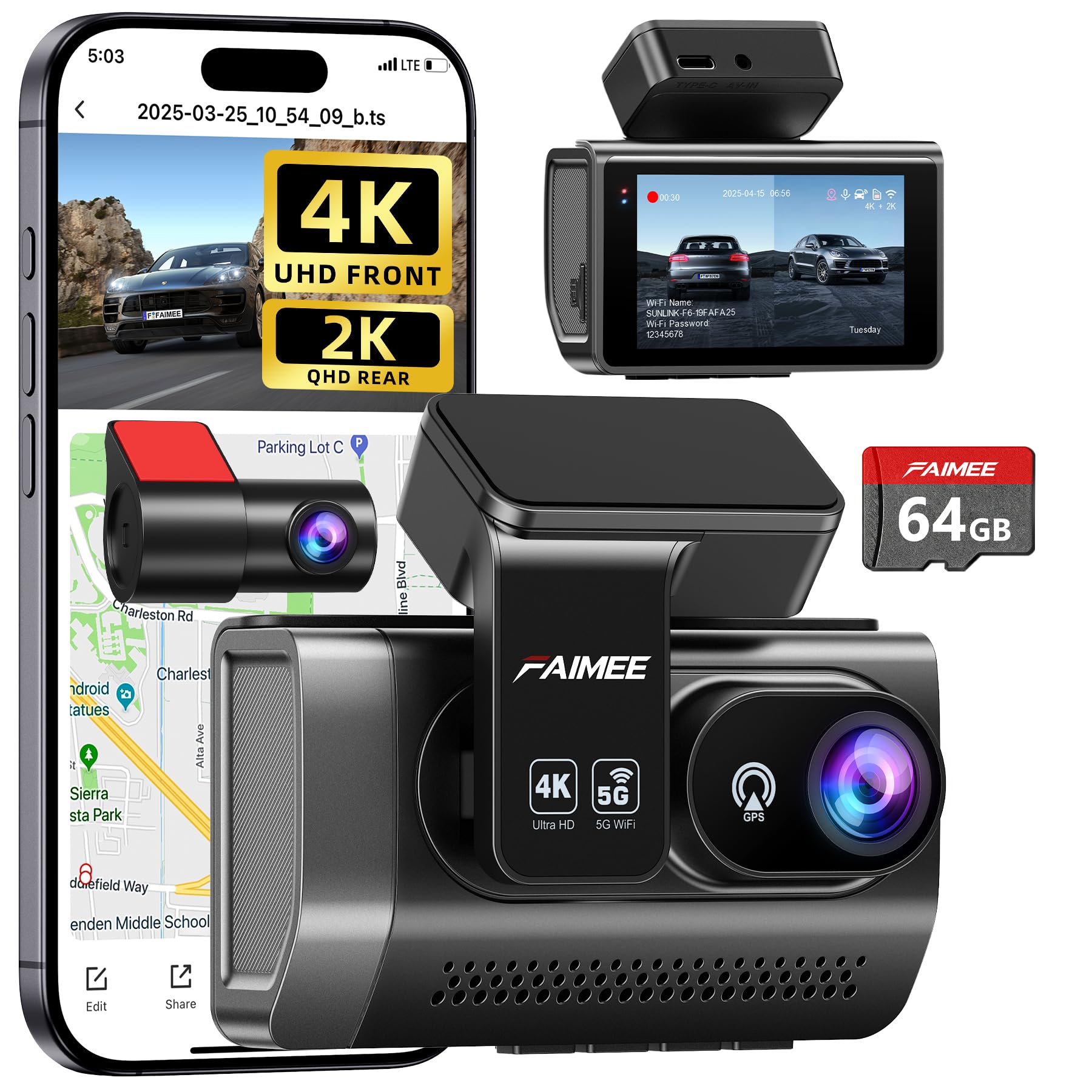
1. FAIMEE 4K+2K Dash Cam Front and Rear
Our pick — 4.5★ from 800+ verified ratings; the strongest balance of quality and price.
A budget-friendly dual-cam with built-in GPS and dual-band WiFi that undercuts pricier rivals on core essentials.
The FAIMEE records 4K (3840×2160P) on the front and 2K (2304×1296P) on the rear, which gives the rear camera a noticeable resolution edge over the 1080P rear you get on many budget models. The 170° wide-angle lenses cover about six lanes of traffic — wider than the 160° on the Yonvim and the same width as the Coolcrazy. Built-in GPS logs your speed, route, and location coordinates directly into the video file, so you have timestamped evidence for insurance claims without paying for a cloud subscription.
Unlike the Yonvim, where a buyer described the initial setup as confusing, multiple FAIMEE owners said installation was straightforward and the app connected easily once they remembered to join the camera’s own WiFi network rather than their home network. One buyer mentioned simply: “No battery issues in 3 days.” The 64GB card is a standard inclusion — half the capacity of the Coolcrazy’s 128GB — though the camera supports up to 256GB if you want to upgrade later. Loop recording and G-sensor collision lock work in the background automatically.
The dual-band WiFi (5.8GHz and 2.4GHz) means you get a faster, less-congested connection for live-view and downloads through the FAIMEE app, though shoppers say the camera body is a bit chunkier than some alternatives. The 18-month warranty and 24/7 support add confidence at this price tier. Just note that 24-hour parking monitoring still needs a hardwire kit not included in the box.
Highlights for the price
- Built-in GPS logs speed and route at no extra cost — rare at this price tier.
- 2K rear recording beats the 1080P rears on similarly priced competitors.
- Dual-band WiFi (5.8GHz/2.4GHz) gives a stable app connection.
Areas it cuts corners
- Included 64GB card, while the Coolcrazy includes a 128GB card.
- Camera body is bulkier — harder to hide behind the rearview mirror.
Smart budget choice: If you need GPS tracking in your footage but do not want to spend ROVE money, the FAIMEE gives you GPS, 2K rear, and a 170° view at a sharp entry price.
Look elsewhere if: you want the smoothest highway footage — the FAIMEE runs 30fps, not the 60fps the Coolcrazy offers for a small step up.
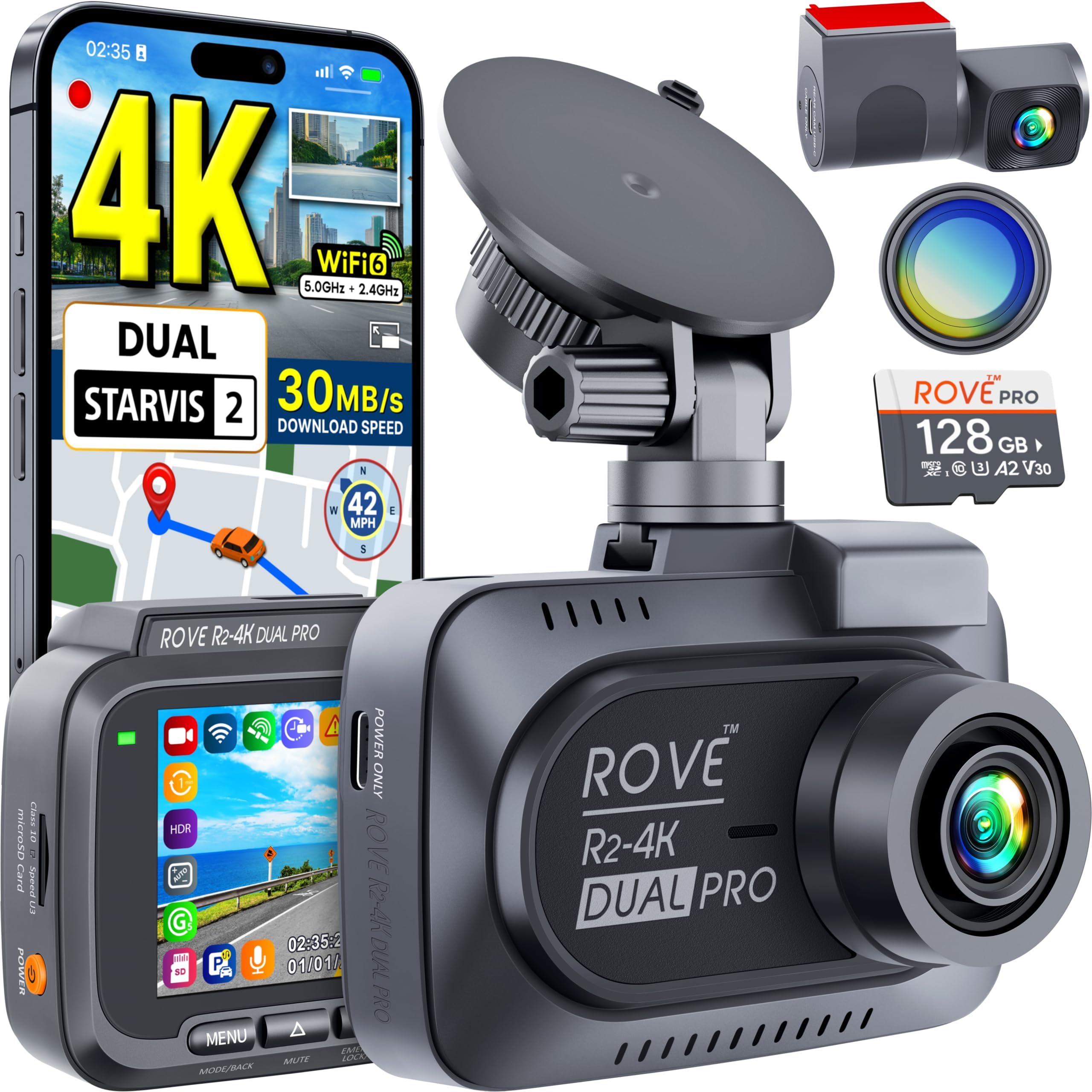
2. ROVE R2-4K Dual PRO Dash Cam
A top-tier dual-channel camera with Sony’s most advanced sensors that reads plates at dusk as clearly as at noon.
The ROVE is built for buyers who want the sharpest possible footage front and rear without ever touching a monthly bill. The front uses a Sony STARVIS 2 IMX678 sensor (an 8-megapixel chip that pulls in light like a night-vision goggle) and records 4K at 30fps, while the rear uses a IMX675 (5-megapixel) sensor for 2K at 30fps. Unlike the Coolcrazy which runs 4K at a higher 60fps on the front, the ROVE compensates with superior light sensitivity from its dual STARVIS 2 hardware — detail stays usable even in near-darkness.
You get a free 128GB ROVE PRO microSD card in the box and a CPL filter (a polarizing lens that cuts windshield glare from the dashboard). Buyers report the WiFi 6 connection transfers videos at up to 30MB/s, making phone downloads fast enough to share before you leave the parking lot. The built-in Quad-Mode GPS (compatible with GPS, BEIDOU, GALILEO, and GLONASS) stamps your speed and route on every clip, viewable on the free ROVE Dash Cam GPS Player software later.
The 24-hour parking mode offers three choices — time-lapse, motion detection, or collision detection — but you still need the separately sold hardwire kit to keep it powered with the engine off. At 150° front and 140° rear, the field of view is slightly narrower than the 170° offered by the Coolcrazy, though the trade-off is less fisheye distortion at the edges. One owner noted the app takes a bit of time to learn, but once set, owners mention the camera “starts reliably every time.”
What raises the bar
- Dual STARVIS 2 sensors (IMX678 + IMX675) deliver top-tier low-light clarity.
- Included 128GB card and CPL filter save you on extras.
- WiFi 6 reaches 30MB/s downloads—fastest wireless file transfer on this list.
Where it gives ground
- 150° front lens is narrower than the 170° budget alternatives.
- Parking hardwire kit sold separately; standard install requires a trip to the fuse box.
The sharp-shooter’s pick: If clear license plates at night are your top priority, and you are comfortable with a fuse-tap install, the ROVE R2-4K Dual PRO gives you the best sensor hardware and fastest WiFi in this lineup.
One catch: At roughly double the price of the Coolcrazy, you pay a premium for the STARVIS 2 sensors and the included 128GB card and CPL filter.
3. Coolcrazy 4K Dash Cam Front and Rear, STARVIS Sensor, Free 128GB Card
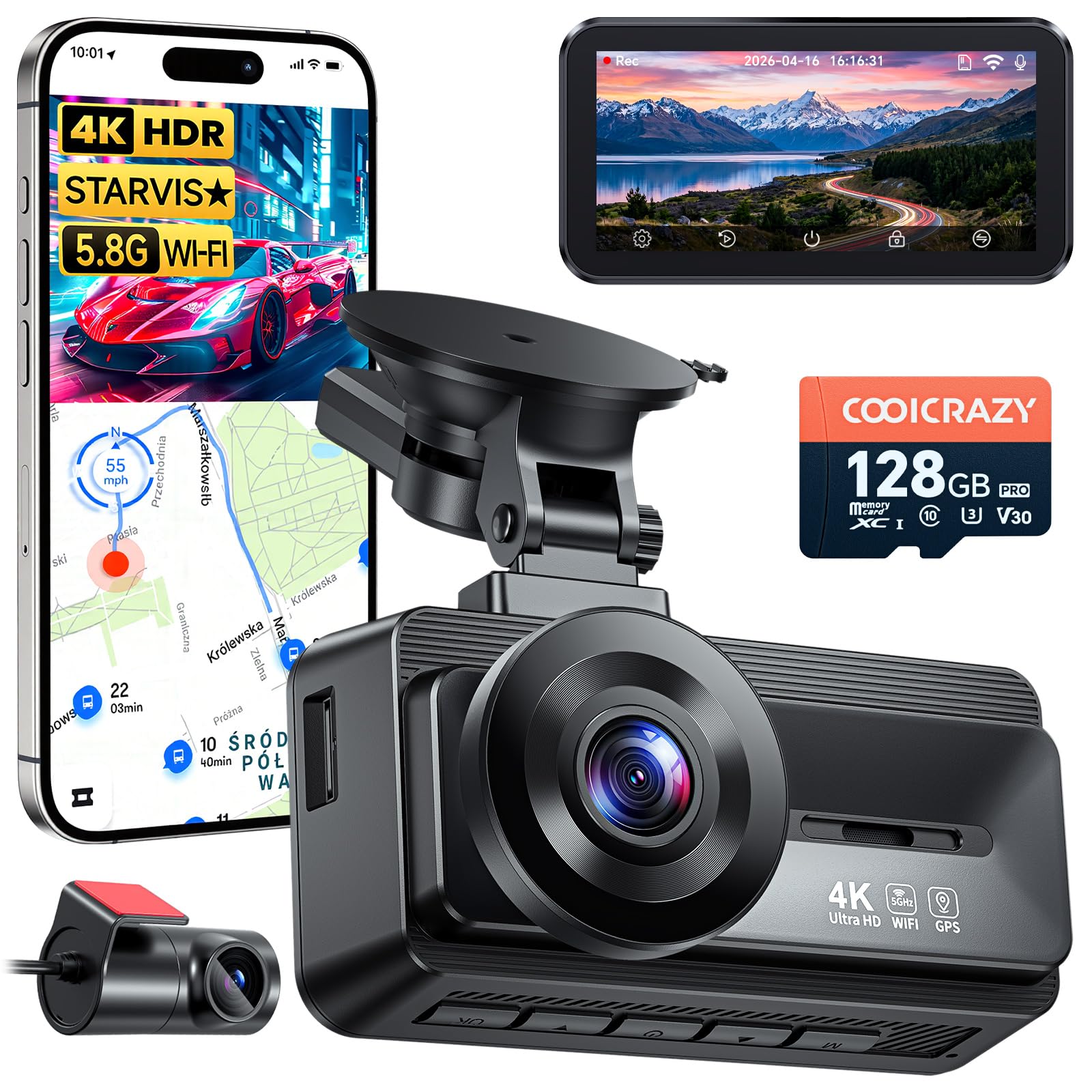
A 60fps front camera with a free 128GB card that captures smoother high-speed footage than anything near its price.
Coolcrazy hits the balance between specs and value by giving you 4K UHD on the front at 60fps, while the Yonvim records at 30fps. Higher frame rate matters on highways because each second has twice as many frames to freeze a plate at 70 mph, so moving objects look sharper in playback. The 170° front lens and 150° rear lens provide a wider field than the 160° Yonvim, which means better peripheral capture in intersections.
The free 128GB card (larger than the 64GB that comes with the FAIMEE or 70mai) means you can run dual recording for roughly twice as long before it loops over old clips. “I’ve had this dash cam for a while now, and I honestly love it,” one buyer wrote, specifically praising the 4K clarity on license plates and road signs both day and night. The built-in 5GHz WiFi supports downloads of 1-minute large videos to your phone. Customers note the sticky tape for the rear camera was the only weak point on two separate units, so you may want to use the included electrostatic sticker for a more secure bond.
The G-sensor locks clips on sudden impact, and the STARVIS sensor handles nighttime recording better than generic sensors. The price range puts it in the same tier as the FAIMEE, but with a faster frame rate and double the free storage — making it the strongest middle-ground pick.
Why it wins the middle ground
- 4K at 60fps is smoother than the 30fps most competitors deliver at this price.
- Comes with a 128GB card — double the included capacity of the FAIMEE and 70mai.
- 170° front lens gives one of the widest fields of view in this roundup.
Where it slips
- Rear camera tape failed for some buyers; aftermarket adhesive may be needed.
- Some owners found the 4K detail on distant plates slightly soft compared to the ROVE.
Best all-around pick: If you want 60fps 4K footage and a big 128GB card, the Coolcrazy is the strongest value-for-features option here.
Reach for the ROVE if: low-light plate capture is your make-or-break need — the ROVE’s STARVIS 2 sensors outclass the standard STARVIS in this unit.
4. AZDOME M550 Max 4K 3 Channel Dash Cam
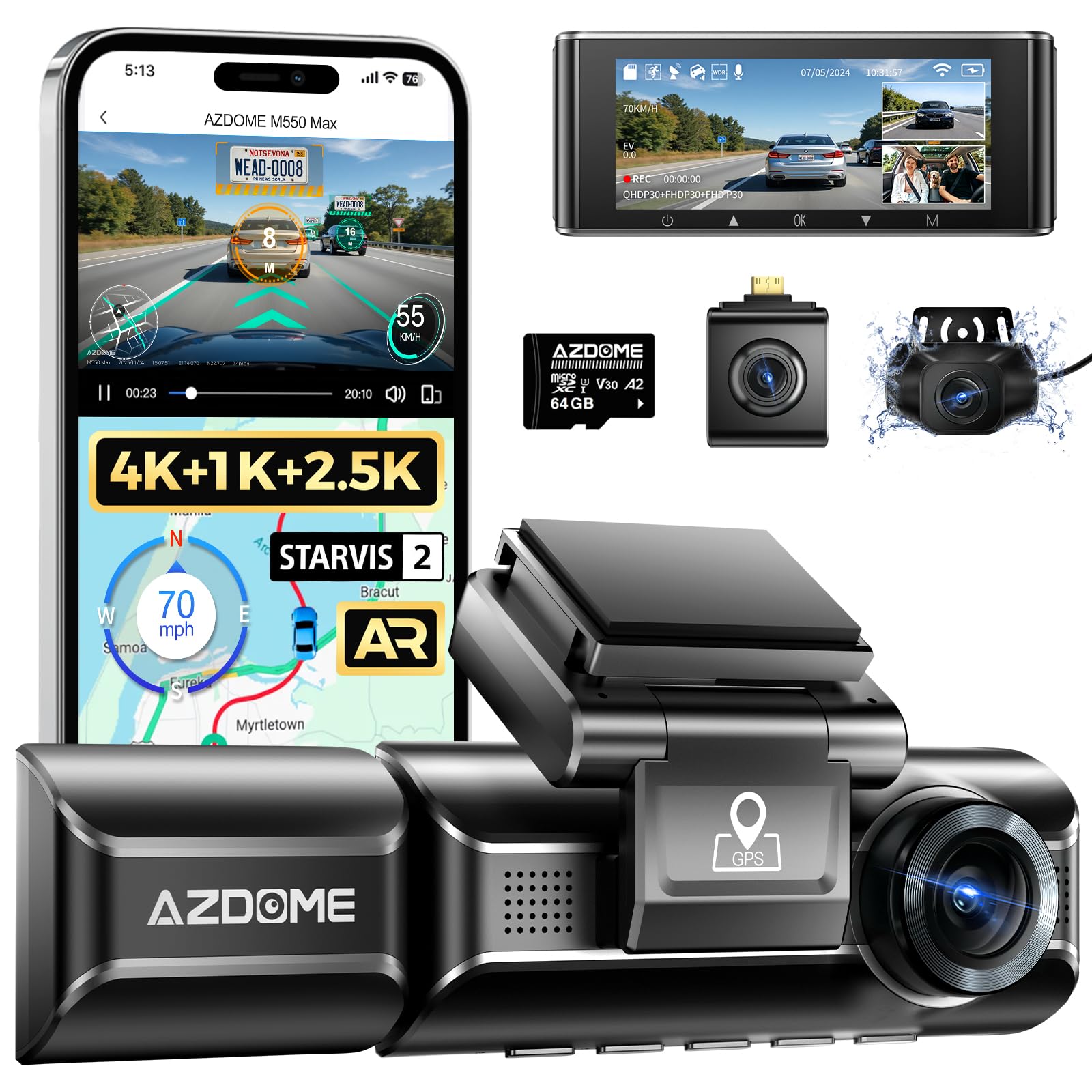
A triple-camera system (4K front / 2.5K rear / 1080P cabin) with IR night vision for full 360-degree surveillance.
The AZDOME M550 Max records your front view in 4K, the rear in 2.5K (sharper than the standard 1080P rear most cameras offer), and the cabin in 1080P with infrared night vision — so you can see inside the car even in pitch black. This makes the M550 Max a natural fit for rideshare drivers (Uber, Lyft, taxi) who need to document both the road and passenger behavior without a subscription. Unlike the FAIMEE, which uses a general sensor for night vision, the AZDOME packs dual STARVIS 2 sensors (IMX675 and IMX662) that keep footage cleaner at night and reduce motion blur when lighting shifts suddenly.
The included 64GB card is entry-level, but the camera supports up to 512GB — more than enough for a full shift of three-channel recording. A magnetic mount makes it easy to pop the camera off for overnight storage or switching vehicles. Reviewers point out customer service — one reviewer noted Melody — was exceptionally responsive, replacing a mounting part that fixed an angle issue. The rear camera is IP68-rated (dust- and waterproof), so it survives rain and car washes. A 24-hour parking mode is available but requires the separately sold hardwire kit.
At 150° field of view for the front, it is slightly narrower than the 170° on the Coolcrazy, but the trade-off is a more focused image with less barrel distortion at the edges. Some users found the AZDOME app a little buggy, though OTA updates have improved stability over time.
Strengths at a glance
- Triple-channel recording (4K front, 2.5K rear, 1080P cabin) gives coverage no dual-cam can match.
- Dual STARVIS 2 sensors deliver strong low-light performance across all three cameras.
- Magnetic mount and IP68 rear cam add versatility for multi-vehicle use.
Trade-offs to know
- 64GB card fills quickly with three cameras — plan to upgrade to a larger card.
- App interface feels less polished than the ROVE and 70mai apps according to some reviewers.
Perfect for rideshare drivers: The cabin IR camera and triple-channel recording give you the complete interior + road picture needed for passenger disputes.
skip it if: you only need front/rear coverage — you are paying for a cabin camera you never use, and the 64GB card runs short fast.
5. Yonvim 2.5K Front and Rear Dash Cam
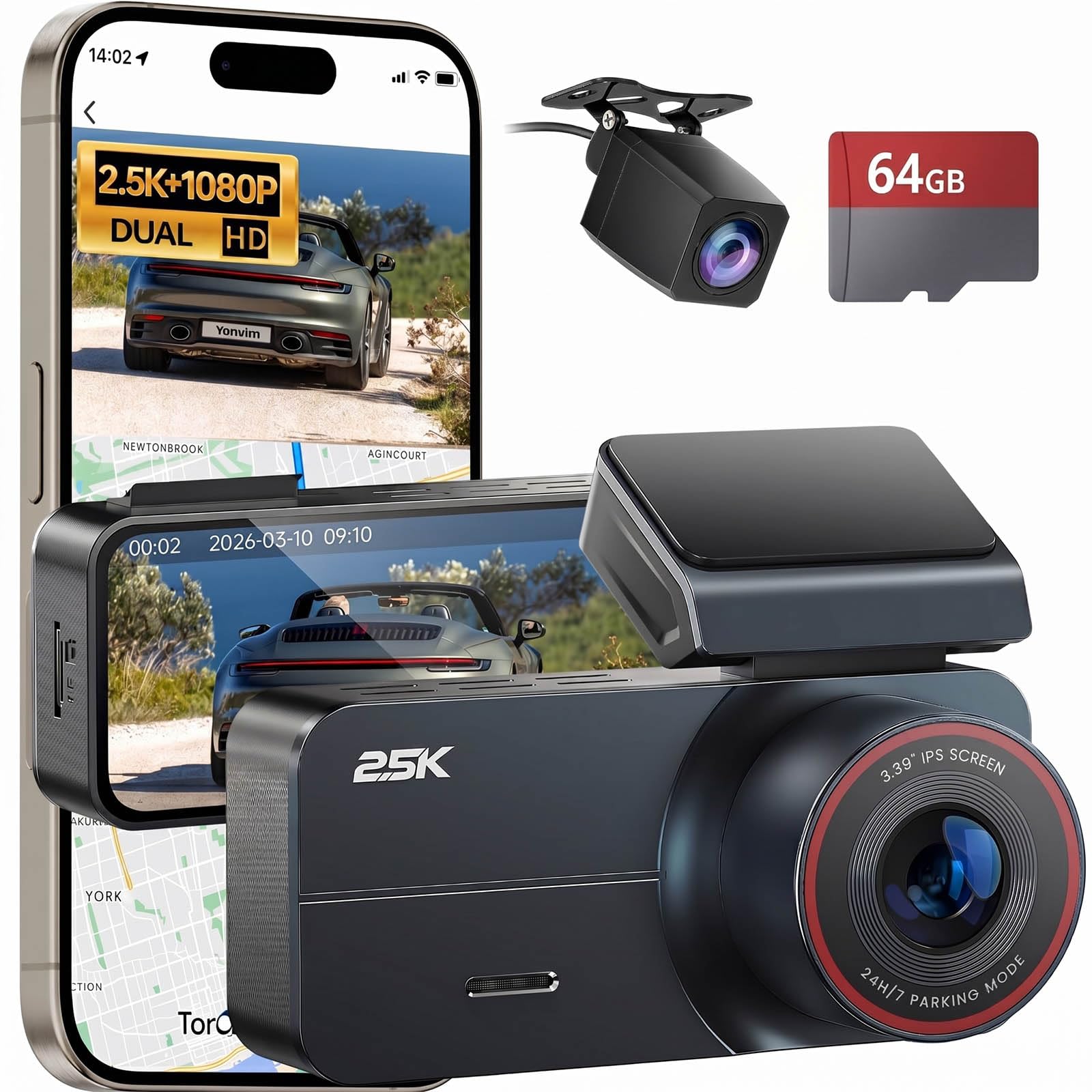
A walk-in-the-park install with a crisp 3.39-inch screen and usable night vision aimed at daily commuters.
If you want the absolute shortest route from unboxing to recording, the Yonvim stands out for its straightforward adhesive mount — one owner reported it gets you running in about 30 minutes. The 3.39-inch IPS display is the largest screen on this list — noticeably bigger than the 3-inch screen on the FAIMEE — so you can glance at a live view without needing the app. It records 2.5K on the front and a standard resolution on the rear at 30fps, which is enough detail for daily commutes but falls behind the 4K front of the Coolcrazy and the FAIMEE.
The F1.8 aperture (the lens opening that lets in light) paired with an 8-layer glass lens and WDR technology handles glare from headlights and streetlights well. Buyers described the night screen as “crisp.” One reviewer did flag a confusing initial setup — the micro USB cable, the 12V plug, and unclear SD card sizing (the unit shipped with 32GB instead of the advertised 64GB in some cases) — and noted the 45° tilt bracket and weak adhesive could be improved. The camera itself is lightweight and the app interface is simple enough for first-time users.
Loop recording and a G-sensor are included for automatic file management. Parking mode is advertised but the same hardwire kit caveat applies — you need the separately sold kit for it to run with the engine off. The Yonvim is a clean, no-surprises choice for someone who wants basic front/rear protection without the learning curve of multi-sensor systems.
What makes it easy
- Largest screen (3.39″ IPS) in this lineup makes playback and angle-checking simple without the app.
- Adhesive mount and clear instructions — many buyers report a 30-minute install.
- F1.8 aperture and 8-layer lens deliver genuinely usable low-light clips.
Things to watch
- Recorded at 2.5K front — less detail than the 4K from the Coolcrazy or FAIMEE.
- Some units shipped with 32GB instead of the advertised 64GB; the recording indicator is also hard to spot.
Best for the “just works” buyer: If you want a screen you can actually read without sunglasses and a setup that takes one YouTube video, the Yonvim delivers.
Not for you if: 4K front resolution is a dealbreaker, or you need GPS tracking in your footage — the Yonvim stamps speed and location but does not include route logging.
6. 70mai 4K Dash Cam Front and Interior
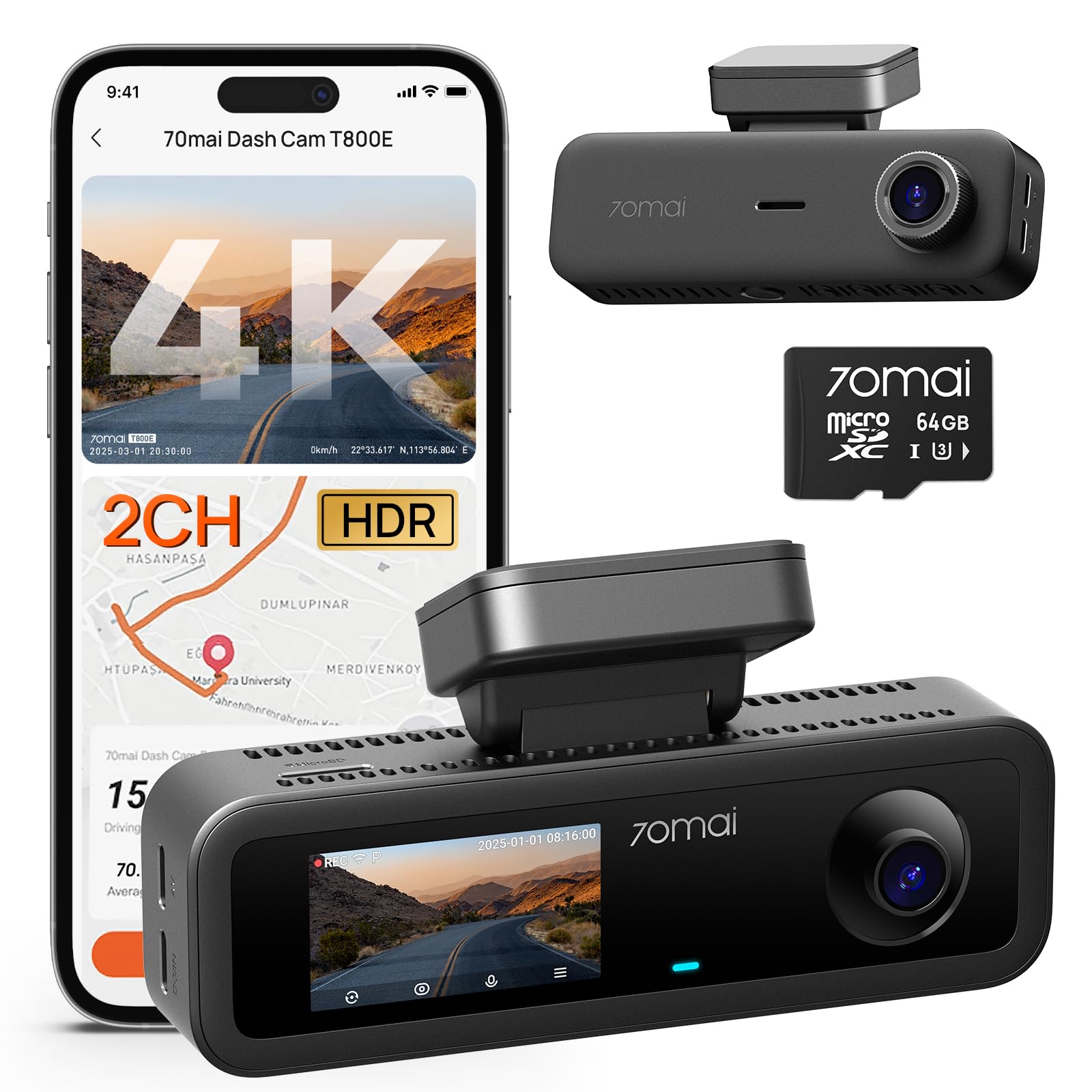
A front-and-interior dual-cam with Wi-Fi 6 and voice commands built specifically for rideshare drivers.
The 70mai T800E is not a typical front/rear camera — it pairs a 4K front lens with F1.55 aperture (a very wide opening that captures more light than the F1.8 used on the Yonvim) and a 1080P interior camera aimed at the cabin. That makes it a direct pick for Uber, Lyft, and taxi drivers who need to document passenger behavior along with the road. It does not include a rear window camera, so if you need rear coverage, you will need to pair it with a separate camera.
The MaiColor Vivid+ Solution and 70mai Night Owl Vision work together to keep footage accurate in tricky lighting — tunnels, dusk, garage exits — where other cameras wash out. Built-in Wi-Fi 6 provides faster connections than the 5.8GHz WiFi on the FAIMEE, and voice control lets you snap a photo or lock a clip hands-free while driving (though one customer observed voice commands did not work reliably). The included 64GB card is a standard start, but the camera supports up to 512GB, enough to store an entire week of driving. A heat-resistant supercapacitor instead of a battery makes it safer in hot cars.
The 24-hour smart parking surveillance uses time-lapse recording to save power, and the 18-month warranty covers the whole unit including the SD card — a nice touch. Owners mention the app is straightforward and the video quality is excellent, even at night, though file transfers over WiFi can be slow with high-resolution clips. One user highlighted the power cord is generously long for routing around the windshield.
Designed for the cabin
- 4K front + 1080P interior records both road and passenger area in one unit.
- Wi-Fi 6 gives a faster, more stable app connection than dual-band 5.8GHz models.
- F1.55 aperture is the widest lens opening in this roundup, maximizing low-light intake.
Where it comes up short
- No rear window camera — anyone needing rear coverage needs a separate add-on.
- 64GB fills in less than half a day with all cameras running; upgrading to a larger card is almost mandatory.
Made for rideshare pros: The interior camera and voice control directly address the documentation needs of Uber/Lyft drivers who want a single-device solution.
Pass if: you park on the street or need rear coverage — the 70mai lacks a rear cam, and the parking mode still needs a hardwire kit (available from 70mai’s service centers in New York and California).
Understanding the Specs
STARVIS vs STARVIS 2
A STARVIS sensor is Sony’s starlight technology — it captures usable color footage in very low light where older sensors would produce grainy black-and-white clips. STARVIS 2 (the IMX678 and IMX675 chips) is the second generation with even higher light sensitivity and less motion blur. If you drive at night frequently or park on dark streets, a STARVIS 2 camera like the ROVE or AZDOME preserves more detail in the shadows.
Frame Rate (fps)
FPS stands for frames per second — how many individual pictures the camera takes each second. 30fps is standard and smooth enough for city driving. 60fps (like the Coolcrazy front camera) captures twice as many frames per second, which means less motion blur on fast-moving vehicles and a better chance of freezing a license plate at highway speed. The trade-off is that 60fps footage takes up more space on the memory card.
FAQ
Do I need a subscription to use any of these dash cams?
What size memory card should I use for a 4K dash cam?
How does parking mode work without a subscription?
Can these dash cams record both front and rear at the same time?
How do I view footage on my phone without a monthly app fee?
What is the difference between 30fps and 60fps on a dash cam?
Will these dash cams work with my phone’s app for live viewing?
Do these dash cams record sound inside the car?
Can I install a dash cam without professional help?
What is a G-sensor and why does it matter?
Final Thoughts: The Verdict
For most people, the dash cam without subscription winner is the Coolcrazy 4K Dash Cam because it packs 4K at 60fps, a free 128GB card, and a 170° wide-angle lens at a mid-range price that undercuts the premium contenders. If you want the absolute best low-light performance and fastest WiFi downloads, grab the ROVE R2-4K Dual PRO. And for full coverage including cabin recording, the AZDOME M550 Max gives you every angle without a monthly fee.
How We Picked
We do not accept paid placement. Every pick is matched to a real buyer and a real use-case; we do not hands-on test units.
Sources & Methodology
Specifications: manufacturer listings and product documentation. Review insights: verified customer reviews, as of July 2026. Pricing: not shown on this page (it changes often); check the current price via the retailer link.
As an Amazon Associate, Trending Car earns from qualifying purchases. This does not affect which products we feature.