
Our readers keep the lights on and my garage snacks stocked. As an Amazon Associate, I earn from qualifying purchases.
Specs are compiled from manufacturer listings and verified buyer reviews and can change over time — please confirm the key details on the product page before buying.
Choosing a dash cam under $200 used to mean sacrificing night vision, rear coverage, or storage. That trade-off is gone. Today’s dual-lens models under $200 record crisp 4K front footage, monitor your parked car, and often include a memory card. Your only task is matching a model to your driving habits.
I’m Min Islam — the founder and writer behind Trending Car. This guide is built by comparing the manufacturers’ published specifications and the patterns across verified customer reviews, so you get each pick’s real strengths and trade-offs instead of marketing spin.
From 170-degree lenses to GPS speed stamps, the best sub-$200 dash cams deliver evidence-grade clarity for accidents and commutes.
Our Picks at a Glance
How To Choose The Best Dash Cam Under $200
A few key specs separate a reliable witness from a frustrating gadget. You need a camera that reads plates at night, survives windshield heat, and transfers clips quickly. Here are the specs that matter most in this price range.
Resolution: Front 4K vs 2.5K
A 4K front camera (3840x2160P) gives you the sharpest detail — think readable signs far down the highway. A 2.5K (2560x1440P) front camera is still very good and often smoother at higher frame rates. The rear camera matters too; 1080P full HD in the back is the standard you want to see for capturing someone hitting you from behind.
Night Vision and Aperture
Most accidents and hit-and-runs happen in low light, so this is the spec to obsess over. The aperture number (F1.5, F1.6, F1.8) tells you how much light the lens lets in — the lower the number, the better the night performance. A STARVIS or STARVIS 2 sensor is a Sony image chip designed specifically to perform in the dark, and it is a major reason footage stays usable after sunset.
Storage and Loop Recording
Loop recording automatically overwrites the oldest files when the card fills up, so you never have to manually delete anything. Check whether a memory card ships in the box — several strong picks here include a 128GB card, which saves you a separate purchase. Look for support up to 256GB or 512GB if you want long trips covered.
Parking Mode
Parking mode keeps the camera on guard while you are away, using time-lapse, motion detection, or collision detection to capture bumps and vandalism. The catch: this feature almost always requires a separate hardwire kit to draw power from your car’s fuse box. Many owners skip the hardwire and simply keep the camera plugged into the cigarette lighter.
Quick Comparison
| Model | Best For | Front Resolution | Field of View | Max Card Support | Amazon |
|---|---|---|---|---|---|
| 70mai A410★ Best Overall | Best Overall Value | 2.5K (2560x1440P) | 125° | 256 GB | Amazon |
| Coolcrazy 4KSmooth Motion Pick | High Frame Rate | 4K UHD | 170° | 256 GB | Amazon |
| 70mai A800SE | Wi-Fi 6 Speed | 4K | 140° | 512 GB | Amazon |
| TERUNSOUl 3-Channel | Cabin Coverage | 4K | 170° | 512 GB | Amazon |
| COOAU D20S | Rideshare Drivers | 4K/2.5K | 170° | 256 GB | Amazon |
| ROVE R2-4K | Proven Reliability | 4K (3840x2160P) | 150° | 1 TB | Amazon |
| REDTIGER F7N Touch | Touch Screen Control | 4K UHD | 170° | 128 GB | Amazon |
In‑Depth Reviews
1. 70mai Dash Cam A410
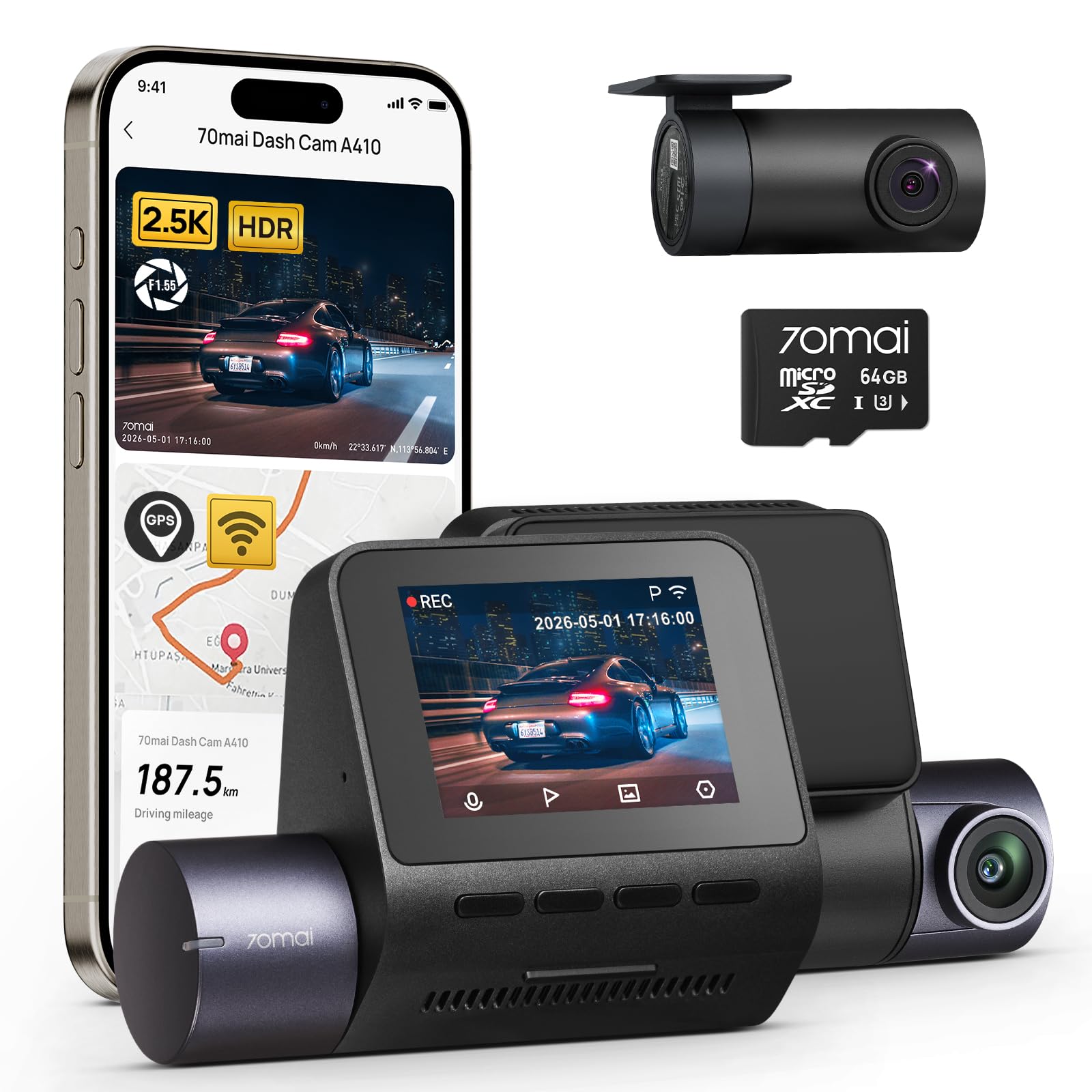
The complete package that nails the essentials: sharp dual video, GPS, and a free 64GB card.
The 70mai A410 opens with the spec that wins people over — camera quality, with 35 owners singling it out. It pairs a 2.5K (2560x1440P) front camera with a 1080P rear unit, capturing license plates and road signs clearly both day and night. The 125-degree wide-angle lens still covers four lanes of traffic, which is plenty for most everyday commutes.
Installation is genuinely painless, which 24 buyers call out. The electrostatic sticker holds firmly without sticky residue, and buyers report being set up in under five minutes. The 64GB card ships in the box, so you can start recording immediately, and you can expand up to 256GB if you want longer road-trip coverage. The G-sensor locks footage on impact, and the emergency button freezes a clip on demand.
The A410 records at 30 fps, while the Coolcrazy above shoots 4K at 60 fps — a 2.0x frame-rate gap that matters if you drive fast and want the smoothest motion. The A410’s edge is its reliability and value: owners who have bought multiple 70mai units call the build durable and note the internal battery lasts 1.5-2 years with easy DIY replacement. The trade-off is connectivity: some owners mention finicky app pairing, so budget patience.
Why Owners Stick With It
- Sharp 2.5K front and 1080P rear video quality praised by the most owners
- True plug-and-play: electrostatic mount, free 64GB card, and setup under 5 minutes
- Built-in GPS stamps coordinates, speed, and time onto footage for court-admissible evidence
Where It Tests Patience
- App connectivity gets mixed reviews — some owners struggle to pair reliably
- 30 fps front frame rate is smoother on rivals like the Coolcrazy’s 60 fps
Reach for this if: you want the most complete, fuss-free dash cam package under $200 — clear dual video, GPS, and a memory card all in one box.
Look elsewhere if: you drive at high speeds and demand the buttery-smooth motion that only a 60 fps camera delivers.
2. Coolcrazy 4K Dash Cam
The speed demon of the list — 60 fps 4K footage that stays sharp when you are cruising.
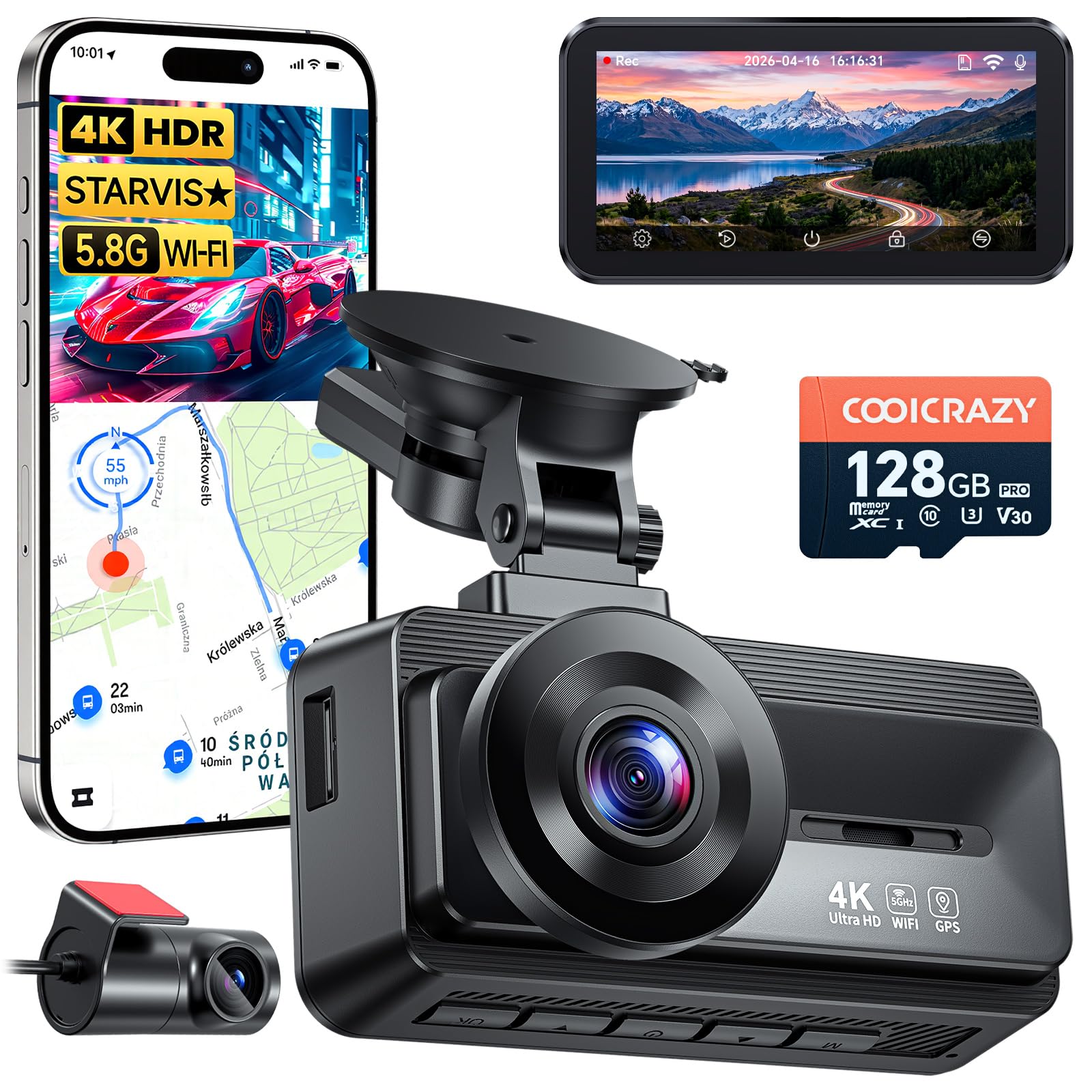
The Coolcrazy is built for drivers who want the widest, fastest view of the road. Its front camera shoots true 4K UHD at 60 fps, which means smooth, detailed footage even at highway speeds. The 170-degree front and 150-degree rear ultra-wide lenses capture far more of your surroundings than the 125-degree view on the 70mai A410 — a 36% wider angle that nearly eliminates blind spots at your front corners.
Customers note this is a great value 4K dash cam with clear day and night video, crisp audio, easy setup, and a reliable app. The 128GB memory card is preinstalled, and a strong suction cup makes it a favorite for rental cars since you can pop it off to prevent theft. The STARVIS starlight sensor and large-aperture WDR cut glare from oncoming headlights while boosting dark-area detail on rainy nights and in tunnels.
The trade-offs are minor but real: a sluggish app and unclear manual. The mobile app gets called sluggish by some owners, and the printed instructions could be clearer. None of that stops owners from recommending it for everyday use — and for rideshare or rental situations where the removable mount is a genuine advantage.
Why It Feels Fast
- 4K UHD front footage at 60 fps — double the frame rate of the 70mai A410’s 30 fps
- 170° front lens is one of the widest views here, covering nearly your whole front corners
- 128GB card preinstalled so it records right from the start
The Small Gripes
- Mobile app feels sluggish to some owners, and the manual is not the clearest
- Suction cup mount is removable for theft-proofing, but less permanent than an adhesive sticker
Pick it for: highway drivers and rental-car users who value the widest field of view and the smoothest 60 fps motion.
Think twice if: you dislike dealing with a slightly clunky app for adjusting settings or downloading clips.
3. 70mai 4K Dash Cam A800SE
The future-proofed 70mai with Wi-Fi 6 transfer speeds up to 5 times faster than standard.
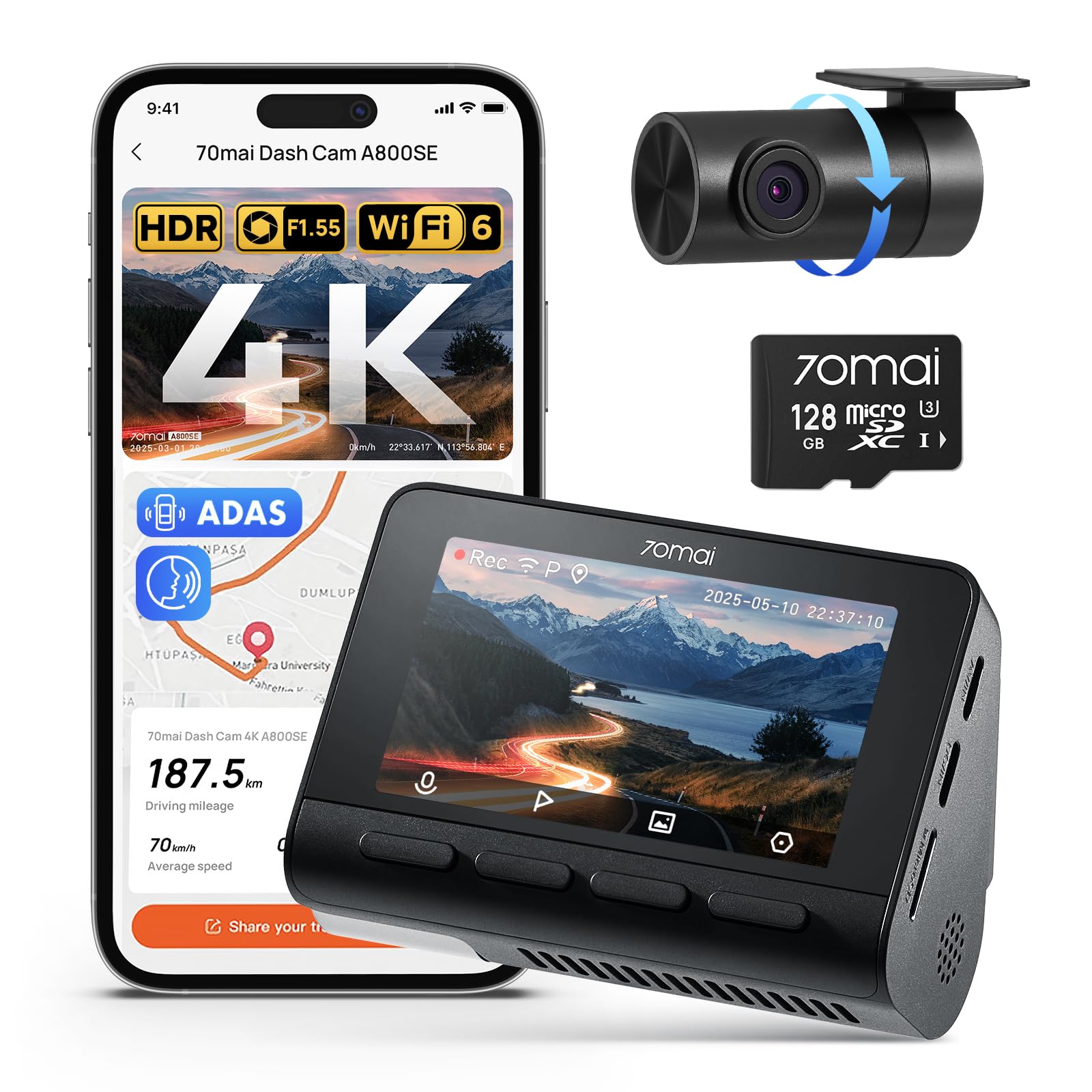
The A800SE takes 70mai’s proven formula and adds speed where it counts: getting footage off the camera. Built-in Wi-Fi 6 transfers videos up to 5x faster than traditional Wi-Fi dash cams, so downloading a clip to your phone for an insurance claim takes seconds instead of minutes. It records 4K in front with a 1080P rear camera, and the rear lens is adjustable so you can point it into the cabin or behind the vehicle.
Night performance leans on a 7-layer glass lens with an F1.55 large aperture and Dual HDR — owners consistently praise the 4K clarity, with quality being the most-mentioned positive at 83 mentions. The 128GB card is free in the box, and support extends to 512GB if you want a week’s worth of loop footage. It adds ADAS, an advanced driving-assistance system that gives real-time voice alerts for lane departure and forward collisions, plus OTA updates to keep the software fresh.
The honest caveat: the rear camera struggles in very low light — owners with dark window tint report the back footage goes black at night. The front stays sharp, and for most buyers the value is exceptional, but if you rely on rear night footage, this may not be your pick.
Why it is popular: Quality is the top-mentioned aspect at 83 counts, and owners repeatedly buy a second unit for another vehicle — the reliability and app experience keep them coming back.
Fair warning: The rear camera’s low-light performance is the recurring weakness, especially behind dark tint.
Best suited to: tech-savvy owners who want fast phone downloads, ADAS safety alerts, and the flexibility of an adjustable rear lens.
Make sure you know: with heavy window tint, the rear camera’s night footage can come out black — a non-issue for front-focused drivers.
4. TERUNSOUl 3-Channel 4K Dash Cam
The only triple-channel pick here — front, rear, and cabin all recording in crisp detail.
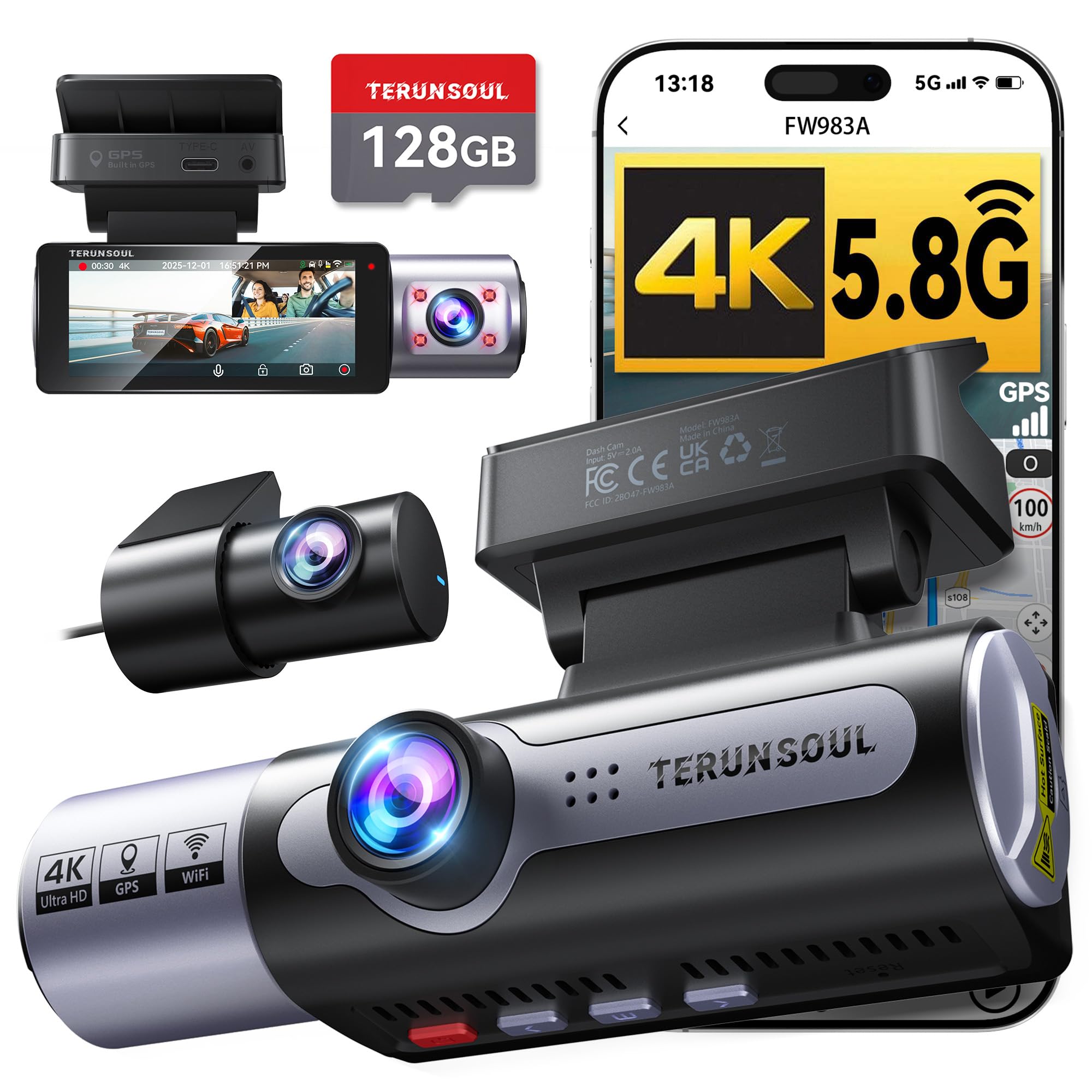
The TERUNSOUl is the choice for rideshare drivers and families who want eyes inside the car, not just on the road. It records three channels simultaneously: 4K front, 1080P rear, and a 1080P cabin camera. The front lens offers a 170-degree ultra-wide angle while the rear and cabin each bring a 165-degree view, delivering near-360-degree panoramic coverage of your vehicle.
You get sharp video around the clock, according to owners, and one buyer says the 3-channel coverage (three cameras recording at once) brings real confidence. The starlight-grade five-layer lens with an ultra-large F1.6 aperture (a wide opening that lets in more light) uses HDR (high dynamic range, which balances bright and dark areas) to keep details visible in low light, so number plates stay readable at night. A 128GB card is preinstalled, and the built-in G-sensor (a small motion sensor that detects a bump) locks footage automatically on severe impact, protecting evidence in a crash. At 250 grams it is compact and unobstructive, and the 5.8GHz WiFi along with the 2.4GHz band gives you fast app downloads at up to 20MB/s, so you can pull clips to your phone quickly.
One practical note: a separate hardwire kit is required for the 24H parking mode. The built-in GPS embeds route, speed, location, and a compass timestamp directly into the video, viewable on a free GPS player for Windows and Mac.
The All-Around Guard
- Three channels — front, rear, and cabin — give near 360° coverage for rideshare or family cars
- Starlight-grade lens with F1.6 aperture keeps night footage usable in low light
- 5.8GHz WiFi downloads at up to 20MB/s, and the 128GB card is included
Know Before You Buy
- Parking mode needs a separate hardwire kit — it does not run off the standard 12V plug
- Cabin camera could be a privacy consideration for passengers
Grab it if: you drive for Uber, Lyft, or a taxi and need to document both the road and the cabin for passenger safety.
skip it if: cabin recording is not something you need — the extra channel adds setup complexity you will not use.
5. COOAU 4K Dual Dash Cam D20S

The infrared cabin cam that keeps recording even in complete darkness for rideshare pros.
The COOAU D20S is built for professional drivers who need to record both the road and their passengers. Its 4K front camera captures 6-8 lanes of traffic, while a second camera points inside the cabin. what separates it is infrared night vision — four IR lights with wide F1.6 front and F1.8 inside apertures (openings that let in more light) let it record in complete darkness, which is ideal for Uber, Lyft, and taxi drivers working late shifts. The inside camera sees through the rear side window, giving you a view of what is happening behind the car too, so you can spot tailgaters or incidents from the rear.
The design is built for all-weather durability, with dual supercapacitors handling temperatures from -4°F to 158°F. Owners note the build feels premium and the front 2K footage is crisp, while the cabin 1080P view handles night duty well. The 1.5-inch mini display keeps the unit compact enough not to block your view. It records 2.5K+1080P with a 170°+150° wide-angle view, and supports up to 256GB cards — though the card is not included, so factor that into your budget.
The honest trade-offs: some reviewers point out the video download app can be confusing, and one found the claimed 4K front resolution actually captured at 2.5K. Parking mode also requires a hardwire kit — it will not run reliably off a battery pack. For the money, though, it remains a solid value for anyone who needs cabin documentation.
What makes it special: The 4 IR lights deliver true infrared cabin recording in zero light — the only camera on this list you can rely on in a pitch-black car.
Set expectations: The memory card is not included, and parking mode demands a hardwire kit to function properly.
Choose this for: rideshare and fleet drivers who need documented cabin footage even in total darkness.
Reconsider if: you want a fully out-of-box kit without buying a memory card separately.
6. ROVE R2-4K Dual Dash Cam

The crowd favorite with a SONY STARVIS 2 sensor and massive support for 1TB cards.
The ROVE R2-4K is the most proven dual cam here, trusted by a huge base of owners for its day-and-night clarity. Its front camera runs a SONY IMX675 STARVIS 2 image sensor — the gold standard for low-light dash cam performance — paired with an F1.5 aperture front and F1.8 rear lens. The front records at 3840x2160P @30fps with a 150-degree ultra-wide angle, while the rear captures 1920x1080P @30fps at 140 degrees.
What makes the ROVE stand out is its upgrade path. It supports microSD cards up to 1TB, so you can keep weeks of footage without touching the included free 128GB card. The built-in supercapacitor keeps recording briefly after shutdown — a durability feature that handles extreme heat far better than a lithium battery. The 5.8GHz WiFi downloads clips at up to 20MB/s, and the free GPS Player for PC and Mac lets you review routes with embedded location and speed data.
Buyers praise the intuitive app and the user guide with color photos. Some shoppers say occasional firmware quirks, but the support team has a reputation for prompt, professional fixes — even replacing a failed unit out of warranty. The 24-hour parking mode requires a separate hardwire kit, and the suction mount is solid but bulkier than a low-profile adhesive.
Why It Wins Loyalty
- SONY STARVIS 2 sensor with F1.5 aperture delivers exceptional night clarity
- Supports up to 1TB microSD — more storage headroom than any other pick here
- Supercapacitor design survives extreme interior heat better than battery units
Where It Falls Short
- Parking mode needs the separate hardwire kit to work at all
- Front field of view at 150° is slightly narrower than the 170° leaders
Reach for this if: you want the most trusted, reliable dual-cam setup with the best low-light sensor you can get under $200.
Look elsewhere if: you expect parking mode to work straight from the box without buying a hardwire kit.
7. REDTIGER F7N Touch
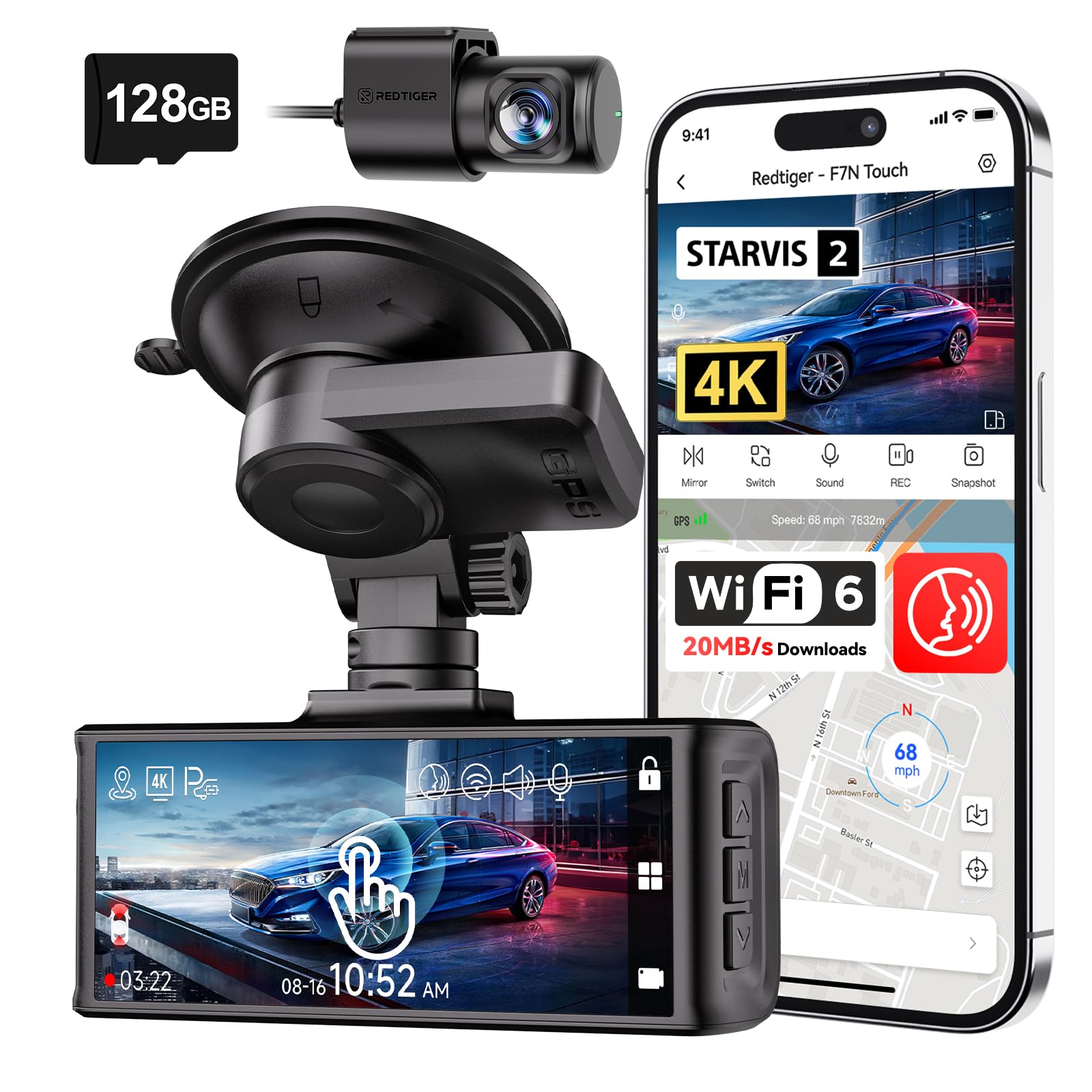
The hands-free operator — voice commands and a touch screen keep your eyes on the road.
The REDTIGER F7N Touch is the most modern-feeling camera on this list. It replaces fiddly buttons with a smart touch screen and adds voice control, so you can lock emergency video or snap a scenic still without taking your hands off the wheel. Quality is the top mentioned positive at 633 counts, and ease of installation follows at 445 — owners find the suction cup mount and included pry tool make setup straightforward.
Image quality is anchored by a STARVIS 2 sensor on the front camera with a 170-degree wide-angle view, recording true 4K UHD. The rear camera captures 1080P FHD at 140 degrees. WDR and HDR technology boost night visibility, and the included 128GB card means endless loop recording right away. Built-in GPS records location, speed, and route directly into the footage, and the 5.8GHz WiFi app downloads at up to 20MB/s.
The caveats are heat-related. One owner in Arizona warns about using it in warmer weather, noting the memory card can struggle in extreme interior temperatures. Time-lapse parking mode also chews through the 128GB card in about two days — many owners switch to G-sensor mode to stretch storage. The 18-month guarantee and responsive 24/7 support do soften these concerns, and owners who had units fail early got free replacements quickly.
Why buyers love it: The voice control and touch screen are the standout features — owners call it a great unit for the price with a 4K front and 1080P rear where “you don’t miss a thing.”
Heads up: Extreme heat can stress the SIM card, and time-lapse parking mode fills a 128GB card in about two days.
Best for: drivers who want modern convenience — touch controls, voice commands, and a big dose of 4K clarity in one unit.
Fair warning: if you park in brutal summer heat, you may want to unplug it when the car sits for days.
Understanding the Specs
Frame Rate and Resolution
Frame rate, measured in fps (frames per second), controls how smooth your footage looks. A 60 fps camera like the Coolcrazy captures twice the frames of a 30 fps unit like the 70mai A410, meaning less motion blur when you are driving fast or passing another car. Resolution decides detail — 4K (3840x2160P) shows more fine detail than 2.5K (2560x1440P), which matters for reading distant license plates.
Field of View
The field of view, measured in degrees, sets how wide your camera sees. A 170-degree lens like the Coolcrazy or TERUNSOUl captures a much broader scene than a 125-degree lens on the 70mai A410 — a 36% wider angle. Wider views cover more of your front corners, but they can slightly distort objects at the edges. For city driving with side-street surprises, wider is usually better.
FAQ
Will a dash cam under $200 work with my car model?
Do I need a hardwire kit for parking mode?
Is a 4K front camera worth it over a 2.5K camera?
How long does a dash cam battery last?
What size memory card do I need?
Can I view footage on my phone without removing the card?
Will a dash cam drain my car battery?
How do G-sensor and loop recording work together?
Final Thoughts: The Verdict
For most buyers, the dash cam under $200 winner is the 70mai A410 because it pairs sharp 2.5K front and 1080P rear video with built-in GPS and a free 64GB card at a price that undercuts the field. If you want silky 60 fps motion and the widest 170-degree view, the Coolcrazy 4K is the one to grab. And for rideshare drivers who need cabin coverage in the dark, the TERUNSOUl 3-Channel or the COOAU with infrared night vision is the smart professional choice.
How We Picked
We do not accept paid placement. Every pick is matched to a real buyer and a real use-case; we do not hands-on test units.
Sources & Methodology
Specifications: manufacturer listings and product documentation. Review insights: verified customer reviews, as of August 2026. Pricing: not shown on this page (it changes often); check the current price via the retailer link.
As an Amazon Associate, Trending Car earns from qualifying purchases. This does not affect which products we feature.