
Our readers keep the lights on and my garage snacks stocked. As an Amazon Associate, I earn from qualifying purchases.
Specs are compiled from manufacturer listings and verified buyer reviews and can change over time — please confirm the key details on the product page before buying.
Loop recording is the reason a dash cam can run nonstop without you ever touching a memory card — it overwrites the oldest footage so the newest moments always have a home. The real question is which camera keeps those newest moments sharp enough to read a license plate, both day and night, without dropping the connection when you need it most. This guide sorts through the front-and-rear field, weighs the tech that actually matters, and lands on the picks that earn their spot on your windshield.
I’m Min Islam — the founder and writer behind Trending Car. This guide is built by comparing the manufacturers’ published specifications and the patterns across verified customer reviews, so you get each pick’s real strengths and trade-offs instead of marketing spin.
Whether you commute daily or drive for work, a dash cam with loop recording acts as your reliable witness on the road. dash cam loop recording is the feature that keeps your evidence safe and your driving stress-free.
Our Picks at a Glance
How To Choose The Best Dash Cam Loop Recording
Every dash cam here loops recordings, but the way they handle that loop — and what happens to the footage before it gets overwritten — is where the real differences live. Start with your nightly driving habits, then match the camera’s sensor and aperture to that reality.
Loop Recording and the G-Sensor Safety Net
Loop recording alone just means the card never fills up. The crucial partner is the G-sensor (a small motion sensor that detects a bump or sudden braking). When it feels an impact, it locks that clip into a protected folder so the loop won’t overwrite your evidence. If you park in shared lots or busy streets, a camera with reliable collision detection matters far more than a slightly higher resolution.
Front Resolution: Upscaled vs. Native
Some cameras advertise 4K but actually capture at 2.5K (QHD) and upscale it, while others record native 4K (3840×2160P). The upscaled route still shows more everyday detail than a plain 1080P cam, so it’s a fair trade if the price is right. If reading plates from a distance is your top priority, native 4K with a wide aperture gives you the best chance.
Night Vision: Sensor and Aperture
Low-light performance is decided by the image sensor and the aperture (how wide the lens opens). A Sony STARVIS 2 sensor paired with an F1.5 or F1.55 aperture pulls in noticeably more light than older sensors. If you drive at dawn, dusk, or through tunnels, this combination is what separates a readable plate from a blur.
Parking Mode and the Hardwire Kit Reality
Most cameras advertise 24-hour parking monitoring, but almost all of them need a hardwire kit (a cable that taps your fuse box) that you buy separately. Without it, the camera powers down with the engine. Factor that extra cost and install effort into your decision if overnight protection matters to you.
Quick Comparison
| Model | Best For | Front Resolution | Field of View | Max Card Size | Amazon |
|---|---|---|---|---|---|
| ROVE R2-4K★ Best Overall | Overall reliability and value | 4K Upscaled (2.5K native) | 150 degrees | 1 TB | Amazon |
| Yonvim 2.5KBudget Champion | Budget-friendly entry point | 2.5K | 160 degrees | 64 GB | Amazon |
| 70mai A410Top Performer | Balanced dual-cam value | 2.5K | 125 degrees | 256 GB | Amazon |
| FAIMEE 4K | Wide-angle 4K coverage | 4K UHD | 170 degrees | 256 GB | Amazon |
| 70mai A800SE | Fast Wi-Fi 6 transfers | 4K | 140 degrees | 512 GB | Amazon |
| YEECORE 4K | 360-degree rotating rear cam | 4K + 1080P | 140 degrees | 512 GB | Amazon |
| REDTIGER 4K | Heat-resistant supercapacitor build | 4K | 170 degrees | — | Amazon |
| Carpuride W125S | All-in-one CarPlay screen and dash cam | 4K | 170 degrees | 64 GB | Amazon |
| Vantrue N5S | Full 360-degree 4-channel coverage | 2.7K | 360 degrees | 1 TB | Amazon |
In-Depth Reviews
1. ROVE R2-4K Dual Dash Cam
Our pick — 4.5★ from 13,500+ verified ratings; the strongest balance of quality and price.
The front-and-rear powerhouse that turns night drives into readable, courtroom-ready footage.
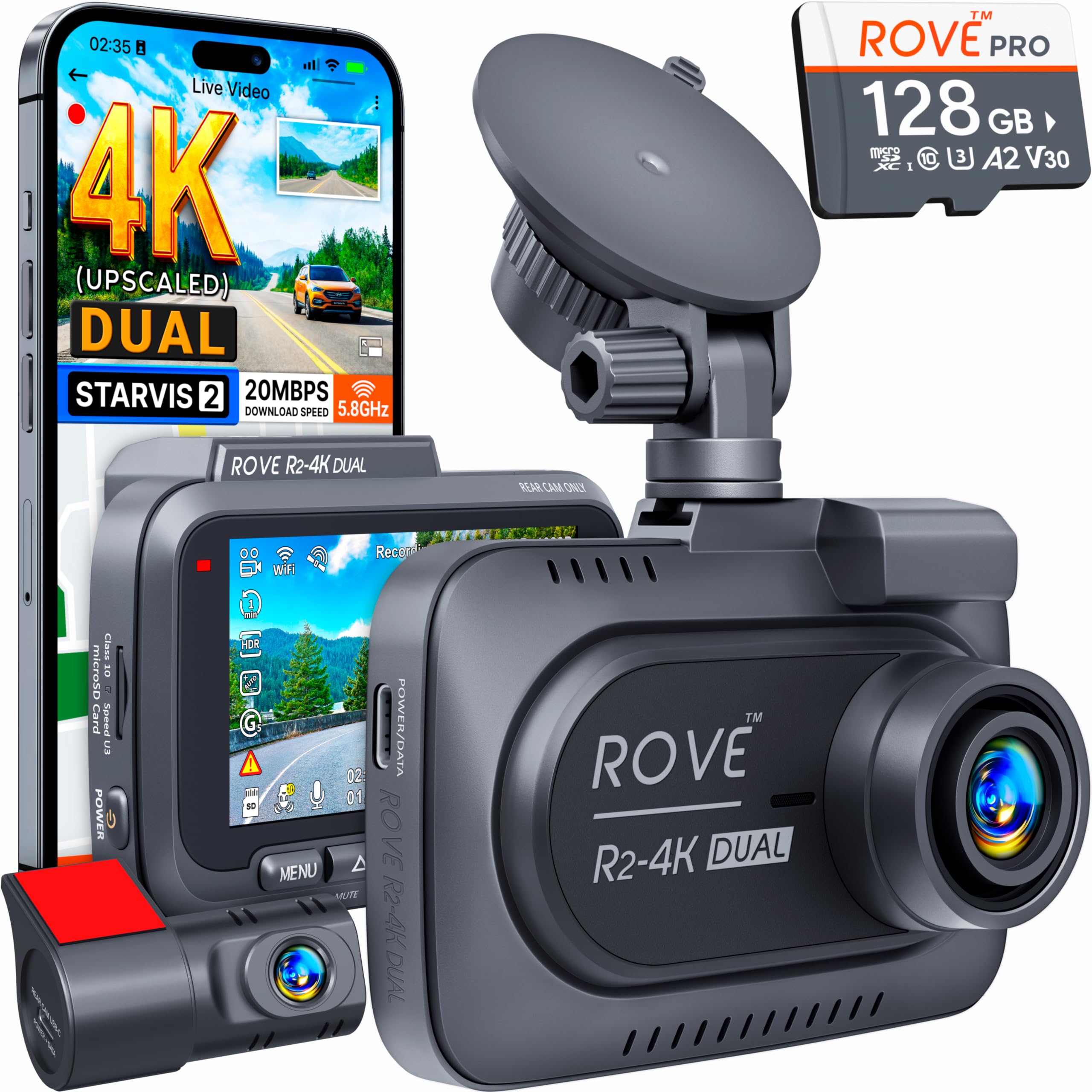
The ROVE R2-4K leads this list because it nails the fundamentals most drivers actually need. The front camera records at 2.5K (QHD) and upscales to 4K, while the rear captures Full HD 1080P — so you get sharp detail on both ends without the massive file sizes of native 4K. Paired with a Sony STARVIS 2 IMX675 sensor and an F1.5 aperture, it pulls in enough light to keep plates readable after dark, through tunnels, and at dusk.
What wins people over is the sheer completeness of the package. You get a free 128GB microSD card right in the box, which is double the capacity of the 64GB card that ships with the Yonvim below. The 5.8GHz WiFi hits download speeds up to 20MB/s, so pulling a clip to your phone takes seconds, not minutes. Built-in GPS stamps your route, speed, and location onto the footage, and the voice-guided 24-hour parking mode offers time-lapse, motion, and collision detection — though it needs a hardwire kit you’ll buy separately.
You get a camera that survives hot car interiors because it uses a supercapacitor (a power-storage component with no chemical battery) instead of lithium-ion, so it won’t degrade in high heat. Buyers report a year of daily use with zero complaints about video quality or build — one review sums it up: “A year later and still the best dash-cam for the money.” The only real annoyance is the screen, which one owner found hard to read while wearing polarized sunglasses.
What Owners Celebrate
- Tack-sharp day and night video with license plates readable from both cameras
- Free 128GB card and dual USB fast charger included in the box
- Supercapacitor design handles heat far better than battery-based rivals
Honest Trade-offs
- 4K is upscaled from 2.5K, not native, so don’t expect true 2160P detail
- Parking mode needs a hardwire kit sold separately
- Screen is tough to view through polarized lenses
Reach for this if: you want one camera that covers front, rear, night driving, and parking without compromises, backed by the strongest owner consensus in this lineup.
Look elsewhere if: you specifically demand native 4K capture — this upscales from 2.5K, so a true 4K sensor model fits you better.
2. Yonvim 2.5K Front and Rear Dash Cam
The wallet-friendly dual cam whose 160-degree lens sees more road than cameras twice its price.
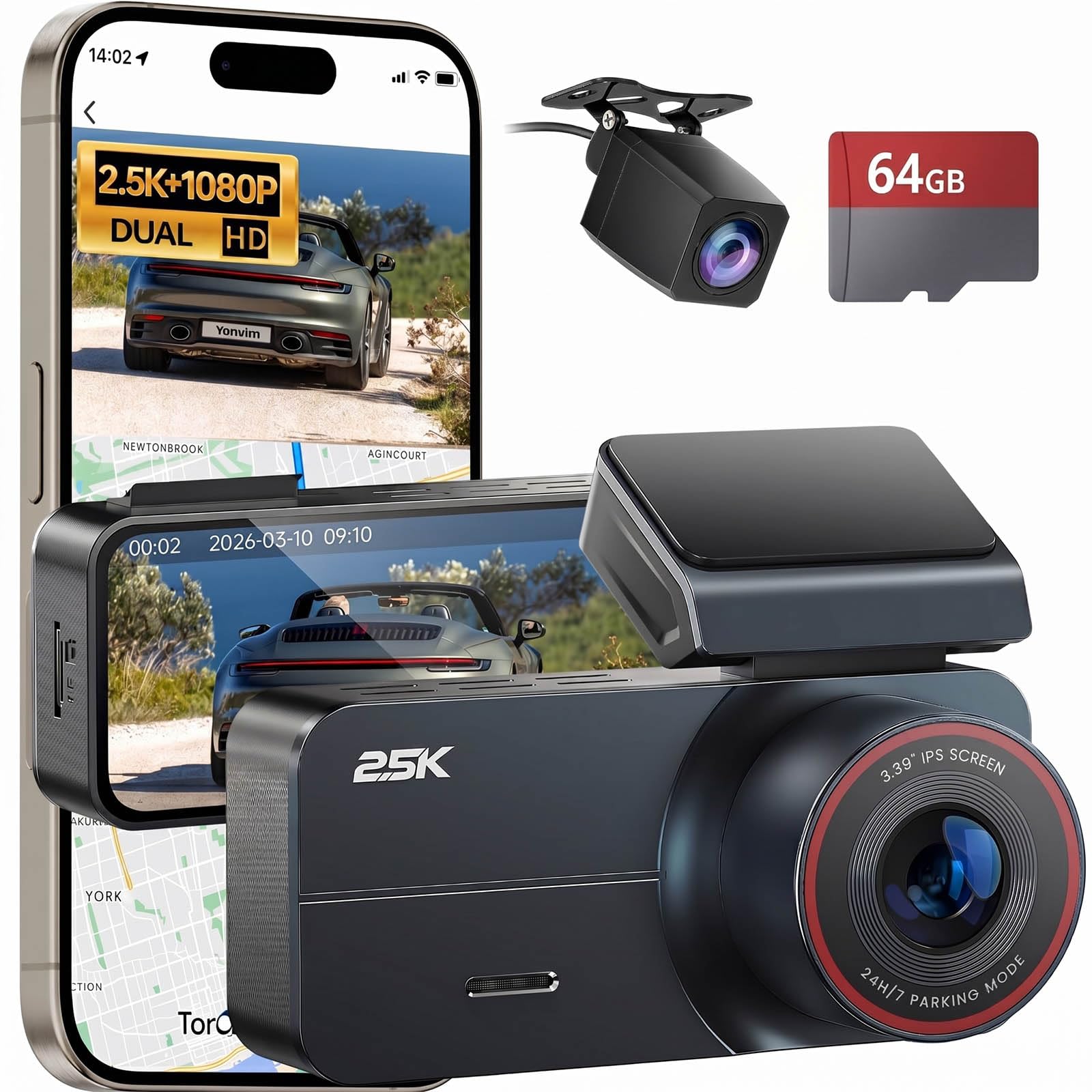
You get a budget camera that doesn’t feel cheap. With 2.5K front resolution and a 160-degree field of view, it captures 28% more of the road ahead than the 70mai A410’s 125-degree lens — a real gap when you’re trying to catch a car cutting in from the next lane. The F1.8 aperture (a wide lens opening that lets in more light) and 8-layer glass lens work with WDR (Wide Dynamic Range, a tech that balances bright and dark areas) to keep night footage usable, not just visible.
Setup is genuinely quick: the adhesive mount and pre-installed 64GB card get you running in about 30 minutes, and WiFi lets you pull clips to your phone without removing the card. The 3.39-inch IPS screen is bright and crisp. When the G-sensor feels a sudden impact, it locks that clip so the loop recording won’t overwrite your evidence.
The recurring gripe is the adhesive — several owners found the mount didn’t hold securely, and one noted the camera would drop and hang by its cord after a few months, though it kept working. The 64GB card it ships with is half the ROVE’s 128GB, so you’ll overwrite footage sooner on long trips. For the price, the video quality and feature set are hard to argue with.
Best-fit verdict: This is the pick for a first-time buyer who wants dependable dual-cam protection on a tight budget and doesn’t need 4K detail.
One caution: The adhesive mount is the weak link — use the included mount thoughtfully or consider a stronger third-party option if you park in extreme heat.
3. 70mai A410 Dual Dash Cam
A compact dual cam that tucks behind the mirror and records four lanes of traffic in crisp 2.5K.
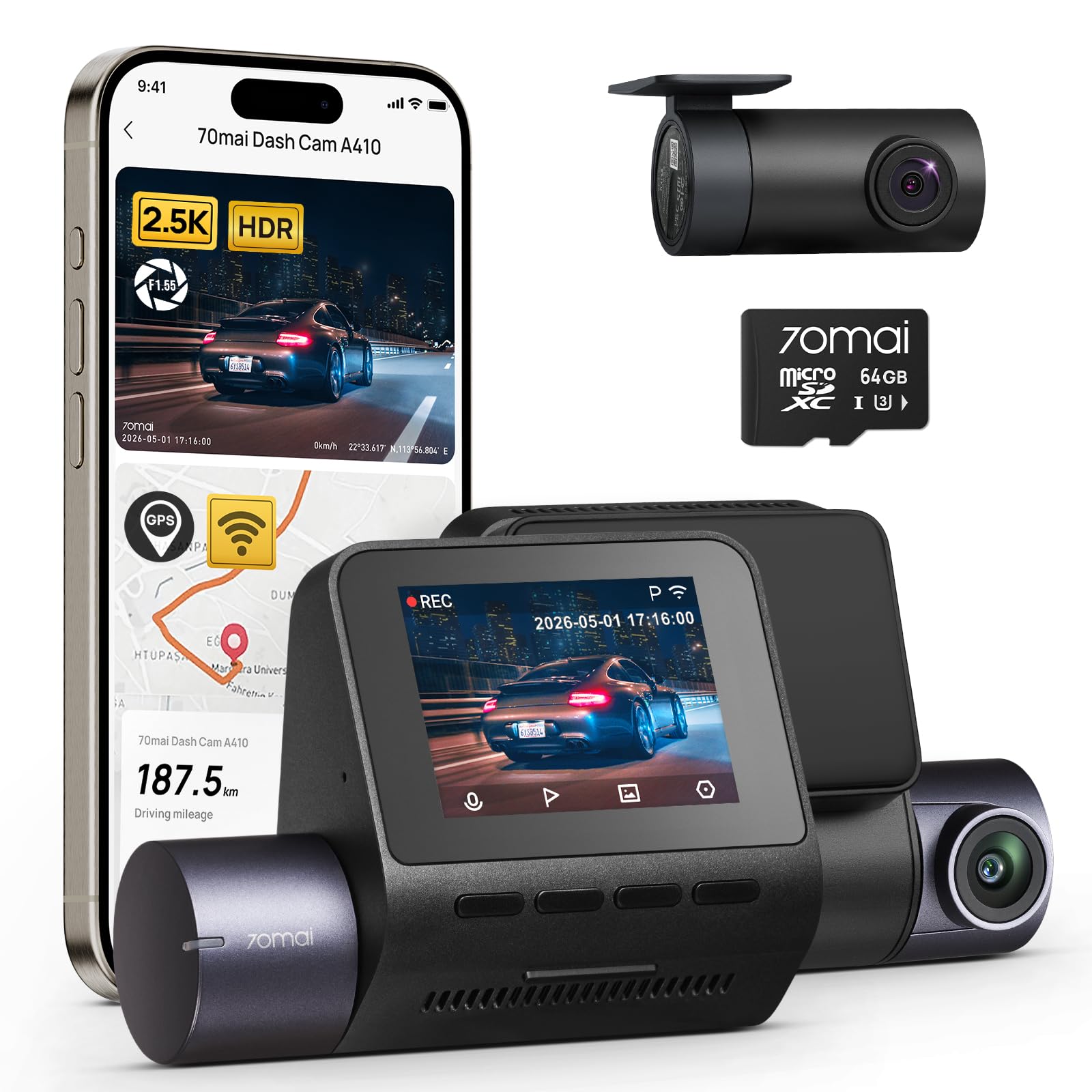
The 70mai A410 earns its place with a 2.5K (2560x1440P) front camera and 1080P rear, wrapped in a body so small owners say you barely notice it behind the mirror. The 125-degree wide-angle lens spans four lanes of traffic, which is narrower than the Yonvim’s 160 degrees but still plenty for standard commuting. Its F1.55 ultra-large aperture and HDR (High Dynamic Range, which balances bright and dark areas in one frame) deliver sharp, low-noise footage in near-darkness.
Built-in GPS embeds coordinates, speed, and timestamps directly onto the footage, and the electrostatic sticker mount holds firmly without sticky residue — a real plus for leased cars. The 64GB card included covers daily commutes, and you can expand to 256GB for cross-country trips. The G-sensor locks clips on impact, and the emergency button saves a moment instantly if you see something worth keeping.
What owners appreciate most is the polish: a dedicated app for settings, an 18-month warranty, and durability tested through Florida heat and Georgia winters. The night vision does need some ambient light — it’s excellent but not magical in total darkness. The narrow field of view compared to the FAIMEE’s 170 degrees is the one spec where it falls short.
What Makes It Stand Out
- Ultra-compact design that hides cleanly behind the rearview mirror
- F1.55 aperture and HDR deliver strong low-light footage
- Electrostatic sticker mount leaves no residue and holds firm
Where It Falls Short
- 125-degree lens sees less road than wider-angle rivals
- Night vision needs some light to perform at its best
- Parking mode needs the separate UP03 hardwire kit
Who it beats: Anyone comparing this to the Yonvim gets a more refined app, a trusted brand, and better low-light optics for a modest step up.
Who it doesn’t suit: Drivers who want to capture every lane of a busy highway — the 125-degree angle is the trade-off.
4. FAIMEE 4K Dash Cam Front and Rear
Native 4K capture with a 170-degree lens that watches up to six lanes at once.
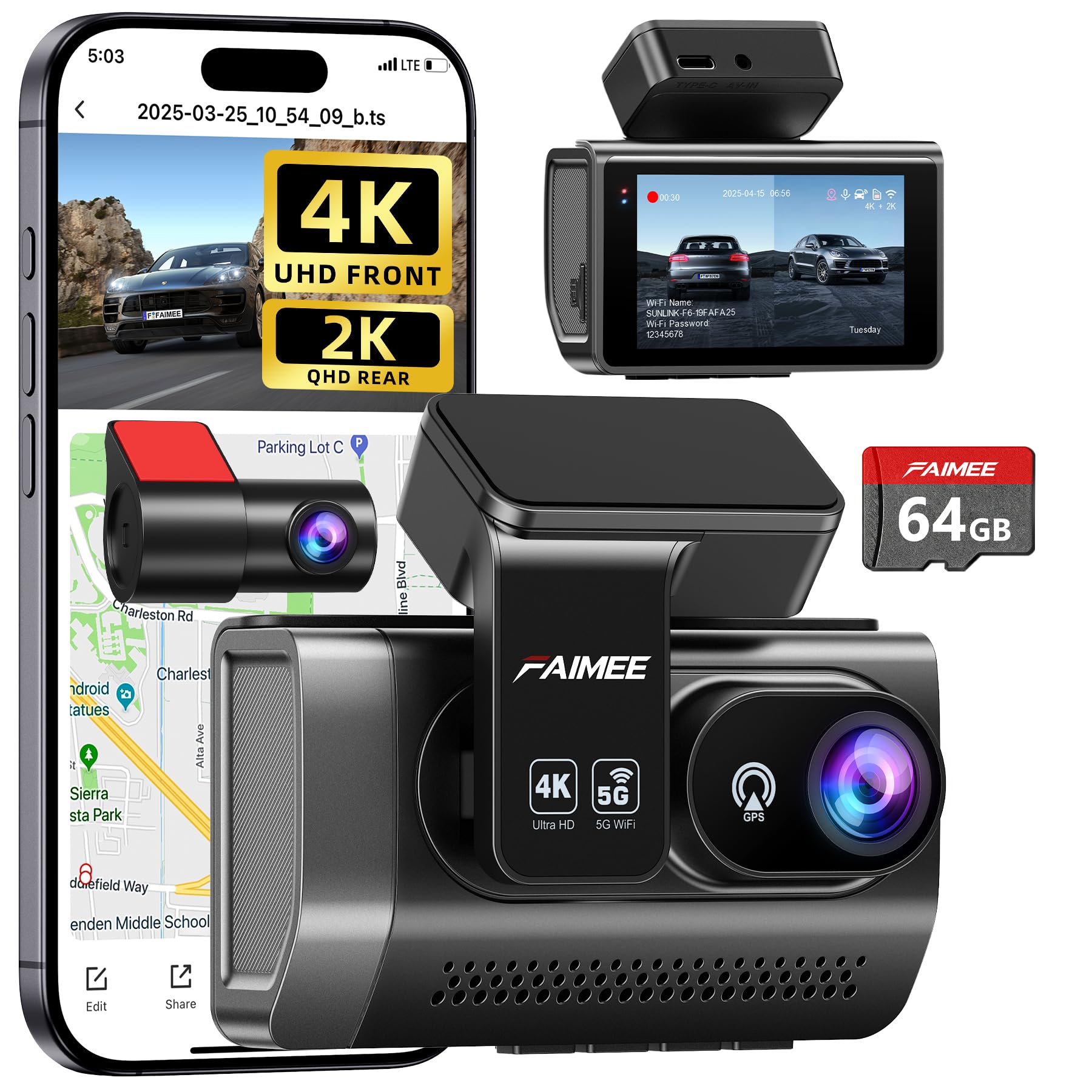
The FAIMEE is the camera for drivers who want true 4K — not upscaled — paired with the widest field of view in this lineup. The front records 4K UHD (3840×2160P) natively, and the rear captures 2K (2304x1296P), a step above the 1080P rear cameras on most rivals. The 170-degree wide-angle lens covers up to six lanes, so a side-swipe from the next lane over stays in frame.
It comes ready to record with a 64GB high-endurance card included, and supports expansion to 256GB. Time-lapse parking mode runs at a low frame rate with minimal power draw for continuous 24-hour surveillance, while the G-sensor locks event clips on impact. Dual-band WiFi (5.8GHz/2.4GHz) gives you a stable connection to the FAIMEE app for live view and quick downloads.
You get an 18-month warranty and 24/7 technical support, so a first install feels less risky. The 3-inch IPS screen (a high-clarity display type) is compact enough to sit discreetly behind your mirror. Owners consistently describe the 4K front footage as crisp with impressive night vision — and the app connects without fuss. If you value sheer field of view and native resolution, this is the balance in the mid-range.
Best for wide-road vigilance: The 170-degree lens and native 4K make it the top choice for highway drivers and anyone paranoid about blind spots.
Consider instead: The ROVE pairs a similar feature set with a supercapacitor and a bigger included card if long-term heat durability matters more.
5. 70mai A800SE 4K Dash Cam
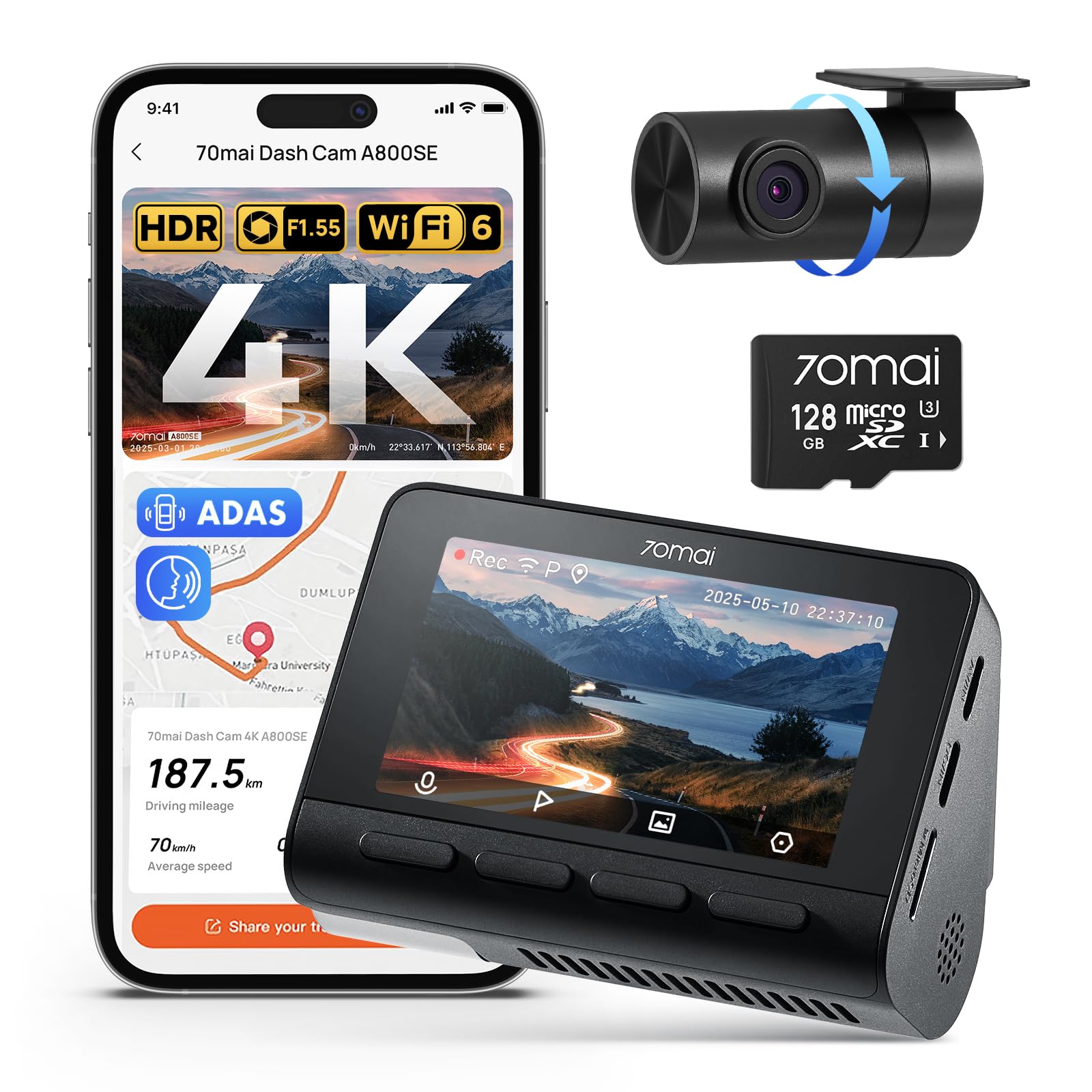
Wi-Fi 6 data transfers run up to five times faster than standard dash cam WiFi.
The A800SE is the 70mai flagship for buyers who hate waiting on file transfers. Its built-in Wi-Fi 6 delivers data speeds the brand claims run up to 5× faster than traditional WiFi dash cams, so pulling a 4K clip to your phone for an insurance claim takes moments. The front camera records native 4K, and the rear captures 1080P with an adjustable lens that can face the cabin or the road behind you.
Night performance leans on an F1.55 aperture, a 7-layer glass lens, and Dual HDR technology to brighten footage in tunnels, rain, and glare. The free 128GB microSD card is a solid inclusion, and it supports expansion to 512GB for serious road-trippers. ADAS (Advanced Driving-Assistance System, which sends lane-departure and forward-collision alerts) adds a layer of active safety most dash cams skip entirely.
Owners praise the crisp daytime 4K and the clean, compact install, with one noting the view covers roughly 180 degrees despite the 140-degree spec. The honest caveat is night quality — several buyers found night footage softer than daytime, with plates harder to read in low light, though it still beats most peers. You also get an 18-month warranty and optional in-person install at New York and California service centers, which adds confidence.
Why It Wins Fans
- Wi-Fi 6 transfers clips dramatically faster than older standards
- Native 4K front with adjustable rear lens for cabin or road
- Included 128GB card plus 512GB expansion headroom
The Fair Warning
- Night footage is soft compared to its excellent daytime clarity
- ADAS alerts can be sensitive for some drivers
- Rear cam struggles in very dark or heavily tinted windows
Choose this for: fast, frequent clip transfers and a flexible rear camera that doubles as an interior cam for rideshare drivers.
skip it if: you do most of your driving in unlit areas — the night vision is good, not stellar.
6. YEECORE 4K Dash Cam Front and Rear
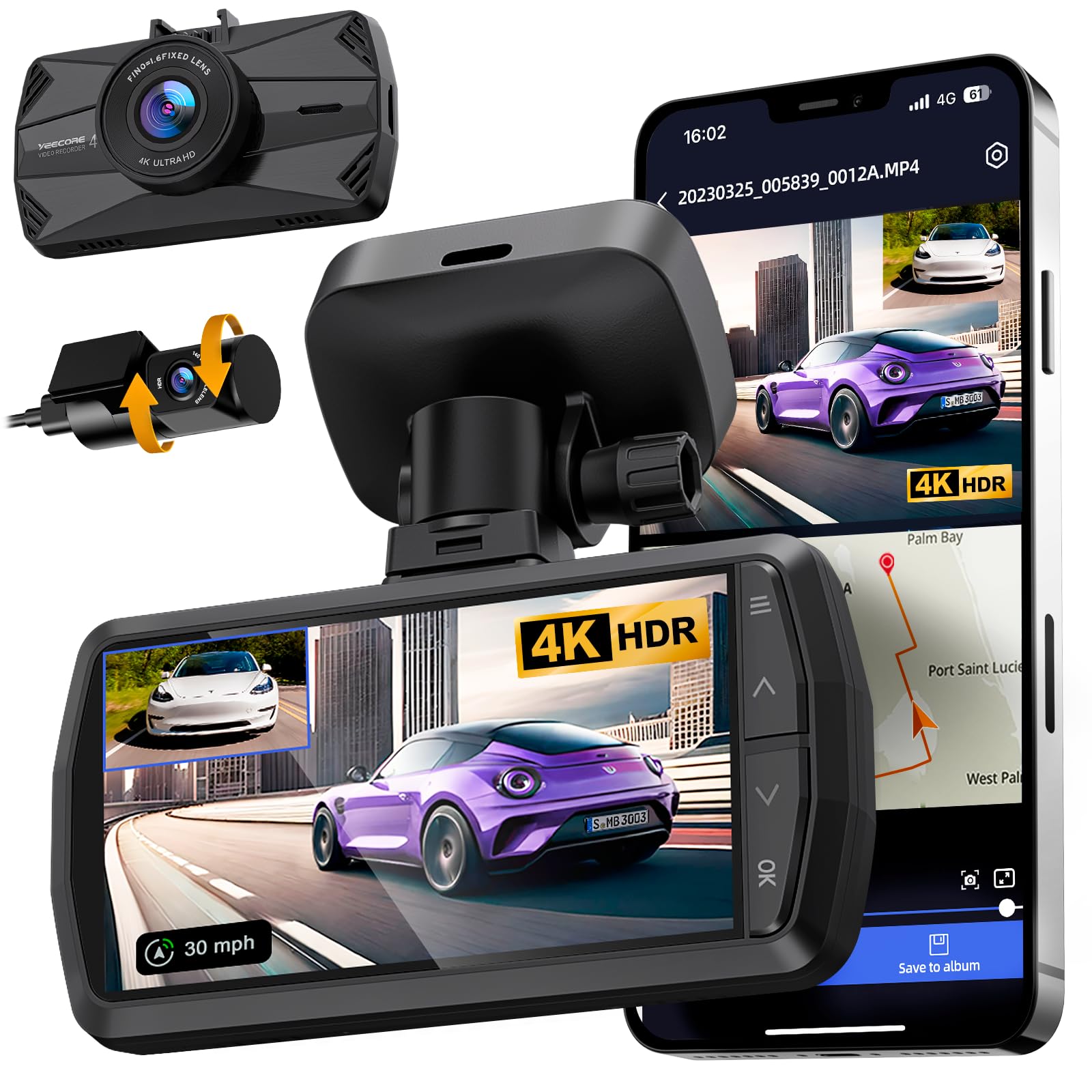
The rear camera spins a full 360 degrees to watch the road or your trunk load.
The YEECORE stands apart with a truly flexible rear camera that rotates 360 degrees. For SUV and pickup owners, that means turning it toward the trunk to monitor luggage or cargo — a trick no other camera in this list offers. The front captures 4K with a 157-degree lens, while the rear shoots 1080P HDR at 140 degrees, giving you broad coverage front and back.
Four parking modes — collision detection, motion detection, low-frame-rate, and low-bitrate — let you match recording to your parking situation, though 24-hour monitoring still needs a hardwire kit sold separately. The Sony STARVIS sensor with HDR keeps plates visible even when the car behind you has high beams on. A 20-foot rear camera cable suits most cars, and the 11.5-foot car charger reaches your cigarette lighter without fuss.
Owners are enthusiastic enough that several bought multiple units for family members, and the customer service earns repeated praise for quick replacements. The app confused a few first-timers during setup, so budget a few extra minutes to get the Yeecoreviewer app configured. The 512GB max card support gives you room for weeks of loop recording before anything gets overwritten.
Perfect for SUV owners: The rotatable rear cam makes this the only pick that secures both the road behind you and the cargo in your trunk.
Note before buying: The app setup trips up some users, and parking mode needs the separate hardwire kit.
7. REDTIGER 4K Dash Cam
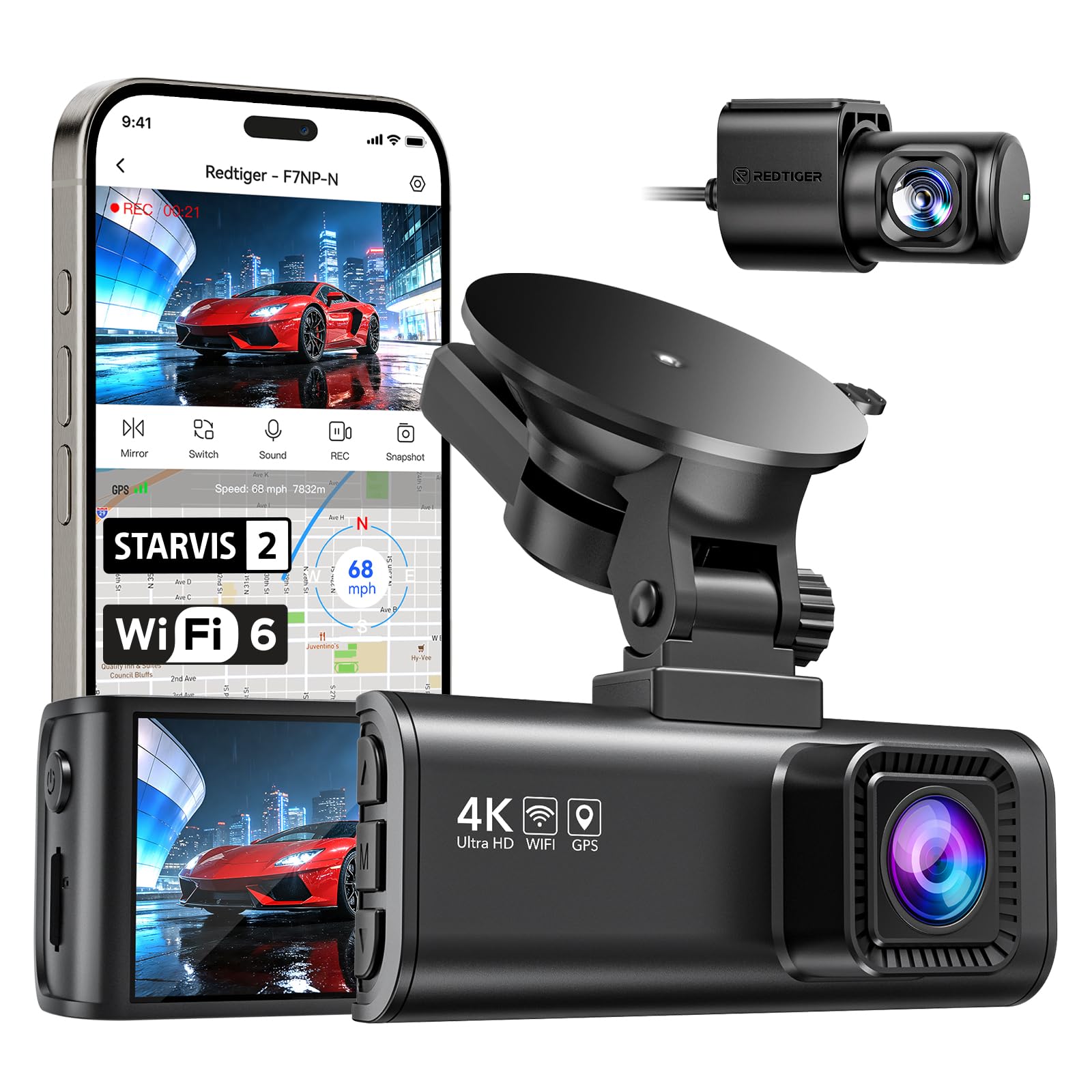
A 4K dual cam built around a supercapacitor for serious heat resistance.
If you park in Texas summers or leave your car baking in the sun, the REDTIGER is built for you. It has a native 4K front camera powered by a STARVIS 2 sensor (a low-light image chip) and a 1080P rear cam, both wrapped in a body built on a supercapacitor (a component that stores power without a chemical battery, so it shrugs off high heat). Battery-based cams degrade faster in those conditions, so this design choice matters.
The 170-degree wide-angle lens captures a broad view, and the combination of HDR and WDR keeps exposure balanced from bright daylight to dark nights. Built-in 5.8GHz WiFi hits download speeds up to 20MB/s through the Redtiger Cam app, with OTA firmware updates and GPS data viewing — route, speed, and location — all without pulling the card. Loop recording pairs with a G-sensor that locks event clips on impact.
Installation is genuinely easy, and owners mention the auto-start with ignition works flawlessly. The honest catch is that the SD card is not included — the brand recommends its own high-endurance card, so factor that purchase into your budget. The 18-month warranty and responsive customer support cover the occasional mount issue, which owners say gets resolved quickly.
Built for hot climates: The supercapacitor design and heat tolerance make this the safest bet for extreme-temperature parking.
Budget note: Remember to add the cost of a high-endurance microSD card since none ships in the box.
8. Carpuride W125S 11.26″ CarPlay Screen with Dash Cam
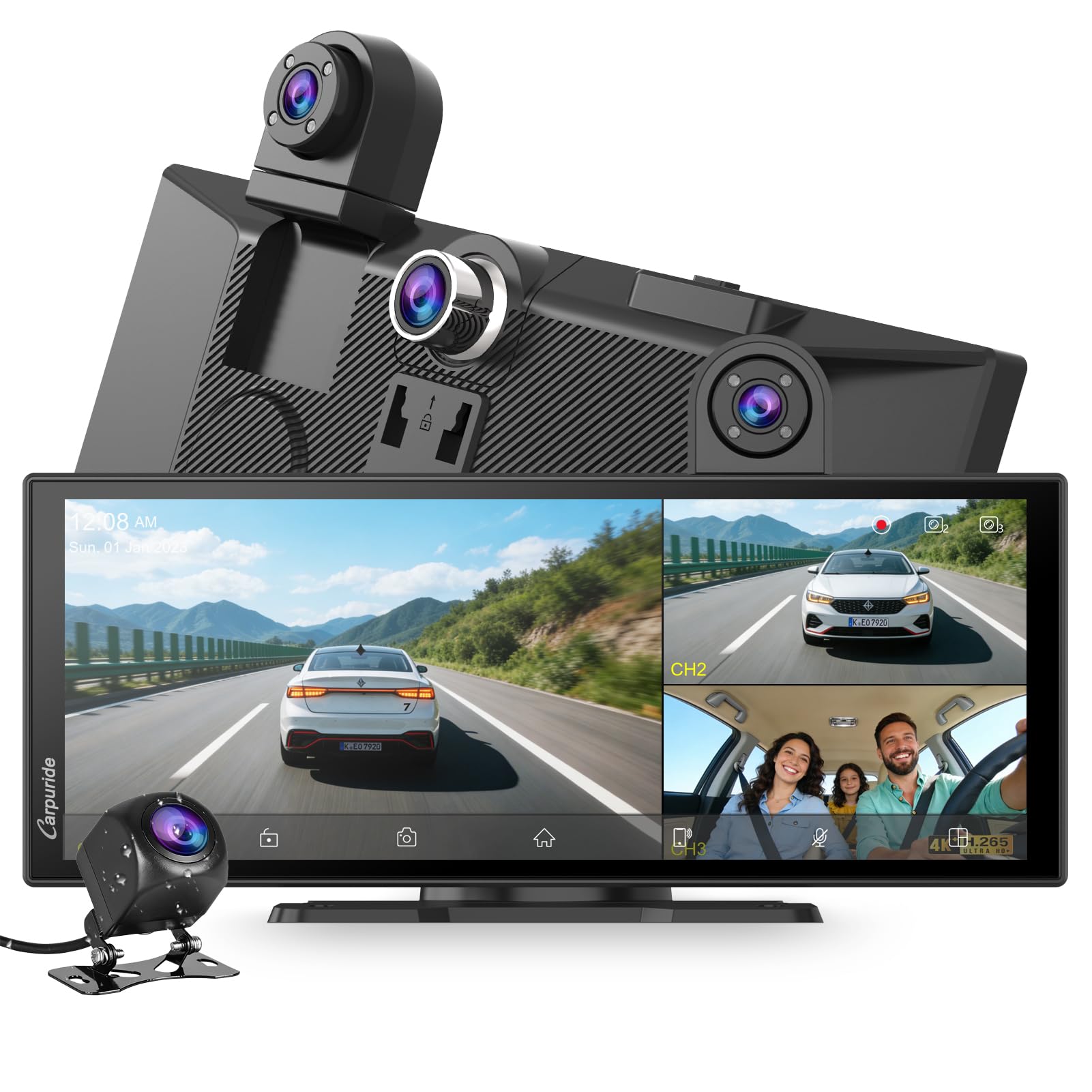
An 11.26-inch CarPlay screen that doubles as a three-camera dash cam system.
The Carpuride W125S is a different animal entirely — a full 11.26-inch wireless CarPlay and Android Auto screen that also records the road. The front camera captures 4K, with a 1080P interior infrared cam and a 1080P rear cam covering the other angles. It’s the pick for drivers whose cars lack modern smartphone integration and want one device to handle navigation and surveillance.
Loop recording runs on a 64GB TF card that’s included, and the built-in gravity sensor locks key videos on collision so they survive the overwrite cycle. The anti-glare IPS display runs 1920×720 resolution with automatic brightness adjustment from 0% to 100%, keeping maps readable even in direct sunlight. When you reverse, the screen shows front and rear views simultaneously to improve backing safety.
Owners on BMW GS motorcycles and adventure bikes especially love the plug-and-play ease and the way it keeps their phone dry and mounted. The trade-offs are real: there’s no built-in GPS, so it relies on your phone’s signal, and the system’s RAM can feel sluggish with apps loading slowly. The 1080P interior camera needs careful positioning — infrared light reflecting off windows can cause flickering, so it’s best aimed at the cabin.
What Makes It Unique
- Replaces your car’s missing CarPlay with a huge, bright touchscreen
- 3 cameras cover front, cabin, and rear in one device
- Auto-brightness keeps the screen readable in sunlight
Know Before You Buy
- No built-in GPS — navigation relies on your phone’s connection
- Interface can lag when launching apps
- Infrared cam works best aimed at the cabin, not the road
Ideal for: classic cars, motorcycles, and older vehicles that sorely need CarPlay and a dash cam in one elegant unit.
Not for: drivers who simply want the best dash cam footage — dedicated cameras record sharper video.
9. Vantrue N5S 4-Channel Dash Cam
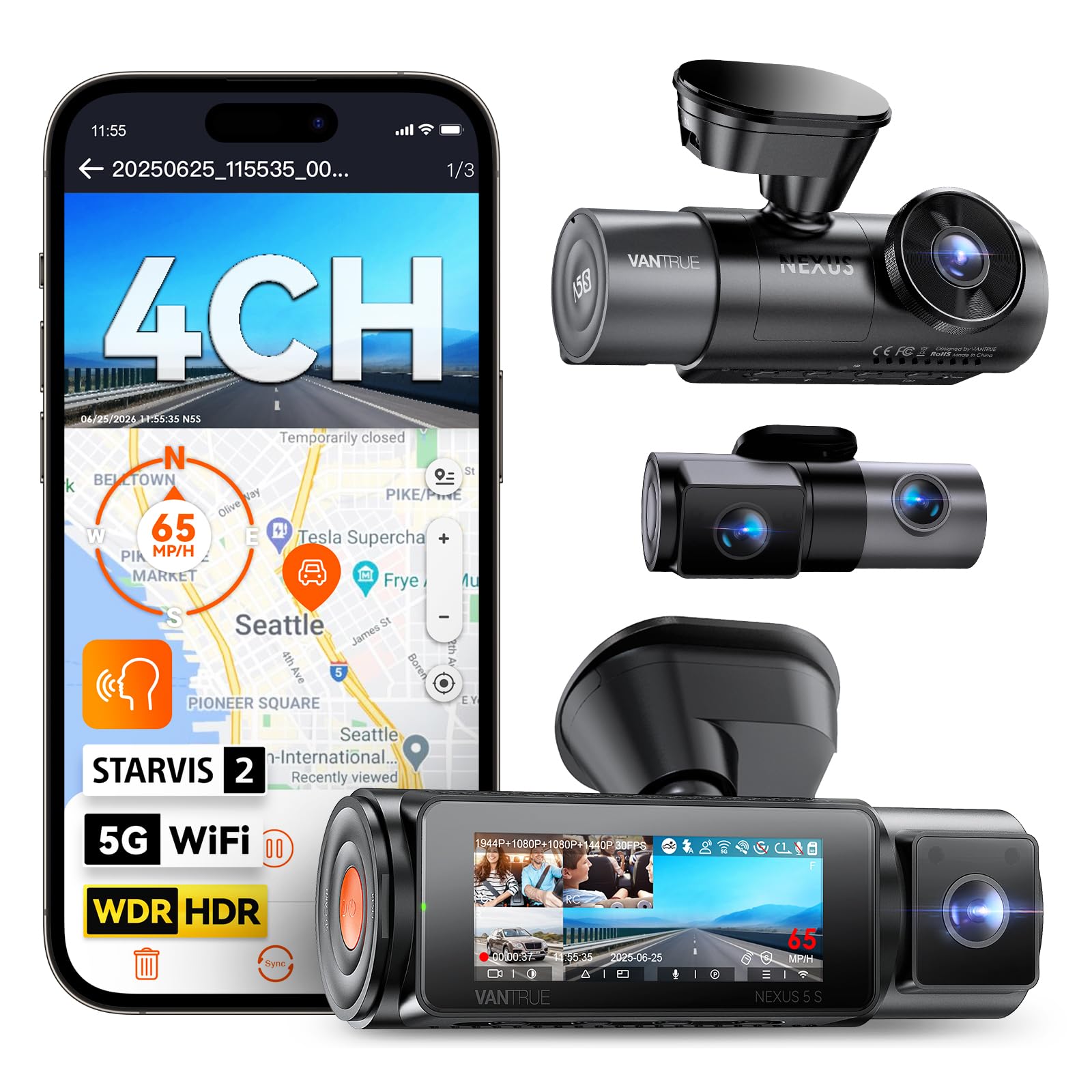
Four cameras, zero blind spots, and 360-degree coverage for the paranoid driver.
The Vantrue N5S is the ultimate surveillance rig: four channels record front at 2.7K, a 2.5K rear, and two 1080P cabin cams, giving you complete 360-degree coverage of the road and the inside of your car. All four cameras use STARVIS 2 sensors with infrared lights for the cabin cams, so even a completely dark interior captures clear footage of children, pets, or any unexpected movement.
Flexible recording modes (1CH through 4CH) let you balance coverage against storage, and the camera supports up to 1TB of microSD — the brand claims up to 40 hours of continuous 4-channel recording. The buffered parking mode includes a 10-second pre-recording buffer, so motion detection captures the moments leading up to an event, not just after. Voice control in multiple languages lets you save video or snap a photo hands-free.
The 5GHz WiFi offers 4x faster data transfer than older standards, and the dual-system GPS generates mileage reports useful for insurance claims. With a temperature range from -4°F to 140°F, it’s built for the harshest climates. The catch: reliability gets mixed feedback, with occasional reports of defective units and the app’s 5GHz WiFi being finicky. And with all four channels recording, you’ll fill even a large card quickly.
Why It’s the Heavyweight
- class-leading 360-degree coverage with 4 synchronized cameras
- Buffered parking mode captures 10 seconds before an event
- Handles extreme temperatures from -4°F to 140°F
Where It’s Demanding
- High-endurance memory card sold separately and fills fast
- 5GHz WiFi connectivity reports mixed reliability
- Premium price to protect every angle
For maximum protection: Rideshare drivers, fleet managers, and parents who want eyes on the road and the cabin choose this.
Consider a simpler cam if: you only need front and rear evidence — the extra channels add cost and card-hungry recording.
Understanding the Specs
Loop Recording and the G-Sensor
Loop recording means the camera automatically overwrites the oldest footage when the card is full, so it never stops recording. The G-sensor (a small motion sensor that detects a bump or sudden braking) is your safety net — when it feels an impact, it locks that clip into a protected folder so the loop can’t erase your evidence. Always confirm the camera has both, because loop recording alone has no way to save a crash moment.
Resolution: 2.5K vs. 4K vs. Upscaled
Front cameras range from 2.5K (QHD) to native 4K (3840×2160P). Some cameras record at 2.5K and upscale to 4K, which shows more detail than 1080P but isn’t true 4K. Higher resolution means sharper plates, but it also fills your memory card faster. Match resolution to your card size — a 64GB card fills quicker with 4K than with 2.5K.
FAQ
How does loop recording actually work on a dash cam?
What size memory card do I need for a 4K dash cam?
Does parking mode work without a hardwire kit?
Is upscaled 4K the same as native 4K recording?
Why is my dash cam footage blurry at night?
What is the difference between a 125-degree and 170-degree field of view?
Will a front and rear dash cam fit my vehicle?
How do I transfer footage from my dash cam to my phone?
What is a G-sensor emergency lock and why does it matter?
Do dash cams record audio inside the car?
Final Thoughts: The Verdict
Across the board, the dash cam loop recording winner is the ROVE R2-4K because it pairs the strongest owner consensus with a complete out-of-the-box kit, sharp upscaled 4K, and a heat-tolerant supercapacitor. If you want native 4K with the widest coverage, grab the FAIMEE 4K. And for budget-conscious first-timers, the Yonvim 2.5K delivers dependable dual-cam protection while staying affordable.
How We Picked
We do not accept paid placement. Every pick is matched to a real buyer and a real use-case; we do not hands-on test units.
Sources & Methodology
Specifications: manufacturer listings and product documentation. Review insights: verified customer reviews, as of August 2026. Pricing: not shown on this page (it changes often); check the current price via the retailer link.
As an Amazon Associate, Trending Car earns from qualifying purchases. This does not affect which products we feature.