
Our readers keep the lights on and my garage snacks stocked. As an Amazon Associate, I earn from qualifying purchases.
Specs are compiled from manufacturer listings and verified buyer reviews and can change over time — please confirm the key details on the product page before buying.
You get into a fender bender, the other driver blames you, and you have zero proof. That gut-punch is why most drivers finally buy a dash cam. You need a camera that turns a chaotic moment into a clear, indisputable video file — one that actually reads a license plate at night and does not corrupt the footage when you need it most. This guide walks you through the dash cams that actually deliver on that promise, cutting through the confusion of resolutions and jargon.
I’m Min Islam — the founder and writer behind Trending Car. This guide is built by comparing the manufacturers’ published specifications and the patterns across verified customer reviews, so you get each pick’s real strengths and trade-offs instead of marketing spin.
Whether you commute daily or hit the open road on weekends, the right dash cam for car means the difference between a headache and a solid piece of evidence that saves your insurance claim.
Our Picks at a Glance
How To Choose The Best Dash Cam for Car
Ignore the “K” number on the box and focus on real-world performance.
Resolution and the Night Test
Resolution alone doesn’t guarantee clear footage. A dash cam with a large aperture lens (like F1.55 or F1.8) and a sensor with high dynamic range — often called HDR or WDR — is what actually lets you read a license plate in the dark. A lower-resolution camera with a quality sensor often outperforms a high-resolution one with a cheap sensor at night.
Channel Count: Two, Three, or Four Cameras
A front-and-rear (2-channel) setup covers the most common accident scenarios. If you drive for a rideshare service, have children in the back, or worry about vandalism, a 3-channel system (adding an interior cabin view) gives you total coverage. The newest 4-channel systems add a second side or rear-cabin camera for near-360-degree surveillance.
Parking Mode Reality
Parking mode requires a separate hardwire kit connected to your car’s fuse box. Without it, the camera runs on its internal battery for only a few minutes. The best parking modes use time-lapse or buffered recording to capture the 10 seconds before an impact.
Storage and the SD Card
A bundled 64GB card provides several hours of loop recording before overwriting old clips. Multi-channel high-resolution systems require a U3 or A2 rated microSD card to prevent recording interruptions.
Quick Comparison
| Model | Best For | Recording Channels | Front Resolution | Night Vision Sensor | Amazon |
|---|---|---|---|---|---|
| FAIMEE 4K+2K★ Best Overall | All-Round Value | 2 (Front + Rear) | 4K UHD (3840×2160P) | WDR + F1.8 aperture | Amazon |
| 70mai A410Top Value | Budget Night Driver | 2 (Front + Rear) | 2.5K (2560×1440P) | F1.55 + HDR Night Vision | Amazon |
| virrow X5 | Touchscreen Simplicity | 2 (Front + Rear) | 4K (3840×2160P) | SC2336 sensor + WDR | Amazon |
| 70mai T800E | Rideshare Coverage | 3 (Front + Cabin + Rear) | 4K Ultra HD | HDR + 3D noise reduction | Amazon |
| Vantrue N4S | Premium Clarity | 3 (Front + Cabin + Rear) | 2.7K Super HD | Triple STARVIS 2 + PlatePix | Amazon |
| ROVE R2-4K DUAL PRO | Top-Tier Dual Sensor | 2 (Front + Rear) | 4K (3840×2160P) | Dual STARVIS 2 IMX678+675 | Amazon |
| Vantrue N5S | Complete 360° View | 4 (Front + Cabin + Rear + Rear Cabin) | 2.7K | Quad STARVIS 2 | Amazon |
In‑Depth Reviews
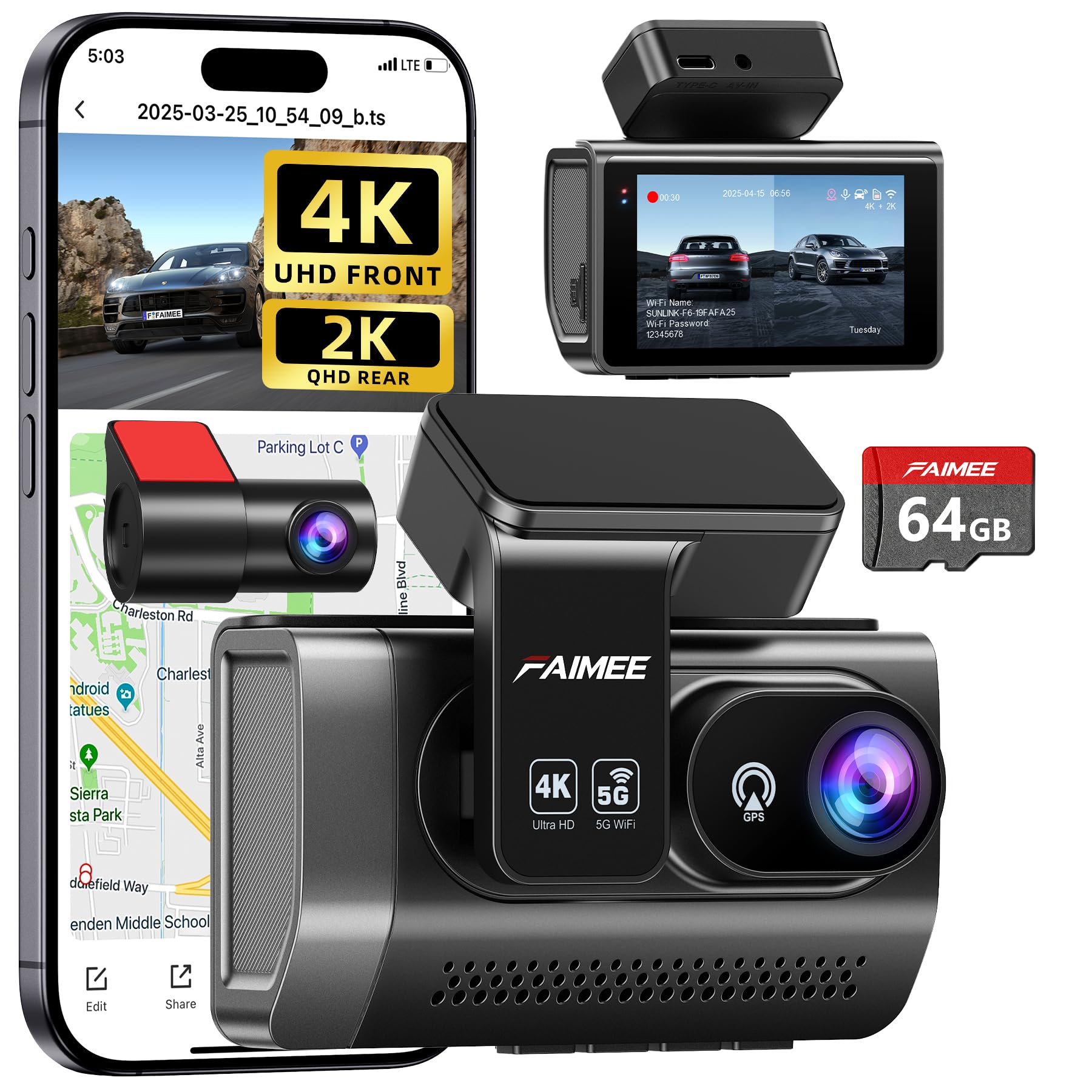
1. FAIMEE 4K+2K Dash Cam Front and Rear
Our pick — 4.5★ from 800+ verified ratings; the strongest balance of quality and price.
A complete kit with built-in GPS that captures plate numbers from six lanes away.
You do not have to guess whether a license plate will be readable in the final video. This FAIMEE dash cam records in 4K UHD (3840×2160P) from the front and 2K (2304x1296P) from the rear, pairing that with a 170-degree wide-angle lens and a F1.8 aperture to pull in enough light during dusk and dawn. The built-in GPS logs your real-time speed, route, and location coordinates directly onto the footage, so every piece of evidence is timestamped and mapped without needing an extra module.
The included 64GB high-endurance memory card means you can plug this in and start recording immediately, and you can upgrade the flash memory to up to 256GB if you want more buffer storage before it loops. Buyers report “good video quality for the price, easy setup, works as expected, great value.” The 3-inch IPS screen is compact enough to tuck behind your rearview mirror without blocking your view, and the dual-band Wi-Fi (5.8GHz/2.4GHz) lets you pull clips onto your phone in seconds through the FAIMEE app — unlike the 70mai A410 which offers a narrower 125-degree field of view, this FAIMEE’s 170-degree lens gives you a 36% wider coverage of traffic.
Real-world edge: The 24-hour parking monitor uses time-lapse recording at a low frame rate to keep watch without draining your car battery, and the G-sensor (a motion sensor that detects bumps) locks the current video instantly when it senses a collision.
The honest catch: The rear camera is 2K rather than 4K, which means the front footage is sharper, and the hardwire kit for continuous parking recording is sold separately.
Reach for this if: You want a fully-loaded 2-channel system with GPS, wide-angle coverage, and a free 64GB card that works from the start.
Look elsewhere if: You need a 3-channel system with an interior cabin camera for rideshare driving.
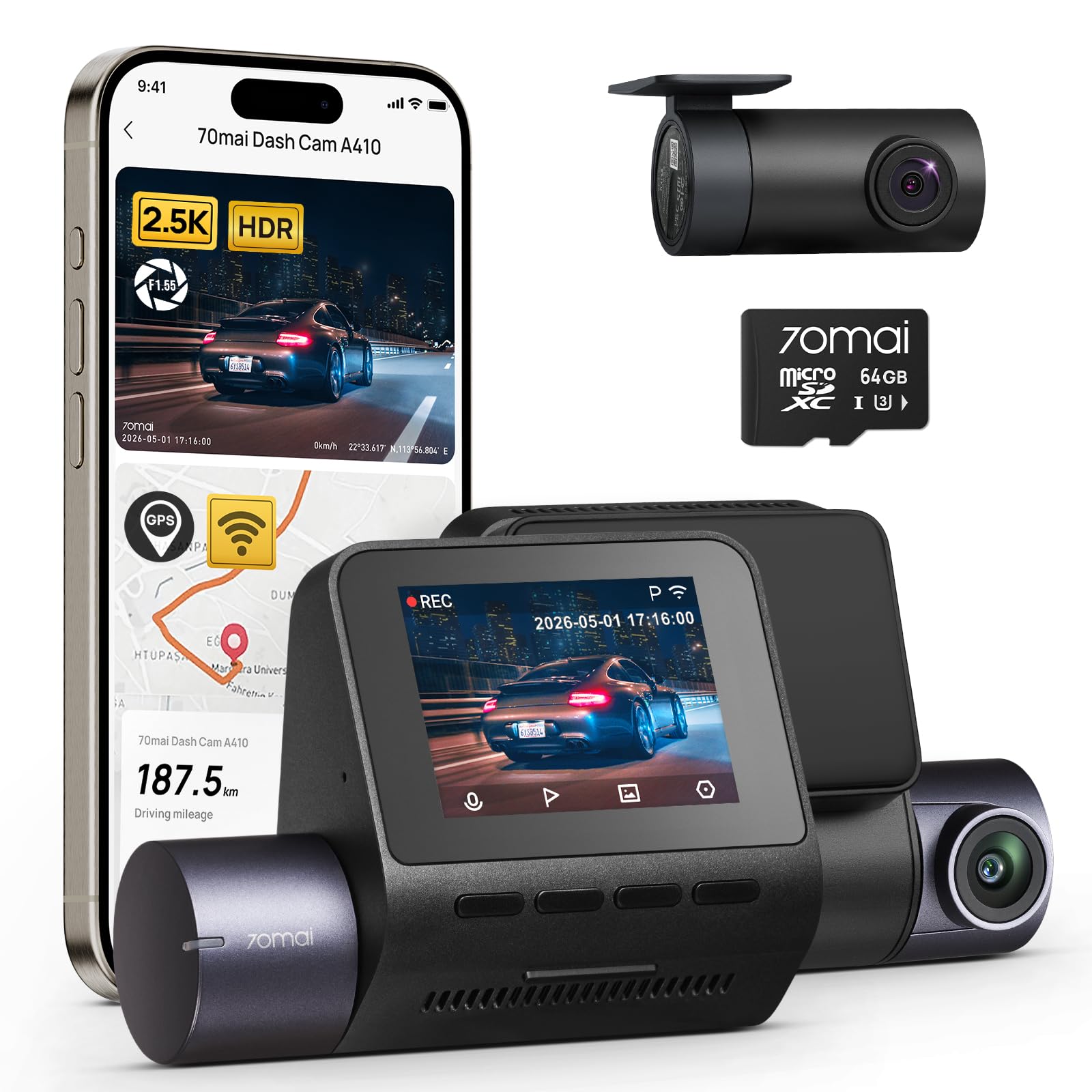
2. 70mai A410 2.5K+1080P Dual Dash Cam
Combines strong night vision with an electrostatic sticker mount that leaves zero residue.
This 70mai A410 keeps things practical for the driver who wants solid evidence without spending on a 4K sensor they may not need. The front camera records at 2.5K (2560×1440P) and the rear at 1080P, but the real trick is the F1.55 ultra-large aperture paired with HDR (High Dynamic Range) technology — this combination lets the camera pull detail from dark roads and balance harsh headlight glare in a single frame. The 125-degree wide-angle lens is narrower than some rivals, covering four lanes of traffic instead of six, but it reduces the barrel distortion that can sometimes make plates look curved and unreadable at the edges.
The kit uses an electrostatic sticker that sticks to the windshield without leaving any sticky residue when you peel it off, which is a nice touch if you lease your car. It also includes a 64GB SD card, and supports expansion up to 256GB via microSD. One reviewer noted, “Battery lasts 1.5-2 years, easy to replace,” which points to a thoughtful design where the internal battery is user-serviceable. The G-sensor (collision sensor) locks footage on impact, and the built-in GPS embeds your coordinates and speed right onto the video file for court-admissible records.
Smart value angle: The free 70mai app lets you view both front and rear camera feeds live and adjust settings like resolution and collision sensitivity — all without needing to pull the memory card.
The honest catch: The 125-degree field of view is noticeably narrower than the 170-degree coverage you get on the FAIMEE, so you lose some peripheral lane coverage.
Best for: Budget-minded drivers who prioritize strong night performance and a clean, residue-free mount over maximum coverage width.
skip it if: You prefer a touchscreen interface for adjusting settings on the camera itself rather than using an app.
3. virrow X5 4K+2.5K Dash Cam
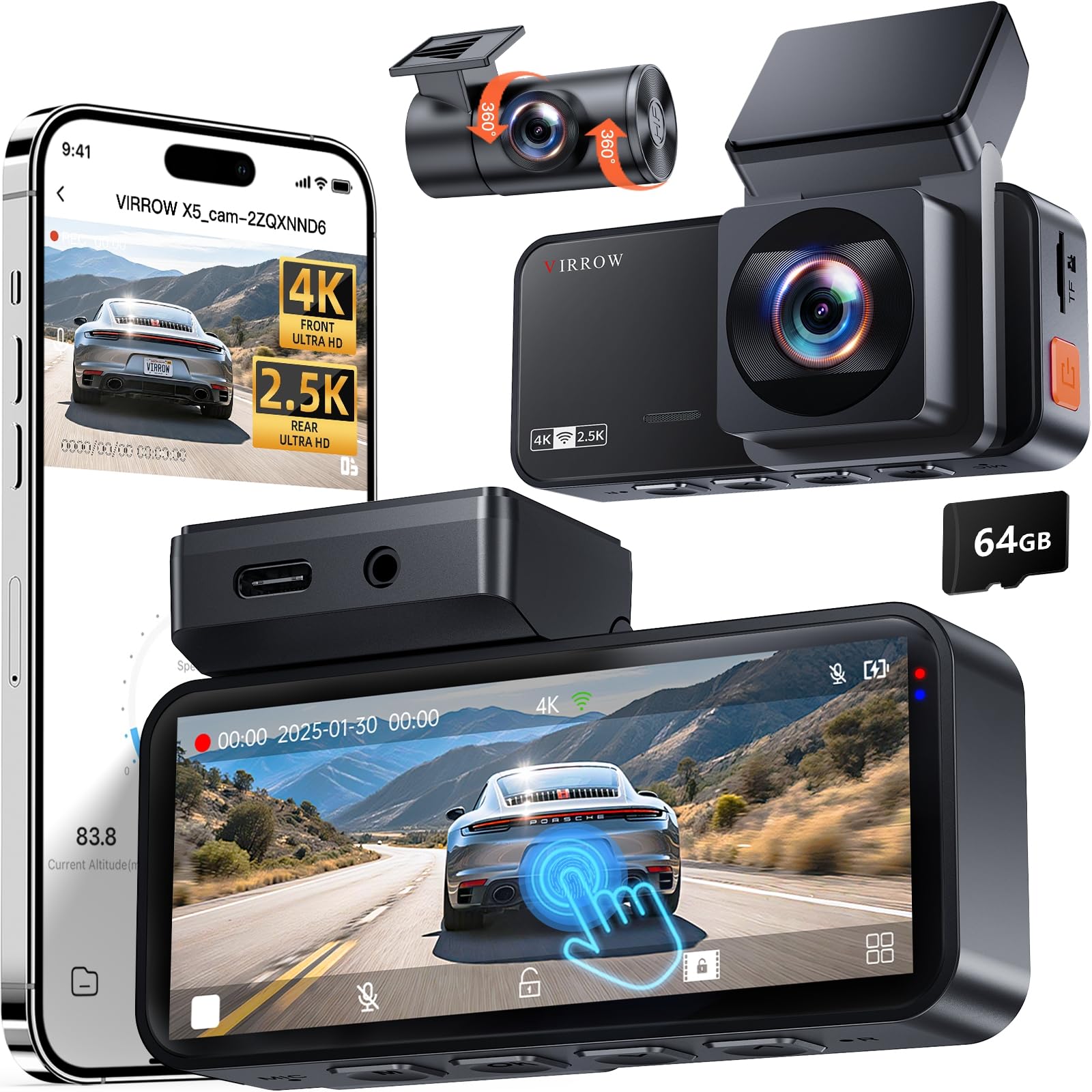
A 3.39-inch touchscreen that makes playback and settings a tap away.
If you like to control your camera from the device itself rather than through a phone app, the virrow X5 is built around a bright 3.39-inch touchscreen display. The dash cam records 4K (3840×2160P) from the front and 2.5K HD from the rear, with 170-degree front and 165-degree rear ultra-wide lenses that minimize blind spots. It uses a SC2336 sensor and WDR (Wide Dynamic Range) processing with a F1.8 aperture and a 6-layer lens system, so the camera automatically balances the exposure when you drive from under a bridge into bright sunlight — keeping license plate detail visible through the transition.
The package includes a free 64GB memory card and uses smooth loop recording to automatically overwrite the oldest footage when the card fills up. Owners mention that “good resolution and video locking after accident” is a standout feature, and one owner noted the camera survived a totaled car (the memory card stayed intact with the footage). The X5 offers a 24/7 parking guard with time-lapse mode that condenses 24 hours into minutes of footage, but it requires the hardwire kit (ASIN: B0F8HJPVZP) which you purchase separately.
Touchscreen advantage: The G-sensor collision lock automatically stores emergency footage in a protected folder on the microSD card so it never gets overwritten by loop recording.
The honest catch: Some buyers mentioned the Wi-Fi does not auto-reconnect every time you start the car, so you may need to manually reconnect to the app for live preview.
Best for: Drivers who prefer tapping on a touchscreen to change settings rather than fumbling with a phone app while parked.
pass on it if: You want a 3-channel system that includes an interior cabin camera for rideshare duties.
4. 70mai T800E 4K 3-Channel Dash Cam

Three cameras — front, cabin, and rear — with switchable infrared for pitch-black interior recording.
The 70mai T800E is purpose-built for rideshare drivers, delivery workers, or anyone who needs to see inside the vehicle. It records 4K front, 1080P interior, and 1080P rear simultaneously through three separate lenses, each with ultra-wide views and an F1.55 aperture for low-light performance. The interior camera features switchable infrared recording — flip it on and the camera can capture clear footage of the cabin even in complete darkness, which is useful for Uber or Lyft drivers who want protection against passenger disputes.
This model uses Wi-Fi 6 (the latest wireless standard) for file transfers that reach up to 10 MB/s, which is about 5 times faster than the older Wi-Fi 4 standard found on many budget cams. It also has 5-mode GPS (satellite positioning) that tracks speed, location, and route, plus smart voice control — you can say “Take photo” or “Lock video” without touching the camera. The super capacitor (an electronic component that stores power without a lithium battery) lets the camera handle extreme temperatures from 14°F to 140°F, which prevents the battery bulge problems common in cheaper cams left in hot cars.
Total coverage move: The 24/7 parking monitor with G-sensor detection automatically triggers recording when it detects motion or impact while parked, and the included 64GB SD card supports expansion up to 512GB for extended recording.
The honest catch: The 4G connectivity is not supported, so you cannot check the live feed remotely from your phone — it only records locally.
Best for: Rideshare drivers and families who want an interior cabin camera with infrared for nighttime recording.
Look elsewhere if: You do not need the interior camera and prefer a simpler 2-channel setup to save on installation time.
5. Vantrue N4S 3-Channel Dash Cam

Three STARVIS 2 sensors and a PlatePix algorithm that sharpens license plates by 2x at night.
The Vantrue N4S is designed for the driver who treats their dash cam as an insurance policy and wants the best possible footage in low-light conditions. All three channels — front (2.7K), interior (1440P), and rear (1440P) — use Sony’s STARVIS 2 sensors, which are engineered to boost light sensitivity and cut motion blur in dim environments. The camera also includes Vantrue’s PlatePix technology, a processing algorithm that sharpens license plates by 2x and balances harsh contrasts like headlights against dark asphalt, so plates stay readable even at night.
The rear camera rotates a full 360 degrees, so you can pivot it to face inward to monitor cargo, kids, or pets when you are not using it for rear traffic. It supports up to 1TB microSD cards (though not included) and features 5GHz Wi-Fi for fast downloading of clips to your phone. A super capacitor design allows it to operate in extreme temperatures from -4°F to 140°F — far surpassing lithium battery cams that can fail in a hot car. The magnetic GPS mount snaps on easily, and the adhesive mount uses a static cling film that leaves no residue.
Night vision edge: The N4S offers 4 different parking modes — motion detection with 10-second pre-event recording, collision detection, and two low-bitrate modes that extend recording by compressing the file size.
The honest catch: The RC18 rear camera is not waterproof, so you cannot mount it outside the vehicle on the rear bumper — it must be mounted on the inside rear window.
Best for: Drivers who regularly drive at night or in low-light conditions and want the clearest possible license plate footage from all three cameras.
it’s not for you if: You need a 4-channel system for full 360-degree coverage around the vehicle.
6. ROVE R2-4K DUAL PRO Dash Cam
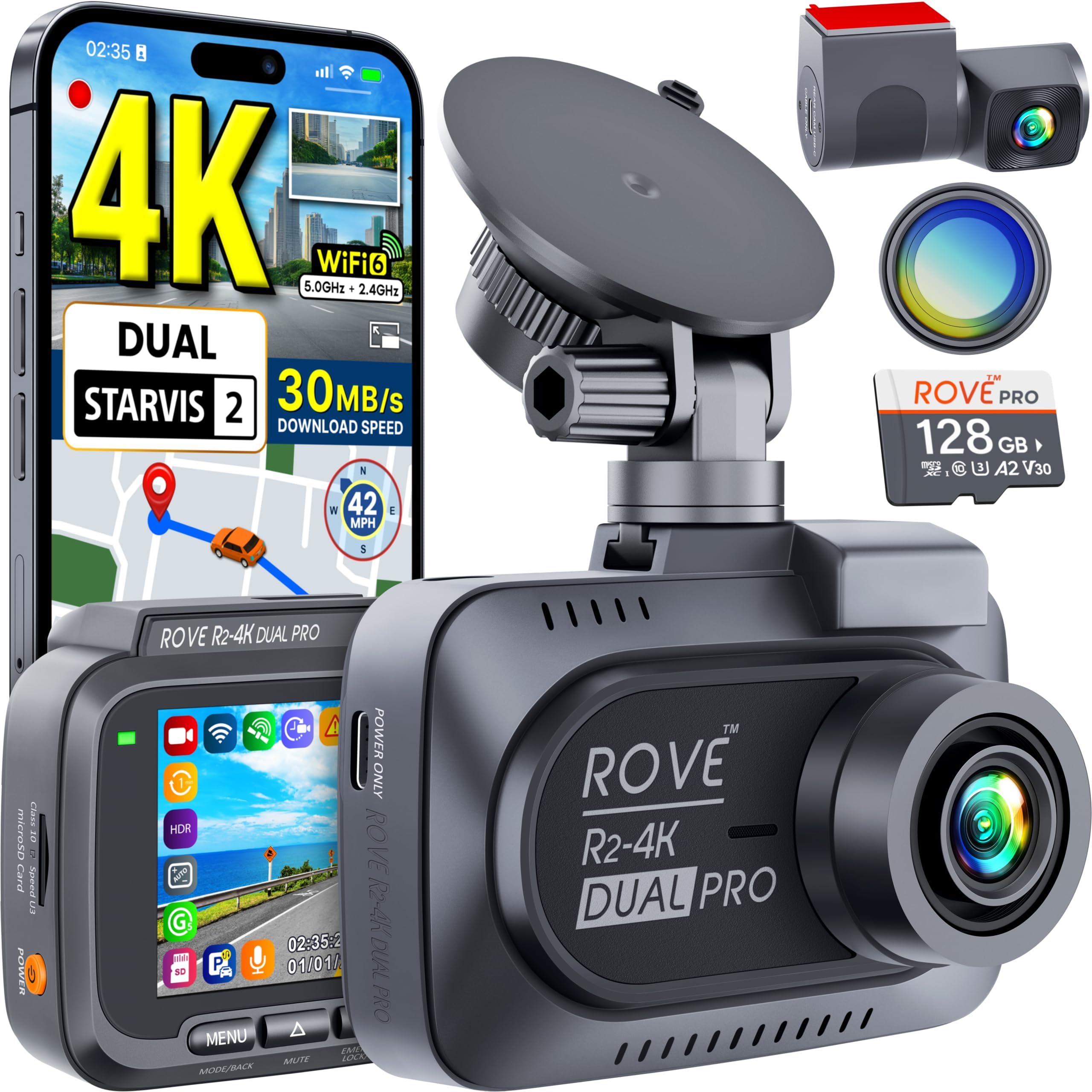
Sony’s most advanced STARVIS 2 sensors for both front and rear — the same sensor used in high-end security cameras.
ROVE packs the R2-4K DUAL PRO with the Sony IMX678 (8MP) sensor for the front and the IMX675 (5MP) sensor for the rear — a combination that delivers higher light sensitivity and less motion blur than most dual-cam setups. The front records crisp 4K (3840×2160P) at 30fps and the rear captures 2K (2560×1440P) at 30fps, with wide-aperture lenses of F1.7 front and F1.55 rear. This means when you drive through a tunnel into sudden sunlight or hit a patch of rain at dusk, the HDR imaging balances the exposure to keep the plate readable instead of washing out the frame.
The dash cam includes a free 128GB ROVE PRO microSD card and a ROVE Ultimate CPL filter (a circular polarizing lens) that screws onto the main camera to cut windshield glare and reflections. Customers note the “front 4K (IMX678) and rear 2K (IMX675) video quality is impressive, capturing license plates day/night.” The built-in Quad-Mode GPS syncs with GPS, BeiDou, Galileo, and GLONASS satellites, displaying live speed and coordinates on the 3-inch IPS screen while embedding the route data directly into the video file. WiFi 6 with 5GHz and 2.4GHz bands enables download speeds up to 30MB/s, so you can pull a full 4K clip to your phone in seconds instead of minutes.
Parking mode advantage: The 24-hour parking monitor offers three options — 1FPS time-lapse, motion detection, and collision detection — and the camera delivers a voice alert the next time you start the car to tell you an event was recorded.
The honest catch: The hardwire kit for continuous parking recording is sold separately, and the 128GB card included may need to be upgraded to a higher-endurance card if you record long 4K trips every day.
Best for: Enthusiasts who want the best possible dual-sensor image quality and ultra-fast WiFi 6 transfer speeds for reviewing footage on their phone.
Look elsewhere if: You need a 3-channel system with interior cabin recording — this is a dedicated front-and-rear setup only.
7. Vantrue N5S 4-Channel 360° Dash Cam
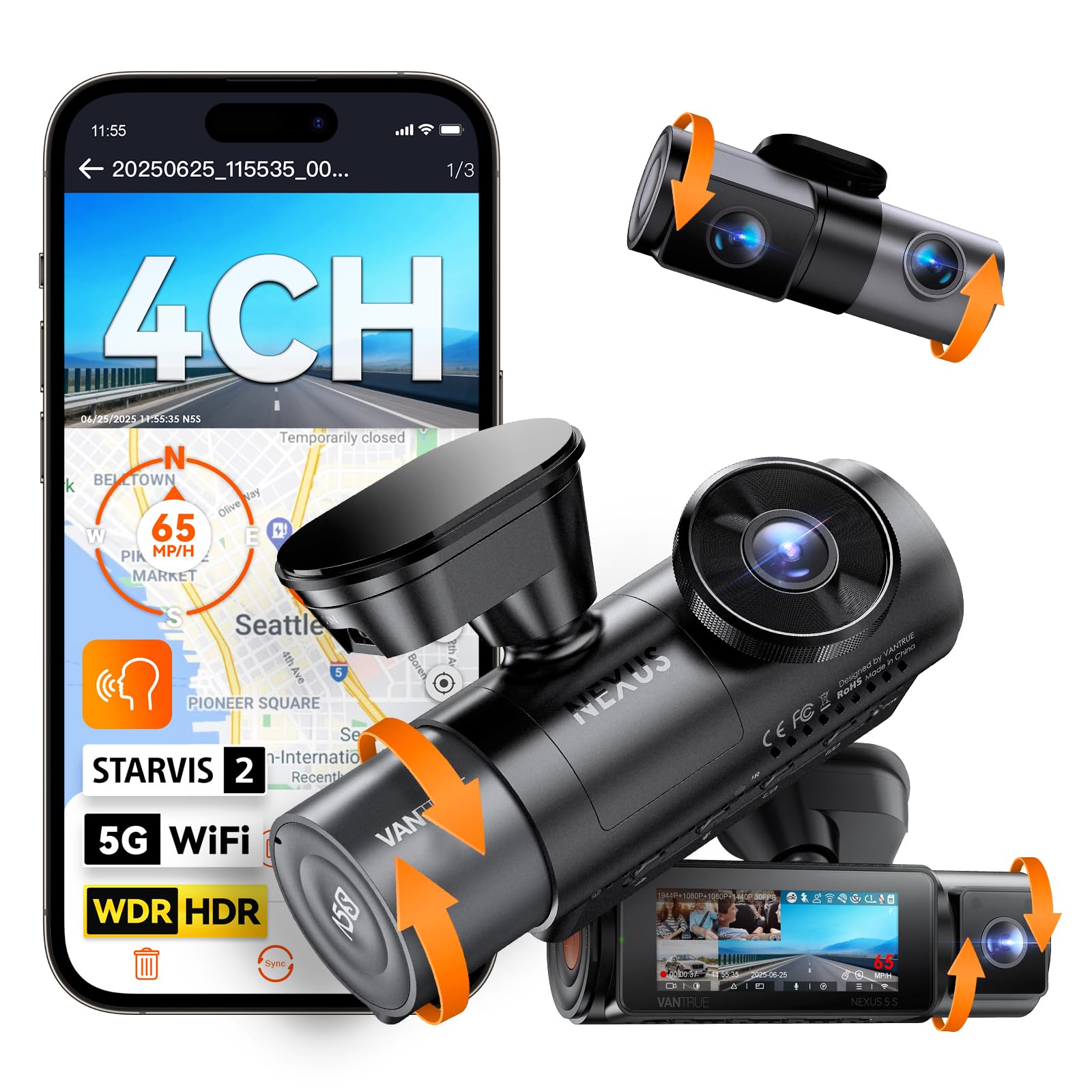
Four channels covering front, cabin, and both rear angles for the ultimate defensive driving record.
The Vantrue N5S is the most comprehensive dash cam on this list, using four separate cameras to create a 360-degree view around and inside your car. The recording configuration splits into 2.7K front + 1080P x2 (front cabin and rear cabin) + 1440P rear, all powered by Sony STARVIS 2 sensors that deliver 100% higher low-light performance compared to first-generation STARVIS sensors, according to the manufacturer. The front cabin camera includes infrared lights, letting it capture clear video inside the vehicle even in complete darkness — important for monitoring passengers or cargo at night.
It features a premium IMX675 sensor for the 2.5K rear camera, which delivers 1.5 times sharper footage than standard 1080P rear cameras — a meaningful difference if you are rear-ended and need to read the other driver’s plate from a distance. The 24/7 buffered parking mode uses a 10-second pre-recording buffer, meaning it saves the 10 seconds before the impact happens, not just after. The dual-system GPS provides accurate positioning, and the free Vantrue app with 5GHz Wi-Fi allows 4x faster data transfer than standard 2.4GHz Wi-Fi. The N5S supports up to 1TB microSD cards and uses loop recording to automatically overwrite old files when storage runs full.
Complete vehicle protection: The N5S offers four flexible recording modes (1CH/2CH/3CH/4CH), so you can switch to a simpler setup when you do not need full multi-camera monitoring and extend your storage time.
The honest catch: It does not include a microSD card or the hardwire kit, and with four channels recording high resolution, the storage fills up quickly — you will want a large (256GB or higher) high-speed U3/A2 card.
Best for: Owners of large vehicles like SUVs, vans, or trucks who want total surveillance around the vehicle and inside the cabin with no blind spots.
look elsewhere if: You only need basic front-and-rear coverage and don’t want to manage the complexity of wiring four separate cameras.
Understanding the Specs
STARVIS 2 Sensor
STARVIS 2 is Sony’s second-generation back-illuminated CMOS sensor technology designed specifically for surveillance and automotive cameras. It boosts light sensitivity to capture usable video in near-darkness and reduces motion blur when objects move across the frame. A dash cam with a STARVIS 2 sensor — like the Vantrue N4S, ROVE R2-4K, or Vantrue N5S — will produce a cleaner, more readable image at night than a camera with a standard sensor at the same resolution.
G-Sensor
A G-sensor is a small accelerometer (motion detector) inside the dash cam that senses sudden changes in movement or impact. When it detects a collision, it instantly locks the current video file into a protected “event” folder so that the loop recording feature — which automatically overwrites the oldest footage — does not erase your crash evidence. Most dash cams let you adjust the sensitivity of the G-sensor so that potholes and train crossings do not trigger false locks.
FAQ
Do I need a hardwire kit for parking mode or can I use the cigarette lighter?
Will a dash cam drain my car battery overnight?
Can a dash cam record audio inside the car?
How long does a 64GB SD card last before it loops and overwrites?
Is a 4K dash cam always better than a 2.5K model?
What does loop recording mean in a dash cam?
Can I mount a dash cam on a tinted windshield?
Do all dash cams work in extreme heat?
What SD card speed do I need for a 4-channel dash cam?
Is the rear camera cable long enough for a large SUV or truck?
Final Thoughts: The Verdict
Across the board, the dash cam for car winner is the FAIMEE 4K+2K Dash Cam because it bundles a 64GB card, built-in GPS, 170-degree wide angle, and dual-band Wi-Fi into one clean package without pushing the price into premium territory. If you want 3-channel coverage for rideshare driving, grab the Vantrue N4S for its triple STARVIS 2 sensors and plate-sharpening algorithm. And for total 360-degree surveillance across four channels, the standout is the Vantrue N5S — the top-tier option for drivers who want complete visual protection around and inside their vehicle.
How We Picked
We do not accept paid placement. Every pick is matched to a real buyer and a real use-case; we do not hands-on test units.
Sources & Methodology
Specifications: manufacturer listings and product documentation. Review insights: verified customer reviews, as of July 2026. Pricing: not shown on this page (it changes often); check the current price via the retailer link.
As an Amazon Associate, Trending Car earns from qualifying purchases. This does not affect which products we feature.