
Our readers keep the lights on and my garage snacks stocked. As an Amazon Associate, I earn from qualifying purchases.
Specs are compiled from manufacturer listings and verified buyer reviews and can change over time — please confirm the key details on the product page before buying.
Choosing a DA polisher can feel like deciphering a secret code—between throw lengths, orbit sizes, and wattage numbers, it is easy to pick a tool that either stalls on every curve or weighs you down before you finish the hood. The goal is a machine that cuts paint correction time in half without a punishing price tag or a sore forearm by the end of the job. This list narrows the field to nine proven models that balance real cutting power against everyday ergonomics, so you can pick the one that actually fits your garage and your skill level.
I’m Min Islam — the founder and writer behind Trending Car. This guide is built by comparing the manufacturers’ published specifications and the patterns across verified customer reviews, so you get each pick’s real strengths and trade-offs instead of marketing spin.
Whether you are breathing new life into weathered clear coat or chasing a mirror finish on a weekend project, finding the right da polisher depends on matching the motor’s torque and the throw’s reach to your car’s actual condition — and your own patience for vibration fatigue.
Our Picks at a Glance

How To Choose The Best DA Polisher
Every DA polisher promises to erase swirls, but the real difference lies in three areas: the orbit throw, the motor’s wattage, and the ergonomics that keep you working comfortably for an hour or more. Here is what to look for.
Orbit Throw: 8mm vs 15mm
The throw is the distance the pad travels in a circular path. A standard 8mm or 9mm throw is safe and beginner-friendly, but it takes longer to cover large panels like a hood or roof. A 15mm long throw covers more surface per pass, cutting correction time significantly. The trade-off is that a long throw can be more aggressive, so you need a steady hand on curves and edges.
Motor Power and Stalling Resistance
The wattage (or amps) tells you how much torque the tool has. A 700W motor works fine for light waxing but will stall when you apply pressure to a curved panel. A 1000W motor, by contrast, maintains its speed under load, which means you can bear down on a scratch without the pad stopping. Look for a motor that matches the size of your vehicle and the severity of the paint defects.
Ergonomics and Vibration Control
A heavy polisher that vibrates badly will leave your hands numb and your arms tired after one panel. The best tools balance counterweights and use rubberized grips to absorb oscillation. A comfortable side or D-handle also lets you switch positions as you move from a flat hood to a vertical door. If you plan to detail for multiple hours, weight matters more than the spec sheet suggests.
Quick Comparison
| Model | Best For | Throw / Orbit | Motor Power | Speed Range | Amazon |
|---|---|---|---|---|---|
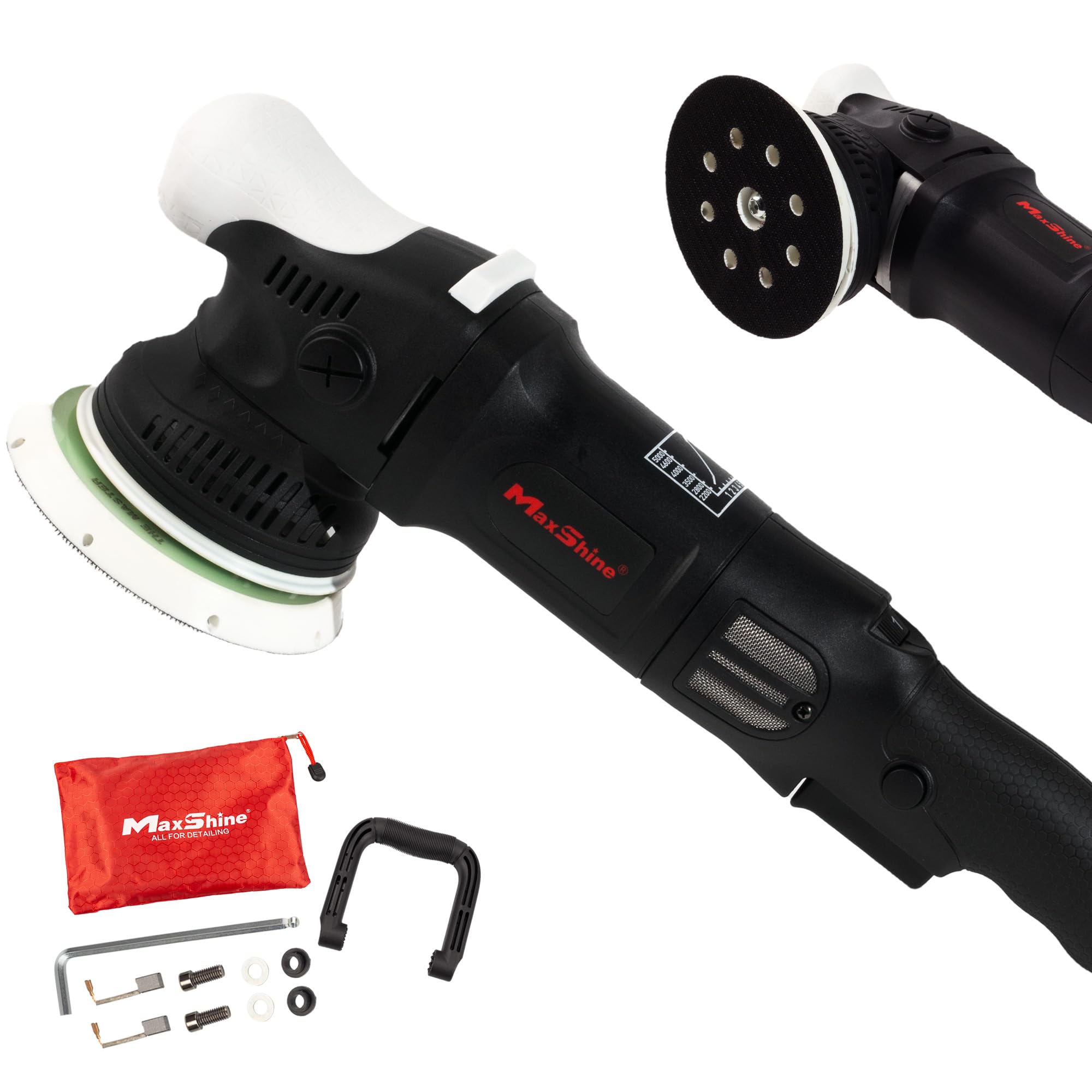
| Maxshine M15 Pro★ Best Overall | Pro Long Throw | 15mm | 1000W | 2500–5000 OPM | Amazon |
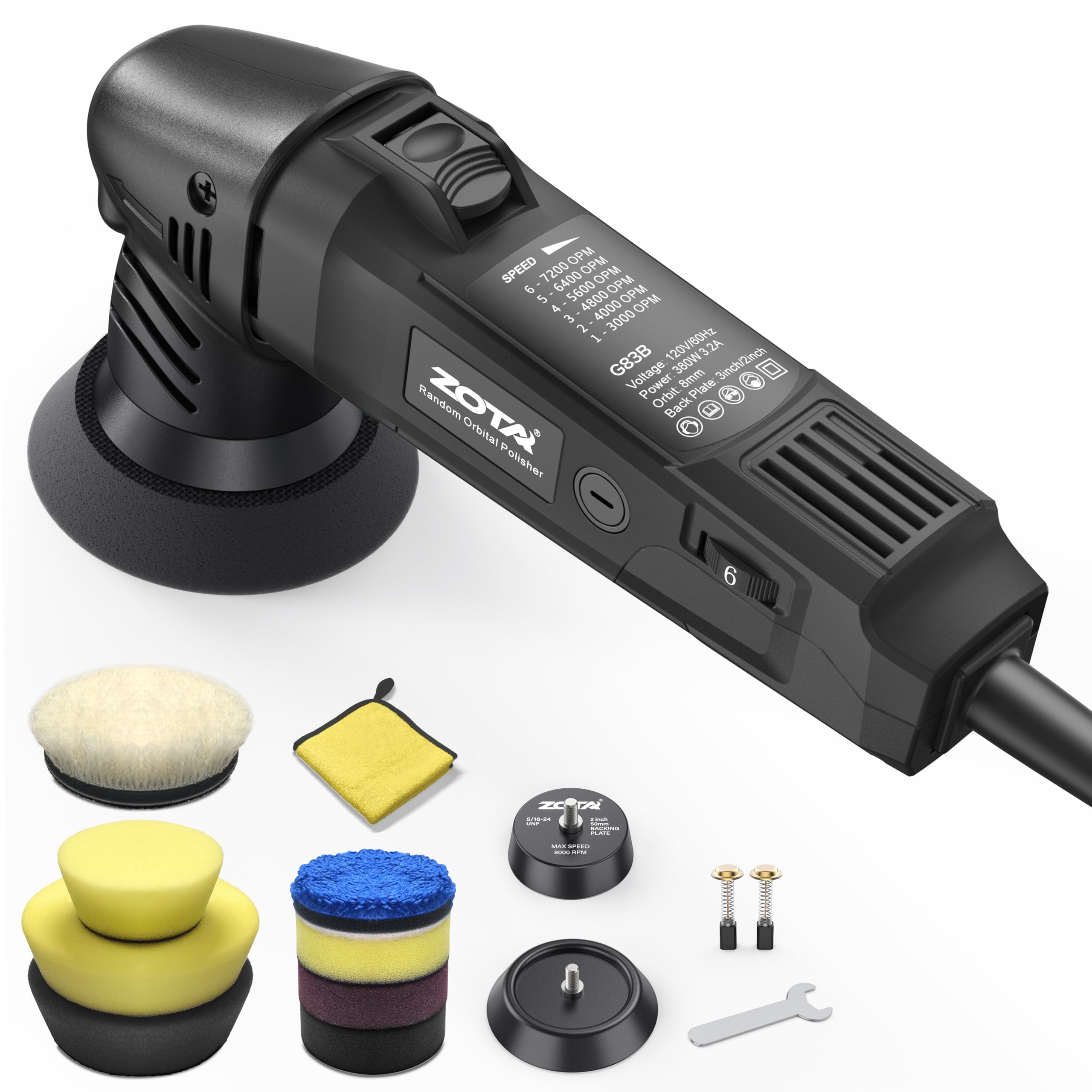
| ZOTA Mini BufferCompact King | Tight Spaces | 8mm | 380W | 3000–7200 RPM | Amazon |
| LDHTHOPI Dual ActionBudget Champion | Budget All-Rounder | 9mm | 980W | 2800–5800 RPM | Amazon |
| WORKPRO Buffer | High Torque Value | 15mm | 1080W | 1400–5000 RPM | Amazon |
| SPTA Mini Orbital | 3-Inch Precision | 10mm | 780W | 2000–5500 OPM | Amazon |
| BATOCA 6″ DA | Kit Inclusions | (Standard DA) | 700W | 1000–3800 OPM | Amazon |
| Meguiar’s MT300 | Digital Torque Control | (Standard DA) | 4.5A | Variable | Amazon |
| Griot’s Garage G9 | Beginner-Friendly Power | 9mm | 1000W | 2000–6400 OPM | Amazon |
| Milwaukee M18 Fuel | Cordless Freedom | 15mm | Battery (M18) | 2650–5100 RPM | Amazon |
In‑Depth Reviews
1. Maxshine M15 Pro Dual Action Polisher
Our pick — over 4.5★ from 400+ verified ratings; the strongest balance of quality and price.
The 1000W workhorse that makes seven-year-old paint look like a fresh respray.
This 15mm long-throw polisher is the crowd favorite for a simple reason: its 1000W motor delivers consistent torque even when you lean into a tough scratch, and the 15mm orbit means you cover more area per pass than standard 8mm or 9mm machines. Variable speed from 2500 to 5000 OPM gives you precise control for everything from heavy cutting to final wax finishing. Buyers report it is a “huge improvement over Porter Cable 7424xp” — specifically for one-step correction work that leaves virtually no holograms.
The honest trade-off is stability on curved panels. While owners praise its power and smooth operation on flat surfaces, a fair number note that it can stall more easily on tight curves and creases. An aftermarket spacer is a common fix. At a 5.2-pound weight, it is noticeably heavier (41% more) than the ZOTA mini, but that heft also delivers the momentum you want for sustained correction on large SUV panels and boat gel-coat.
The build quality and performance earn the most praise from owners — 41 and 29 counts respectively — and the consensus is that it matches Rupes-level results for roughly half the price. For anyone ready to move beyond a standard throw into pro-level efficiency, this is the one that delivers.
Why it wins
- 1000W motor with real torque that does not bog down under pressure
- 15mm long throw cuts correction time versus 8–9mm machines
- Owners say it outperforms Porter Cable and nearly matches Rupes
The honest limit
- Stalls more easily on tight curves than on flat panels
- 5.2 pounds is weightier than mini options
Reach for this if: you want 15mm long-throw efficiency and enough torque to correct heavy defects without spending Rupes money.
Think twice if: you mostly work on tight, complex curves where stalling becomes frustrating.
2. ZOTA Mini Buffer Polisher
The lightweight that slides into spots a full-size polisher cannot reach.
At only 3.7 pounds and with a compact 2-inch and 3-inch pad system, this 380W mini polisher is built for the tight real estate around headlights, A-pillars, bumpers, and motorcycle tins. It runs at a variable 3000–7200 RPM with an 8mm random orbital action, so you get 44% more speed than the Maxshine’s top end — ideal for small surface work where fast oscillation is an advantage. Owners say it works great for a full boat compound, buff, polish, and wax routine, and that it “doesn’t overheat if used gently.”
The included accessory kit is generous: two backing plates (2″ and 3″), six sponge pads, a wool pad, and a microfiber towel all come in the box. What wins owners over most is the effectiveness (74 counts) and the size (55 counts) — it truly reaches crevices that would require hand-polishing with a bigger machine. The trade-off is that with 380W (a 2.6x gap versus the Maxshine’s 1000W), it is not a heavy-correction tool; you will need patience for deep scratch removal on large panels.
The build quality also draws praise — the rugged nylon PA6-30%GF housing feels durable — and the variable speed dial gives you six settings for light waxing through heavier cutting. For a secondary polisher that lives in your door pocket for intricate work, this is the play.
What it nails
- 3.7 pounds and compact enough for tight spots and small panels
- Comes with a full kit of 2″ and 3″ pads and backing plates
- 7200 RPM top speed for fast work on small areas
Where it sits
- 380W motor lacks torque for heavy correction on large SUV panels
- Included pads are described as low quality by some owners
If you mainly detail: motorcycles, engine bays, or need a spot-finisher for curves, this mini covers every awkward angle.
If you only correct: large flat panels and deep scratches on sedans, look for a 1000W full-size machine instead.
3. LDHTHOPI Dual Action Polisher
The entry-level machine that punches well above its price tag.
With a 980W motor, a 9mm random orbital action, and variable speed from 2800 to 5800 RPM, this polisher aims squarely at the budget-conscious buyer who still wants real cutting power. The 9mm throw makes it beginner-friendly — you are far less likely to burn through clear coat than with a forced-rotation buffer — and the kit includes eight detachable pads, two handles (a D-handle and a side handle), and a carrying bag. Owners rate its effectiveness and quality highest (59 and 47 counts respectively), calling it “excellent value and performance – great for beginners and pros.”
The kit is notably complete: five-inch and six-inch backing plates, wool pads, foam pads in three colors (yellow for heavy cut, orange for medium, blue for polish, white for final), and even sandpaper sheets all arrive in the box. The ergonomic D-handle and side handle give you options for grip, which helps on long sessions. The catch is durability — a mixed 30-count shows that while most owners are satisfied, some report the power head breaking off over time. The unit also generates noticeable heat and noise during extended use.
Still, for a first-time buyer or someone who needs a capable DA for occasional weekend projects, the LDHTHOPI delivers near-pro results without a painful entry cost.
Why it stands out
- 980W motor provides smooth cutting power for a beginner-level price
- Comes with 8 pads, two handles, sandpaper, and a carrying case
- Random orbital action is safe for learning paint correction
Watch for
- Durability is a mixed topic — some owners mention head breakage
- Runs hot and noisy during longer sessions
Grab this if: you are new to detailing and want a complete kit with real 980W power that won’t break the bank.
skip it if: you need a tool for daily professional use where long-term durability is essential.
4. WORKPRO Buffer Polisher

The strongest motor in the lineup for those who want to cut fast and heavy.
At 1080W and 9 amps, this WORKPRO polisher has the highest wattage of any machine on this list. Paired with a 15mm dual-action orbit, it delivers the kind of torque that lets you apply real downward pressure on deep scratches without the pad stalling. Speed ranges from 1400 to 5000 RPM, and the six-setting dial lets you dial in a low waxing speed or a high cutting speed. Owners praise its polishing performance (16 counts) and overall quality (15 counts), with one detailing a 40-foot gel-coat trailer off a generator — the machine never bogged down.
The ergonomic design includes a grip hood and an auxiliary handle, plus a switch-lock mechanism that reduces hand fatigue. The kit supplies a six-inch backing pad, one wool pad, six foam pads, and spare carbon brushes. The honest weight penalty is real: at 3.37 kg (around 7.4 pounds), buyers consistently note it is heavy, and the free-spin stops too easily under the machine’s own weight on horizontal surfaces. The six-inch pad size also makes it less efficient around bumpers and door handles.
For someone who corrects large panels or boats where raw torque matters more than maneuverability, the WORKPRO offers the highest ceiling of cutting performance in this mid-range tier.
The muscle
- 1080W / 9 amp motor is the most powerful in this guide
- 15mm dual action throw covers large panels efficiently
- Well-supplied kit with wool and foam pads included
The weight
- Around 7.4 pounds is tiring for extended overhead or vertical work
- Six-inch pad struggles to fit tight curves and door handles
Best for: heavy correction on large flat surfaces like SUV hoods, boat gel-coat, and fleet vehicles where torque is everything.
Not ideal for: one-handed work on motorcycle tins or tight bumper recesses.
5. SPTA Mini Orbital Polisher

The 3-inch specialist for paint correction in places a 6-inch pad cannot go.
This 780W, 10mm orbit mini polisher is designed for the intricate work that a full-size DA polisher handles poorly — tight curves, door jambs, mirror housings, and motorcycle fuel tanks. The three-inch pad format and variable speed from 2000 to 5500 OPM give you precise control in small zones, and owners repeatedly call it an excellent value compared to the Griot’s G8, noting it has “more power, larger orbit, soft start, locking switch.” The build quality (42 positive counts) and performance (43 positive counts) are the most-praised aspects.
The kit is unusually complete for a mini: three polishing pads, two wool pads, a pad conditioning brush, 12 sanding discs, a tool apron, a carry bag, and two bottles of scratch remover are all included. The ergonomics are thoughtful — the speed dial sits right above the thumb for easy on-the-fly adjustment. The main catch is weight. At 3.2 kg (about 7 pounds), it is heavy for a so-called mini — owners flag this as a negative (28 counts), noting it feels solid but can fatigue the hand during extended use in tight positions that require one-handed holding.
For an enthusiast who wants a dedicated small-pad machine that can handle real correction without blowing the budget, the SPTA is the pick.
What it brings
- 3-inch pad size reaches spots a standard 6-inch polisher cannot touch
- 780W motor gives it genuine correction power for a mini
- Comes loaded with pads, sanding discs, and scratch remover
The weight penalty
- About 7 pounds is heavier than it looks — tiring for one-handed tight-spot use
- Difficult lock/start button noted by several owners
Ideal for: the detailer who already owns a full-size DA and needs a compact correction tool for intricate bodywork.
Less suited for: someone expecting a lightweight one-hand polisher for quick wax application.
6. BATOCA 6″ Dual Action Random Orbital Polisher
The ready-to-go kit that includes almost everything but the car.
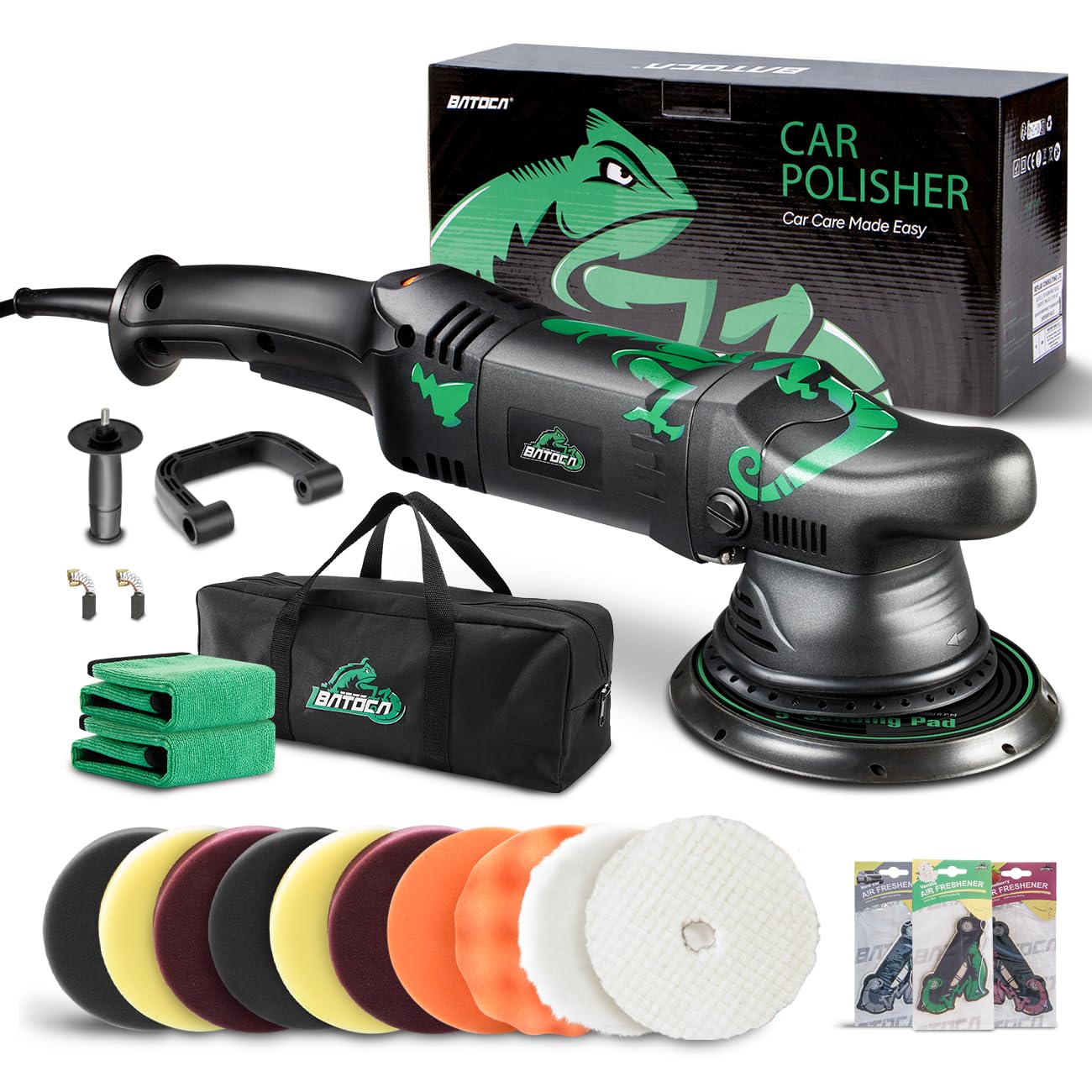
BATOCA’s 700W DA polisher is built around convenience. Six variable speeds (1000–3800 OPM) make it easy to switch from waxing to polishing, and the kit arrives with a generous accessory bundle: six-inch flat foam pads, wool pads, polishing bonnets, sandpaper, a microfiber towel, a tool bag, and even disposable gloves. Owners highlight the quality (30 counts) and functionality (25 counts) most, noting it works beautifully on gel-coat boats and comes with “a LOT of pads.” The eccentric shaft design is meant to keep the action safe for beginners, reducing the chance of paint damage.
The green chameleon design on the body is a style call only you can judge, but the ergonomics are solid: a curved body grip and a straight plus D-handle give you grip options. Two pairs of carbon brushes are included for the periodic replacement around every six months. The honest catch is that at 8 pounds, this is the heaviest machine in the lineup, and durability gets mixed feedback — some customers note the head falling off over time. On the plus side, running three full car details in an eight-hour session is reported as flawless by several owners.
If you want one box that gets you polishing without buying pads separately, the BATOCA delivers an excellent starter experience for the price.
Box bonus
- Comprehensive kit with foam pads, wool pads, bonnets, towels, bag, and gloves
- Eccentric random orbital action is beginner-friendly
- Reviewers point out excellent results on boats and cars from the start
Heads-up
- 8 pounds is heavy — arm fatigue is real on vertical panels
- Mixed durability reports: some owners experience head failure
Who it fits: the first-time buyer who wants everything in one shipment and is okay with 700W of power for weekend use.
Who should skip: professionals needing a lighter tool for all-day correction work.
7. Meguiar’s MT300 Variable Speed Dual Action Polisher

The name-brand DA that brings digital torque management to the home garage.
Meguiar’s MT300 stands apart from the pack with its Digital Torque Management — an electronic system that adjusts torque on the fly to maintain consistent speed under load, so you can apply pressure without suddenly bogging down or burning the paint. The soft start technology prevents product sling when you pull the trigger, a small refinement that saves cleanup time. Owners also note the billet counterweight keeps vibration well-managed compared to older Porter Cable models. The build quality (68 positive counts) is the most-praised aspect by far.
At 5.4 pounds, it is a mid-weight machine, and the multi-position D-handle improves comfort across flat and vertical panels. Shoppers say it flawlessly corrects nine-year-old weathered black clearcoat and works safely on RV fiberglass restoration. The catch is that the MT300 has seen reliability concerns — 59 mixed counts land on reliability, with some owners reporting the motor dying after ten minutes or erratic speed fluctuation. It also requires a separate backing plate and pads (not included), so your total cost goes beyond the base price.
For the enthusiast who values smart torque control and the Meguiar’s ecosystem (the DMCKIT5 correction kit is a common pairing), this is a precision tool — but check the warranty terms carefully.
What makes it different
- Digital Torque Management maintains constant speed under heavy pressure
- Soft start prevents product sling and pads walking on startup
- Build quality is near-universally praised by owners
Critical watch
- Reliability is mixed — a notable number of buyers report early motor failure
- No backing plate or pads included; adds cost
Reach for this if: you want variable torque control and a proven brand name for mid-level correction.
Consider alternatives if: you need a tool for daily professional use where reliability every single day is non-negotiable.
8. Griot’s Garage G9 Random Orbital Polisher

The 1000W beginner-friendly polisher that even first-timers use without burning paint.
Griot’s Garage built the G9 around a 1000W motor with a 9mm orbit — a combination that gives you real cutting power (matching the Maxshine’s wattage) but a shorter, safer throw that is much harder to burn through clear coat with. Variable speed from 2000 to 6400 OPM covers everything from gentle wax spreading to aggressive compound work. Owners rate the quality (28 counts) and performance (27 counts) highest, describing it as quiet, smooth, and low-vibration. One first-time user said it “worked excellent for a first time correction” and that the five-inch backplate conversion eliminated stalling.
The ergonomics are a strong point: a double-shot rubber grip and a contoured shroud keep it comfortable for extended sessions, and the fan-cooled counterbalance plus premium bearings keep vibration impressively low. The ten-foot quick-connect power cord gives you good reach without dragging an extension through puddles. The two most common gripes are a trigger lock design that long-time users find frustrating, and the lack of a removable right-angle handle for better control on vertical panels. The G9 also lacks a soft-start feature that some competitors at this price include.
For a home detailer who wants professional results without professional risk, the G9 is a powerfully safe choice.
Why beginners love it
- 1000W motor with a 9mm short throw — hard to burn paint with
- Very low vibration and quiet operation for long sessions
- 5-inch backplate conversion available to reduce stall on curves
Room for improvement
- Trigger lock design annoys experienced users
- No soft-start feature at this price point
Best for: the first-time polisher who wants 1000W power with a wide safety margin on clear coat.
Not ideal for: pros who need a soft start and a more intuitive trigger lock on a daily driver.
9. Milwaukee M18 Fuel 15mm Random Orbital Polisher (Bare Tool)

The cordless 15mm long-throw that frees you from extension cords entirely.
Milwaukee’s M18 Fuel polisher brings the 15mm long throw into a battery-powered platform, meaning you can walk around a car without tripping over a cord or hunting for an outlet in a driveway. The eight-speed dial (2650–5100 RPM) and a variable-speed trigger give you fine control, while the premium electronic motor feedback maintains speed and torque under load — the same kind of consistency the Maxshine delivers, but cordless. Owners call it a standout, noting that an M18 6.0Ah battery can complete a whole track car on one charge, and that the zero-swirl finish is “buttery smooth.”
The performance (62 positive counts) and quality (43 positive counts) are the top-rated traits by owners, and at 6 pounds it is well-balanced for the power it delivers. The caveat is that this is a bare tool — no battery or charger is included — so if you are not already in the M18 ecosystem, the total investment jumps significantly. The battery life also gets mixed feedback (23 counts): while it is impressive, a full day of heavy correction may require two high-capacity batteries (6.0Ah or higher).
For the mobile detailer, the RV owner, or anyone who already owns Milwaukee M18 batteries, this is the most versatile long-throw polisher on the list.
The cordless edge
- 15mm long throw in a battery-powered platform — total cordless convenience
- Premium motor feedback maintains speed under load like a 1000W corded tool
- Variable trigger plus an 8-speed dial provides pro-level speed control
The real cost
- Bare tool — batteries and charger sold separately
- Battery life is good but heavy correction eats through multiple packs
Ideal for: the mobile detailer or M18 ecosystem owner who needs cordless freedom without sacrificing 15mm long-throw cut.
Think twice if: you are starting from scratch — corded models at half the investment offer comparable performance.
Understanding the Specs
Orbit Throw (8mm vs 15mm)
The throw is the diameter of the pad’s circular path. An 8mm or 9mm throw is gentler and safer for beginners, but each pass covers a smaller area, so correcting a full hood takes longer. A 15mm long throw covers more surface per pass, cutting correction time by as much as half. The trade-off is that a longer throw is less forgiving on curves — it can stall or create buffer trails if you are not smooth with your hand pressure. If you plan to do full paint corrections, a 15mm machine is worth the learning curve. If you mostly wax or do spot-polishing, a standard 8–9mm throw is fine.
Motor Wattage (700W vs 1000W+)
Wattage tells you the raw power the motor can deliver. A 700W motor is adequate for light polishing, wax application, and gentle scratch removal, but it will likely stall when you push down hard on a deep scratch or a curved panel. A 1000W motor gives you torque to maintain speed under load, so you can apply pressure to stubborn defects without the pad stopping. For most buyers, an 800W to 1000W motor is the balance — powerful enough for heavy correction without the weight penalty of the very high-end 1400W+ professional machines.
FAQ
Is a 15mm long-throw polisher safe for a beginner?
How many watts do I need for heavy paint correction?
Can I use a DA polisher on a motorcycle or boat?
Should I buy corded or cordless for car detailing?
What size pad should I start with?
How long does a DA polisher typically last?
Does a DA polisher need a special backing plate?
What is the difference between a DA polisher and a rotary buffer?
Final Thoughts: The Verdict
Across the board, the da polisher winner is the Maxshine M15 Pro because it delivers a 1000W motor and a proper 15mm long throw at a price that undercuts the pro brands by half, backed by a strong owner consensus on build quality. If you want the beginner-friendly safety of a 9mm throw with the same 1000W power, the Griot’s Garage G9 is the one to reach for. And for a mobile detailer who needs cordless freedom, the Milwaukee M18 Fuel is class-leading — as long as you already own the batteries.
How We Picked
We do not accept paid placement. Every pick is matched to a real buyer and a real use-case; we do not hands-on test units.
Sources & Methodology
Specifications: manufacturer listings and product documentation. Review insights: verified customer reviews, as of July 2026. Pricing: not shown on this page (it changes often); check the current price via the retailer link.
As an Amazon Associate, Trending Car earns from qualifying purchases. This does not affect which products we feature.