
Our readers keep the lights on and my garage snacks stocked. As an Amazon Associate, I earn from qualifying purchases.
Specs are compiled from manufacturer listings and verified buyer reviews and can change over time — please confirm the key details on the product page before buying.
A flat tire is only a minor setback if your pump delivers the right pressure and airflow for your bike. The right pump tops off road tires at 100 PSI or rescues a mountain bike mid-trail without wasting your energy. This guide compares the best cycle pumps on the market—from budget-friendly floor models to pocket-sized electric powerhouses—so you can pick the one that matches how you actually ride.
I’m Min Islam — the founder and writer behind Trending Car. This guide is built by comparing the manufacturers’ published specifications and the patterns across verified customer reviews, so you get each pick’s real strengths and trade-offs instead of marketing spin.
Match pressure, portability, and valve compatibility to your bike and riding habits to find the best cycle pump.
Our Picks at a Glance

How To Choose The Best Cycle Pump
Before you buy a cycle pump, answer three quick questions: where you’ll use it, how much pressure your tires need, and which valve type your bike has.
Match the Pump to Your Riding Style
Road bikes need high pressure—often 100 PSI or more—so a floor pump with a precise gauge is your best friend at home. Mountain bikers and commuters running wide, low-pressure tires benefit more from high airflow, which fills big tires faster. If you ride long distances or off-road, a compact pump that fits in your pocket or saddle bag is non-negotiable for roadside emergencies.
Valve Compatibility: Don’t Get Caught Short
The two main valve types are Presta (thin, with a small locknut) and Schrader (the same as car tires). Many pumps now handle both, but some require flipping an adapter or reversing a head. A universal head that locks onto either valve without tools saves you from fumbling on the roadside. Check your bike’s valve type before buying—this is the #1 mismatch in the category.
Quick Comparison
| Model | Best For | Max Pressure | Airflow | Weight | Amazon |
|---|---|---|---|---|---|
| WEOLULI Portable Inflator★ Best Overall | Best Overall | 150 psi | 24 L/min | 0.89 kg | Amazon |
| AstroAI L7Budget Champion | Budget Electric Value | 150 psi | 17 L/min | 14.08 oz | Amazon |
| BV Bicycle Floor PumpEntry Floor Pick | Budget Floor Pump | 160 psi | Manual | 16 oz | Amazon |
| LEZYNE Pocket Drive HP | Ultra-Compact Backup | 160 psi | 12 cl/s | 75g | Amazon |
| Beto Floor Pump | Gauge Readability | 160 psi | Manual | — | Amazon |
| HOTO Electric Pump | Fast 25s Inflation | 150 psi | — | 8.96 oz | Amazon |
| AUXITO Electric Pump | Pocket-Sized Electric | 120 psi | 14 L/min | 4.48 oz | Amazon |
| Topeak JoeBlow Max HP | Home Shop Workhorse | 160 psi | 322 cc/s | 1.39 kg | Amazon |
| LEZYNE Classic Floor Drive | Track & Road Precision | 220 psi | Manual | 3.1 lb | Amazon |
In‑Depth Reviews
1. WEOLULI Tire Inflator Portable Air Compressor
Our pick — over 4.5★ from 650+ verified ratings; the strongest balance of quality and price.
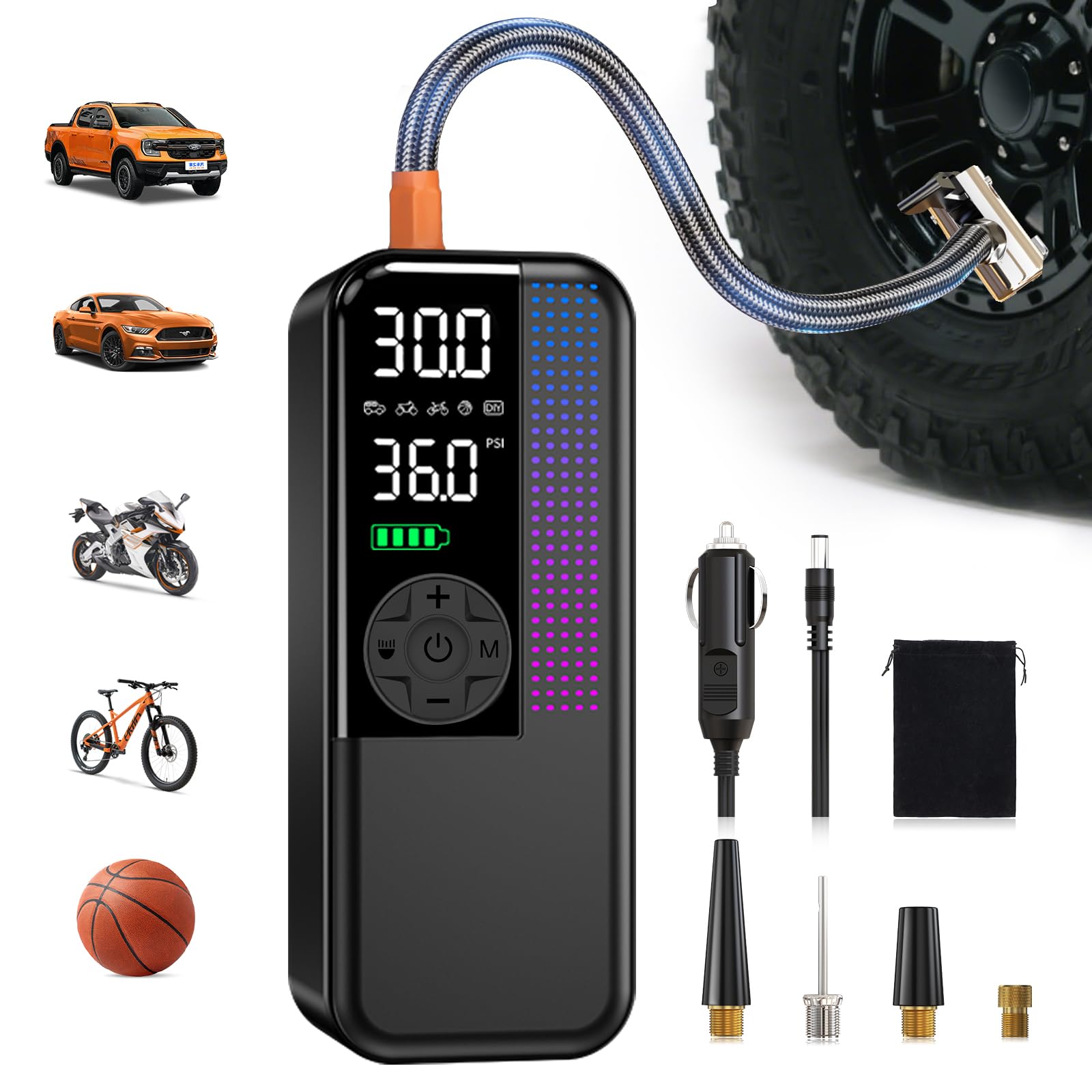
The cordless inflator that tops off three car tires on one charge—without ever overheating.
The WEOLULI takes the top spot because it solves the two biggest electric-pump frustrations: overheating and battery worry. Its smart cooling design keeps the motor running through long sessions, so you can inflate three standard car tires (195/65 R15) back-to-back without the unit shutting down halfway. Buyers report it packs “ton of power in this tiny package,” and the specs agree—it moves 24 liters per minute, a full 41 percent more than the AstroAI L7’s 17 liters per minute, so every fill feels faster.
You get dual power options: a built-in 6000mAh battery for cordless convenience, or your car’s 12V outlet for backup. The digital gauge reads with a ±1 PSI accuracy, calibrated slightly high on purpose so that when you disconnect the valve and lose a puff of air, your tire still lands on target. Four one-touch preset modes—Car, Bike, Motorcycle, and Balls—automatically stop at your desired pressure, so you never overinflate.
Performance is the thing owners praise most by a wide margin (79 buyers single it out), followed closely by quality (46). The practical proof: owners mention it “inflated two flat tires in under a minute,” and one reviewer topped a mini spare from 12 to 60 psi in about 4-5 minutes. The included kit—a 500mm hose, Presta adapter, ball needle, two tapered nozzles, USB cable, and a storage bag—means it works for everything from e-bikes to basketballs.
Why It Wins Riders Over
- 24 L/min airflow is the fastest in this lineup
- 6000mAh battery plus 12V car plug means no dead-end situations
- 4 preset modes with auto shut-off for simple to use fills
The Honest Trade-Offs
- Somewhat noisy during operation, per owner reports
- At 0.89 kg it’s heavier than pocket-sized electrics
Reach for this if: you want one inflator that handles your car, bike, motorcycle, and sports balls without overheating or dying mid-task.
Set your expectations: it’s compact but not pocket-sized—best kept in the car or garage, and it’s louder than a manual floor pump.
2. AstroAI L7 Air Tire Inflator
The mighty little titan that refills 30 bike tires on a single charge without breaking a sweat.
The AstroAI L7 proves you don’t need to spend big for cordless convenience. AstroAI claims it inflates 300 percent faster than traditional car pumps, and for bikes the math holds up—owners watched it take tires from 16-27.5 PSI up to 55 PSI in under a minute. Its 150 PSI max pressure and 17 liters per minute airflow trail the WEOLULI, but it weighs just 14.08 ounces versus the WEOLULI’s 0.89 kg, a 14 percent gap that makes it far easier to toss in a pannier.
Functionality is what wins people over here—nearly 50 owners call it out. The auto shut-off and preset pressure are the stars, letting you set your target and walk away while the pump stops itself. Five preset modes cover Car, Motorcycle, Bicycle, Ball, and Manual, with unit switching between PSI, kPa, BAR, and kg/cm². The top-mounted flashlight has three modes—flashlight, SOS, and strobe—for night-time roadside fixes.
The L7’s clever trick is its dual USB-C ports: they can charge your phone in a pinch, turning the pump into a backup power bank. The 5-in-1 accessory kit includes a Presta adapter, ball needle, and an inflatable ring nozzle for swim rings and pool floats. Battery feedback is mixed (26 mentions, split verdicts)—some owners say the charge drains faster than expected between uses, so treat it as an emergency tool rather than an everyday workhorse.
Who it beats: the L7 undercuts the WEOLULI on weight and matches its 150 PSI ceiling, but it gives up speed—17 L/min vs 24 L/min moves noticeably less air on big tires.
The real catch: owners note it gets sluggish above 40 PSI and can overheat after sustained runs; treat it as a top-off tool, not a tire-shop replacement.
Best if: you want a light, cordless inflator for bike tires, balls, and car top-offs at a budget-friendly price.
Think twice if: you regularly pump large SUV tires from flat—the slower airflow and battery drain will test your patience.
3. BV Bicycle Pump 17/24 inch Floor Pump
The budget floor pump that reaches 120 PSI easily and flips between valve types instantly.
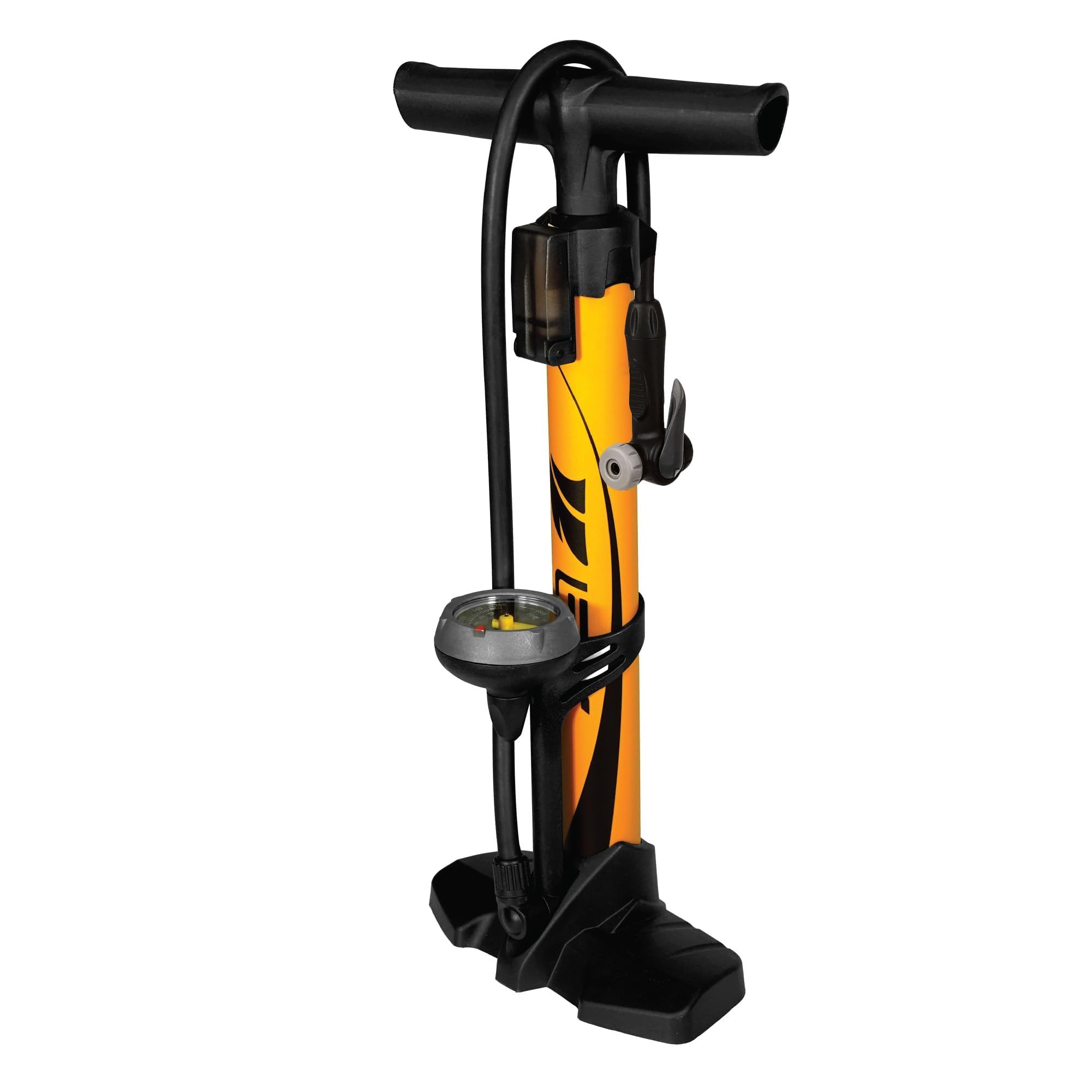
The BV is the entry-level floor pump that gets the basics right. It tops out at 160 PSI—edging out the 150 PSI of the electric picks (a 7 percent margin)—which is plenty for road tires. The 16.25-inch barrel keeps it easy to carry, and the ergonomic handle makes high-pressure pumping less of a forearm workout. The twin valve design lets you switch between Presta and Schrader by simply reversing the components in the head, no tools needed.
At 16 ounces, it’s lighter than it looks, and the alloy steel construction gives it a solid, stable feel on the floor. The crowd has been massive—over 30,000 ratings at 4.5 stars—making it among the most-tested pumps in this guide. Owners confirm it “reaches 120 PSI easily,” and the gauge stays accurate at higher pressures, though it runs a bit off at the low end (showing 40 on a car tire that actually holds 32).
The honest catch is the gauge: the most common complaint is that it reads 10-15 PSI low, which matters if you’re a precision rider who tunes pressure to the pound. The presta side also has a durability question mark—one owner’s failed after about 12 uses. But for the price, the build quality holds up well and the dual-valve convenience is genuinely useful for households with mixed bike types.
The verdict: a dependable low-cost floor pump for casual riders who want one tool that handles both valve types—just keep a separate gauge handy if precise pressure matters to you.
Grab it for: the garage as a no-fuss pump for family bikes, kids’ rides, and ball inflation.
Pass if: you’re a road racer who needs dead-accurate pressure readings—the gauge drift will frustrate you.
4. LEZYNE Pocket Drive HP Hand Pump
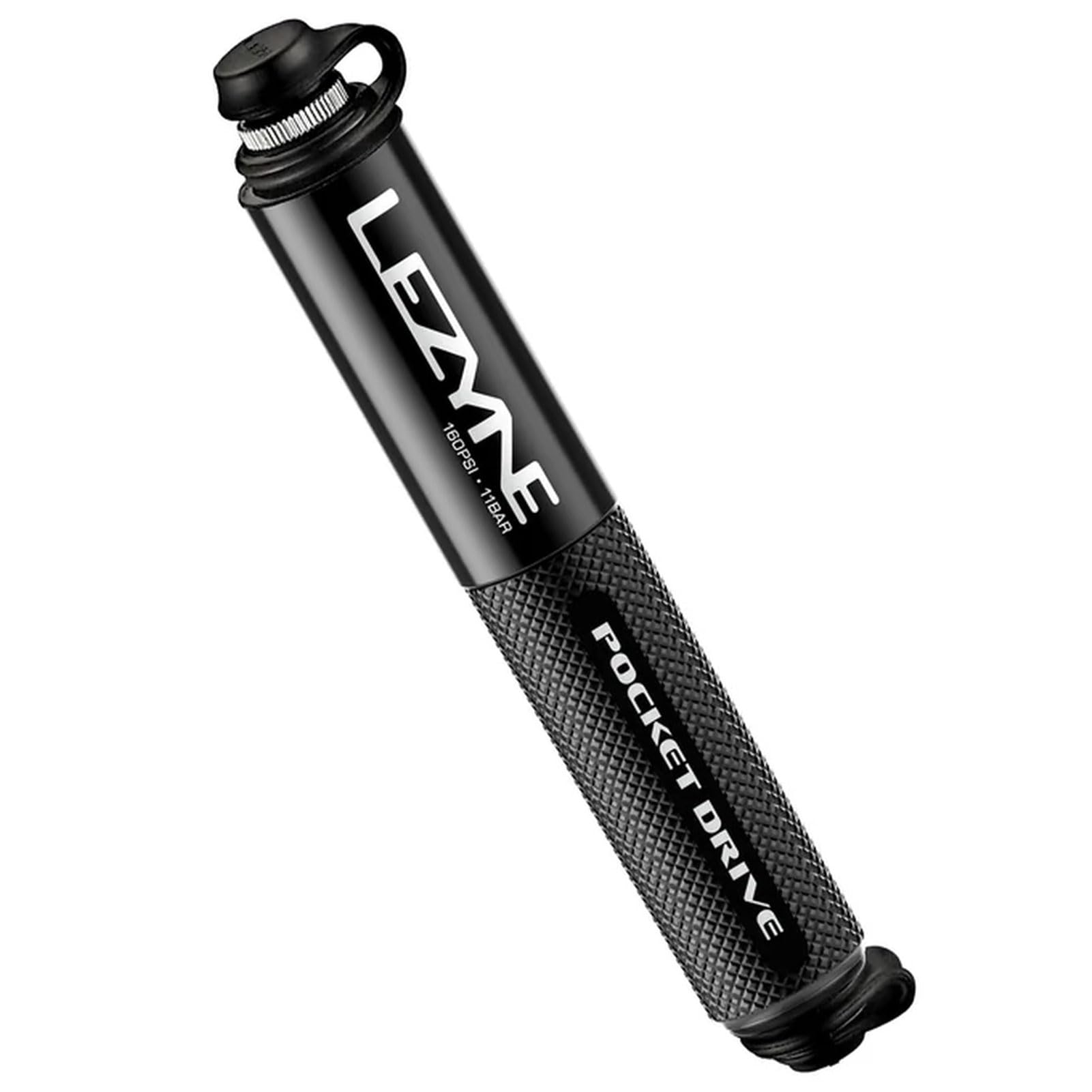
The 75-gram pocket rocket that delivers a genuine 160 PSI when you’re stranded miles from home.
The LEZYNE Pocket Drive HP is what you carry, not what you keep in the garage. Weighing just 75 grams and measuring 150x23x28.8mm, it disappears into a jersey pocket, saddle bag, or clips to your frame with the included Composite Matrix mount. CNC-machined aluminum construction means it’s built to survive years of roadside flats—owners describe it as “built to last 10 years”—and the knurled, slip-resistant handle keeps your grip secure even with sweaty hands.
Size is the thing everyone raves about (the most-praised aspect), and for good reason: it delivers a legit 160 PSI (11 bar) from a body smaller than most phone chargers. The screw-on Presta connection prevents air loss—a problem with cheaper lever-style heads—and the ABS Flex Hose reduces valve stress for a secure, leak-free seal. The integrated design works with both Presta and Schrader valves.
The trade-off is time. Owners confirm a 700cx23 tube fills quickly, but a tubeless 2.8-inch MTB tire needs roughly 200 pumps for 25 PSI, taking 3-7 minutes per tire. Above 110 PSI, pumping requires serious force. This is a backup tool, not a primary pump—but it replaces the recurring cost of CO2 cartridges, and plenty of owners conclude it’s “better than a co2 pump” for reliability and cost.
The mic-drop: 160 PSI of trail-side rescue power in a 75g package you’ll forget you’re carrying—until your tire doesn’t.
Perfect for: roadies, gravel riders, and bikepackers who need a dependable safety net that vanishes into a pocket.
Not for: anyone who wants quick inflation—this is slow, deliberate work, and fat-tire bikes will test your patience.
5. Beto Bike Floor Pump with Top-Mounted Gauge

The floor pump with a 47.2-inch hose that reaches your valve even when the bike’s on a work stand.
The Beto floor pump tackles the most annoying part of pumping: reaching the valve. Its hose runs a generous 47.2 inches and starts near the top of the barrel, so you can reach a valve on a raised surface or a bike in a work stand without contorting. That long reach, plus a 2.5-inch top-mounted gauge, makes it the easiest pump in this guide to read at a glance.
Quality is what owners praise most (59 call it out), and it shows in the details. The patented AH4 Auto Head connects automatically to Schrader, Presta, and Dunlop valves with zero adjustment—push down, lock the lever, pump. The steel barrel and wide base hold firm on the floor, and the ergonomic anti-skid handle keeps pumping comfortable. A ball needle stores right in the handle for inflating balls and air beds.
The raised gauge is the standout feature, with owners confirming it “can reach up to 100 PSI without much effort” and that the big numbers are easy to read. The recurring gripe is the presta clamp—some customers note it doesn’t hold a perfect seal, losing a little air on release. The lever also feels stiff initially, though it eases with use. One long-term owner’s valve head gave out after two years of heavy use, which is a fair durability note at this price.
Where it shines: the long hose and readable gauge make this the most comfortable floor pump for home mechanics working on multiple bikes.
The trade-off: the presta seal can be finicky—tighten the lever firmly and expect minor air loss on release.
Choose this if: you pump bikes on a stand or raised surface and want a gauge you can actually read without bending over.
Look elsewhere if: you need a bomb-proof presta seal for daily track bike use—the clamping mechanism is the weak spot.
6. HOTO Electric Bike Tire Pump

The palm-sized electric that takes a road tire from 80 to 100 PSI in just 25 seconds.
The HOTO is the speed king of the electric picks. It takes a 700×23C road tire from 80-100 PSI in just 25 seconds, with a 150 PSI ceiling that matches the best in this lineup. The smaller-than-most-smartphones body packs a punch—owners call it “powerful” and “compact”—and the 360° rotating hose means you can connect from any angle, which matters when you’re reaching a valve in a cramped bike rack.
What makes the HOTO genuinely smart is its memory function: it stores your last two pressure settings, so switching between your road bike’s 90 PSI and your gravel bike’s 45 PSI is a one-tap operation. The auto-stop feature cuts off exactly at your preset PSI, and the LED display shows real-time pressure with ±1 PSI accuracy. There’s no traditional on/off switch—swinging the hose out powers the unit on, a clever design that prevents accidental battery drain.
The battery is a workhorse: up to eight flat tires or eighteen low-pressure 700×23C tires on a single charge, and it recharges fast via Type-C. Owners note it holds ~75 percent charge after three fills, and the included adapters cover Presta, Schrader, and ball valves. One owner found the gauge reads 10 PSI low (setting 80 gives you 70 actual), so double-check against a known source the first few times.
The standout: nobody else in this guide hits 25-second road-tire fills from a device this small—it’s the best speed-to-size ratio here.
Know before you buy: the Presta adapter is a separate piece you attach first, and the gauge can read slightly low on some units.
Ideal for: the rider who wants electric speed without lugging a compressor—slips in a jersey pocket or seat bag.
skip it if: you pump large-volume MTB or fat tires regularly; the small barrel moves less air than a floor pump.
7. AUXITO Electric Bike Pump

The lightest electric in the guide at 4.48 ounces—true pocket-size inflation with auto-stop precision.
The AUXITO is the featherweight of the electric category, measuring just 2.49 x 1.57 x 1.15 inches and weighing only 4.48 ounces. Its 4.48-ounce weight makes it easy to forget in a pocket until a roadside flat demands it. Despite the tiny footprint, it delivers a 120 PSI max pressure and 14 liters per minute airflow, taking a 700×23C road tire from 80 to 100 PSI in 20 seconds. Reliability is the thing owners praise most (103 call it out), with quality close behind (100).
The brushless motor and 1000mAh battery give it a surprisingly strong inflation rate, and the smart auto-stop uses a high-precision sensor to cut off exactly at your preset PSI—with ±1 PSI accuracy on the LED display. The “+” and “−” buttons let you adjust pressure from 2 to 120 PSI, and it remembers your last setting. A built-in LED light handles roadside repairs in the dark, and Type-C charging reaches full in just 1.5 hours.
The battery earns mixed feedback (65 mentions, split verdicts)—some owners left it in the trunk for two months with a full charge and plenty of fills, while others found it drains faster than expected. The adapters are separate accessories you must switch manually, and the hose gets hot with extended use, needing a cool-down between tires. One owner sums it up: “in a few seconds it leaves the tires with the right pressure” and loves that it stops automatically.
The edge: at 4.48 ounces it’s the easiest electric to carry daily, yet still inflates three full 700×25C tires from 0-80 PSI on one charge.
The limit: 120 PSI cap falls short of the WEOLULI’s 150 PSI, so track racers chasing 140+ PSI should look upmarket.
Perfect for: commuters and weekend riders who want an electric emergency pump that doesn’t weigh down the bike.
Not ideal for: high-pressure track bikes above 120 PSI or anyone who hates juggling separate valve adapters.
8. Topeak JoeBlow Max HP Floor Pump

The heavy-duty home shop pump with a TwinHead design that handles Presta, Schrader, and Dunlop.
The Topeak JoeBlow Max HP is the floor pump for riders who want one tool that does everything, forever. The universal TwinHead design works with Presta, Schrader, and Dunlop valves with no adapters or extra tools—swap between your road bike and your kid’s hybrid without touching a thing. The heavy-duty painted steel barrel and composite base are built for years of frequent home or shop use, and the 160 PSI ceiling covers everything except extreme track setups.
The large analog gauge is a joy to read, giving you accurate control for road, mountain, and hybrid tires. The oversized padded handle and extra-long hose make pumping comfortable from any angle. With 322 cubic centimeters per second of airflow, it fills high-volume tires quickly—owners confirm it “pumps up tires fast” and handles both valve types with “sturdy and smooth operation.” One returning customer bought a second unit because the first had served so well, noting the satisfaction runs deep enough to buy again.
The build quality is substantial enough that riders keep it in the car for road trips. The one recurring complaint is the valve lock lever—it’s stiff to engage and pointed enough to be painful if your hand slips. That’s a minor ergonomic gripe on an otherwise rock-solid pump that owners describe as a “reputable company & quality hardware” purchase.
The takeaway: if you want a floor pump that will likely outlast your current bike, the JoeBlow’s steel construction and universal valve head make it the one to buy.
Buy it for: the home mechanic who works on multiple bikes and wants one sturdy, reliable pump that never needs adapters.
Steer clear if: you need a portable pump or have a small storage space—this is a full-size floor pump built to stay put.
9. LEZYNE Classic Floor Drive 3.5

The 220 PSI floor pump with a varnished wood handle for road and track riders who chase every pound.
The LEZYNE Classic Floor Drive 3.5 is the precision instrument of this guide, delivering up to 220 PSI for road, gravel, and track bikes. The smaller-diameter barrel is the engineering trick: it achieves high pressure with minimal pumping force, so you’re not fighting the pump as you approach 200 PSI. Ease of use is the most-praised aspect (87 owners call it out), with quality close behind (84).
The 3.5-inch analog gauge is the largest in this guide, so you get precise pressure readings at a glance. The threaded ABS-1 Pro chuck screws securely onto both Presta and Schrader valves, forming a solid connection with virtually no leakage—owners confirm “it makes it easy to switch between presta and shrader” and note the screw-on design seals better than lever-type heads. The durable steel and aluminum construction, topped with a varnished wood handle and premium paint finish, makes it as much a workshop centerpiece as a tool.
The accuracy feedback is mixed (34 mentions, split verdicts)—some owners find the analog gauge reliable, while others report readings that drift from a digital reference. That’s common across analog gauges, and the screw-on chuck’s negligible air loss on removal helps compensate. One owner’s five-year durability confirmation speaks to the build quality. The stable foot braces and oversized handle reduce fatigue, making it comfortable for repeated inflation during race-weekend prep.
The specialty: nobody else here hits 220 PSI—if you run tubular track tires or latex tubes at extreme pressures, this is the pump that gets you there without a hernia.
The compromise: it’s a premium price for a single-purpose high-pressure tool, and the gauge can drift slightly versus digital references.
Reach for this: the dedicated road or track cyclist who tunes pressure to the pound and wants a durable, beautiful floor pump.
Look past it: casual riders who just need a simple garage pump—the 160 PSI options cover you for less.
Understanding the Specs
PSI and Maximum Pressure
PSI (pounds per square inch) measures how much pressure the pump can push into your tire. Road bike tires often need 100-120 PSI; mountain bikes run 25-50 PSI. A higher max rating (160 PSI or more) means the pump can comfortably handle road tires without straining. Check your tire’s sidewall for its recommended range—that’s your target.
Airflow Rate (L/min or cc/s)
This tells you how fast air moves. Measured in liters per minute (L/min) for electric pumps or cubic centimeters per second (cc/s) for manual ones, a higher number fills big tires faster. A 24 L/min electric pump will beat a 17 L/min one on a flat car tire; a floor pump’s high airflow makes quick work of mountain bike tires.
FAQ
What is the difference between Presta and Schrader valves?
How much PSI do I need for my bike tires?
Are electric bike pumps worth it versus manual floor pumps?
How long does a cordless bike pump battery last?
Can I use a bike pump for car tires?
What does auto shut-off do on an electric pump?
How accurate are the gauges on budget bike pumps?
Is a floor pump or a mini pump better for beginners?
Final Thoughts: The Verdict
For most riders, the best cycle pump is the WEOLULI Portable Inflator — the crowd favorite at 4.6 stars with 696 ratings — because its 24 L/min airflow and 6000mAh battery handle everything from road tires to car tires without overheating. If you want a budget-friendly electric that saves weight, the AstroAI L7 delivers 150 PSI at just 14.08 ounces. And for the home mechanic who wants a durable, no-fuss floor pump, the Topeak JoeBlow Max HP is the one to reach for.
How We Picked
We do not accept paid placement. Every pick is matched to a real buyer and a real use-case; we do not hands-on test units.
Sources & Methodology
Specifications: manufacturer listings and product documentation. Review insights: verified customer reviews, as of July 2026. Pricing: not shown on this page (it changes often); check the current price via the retailer link.
As an Amazon Associate, Trending Car earns from qualifying purchases. This does not affect which products we feature.