
Our readers keep the lights on and my garage snacks stocked. As an Amazon Associate, I earn from qualifying purchases.
Specs are compiled from manufacturer listings and verified buyer reviews and can change over time — please confirm the key details on the product page before buying.
Staring at a deep scratch on your hood is frustrating, especially when a basic polish just glosses over it without actually removing it. A cutting compound is the heavy lifter that actually abrades the clear coat level with the damage, so you walk away with flat, glossy paint instead of a hidden valley. The trick is picking the right grit and lubricity for your paint’s hardness and your tool — this guide matches real compounds to real results.
I’m Min Islam — the founder and writer behind Trending Car. This guide is built by comparing the manufacturers’ published specifications and the patterns across verified customer reviews, so you get each pick’s real strengths and trade-offs instead of marketing spin.
Whether you are correcting a single scuff on a daily driver or compounding an entire panel after wet sanding, these are the best options for anyone hunting a reliable cutting compound that actually delivers.
Our Picks at a Glance


How To Choose The Best Cutting Compound
Grabbing a compound off the shelf is easy. Grabbing the right one for your paint and your tool takes a minute of planning. These three factors separate a perfect correction from frustrating dust, hazing, or burned clear coat.
Grit Number (Cutting Aggression)
The grit number on a compound tells you how coarse the abrasive particles are. Lower numbers (400, 800) cut fast and deep — ideal for removing 1200-1500 grit wet sanding marks or heavy oxidation. Higher numbers (1000, 1500, 2000) refine the surface, knocking down the haze left by a coarser cut so the paint is ready for polishing or wax. If you skip from a 400-grit compound straight to wax, you will trap swirl marks under the wax. Plan two steps if you use a heavy cut.
Tool Compatibility (Rotary vs DA Polisher)
Not every compound behaves the same under a rotary buffer versus a dual-action (DA) polisher. Rotary machines spin in one direction at higher speeds (say 1800-2000 rpm), which generates heat and friction quickly — ideal for heavy cutting, but a compound that “dusts” badly at high rpm will coat your garage in powder. DA polishers oscillate rather than spin, so they run cooler and require a compound that retains lubricity during longer work times. Some recipes mention specific rpm ranges in the label, so match your tool.
Dusting and Cleanup
A compound that dries into a chalky powder during buffing (high dusting) makes the job messier and can clog your pad mid-panel, forcing you to stop and clean. Low-dust formulas keep the pad wet and the abrasion consistent. The trade-off is that very creamy, low-dust compounds often have less aggressive cutting power because the lubricants cushion the abrasives. Decide whether you value speed of cut or a clean work area, especially if you are working indoors or on a panel you cannot move.
Quick Comparison
| Model | Best For | Grit Rating | Volume | Cut / Gloss | Amazon |
|---|---|---|---|---|---|
| Menzerna Heavy Cut 400★ Best Overall | Pro-grade heavy correction | 400 | 8 fl oz | 8/10 cut / 8/10 gloss | Amazon |
| Meguiar’s M11032 Ultra Pro SpeedPro Speed | Fast, user-friendly correction | 200 | 32 fl oz | 1200 grit removal | Amazon |
| Farécla G3 PremiumPremium Finish | Professional finishing & cut | 1500 | 1 kg (35.2 oz) | High-gloss finish | Amazon |
| Malco Super Duty Heavy Cut | Marine & heavy sandscratch removal | 800 | 32 fl oz | Removes 1500 grit marks | Amazon |
| Chemical Guys V32 Extreme Cutting | Ceramic clear coats | 1500 | 16 fl oz | Removes 1200-1500 sanding marks | Amazon |
| Meguiar’s M04 Heavy Cut Cleaner | Older lacquer & enamel paints | 40 | 16 fl oz | Aggressive cut | Amazon |
| Chemical Guys V36 Optical Cutting Polish | One-step defect removal + gloss | 2000 | 16 fl oz | Fine cut / high gloss | Amazon |
| Menzerna Heavy Cut 1000 | DIY scratch removal by hand | 1000 | 8 fl oz | Medium cut | Amazon |
| ABRO Rubbing Compound | Budget oxidation & scuff removal | Fine (clay) | 10 oz | Fast cut | Amazon |
In‑Depth Reviews
1. Menzerna Heavy Cut 400 (8 fl oz)
Our pick — over 4.5★ from 900+ verified ratings; the strongest balance of quality and price.
The professional’s benchmark for single-step scratch removal and gloss.
You get scratch removal that over two dozen owners single out — the consensus is that this compound cuts as well as the legendary Meguiar’s M105 but with less dust and clogging. The label rates the cut at 8 out of 10 and the gloss at 8 out of 10, meaning you can chase a deep scratch and still walk away with a reflective finish rather than a dull haze that needs a second polish step. For a rotary polisher (a power tool that spins the pad), the recommended window is 800-1500 rpm at the start and 1800-2000 rpm near the end; buyers report that staying at or under 2500 rpm with a heavy cut foam pad keeps the pad from loading up (clogging with dried compound).
A few note that the 8-ounce bottle is small for full-panel work. The crowd favorite here is a crowd favorite for a reason: 4.8 stars from nearly a thousand owners, making it the highest-rated pick in this roundup.
Why it dominates
- 8/10 cut paired with 8/10 gloss — minimal finishing work needed.
- Low dusting compared to Meguiar’s M105, per owner reports.
- Proven on heavy oxidation, water spots, and 1200+ grit sanding marks.
The honest trade-off
- Clogs pads if you push above 2500 rpm on a rotary.
- Smaller bottle format (8 oz) for a premium price; per-ounce cost is high.
- Not beginner-friendly for hand application — really needs a machine.
Reach for it if: you value a single-step correction that cuts hard and finishes glossy, and you are comfortable with a rotary or DA at controlled speeds.
Look elsewhere if: your budget is tight or you plan to work by hand on a small spot — this wants a machine to shine.
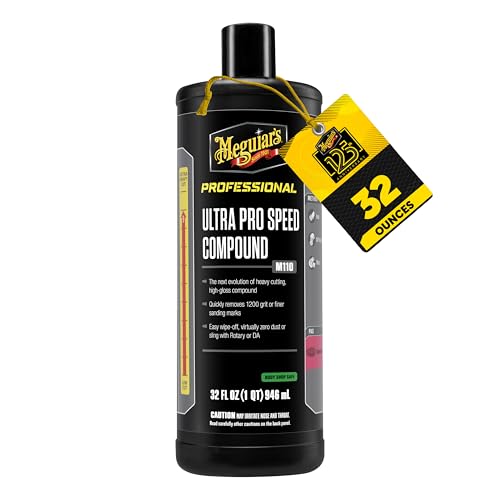
2. Meguiar’s M11032 Ultra Pro Speed Compound (32 oz)
The fast-working runner-up that novice detailers can trust for glossy results.
Meguiar’s claims this compound removes up to 1200-grit sanding marks, and owners consistently report that it leaves a mirror-like finish with less effort than the older M105 formula. The quality rating (32 owners praise it) and the ease of removal (15 owners flag it) make this the pick for someone who wants correction without a wrestling match. Owners mention that it works beautifully with both rotary and DA polishers, and several call it dummy-proof compared to 3M Perfect-It.
The recurring note is dust — about a third of owners mention that it produces a fair amount of powder during buffing, especially if you overwork it on a dry panel. Still, at 4.6 stars from over 800 owners, the overall satisfaction is sky-high. It beats the Menzerna 400 on user-friendliness but falls short on pure cutting aggression for the deepest scratches.
What makes it easy
- Easy wipe-off and minimal hazing, even for a first-time user.
- Generous 32 oz bottle delivers good per-ounce value.
- Proven on repainted panels wet-sanded to 1500-3000 grit.
What to watch
- Dusts noticeably if you push it too long on a dry surface.
- Needs more passes to tackle deep scratches compared to Menzerna 400.
Ideal for: the DIY detailer who wants pro results with an easy wipe-off and a forgiving work window.
skip it if: you need an ultra-heavy cut for deep sanding marks or you hate dealing with compound dust.
3. Farécla G3 Premium Abrasive Compound (1 kg)
The British icon that pro painters reach for on fresh lacquer.
Farécla G3 has been a staple in body shops for decades, and the 1 kg bottle confirms why: it is clean in use, easy to wipe off, and leaves no dragging or hazing on fresh paint. The 1500-grit rating puts it in the middle of the aggression scale — aggressive enough to cut through 1200-grit sanding marks but fine enough to leave a surface that only needs a final polish. Owners consistently call it the best compound on the market, and many refuse to use anything else for finishing a paint job.
At 4.8 stars from over 750 owners, it ties the Menzerna 400 for the highest rating in this guide. The catch is that it is priced at a premium per ounce, and the large bottle may outlast the average DIY user’s needs. For a shop that does multiple corrections a week, the cost per job is very reasonable.
One-sentence verdict: The go-to for body-shop pros and serious detailers who want a clean-cutting compound that finishes nearly polish-ready.
Best for: professional paint correction and high-end detailing where finish quality matters more than budget.
Not for: the occasional weekend warrior who only needs to spot-treat a single scratch.
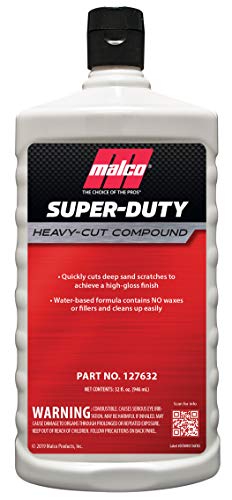
4. Malco Super Duty Heavy Cut Compound (32 oz)
The workhorse for boats, RVs, and neglected single-stage paint.
Malco’s 800-grit compound is made for heavy abuse — it easily removes P1500 sand scratches (scratches from 1500-grit sandpaper) from automotive clear coat and gel coat surfaces alike, making it one of the few compounds that pulls dual duty on boats and cars. Owners praise its cut performance (10 owners mention it) and its removability (10 owners mention it), noting that it wipes off easier than Meguiar’s M105 while leaving a high-gloss finish.
The honest note is that it is designed for clear coat safety but works best with a wool cutting pad — not ideal for soft clear coats or delicate finishes. One owner noted it leaves visible scratches if used on a show-car finish and recommended it for “10 to 20 foot paint jobs” rather than concours-level work.
Where it excels
- Safe on clear coat, gel coat, and single-stage urethane (marine/RV).
- Low dusting compared to M105, per owner feedback.
- Made in the USA and VOC compliant.
Where it stumbles
- Not fine enough for soft clear coats without a follow-up polish.
- Residue can be hard to remove if overworked.
Choose it for: heavy oxidation on boats, RVs, and daily drivers with tough clear coat — the value per ounce is strong.
Pass if: you need a one-step finish on a show car or you work only with a DA and foam pads.
5. Chemical Guys V32 Extreme Cutting Compound (16 oz)

Engineered for ceramic-infused clear coats that resist standard compounds.
Chemical Guys formulated V32 specifically for scratch-resistant and ceramic clear coats, and it removes 1200-1500 grit sanding scratches without the silicone fillers that can interfere with subsequent coatings. The 1500-grit abrasive is fine enough to leave a surface ready for finishing, and the extended work time gives you room to refine your passes before the compound flashes off.
Customers note great results on water spots, paint transfer, and even headlight restoration. A 2019 GMC Denali owner used V32 with felt pads to clear hard water spots from windows. The mixed feedback on scratch retention (23 mentions) suggests that very deep scratches may need extra passes or a coarser first step. No silicone means it is body-shop safe.
The bottom line: A precise, low-dust compound for modern clear coats — pair it with a DA polisher for best results.
Best if: you drive a newer car with ceramic clear coat and want a compound formulated for that hardness.
Skip if: you are chasing deep scratches on soft, older single-stage paint — you need a coarser grit first.
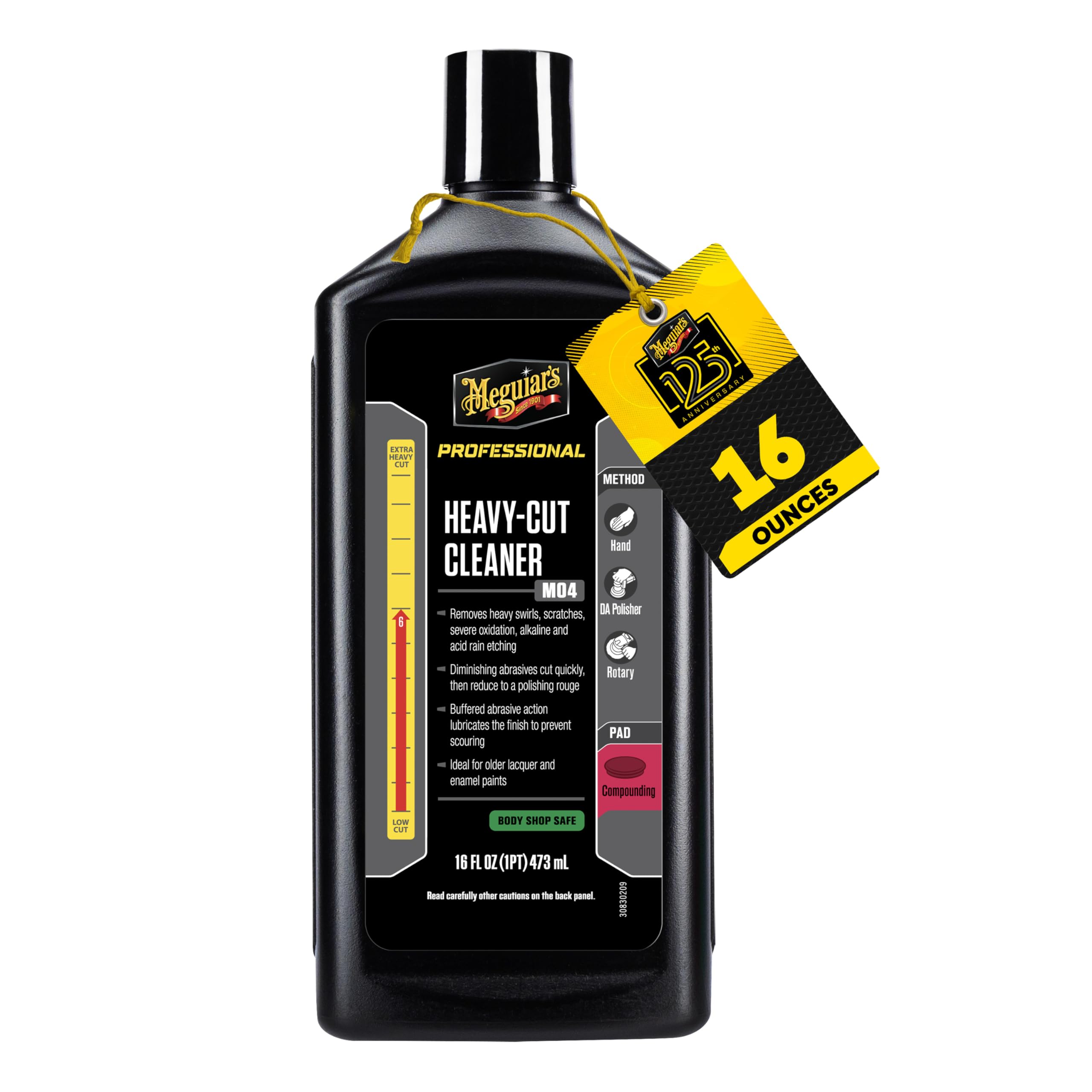
6. Meguiar’s M04 Heavy Cut Cleaner (16 oz)
The old-school formula that specialty restorers swear by for lacquer.
Meguiar’s M04 Mirror Glaze Heavy Cut Cleaner uses a coarse 40-grit abrasive (a very rough particle) to aggressively remove defects on older lacquer and enamel paints, as well as modern clear coats. It is a body-shop-safe formula that cuts quickly and then reduces to a buffing rouge (a fine polishing paste) to minimize swirling — a dual-action abrasive behavior that separates it from simpler compounds. Owners use it for everything from severe oxidation on classic cars (one owner noted it “cleared up oxidation and showed the original paint”) to polishing motorcycle parts and even drum cymbals.
The 16 oz bottle is compact, but the 40-grit abrasive is very coarse — it needs a follow-up with a finer polish or compound to restore full gloss. It is also designed for a rotary buffer, not a DA polisher or hand application, which limits its appeal for casual users.
Best for: classic car restoration where heavy oxidation or single-stage enamel needs a serious first cut.
Reach for this if: you are restoring a vintage paint job or need to strip heavy oxidation from a neglected surface.
Not your pick if: you want a one-step compound that also finishes glossy — you will need a second product after M04.
7. Chemical Guys V36 Optical Cutting Polish (16 oz)

The optical-grade finisher that levels defects and leaves a deep gloss.
Chemical Guys V36 is a 2000-grit optical-grade cutting polish that lives at the fine end of the cutting spectrum. It eliminates moderate to heavy paint defects without filler, then refines toward a deep, glossy finish — effectively skipping the separate polish step for many users. Reviewers point out success on etched water spots on windows, fine scratches on black paint, and even wood trim restoration. The extended work time formula is free of powder and dust during buffing, which is a major plus for indoor work.
The mixed feedback on cutting performance (11 owners) suggests that for very deep scratches, V36 is not aggressive enough — you would need V32 or a coarser compound as a first pass. It pairs beautifully with a DA polisher and orange pad, and the 2000-grit rating leaves a surface that is ready for wax or sealant.
the balance: A cutting polish for the DIYer who wants to correct and finish in one step, especially on newer paint.
Ideal for: removing moderate swirls, water spots, and light scratches while leaving a high-gloss surface.
Pass if: you need to cut through 800-grit sanding marks or deep key scratches — step up to V32 or a coarser compound first.
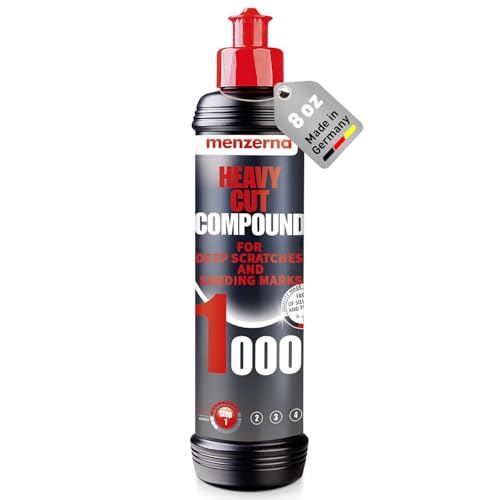
8. Menzerna Heavy Cut Compound 1000 (8 fl oz)
The beginner-friendly compound that cuts fast with a drill and foam pad.
Menzerna Heavy Cut Compound 1000 is a 1000-grit medium abrasive that bridges the gap between a heavy cut and a finish polish. It is specifically marketed as beginner-friendly, and the reviews confirm that: one owner used a cheap 3-inch foam buffing pad on a drill after 1500-grit wet sanding and got a glossy, flat finish. The grit number is 1000, compared to the Heavy Cut 400’s 400 grit — meaning it is noticeably less aggressive but also harder to burn through clear coat.
The trade-off is dust — 10 owners mention it as a negative aspect, so expect powder when buffing. The 8 oz bottle is small, but the per-ounce cost is very low, making it a good trial size before committing to a larger volume.
A solid start: A forgiving medium-cut compound that works by hand or machine, ideal for first-time correctors.
Pick it if: you are new to paint correction and want a compound that won’t cut through clear coat on your first pass.
pass on it if: you need to remove deep 400-grit sanding marks — start with the 400 instead.
9. ABRO Rubbing Compound (10 oz)

The budget entry that punches above its weight on faded clear coat.
ABRO’s fine-grit rubbing compound is the most affordable option in this lineup, and it earns that spot with real results. Owners call it effective for sun-faded and oxidized clearcoat, heavy hail damage with rust, and tree-branch scratches that survive a clay bar treatment. The formula is aggressive enough that one owner warns: “avoid sitting in one spot to prevent burning through paint.” It works by hand or with a dual-action buffer, and it is body-shop-safe for prep work.
The downsides are predictable for a budget compound: it dries quickly during hand buffing and has a fuel-oil smell that some owners find unpleasant. It also leaves visible scratches if used dry or overworked. For a quick spot correction on a beater car or a first-time attempt at compounding, it is tough to top the value.
Why it works
- Very aggressive for a budget product — cuts through heavy oxidation fast.
- Works by hand for spot correction or with a machine for full panels.
- Silicone-free formula safe for prep and body shop use.
Where it shows its price
- Dries quickly, requiring fast work and a mist of water or product to re-lubricate.
- Fuel-oil smell is noticeable during use.
- Can leave micro-scratches if not worked properly or over-buffed.
Grab it for: a single scratch on a daily driver or a test run before investing in a premium compound.
Not for: a show-car finish or a full-panel correction — step up to a finer, longer-working compound.
Understanding the Specs
Grit Number (Abrasive Coarseness)
The grit number on a compound is the same idea as sandpaper — lower numbers mean larger, more aggressive particles that cut paint faster but leave a rougher surface. A 400-grit compound (like Menzerna Heavy Cut 400) is for deep scratch removal and should be followed by a finer polish. A 1000 to 2000-grit compound (like Menzerna 1000 or Chemical Guys V36) refines the surface and can sometimes serve as a one-step correction on lighter defects. If you see a very low number like “40” (Meguiar’s M04), that is an industrial-strength abrasive for severe oxidation on older paints. Match the grit to the depth of the damage — do not use a 400-grit compound on a light swirl mark or you will unnecessarily thin the clear coat.
Cut Rating & Gloss Rating
Some manufacturers rate their compounds on a 1-10 scale for cut and gloss (Menzerna’s 8/8 is a strong example). Cut rating tells you how aggressively the compound levels paint, while gloss rating tells you how reflective the surface is immediately after wiping — a high-gloss rating means you may skip the polishing step. A compound with a high cut but low gloss (e.g., 8/4) forces a second step. Look for both numbers if you value efficiency. For a one-step correction on a daily driver, a cut/gloss of at least 6/7 is a realistic target.
FAQ
Can I use a cutting compound by hand or do I need a machine?
What is the difference between a cutting compound and a polish?
Will a cutting compound damage my clear coat?
How do I know which grit compound to use on my car?
What does “silicone-free” or “body shop safe” mean for a cutting compound?
Can I use a cutting compound on plastic trim or headlights?
How much cutting compound do I need for a full car correction?
How do I clean compound residue from trim and crevices?
Why does some cutting compound dust more than others?
Can I use a cutting compound on a matte paint finish?
Final Thoughts: The Verdict
Across the board, the best cutting compound is the menzerna heavy cut 400 because it delivers an 8/10 cut and an 8/10 gloss in a single step, and it is backed by the highest owner satisfaction — 4.8 stars from nearly a thousand owners. If you want a fast, user-friendly compound that leaves a mirror finish without fighting cleanup, grab the Meguiar’s M11032 Ultra Pro Speed. And for heavy oxidation on boats, RVs, or neglected single-stage paint, the Malco Super Duty Heavy Cut is the one to reach for.
How We Picked
We do not accept paid placement. Every pick is matched to a real buyer and a real use-case; we do not hands-on test units.
Sources & Methodology
Specifications: manufacturer listings and product documentation. Review insights: verified customer reviews, as of July 2026. Pricing: not shown on this page (it changes often); check the current price via the retailer link.
As an Amazon Associate, Trending Car earns from qualifying purchases. This does not affect which products we feature.