
Our readers keep the lights on and my garage snacks stocked. As an Amazon Associate, I earn from qualifying purchases.
Specs are compiled from manufacturer listings and verified buyer reviews and can change over time — please confirm the key details on the product page before buying.
Aluminum radiators demand a specific kind of coolant — one that doesn’t react with the metal or let corrosion creep in. Pick the wrong bottle and you risk pinhole leaks or a clogged system that leaves you stranded. This guide breaks down the coolants that are proven safe for aluminum, from value concentrates to track-ready performance blends.
I’m Min Islam — the founder and writer behind Trending Car. This guide is built by comparing the manufacturers’ published specifications and the patterns across verified customer reviews, so you get each pick’s real strengths and trade-offs instead of marketing spin.
Whether you are topping off a classic American truck or flushing a Japanese import, the right coolant for aluminum radiator keeps your engine running at the proper temperature without eating away at the metal that keeps it cool.
Our Picks at a Glance


How To Choose The Best Coolant for Aluminum Radiator
Aluminum is lighter and transfers heat better than the old cast-iron blocks, but it is also more reactive to the wrong chemistry. You want a coolant that explicitly says it protects aluminum.
Organic Acid Technology (OAT) vs Older Formulas
OAT coolants (the orange, pink, or violet ones) use additives that form a thin protective layer on aluminum surfaces rather than coating everything in silicates. Older green coolants rely on silicates and phosphates that can drop out of solution and clog an aluminum radiator’s narrow passages or even corrode the metal over time.
Concentrate vs Pre-Diluted
A concentrate needs to be mixed 50/50 with distilled water to get the right freeze and boil protection. A pre-diluted bottle is already mixed and ready to pour straight in — no distilled water, no measuring, no guesswork. Pre-diluted is convenient for a top-off; concentrate gives you two gallons of usable coolant for roughly the same price as one pre-mixed.
Your Cooling System’s Factory Specs
Many modern vehicles (especially post-2000 GM, Ford, and Asian makes) require a specific OAT type. Check your owner’s manual for the ASTM spec or vehicle-specific standard. Using the wrong type can void your warranty or cause gasket damage even if the coolant is aluminum-safe.
Quick Comparison
| Model | Best For | Chemistry | Form | Protection Rating | Amazon |
|---|---|---|---|---|---|
| PEAK Global Lifetime Concentrate★ Best Overall | All-around value | OAT | Concentrate | Lifetime (with maintenance) | Amazon |
| Zerex American Vehicle 50/50Best Value | Domestic cars & trucks | OAT | 50/50 Pre-diluted | 5 yr / 150k mi | Amazon |
| Kawasaki Aluma CoolFor Motorcycles | Motorcycles | OAT (pre-dilute) | Pre-diluted | Not specified | Amazon |
| PEAK DEX-Cool | GM vehicles (1995+) | OAT | Concentrate | 10 yr / 150k mi | Amazon |
| Shell Rotella ELC 50/50 | Diesel & heavy duty | ELC OAT | 50/50 Pre-diluted | Up to 1.2M mi (Class 8) | Amazon |
| Zerex Pink Heavy Duty 50/50 | Heavy-duty diesel fleets | OAT (heavy duty) | 50/50 Pre-diluted | 3 yr / 150k mi | Amazon |
| Valvoline Multi-Vehicle Concentrate | DIYers who mix their own | OAT with Alugard Plus | Concentrate | Up to -84°F (70/30 mix) | Amazon |
| Zerex G40 Concentrate | European cars | Si-OAT | Concentrate | 5 yr / 150k mi | Amazon |
| Mishimoto Liquid Chill | Performance & track use | Synthetic (low ethylene glycol) | Pre-mixed | 265°F boil / -26°F freeze | Amazon |
In‑Depth Reviews
1. PEAK Global Lifetime Concentrate Antifreeze and Coolant
Our pick — over 4.5★ from 900+ verified ratings; the strongest balance of quality and price.
The value jug that covers everything from a Miata to a Mack.
This is a concentrate based on Organic Acid Technology (OAT) — the modern chemistry that lays down a thin protective coat on aluminum rather than dumping abrasive silicates into the system. Since it is a concentrate, you mix it 50/50 with distilled water yourself, which means one gallon of this gives you two gallons of ready-to-use coolant. That dollar-stretching is what wins people over: you get twice as much for roughly the same price as a single pre-mixed jug. As buyers put it, “the concentrate is the way to go since you get twice as much.”
The amber color won’t clash with whatever coolant is already in your radiator if you are just topping off. PEAK claims lifetime protection with proper maintenance, and the formula works across American, Asian, and European vehicles. Expect smooth performance in a 2003 Miata, a Dodge pickup, or a Jeep. The lid can be stubborn to reseal — make sure it clicks tight to avoid drips.
The thing everyone raves about here is the functionality — it prevents corrosion, stops leaks, and keeps engines running cool across multiple vehicle types. At 10 pounds per jug, it is slightly heavier than the Zerex 50/50 (9.24 pounds), but you are getting concentrated chemistry that goes twice as far.
Why It Wins
- One gallon makes two gallons of ready-to-use coolant — unbeatable value
- OAT formula protects aluminum, brass, copper, and solder equally
- Works in all makes and models; no need to stock separate bottles
One Thing to Note
- You must supply your own distilled water and measure the 50/50 ratio — not a pour-and-go bottle
Reach for this if: you want the best balance of cost and universal coverage — one jug handles your whole fleet.
Look elsewhere if: you hate mixing anything and want coolant straight from the bottle.
2. Zerex American Vehicle 50/50 Ready-to-Use Antifreeze Coolant
Pour, drive, forget — the 50/50 convenience king for American iron.
This is a pre-mixed orange coolant that comes ready to use. No distilled water, no measuring, no math. It uses Organic Acid Technology (OAT) to protect aluminum and every other metal in your cooling system, and it carries a 5 year / 150,000 mile guarantee against freeze-ups or boil-overs. That freeze protection hits -34°F while the anti-boil performance reaches 265°F — solid margins for most of North America.
Zerex batch-tests every run in the lab and fleet-tests in real trucks, so the chemistry is consistent. The crowd is a loyal bunch: “have been using this brand for as long as I can remember” is a common refrain. Even niche owners like 4.3-L Aston Martin Vantage drivers confirm it works great in their aluminum blocks. The pre-mix is a touch heavier than the PEAK concentrate at 9.24 pounds vs 10 pounds, but that weight is all water you don’t have to add yourself.
The honest trade-off is that you pay for that water. A 50/50 jug costs about the same as a gallon of concentrate, but you get half the usable coolant. If you are doing a full system flush, the concentrate doubles your money.
The Case For It
- Zero prep — open the cap and pour directly into the radiator
- OAT chemistry protects aluminum, gaskets, hoses, and plastic tanks
- 5 year / 150k mile guarantee backs the formulation
The Catch
- You are paying premium for water; the concentrate version would give you twice as much coolant for similar money
Best for: quick top-offs, nervous DIYers, and anyone who wants to skip the distilled-water run.
Not for: a full-system drain-and-fill where concentrate makes more sense.
3. Kawasaki Aluma Cool QT 1.0 Liters Coolant
The factory-fresh coolant your Ninja or KLR was born to drink.
This is Kawasaki’s own pre-diluted coolant, designed specifically for motorcycles with aluminum cooling systems. It is already mixed — the label says “do not add water.” You just uncap it and pour it into your bike’s reservoir. “Perfect for aluminum coolant systems” is exactly what buyers report, and it fits everything from a 1996 Ninja 500 to a KLR650.
Motorcycle enthusiasts report that temperature control is noticeably better than with random-brand coolant. For a novice mechanic, that means real confidence — you know the chemistry matches your engine’s metallurgy exactly. The bottle holds 1 liter, which is just enough for most motorcycle systems or a top-off after a flush.
The limitation is obvious: this is a vehicle-specific fit (motorcycles only). You wouldn’t pour it into a Civic or a F-150. It also costs more per ounce than a universal gallon jug, though the convenience and factory spec match justify it for bike owners who want zero guesswork.
One-sentence verdict: The right stuff for Kawasaki aluminum engines — pre-diluted, drop-in ready, and confirmed by owners to keep Ninjas and KLRs running cooler.
4. PEAK DEX-Cool Antifreeze + Coolant
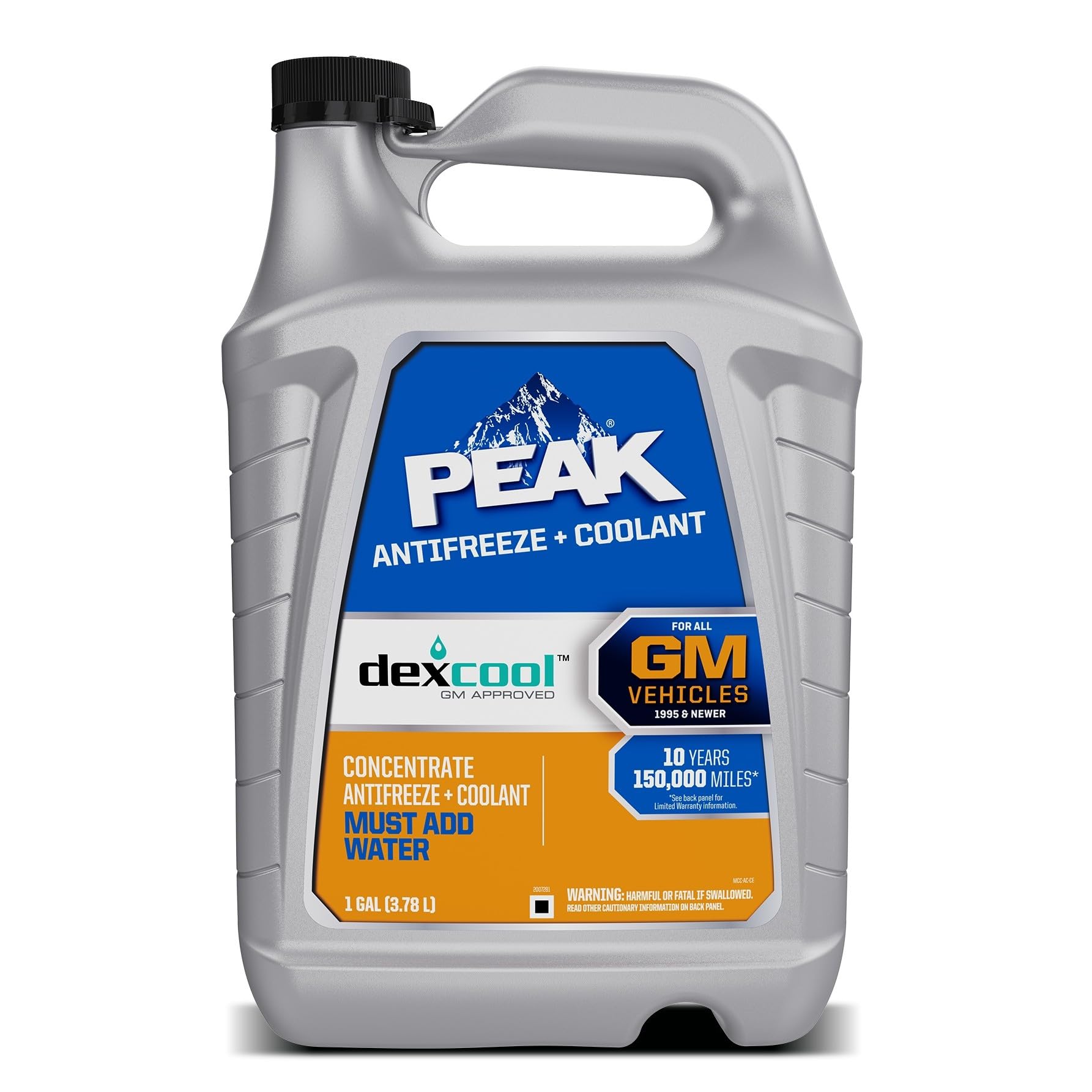
The orange OAT that GM trusts — 150,000 miles between changes.
This is a concentrate built for GM vehicles from 1995 onward that call for an orange Organic Acid Technology (OAT) coolant. It meets GMW3420 and GM6277M, so it is exactly what your Silverado, Yukon, or Corvette needs. The formula is free of amines, phosphates, borates, nitrites, and silicates — those old-school additives that can drop out and clog an aluminum radiator over time.
The service life is up to 10 years or 150,000 miles with a complete flush and fill. One owner says “I’ve been using this product in my car for the last 25 years” — a strong testament to consistency. After mixing 50/50 to make two gallons, owners mention lower engine temps in a 2005 H2 that had just gotten a hose repair.
The concentrate form means you must supply distilled water, but that also gives you twice the volume for your money compared to buying a pre-mix. The downside: this is GM-specific, so if you drive a Ford, Toyota, or European car, you need a different formulation.
Worth it if: you own a GM vehicle with an aluminum radiator and want the official chemistry without the dealership markup.
5. Shell Rotella Nitrite-Free Extended Life ELC Coolant 50/50
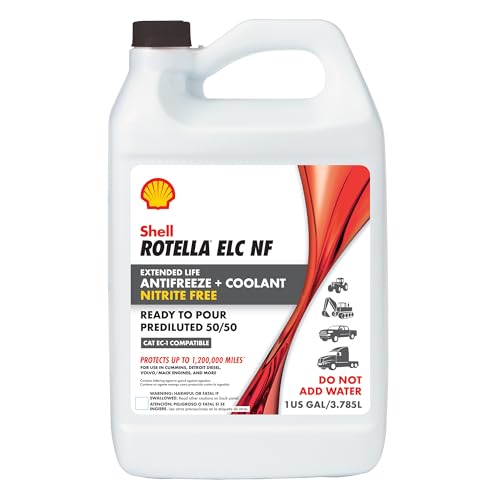
Class 8 trucks and daily drivers alike — this Rotella ELC goes a million miles.
Shell Rotella’s Extended Life Coolant (ELC) uses an OAT formulation that is nitrite-free, which means it treats aluminum components — including brazed aluminum heat exchangers — with extra care. The headline number is up to 1,200,000 miles of protection in Class 8 over-the-road diesel operation. That is not a typo; this is the kind of coolant fleets run.
But it is not just for big rigs. The bottle says it works in diesel, gasoline, and natural gas engines, plus light-duty passenger cars and pickups. It protects against cylinder liner pitting (that pockmark damage cavitation causes in diesel blocks) and corrosion of all cooling system metals. The pre-diluted form means no mixing — pour and go.
Buyers consistently praise its quality and value: one says it “works like said and inexpensive,” and another calls it “good quality not watered down.” The only hitch is that the bottle lacks detailed vehicle-specific fitment notes, so double-check your owner’s manual for an ASTM (American Society for Testing and Materials) spec match.
The bottom line: A fleet-grade ELC that treats aluminum right and lasts longer than you will own the vehicle — especially smart for diesel owners who do not want to flush every two years.
6. Zerex Fully Formulated Pink Heavy Duty 50/50 Antifreeze Coolant

Built for Cummins, MACK, and Navistar — the pink stuff that keeps clean fleets clean.
This is a heavy-duty OAT coolant pre-charged with corrosion, scale, and rust inhibitors. It meets the specific demands of diesel engines like Cummins, DDC, MACK, Navistar, and Paccar. The pink pre-mix is ready-to-use in a 50/50 ratio, protecting aluminum and all other cooling system metals without harming gaskets, hoses, or the original finish.
The protection package includes a 3 year / 150,000 mile guarantee against freeze-ups or boil-overs. Semi-truck drivers are the core fans here: “I drive Semi truck and keep these in my truck. I always buy the 50/50 Pre-diluted.” It also works well in Ford 6.4-liter Power Stroke engines according to owner feedback. The cooling performance gets mixed marks — most are happy, but a few found it ran slightly warmer than expected in specific high-load conditions. Keep an eye on your temp gauge for the first few drives if you switch to this.
It is heavier-duty than a standard passenger-car OAT, so you pay a small premium for the extra corrosion inhibitors.
Reach for it if: you are topping off a semi, an RV with a diesel pusher, or a heavy-duty pickup that works for a living.
7. Valvoline Multi-Vehicle Concentrate Antifreeze Coolant
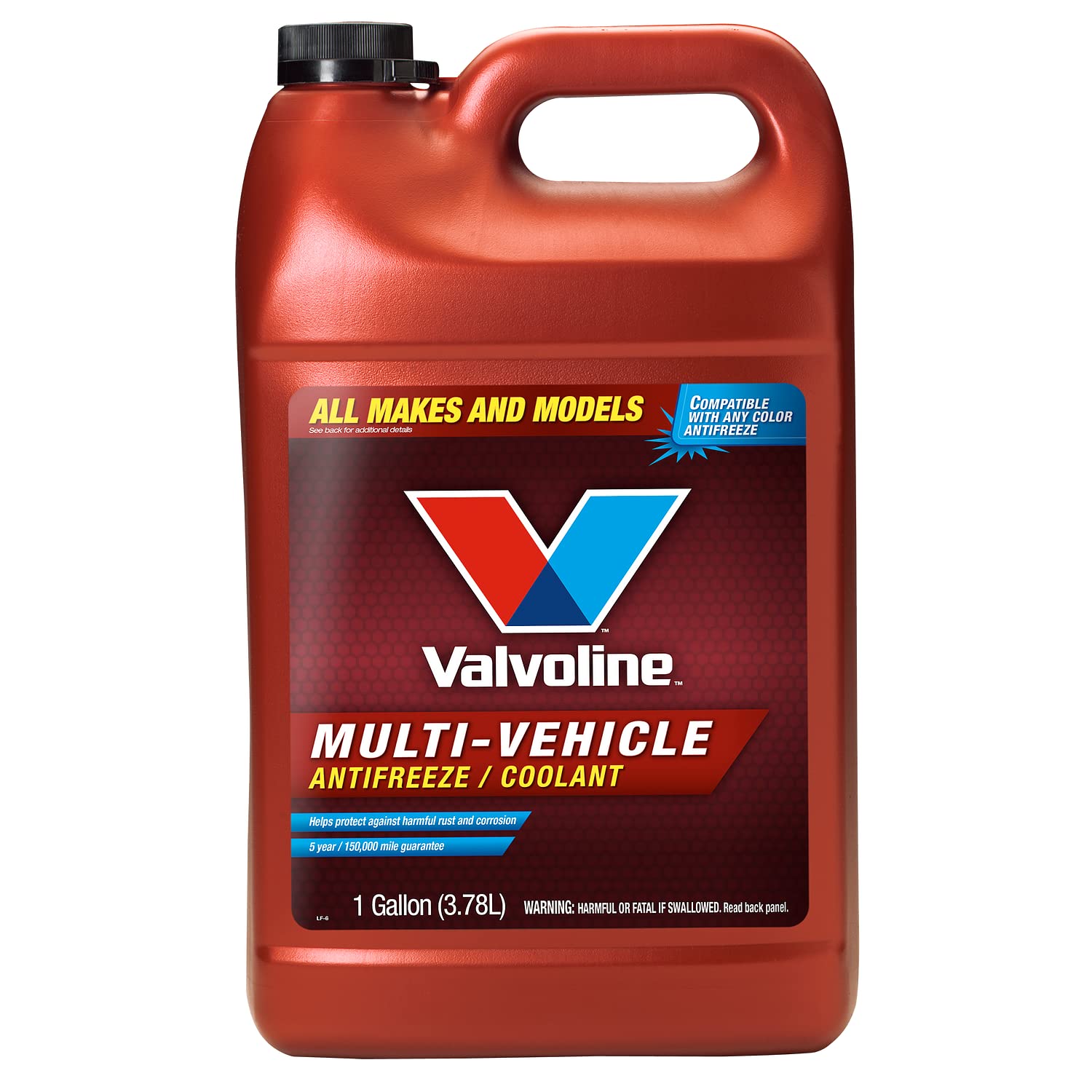
Full-strength yellow concentrate — you pick the ratio to match your climate.
Valvoline’s yellow concentrate contains Alugard Plus, their proprietary additive package designed specifically for aluminum compatibility. It protects against corrosion, scaling, and rust across all cooling system metals. The big advantage here is mixing flexibility: a 50/50 blend with water gives you -34°F freeze protection and 265°F boil protection (so your engine stays safe in most climates); a 60/40 blend (more concentrate) pushes freeze protection to -62°F and boil protection to 270°F; a 70/30 blend reaches -84°F and 267°F.
DIYers who live in extreme northern or southern climates appreciate being able to dial in the exact ratio. “I like that I can get the antifreeze in full strength and I can mix it myself — I don’t like paying for the premixed stuff saying for water” is exactly the sentiment. It is a universal fit for cars and light-duty trucks, and owners call the performance and quality “great.”
The yellow concentrate means it will change the color of whatever is in your system, so keep that in mind if you care about maintaining a specific factory shade.
Who it fits: DIYers who want total control over their freeze/boil protection and don’t mind grabbing a gallon of distilled water.
8. Zerex G40 Phosphate and Nitrite Free Concentrate Antifreeze/Coolant
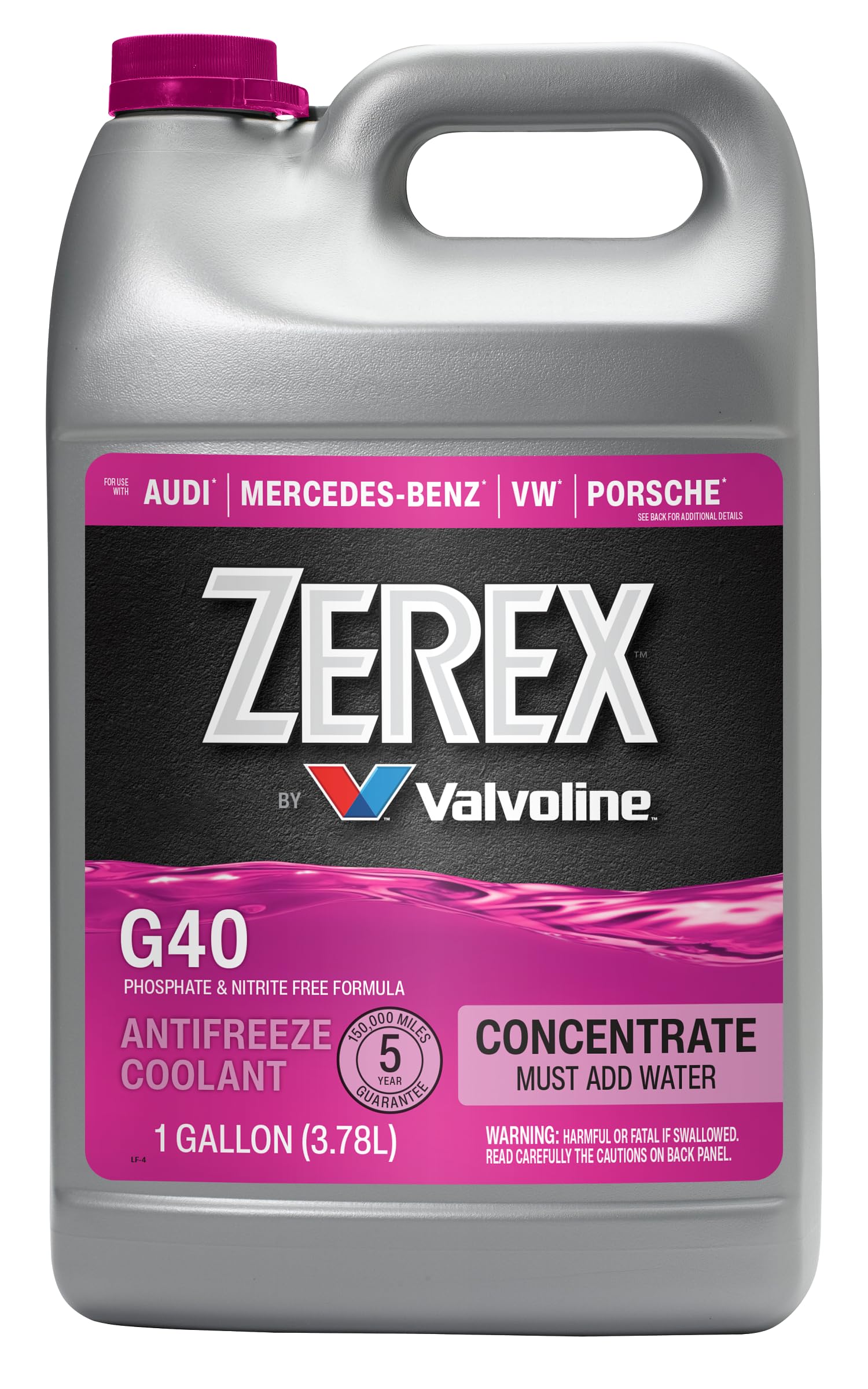
The violet Si-OAT that European cars need — phosphate-free for sensitive seals.
This is Zerex’s G40-rated concentrate, a violet Si-OAT (Silicate Organic Acid Technology) formula. European cars (BMW, Mercedes, VW, Audi) often require a phosphate-free coolant to avoid attacking water-pump seals and gaskets. This meets that spec while protecting aluminum and all other cooling system metals.
The 5 year / 150,000 mile guarantee is the same confidence as the American-vehicle Zerex. Owners note the engine temperature sits dead center on the gauge, and they call it “more cost-effective than parts stores” with “no performance difference from OEM after years of use.”
Durability gets mixed feedback — a small number of owners felt the corrosion protection fades a bit earlier than other premium coolants. The concentrate pricing is higher than universal jugs, but for a European vehicle that demands the right chemistry, it is the correct choice.
Note for Euro owners: This is the concentrate you want for a VW, BMW, or Mercedes that specifies a phosphate-free coolant — cheaper than the dealer and matches the factory formulation.
9. Mishimoto Liquid Chill Performance Synthetic Radiator Coolant
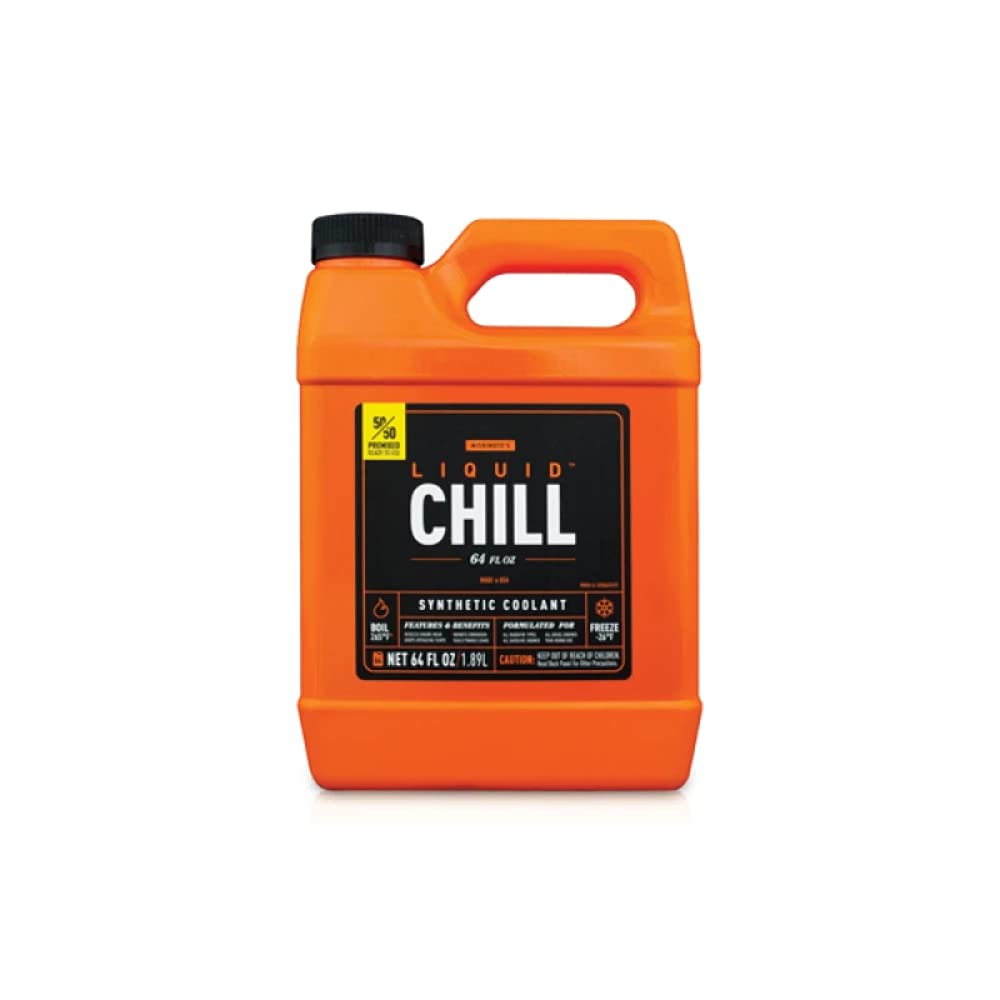
The synthetic blend that dropped one owner’s temps from 270°F to 210°F.
Mishimoto Liquid Chill is different from everything else on this list. It is a synthetic coolant that contains less than 10% ethylene glycol (no bittering agent either), so it is not the traditional green or orange formula. It is safe for all radiators and all gas/diesel engines, but its real strength is heat transfer. The spec says it protects against boil-over to 265°F and freezing to -26°F.
Track-day and off-road owners are the true believers. One owner driving a vehicle that hit 270°F during a 5-hour off-road run saw temps drop to 210°F after switching to Liquid Chill — preventing a radiator replacement. The 64-ounce bottle is pre-mixed, so you pour it straight in. Mishimoto backs it with a lifetime warranty, which is rare in coolant. Quality and temperature control are the most-praised aspects, with owners saying it “keeps multiple of my vehicles cool” and “stays clean.”
Value for money is mixed — at roughly for a 64-ounce bottle, it costs more per ounce than standard OAT coolants. This is a performance-oriented product for people who actually push their cooling system to the limit. For a daily commuter, a jug of OAT concentrate is probably smarter.
Best for: modified cars, track-day toys, off-road rigs, or anyone who has seen their temp needle climb into the red zone after a hard pull.
Understanding the Specs
OAT (Organic Acid Technology)
OAT coolants use organic acids to form a microscopic protective layer on metal surfaces. This is the modern standard for aluminum radiators because it does not rely on silicates or phosphates — the older additives that can precipitate out and clog the radiator’s narrow channels. OAT coolants are typically orange, pink, red, or violet, and they last much longer than conventional green coolant.
Concentrate vs 50/50 Pre-Diluted
Concentrate is pure ethylene glycol or propylene glycol (the active antifreeze chemicals) that you must mix with distilled water — usually 50/50 — to get the right freeze and boil protection. Pre-diluted (50/50) is already mixed: open the cap and pour. Concentrate gives you more coolant per dollar; pre-diluted is simple to use for top-offs. Never mix a concentrate with tap water — the minerals in tap water can scale up inside an aluminum radiator over time.
FAQ
Can I use regular green coolant in an aluminum radiator?
How often should I flush coolant from an aluminum radiator?
What happens if I mix two different coolant colors?
Is pre-diluted coolant better than concentrate for aluminum radiators?
Can I put this coolant in a motorcycle?
Does a higher price mean better protection for aluminum?
How do I properly flush an aluminum radiator before switching coolant?
Can I use diesel-specific ELC coolant in my gas car?
Final Thoughts: The Verdict
For most buyers, the coolant for aluminum radiator winner is the PEAK Global Lifetime Concentrate because it balances universal compatibility with unbeatable value — one jug makes two gallons and protects every metal in your system. If you want pour-and-go convenience for an American car or truck, grab the Zerex American Vehicle 50/50. And for European cars that demand a phosphate-free spec, the Zerex G40 Concentrate is the one to reach for.
How We Picked
We do not accept paid placement. Every pick is matched to a real buyer and a real use-case; we do not hands-on test units.
Sources & Methodology
Specifications: manufacturer listings and product documentation. Review insights: verified customer reviews, as of July 2026. Pricing: not shown on this page (it changes often); check the current price via the retailer link.
As an Amazon Associate, Trending Car earns from qualifying purchases. This does not affect which products we feature.