
Our readers keep the lights on and my garage snacks stocked. As an Amazon Associate, I earn from qualifying purchases.
Specs are compiled from manufacturer listings and verified buyer reviews and can change over time — please confirm the key details on the product page before buying.
You want a garage floor that looks sharp and survives daily abuse—hot tires, dropped tools, oil drips, and foot traffic. The challenge is finding a concrete paint that actually bonds to your slab without peeling after one winter. This guide cuts through the marketing to seven proven garage floor paints, from a single-gallon weekend project to a full industrial epoxy kit.
I’m Min Islam — the founder and writer behind Trending Car. This guide is built by comparing the manufacturers’ published specifications and the patterns across verified customer reviews, so you get each pick’s real strengths and trade-offs instead of marketing spin.
The right floor coating saves you a re-do next year; here is everything you need to make that call on the best concrete paint for garage floor projects, ranked by real-world durability and ease.
Our Picks at a Glance

How To Choose The Best Concrete Paint for Garage Floor
Three decisions define whether your garage floor paint job lasts: the paint chemistry, the coverage math, and the surface prep you are willing to do. Get these right, and you avoid the peeling, bubbling, and tire-pickup that send homeowners back to the hardware store every season.
Paint Type: 1-Part vs. 2-Part vs. Oil-Based
Your biggest fork in the road. A 1-part epoxy acrylic (like the KILZ or Rust-Oleum picks here) is water-based, rolls on easy, and cleans up with soap. It gives you a solid satin finish that resists scuffs and stains for years. A 2-part epoxy kit (like the ArmorPoxy) delivers a much harder, glossier surface that bonds chemically to the concrete—but the prep is more demanding and the cure time longer. Oil-based enamel (Diamond Brite) fills a niche: it sticks tenaciously to metal and masonry and laughs off salt and moisture, but the solvent smell is strong and cleanup requires mineral spirits.
Coverage and Total Cost Per Square Foot
Manufacturers list a coverage range, but the real number depends on your concrete’s porosity. A smooth garage floor gets the high end (300-400 sq. ft. per gallon); a rough, pitted slab eats the low end (200-250 sq. ft.). Always buy a little extra: if a gallon covers 300 sq. ft. on paper, that assumes two thin coats on a smooth surface. One coat on rough concrete might cover barely 150. Over-buying is cheaper than driving back for a second can mid-project.
Dry Time and Curing Patience
Most water-based paints dry to the touch in 1-6 hours, but full chemical cure takes 3-5 days (and some oil-based enamels take even longer). The biggest mistake is parking a car or dragging a toolbox across the floor before the paint has fully hardened. If you need your garage usable in 24 hours, look for a paint that advertises light foot traffic in a day—but even then, wait the full cure window for vehicle weight.
Slip Resistance and Texture
A glossy, high-sheen floor looks beautiful but becomes a skating rink when wet. If you walk on your garage floor in rain or snow, or if you use it as a workshop, choose a coating with a textured finish or add a non-slip additive (some kits include one). The trade-off is that textured floors are harder to sweep clean.
Quick Comparison
| Model | Best For | Coverage | Finish Type | Dry Time | Amazon |
|---|---|---|---|---|---|
| KILZ 1-Part Epoxy★ Best Overall | Best Overall durability | 300–400 sq. ft. | Satin | 6 hours | Amazon |
| Professional Floor Paint KitBudget Champion | Budget-friendly entry | 200–250 sq. ft. | Low gloss | — | Amazon |
| Diamond Brite Oil-Based Enamel | Extreme moisture resistance | 300 sq. ft. | High-Gloss | Long (oil-based) | Amazon |
| KILZ Decorative Slip-Resistant | Textured, slip-safe finish | 40–60 sq. ft. | Textured, Matte | 1 hour | Amazon |
| Rust-Oleum Concrete & Garage 1-Part Epoxy | Large-area coverage | 300–400 sq. ft. | Satin | Quick | Amazon |
| RUST BULLET DuraGrade Concrete | No-etching premium finish | 300–350 sq. ft. | Gloss | 2 hours | Amazon |
| ArmorPoxy Garage Epoxy Floor Kit | Industrial-grade 2-part epoxy | 300 sq. ft. (kit) | High-Gloss | 24 hours | Amazon |
In‑Depth Reviews
1. KILZ 1-Part Epoxy Concrete & Garage Floor Paint, Slate Gray, 1 Gallon
Our pick — over 4★ from 3,000+ verified ratings; the strongest balance of quality and price.
The crowd-pleasing satin that scalds hot tires and scuffs without complaint.
Your garage floor takes a beating every single day—parking hot tires straight off the highway, dragging jacks and tool boxes, dripping oil and coolant. KILZ built this 1-part epoxy acrylic formula specifically to resist hot tire pickup, scuffing, cracking, and fading. The coating gives your concrete a satin finish that looks clean without blinding you under fluorescent lights. It is water-based, so cleanup is just soap and water, and it stays low-VOC for indoor use.
Coverage is genuinely generous: a single gallon hits 300–400 sq. ft. on a smooth surface (200–300 on rough concrete). That means you need fewer cans for a typical two-car garage. Buyers report that after two years of service, the finish holds up against scuffs from dragged metal objects and wipes clean of oil and coolant stains without peeling. The few small peel spots owners saw were traced back to insufficient prep or paint thickness—not the paint itself.
The honest trade-off is that this is not a professional-grade two-part epoxy. On exterior concrete, it fades in direct sun over time and will need a repaint. And if your slab lacks a vapor barrier, moisture push from below will cause adhesion failure no matter what paint you use. But for a dry, indoor garage floor that sees daily vehicle traffic and workshop abuse, this formula has won over thousands of owners for a reason.
What Owners Love
- Resists scuffs and scratches from dragged metal objects after years of use
- Easy to apply with a roller; second coat delivers great depth
- Cleans up with soap and water, low odor
- Prevents oil and coolant staining
Know Before You Buy
- Not for heavy exterior sun exposure—fades over time
- Requires strict prep (clean, dry concrete; primer recommended)
- Not a replacement for two-part epoxy under extreme industrial loads
Reach for this if: your garage is dry, you park inside, and you want a proven satin finish that brushes on easily and lasts years.
Look elsewhere if: your concrete has no vapor barrier, or you need a glossy showroom shine that resists outdoor UV.
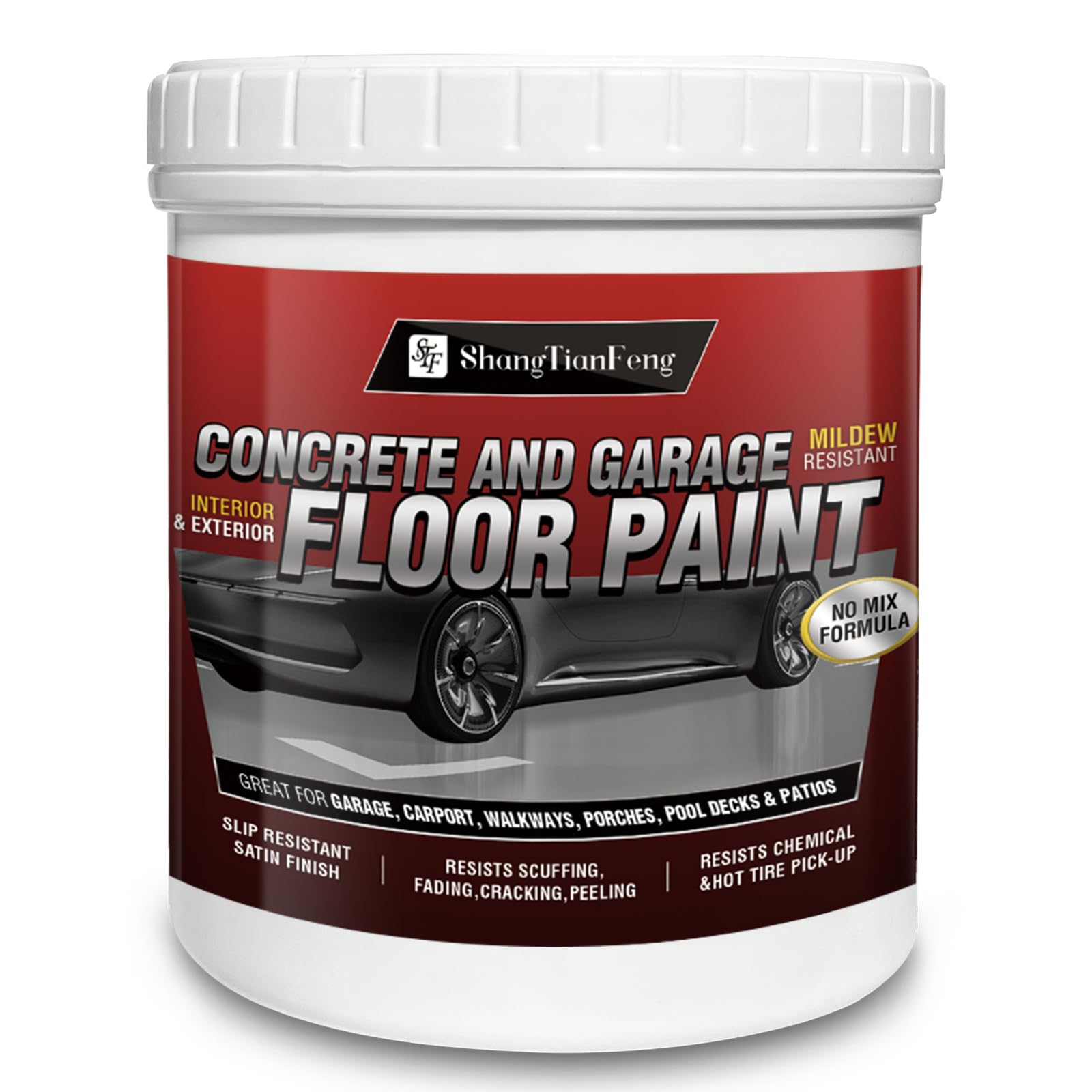
2. Professional Floor Paint Kit, Sea Gray, 1 Gallon
An entry-level acrylic that punches above its price for a clean, low-sheen floor.
If your budget is tight but you still want a finished garage floor that looks intentional, this single-component acrylic coating from STF ShangTianFeng gets the job done. It covers 200–250 sq. ft. per gallon—so factor that into your project math. The low gloss finish actually works in your favor: it hides dust and imperfections better than shiny epoxy, and the manufacturer claims the VOC content (volatile organic compounds, the chemicals that create fumes) sits at only 2 g/L, with formaldehyde at 8 mg/kg, both far below typical limits.
The application is straightforward. Owners mention the paint goes on smoothly and dries to a clean, uniform surface. A few early owners noted it goes “a lot further than I thought it would” after applying a couple of coats. Because it is water-based and non-toxic, you can use it indoors without worrying about fumes lingering in the house. The finish resists stains and is easy to wipe clean—a practical benefit if you use your garage as a workshop.
The catch is coverage math. Because it covers roughly half the area per gallon versus the KILZ, a two-car garage might need two full gallons instead of one, narrowing the price advantage. Also, as with any low-cost acrylic, long-term durability in a high-traffic garage—daily parking, hot tires—is less proven than the epoxy-based alternatives. This is a solid choice for a low-traffic garage, a basement workshop, or a porch where the budget matters most.
Verdict at this price: A great starter paint for light-duty spaces, but plan on buying more gallons than you expect.
Best for: a clean, low-traffic garage or basement where budget is the first concern.
Think twice if: you park a car daily on a rough, porous slab—the thinner acrylic may not hold up.
3. Diamond Brite Oil-Based Enamel Paint, Tile Brown, 1 Gallon

The old-school oil enamel that clings to concrete when water-based paints bubble off.
Salt, ice melt, and moisture are the enemies of any garage floor paint. Water-based epoxies bubble and lift when moisture pushes up from the slab or when road salt sits on the surface. Diamond Brite’s oil-based enamel formula handles exactly that environment. Customers note it “outperforms water-based epoxy paint” and resists bubbling from salt and ice melt, which is a specific life-saver for garages in snowy climates. It also withstands a floor jack and hot tires without peeling—one owner noted heavy truck traffic caused only minimal paint transfer.
The coverage is a practical 300 sq. ft. per gallon (at two thin coats), slotting it right between the KILZ and the STF options. The high-gloss finish is noticeably shinier than satin alternatives, which makes the floor look polished but also shows every speck of dust. The paint sticks to wood, concrete, metal, masonry, and even stucco, so it is versatile beyond just the garage floor. It is made in Louisville, Kentucky, and the brand has a solid following for industrial and commercial coatings.
The downsides are real. The drying time is long—owners say it cures slower in winter and faster in summer, but always requires patience. The solvent smell is stronger than water-based paints, so you need ventilation. And while quality (48 aspects mentions) and color (17 mentions) earn strong positive feedback, the “mixed” verdict on drying time (26 mentions) and durability (24 mentions) tells you that a perfect prep and a full cure are non-negotiable.
Standout Strengths
- Resists bubbling from salt and ice melt—ideal for snowy climates
- High-gloss finish looks polished and professional
- Adheres to concrete, metal, wood, masonry, and more
What to Prepare For
- Long drying time; plan on a full weekend for curing
- Strong solvent fumes—requires good ventilation
- High-gloss shows dust and imperfections
Take this if: your garage sees road salt, moisture, or heavy tools—oil-based adhesion beats water-based here.
Pass on it if: you cannot wait days for the cure or you are sensitive to solvent smell.
4. KILZ Decorative Slip-Resistant Concrete Coating, Gray, 1 Gallon

A pebbly, slip-resistant coating for zones where a slick epoxy is a liability.
Not every garage needs a glossy showroom floor. If you walk on your garage floor in wet shoes, or if you use it as a workshop where a slip could mean a busted tool or a busted knee, the textured finish here is the right call. This KILZ coating dries to a stone-like, speckled matte texture that provides genuine slip resistance—something a high-gloss paint simply cannot offer. It dries to the touch in just 1 hour and you can recoat in 3–4 hours, which is the fastest dry time on this list. Light foot traffic is fine after 24 hours, with full cure at 72 hours.
The appearance earns genuine praise from owners (appearance is the top positive aspect, with 58 mentions). Reviewers point out it looks “fresh as the day it was applied” even years later, and it has the practical bonus of being self-cleaning—one owner noted bird droppings washed off easily from a porch without fading or chipping. It fills hairline cracks and resists hot tire pickup, UV damage, and household chemicals.
The major caveat is coverage: at 40–60 sq. ft. per gallon, this is a high-build textured coating, not a thin paint. You will need considerably more product than a standard garage floor paint. The application is also the most polarizing spec here—68 owners mention application with a mixed verdict, and “ease of spreading” is rated negative by 34 owners. The trick, according to successful owners, is specific tools: a black foam roller (Rust-Oleum #306214) rather than a standard adhesive roller, and applying the coating in shade below 80°F. This is a specialized pick for a specific need, not a do-it-all floor paint.
The honest trade-off: superb slip resistance and fast dry time, but you prep for a much smaller coverage area and a finicky application.
Choose this for: a patio, pool deck, or garage entry where wet-foot traction matters more than a mirror finish.
Avoid it if: you need to cover a large garage floor on a budget—the low coverage rate adds up fast.
5. Rust-Oleum Concrete & Garage Floor Satin, Battleship Gray, 5 Gallon
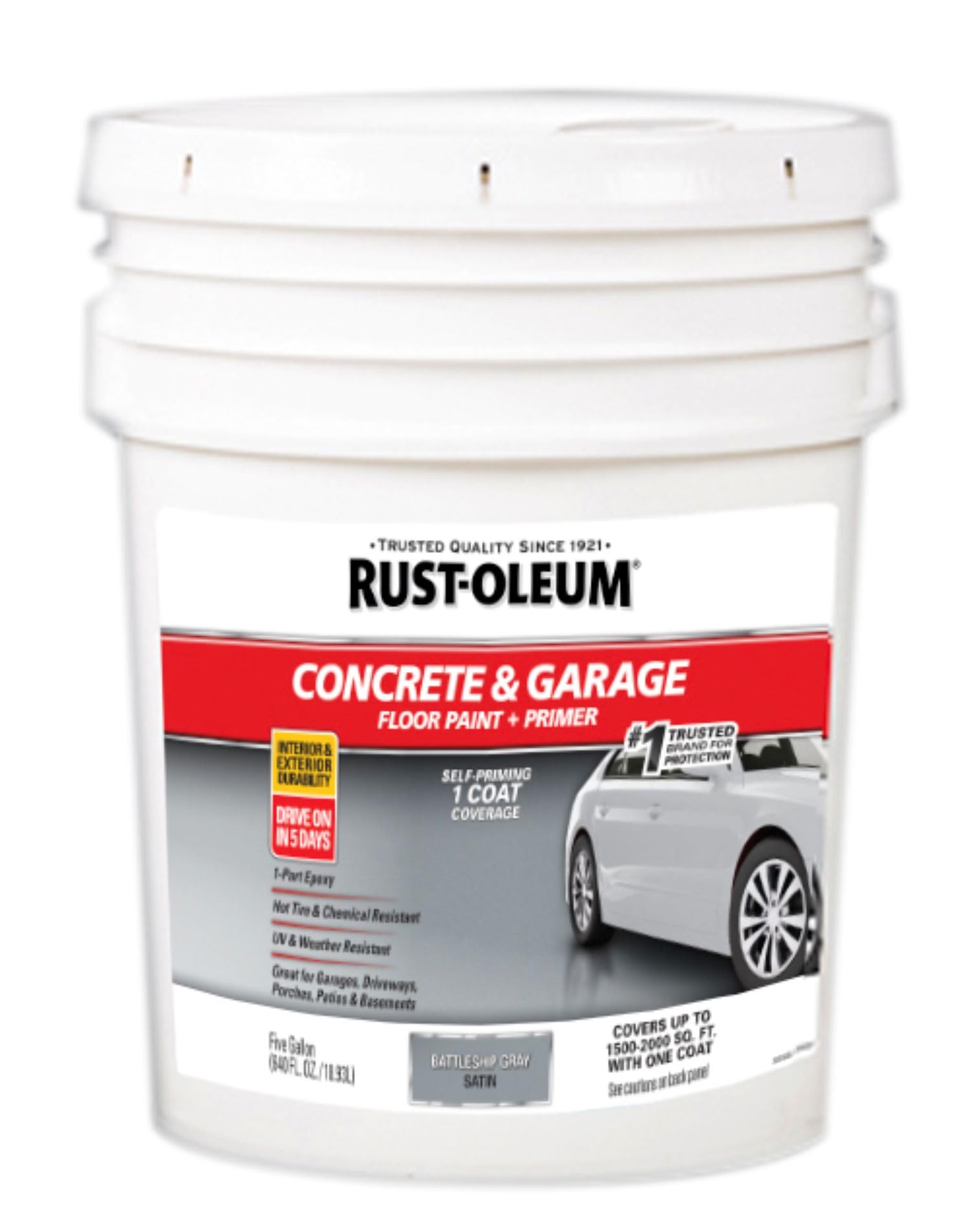
The 5-gallon bulk buy for whole-floor projects that need satin finish.
When your garage floor is big—a two-car or three-car space—buying paint by the gallon gets expensive and wasteful. This Rust-Oleum 1-part epoxy acrylic comes in a 5-gallon pail that covers 300–400 sq. ft. per gallon, so you are looking at 1,500–2,000 sq. ft. of coverage from one purchase. The formula is UV (ultraviolet light) and weather resistant, making it a rare outdoor-friendly pick among the 1-part epoxies. The satin finish hits that balance between flat and glossy: looking clean without being slippery.
Application is straightforward. Shoppers say it rolls on smoothly and dries to a finish that “makes concrete look wet and fresh.” The formula is designed to resist hot tires and household chemicals, and it works on outdoor decks and driveways as well as garage floors. The full cure time is 5 days, which is longer than most water-based alternatives—plan your project around that waiting period before parking a car on it.
The durability gets mixed feedback in the reviews. While many owners praise the appearance and ease of application, a smaller group reports coverage issues and note that it scratches off with a fingernail if applied too thin or if the concrete was not properly sealed. One owner who tried it as a money-saving alternative to two-part epoxy regretted the choice after seeing shoe prints permanently cling to the surface. The lesson: this is a great finish for garages that see normal use, but if you plan on drag-racing your floor jack across it daily, spend the extra on a two-part epoxy.
Best for: a large, dry garage where you want a consistent satin look without mixing chemicals—buy the pail and roll.
Grab it if: your floor is big and your expectations are realistic—this is a quality 1-part, not an industrial 2-part.
skip it if: your concrete is damp, pitted, or sees heavy industrial abuse every day.
6. RUST BULLET DuraGrade Concrete, Slate Grey, 1 Gallon

The premium paint that skips the etching step without skimping on durability.
Most concrete paints demand you etch the surface with acid or a heavy-duty cleaner before you can roll on a coat. RUST BULLET DuraGrade eliminates that step entirely: you clean the floor, dry it, and paint directly. The formula is an industrial-strength coating that resists wear, chemicals, and moisture, and buyers consistently rate its quality and durability as its strongest features (quality is the top aspect at 39 mentions, durability second at 35 mentions). It covers 300–350 sq. ft. per gallon per coat.
The finish is a full gloss—noticeably shinier than the satin options on this list—which gives your garage floor a polished, almost wet appearance. It withstands heavy foot and vehicle traffic without chipping or peeling. One owner reported driving a tractor and ATV over the coated floor without any tire lift. It dries to the touch in 2 hours and fully cures in 72 hours, which is fast for a gloss coating. It is UV and weather resistant, so it works equally well on an indoor garage floor or an outdoor patio.
The downsides are the price—this is among the most expensive paints per gallon on this list—and the odor. Owners warn that the fumes are potent; you need a respirator and good ventilation. The paint is also very thick; applying it with a wide, sturdy roller is recommended. If you apply it too thick, air bubbles can form that pop and leave marks. One owner noted that leftover paint hardens in the can, so you must finish the project the same day or use disposable tools. Despite the higher upfront cost, owners say the durability makes it “worth the price” for high-traffic garages.
Why It Stands Out
- No etching or primer needed—saves hours of prep
- Gloss finish with excellent durability; resists tractors and ATVs
- UV and weather resistant for indoor and outdoor use
What to Watch For
- Strong fumes require a respirator during application
- Thick formula can bubble if applied too heavily
- Leftover paint hardens quickly—plan for a single-session project
Choose this if: you hate etching concrete and want a high-gloss, industrial-strength finish that stands up to heavy use.
Skip this if: you are on a tight budget or cannot ventilate a strong-smelling paint project.
7. ArmorPoxy Garage Epoxy Floor Kit, Designer Gray, 300 Sq Ft

The 2-part kit that delivers a glass-like finish for the floor you want to show off.
If your definition of a finished garage floor includes a mirror-like gloss, decorative flake chips, and a surface that feels as hard as glass, you are looking at a 2-part epoxy. This ArmorPoxy kit covers 300 sq. ft. and includes 17 pieces: etching solution, decorative flake mix, non-slip additive, roller, squeegee, and more. The chemical formula is “100% solids” epoxy, which means it contains no water or solvents to evaporate—it cures by chemical reaction into a hard, dense plastic layer that bonds permanently to concrete.
The manufacturer claims the cured epoxy is 10 times stronger than steel with zero shrinkage, and owners confirm the professional-level result. One owner applied the kit to a standard two-car garage and described the finish as “sleek, clean, and improve.” The process takes about 3 days (clean, etch, apply, cure), with 24 hours for the initial cure and 72 hours before driving a car on it. The kit includes flakes that let you customize the look—from a light broadcast to a heavy coverage for a full floor design.
The honest downsides: the kit lacks measurement markings on the epoxy cans, which can lead to uneven tone between batches. The included squeegee is cheap and broke on one owner. And if your climate is humid, the clear topcoat can stay tacky longer than expected. A small number of owners reported peeling issues after several months, which suggests that the concrete preparation must be absolutely thorough (etching, cleaning, drying) before the epoxy goes down. For the average homeowner, the ease of a 1-part epoxy may outweigh the extra gloss of this 2-part system—but if you want the hardest, glossiest floor money can buy for a DIY project, this is the kit.
Professional Results
- 100% solids epoxy cures into a glass-hard, chemical-proof surface
- Complete 17-piece kit includes everything except a floor scrubber
- 24-hour cure, 72-hour vehicle-ready—fast for a 2-part system
DIYer Disclaimers
- No measurement markings on cans—use a scale for accurate mix
- Humid climate can cause tacky clear coat; plan for dry weather
- Cheap squeegee and limited flake quantity in the base kit
Go for it if: you want a showroom-quality gloss floor and are willing to meticulously prep and follow the multi-day cure schedule.
Stick with a 1-part if: you just need your garage floor sealed, protected, and looking good without the complexity and cost of a full epoxy project.
Understanding the Specs
Coverage (sq. ft. per gallon)
Coverage tells you how many square feet a single gallon will coat at the recommended thickness. A higher number (300–400 sq. ft.) means the paint spreads thin and works best on smooth concrete. A lower number (40–60 sq. ft.) means the paint is thick and high-build—it fills cracks and adds texture but needs far more product. Always calculate your garage’s square footage and buy an extra can; rough concrete eats paint faster than a smooth slab.
Finish Type (Satin vs. Gloss vs. Textured)
The finish determines how the floor looks and how slippery it gets when wet. Satin is the middle ground—a low sheen that hides dust but is safer to walk on than gloss. High-gloss gives you a wet, reflective look but becomes a skating rink with moisture. Textured/matte finishes add physical grip through a stone-like or sand-like texture, which is safer but harder to sweep clean. Choose based on whether you park cars or walk on the floor in wet shoes.
Dry Time and Full Cure
Dry-to-touch is when the paint is no longer sticky (usually 1–6 hours for water-based paints). Full cure is when the paint has reached its maximum hardness and chemical resistance—this can take 3–5 days for water-based paints and longer for oil-based or 2-part epoxies. Do not park a car or drag heavy items across the floor before the full cure window, or you risk peeling and scuffing. Plan your project start date so the garage can sit unused for the full cure period.
1-Part vs. 2-Part (Epoxy Acrylic vs. 100% Solids Epoxy)
1-part epoxy acrylic (like the KILZ and Rust-Oleum on this list) comes ready to use in one can. It is water-based, easy to apply, and cleans up with soap, but it is a surface coating—it can peel if moisture pushes up from below. 2-part epoxy (like the ArmorPoxy) requires mixing a resin and a hardener on-site. It cures into a thick, hard plastic layer that bonds chemically to the concrete and is nearly impossible to peel off once fully cured. The trade-off is higher cost, more complex application, and a much longer cure time.
FAQ
Can I apply concrete paint over old paint on my garage floor?
How do I prep my garage floor for painting?
How long does concrete paint for garage floors last?
Can I paint my garage floor in cold or humid weather?
Do I need to use a primer before painting my garage floor?
How do I make my painted garage floor slip-resistant?
How many coats of concrete paint should I apply?
Can I walk on my painted garage floor before it fully cures?
Final Thoughts: The Verdict
For most people, the best concrete paint for garage floor winner is the KILZ 1-Part Epoxy because it delivers proven durability across thousands of garages, resists hot tires and scuffs, and covers a full 300–400 sq. ft. per gallon—all with an easy water-based clean-up. If you want a budget-friendly option for a low-traffic space, grab the Professional Floor Paint Kit. And for a showroom-quality, glass-hard finish that resists salt and chemicals better than any paint, the ArmorPoxy 2-Part Epoxy Kit is the one to reach for. Whichever you choose, prep the surface well and give the coat the full cure time—that is the single step that separates a proud floor from a peeling regret.
How We Picked
We do not accept paid placement. Every pick is matched to a real buyer and a real use-case; we do not hands-on test units.
Sources & Methodology
Specifications: manufacturer listings and product documentation. Review insights: verified customer reviews, as of July 2026. Pricing: not shown on this page (it changes often); check the current price via the retailer link.
As an Amazon Associate, Trending Car earns from qualifying purchases. This does not affect which products we feature.