
Our readers keep the lights on and my garage snacks stocked. As an Amazon Associate, I earn from qualifying purchases.
Specs are compiled from manufacturer listings and verified buyer reviews and can change over time — please confirm the key details on the product page before buying.
A key scratch on a new door panel is a gut punch. You run a fingernail across it, feel the catch, and wonder if the paint is ruined. The right compound levels the clear coat so a scratch visually disappears, but the wrong one wastes effort or burns through paint. This guide ranks nine compounds by cutting power, dust levels, and ease of use to match each abrasive to your scratch depth.
I’m Min Islam, founder of Trending Car. This guide compares manufacturer specs and verified customer review patterns to highlight each pick’s real strengths and trade-offs.
The best compound removes scratches without introducing new micro-marring. The top compound for car scratches on this list earns a 4.6-star average from over 800 verified owner reviews, so you can trust it to handle both light holograms and deep 1200-grit sanding marks.
Our Picks at a Glance
How To Choose The Best Compound for Car Scratches
Match the abrasive strength to your scratch depth before buying. A compound that is too mild will never touch a deep key mark, while one that is too aggressive will leave hazy micro-marring on light-colored daily drivers. Here is the short version of what actually matters.
Match the grit to the damage
Think of compounding like sanding with liquid sandpaper. The lower the grit number, the harsher the cut. A compound rated for 1200-grit scratches (like the Meguiar’s M110) will chew through serious defects but needs a machine to work properly. A finer formula rated for 2000-grit or higher (like the Chemical Guys C4) is safer for light swirls and towel marks. If you have ever wondered why one product removes your scratch and another just smears it, this grit rating is the reason.
Consider your machine and your patience
Most of these compounds are designed for a dual-action or rotary polisher, and that changes your results dramatically. If you plan to work by hand, look for a formula with a longer working time so it does not dry out mid-panel. If you are using a rotary, you want a product with lower dust so you are not choking on compound residue. Every product below notes which application method it favors, so match it to the tool you already own.
Quick Comparison
| Model | Best For | Grit Rating | Size | Abrasive Type | Amazon |
|---|---|---|---|---|---|
| Meguiar’s M110 Speed Compound★ Best Overall | Fast single-step correction | 200 | 32 oz | Aluminum Oxide | Amazon |
| menzerna Super Finish Plus 3800Deep Gloss Pick | Final gloss on dark paint | — | 8 oz | Aluminum Oxide | Amazon |
| Meguiar’s M04 Heavy Cut CleanerHeavy Cut Value | Heavy oxidation and water spots | 40 | 16 oz | Aluminum Oxide | Amazon |
| Mothers Professional Rubbing Compound | Gentle machine buffing | — | 12 oz | — | Amazon |
| 3D ACA 500 Cutting Compound | Deep sanding marks with low dust | 100 | 8 oz | Ceramic | Amazon |
| Wizards Turbo Cut | Auto and marine correction | 1200 | 32 oz | Aluminum Oxide | Amazon |
| Malco Super Duty Heavy Cut | Oxidized boat and truck paint | P1500 | 32 oz | Wool | Amazon |
| Chemical Guys C4 & P4 Kit | Two-step DIY correction | 2000 | 2 x 16 oz | Fine | Amazon |
| Meguiar’s Diamond Cut M8501 | Low-swirl on high-solids paint | 1500 | 1 gal | Diamond | Amazon |
In-depth Reviews
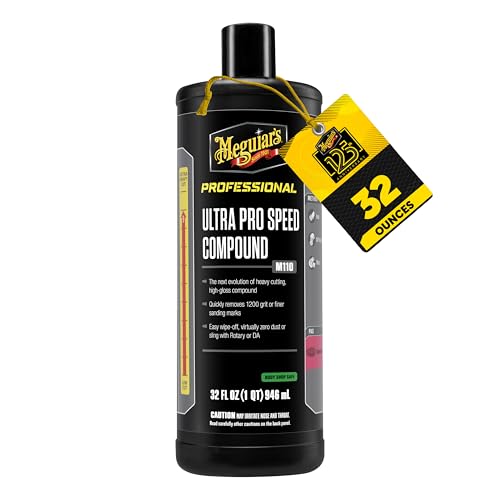
1. Meguiar’s Professional M110 Ultra Pro Speed Compound, 32oz
Our pick — over 4.5★ from 800+ verified ratings; the strongest balance of quality and price.
The single-step cutter that gives beginners that glass-smooth mirror finish in one pass.
This is the compound that owners describe as “smooth as glass in no time,” and the reason is its fine 200-grit aluminum oxide abrasive. It is aggressive enough to remove swirls, scratches, and oxidation, yet safe enough that a first-timer with a dual-action polisher can finish a panel without fear. The 32 oz jug means you get plenty of passes before you need a refill, and buyers report you need very little product per panel.
Cutting is only half the story, because the finish matters just as much. Users report a mirror-like, deep shine that rivals pro work, and they appreciate how easily it wipes off after working. Owners mention that “advertises removing 1200 grit scratches but you have to really work your machine and use a decent amount of compound,” so expect to put in some effort for the heaviest defects. The one trade-off everyone mentions is dust — it creates a significant amount during use, so wear a mask and clean your workspace after.
Compared to the Meguiar’s M04 below, the M110 is the more versatile daily driver, trading some raw cutting power for a much finer finish that rarely needs a follow-up polish. On a repainted black hood wet-sanded with 1500 to 3000 grit paper, customers note a phenomenal deep shine that is “dummy-proof” and easier than a 3M system.
Cutting speed: Highly effective on swirls and sanding marks, with quick results that owners praise for speed.
Dust caveat: Expect visible dust; it is the most-mentioned trade-off but does not stop buyers from reordering.
Reach for it if: you want one product that cuts and finishes well enough to skip a second polish step on most daily drivers.
Look elsewhere if: you are working indoors in a clean-room space where airborne dust is a dealbreaker for you.
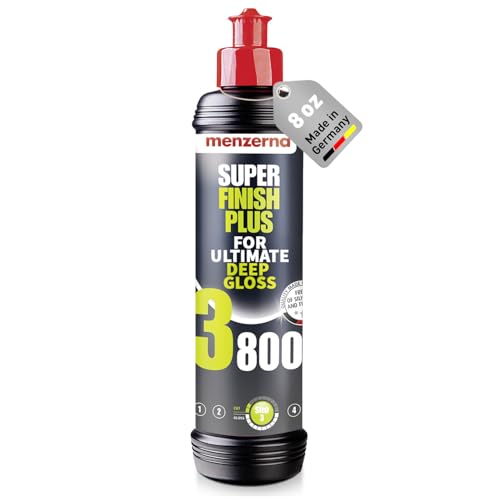
2. menzerna Super Finish Plus 3800, 8 oz
The jeweler’s final step that makes dark paints look like liquid glass.
While most compounds focus on cutting, the menzerna 3800 is all about the finish. It is a polish/compound hybrid that owners say leaves paint looking like glass, and it is specifically praised for dark-colored coats where holograms and micro-abrasions show up most. At 8 oz it is far smaller than the 32 oz Meguiar’s M110 (a 4.0x capacity gap), but it is not meant for heavy cutting — it is the refinement step after you have already leveled the paint.
The standout feature is its long working time, so you can polish a panel slowly without the compound drying out. One owner removed holograms from black paint using a rotary polisher at low speed with a red jeweling pad, reporting crisp results and calling it “cheaper than competitors” and “worth it.” This silicone-free formula requires a wax or sealant on top afterward to lock in the gloss.
Storage is easier with this pick because it is lighter and smaller than the Meguiar’s M04: it weighs 16 ounces (a 2.0x weight gap) and its 8.3 x 1.9 x 1.9-inch bottle is 20% smaller than the M110’s 10 x 10 x 10-inch jug. That fits neatly in a tight garage drawer. But do not expect it to remove deep key scratches — this is a finisher, not a cutter.
Gloss master: The thing everyone raves about is the deep, mirror-like shine it pulls from black and dark paint with zero dust.
Scope limit: It will not level deep scratches; pair it after a true cutting compound for the best result.
Best suited for: owners who have already done the heavy correction and want that final show-car gloss on dark paint.
Consider the trade: if you only have budget for one product and your car has deep scratches, step up to a dedicated cutter first.
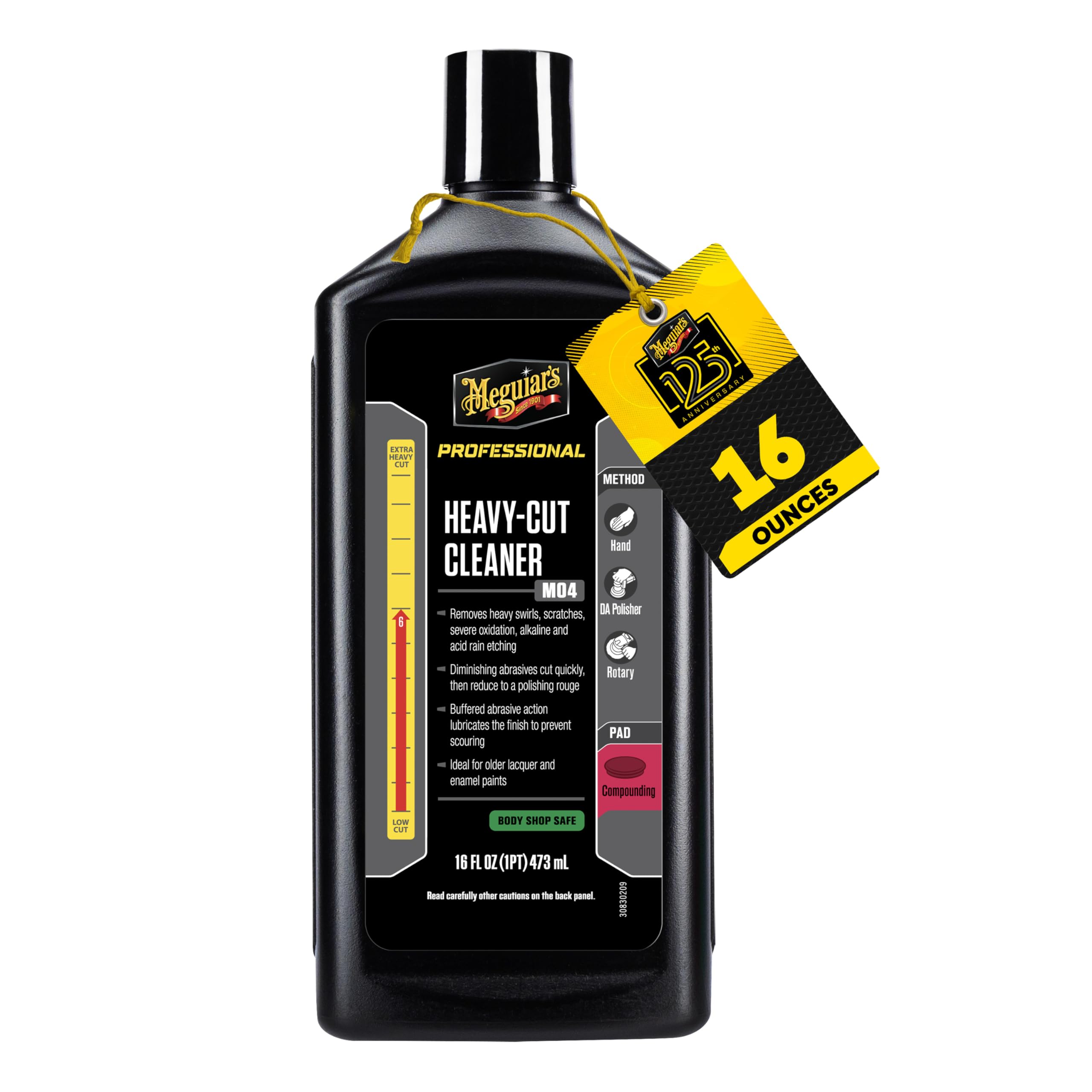
3. Meguiar’s Professional M04 Heavy Cut Cleaner, 16oz
The aggressive body-shop cutter that chews through oxidation and orange peel fast.
When your paint is beyond swirls — think heavy oxidation, acid rain etching, or severe scratches — this coarse 40-grit formula is the sledgehammer you need. That is a full 5.0x coarser than the fine 200-grit on the M110 above, and you feel it immediately in how fast it levels surface defects. It is designed for a rotary buffer and body shop use, so it is not the gentlest option for a nervous beginner.
Owners praise it as “a great cutter to bring out the best shine while removing the orange peel,” and it is especially recommended for older lacquer and enamel paints. One buyer used it to clean mineral deposits off an Audi where a neighbor’s sprinkler had been hitting it for months, and after chemical decontamination this was the step that finally did the trick. It cuts aggressively, then reduces to a buffing rouge to minimize swirling.
The 16 oz bottle is half the size of the M110’s 32 oz jug, so heavy users may go through it faster. At 16 ounces it is also exactly twice the weight of the menzerna 3800’s 8-ounce bottle, so you are getting a lot more product and a lot more cutting power for your money. Just know that its aggressive nature means you should follow up with a finer polish to restore maximum gloss.
Why pros keep it stocked
- Removes heavy oxidation and water spots fast
- Lubricates to prevent scouring or scratching
- Ideal for older lacquer and enamel paints
Who should be careful
- Very abrasive, requires rotary buffer experience
- Finish is not final-grade, needs a polish step
Grab this for: single-stage classics, badly faded daily drivers, or paint that has not been corrected in years.
Not for: light swirl removal on a newer clear coat where a finer compound is safer.
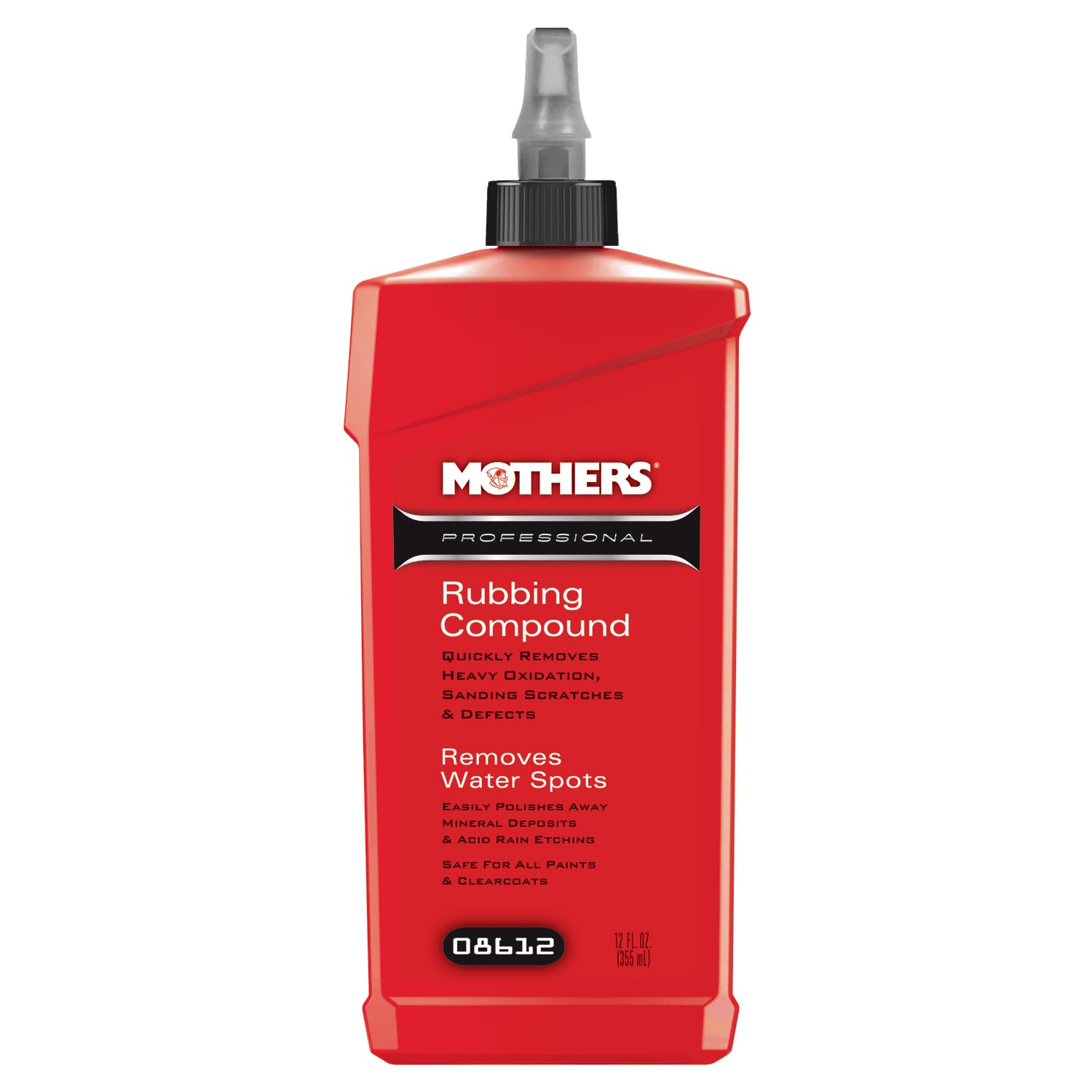
4. Mothers Professional Rubbing Compound, 12 oz
The forgiving cream that delivers showroom gloss without demanding pro-level technique.
This 12 oz cream stands out for its gentleness — owners note it “doesn’t have a scratchy feel” and has a much milder abrasive effect than a true polishing compound. That makes it the safest choice if you are new to machine buffing or working on a daily driver you do not want to damage. It uses the same industry-proven formulas found in body shops, so it is not a toy, but it is simple enough for anyone.
The formula is silicone-free and cuts through water spots in addition to removing heavy oxidation and car wash scratches. Owners find it easy to use, noting it buffs off “without requiring much elbow grease” when used with a buffer. One owner summed it up as “just shy of 3m’s hallowed performance” at a much friendlier value point. It also works well on headlights, giving lenses that final high gloss.
Keep in mind that its gentleness is also its limit — do not expect it to level deep key scratches or 1500-grit sanding marks. For those, the 3D ACA 500 below cuts P100 grit and is the step-up choice. For light swirls, hazing, and water spots that you want gone with minimal risk, this is the bottle to keep on the shelf.
Gentle power: Effectiveness is what wins people over here — it removes defects without the scratchy feel of harsher products.
Match it right: If your paint has deep scratches, pair this with a more aggressive compound first, then finish with this for gloss.
Choose it if: you are a first-timer who wants a forgiving cream that still delivers professional-level results on light defects.
Reconsider for: heavy oxidation or deep sanding marks that need a coarser abrasive to tackle.
5. 3D ACA 500 Cutting Compound, 8 oz
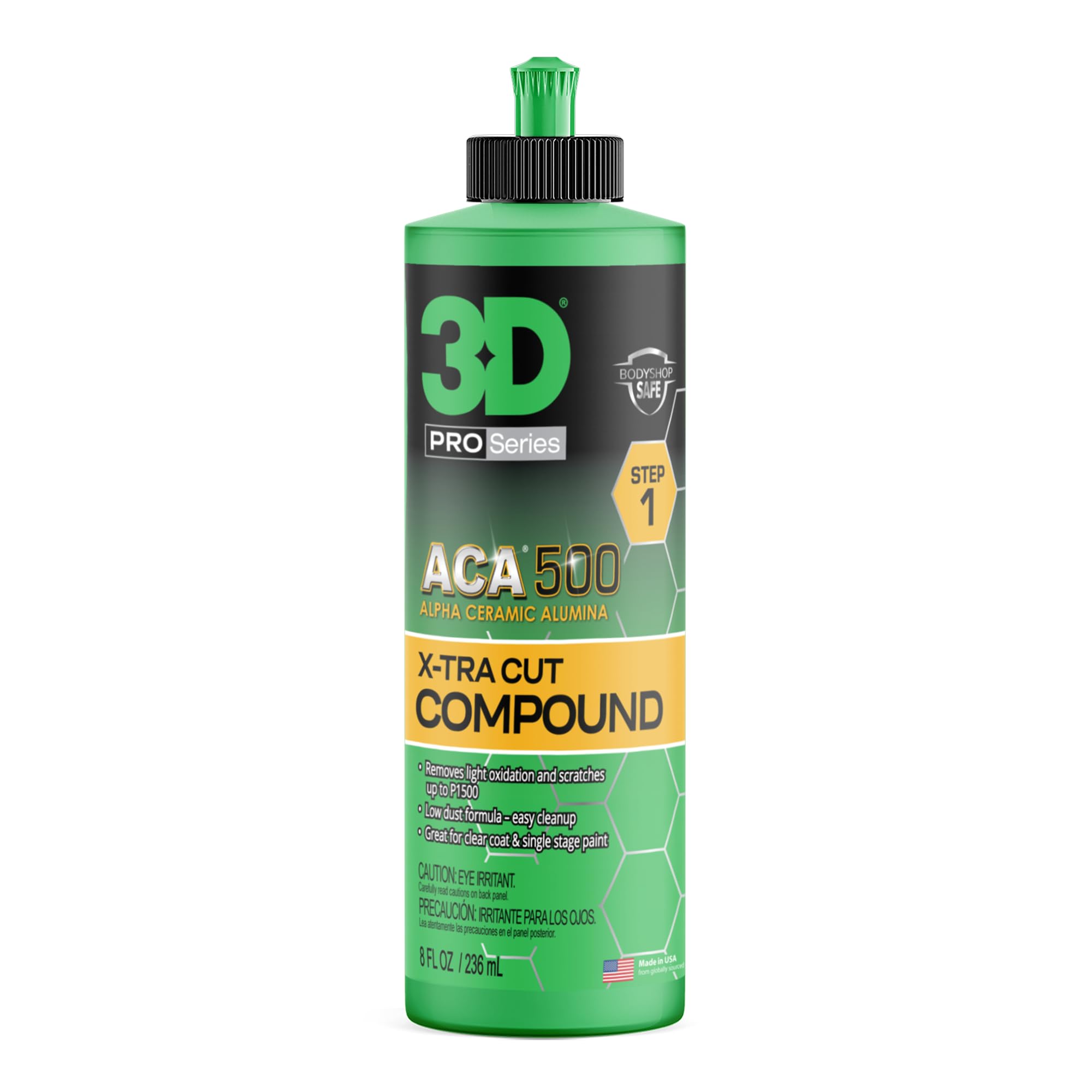
The ceramic-tech cutter that tackles P100 sanding marks while running cooler than most.
This is the special-ops compound for the worst damage. With a fine 100-grit ceramic abrasive, it is formulated to remove deep scratches, heavy oxidation, and P100 grit sanding marks — that is rougher damage than what the Wizards Turbo Cut at 1200-grit will touch. The Advanced Alpha Ceramic Alumina Technology keeps the compound cool during polishing, which means less heat buildup and more control on modern clear coats.
Owners confirm its cut performance, with one reporting “impressive results” from hand testing on a metallic grey Mercedes before even breaking out the orbital machine. It is a body-shop-safe formula made in the USA, and the low-dusting design means less compound dust in your workspace and on your paint. Reviewers point out it is forgiving and cleans up easily, bringing old faded paint back to life.
The honest trade-off is that it does not finish as perfectly as a dedicated polish — one owner noted it “doesn’t finish as well but good for starters.” Use it as the aggressive first step to level the surface, then refine with a finer polish like the menzerna 3800 above to restore deep gloss. At 8 oz, the bottle is small relative to its power, so heavy users may want to stock up.
Cutting muscle: The thing that impresses owners most is how fast it removes deep sanding scratches with controlled heat.
Finish gap: It leaves a good base but not a show-grade gloss, so budget for a finishing polish step.
Reach for this when: you have wet-sanded panels, deep gouges, or P100 marks that milder compounds cannot touch.
Skip it when: you only have light swirls and want a one-step product that finishes glossy.
6. Wizards Turbo Cut Rubbing Compound, 32 oz

The time-release leveler that lifts deep scratches then self-moderates to a smooth 4000-grit finish.
What makes the Wizards Turbo Cut different is its Time-Release Abrasive Technology. It starts with an aggressive cut to lift deep paint scratches and surface oxidation, then progressively self-moderates as you work the panel, leaving a surface that levels to a smooth 4000-grit finish without hazing or pad loading. That is a smarter workflow: one product handles both the heavy lifting and the smoothing.
It is engineered for machine application at 1400 to 2200 RPM with a blended wool pad, making it precise for professional detailers working on cars and trucks. But it also shines on marine gelcoat and neglected fiberglass, which is why shoppers say great results on fiberglass boats and trailers that look new again. The water-based, silicone-free formula cleans up without staining shop towels or pads.
Owners describe it as “pretty aggressive cutting” that handles up to about 1000 grit, though one buyer cautions it will burn paint if you use high polisher speeds — so control your RPMs. It is also a generous 32 oz jug, giving you far more product than the 8 oz 3D ACA 500 above for long correction sessions. Pair it with a white foam cutting pad and a finishing step for a complete system.
What makes it versatile
- Time-release abrasive self-moderates as you work
- Works on automotive paint and marine gelcoat
- Water-based formula cleans up easily
Handle with care
- Will burn paint on high polisher speeds
- Best results need a machine, not hand work
Ideal for: owners juggling a car and a boat or trailer who want one compound that levels both paint types.
Watch out: if you are new to rotary buffing, practice on a scrap panel first to avoid heat damage.
7. Malco Super Duty Heavy Cut Compound, 32 oz
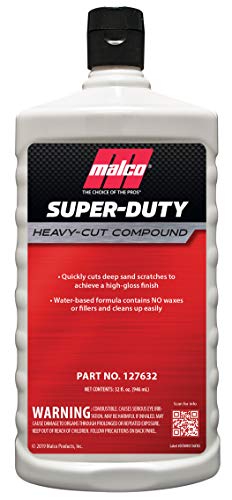
The cut-and-buff workhorse that revives oxidized paint with night-and-day results.
If your paint has lost its color to years of sun exposure, this Malco compound is the revival kit. It is a versatile heavy-cut formula designed to remove P1500 grit and finer sand scratches from clear coat painted and gel coat surfaces, on cars, trucks, or boats. Made in the USA, it is body shop safe and VOC compliant, so it passes professional standards.
Owners who were ready to give up on severely oxidized paint report results that “far exceeded expectations.” One detailer described the difference from another brand as “night and day,” noting it delivers “true grit” with a high-polish finish. This formula leaves a high-gloss finish on any automotive, marine, or industrial coating, which is rare for a heavy cutter. It works best with a 100% twisted white wool cutting pad.
The 32 oz bottle is a generous size, matching the Wizards Turbo Cut above for value. A professional detailer recommends it to others struggling to get results, and it handles 2000 grit marks easily. The only note from owners is that if you use too much and work an area too long, it can be a little difficult to remove — so use it sparingly and keep moving.
Revival power: Effectiveness is the overwhelming crowd favorite — it cuts right past dead paint and brings back gloss.
Easy overuse: Work in small amounts and keep the pad moving to avoid residue that is hard to wipe off.
Choose it for: badly oxidized daily drivers, faded single-stage urethane trailers, or a full cut-and-buff project.
Not the one for: light swirl removal where a finer compound like the Mothers above is gentler.
8. Chemical Guys C4 & P4 Paint Correction Kit, 2 x 16 oz
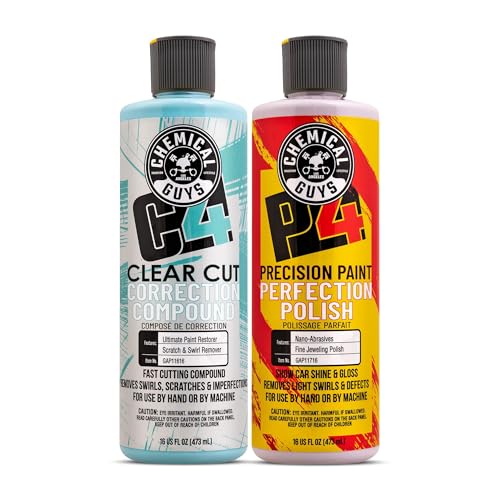
A complete two-bottle correction system that takes paint from scratched to show-ready in sequence.
This kit thinks for you by pairing two products that are meant to be used one after the other. The C4 Clear Cut Compound is an ultra-fine 2000-grit formula that cuts through scratches, swirls, oxidation, towel marks, and etching, restoring clarity and leveling the paint. Then the P4 Precision Polish refines that surface, removing micro-marring and enhancing depth, gloss, and color vibrancy for a show-quality finish.
Buyers report professional results without the professional price tag. One buyer removed 95% of off-road scratches on a truck, with the remaining one barely visible, and improved 8-year-old scratches. Another called it “outfreakingstanding” for making a bike look new again. The kit is safe on clear coat, single-stage, and ceramic-coated vehicles, and works with dual-action, rotary, or hand application.
The key benefit is that you get both necessary steps in one box at 2 x 16 oz, saving you from buying two separate bottles. It is easy to spread and not messy, and the two products work well together. The honest note is that C4 cuts somewhat less than expected on very hard clear coats like a 1999 Corvette when using light pressure, so you may need more passes on rock-hard paint. Still, for most DIY owners this is a complete correction solution.
Complete workflow: Buyers love that the cut and polish pair is designed to work together, not as separate guesses.
Hard clear coats: Expect to work a bit harder on ultra-hard factory paint; add pressure or an extra pass.
Best for: DIY enthusiasts who want a guided two-step correction without researching which polish matches which compound.
Better alternatives: Pros with deep P100 marks should start with a heavier cutter like the 3D above before this kit.
9. Meguiar’s Diamond Cut Compound 2.0 M8501, 1 Gal
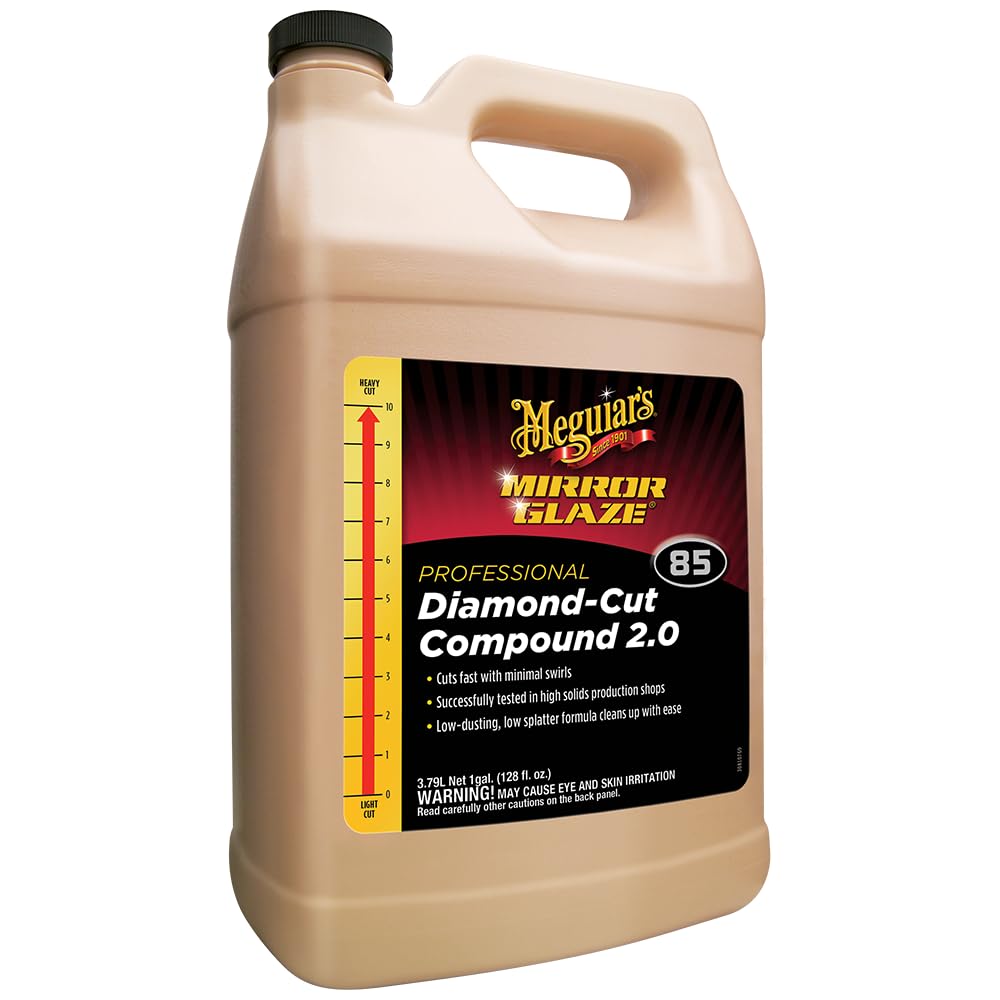
The shop-grade gallon that cuts with a diamond edge and leaves fewer swirls than the classic M105.
This is the heavy-duty volume buy for people who compound a lot of paint. At a full 1 gallon, it dwarfs every other bottle on this list — nearly three times the size of the 32 oz Meguiar’s M110 — and it is built for high-solids, glossy paints. The fine 1500-grit diamond abrasive delivers a “super fast, low swirl” cut that owners say brings paint back to life with less effort.
The M8501 replaces the older M105 with a formula that leaves noticeably fewer swirl marks. One BMW owner reported it “leaves a lot less swirl marks” with “light dust vs other brands,” and it “cuts well with little effort.” Even more striking, a guitar luthier calls it “the ONLY polish I’ll use on my custom nitrocellulose lacquer guitar finishes,” praising its clean emulsification to a fine rouge. It works with a right angle polisher and by hand.
With a fine 1500-grit rating, it is less aggressive than the Malco’s P1500-equivalent on paper but uses diamond particles for efficient cutting. The low-dusting, low-splatter formula means easier clean-up than traditional compounds. Owners rate the quality highly, though cutting performance gets mixed feedback — some want more aggression for the deepest defects. At 8.9 pounds, this is the heavyweight of the list, so keep it on a sturdy shelf.
Quality finish: The crowd favorite here is the low-swirl, low-dust formula that still cuts effectively on high-solids paint.
Mixed cut feedback: Some owners wish for more aggressive cutting; pair with a heavier compound for the deepest gouges.
Reach for it if: you detail multiple vehicles or custom finishes and want a gallon-sized, low-swirl workhorse that lasts.
Pass it up if: you only correct one car a year — the 32 oz jugs above give you plenty without the bulk.
Understanding the Specs
Grit Number and Abrasive Type
The grit number on a compound tells you how aggressive the abrasive particles are. A lower number like 40 on the Meguiar’s M04 means a very coarse cut for heavy oxidation, while a higher number like 2000 on the Chemical Guys C4 means a fine polish. The abrasive material matters too — aluminum oxide is common for general cutting, ceramic runs cooler, and diamond particles like the M8501 cut efficiently with less effort.
Working Time and Dust
Working time is how long the compound stays wet and effective before it dries out on the panel. A longer working time like the menzerna 3800 gives you more time to work a panel slowly. Dust is the powder that flies off as the compound dries — some formulas like the 3D ACA 500 and Meguiar’s M8501 are engineered to be low-dust, keeping your workspace cleaner and your paint free of dried residue.
FAQ
What is the difference between a rubbing compound and a polish?
Will compound remove deep scratches down to the primer?
Can I use these compounds by hand instead of a machine?
How do I know which compound is safe for my clear coat?
What does “cut” mean in a cutting compound?
Why does my compound create so much dust?
Is a two-step compound and polish kit better than a single compound?
Can I use car compound on my headlights?
How much compound should I use per panel?
What is the 4000-grit finish mentioned on some compounds?
Final Thoughts: The Verdict
For the majority of shoppers, the compound for car scratches winner is the Meguiar’s M110 Speed Compound because it delivers that rare balance of aggressive cutting and a clean finish in one step. If you want the absolute deepest gloss on dark paint, grab the menzerna Super Finish Plus 3800. And for badly oxidized or factory-aged paint, the Malco Super Duty Heavy Cut is the one to reach for.
How We Picked
We do not accept paid placement. Every pick is matched to a real buyer and a real use-case; we do not hands-on test units.
Sources & Methodology
Specifications: manufacturer listings and product documentation. Review insights: verified customer reviews, as of August 2026. Pricing: not shown on this page (it changes often); check the current price via the retailer link.
As an Amazon Associate, Trending Car earns from qualifying purchases. This does not affect which products we feature.