
Our readers keep the lights on and my garage snacks stocked. As an Amazon Associate, I earn from qualifying purchases.
Specs are compiled from manufacturer listings and verified buyer reviews and can change over time — please confirm the key details on the product page before buying.
Walking into a garage or workshop where a loud air compressor kicks on is like standing next to a jackhammer — it interrupts conversations, spooks pets, and makes you reach for earplugs before you even grab a tool. Modern commercial air compressors have flipped that old reality: the best ones now deliver serious pneumatic power without forcing you to shout over them. This guide walks through eleven real-world picks, comparing their tank sizes, CFM output, noise levels, and everything else that actually matters when you are choosing a unit for daily shop use, automotive work, or production framing.
I’m Min Islam — the founder and writer behind Trending Car. This guide is built by comparing the manufacturers’ published specifications and the patterns across verified customer reviews, so you get each pick’s real strengths and trade-offs instead of marketing spin.
Whether you are outfitting a home garage or a busy job site, the right unit balances air delivery with uptime, and this roundup of the best commercial air compressor models gives you a clear reason to pick one over the rest.
Our Picks at a Glance

How To Choose The Best Commercial Air Compressor
Match the compressor to your tools’ CFM requirements, not just the tank size. A compressor that runs a framing nailer all day may struggle with a continuous-use sandblaster, so match specs to your specific tools.
Focus on three specs: tank capacity (gallons), CFM at 90 PSI, and maximum PSI. Your tools list their CFM requirements; the compressor must deliver at least that much at the needed pressure to avoid mid-job recovery waits.
Pump Design: Oil-Lubricated vs. Oil-Free
Oil-lubricated pumps use a bath of oil to cool and seal the cylinder, which means they run cooler, last longer (often thousands of hours), and are generally quieter. The trade-off is maintenance: you check and change oil. Oil-free pumps skip that chore entirely, using pre-lubricated bearings and special piston rings, but they tend to run hotter, louder, and with a shorter service life. For intermittent home-shop use, oil-free is fine; for daily commercial use, oil-lubricated is the standard.
CFM and PSI: The Real Power Numbers
CFM (cubic feet per minute) tells you how much air the pump can push. Every pneumatic tool comes with a CFM rating — a framing nailer might need 2.1 CFM at 90 PSI, while a die grinder could need 5.0 CFM at 90 PSI. PSI (pounds per square inch) is the pressure the tank holds. Most tools work at 90 PSI, so a compressor that delivers high CFM at that pressure is the one you want.
Tank Size and Recovery Time
A bigger tank stores more air, so you get longer run time before the motor kicks on again. But recovery time — how fast the pump refills the tank — matters just as much. A compressor with a 20-gallon tank and a fast-recovering pump can outperform a slow 60-gallon unit in continuous-use situations. The tank is your air buffer; the pump is your refill speed — both must work together.
Quick Comparison
| Model | Best For | Capacity | Max PSI | CFM @ 90 PSI | Amazon |
|---|---|---|---|---|---|
| Makita MAC5200★ Best Overall | Reliable daily shop work | 5.2 gal | — | 6.5 | Amazon |
| Klutch 29-GallonTop Performer | High-volume stationary use | 29 gal | 175 | 5.1 | Amazon |
| Stealth 20 Gallon (SAQ-12018)Quiet Champ | Ultra-quiet operation | 20 gal | 150 | 5.0 | Amazon |
| Craftsman 20 Gallon | Budget-friendly 20-gallon | 20 gal | 175 | 4.0 | Amazon |
| Stealth 20 Gallon Ultra Quiet (SAQ-12018) | Ultra-quiet with long life | 20 gal | 150 | 5.0 | Amazon |
| VEVOR 20 Gallon | High CFM for multiple tools | 20 gal | 125 | 10.6 | Amazon |
| DEWALT 25 Gallon | Industrial belt-drive | 25 gal | 200 | — | Amazon |
| Industrial Air ILA1883054 | Heavy-duty cast iron build | 30 gal | 155 | 7.0 | Amazon |
| Ingersoll Rand P1.5IU-A9-H | Compact professional unit | 20 gal | — | 5.2 | Amazon |
| Ingersoll Rand SS3L3 | Continuous-duty 60-gallon | 60 gal | 135 | 10.3 | Amazon |
| California Air Tools CAT-60040CAD | Ultra-quiet 60-gallon shop unit | 60 gal | 125 | 10.6 | Amazon |
In‑Depth Reviews
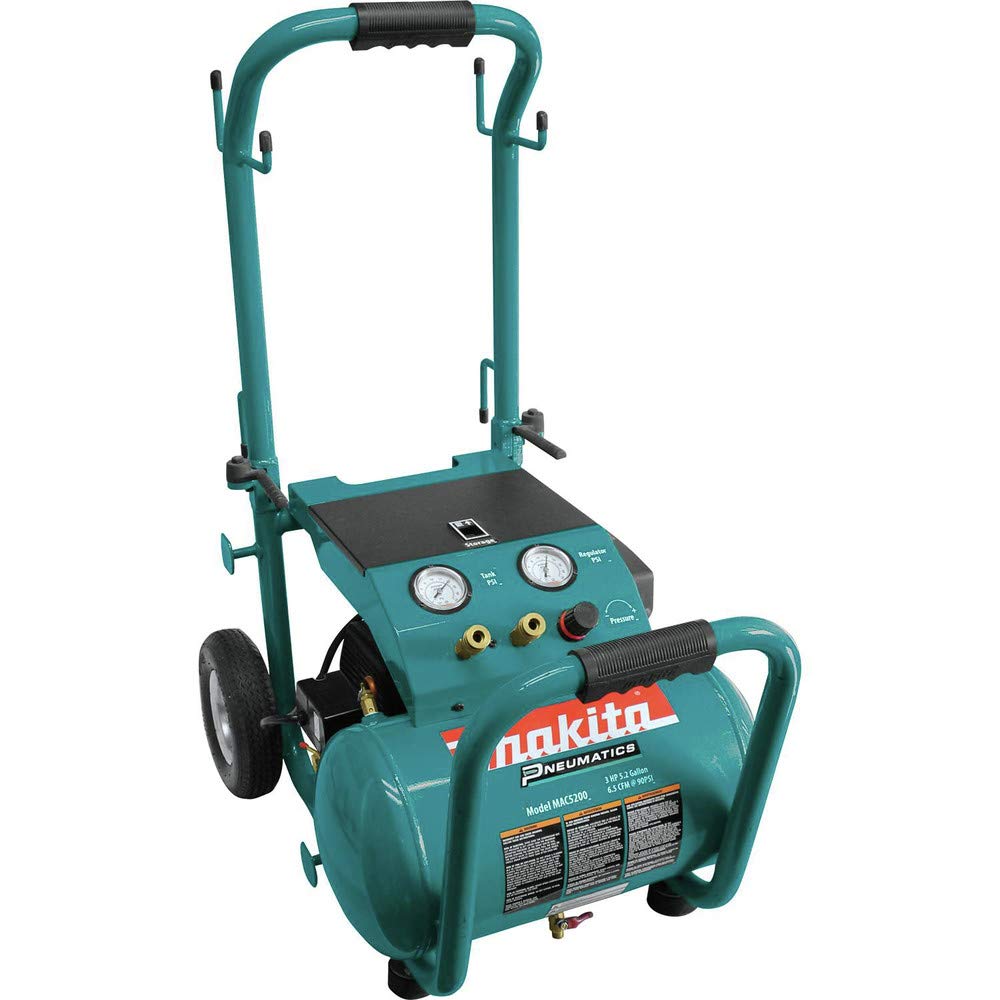
1. Makita MAC5200 3.0 HP* Big Bore™ Air Compressor
Our pick — 4.5★ from 900+ verified ratings; the strongest balance of quality and price.
The workshop workhorse that fires up an impact wrench before you finish your coffee.
This Makita runs a 3.0 HP motor that delivers 6.5 CFM at 90 PSI — enough air to remove lug nuts from a car or SUV without the compressor struggling to keep up. The Big Bore cast iron cylinder and oil-lubricated pump keep running temperatures lower than oil-free designs, which directly translates to longer pump life. Buyers report it “charges tank to 120 PSI in 1 min 17 sec,” a recovery speed that makes it feel ready before you are.
At 75 pounds on wheels, this is the portable unit that actually moves where you need it, with a folding handle for storage. The 5.2-gallon tank is compact, yet the crowd favorite — with over 900 owners rating it — proves it punches above its size. What wins people over most is the build quality, followed closely by the real-world CFM that runs everything from a flooring nailer to a die grinder.
What owners love
- Solid cast iron pump runs cooler and lasts longer than oil-free alternatives
- 6.5 CFM at 90 PSI drives impact wrenches, nailers, and smaller sanders without waiting
- Portable enough (75 lbs on wheels) to move between garage bays or job sites
- Folding handle stores compactly when not in use
The honest trade-offs
- Noise level is mixed — quieter than cheap oil-free units but not as silent as belt-drive alternatives
- Small 5.2-gallon tank means more frequent cycling during continuous-use tools like paint sprayers
Reach for this if: You want a proven, portable, cast-iron compressor that can handle automotive work and framing without needing a 60-gallon footprint.
Look elsewhere if: Your work demands hours of continuous high-volume air (sandblasting, production spray painting) — the small tank and fast cycling will test your patience.
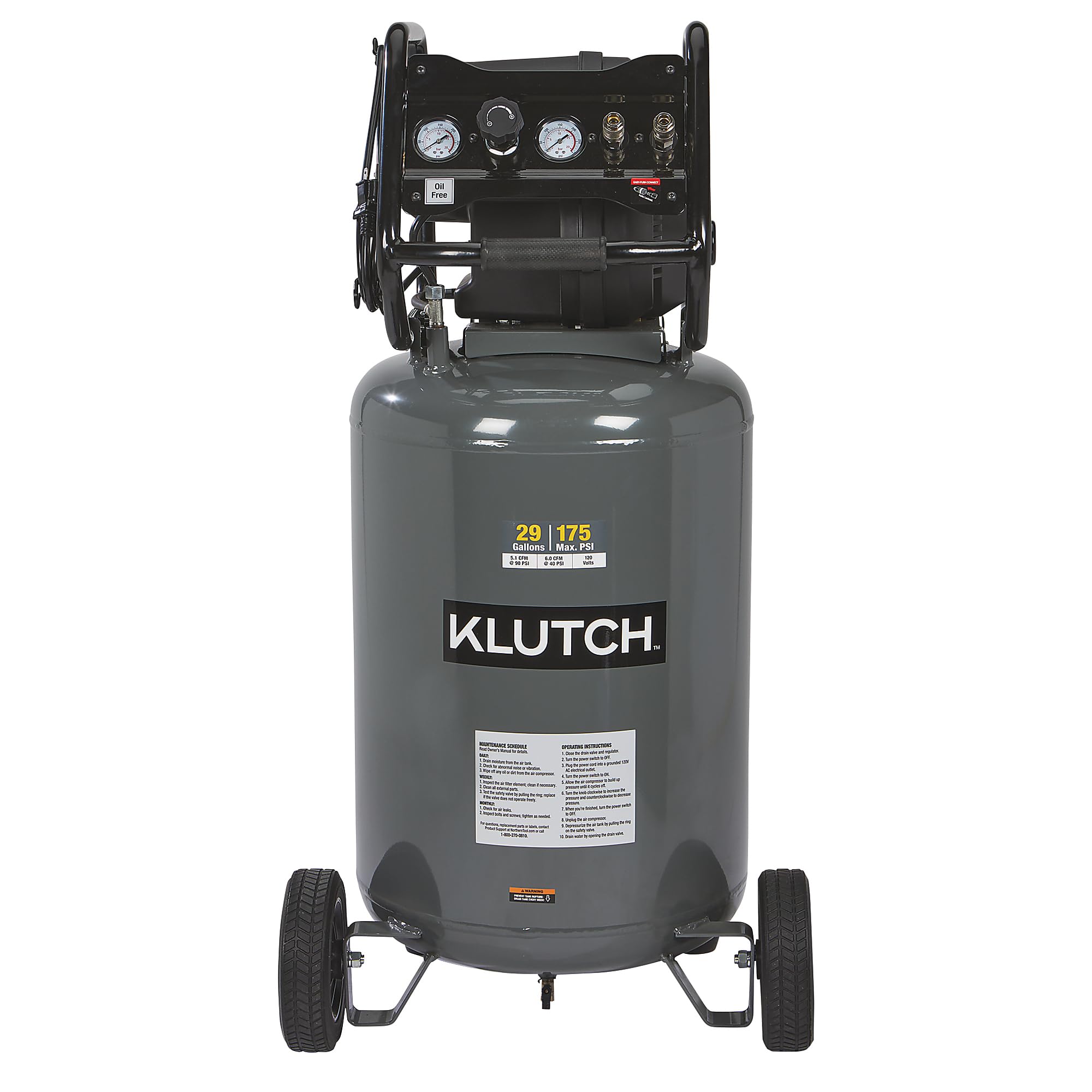
2. Klutch 29-Gallon Air Compressor, 2.5 HP, 120 Volts, 175 PSI
The oversized vertical tank that keeps your tools running long after smaller units cycle on.
With a massive 29-gallon tank and a maximum 175 PSI, this Klutch is built for the person who wants to inflate tires, run a paint sprayer, and drive framing nails without the compressor kicking on every 30 seconds. The 2.5 HP oil-free pump delivers 5.1 CFM at 90 PSI, and owners confirm it “builds pressure quickly, holds air well, handles automotive tools.” The oil-free design means zero maintenance — no oil changes, no spills to clean up.
It is a vertical floor unit that saves space compared to horizontal tanks, but at 127 pounds, portability means rolling it on the large flat-free tires, not carrying it. The build quality and noise level earn strong positive marks from buyers. The honest pinch-point is pressure buildup: while most owners are satisfied, some report it takes a while to climb to the higher PSI range.
The standout feature: The 29-gallon tank at this price point is rare — it gives you serious air capacity for under mid-range money.
Best for: Shop owners who need a high-volume, low-maintenance compressor for daily nailing, inflation, and spray work without paying premium-tier prices.
Think twice if: You need true portability to move between job sites — this is a wheel-around-the-garage machine, not a truck-loader.
3. Stealth 20 Gallon Ultra Quiet Air Compressor, 1.8 HP Oil-Free
The silent partner you can actually have a conversation next to while it works.
At just 68 decibels — buyers describe it as “half the noise of a jackhammer” — this Stealth is the go-to for noise-sensitive environments like residential garages, indoor workshops, or job sites where earplugs are optional. The 1.8 HP oil-free pump delivers 5 CFM at 90 PSI with a peak of 150 PSI, and the 20-gallon steel tank handles framing nailers, impact wrenches, and blow guns with ease. The fast recovery time makes it feel responsive even during continuous stapling or nailing.
The oil-free design keeps maintenance simple, and the 8-inch rubber wheels make the 121.4-pound unit manageable across a shop floor. Two quick-couplers let you switch between tools without crawling under the unit. Quiet operation is the star here — it is the most-discussed feature by far. On the flip side, reliability receives mixed feedback from the buying community; some units arrive with shipping damage, and a few owners mention pressure switch issues after light use.
The catch: The quiet that makes it so appealing in a garage also makes it a stationary unit — at over 120 pounds, you want it set up once.
Reach for this if: Noise is your biggest concern and you need a 20-gallon machine that runs a framing nailer or impact wrench without waking the house.
Look elsewhere if: You need a unit that can survive rough daily transport to construction sites — the mixed reliability feedback suggests a gentler home-shop life.
4. Craftsman Air Compressor, 20 Gallon Oil-Free 1.8 HP

The red tank that proves a name you trust still delivers at a sensible price.
Craftsman’s 20-gallon vertical compressor hits a balance for the home mechanic or hobbyist who wants 175 PSI and a stainless steel tank without over-spending. The 1.8 HP motor pushes 4.0 CFM at 90 PSI — enough for brad nailers, finish nailers, inflation, and basic cleaning. Owners who replaced old Craftsman units report the 30+ year lifespan of their previous machine is why they came back. Setup is easy, the rubber feet reduce vibration, and the two quick-couplers let you share the tank between a hose and an inflation nozzle.
The build quality and setup simplicity are the top positives among buyers. Durability, however, gets negative feedback — a small but notable number of customers note failure after heavy use. This is a machine that treats you well as long as you treat it to intermittent duty.
The honest note: The CFM at 90 PSI (4.0) is lower than the Stealth or Makita, so continuous spray painting or sanding will push its limits.
Best for: The occasional-use shop — nailing baseboards on weekends, inflating tires, and light automotive work where you want a known brand at a fair price.
skip it if: You plan to run a paint sprayer or die grinder for hours at a time — the lower CFM and mixed durability reports make that a gamble.
5. Stealth 20 Gallon Ultra Quiet Air Compressor (SAQ-12018)

The indoor-friendly compressor that lets you spray lacquer on guitars without ear protection.
This Stealth variant pushes the quiet theme further: it operates below 70 dB and uses an induction motor rated for over 1,000 hours of service life. At 5.0 CFM at 90 PSI and 150 PSI max, the oil-free pump is quiet enough for residential zones and sensitive work like painting cabinets or musical instruments. Owners specifically call out using it for spraying lacquer on guitars — a task where a loud compressor would ruin the focus.
The 20-gallon tank and large rubber wheels make it a versatile shop addition at 121 pounds. The noise level and solid performance are the top highlights. The downside: customer support is hard to reach if something goes wrong, and a few units arrive with shipping damage that the seller is slow to address.
What it does best: Operates below 70 decibels with a motor built to last over 1,000 hours — that is a decade of weekend use.
Reach for this if: You do finish work, painting, or any noise-sensitive task inside a home shop and want to keep the peace.
Look elsewhere if: You rely on responsive customer support — reviewers point out that reaching someone at the company takes persistence.
6. VEVOR 20 Gallon Air Compressor, 4HP 10.6 CFM

The 20-gallon tank that breathes like a 60-gallon with its 10.6 CFM output.
This VEVOR is the outlier: at 10.6 CFM at 90 PSI, it delivers more than double the airflow of most 20-gallon competitors — enough to run a spray gun, impact wrench, and nail gun simultaneously. The 4 HP oil-free motor spins at 1680 RPM and keeps noise at just 78 dB, making it both powerful and quiet. The 125 PSI max is lower than some options, but the sheer volume of air makes up for it in continuous-use scenarios.
The 20-gallon steel tank features a three-layer rust-resistant coating, and the automatic overheat protection gives confidence during long sessions. Owners describe it as compact yet powerful, with fast pressure buildup. The short power cord (only 40 inches) and small wheels that make the 134.7-pound unit tippy during movement are the common complaints.
The defining spec: 10.6 CFM at 90 PSI from a 20-gallon tank — that is pro-level air delivery in a compact footprint.
Best for: Shops that need high continuous CFM for spray painting, sanding, or running multiple tools but lack space for a 60-gallon unit.
Think twice if: You need a portable unit — the 40-inch cord and small wheels make movement more hassle than it should be.
7. DEWALT 25 Gallon Vertical Air Compressor, Oil Lubed, Belt Drive

The yellow tank that turns head and holds 200 PSI for demanding industrial tools.
DEWALT brings its job-site reputation to a belt-driven 25-gallon vertical compressor with a 2 HP motor and a maximum 200 PSI — the highest pressure on this list. Belt-drive design naturally runs quieter and lasts longer than direct-drive because the pump speed is reduced, and the oil-lubricated pump adds durability. A high-efficiency aluminum flywheel increases airflow and lowers startup amps, which is helpful if your shop circuit is shared with other equipment.
The 10-inch heavy-duty pneumatic wheels make this 25-gallon unit genuinely portable across rougher terrain than standard rubber wheels allow. Quality and reliability are the top aspects owners praise. A few units arrive with minor quality issues like a dirty air filter or a leaking release valve, and some owners note the 2 HP motor feels less powerful than the rating suggests for continuous tools.
The standout spec: 200 PSI maximum pressure — rare at this tank size, useful for tools that need the extra push like high-torque impact wrenches.
Reach for this if: You want a belt-driven, oil-lubed compressor from a brand you can service at any big-box store, with enough PSI for heavy-duty impact work.
Look elsewhere if: Your tools demand high CFM for continuous operation — this unit is built for pressure, not volume.
8. Industrial Air ILA1883054 30-Gallon Belt Driven Air Compressor

The 190-pound beast that hunkers down and delivers 7.0 CFM without vibration.
Industrial Air builds this 30-gallon unit around a cast-iron, twin-cylinder, oil-lubricated pump and a heavy-duty induction motor. The belt drive keeps the pump spinning at lower RPM, which translates to quieter operation and less wear — owners consistently call it much quieter than oil-free units they owned before. At 155 PSI max and 7.0 CFM at 90 PSI, it drives die grinders, framing nailers, and air ratchets without breaking a sweat.
The dual-voltage motor runs on a standard 120V outlet and can be converted to 240V for more demanding setups. Synthetic oil is included, and the quick-set regulator gives you fine control at the gauge. Quality and quiet operation are the most-praised aspects. The tank drain is awkwardly positioned and the unit is top-heavy during movement, so a few owners recommend adding a drain extension and moving it carefully.
The build statement: Cast iron twin-cylinder pump on a belt drive — this is the kind of construction that keeps industrial shops running for decades.
Best for: A seasoned shop owner who wants a 30-gallon, belt-driven, cast iron compressor that holds air with no leaks and runs quietly.
Think twice if: You need easy portability — at 190 pounds with a top-heavy design, this stays put once set up.
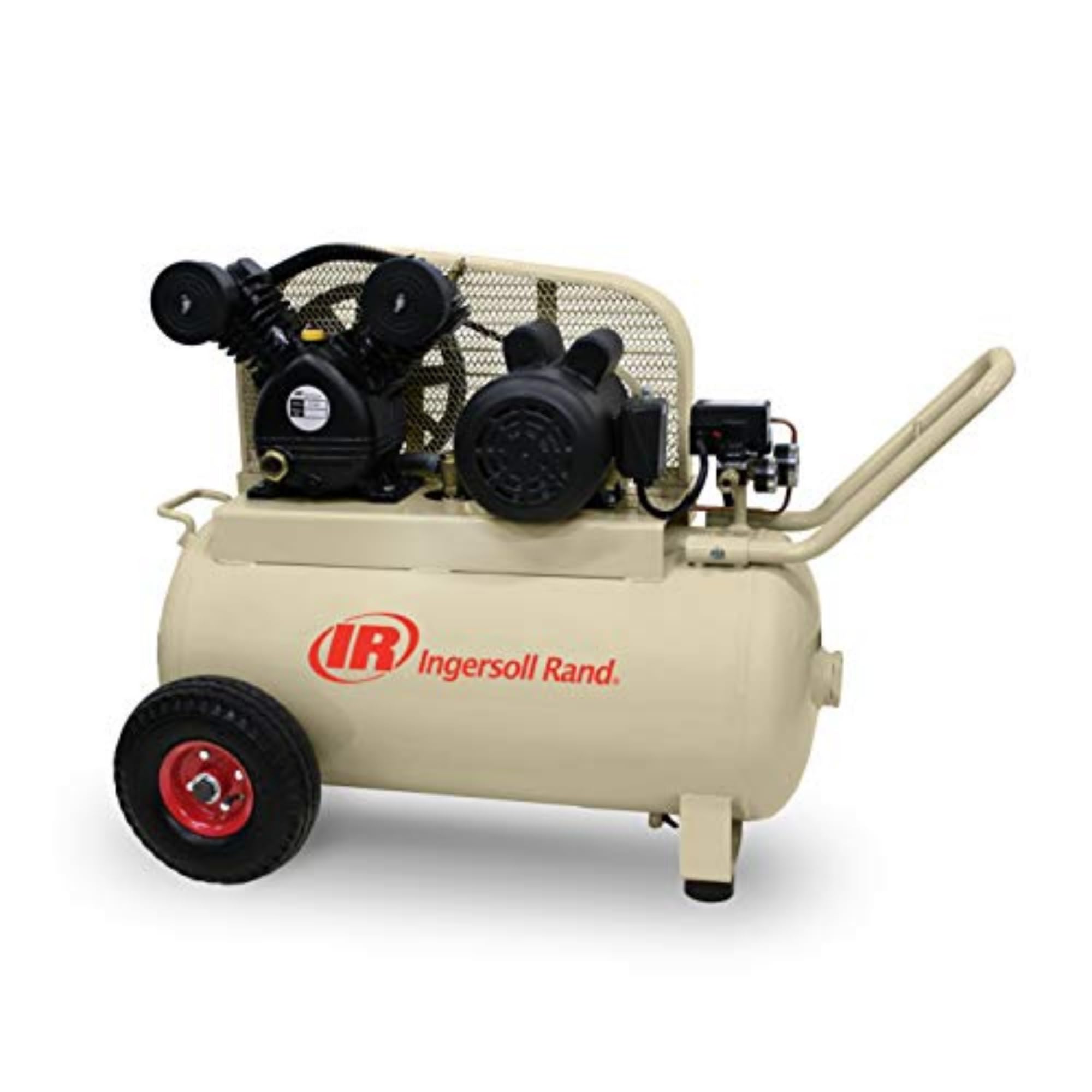
9. Ingersoll Rand P1.5IU-A9-H Garagemate 20 Gallon Horizontal Air Compressor
The compact horizontal tank that brings Ingersoll Rand reliability under a workbench.
Ingersoll Rand’s Garagemate is a 20-gallon horizontal compressor built for tight spaces. The cast iron cylinder and frame provide the rigidity that prevents vibration, and the All Season Select synthetic lubricant lasts 2,000 hours between changes — four times longer than petroleum-based oil. At 80 dBA, the noise level is moderate for a belt-drive, but still quieter than most oil-free units. The automatic start/stop pressure switch means you walk away without babysitting it.
Owners praise the heavy-duty metal build and the fact it is made in Taiwan, not China. The manual is terrible — one owner says the instructions illustrate a different compressor entirely and offer no guidance on pressure adjustments. The tank drain valve hits the ground before fully opening, making draining awkward. At 200 pounds, plan your delivery carefully.
The edge: 2,000-hour synthetic oil intervals — four times longer than standard, so you service it once a year instead of quarterly.
Reach for this if: You need a compact horizontal unit from a top-tier brand that fits under a bench and runs impact wrenches and nailers without fuss.
Look elsewhere if: You want a well-written manual and straightforward setup — this one demands patience from the start.
10. Ingersoll Rand SS3L3 3hp 60 gal Single-Stage Compressor

The stationary 60-gallon unit that powers a sandblaster all afternoon without complaint.
The SS3L3 is a 3 HP single-stage compressor with a 60-gallon ASME receiver tank, delivering 10.3 CFM at 90 PSI on continuous duty cycle. That means it never needs a cooldown break — it is designed to run all day. The cast iron pump is rated for over 5,000 hours of trouble-free life, and the synthetic oil lasts 2,000 hours between changes. This is the unit mechanics recommend for sandblasting, running air wrenches, and feeding a shop full of nail guns.
It runs at 135 PSI max on a 230V single-phase circuit (not 120V, so plan your electrical setup). Owners who bought it for sandblasting praise its ability to keep up, though one notes it struggles with continuous DA sanding —the intake filter melted during extended use. The compressor is top-heavy, and unloading the 60-gallon tank from a truck requires two people.
The spec that matters: Over 5,000-hour cast iron pump life and 100% continuous duty — this is the definition of a commercial-grade air compressor.
Best for: A serious auto shop or woodworking operation that needs uninterrupted air supply for sandblasting, production nailing, or running multiple tools simultaneously.
Think twice if: You do not have a 230V outlet in your shop — this unit cannot run on standard household 120V power.
11. California Air Tools CAT-60040CAD 4.0 HP Ultra Quiet Air Compressor

The 60-gallon giant that whispers — 75 decibels at full tilt.
California Air Tools builds this 4.0 HP twin-motor compressor around quiet: two 2.0 HP motors spinning at just 1680 RPM, an oil-free dual piston pump rated for over 3,000 hours, and a 60-gallon steel ASME tank. The result is 10.6 CFM at 90 PSI at only 75 dB — quieter than most 20-gallon units. The factory-installed EZ-1 auto drain valve eliminates the chore of manual draining, and the 98% Air Dryer System keeps moisture out of your tools.
For a shop that needs high volume without the noise complaint from neighbors or family, this is the premium solution. Owners who replaced old noisy compressors marvel at the difference — it runs on a 20A breaker and stays conversational at 12 feet (72 dB). The performance and reliability receive mixed feedback from a small number of owners, with one reporting the unit failed after light use.
The signature feature: Twin 2.0 HP motors at 1680 RPM deliver high CFM at whisper levels, with an auto drain valve so you never crawl under the tank again.
Reach for this if: You want 60 gallons of air capacity in a noise-sensitive shop — indoor workshops, home garages near living spaces, or any environment where 75 dB is the limit.
Look elsewhere if: Your budget needs to stay below the premium tier, or if you prefer a simpler single-motor design that is easier to service yourself.
Understanding the Specs
CFM At 90 PSI
This is the single most important number for tool performance. CFM stands for cubic feet per minute — the volume of air the pump moves. Every pneumatic tool lists its CFM requirement at a specific pressure (usually 90 PSI for most tools). A framing nailer might need 2.1 CFM at 90 PSI, while a die grinder needs around 5.0 CFM at 90 PSI. If your compressor delivers 5.0 CFM at 90 PSI, it can run that die grinder, but you would struggle to run a second high-demand tool at the same time. When buying, add up the CFM needs of the tools you run simultaneously and pick a compressor that exceeds that total.
Oil-Lubricated vs. Oil-Free Pumps
Oil-lubricated pumps use a continuous oil bath to cool the cylinder and seal the piston rings, which means they run cooler, last thousands of hours, and are quieter. The trade-off is maintenance: you need to check the oil level and change it periodically. Oil-free pumps use special coatings and bearings that never need oil changes. They are lighter and lower-maintenance, but they run hotter, louder, and typically have a shorter service life (often hundreds of hours instead of thousands). For intermittent home-shop use, oil-free is fine. For daily commercial use, oil-lubricated is the standard because it survives the heat and wear.
Tank Size and Recovery Time
A larger tank stores more compressed air, which acts as a buffer. That means you can run a tool longer before the motor kicks on. But the pump’s recovery time — how fast it refills the tank — is just as important. A compressor with a 20-gallon tank and a fast pump can outperform a slow 60-gallon unit in continuous-use scenarios. For short bursts like nailing, any tank size works. For continuous tools like spray guns, prioritize a pump that refills quickly relative to its tank size.
PSI (Pounds Per Square Inch)
PSI is the pressure stored in the tank. Most pneumatic tools operate at 90 PSI, so a compressor with a higher max PSI (like 175 or 200) stores more energy in the tank, giving you longer tool run time before the pressure drops below the tool’s minimum requirement. Higher PSI also helps tools that need extra force — like high-torque impact wrenches or air hammers. The regulator on your compressor lets you dial down the pressure to match the tool, so a higher max PSI never hurts; it only adds flexibility. Just be careful not to exceed a tool’s rating.
FAQ
What size air compressor do I need for a home garage?
How loud is a 68 decibel air compressor in real life?
Can I run an air compressor on a standard 120V household outlet?
What does CFM at 90 PSI mean for my tools?
How long do oil-free air compressors last?
Should I choose a belt-drive or direct-drive compressor?
Can I use an air compressor for painting?
What maintenance does an oil-lubricated compressor need?
How often should I drain the tank on my air compressor?
Is a higher PSI always better in an air compressor?
Final Thoughts: The Verdict
If you want one dependable pick, the commercial air compressor winner is the Makita MAC5200 because it combines a proven cast iron pump, real-world 6.5 CFM, genuine portability, and the highest owner satisfaction across over 900 ratings. If you need a large quiet tank for a noise-sensitive shop, grab the California Air Tools CAT-60040CAD. And for the best mix of high volume and reasonable price, the VEVOR 20 Gallon is the one to reach for with its category-leading 10.6 CFM.
How We Picked
We do not accept paid placement. Every pick is matched to a real buyer and a real use-case; we do not hands-on test units.
Sources & Methodology
Specifications: manufacturer listings and product documentation. Review insights: verified customer reviews, as of July 2026. Pricing: not shown on this page (it changes often); check the current price via the retailer link.
As an Amazon Associate, Trending Car earns from qualifying purchases. This does not affect which products we feature.