
Our readers keep the lights on and my garage snacks stocked. As an Amazon Associate, I earn from qualifying purchases.
Specs are compiled from manufacturer listings and verified buyer reviews and can change over time — please confirm the key details on the product page before buying.
That check engine light staring at you from the dashboard might not mean a catalytic converter replacement. Before you panic, know this: many P0420 and P0430 codes come from carbon buildup, not a dead cat.
I’m Min Islam — the founder and writer behind Trending Car. This guide is built by comparing the manufacturers’ published specifications and the patterns across verified customer reviews, so you get each pick’s real strengths and trade-offs instead of marketing spin.
You are about to read through nine proven formulas that dissolve carbon deposits, restore oxygen sensor accuracy, and help you pass your next smog check — this is the real-world-tested lineup of the best cleaner for catalytic converter.
Our Picks at a Glance

How To Choose The Best Cleaner for Catalytic Converter
Some target converter carbon, while others clean the fuel system and O2 sensors first. The best cleaner depends on your car’s age, check-engine code, and deposit severity.
One-Tank vs. Multi-Treatment Formulas
Some cleaners claim results in a single tank of gas. That works if the deposit layer is thin. Heavier buildup often needs two or three consecutive applications over a week. Products with higher solvent concentration tend to cut through faster but cost more per bottle.
Gasoline vs. Diesel Compatibility
Most catalytic converter cleaners are designed for gasoline engines only. Diesel exhaust systems use a diesel particulate filter (DPF) that reacts differently to chemical treatments. Pouring a gasoline-specific additive into a diesel tank can cause real damage.
The P0420 / P0430 Reality Check
A cleaner can only fix codes caused by carbon or resin buildup. If your catalytic converter is physically cracked, melted, or completely clogged with broken substrate material, no additive will work. A code that returns within a few days after treatment signals a mechanical failure, not a cleaning problem.
Quick Comparison
| Model | Best For | Bottle Size | Vehicle Type | Key Use Case | Amazon |
|---|---|---|---|---|---|
| BG 44K Platinum (3-Pack)★ Best Overall | Professional-grade cleaning | 3 x 11 oz | Gasoline | Intake valves + pistons | Amazon |
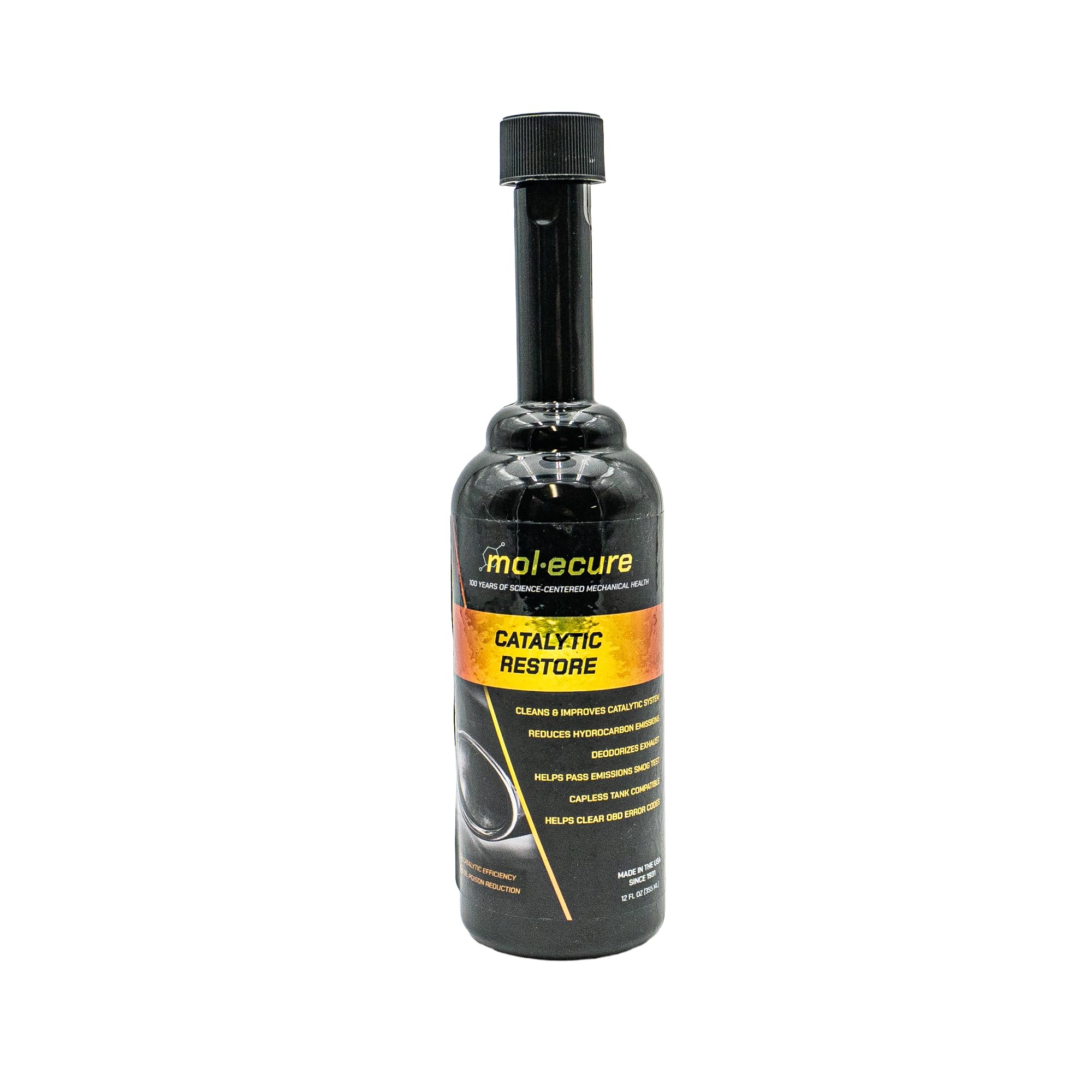
| CR12 Catalytic RestoreBest Value | Smog test prep | 12 oz | Gasoline + Hybrid | One-tank P0420 fix | Amazon |
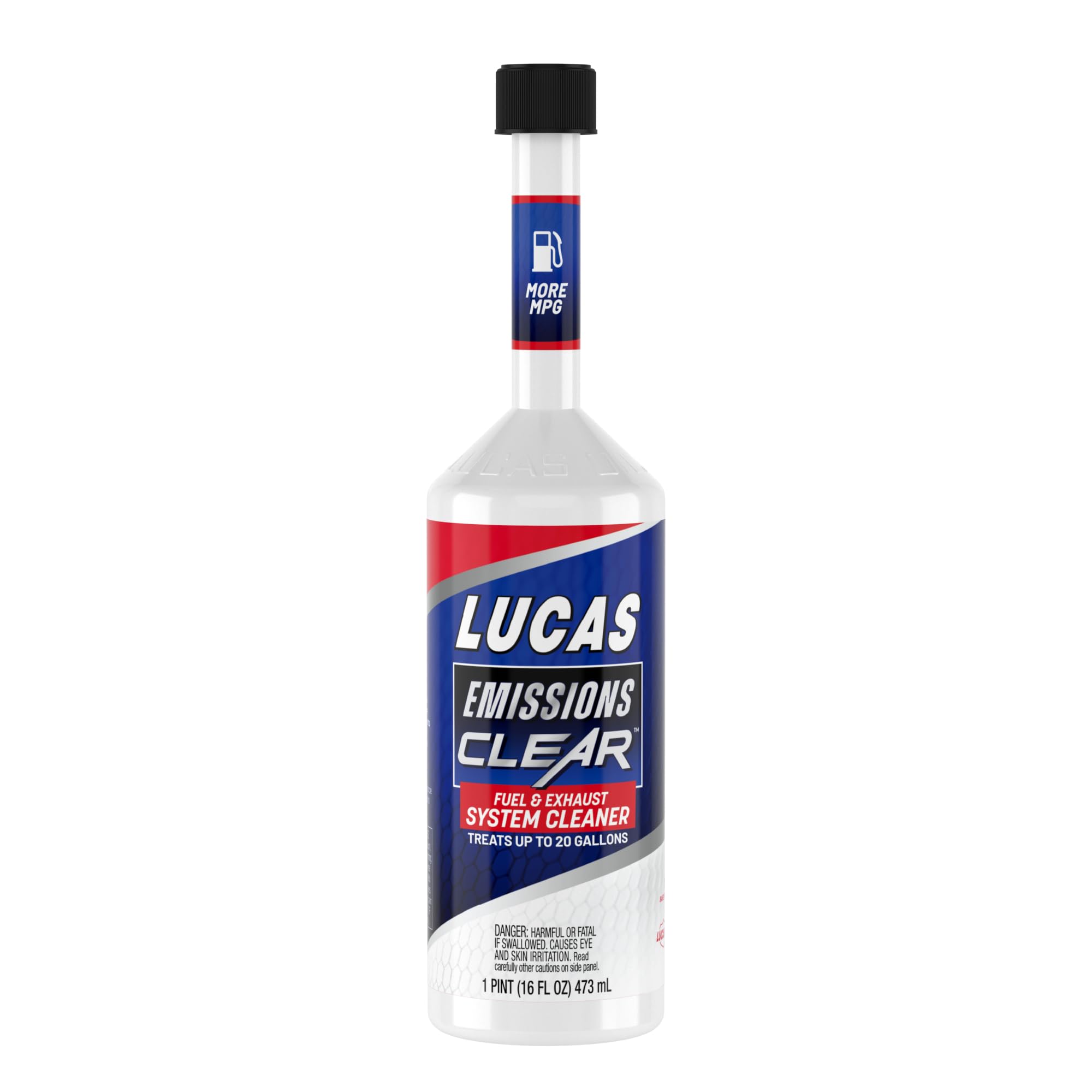
| Lucas Emissions ClearTrusted Brand | High-mileage maintenance | 16 oz | Gasoline | Whole-tank clean | Amazon |
| MotorKote Cat & Exhaust | Broad compatibility | 16 oz | Gasoline + Hybrid + E85 | Pre-test maintenance | Amazon |
| Nitrox Clean Cat | Budget-friendly trial | 17 oz | Gasoline | BHP + throttle response | Amazon |
| MotorPower Care Cat Cleaner 2-Pack | Long-term code clearance | 2 x 8.45 oz | Gasoline + Hybrid | Stubborn P0420/P0430 | Amazon |
| OXICAT Twin-Pack | Preventive maintenance | 2 x 8.45 oz | Gasoline + Diesel | O2 sensor + exhaust | Amazon |
| MotorPower Care Foam Kit | Direct foam application | 2 count spray | Gasoline | Intake-foam clean | Amazon |
| Solder-It Cat Cleaner (12-Pack) | Multi-vehicle / fleet | 12 x 16 oz | Gasoline | Odor elimination | Amazon |
In‑Depth Reviews
1. BG 44K Platinum (3-Pack)
Our pick — over 4.5★ from 250+ verified ratings; the strongest balance of quality and price.
The professional-grade bottle that proves itself with bore-scope photos, not marketing claims
This is the cleaner that shop mechanics pour into customer cars before they recommend a converter swap. BG 44K Platinum improves combustion performance and removes accumulated deposits from the oxygen sensor, combustion chambers, intake manifolds, ports, valves, and the catalytic converter itself. The crowd favorite — a 4.8-star rating from thousands of owners — gives you three bottles in one pack, each designed for a single treatment every 15,000 miles.
One owner documented the results with a bore scope on a 2016 Kia 2.4L at 77,000 miles: after 1,000 miles, pistons were visibly cleaner and intake valve carbon was acceptable on three of four cylinders. Cold-start idle improved noticeably. Another owner with a 2012 Toyota Tundra at 175,000 miles had dash lights from a bad O2 sensor and catalytic converter. One bottle in a full tank, a three-hour drive, and two days later — no lights, no codes, no issues. The bulk three-pack makes it the most affordable option for multiple vehicles or a small shop.
Performance earns the most praise — owners call it genuine professional-grade quality at a consumer-DIY price. Quality follows close behind. The only recurring note is the price: some find it steep per bottle. But the data speaks: most owners buy the three-pack and run one bottle every oil change. Unlike the budget picks below, this one tackles the whole fuel system, not just the converter.
What wins people over
- Bore-scope evidence shows measurable piston and valve cleaning after 1,000 miles
- Covers oxygen sensor, combustion chambers, intake valves, and fuel injectors in one treatment
- Three bottles per pack make it economical for routine 15,000-mile maintenance
The realistic trade-off
- Per-bottle cost is higher than single-use competitors like CR12 or Lucas
- Results depend on highway driving — short-trip city use reduces effectiveness
Reach for this if: you want a single product that cleans the converter and the entire fuel system, backed by real bore-scope proof.
Look elsewhere if: you only need a quick code-clear before a smog test and want to spend less per treatment.
2. CR12 Catalytic Restore Emission Treatment 12 oz
The concentrated one-tank wonder that buyers report made their engine smoother within a day
CR12 targets exactly what a P0420 code usually means: carbon deposits on the catalytic converter substrate and oxygen sensor elements. This concentrated fuel additive treats up to 20 gallons of gasoline with a single 12-ounce bottle. Owners mention that after a short drive, the engine ran smoother with less exhaust smell, and the check engine light did not return. One owner passed a smog test immediately after the treatment.
The formula is safe for PFI, GDI, turbocharged, and start-stop powertrains — including EcoBoost, GTDI, and Ecotec platforms. It is also compatible with hybrid engines. The bottle is compact at 2.25 x 2.25 x 9 inches and weighs only 11.3 ounces, making it the smallest and lightest in this lineup. That is a considerable difference from the Lucas 10715, which measures 14 x 8 x 10 inches and weighs 15.2 ounces. The recommended cycle is every 3,000 miles for ongoing deposit control.
Functionality is what owners single out most — the product does what it promises for a clean-running engine and a cleared emissions light. Engine-smoothness and ease-of-use also get consistent praise. The bottle is pre-measured: pour in, fill up, and drive for 15 minutes. No tools, no draining, no mechanic required. If you are looking at the MotorKote below for its 16-ounce size, the CR12 delivers similar results with a smaller dose and a higher owner satisfaction score.
One-tank smog insurance: Customers note cleaner engine smells, smoother shifting within 15 minutes of driving, and a successful emissions test pass.
Best for: anyone who needs a quick, affordable treatment to pass an upcoming smog check or clear a P0420 code.
skip it if: your check engine light has been on for months with a physically damaged catalytic converter — this cleaner dissolves deposits, not broken ceramic substrate.
3. Lucas Oil 10715 Emissions Clear 16 oz
The high-mileage veteran’s choice — 123,000-mile Subaru owners are believers
Lucas Oil has a decades-long reputation for fuel and oil additives, and the Emissions Clear formula lives up to it. This 16-ounce bottle cleans the entire fuel delivery system to reduce particulate matter sent to the catalytic converter, effectively prolonging its life. One owner was skeptical before using a whole bottle on a 2016 Subaru Forester with 123,000 miles — then became a believer. Another driver with a 2005 Ford Escape V6 at 100,400 miles reported the engine runs “as good as new.”
It reliably clears O2 sensor codes. An owner with a check engine light and an upcoming inspection reset the codes, drove about 75 miles, and the light stayed off long enough to pass the test. Another buyer noted that it “cleared my o2 code and it didn’t come back.” At 15.2 ounces and dimensions of 14 x 8 x 10 inches, the bottle is noticeably larger than the CR12 making it less convenient to store in a glovebox but giving you more product per pour.
Buyers trust Lucas Oil but note it’s hard to separate the additive’s effect from a highway drive. Some owners use it purely for maintenance without a check engine light and notice the car runs smoother after a long highway trip. Unlike the BG 44K above, which targets intake valves and pistons explicitly, Lucas focuses on the emissions system and fuel delivery — a slightly narrower scope but executed with a well-known brand name.
Where it shines
- Trusted brand with decades of additive experience — owners buy it for confidence
- Clears O2 sensor codes reliably; one owner drove 75 miles and passed inspection
- Large 16-ounce bottle treats a full tank with room to spare
The honest gap
- Results can be subtle — some owners weren’t sure it worked until a highway drive
- The bottle is bulky (14 x 8 x 10 inches) compared to the slim CR12 at 2.25 x 2.25 x 9 inches
Grab it for: a high-mileage vehicle with a minor O2 sensor code or as a preventive maintenance step before an emissions test.
Think twice if: you want visible bore-scope proof — this is a fuel-system cleaner, not a combustion-chamber decarbonizer.
4. MotorKote Catalytic and Exhaust Treatment 16 oz

The formula that spans gasoline, hybrid, and ethanol-blended fuels without a second thought
MotorKote specially engineered this 16-ounce treatment to dissolve carbon deposits, soot, and other harmful buildup in catalytic converters and exhaust systems. The pre-measured single-use bottle makes application straightforward — pour it in, fill the tank, and drive. Reviewers point out that the product improves smoothness and acceleration, and many use it specifically to prepare for an emissions test.
Broad vehicle compatibility is its standout feature. It works with all gasoline, hybrid, and ethanol-blended fuel systems, covering cars, trucks, and SUVs. The advanced formula improves exhaust flow by cleaning critical components, which reduces backpressure and leads to better fuel combustion. Owners of higher-mileage vehicles — like a 2010 F150 5.4 with 244,000 miles — have used multiple bottles over several tanks to clear O2 sensor faults. A 1991 Nissan Hardbody with over 200,000 miles passed smog after treatment.
Quality and ease of use are the top positives. However, effectiveness earns mixed feedback — the highest-count aspect at 75 mentions is marked mixed by Amazon’s own analysis. The takeaway: MotorKote works well for routine maintenance and lighter deposits, but if your converter is heavily clogged, you may need multiple bottles or a more aggressive formula. Buyer reports note that the product cleared codes on a 2006 Honda Insight with over 220,000 miles but did not fix a hard mechanical failure.
The compatibility edge: This is the only mid-range pick explicitly safe for E85 ethanol blends, making it a versatile option for flex-fuel vehicle owners.
Best suited for: drivers who want a single cleaner that works across multiple fuel types and don’t mind using two bottles for heavier buildup.
Not the best bet if: you need a guaranteed one-shot fix for a persistent P0420 code — start with a more concentrated formula like BG 44K or CR12.
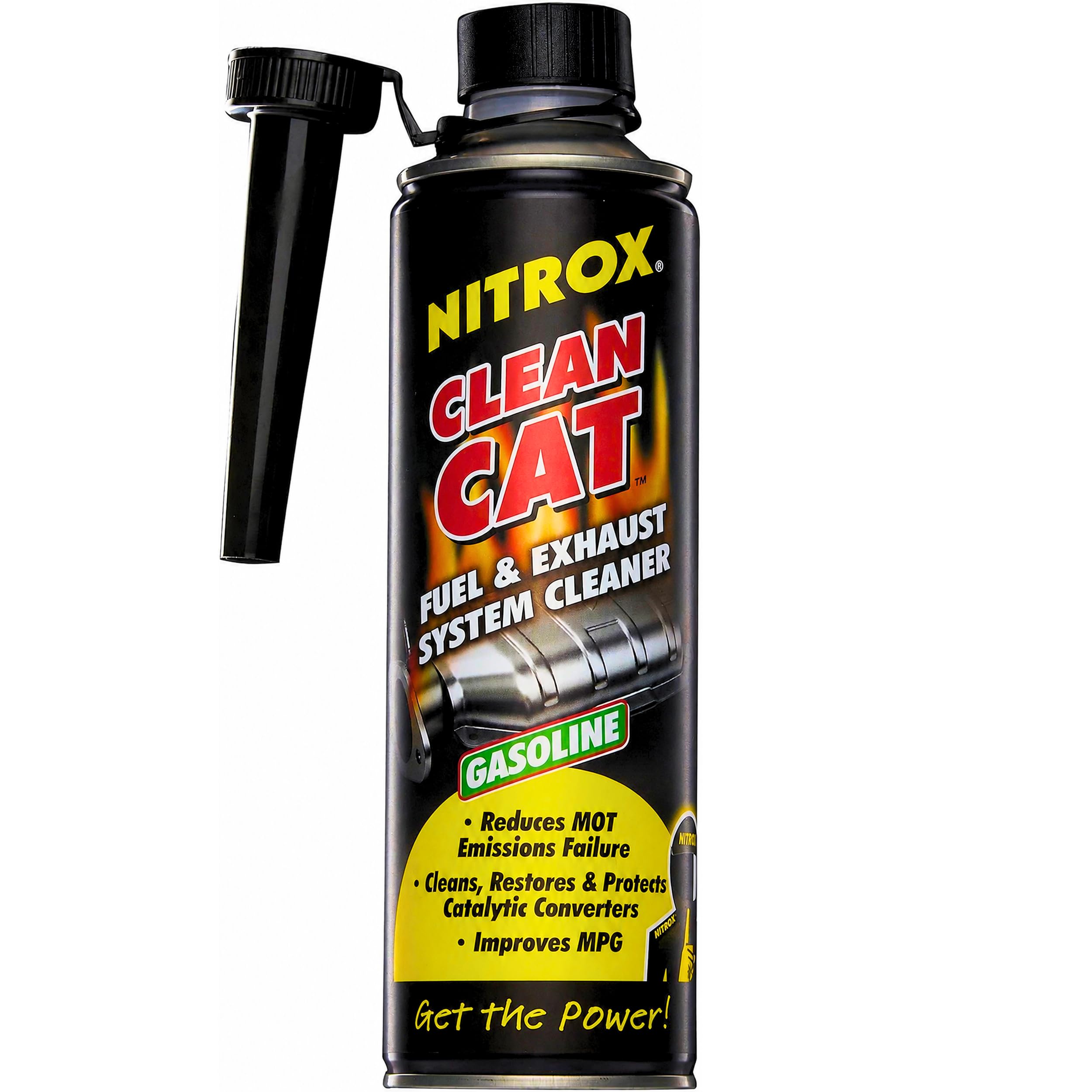
5. Nitrox Clean Cat Catalytic Converter Cleaner 17 oz
The budget entry that promises BHP gains but divides owner opinions sharply
Nitrox Clean Cat packs 17 fluid ounces into a scientifically formulated catalytic system cleaner designed to remove carbon and resin buildup. The maker claims it tune MPG, enhances throttle response, increases BHP, and boosts overall engine performance. The included spout makes pouring into the fuel tank easy, and the product works instantly once you drive it through the system.
Effectiveness is the most-discussed aspect (16 mentions), but Amazon’s analysis calls it mixed. Some shoppers say their check engine light stayed off for months after two cans. One driver with a persistent P0420 code used two treatments and reported the light stayed off for months. Another owner’s review sums it up: “It may or may not work.” The product tends to perform better on newer vehicles — under 15 years old — and when used soon after the check engine light first appears.
There is also a notable caution: one owner reported that Nitrox actually plugged their catalytic converter within two weeks, causing a GMC Terrain to lose 75 percent power and requiring a full converter replacement. That is a rare but serious outcome. As with any deposit dissolver, heavy buildup that breaks loose in large chunks can clog the substrate rather than clear it. If your vehicle already has a severe restriction, a foam cleaner like the MotorPower Care kit below may be a safer approach.
Use-case specific: A strong trial candidate for a newer vehicle with a fresh P0420 code, but risky for a high-mileage car with heavy exhaust restriction.
Try it if: your car is less than 15 years old and the check engine light just appeared — use with low fuel and drive 50-60 miles.
Avoid if: you already have drivability issues like significant power loss or a known converter restriction.
6. MotorPower Care Catalytic Converter Cleaner 2-Pack

The 4,000-mile code-clearer that outperforms Cataclean and DuraLube in head-to-head owner tests
MotorPower Care’s 2-pack has earned a strong following among DIY owners who have tried multiple brands. One owner tested it against Cataclean (which held for 300 miles) and DuraLube (800 miles) — the MotorPower Care cleaner cleared P0420 and P0430 codes, and the check engine light stayed off for 4,000 miles. That is the kind of real-world durability that separates a maintenance product from a short-term band-aid.
Effectiveness is the top positive aspect with 103 mentions — by far the highest count in this entire list. Owners consistently report improved gas mileage, better acceleration, and smoother engine performance. Many use it before smog checks and report passing inspection. The 2-pack format is deliberate: the manufacturer recommends using one bottle per treatment, and two applications are often needed for stubborn codes. One owner used two cycles with 7 gallons of gas each, disconnected the battery for 30 minutes, and drove 200 miles for the OBDII sensors to reset — and passed smog afterward.
The product is compatible with gasoline and hybrid vehicles, but the maker explicitly states it will not repair a cracked, broken, or melted catalytic converter. The engine-light aspect is mixed — some owners say the light returns if there is a separate mechanical issue. But the volume of positive effectiveness feedback (103 mentions) compared to the next-closest (BG 44K at 24) makes this the most proven formula in the list for actually clearing codes and keeping them off.
Why owners love it
- 103 positive mentions for effectiveness — highest of any product in this guide
- One owner reported the check engine light stayed off for 4,000 miles, beating Cataclean and DuraLube
- Compatible with gasoline and hybrid vehicles; designed for 2-bottle stubborn-code protocol
The honest drawback
- Engine-light results are mixed — some owners need multiple applications before the code clears
- Value-for-money draws mixed feedback; the 2-pack costs more than a single-bottle competitor
Pick this if: you have tried other cleaners that only held the code off for a few hundred miles and want a longer-lasting solution.
pass on it if: you need a foam-based cleaner (like product 8) to reach the converter directly through the intake system.
7. OXICAT Oxygen Sensor & Catalytic Converter Cleaner Twin-Pack

The German-engineered twin-pack that is TUV certified and treats both gasoline and diesel engines
OXICAT stands apart because of what it says on the bottle: TUV certified, made in Germany, and safe for all gasoline and diesel-fuel vehicles. No other product in this guide carries a certification from a major European testing authority. The formula is activated when the catalytic converter reaches its required working temperature, meaning it only starts working once the engine is fully warm — a more targeted chemical reaction than simple fuel dilution.
Functionality is the most-discussed positive with 43 mentions. One owner with a Toyota RAV4 had an O2 sensor acting strange due to carbon buildup. A single can of OXICAT cured the problem. Another owner reported that after replacing one converter and both O2 sensors, several applications over six months kept the check engine light off for weeks. A severe case — a vehicle with rough idle, misfire on cylinder 3, and barely running — added one can, drove 60 miles on the freeway, and the codes cleared. The engine has been running smoothly for 1,400 miles since.
The check-engine-light results are mixed — some buyers report the light returns after a few days. One buyer used both cans and the light stayed off for only 3-4 days each time. Like all cleaners in this list, OXICAT works best as part of a preventive maintenance routine rather than a cure for a physically damaged converter. The twin-pack format is positioned specifically for regular use, not emergency code-clearing.
The diesel advantage: OXICAT is the only cleaner here explicitly safe for diesel fuel systems, making it a must-have if you own both a gasoline car and a diesel truck.
Reach for this if: you want a certified German formula for annual maintenance, especially if you run a mixed fleet of gasoline and diesel vehicles.
Look elsewhere if: you need a guaranteed one-bottle code-clear for an imminent smog test — the MotorPower Care 2-pack has stronger single-treatment results.
8. MotorPower Care Catalytic Converter Cleaner Foam Kit

The foam spray that works directly inside the catalytic converter, not just through the fuel system
Every other product in this list works as a fuel additive — you pour it into the gas tank and it reaches the converter through combustion. This MotorPower Care kit takes a different approach: it is a spray foam that you apply directly to the catalytic converter material without disassembling anything. The maker claims it is the most effective and inexpensive cleaning solution for fixing P0420 and P0430 codes — as long as the catalyst substrate is not physically broken.
Owner results are dramatic when it works. One 2017 Kia Sorento with a 2.4L engine had a P0420 code after an oil consumption test, O2 sensor changes, and fuel additives all failed — the catalyst test ratio was 1.57 against a limit of 0.9995. After the foam cleaner, the ratio dropped to 0.78, clearing the code permanently. An Audi A3 8V owner reported massive performance improvements and saved significant money on a converter service. The process is straightforward: follow the instructions, apply the foam, and let it soak.
The trade-off is consistency. An owner with a persistent P0420 code followed the instructions to the letter and the code remained. Another buyer reported the check engine light returned after only 15 miles post-reset. The effectiveness is mixed, which matches the 3.9-star rating. This is the product to try when fuel additives have failed, but be prepared for the possibility that it won’t work on your specific vehicle’s deposit type.
Where it works best
- Direct application to the catalytic converter material — bypasses the combustion chamber entirely
- Proven to drop catalyst test ratios from 1.57 to 0.78 in documented owner cases
- No disassembly required; the foam is applied through the intake or exhaust path
The unpredictable side
- Owners mention that results are inconsistent — some see no change after a full bottle
- Rating (3.9 stars) is the lowest in this lineup, reflecting the mixed outcomes
Try this when: you have already run a fuel-additive cleaner and the P0420 code is still present — the foam method tackles the converter directly.
it’s not for you if: you want a simple pour-and-drive solution; start with the CR12 or Lucas Emissions Clear for an easier application.
9. Solder-It Catalytic Converter Cleaner & Deodorizer (12-Pack)

The 12-pack bulk option that combines converter cleaning with deodorizing for a better-smelling exhaust
This is the only product in the guide that explicitly addresses exhaust odor. The Solder-It formula is a fuel additive designed to support functional catalytic converters by removing buildup, and it also works as an oxygen sensor cleaner for both monolithic and pelletized converters. The deodorizer component helps eliminate the rotten-egg smell that often signals a sulfur-clogged catalyst. One owner used it with Cataclean on a 2005 Cadillac STS with a P0430 code — after four days, the code cleared and the exhaust odor noticeably reduced.
The 12-pack format at 16 ounces per bottle makes this the clear choice for fleet owners, families with multiple cars, or anyone who wants to keep a stock of treatment on hand. One owner with a P0430 code ran the tank down to 5 gallons, poured in Solder-It, drove 15 miles, and filled up with premium gas — six weeks later, no check engine light. Another VW owner used two cans over several months and reported the car now accelerates immediately with no lag, calling it “like new.”
The primary trade-off is the upfront commitment. At 12 bottles, this is a large investment even if the per-bottle cost is lower. The functionality feedback is mixed — some customers note it works effectively while others say it does not. The manufacturer recommends using it as a routine maintenance product, not an emergency code-clear. If you only need to treat one car once, the single-bottle options above make more sense. If you have a driveway full of vehicles or run a small shop, this is the most economical long-term choice.
The odor advantage: No other product here markets itself as a deodorizer. If the rotten-egg smell is your main complaint, this is the targeted solution.
Buy it for: a multi-vehicle household, a small shop, or a persistent sulfur smell from your exhaust.
Pass on it if: you only need a single treatment — a 2-pack or single bottle will save you shelf space and upfront cost.
Understanding the Specs
One-Tank vs. Multi-Treatment Cleaners
The biggest difference between these products is how many tanks of gas they need to work. A one-tank formula like the CR12 is designed for a single pour-and-drive session — you add it to a near-empty tank, fill up, and drive for 15 minutes. A multi-treatment product like the MotorPower Care 2-pack often needs two or three applications over a week to clear stubborn P0420 codes. The BG 44K three-pack is designed for scheduled maintenance every 15,000 miles, not an emergency fix before a smog check.
Foam vs. Fuel-Additive Delivery
Most cleaners reach the catalytic converter through the fuel system — the additive mixes with gasoline, burns in the engine, and the chemical vapors travel through the exhaust to the converter. Foam cleaners like the MotorPower Care kit are applied directly to the converter through the intake or exhaust path, letting the chemical soak into the substrate without passing through combustion. Foam is more targeted but requires a more involved application. Fuel additives are simpler — just pour and drive — but the chemical is diluted by the combustion process.
FAQ
Will a catalytic converter cleaner fix a P0420 or P0430 code?
How long does it take for a catalytic converter cleaner to work?
Can I use a gasoline catalytic converter cleaner in a diesel engine?
How often should I use a catalytic converter cleaner?
Will a cleaner fix a clogged catalytic converter that causes power loss?
Can a catalytic converter cleaner damage my engine or oxygen sensors?
Is there a difference between a catalytic converter cleaner and a fuel system cleaner?
Should I use a cleaner before an emissions test even if I have no check engine light?
Final Thoughts: The Verdict
For most drivers, the winner among the cleaner for catalytic converter options is the BG 44K Platinum 3-Pack because it cleans the entire fuel system from intake valves to the catalytic converter, backed by bore-scope proof and a near-perfect owner satisfaction score. If you want a quick, affordable one-tank treatment before a smog test, grab the CR12 Catalytic Restore. And for a stubborn P0420 code that has resisted other cleaners, the MotorPower Care 2-Pack has the most positive owner feedback for effectiveness — 103 mentions of successful code clearance and longer-lasting results.
How We Picked
We do not accept paid placement. Every pick is matched to a real buyer and a real use-case; we do not hands-on test units.
Sources & Methodology
Specifications: manufacturer listings and product documentation. Review insights: verified customer reviews, as of July 2026. Pricing: not shown on this page (it changes often); check the current price via the retailer link.
As an Amazon Associate, Trending Car earns from qualifying purchases. This does not affect which products we feature.