
Our readers keep the lights on and my garage snacks stocked. As an Amazon Associate, I earn from qualifying purchases.
Specs are compiled from manufacturer listings and verified buyer reviews and can change over time — please confirm the key details on the product page before buying.
The hardest part about buying a helmet for a child isn’t safety — it’s getting them to actually leave it on. Between the whining about chin straps and the way a wrong fit slides over their eyes, most parents just want a helmet that disappears from their kid’s mind so the fun can start. This guide focuses on the children’s crash helmets that solve that problem first, then layer in proper protection — because a helmet they refuse to wear protects nobody.
I’m Min Islam — the founder and writer behind Trending Car. This guide is built by comparing the manufacturers’ published specifications and the patterns across verified customer reviews, so you get each pick’s real strengths and trade-offs instead of marketing spin.
From a budget-friendly 6-piece protective gear set to a premium magnetic-buckle helmet that toddlers can fasten themselves, here is the shortlist of the most parent-tested and durable children’s crash helmets worth considering.
Our Picks at a Glance

How To Choose The Best Children’s Crash Helmets
The difference between a helmet that gets worn and one that collects dust in the garage usually depends on three things: how it feels on the head, how easy it is to adjust, and how much your child actually likes the look of it. Here is what to look for.
Weight and Willingness
A heavy helmet makes a child’s neck sore fast, which leads to them pulling it off mid-ride. The lightest children’s helmets weigh around 180 grams — about as much as a large apple. Anything pushing past 350 grams is going to feel like a burden on a small head, especially during long scooter rides or bike trips. Look for the weight in grams on the spec sheet before you buy.
The Fit System: Dial vs. Strap Only
A rear dial adjustment lets you tighten or loosen the helmet with a simple turn, which is far more precise than pulling on two side straps. The best systems have multiple click positions so the helmet stays snug as your child grows. Models with only strap adjustment often slip out of position, especially on active kids who jump and turn their heads quickly.
Ventilation and Sweat
More air vents does not automatically mean a cooler head — the placement of the vents matters just as much. A helmet with 15 to 21 well-positioned vents can keep a child comfortable on a hot afternoon, while 6 vents in the wrong spots will simply trap heat. Look for helmets that mention internal air channels or “active airflow” in their design, not just a high vent count.
Quick Comparison
| Model | Best For | Weight | Vents | Fit System | Amazon |
|---|---|---|---|---|---|
| Retrospec Remi★ Best Overall | Sun Visor & Coverage | — | 11 | ErgoKnob Dial | Amazon |
| OnBros Kids | Lightest Build | 180 g | 15 | Dial (50-57cm) | Amazon |
| SIFVO Youth | Max Ventilation | 313 g (0.69 lbs) | 21 | Dial (54-57cm) | Amazon |
| Raskullz Sharkmo | 3D Design Appeal | 358 g | — | Strap (50-54cm) | Amazon |
| Gingili Life Toddler Set | Full Protective Gear Set | 220 g | — | Dial (47-52cm) | Amazon |
| Banzk 6-Piece Set | Multi-Sport Value Set | 499 g (1.1 lbs) | — | Dial | Amazon |
In‑Depth Reviews
1. Retrospec Remi Kids Bike Helmet
Our pick — over 4.5★ from 800+ verified ratings; the strongest balance of quality and price.
A sun visor built right into the shell — no separate piece to lose on the trail.
The Retrospec Remi integrates its sun visor directly into the helmet design, so you never have to hunt for a detached piece after a fall. The 11 vents are positioned for efficient airflow, though they fall short of the SIFVO’s 21 vents in sheer cooling power. The ErgoKnob dial system adjusts precisely without pinching. A soft chin pad prevents the irritation some kids get with cheaper models. Reviewers point out that even after multiple falls, the helmet holds up well without cracking. The quick-release padding removes for a hand wash, a practical feature for sweaty summer rides. Reflective straps add evening visibility. Extra padding inserts included in the box let the fit work for toddlers as young as 3. At a budget-friendly price, it undercuts the premium Thousand Jr. while still delivering CPSC certification and a built-in visor.
Built-in advantage: The integrated visor never gets lost, unlike detachable ones that fall off during tumbles.
The cooling difference: With 11 vents versus the SIFVO’s 21, your child may feel warm during long summer rides in direct sun.
Perfect for: Parents who want a reliable, CPSC-certified helmet with a permanent sun visor at a reasonable price — no extra parts to misplace.
Consider the Thousand if: You value a magnetic buckle that eliminates pinching more than the built-in visor — the Thousand’s buckle is a bigger daily upgrade.
3. OnBros Kids Bike Helmet

The featherweight on the list weighs 180 grams — about as much as a large apple.
That is 180 grams versus the Raskullz Sharkmo’s 358 grams, so your child’s neck does not get tired after 20 minutes of riding. The PC shell (a hard plastic outer layer) and EPS foam (the impact-absorbing inner layer) meet CPSC (U.S. safety standard) and CE (European safety standard) certifications. The dial adjusts from 50 to 57cm, giving it a larger fit range than the SIFVO (54-57cm), so it can work from about age 5 up through age 14. Owners mention that the bright rainbow colors make kids easy to spot from a distance, and the detachable visor blocks sun without blocking upward view. The 15 vents provide good airflow, though not as extreme as the SIFVO’s 21 vents. An included storage bag keeps the helmet clean in backpacks during school commutes.
The weight payoff: Your child forgets it is on within minutes. That 180g makes real difference for building neck strength.
Honest limit: The Velcro strap covers can loosen if removed and re-attached frequently. The Thousand’s magnetic buckle is more durable for daily use.
Grab this for: A child who complains about heavy helmets or has a smaller head that needs a lightweight fit without feeling top-heavy.
Consider the SIFVO instead if: Your older child (8-14) rides hard in hot weather and needs maximum airflow — the 21 vents on the SIFVO pull ahead there.
4. SIFVO Kids Bike Helmet

Twenty-one air vents turn a sweaty summer ride into a breeze — 21 vents versus the Retrospec Remi’s 11 vents.
That airflow keeps heads cool during long rides in warm weather. The full-coverage construction wraps around the back of the head for 360-degree protection, so it works on bikes, scooters, and hoverboards alike. The detachable visor shades your child’s eyes from direct sunlight without blocking peripheral view, a detail reviewers with younger riders appreciate. The PC shell bonded with impact-resistant EPS foam is certified to CPSC, ASTM (a multi-sport safety standard), and CE standards — triple certification for broader activity use. Customers note that the rear adjustment knob is easy for small hands to turn and stays locked in place even after rough rides. At 313 grams (0.69 pounds), it sits mid-pack in weight — heavier than the 180-gram OnBros but lighter than the 358-gram Raskullz. The 54-57cm size range fits ages 8-14 best, so smaller toddlers will need the Gingili Life set below.
Airflow leader: No other helmet here matches 21 vents for hot-weather riding. Your child’s head will feel the difference on every climb.
The fit constraint: The 54-57cm range starts at 8 years old, so most 5-7 year olds will find it too loose even at the smallest dial setting.
Ideal for: Active older kids (ages 8-14) who ride year-round and overheat easily in standard helmets.
Not for: Toddlers or small preschoolers — check the 47-52cm Gingili Life set if your child is under 5.
5. Raskullz Sharkmo Bike Helmet

A 3D shark fin on top turns safety into a costume — the coolest helmet on the block.
Most kids do not care about CPSC certification — they care about looking like a shark. This helmet delivers a 3D fin hawk on the shell, making it the most visually notable option here. The durable PVC outer shell (a type of hard plastic) with expanded polystyrene inner foam meets the CPSC safety standard for ages 5 and older. Aerodynamic cooling vents help airflow even with the fin in place. Shoppers say that toddlers as young as 2 love it for scooter rides. The adjustable straps provide a custom fit, though it uses traditional strap adjustment rather than the rear dial found on the OnBros and SIFVO. At 358 grams versus the OnBros’ 180 grams, this is a noticeable difference that heavier-headed toddlers may feel after 20 minutes. The 50-54cm size range fits smaller heads well, but older children above age 6 will likely outgrow it quickly, unlike the 50-57cm range on the OnBros.
Cool factor: The 3D shark fin is class-leading for getting a reluctant child excited about wearing a helmet every time.
The weight penalty: At 358 grams versus the OnBros’ 180 grams. A small child with a short neck may find it tiring on long rides.
Best for: A preschooler who needs convincing to keep a helmet on — the shark design does the convincing for you.
Choose the OnBros instead if: Your child rides daily for more than 30 minutes — the weight difference becomes real on longer outings.
6. Gingili Life Toddler Helmet & Protective Gear Set

A full set of pads plus a 220-gram helmet that fits heads from 47 to 52cm.
For parents of toddlers between 2 and 5 years old, the biggest challenge is finding a helmet small enough. Most kids’ helmets start at 50cm, but this one fits down to 47cm with its adjustable dial system. The 6-piece set includes the helmet plus two elbow pads, two knee pads, and two wrist guards, all in one box, which saves you from piecing together separate protective gear. The PC shell with EPS foam inner layer is CPSC certified, so the impact protection is not sacrificed despite the smaller size. The 3D dinosaur design is a hit — buyers report that “my son absolutely loved the design” and that the adjustable sizing fits with room to grow. The removable foam pads are machine-washable, important for toddlers who sweat more. At 220 grams, it is lightweight enough that a 3-year-old does not complain, though it is heavier than the 180-gram OnBros. The included carrying bag keeps everything organized. One reviewer noted it can be a bit large for some toddlers’ heads even at the smallest setting, so measure your child’s head circumference (47-52cm recommended) before ordering.
Complete package: Six pieces in one box means no separate shopping for knee pads — just open and ride.
Size caution: The 47-52cm range fits most 2-5 year olds, but some smaller toddlers may still find it loose even with the dial tightened fully.
Ideal for: Toddlers ages 2-4 who need a complete protective gear set for their first bike or scooter adventures.
skip it if: Your child is over 5 years old or has a head circumference above 52cm — the OnBros or SIFVO will fit better and last longer.
7. Banzk 6-Piece Kids Helmet & Pad Set
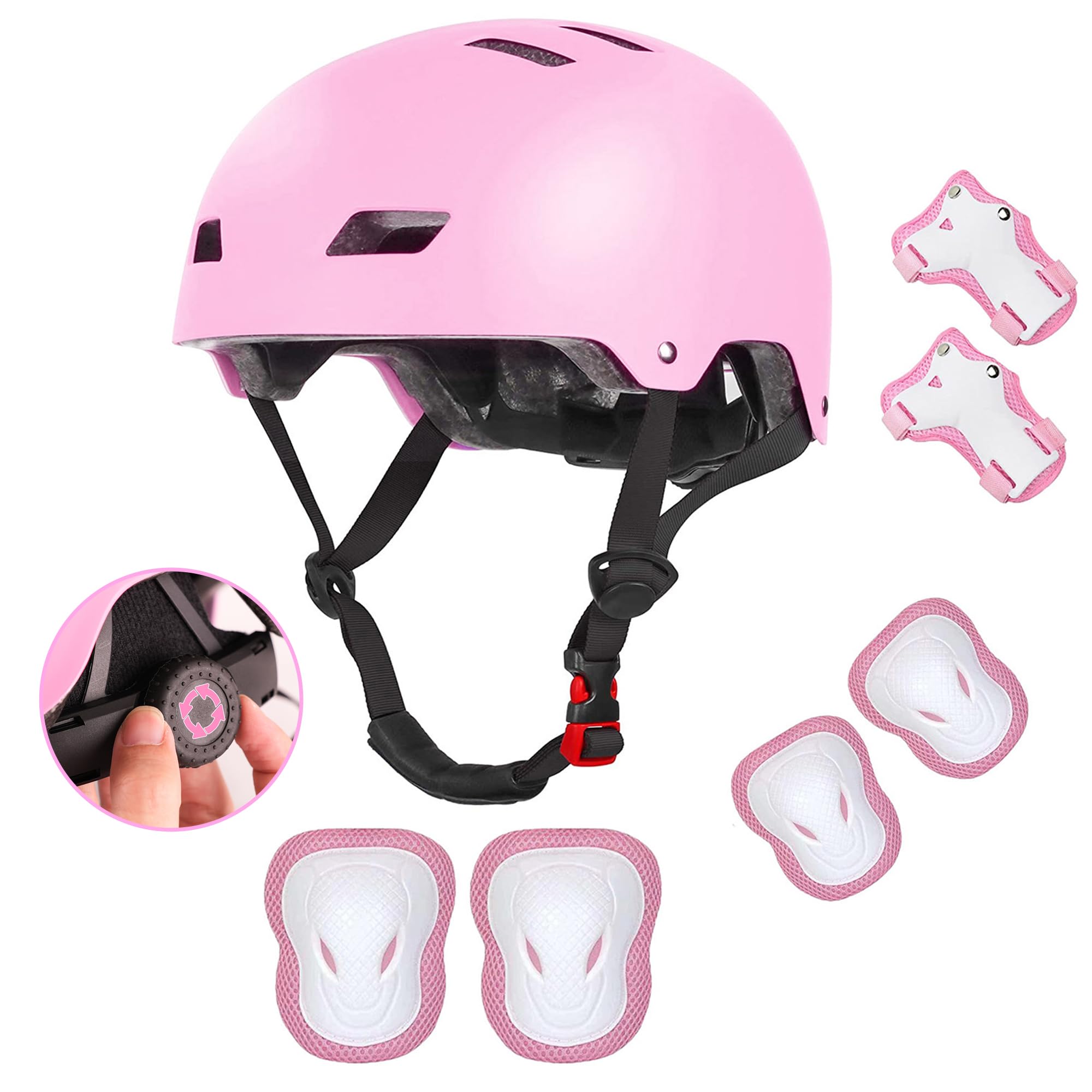
An eggshell-shaped ABS helmet that wraps around the back of the head like a protective shell.
The Banzk set uses an “eggshell biomimetic design” — the helmet curves around the back of the head more fully than typical youth helmets. That is especially useful for skateboarding and roller skating, where backward falls are more common. The rugged ABS outer shell (a stiff, durable plastic) with high-density EPS foam provides solid impact absorption. The included knee pads, elbow pads, and wrist guards offer complete coverage for multi-sport activities. An ABS shell is stiffer than the PC shells used on most other picks here, which adds durability at the cost of extra weight — this helmet is 1.1 pounds (about 499 grams), making it the heaviest on the list by a noticeable margin. The adjustable dial and chin strap let you dial in a snug fit. Multiple air vents improve airflow during active play. The set is available in a variety of colors, and the company offers a lifetime warranty. Owners mention that the pads are easy to put on and give kids more confidence — “my kids adore this set.” The small size fits 3-8 year olds. The trade-off is clear: at nearly half a kilogram, a small 3-year-old may find the helmet heavy after 15-20 minutes of active riding, unlike the 180-gram OnBros.
Full coverage: The eggshell shape protects the back of the head better than typical youth helmets — a real advantage for beginner skaters learning to fall backward.
The weight matter: At 1.1 pounds this is the heaviest helmet here. Smaller toddlers may get tired of wearing it during long sessions.
Choose this for: A child between 3-8 years old learning to skate, rollerblade, or ride a scooter — the pad set and eggshell protection cover the most common beginner fall types.
Pick the Gingili Life instead if: Your child is younger (2-4) and lighter-weight — the Gingili at 220 grams is much easier on a toddler’s neck.
Understanding the Specs
CPSC & ASTM Safety Certifications
You will see “CPSC certified” on most children’s helmets — this means the helmet meets the U.S. Consumer Product Safety Commission’s standard for bicycle helmets, which tests impact absorption and strap strength. ASTM certification goes a step further, covering additional multi-sport use like skateboarding and roller skating. A helmet with both (like the SIFVO above) offers broader protection across more activities. Helmets sold without either certification are not safe for active riding and should be avoided entirely.
Dial Fit System vs. Strap Adjustment
A dial fit system uses a circular knob at the back of the helmet that tightens or loosens the entire inner ring in small increments as you turn it. This is more precise than strap-only helmets, which rely on pulling two side straps to different tightnesses — a process that often results in a crooked fit. Most children above age 4 can learn to turn the dial themselves, which makes the helmet easier to take on and off without parental help each time.
FAQ
How do I measure my child’s head for a helmet?
Can my child use a bike helmet for skateboarding?
How tight should a children’s crash helmet fit?
How often should I replace a child’s helmet?
What is the difference between EPS and EPP inner foam?
Will a helmet that is slightly too large work with extra padding?
Can a 2-year-old wear a helmet meant for ages 5 and up?
How do magnetic buckles compare to traditional buckles for kids?
Final Thoughts: The Verdict
If you want the lightest possible build that your child will forget they are wearing, grab the OnBros Kids Helmet at 180 grams. And for a value-packed set that includes knee and elbow pads for toddlers taking their first wobbly rides, the Gingili Life Toddler Set delivers a complete kit in one box.
How We Picked
We do not accept paid placement. Every pick is matched to a real buyer and a real use-case; we do not hands-on test units.
Sources & Methodology
Specifications: manufacturer listings and product documentation. Review insights: verified customer reviews, as of July 2026. Pricing: not shown on this page (it changes often); check the current price via the retailer link.
As an Amazon Associate, Trending Car earns from qualifying purchases. This does not affect which products we feature.