
Our readers keep the lights on and my garage snacks stocked. As an Amazon Associate, I earn from qualifying purchases.
Specs are compiled from manufacturer listings and verified buyer reviews and can change over time — please confirm the key details on the product page before buying.
A cheap dash cam doesn’t have to mean blurry footage or a device that gives up after a few months. The best ones now pack sharp daytime video, usable night vision, and smart features like parking monitoring or voice control into a tiny body you can hide behind your mirror. This guide cuts through the listings to show you which budget-friendly models actually deliver reliable protection for your daily drive.
I’m Min Islam — the founder and writer behind Trending Car. This guide is built by comparing the manufacturers’ published specifications and the patterns across verified customer reviews, so you get each pick’s real strengths and trade-offs instead of marketing spin.
if you need a simple front-facing unit or a dual-camera setup for front and rear coverage, here are the top-rated options for the best cheap dash cam that balance price with real-world performance.
Our Picks at a Glance

How To Choose The Best Cheap Dash Cam
Picking a budget dash cam means knowing where a low price can cut corners and where it still delivers solid performance. Here are the key specs and features to check before you buy.
Video Resolution and the 1080P Floor
At this price level, 1080P Full HD is the minimum you should accept for a clear daytime picture. Many models now offer 1296P or “2K” resolution, which gives you roughly 1.5 times the detail of standard 1080P, making it easier to read a plate or a road sign from a few car lengths ahead. Anything below 1080P is too blurry to be useful in an accident report.
Night Vision and WDR Technology
Since many incidents happen at dusk, dawn, or in tunnels, a dash cam needs strong low-light performance. Look for models that advertise WDR (Wide Dynamic Range) — a feature that balances bright and dark areas in the same frame so headlights don’t wash out a plate while shadows stay black. Some add extra infrared lights or a larger aperture (F1.55 or F1.8) to pull in more light for nighttime recording.
Field of View — Wider Isn’t Always Better
A wider lens covers more lanes, which helps capture side-angle collisions. But an extremely wide view (170 degrees or more) can distort the edges of the image and make plates further away harder to read. A 130- to 160-degree range generally gives a good balance of lane coverage and usable detail. The key trade-off is between seeing more of the road and keeping a clear image of the cars directly ahead.
Parking Monitoring and the Hardwire Reality
Nearly every dash cam at this price claims “24H Parking Mode,” but almost none include the required hardwire kit in the box. This means you will have to buy a separate wiring accessory to keep the camera powered when the car is off. Without it, parking mode is not active, so factor that extra cost into your decision if you park on the street or in a shared lot.
Storage, Loop Recording, and the SD Card
All modern dash cams use loop recording — they automatically overwrite the oldest footage when the memory card is full, so you never run out of space. Most support microSD cards from 32GB up to 256GB, but many budget models do not include a card at all. A 32GB card stores roughly 3 to 4 hours of 1080P video before it starts looping, while a 256GB card holds a full day of driving. Check whether the model you pick includes a card or requires a separate purchase.
Quick Comparison
| Model | Best For | Resolution | Field of View | Max Card Size | Amazon |
|---|---|---|---|---|---|
| 70mai M310★ Best Overall | Compact screenless front cam | 2304 x 1296P | 130° | 256 GB | Amazon |
| 70mai A410Also Great | Best all-round dual-camera setup | 2.5K Front + 1080P Rear | 125° Front | 256 GB | Amazon |
| Vantrue E1 Lite | Smallest single-camera with GPS | 1080P @ 30fps | 160° | 512 GB | Amazon |
| E-YEEGER GT830 | 4K front detail on a budget | 4K Front + 1080P Rear | 160° | 256 GB | Amazon |
| KAWA Spherical | Unique 360° mount with voice control | 2K | — | — | Amazon |
| KAWA Tiny Dash Cam | Ultra-compact front cam with free SD card | 1296P | — | 256 GB | Amazon |
| ORSKEY Dual Cam | Absolute cheapest dual-camera entry | 1080P Front + VGA Rear | 170° | 32 GB | Amazon |
In‑Depth Reviews
1. 70mai Dash Cam M310
A tiny no-screen cam that hides completely and punches well above its weight in video quality.
This is the best option if you want something that vanishes behind the rearview mirror — buyers confirm the “compact, screenless design hides behind rearview mirror” and call it “unobtrusive.” The 70mai M310 records at 2304 x 1296P resolution, which is roughly 1.5 times the detail of standard 1080P and a meaningful upgrade over the ORSKEY’s 1920x1080P. The 130-degree wide-angle lens is narrower than the ORSKEY’s 170-degree lens, but that trade-off means distortion-free plates directly ahead, which matters more for evidence.
The 3D Noise Reduction and WDR (a smart-exposure system that balances bright and dark zones in each frame) work well together in tunnels and low-light parking lots. Owners consistently praise the “excellent day/night video quality” and note that the Wi-Fi app connection and voice controls work without glitches. It supports microSD cards up to 256GB — a huge jump over the ORSKEY’s 32GB max — matching the capacity of the 70mai A410 and the KAWA Tiny Dash Cam.
One thing to know: this model has no display at all, so you must use the phone app to view or adjust settings. A few users report the app connection can be “inconsistent” when trying to watch clips. Also, parking mode needs the separate 70mai Hardwire Kit UP03, and there is no included SD card.
What makes it a bargain
- 1296P resolution beats standard 1080P by about 1.5x for extra plate-reading detail
- Screenless, compact body mounts discreetly behind the mirror
- Supports up to 256GB cards — a massive 8x gap over the ORSKEY’s 32GB max
What to expect
- No built-in screen — everything is done through the phone app, which can be finicky
- No SD card included; you will need to buy a Class 10 card separately
- Parking mode requires a separately sold hardwire kit, adding to the total cost
Grab it if: you want a front cam that is almost invisible from the driver’s seat and delivers sharper-than-1080P video without a big price jump.
skip it if: you prefer a screen for quick checks, or you want a camera that includes a memory card in the box.
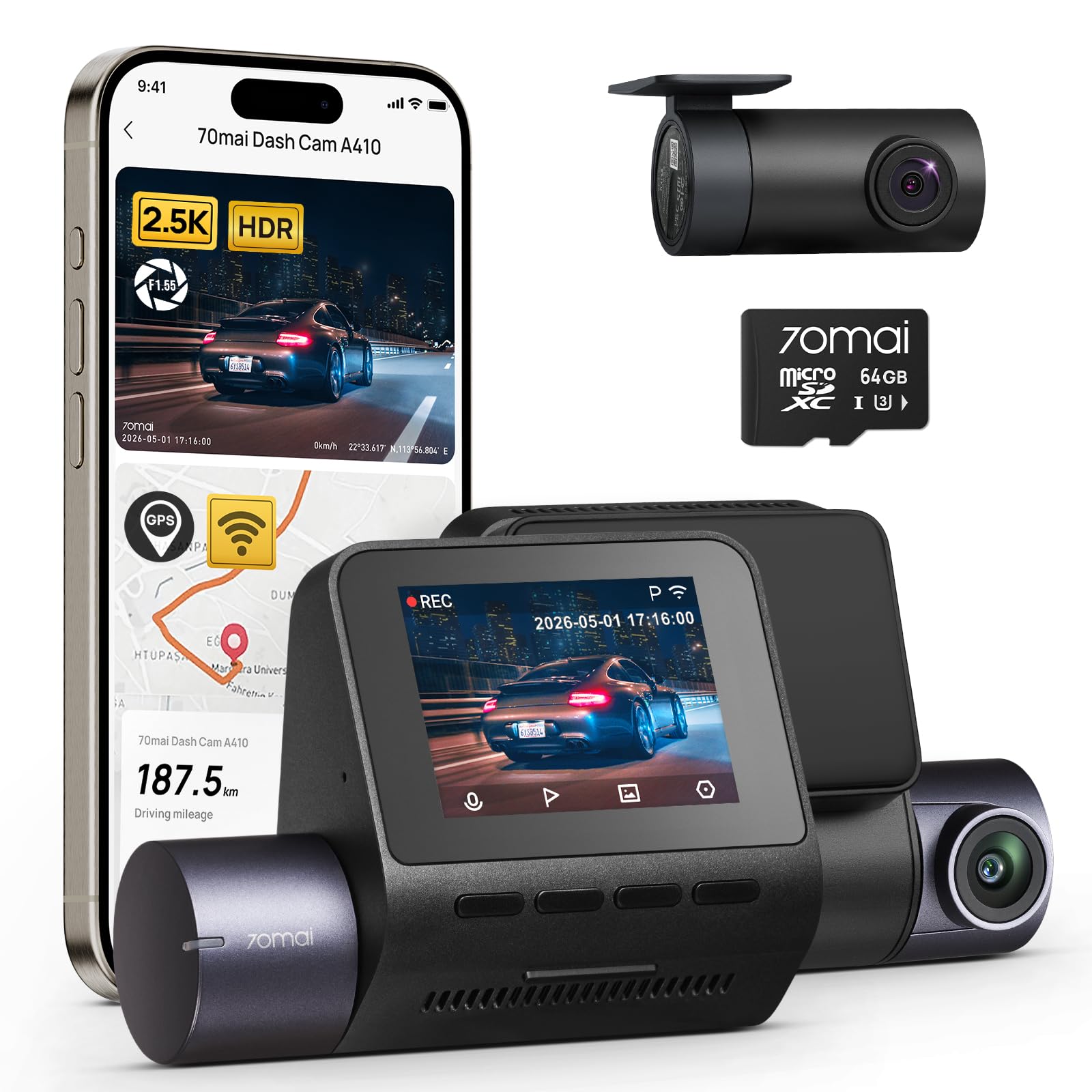
2. 70mai Dash Cam Front and Rear A410
The front-and-rear champ that includes a 64GB card and GPS from the start.
This is the best all-in-one value on the list because it gives you a proper dual-camera system without asking you to buy extra accessories just to get started. The front camera records at 2.5K (2560x1440P) — a noticeable step up in sharpness compared to standard 1080P — while the rear cam captures 1080P; that combination beats the 70mai M310 in resolution for both front and rear views. The advanced HDR and F1.55 aperture (a very wide lens opening that lets in more light) work together to keep plates readable even in near-darkness.
Buyers report it is a “fantastic choice” that “withstands GA heat/cold, zero malfunctions” after long use. The built-in GPS embeds coordinates and speed into the footage, giving you court-ready evidence without any extra module. One note: the 125-degree field of view is narrower than the 170-degree lens on the ORSKEY, so you get slightly less side-lane coverage but sharper details straight ahead. The kit includes a 64GB microSD card, rear camera, electrostatic stickers, and a 18-month warranty.
The main trade-off is that parking mode still needs a separately sold hardwire kit (UP03), and the internal battery reportedly lasts about 1.5 to 2 years before needing a replacement — though one owner called the battery swap “easy.”
What makes it worth the money
- Sharp 2.5K front + 1080P rear recording with HDR for balanced low-light video
- Built-in GPS records speed, route, and coordinates on the footage
- Comes with a 64GB SD card, rear cam, and all mounting stickers — ready to install
The honestly small catches
- 125-degree front lens is narrower than many rivals, so less side coverage
- Parking mode requires a separate hardwire kit (UP03, sold separately)
- Internal battery lasts roughly 1.5-2 years and needs eventual replacement
Reach for this if: you want a complete dual-camera package — GPS, a 64GB card, and strong night vision — without hunting for extra parts at checkout.
Look elsewhere if: you need the widest possible side-to-side view of the road, or you don’t want to think about a battery replacement in a couple of years.
3. Vantrue E1 Lite 1080P Mini Dash Cam

A tiny, durable single-cam that swallows up to 512GB and comes with honest GPS tracking.
If you only need front coverage and want the absolute smallest body that still packs a proper feature set, this Vantrue fits the bill. It records crisp 1080P at 30 frames per second through a 160-degree ultra-wide lens — much wider than the 130-degree lens on the 70mai M310, so you catch more activity in adjacent lanes. But unlike the ORSKEY’s 170-degree lens, the E1 Lite uses a higher-quality sensor and F1.8 aperture to keep the edges from turning mushy in low light.
One reviewer who has used it daily in South Florida heat since July 2024 says the video is “reliable 1080p day/night” and the adhesive mount survives the summer without peeling. The built-in GPS records your speed, route, and direction — and unlike many budget cams, it shows a speedometer overlay on the footage (one reviewer noted this feature “isn’t advertised” but works well). Voice commands work in English, Japanese, Russian, and Chinese, letting you lock clips or snap photos hands-free. The biggest storage advantage here: it supports microSD cards up to 512GB, double the 256GB ceiling of most rivals.
The catch is that at 1080P, it does not match the detail level of the 2.5K front cam on the 70mai A410, and parking mode again requires a sold-separately hardwire kit. Also, you need to use the included car charger — it does not support PD fast charging.
Why it stands out
- Supports microSD cards up to 512GB — more than double what most budget cams handle
- Built-in GPS records speed and route with a live speedometer display
- Proven durability in extreme heat, with owners reporting over 18 months of daily use
What to know first
- 1080P resolution is good, but not as detailed as the 2.5K or 4K front cams on the list
- Hardwire kit for 24/7 parking mode is not included and not compatible with PD fast chargers
- GPS speedometer is always on screen, which some buyers find distracting
Ideal for: drivers who want a tough, tiny single-cam with GPS, voice control, and the ability to store days of footage without running out of space.
Not ideal for: anyone who needs a rear camera included or wants a resolution higher than 1080P for reading plates at highway distance.
4. E-YEEGER GT830 4K+1080P Dual Dash Cam
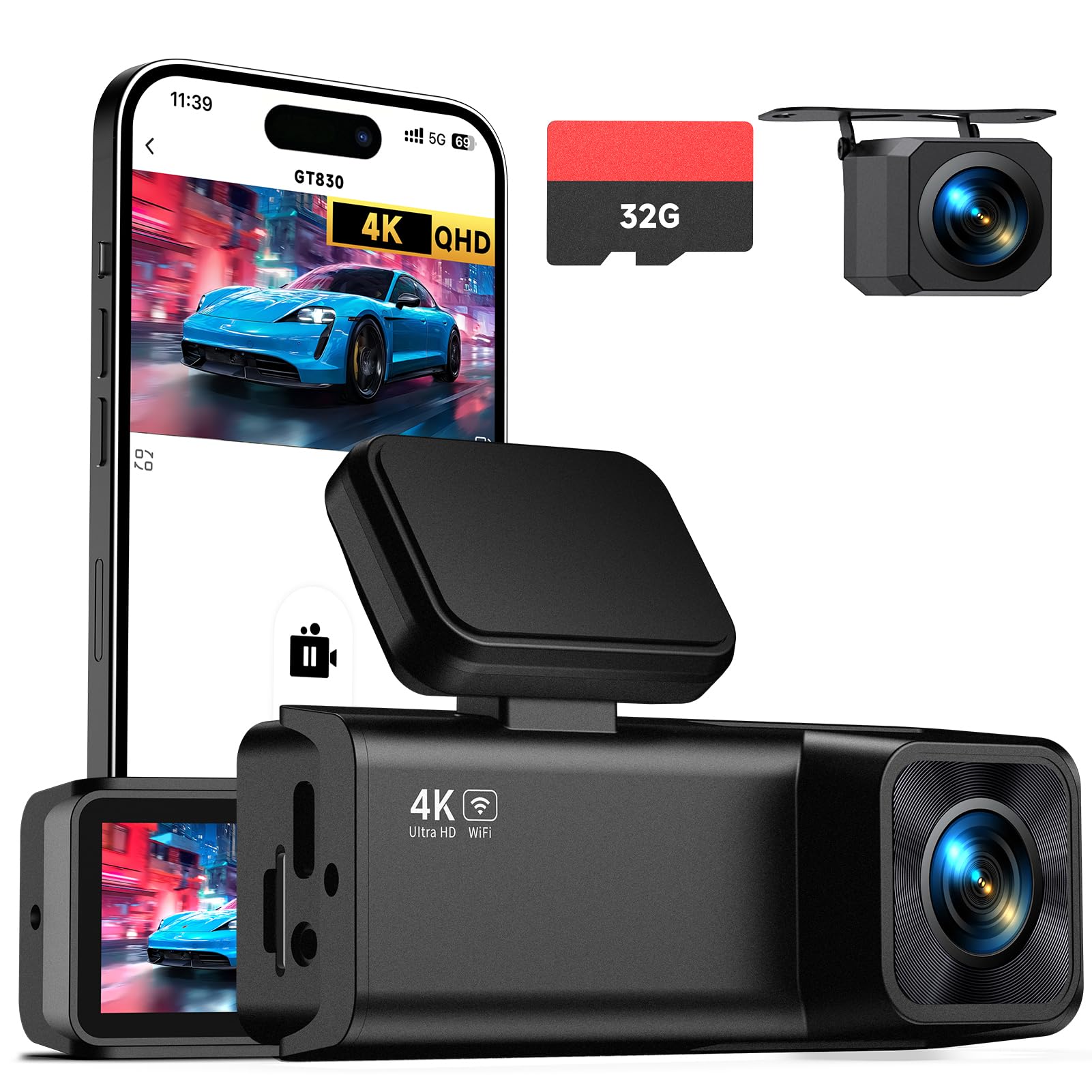
4K front detail for less than many 1080P cameras — a genuine spec anomaly at this price.
This dual-cam manages something rare: a 4K Ultra HD front camera paired with a 1080P rear camera at a price that usually gets you only 1080P on both ends. The 160-degree ultra-wide front lens and advanced WDR (a technology that balances bright and dark zones so headlights don’t blow out the image) combine to produce footage that beats the ORSKEY and the 70mai M310 in raw daytime sharpness. If you drive during bright sunny hours, this is the clearest front video on the list.
The camera comes with a 32GB microSD card pre-installed and supports expansion up to 256GB, so it is ready to record from the start — unlike the 70mai M310 which does not include a card. Owners call the installation “easy” and appreciate the 1.97-inch IPS screen for quick playback without needing an app. The Wi-Fi and VeeCar App let you pull clips to your phone without removing the SD card.
The honest trade-off is that night-time performance on the front 4K sensor is decent but not class-leading — reviewers report the footage is “good quality” but do not rave about low-light clarity the way they do about the 70mai A410’s HDR. And like every model here, the 24-hour parking mode requires a sold-separately Type-C hardwire kit. Also, a few buyers flagged that initial app connection can be a hurdle for people with limited technical experience.
The big wins
- True 4K front recording — a full step above 2.5K and 1080P rivals for daytime clarity
- Comes with a 32GB SD card pre-installed, so you can start recording immediately
- 1.97-inch IPS screen for on-the-spot playback without a phone
Where it gives ground
- Night vision is solid but not as impressive as the 70mai A410’s HDR performance
- Parking mode requires a separate hardwire kit (not included)
- Some buyers find the app pairing process finicky at first
Best for: buyers who prioritize razor-sharp daytime video and want a dual-cam system that includes the memory card from day one.
Pass on it if: you drive mostly at night and need the absolute best low-light detail, or you prefer a simple plug-and-play setup without any app fuss.
5. KAWA Mini Spherical Dash Cam
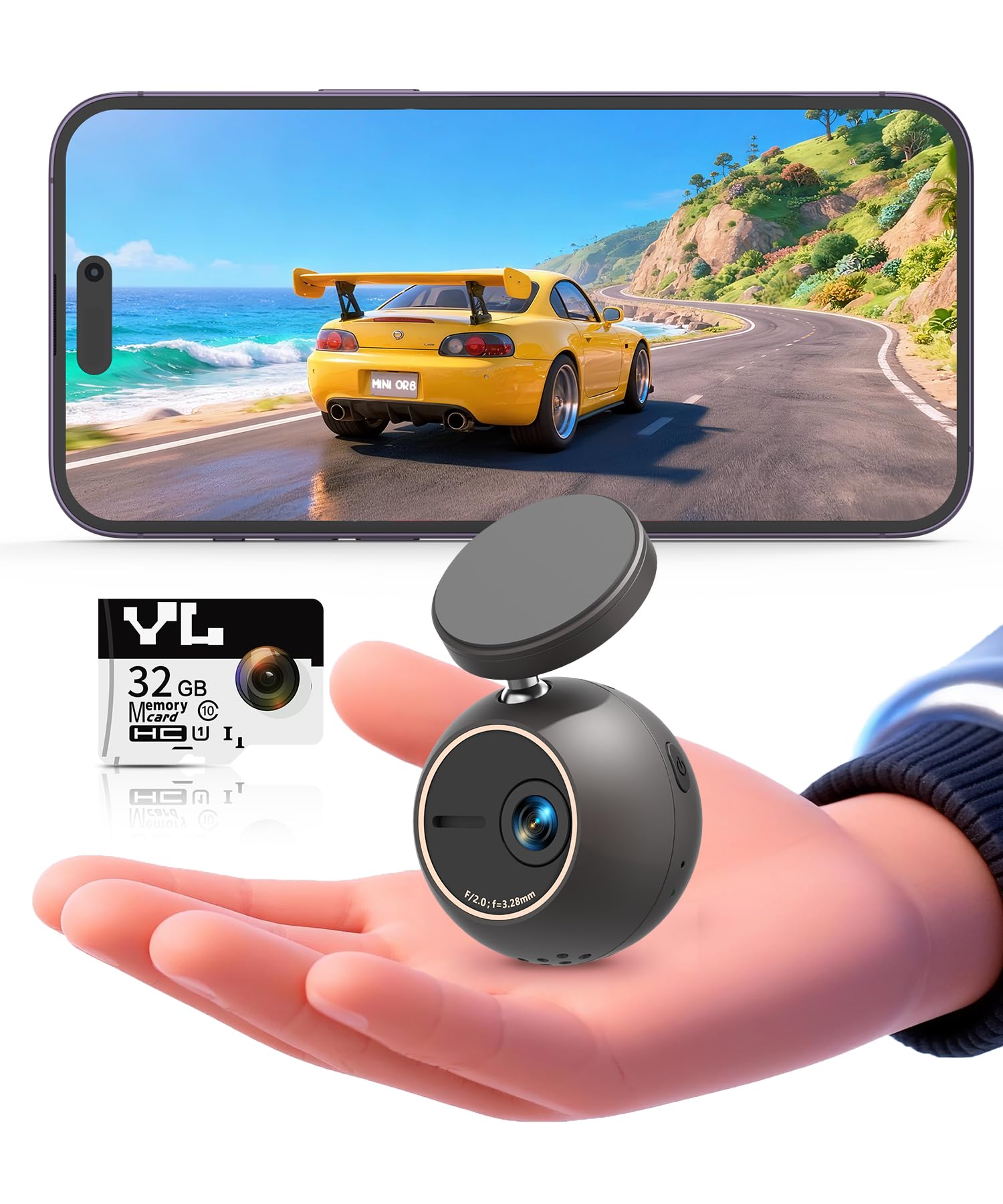
A cute spherical body with a 360-degree mount that points at the road, the cabin, or even both.
This is the most unusual shape on the list — a tiny orb that sits on a fully rotatable mount. The 2K resolution and “NightEagle Engine” (a name for its smart-exposure and noise-reduction processing) capture license plates and road signs clearly in daylight, and owners mention the footage is “lovely and clear.” The 360-degree mount with a 180-degree image flip and mirror mode means you can aim it out the front window, toward the side, or inside the cabin to record passengers — a flexibility none of the other single-cam picks offer.
Like the KAWA Tiny Dash Cam, it comes with a free 32GB SD card, so you won’t need to buy storage separately. Voice control works hands-free, and the built-in Wi-Fi connects to a phone app for live view and downloads. Customers note it is “small, easy to install and use” and that the compact size does not block their windshield view.
The catch is that parking mode — listed as a feature — only works with an optional hardwire kit, and several buyers noted they were disappointed to discover this after purchase. A couple of users also reported trouble getting the phone app to communicate with the camera on the first try, requiring multiple power cycles to pair.
Why it is different
- 360-degree rotatable mount (with 180° image flip) records front, side, or inside
- 2K resolution and NightEagle Engine for good night footage
- Comes with a 32GB SD card — no separate storage purchase needed
What holds it back
- Parking mode requires a separate hardwire kit, which some buyers find misleading
- Phone app pairing can be stubborn on the first attempt, per a few reviews
Choose it for: its unique ability to point in multiple directions and its orb-like design that does not look like a typical dash cam.
6. KAWA 2K Tiny Dash Cam
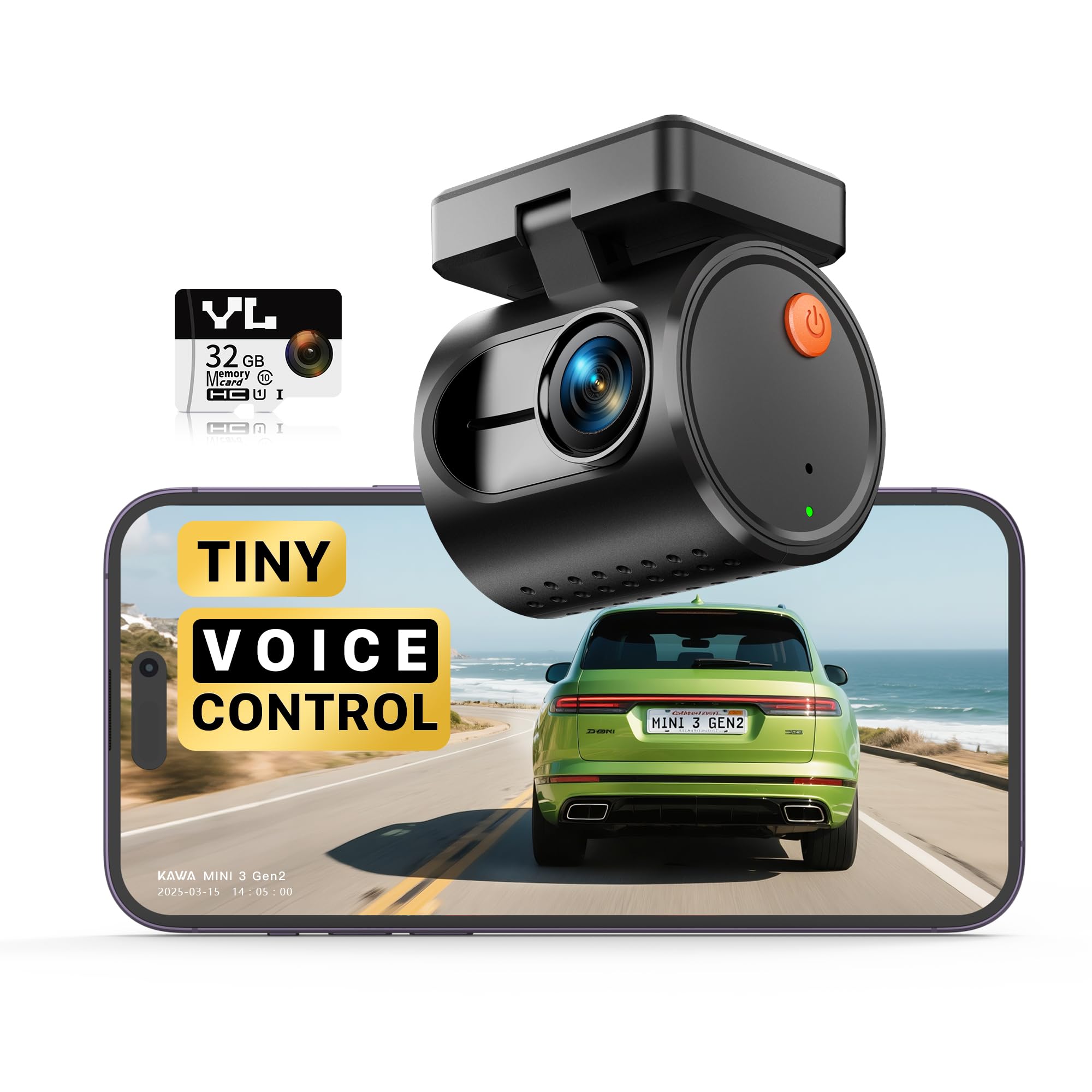
A micro-sized 1296P cam that includes a 32GB card and voice control at a true budget price.
For the price, the KAWA Tiny Dash Cam delivers a lot of the same features you find on more expensive rivals. It records at 1296P QHD, matching the 70mai M310 in resolution, and comes with a 32GB microSD card — something the M310 does not include. It supports microSD cards up to 256GB, an 8x gap over the ORSKEY’s 32GB ceiling, giving you room for hours more looped footage before old files get overwritten. Buyers confirm it is “compact, hides behind rearview mirror” and that the “excellent day/night video quality” and “easy Wi-Fi app setup” make it a satisfying purchase.
The voice control works with simple commands like “take photo” or “lock video,” which helps keep your hands on the wheel. The Wi-Fi app lets you preview and download clips without burning through phone data. One reviewer using it as a rear camera in their car said it was “perfect for that purpose” because they did not have to run a long cable across the whole vehicle.
The main complaint from a small number of buyers is that the KAWA app did not recognize the device immediately. The fix, as one owner figured out, was pressing the power button multiple times with the car off until the LED flashed red and blue, then restarting the app. A finicky initial connection is a recurring theme across KAWA models, so expect a possible hiccup on setup day.
Where it shines
- 1296P QHD resolution at this price level is tough to beat — sharper than 1080P
- Comes with a 32GB SD card, saving you an immediate – purchase
- Voice commands and Wi-Fi app work reliably once connected
Watch out for
- App pairing can be stubborn on the first try, requiring a few restart cycles
- No display — all settings and playback are handled through the phone app
- Parking mode needs a separate hardwire kit, though it is a typical omission at this price
Perfect if: you want 1296P sharpness and a free SD card for under what most 1080P cams cost, and you do not mind a minor app-pairing dance at setup.
7. ORSKEY Dash Cam Front and Rear 1080P Full HD Dual Dash Camera

A true bare-bones dual-cam that gives you front and rear views for the lowest cost.
If your budget is absolutely tight and you still need both a front and rear camera, the ORSKEY is the cheapest way to get that setup. It records at 1080P Full HD on the front and VGA on the rear (a lower-resolution format, so rear plates will be less readable than the 1080P rear feed on the 70mai A410 or the E-YEEGER GT830). The 170-degree wide-angle lens is the widest on the list — 31% wider than the 130-degree lens on the 70mai M310 — so you get maximum side-to-side coverage, which can capture a merging car your narrower cam might miss.
A long-term buyer reports: “Still works after 3 years, but front/rear camera quality degraded after 1.5 years — overexposure occurs daily now.” That honest durability ceiling is the main reason this sits at the bottom of the list. On the plus side, it has a 3.0-inch LCD screen for direct playback, a feature the screenless KAWA and 70mai M310 models lack. The suction cup mount is quick to install, though a few owners say it can fall off in hot weather.
Other drawbacks: it only supports microSD cards up to 32GB — a very small capacity by today’s standards — and there is no Wi-Fi, so you will need to remove the card to view footage on a computer. Customer service complaints appear in a handful of reviews, particularly around refunds after 30 days. Think of this as a strictly entry-level tool rather than a long-term investment.
What you get for the low price
- Front and rear recording for the lowest entry cost on the list
- Ultra-wide 170-degree lens catches more side-lane activity than any other pick
- 3.0-inch LCD screen lets you review clips without a phone or computer
The hard trade-offs
- Rear camera is VGA, not 1080P — rear footage is noticeably less detailed
- Max 32GB card support means short loop cycles compared to the 256GB/512GB rivals
- No Wi-Fi or app; you must pull the SD card to transfer footage to another device
Reserve for: the shopper who needs front and rear coverage immediately on the smallest possible budget, and accepts that the rear will be blurry at night and that the unit may not last beyond a couple of years.
8. KAWA 2K Tiny Dash Cam
A micro-sized 1296P cam that includes a 32GB card and voice control at a true budget price.
For the price, the KAWA Tiny Dash Cam delivers a lot of the same features you find on more expensive rivals. It records at 1296P QHD, matching the 70mai M310 in resolution, and comes with a 32GB microSD card — something the M310 does not include. It supports microSD cards up to 256GB, an 8x gap over the ORSKEY’s 32GB ceiling, giving you room for hours more looped footage before old files get overwritten. Buyers confirm it is “compact, hides behind rearview mirror” and that the “excellent day/night video quality” and “easy Wi-Fi app setup” make it a satisfying purchase.
The voice control works with simple commands like “take photo” or “lock video,” which helps keep your hands on the wheel. The Wi-Fi app lets you preview and download clips without burning through phone data. One reviewer using it as a rear camera in their car said it was “perfect for that purpose” because they did not have to run a long cable across the whole vehicle.
The main complaint from a small number of buyers is that the KAWA app did not recognize the device immediately. The fix, as one owner figured out, was pressing the power button multiple times with the car off until the LED flashed red and blue, then restarting the app. A finicky initial connection is a recurring theme across KAWA models, so expect a possible hiccup on setup day.
Where it shines
- 1296P QHD resolution at this price level is tough to beat — sharper than 1080P
- Comes with a 32GB SD card, saving you an immediate – purchase
- Voice commands and Wi-Fi app work reliably once connected
Watch out for
- App pairing can be stubborn on the first try, requiring a few restart cycles
- No display — all settings and playback are handled through the phone app
- Parking mode needs a separate hardwire kit, though it is a typical omission at this price
Perfect if: you want 1296P sharpness and a free SD card for under what most 1080P cams cost, and you do not mind a minor app-pairing dance at setup.
9. ORSKEY Dash Cam Front and Rear 1080P Full HD Dual Dash Camera
A true bare-bones dual-cam that gives you front and rear views for the lowest cost.
If your budget is absolutely tight and you still need both a front and rear camera, the ORSKEY is the cheapest way to get that setup. It records at 1080P Full HD on the front and VGA on the rear (a lower-resolution format, so rear plates will be less readable than the 1080P rear feed on the 70mai A410 or the E-YEEGER GT830). The 170-degree wide-angle lens is the widest on the list — 31% wider than the 130-degree lens on the 70mai M310 — so you get maximum side-to-side coverage, which can capture a merging car your narrower cam might miss.
A long-term buyer reports: “Still works after 3 years, but front/rear camera quality degraded after 1.5 years — overexposure occurs daily now.” That honest durability ceiling is the main reason this sits at the bottom of the list. On the plus side, it has a 3.0-inch LCD screen for direct playback, a feature the screenless KAWA and 70mai M310 models lack. The suction cup mount is quick to install, though a few owners say it can fall off in hot weather.
Other drawbacks: it only supports microSD cards up to 32GB — a very small capacity by today’s standards — and there is no Wi-Fi, so you will need to remove the card to view footage on a computer. Customer service complaints appear in a handful of reviews, particularly around refunds after 30 days. Think of this as a strictly entry-level tool rather than a long-term investment.
What you get for the low price
- Front and rear recording for the lowest entry cost on the list
- Ultra-wide 170-degree lens catches more side-lane activity than any other pick
- 3.0-inch LCD screen lets you review clips without a phone or computer
The hard trade-offs
- Rear camera is VGA, not 1080P — rear footage is noticeably less detailed
- Max 32GB card support means short loop cycles compared to the 256GB/512GB rivals
- No Wi-Fi or app; you must pull the SD card to transfer footage to another device
Reserve for: the shopper who needs front and rear coverage immediately on the smallest possible budget, and accepts that the rear will be blurry at night and that the unit may not last beyond a couple of years.
10. ORSKEY Dash Cam Front and Rear 1080P Full HD Dual Dash Camera
A true bare-bones dual-cam that gives you front and rear views for the lowest cost.
If your budget is absolutely tight and you still need both a front and rear camera, the ORSKEY is the cheapest way to get that setup. It records at 1080P Full HD on the front and VGA on the rear (a lower-resolution format, so rear plates will be less readable than the 1080P rear feed on the 70mai A410 or the E-YEEGER GT830). The 170-degree wide-angle lens is the widest on the list — 31% wider than the 130-degree lens on the 70mai M310 — so you get maximum side-to-side coverage, which can capture a merging car your narrower cam might miss.
A long-term buyer reports: “Still works after 3 years, but front/rear camera quality degraded after 1.5 years — overexposure occurs daily now.” That honest durability ceiling is the main reason this sits at the bottom of the list. On the plus side, it has a 3.0-inch LCD screen for direct playback, a feature the screenless KAWA and 70mai M310 models lack. The suction cup mount is quick to install, though a few owners say it can fall off in hot weather.
Other drawbacks: it only supports microSD cards up to 32GB — a very small capacity by today’s standards — and there is no Wi-Fi, so you will need to remove the card to view footage on a computer. Customer service complaints appear in a handful of reviews, particularly around refunds after 30 days. Think of this as a strictly entry-level tool rather than a long-term investment.
What you get for the low price
- Front and rear recording for the lowest entry cost on the list
- Ultra-wide 170-degree lens catches more side-lane activity than any other pick
- 3.0-inch LCD screen lets you review clips without a phone or computer
The hard trade-offs
- Rear camera is VGA, not 1080P — rear footage is noticeably less detailed
- Max 32GB card support means short loop cycles compared to the 256GB/512GB rivals
- No Wi-Fi or app; you must pull the SD card to transfer footage to another device
Reserve for: the shopper who needs front and rear coverage immediately on the smallest possible budget, and accepts that the rear will be blurry at night and that the unit may not last beyond a couple of years.