
Our readers keep the lights on and my garage snacks stocked. As an Amazon Associate, I earn from qualifying purchases.
Specs are compiled from manufacturer listings and verified buyer reviews and can change over time — please confirm the key details on the product page before buying.
Adding a subwoofer to your car doesn’t have to drain your wallet. A cheap car subwoofer adds low-end thump that factory door speakers cannot produce, making drives more rich while staying affordable.
I’m Min Islam — the founder and writer behind Trending Car. This guide is built by comparing the manufacturers’ published specifications and the patterns across verified customer reviews, so you get each pick’s real strengths and trade-offs instead of marketing spin.
Whether you drive a truck, sedan, or hatchback, these picks represent the most reliable and punchy entry-level options to help you find the best cheap car subwoofer that actually sounds good and fits your setup.
Our Picks at a Glance

How To Choose The Best Cheap Car Subwoofer
When buying a budget subwoofer, focus your limited dollars on the specs that matter. The specs that matter most are RMS rating, impedance, and mounting depth — not peak power numbers on the box.
Focus on RMS Power, Not Peak Power
Peak power is what the sub can handle in a split-second burst. RMS power is the continuous power it can handle safely all day. On a budget sub, RMS is typically one-quarter to one-third of the peak number. Match your amplifier’s RMS output to the sub’s RMS rating to keep sound clean and prevent damage.
Impedance and Wiring Flexibility
Impedance, measured in ohms, controls how much electrical resistance the subwoofer presents to your amplifier. A dual voice coil (DVC) sub gives you wiring options — you can wire it for a lower or higher final impedance. Lower impedance (like 1 ohm or 2 ohms) draws more power from your amp, which means louder bass, but it also demands a stable amp that can handle that load without overheating.
Physical Fit: Mounting Depth and Cutout Diameter
Before you buy, measure your box or the space under your seat. Mounting depth tells you how far back the sub’s magnet extends into the enclosure. Cutout diameter is the hole you need to cut in the box. An under-seat powered sub skips the box entirely — it slides into a slim space (usually about 3 to 4 inches tall) and includes its own built-in amplifier.
Quick Comparison
| Model | Best For | RMS Power | Driver Size | Type | Amazon |
|---|---|---|---|---|---|
| CT Sounds Bio 10″★ Best Overall | Excellent passive value for small vehicles | 400W | 10 Inches | Passive Sub | Amazon |
| PIONEER A-Series TS-A120D4Also Great | Powerful 12-inch passive setup | 500W | 12 Inches | Passive Sub | Amazon |
| Feikeer 10″ 1200W Underseat | Powered under-seat with 300W RMS | 300W | 10 Inches | Powered Sub | Amazon |
| Seventour 10″ 800W Underseat | Popular powered sub with install kit | 220W | 10 Inches | Powered Sub | Amazon |
| FOLTUSYMY 1200W Underseat | Compact powered sub with remote control | 220W | 10 Inches | Powered Sub | Amazon |
| LUVUMVLT 1200W Underseat | Powered sub with RF remote and LED ring | 220W | 10 Inches | Powered Sub | Amazon |
| BOSS Audio P126DVC | Budget 12-inch passive with big peak power | 1150W | 12 Inches | Passive Sub | Amazon |
In‑Depth Reviews
1. CT Sounds Bio 10” 800-Watt Dual 4-Ohm Car Subwoofer
The little 10-inch that punches far above its price tag with clean, musical bass.
CT Sounds has built a reputation for value, and this Bio 10 delivers on it. With a 400W RMS rating and 800W peak, it offers real continuous power. The dual 4-ohm voice coils let you wire it to either 2 ohms or 8 ohms, giving you flexibility to match almost any mono amplifier on the market. The mounting depth is 4.69 inches with a cutout diameter of 9.09 inches, making it a straightforward drop-in for most prefabricated sealed or ported boxes.
Buyers consistently praise its sound quality over sheer brute force. One owner wrote, “Excellent bass for size; works great in small vehicles (Kei van) with a 100W amp” — proof of how efficiently this sub converts modest power into satisfying low end. The advanced air cooling system and low-carbon iron zinc bottom plate help it run cooler under extended play, which matters more for longevity than any peak power number. Another reviewer called it a “solid value” and compared it favorably to more expensive Polk replacements.
The 2.4-inch 4-layer copper voice coil handles thermal stress better than cheaper single-layer designs, so you can push it harder without worrying about the coil cooking itself.
What Shines
- 400W RMS is strong middle ground — loud enough for real impact
- Dual 4-ohm wiring fits most amp setups
- Compact 10-inch size with 4.69-inch mounting depth fits many boxes
Limitations
- Limited to 800W peak — less headroom than the Pioneer or BOSS
- Still needs a separate amp and enclosure
- Single-stack motor assembly is basic compared to competition-grade subs
Reach for this if: You want a reliable 10-inch passive sub that sounds clean and musical on a modest amp — it is the best balance of price, efficiency, and sound quality among the passive subs here.
Look elsewhere if: You need window-rattling extreme SPL — the CT Sounds prefers quality over sheer volume.
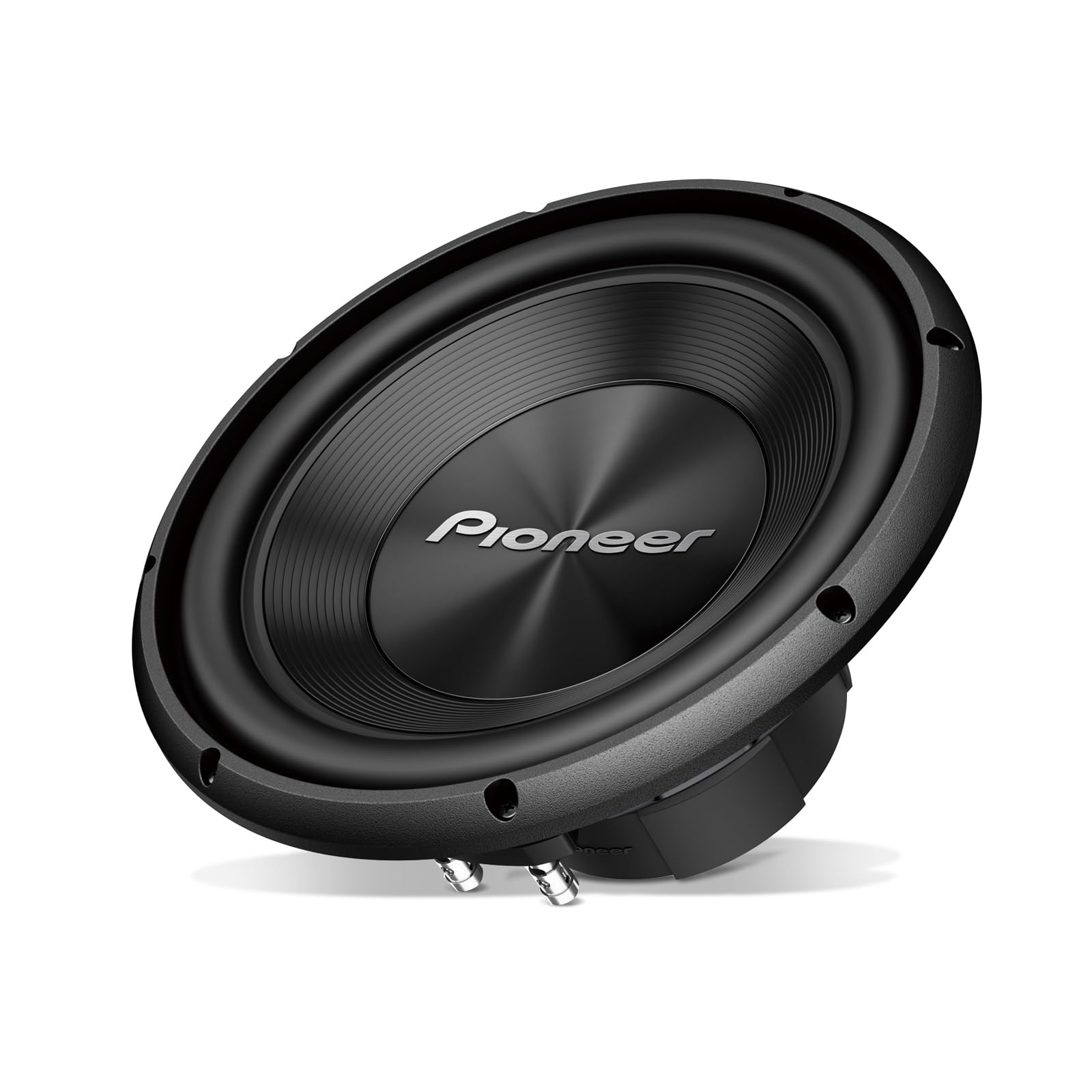
2. PIONEER A-Series TS-A120D4 12” Subwoofer – 1500W Max
The Pioneer that brings real 12-inch authority without leaving the budget aisle.
If you want deep, room-filling bass from a passive subwoofer that you can pair with your own amplifier, this Pioneer is the anchor of your setup. It handles a continuous RMS power of 500 watts — easily the highest sustained power rating among the sub-only picks here — with a peak of 1500 watts for those brief punchy moments. The specially designed dual voice coils give you flexible wiring options (buyers report wiring it parallel to a 2-ohm load) so you can squeeze the most power out of your amp.
The 12-inch driver size gives it a larger cone area than the 10-inch CT Sounds sub, which translates to deeper, more physical bass you can feel in your chest. The 77 dB sensitivity rating means it produces clear sound even when your amp is not cranked to the max, so vocals and instruments stay clean alongside the low end. At 12 inches, it also demands a properly sized enclosure — this is not a slide-under-the-seat solution, so make sure you have box space before buying.
One owner wired theirs in a Q Power box at 2 ohms with 520W RMS via a Recoil red600.1 amp, describing it as “hits hard, responsive 12” — a strong real-world vote for its ability to deliver big sound on a modest power budget.
The Real Muscle
- 500W RMS handles real continuous power without strain
- Dual voice coils give flexible wiring options (2 ohms or 8 ohms)
- 20 Hz to 2.3 kHz frequency response covers sub-bass through lower midrange
Consider This
- 77 dB sensitivity is modest — needs a decent amp to wake it up
- Requires separate box and amplifier, raising total cost
- Not for tight spaces — 12-inch needs a sizable enclosure
Who it fits: This is for the buyer who already has or plans to buy a separate amplifier and wants the deepest possible bass at this price — the 500W RMS rating leads the field among passive subs here.
One catch: You need to budget for a box and an amp separately, so the total spend creeps above the under-seat powered options on this list.
3. Feikeer 10″ 1200W Under Seat Subwoofers with Amp
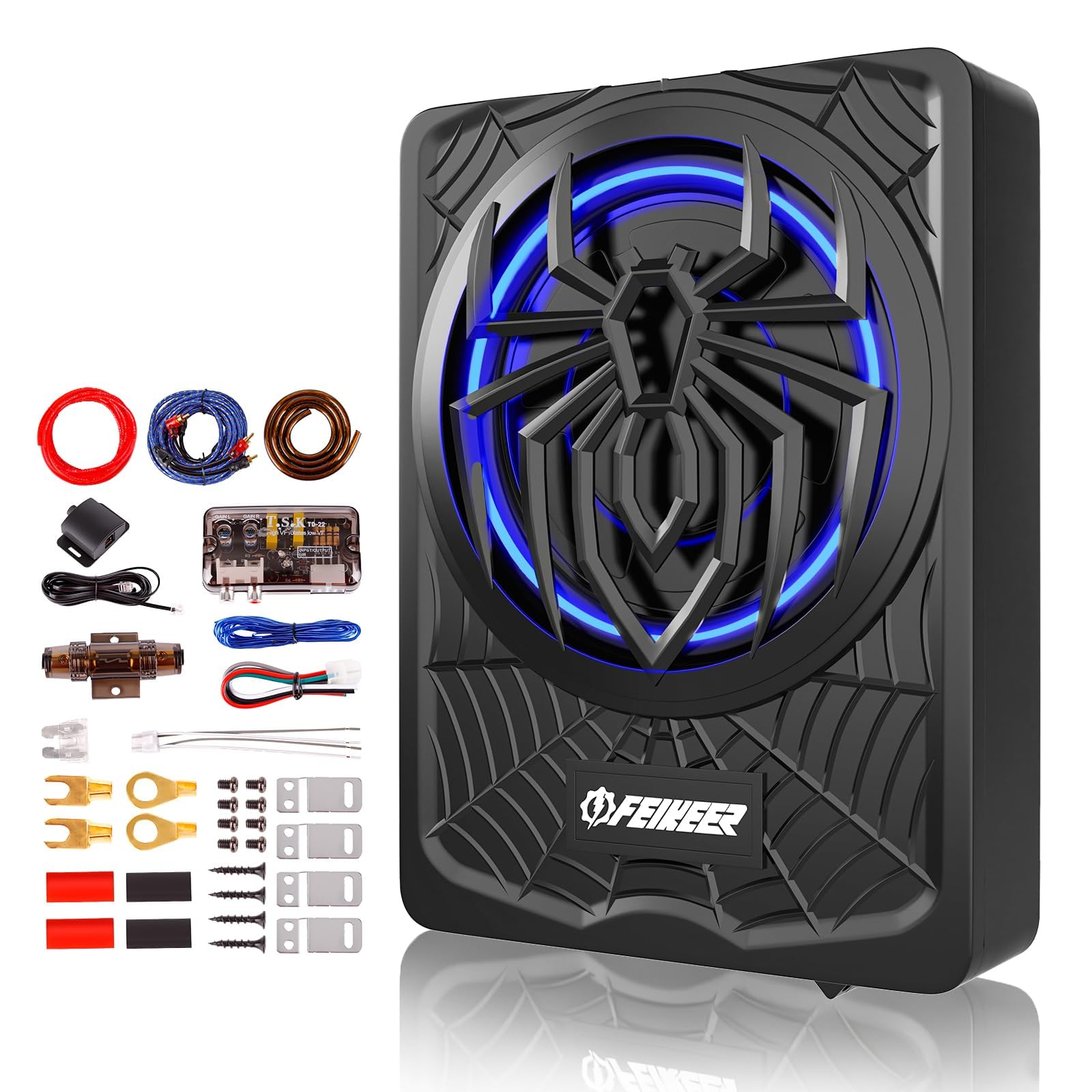
The under-seat powered sub with 300W RMS.
This Feikeer unit is the first all-in-one solution on the list — the subwoofer and amplifier are built into a single slim enclosure that slides under your seat. Its RMS power handling of 300 watts gives you noticeably more clean, continuous output before any distortion creeps in. The peak power hits 1200 watts.
Setting it up is straightforward: it accepts both RCA low-level inputs and speaker-level high-level inputs (0.9V threshold), so it works with factory stereos that lack dedicated sub outputs. You get individual control knobs for low-pass filter (50Hz to 150Hz), gain, and bass boost (0 to 12dB at 45Hz). The slim profile — just 3.38 inches tall — fits under most truck, SUV, and Jeep seats without stealing cabin space. Owners mention it “definitely completes the sound in my cargo van” and call it a “good buy” for adding balanced low end without annoying other drivers.
The signal-to-noise ratio is above 90dB, meaning the bass stays clean even as the volume climbs. And with a total harmonic distortion under 0.4%, the low end remains tight and controlled rather than muddy.
Why It Stands Out
- 300W RMS
- Slim 3.38-inch height fits under almost any seat
- High and low level inputs work with factory and aftermarket stereos
Trade-Offs
- Some customers note rattling issues shortly after install
- Rated fuse is 25A — make sure your power wire can handle the draw
- Blue LED may be too bright for some — not switchable
Best matched with: Truck, cargo van, or SUV owners who want low-maintenance cabin-filling bass without building a separate box — this is the strongest powered sub in RMS on the list.
Heads up: A small number of reviews mention early failure, so inspect the unit quickly after delivery and test it before full install.
4. 10″ Upgrade 800W Slim Under Seat Powered Car Subwoofer (Seventour)

The most-reviewed powered sub in the lineup, praised for its complete install kit and easy fit.
The Seventour 10-inch powered subwoofer (listed here as “10” Upgrade 800W”) is the crowd favorite — 377 ratings and a 4.4-star average tell you buyers are consistently happy. Its RMS rating is 220 watts with an 800-watt peak, which is less continuous power than the Feikeer unit above but still enough to fill a cabin with balanced low-end support. The cast aluminum enclosure helps with heat dissipation — important when the sub is tucked away under a seat with limited airflow.
What makes this a standout pick for first-time installers is the complete wiring kit included in the box: power cable, RCA cables, high-to-low level converter, and a wired remote bass volume controller. One reviewer noted it was “excellent value with complete installation kit” and that the small unit fits in a spare tire area. Another Tacoma owner installed it under the rear seat and confirmed it “filled the cab with low-end balance” — exactly the use case this sub was designed for. The thickness is just 3.1 inches, making it one of the slimmest units here.
You get gain, bass boost (0 to 12dB at 45Hz), and crossover controls (low-pass filter from 50Hz to 150Hz) to dial the sound to your taste. The blue LED ring adds a visual touch when the car is running.
Why It Sells
- Includes everything needed to install — no extra purchases required
- 3.1-inch slim profile fits under nearly any seat
- Cast aluminum shell runs cool and resists corrosion
Watch For
- 220W RMS is modest — not for those wanting room-shaking SPL
- Included wires have thick insulation but thin copper gauge — upgrade to 8-gauge recommended
- Blue LED light is very bright; some buyers disable it
Who this fits: The first-time buyer who wants an all-in-one kit with zero guesswork — just open the box, install, and enjoy balanced bass.
Consider this: If you have a Tacoma, F-150, or similar truck and want low-end fill without rattling windows, this is your pick.
5. FOLTUSYMY 1200W 10″ Slim Under Seat Powered Car Subwoofer

A sleek, modern under-seat sub with a 1200W peak and spider-shaped aluminum grille.
The FOLTUSYMY 1200W follows the same powered-sub formula as the Seventour model but adds a more premium build feel. Its RMS rating is 220 watts (same as the Seventour), and it shares the 1200W peak power claim, though unlike the Feikeer unit it does not offer the highest RMS in this group. what separates it is the aluminum alloy spider-shaped speaker protector and the LED atmosphere light ring — a design choice that looks considerably more upscale than the plain metal grilles on most budget subs.
Installation is straightforward with included high-to-low level converter and remote control for gain, bass boost, and crossover adjustments. Reviewers point out it sounds “more powerful than expected” and that the “built-in amp with high/low-level inputs” makes for an easy hookup in vehicles like a Mustang Mach-E. However, some owners note that it does not fit under all seats — one buyer’s 2018 WRX required placing it elsewhere — and the provided ground wire is very short, so plan on buying a longer one.
The cast aluminum housing is rated for three times better heat dissipation than traditional iron shells, which is a real advantage for a sub tucked under a seat where airflow is minimal.
Design Highlights
- Aluminum spider grille and LED ring look high-end for the price
- Cast aluminum enclosure dissipates heat three times better than iron
- Includes remote control for bass adjustments on the fly
Potential Issues
- 3.54-inch thickness may not fit under some lower seats
- Ground wire in the kit is too short for many installations
- 220W RMS is modest — not for bass-heads chasing extreme output
Best suited for: The buyer who values aesthetics as much as audio — the aluminum grille and blue LED make it the best-looking powered sub in this lineup.
What to know: Buy a 3-foot ground wire before starting the install, and measure your seat clearance — 3.54 inches is a bit taller than the Seventour’s 3.1 inches.
6. 1200W 10″ Car Subwoofer, Slim Under Seat Powered Subwoofer and Amp Package (LUVUMVLT)
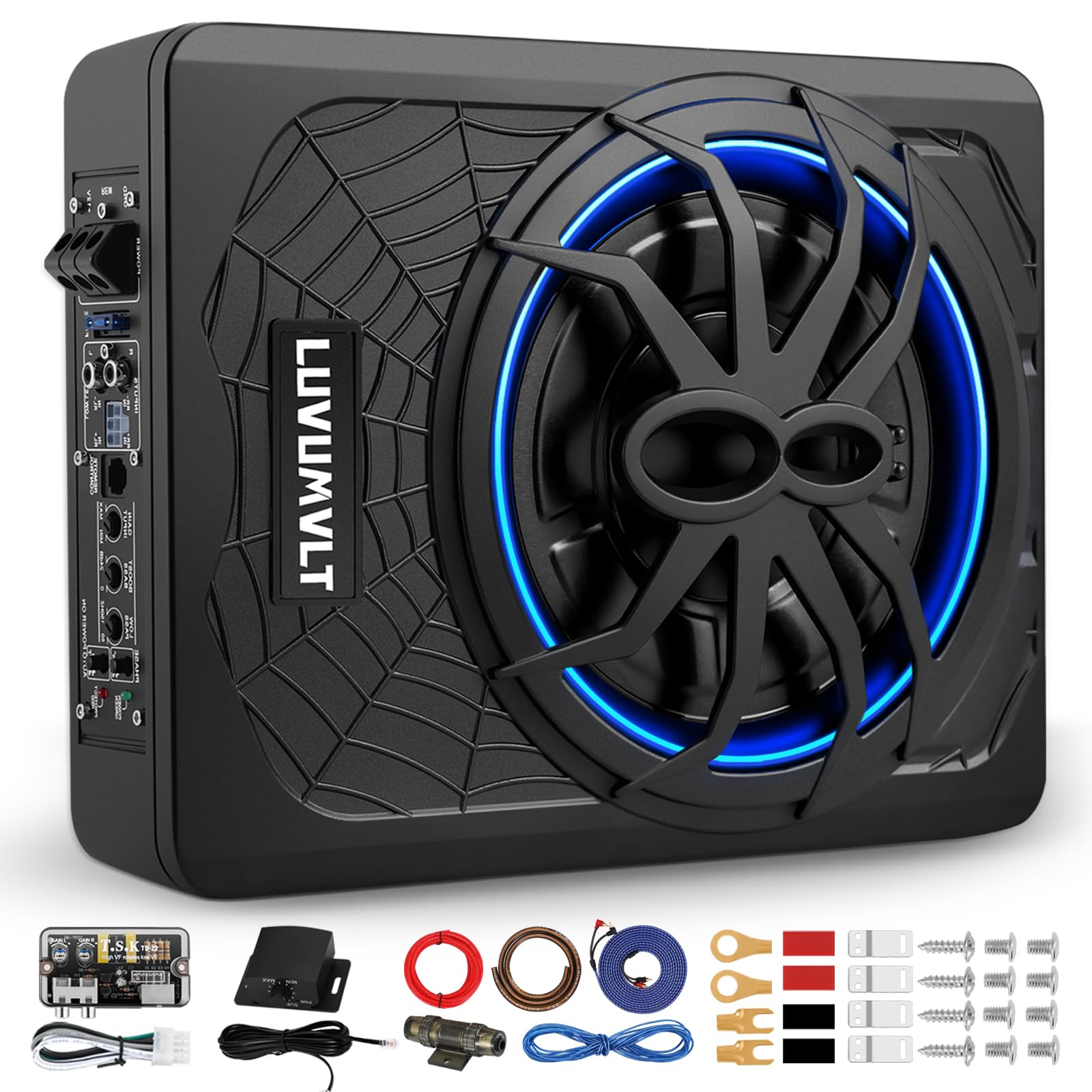
The powered sub that adds an RF wireless remote for bass control without wires across the cabin.
LUVUMVLT takes the same 220W RMS / 1200W peak powered-sub platform and adds a unique differentiator: a dedicated RF wireless remote that lets you adjust gain, bass boost (0 to 12dB), and crossover (50Hz to 150Hz) without running a cable from the sub to your dashboard. That is a real quality-of-life improvement if you do not want to drill holes or fish wires through the cabin trim. The 360-degree blue LED halo around the forged aluminum grille gives it a distinct nighttime look.
Installation is beginner-friendly — the kit includes a high-to-low level converter, power cable with fuse, RCA cables, and mounting hardware. Buyers are generally pleased: one owner with a 2022 Hyundai Santa Cruz described the install as “surprisingly easy” and finished in about 2.5 hours, noting the sub “packs a pretty decent punch” for under total including upgraded door speakers. Another reviewer called it “just enough” bass for someone past the phase of extreme car audio. The 3.54-inch thickness is the same as the FOLTUSYMY, so check your seat clearance.
Some owners note crackling at higher gain settings — keeping the bass boost moderate and the gain properly set avoids that issue.
Unique Advantage
- RF remote lets you control bass wirelessly — no cable routing needed
- Complete install kit means no extra shopping
- Forged aluminum grille with 360-degree LED halo looks distinctive
Watch For
- 220W RMS is on the lower end; not for extreme output seekers
- Some crackling reported if gain and boost are pushed too high
- 3.54-inch height limits under-seat fit in some vehicles
This is for you if: You want wireless bass control and a clean install without running a control cable — the RF remote is genuinely useful.
Skip if: You need maximum RMS output — the LUVUMVLT and its peers top out at 220W RMS, while the Feikeer delivers 300W.
7. BOSS Audio Systems Phantom P126DVC 12″ 2300 Watts Subwoofer

The 12-inch entry-level giant with 1150W RMS that demands respect — and careful tuning.
BOSS Audio is a household name in budget car audio, and the P126DVC is their 12-inch workhorse. Its headline number is the 1150W RMS power handling — significantly above even the Pioneer’s 500W RMS. The peak claims 2300 watts. The dual 4-ohm 2-inch copper voice coil gives you wiring options, and the poly-injection cone with rubber surround is a proven combination for durability and decent sound on a tight budget.
Buyers love the bang-for-buck: one review describes it as “best sub I have found yet for the money,” and another calls it “big sound for fraction of cost.” However, the power handling figure needs context — the 84dB sensitivity is modest, meaning you need a genuinely powerful amplifier to push it to its potential. A real-world caution from one buyer: the sub “blew after ~20 hrs at 500W RMS” — a reminder that RMS is about thermal limits, and pairing it with an amp that delivers clean, undistorted power is critical. The resonant frequency is 31 Hz, meaning it favors very deep sub-bass over punchy mid-bass.
At 12 inches, you will need a properly sized enclosure. The competition-style binding posts make connection secure and easy.
The Big Appeal
- 1150W RMS is the highest continuous power rating on this list
- 12-inch driver moves serious air for deep bass
- Poly-injection cone and rubber surround are durable for the price
The Reality Check
- 84dB sensitivity needs a strong, clean amp to sound its best
- Some shoppers say blowing the sub — careful gain and volume matching is essential
- Requires separate box and amplifier, pushing total cost higher
Who it fits: The budget-focused buyer who wants the sheer cone area and RMS of a 12-inch sub and already has a capable amplifier — the P126DVC offers the most raw power-per-dollar here.
Read this carefully: Do not buy this if you plan to use a weak amp or want a plug-and-play setup. Watch your gain structure and consider spending a bit more for a sub like the Pioneer that is easier to drive cleanly.
Understanding the Specs
RMS vs. Peak Power
RMS (Root Mean Square) is the amount of power a subwoofer can handle continuously without damage. Peak power is the brief burst it can survive for a split second — it is a marketing number. When matching a sub to an amplifier, always match the amp’s RMS output to the sub’s RMS rating. A sub with 300W RMS needs an amp that delivers about 300W RMS at its rated impedance. Running too much RMS overheats the voice coil; too little RMS and the sub never reaches its potential output.
Impedance and Wiring
Impedance (measured in ohms) is the electrical resistance the subwoofer presents to the amplifier. A lower impedance (like 1 ohm or 2 ohms) lets more current flow, producing more power — but your amp must be stable at that load. Dual voice coil (DVC) subs, like the Pioneer and CT Sounds here, give you wiring flexibility: you can wire the coils in parallel (halving the impedance) or series (doubling it). Always check your amp’s stable impedance range before wiring.
Passive vs. Powered Subwoofers
A passive subwoofer is just the speaker — it needs a separate amplifier and an enclosure to produce sound. A powered subwoofer (like the Feikeer, Seventour, FOLTUSYMY, and LUVUMVLT models) has the amplifier built into the same box. Powered subs are simpler to install, take up less space, and work well for adding bass to a factory stereo without a major overhaul. Passive subs generally offer more output potential and upgrade flexibility but require more planning and wiring.
Sensitivity and Frequency Response
Sensitivity (measured in dB) tells you how loud a subwoofer will play given one watt of power. A higher sensitivity number (like 87-90 dB) means the sub produces more volume from a smaller amp. A lower sensitivity (like the Pioneer’s 77 dB or the BOSS’s 84 dB) means you need more amplifier power to reach the same loudness. Frequency response (measured in Hz to kHz) tells you the range of bass notes the sub can reproduce. Numbers like “20 Hz to 500 Hz” mean it can hit very deep sub-bass (20 Hz) as well as upper bass notes near the midrange.
FAQ
Will a cheap car subwoofer damage my factory stereo?
How many watts do I need for decent bass?
Can I install a subwoofer myself without wiring experience?
What size subwoofer should I get for my car — 10-inch or 12-inch?
How long does a cheap car subwoofer last?
Is a dual voice coil subwoofer better than a single voice coil?
Can I use a cheap car subwoofer in my truck under the rear seat?
Will a cheap subwoofer sound good for all types of music?
Do I need a subwoofer box with a passive sub?
Why does my subwoofer make a rattling noise?
Final Thoughts: The Verdict
For most people, the cheap car subwoofer winner is the CT Sounds Bio 10” 800-Watt Dual 4-Ohm Car Subwoofer because its 400W RMS rating and responsive 10-inch driver deliver the cleanest, most musical bass at this price. If you want an all-in-one powered solution that slides under your seat with zero extra gear, grab the Feikeer 10″ 1200W — its 300W RMS. And for the absolute lowest entry point into a 12-inch passive setup that pairs with a strong amp, the standout is the BOSS Audio P126DVC at 1150W RMS for sheer cone area and output potential.
How We Picked
We do not accept paid placement. Every pick is matched to a real buyer and a real use-case; we do not hands-on test units.
Sources & Methodology
Specifications: manufacturer listings and product documentation. Review insights: verified customer reviews, as of July 2026. Pricing: not shown on this page (it changes often); check the current price via the retailer link.
As an Amazon Associate, Trending Car earns from qualifying purchases. This does not affect which products we feature.