
Our readers keep the lights on and my garage snacks stocked. As an Amazon Associate, I earn from qualifying purchases.
Specs are compiled from manufacturer listings and verified buyer reviews and can change over time — please confirm the key details on the product page before buying.
A rough idle, a stumble on acceleration, or a stubborn check-engine light often traces back to one thing: gunk inside your fuel system. A good carburetor cleaner fuel additive dissolves that deposit buildup while you drive, restoring the smooth operation your engine had when it was new. That is the core promise of the nine products here, and the real question is which one matches your engine and your maintenance habits.
I’m Min Islam — the founder and writer behind Trending Car. This guide is built by comparing the manufacturers’ published specifications and the patterns across verified customer reviews, so you get each pick’s real strengths and trade-offs instead of marketing spin.
The best carburetor cleaner fuel additive for most engines is Red Line SI-1, which owners trust to keep fuel systems spotless and running at peak compression.
Our Picks at a Glance

How To Choose The Best Carburetor Cleaner Fuel Additive
Choosing the right one is less about brand loyalty and more about matching the chemistry to your engine type and your driving habits. You are deciding between a pour-in treatment that cleans while you drive and a spray that blasts a carburetor directly.
Know Your Engine’s Fuel System
Carburetors and fuel-injected engines build up different kinds of deposits. A pour-in additive must be safe for both, while a dedicated carburetor spray is designed for the throat and choke plate of a carburetor only. Check that the bottle lists your engine type before you buy.
Understand the Active Chemistry
The most effective cleaners use polyetheramine (PEA), a detergent that survives combustion heat to scrub valves and combustion chambers. Cheaper formulas may only clean the injectors, leaving the hardest carbon untouched. Look for the chemistry on the label or the safety data sheet.
Match the Treatment to Your Routine
Some additives are meant for a one-time shock treatment to clear heavy buildup, while others are designed for a small dose at every fill-up. Buying a multi-pack makes sense if you plan to treat several vehicles or run it monthly as prevention.
Quick Comparison
| Model | Best For | Type | Size | Treats | Amazon |
|---|---|---|---|---|---|
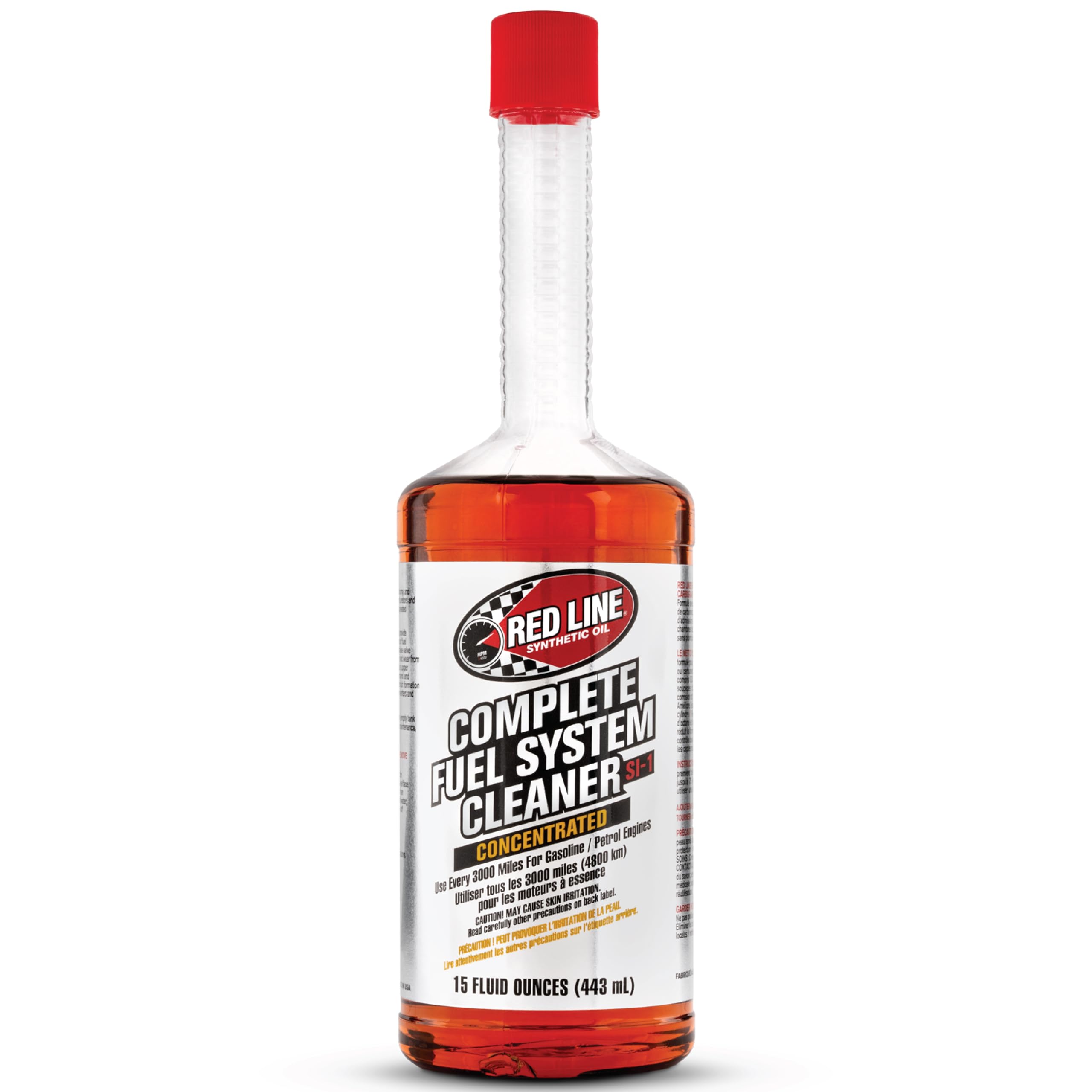
| Red Line 60103 SI-1★ Best Overall | Deep cleaning & prevention | Pour-in | 15 oz | Full tank | Amazon |
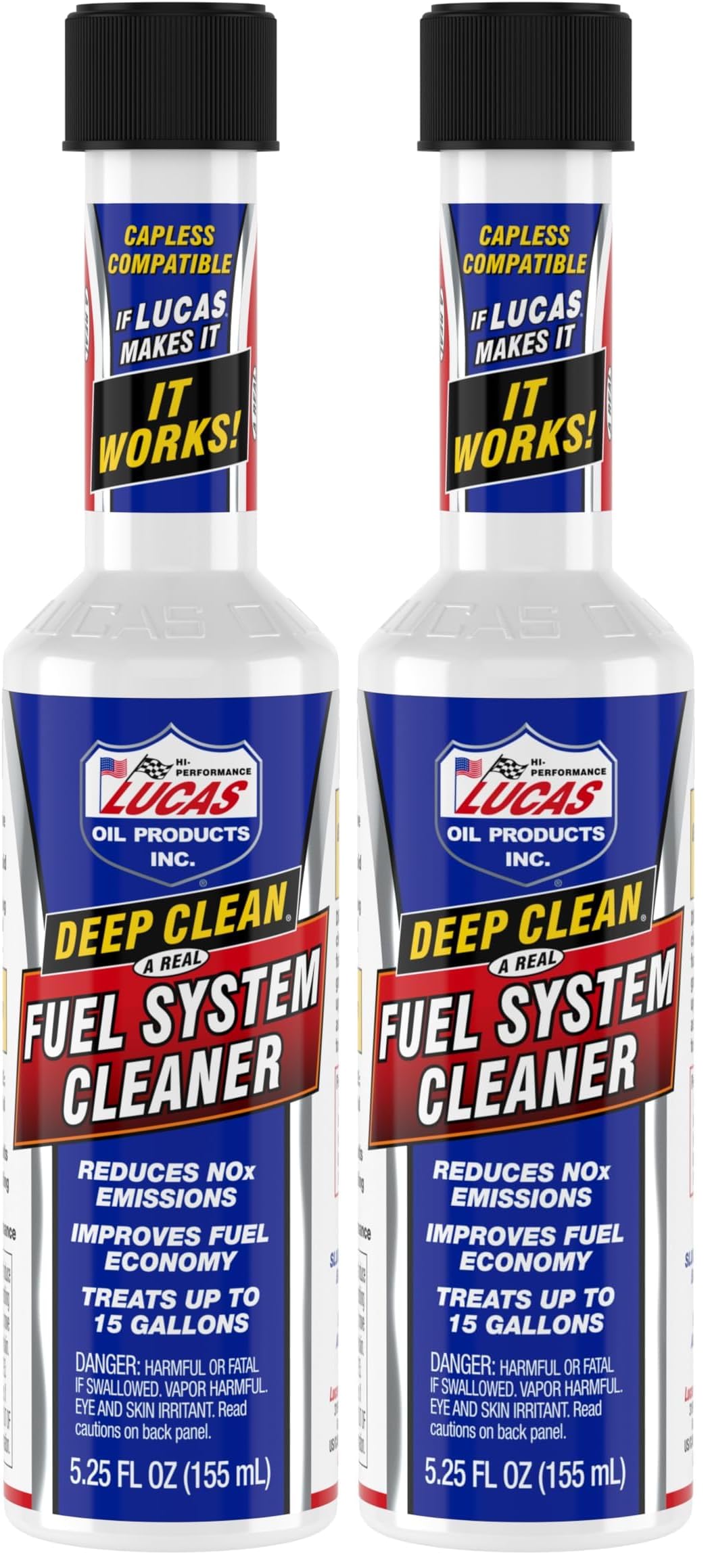
| Lucas Oil Deep CleanFast Fix | Quick check-engine fixes | Pour-in | 5.25 oz (2-pack) | Full tank | Amazon |
| Quicksilver QuickleenMarine Master | Marine & boat engines | Pour-in | 12 oz | 5 gal/oz | Amazon |
| Berryman B-12 (20 oz) | Direct carburetor spraying | Aerosol | 20 oz | Spray | Amazon |
| Gumout 6-Pack | Multi-vehicle maintenance | Pour-in | 6 oz (6-pack) | Full tank | Amazon |
| Royal Purple Max-Clean | Performance & fuel economy | Pour-in | 20 oz (2-pack) | Full tank | Amazon |
| BG 44K | Professional-grade cleaning | Pour-in | 11 oz (2-pack) | 20 gal/can | Amazon |
| Berryman B-12 Chemtool (12-pack) | Case-buy value | Pour-in | 15 oz (12-pack) | Full tank | Amazon |
| SQ Carburetor Cleaner | Small engine startups | Aerosol | 12.5 oz (12-pack) | Spray | Amazon |
In‑Depth Reviews
1. Red Line 60103 SI-1 Complete Fuel System Cleaner
Our pick — over 4.5★ from 9,500+ verified ratings; the strongest balance of quality and price.
The scientific choice for owners who want measurable, long-term cleanliness, not just a quick idle fix.
If you track every mile per gallon, this is the pick for you. It uses polyetheramine (PEA), a detergent that survives combustion heat to clean your engine’s intake and throttle body. One owner reported near-spotless intake and throttle body parts on a 2003 S2000 at 99,700 miles, with a 0.5% cylinder variance.—so your engine runs evenly and efficiently.
The bottle holds 15 ounces, and the recommended routine is a small per-tank dose — about 1/10 to 1/4 of the bottle per 10 gallons — rather than a one-time shock. That steady approach is what buyers report keeps injectors and valves clean between oil changes.
What wins people over is the corrosion prevention baked into the detergent blend. It is a premium fuel additive that tackles injectors, carburetors, valves, and combustion chambers while stabilizing the gasoline itself, which is a layer of protection most rivals skip.
Owner-Reported Wins
- Near-spotless intake and throttle body documented at 99,700 miles
- PEA chemistry cleans valves and chambers, not just injectors
- Corrosion prevention built into the concentrate
Handle With Care
- Works so well it can dislodge heavy debris fast — one mower carb plugged minutes after treatment
- Best results come from regular small doses, not a single pour
Reach for it if: you want the highest-performing fuel system cleaner for routine maintenance on any gas vehicle.
Think twice if: you need a one-and-done quick fix — this rewards a consistent per-tank habit.
2. Lucas Oil Deep Clean Fuel System Cleaner
The two-bottle combo that owners credit with silencing a check-engine light and smoothing a rough idle fast.
This pair is the pragmatic buy when you need a result this week, not a laboratory-grade experiment. Owners mention pouring a bottle into a full tank and watching a persistent check-engine light turn off, and others describe a 40 mph hesitation gone the moment the treated fuel reached the engine.
You get a smoother idle—owners describe it as “running perfectly, better than ever.” Each pack contains two 5.25-ounce bottles — enough for two full-tank treatments — and the flash point is 68 degrees Celsius, so handle it with care. The formula is made in the United States.
The thing everyone praises is effectiveness — 50 owners rank it their top reason to buy, with smooth operation next at 9 mentions. It lands far below the Red Line above on weight and price, but it aims at the same result: a fuel system that behaves.
Owner consensus: this is the quick-turnaround cleaner, praised for effectiveness (50 mentions) and smooth operation (9), with a strong value-for-money reputation.
Best aligned with: drivers who want a simple, reliable pour-in that solves a specific running complaint without a maintenance ritual.
Pick this if: you want a fast, inexpensive shot at fixing an idle or hesitation issue this week.
skip it if: you’re after maximum long-term deposit prevention — the tiny 5.25 oz bottle is a treatment, not a program.
3. Quicksilver Quickleen Engine and Fuel System Cleaner
A marine-grade treatment that brought a 75hp Mercury back to life after a full year of sitting idle.
If your engine lives near water, this Quicksilver formula is built for the ethanol-blend fuels that gum up boat motors. The standout owner story is A 75hp Mercury revived after a one-year idle with a 3oz-per-gallon shock treatment that restored power and cured a miss instantly..
The dosing is flexible: use 1 ounce to treat 5 gallons of gasoline at every fill-up, or double down for a heavier cleaning pass. It removes carbon from carburetors, injectors, intake valves, spark plugs, piston crowns, and cylinder heads, and it prevents engine knocking and piston seize-up.
The thing everyone raves about is effectiveness — 50 owners rank it first — with quality trailing at 31 mentions. One honest note: it lacks a fuel stabilizer, so if your boat sits for months you will want to add one separately. Owners also flag occasional spillage during pouring, so a funnel is worth the trouble.
The recurring gripe: the bottle can spill during use, and the formula skips a stabilizer, so long-term storage needs a separate product.
Why it still wins: for marine ethanol fouling, the shock-treatment results are the most dramatic in this lineup.
Best for: boat and small-engine owners fighting ethanol residue, or anyone who wants a 1oz-per-5-gallon maintenance routine.
Not for: those who need a fuel stabilizer included — you’ll buy that separately.
4. Berryman B-12 Carburetor, Choke and Throttle Body Cleaner

The aerosol that strips gum, varnish, and carbon off a carburetor throat without tearing down the part.
This is the DIYer’s spray for when a pour-in additive is not enough. The 20-ounce aerosol blasts away deposits on carburetors, chokes, and throttle bodies, and its non-chlorinated formula means it is safe for the oxygen sensors and catalytic converters on modern vehicles.
It dries fast with no sticky residue, so you can spray and reassemble without waiting. That speed matters when you are chasing a rough idle or a hard cold start on a weekend. Customers note it works well on carbon removal and call it better than brake cleaner for this job.
Cleaning performance is the thing everyone singles out — 23 owners rank it first, with quality and value both at 7 mentions. The honest catch is that a spray only cleans what it touches, so internal deposits deep in the intake still need a fuel additive.
Owner read: “powerful stuff” for carburetor work, praised for cleaning performance (23 mentions) and a great price.
Real limitation: it cleans external and accessible parts — for internal injector deposit removal, pair it with a pour-in cleaner.
Reach for this if: you are rebuilding or servicing a carburetor and want a fast-drying, sensor-safe spray.
Look elsewhere if: your problem is deep inside the intake — you need a liquid additive for that.
5. Gumout 510021W-6PK Fuel System Cleaner

Six bottles of preventive maintenance for the household that runs multiple cars, bikes, and even boats.
This six-pack turns fuel system cleaning into a habit you can afford to keep. Each 6-ounce bottle treats a full tank, and the concentrated formula prevents carbon from building up on indirect fuel injectors, carburetors, intake valves, and ports in the first place.
It is oxygen sensor safe and safe for turbocharged and supercharged vehicles, so you are not risking modern emissions hardware for a cleaner. Owners who use it once or twice a year report feeling the difference in acceleration, and one boat owner credits it with clearing condensation out of the fuel system.
Functionality is the top-ranked praise at 26 mentions, with quality close behind at 25, and gas mileage at 10. One owner compared it to a pricier rival and found the Seafoam product worked a little better but cost a lot more — which is the honest trade-off here.
Owner consensus: functionality (26) and quality (25) lead the praise, with gas mileage improvements at 10 mentions.
The candid take: a competing foam-based cleaner edges it on results but at a higher price; Gumout wins on value per bottle.
Choose this if: you want affordable, regular prevention across several gas vehicles and a turbo or supercharger in the driveway.
Pass if: you need the absolute strongest single treatment — a premium concentrate cleans deeper.
6. Royal Purple 11722-2PK Max-Clean Fuel System Cleaner

The premium concentrate that diesel owners swear by for quieting injector tap and adding miles per tank.
The two 20-ounce bottles in this pack make a 40-fluid-ounce total, and The 3-in-1 formula claims a 3.2% fuel economy gain and a 2.6% horsepower increase.. Those are manufacturer numbers, but reviewers point out real-world results: a 2002 Ford F250 7.3L diesel fixed its injector tapping, and A 2003 Dodge Durango gained 40 miles per tank..
It prevents rough idle, hesitation, and stalling while cutting hydrocarbon, NOx, and CO emissions. That emissions angle makes it a smart choice before a state inspection, and the owner who gained 40 miles per tank called it a “best kept secret.”
Effectiveness leads the praise at 46 mentions, with quality at 25 and gas efficiency at 11. The honest catch: value for money is a mixed verdict at 15 mentions because this sits at a premium price point — you pay more per ounce, and you get more capability.
Owner consensus: effectiveness (46) and quality (25) dominate, but value-for-money is genuinely mixed at 15 mentions.
The extra: Emission reductions averaging 12%, 13%, and 18% for hydrocarbon, NOx, and CO give it an inspection-day edge..
Best for: diesel and gas owners who want measurable fuel economy and horsepower gains, plus lower emissions.
Not for: budget buyers — the premium per-ounce cost is the recurring complaint.
7. BG 44K Fuel System Cleaner Power Enhancer

The dealership-grade cleaner that a former service writer calls “the best out there” for injectors and valves.
This two-pack of 11-ounce cans is the professional’s choice, with one can treating up to 20 gallons of gasoline. A former dealership employee vouches for its ability to clean valves and carbon deposits, and owners use it every six months to keep trucks running clean and efficient.
Functionality is the top praise by a wide margin — 109 owners rank it first, with quality at 82 and value for money at 44. It has helped clear a P-420 code for one long-time user and smoothed a hard-idling 2017 F150 3.5 EcoBoost that felt like a misfire.
One honest warning from the review pages: wear gloves and avoid inhaling the product when you pour it. This is serious chemistry, and the makers say it is for gasoline engines only.
Owner consensus: functionality (109) and quality (82) are the dominant praises; carbon removal is the single mixed aspect.
The practical note: a 6-month treatment cycle keeps fuel systems clean, but handle the pour carefully.
Reach for this if: you want the professional-grade cleaning that dealerships use, on a two-can cadence.
Think twice if: you are sensitive to strong chemical odors — gloves and ventilation are a must.
8. Berryman B-12 Chemtool Carburetor/Fuel Treatment
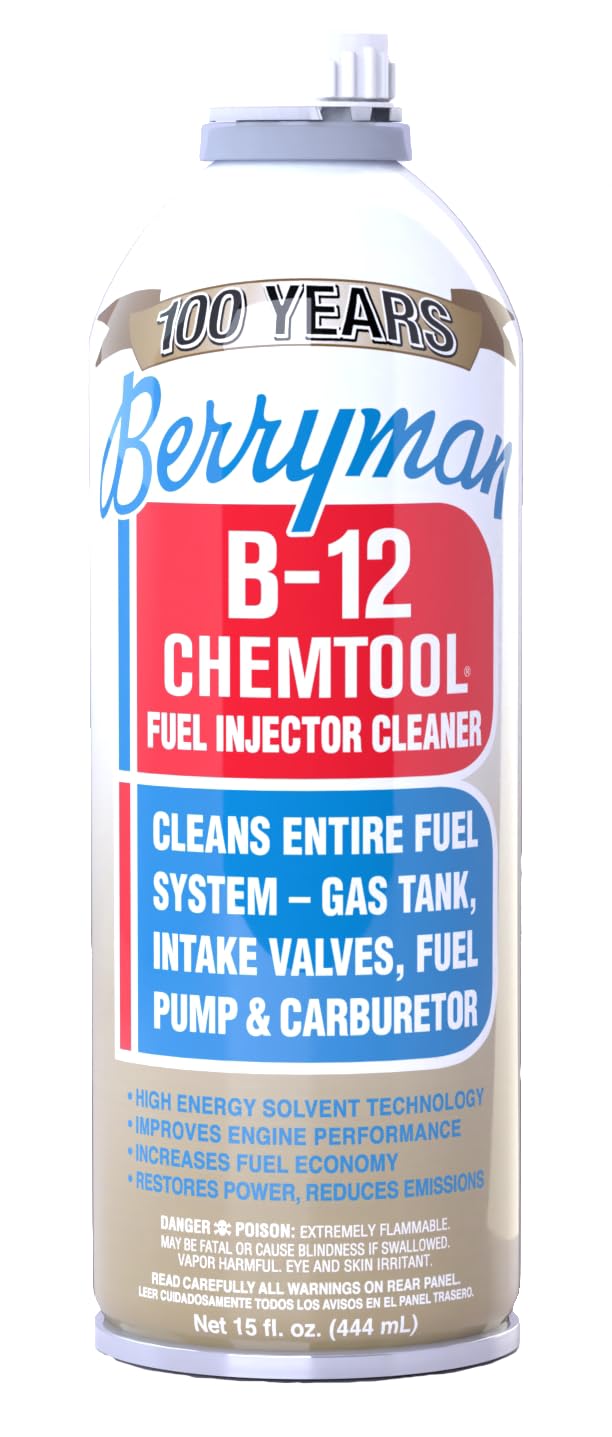
A full case for the owner with a fleet of small engines and a 20-year habit of keeping them all running.
This 12-pack of 15-ounce bottles is the bulk buy for households with boats, chainsaws, mowers, and generators. One long-time owner has used it for 20 years across small engines at 1 ounce per gallon, reporting only one carburetor failure..
The formula disperses moisture and dissolves gum, varnish, and other fuel residues across the entire fuel system — tank, lines, injectors, valves, rings, and pistons — with a high-energy solvent treatment (HEST). It is catalytic converter and oxygen sensor safe, so it is not a shortcut that costs you on emissions hardware.
Effectiveness leads at 50 mentions, with cleaning performance at 39 and value for money at 22. Typical advice from owners: pour a full can into a quarter to half tank and drive at high RPM to clear out sputtering and backfires.
Owner consensus: effectiveness (50) and cleaning performance (39) lead; one user notes it melts cheap plastics, so keep it off trim.
The long-haul proof: two decades of use across a whole small-engine fleet with one carb failure is a track record no rival matches.
Best for: the multi-engine household buying by the case for long-term, low-cost maintenance.
Not for: a single car owner — a 12-pack is more than you will use in a year.
9. SQ Carburetor Cleaner

A no-residue spray that doubles as a fantastic engine starter for lawn mowers and two-strokes that refuse to fire.
This 12-pack of 12.5-ounce non-chlorinated sprays is built for the small-engine repair bench. It cleans carburetors and chokes with no residue left behind, and owners specifically use it as a starting fluid for stubborn lawn mowers and two-stroke engines.
Cleaning performance is the top praise at 19 mentions, with value for money at 15 and effectiveness at 9. One owner used it on a diesel heater, and another bought two boxes for a motorcycle restoration project, calling the small business that makes it dependable.
The honest limitation: it is not sold in California, Colorado, or New York, so check availability before you commit. For everyone else, the 12-pack price per can makes it a budget-friendly choice for shop-floor work.
Owner consensus: cleaning performance (19) and value for money (15) lead; effectiveness trails at 9 mentions.
The catch: restricted from sale in CA, CO, CT, DE, MD, MI, NH, NY, OH, RI, and parts of UT — confirm your state allows it.
Reach for this if: you keep a shop stocked for mowers, chainsaws, and motorcycles and want a bulk spray at a fair price.
pass on it if: you live in one of the restricted states — you cannot get it shipped there.
Understanding the Specs
Polyetheramine (PEA)
This is the detergent chemistry that defines a serious fuel system cleaner. PEA survives the heat of combustion, so it can scrub intake valves and combustion chambers rather than stopping at the injectors. If a bottle lists PEA on the label or its safety data sheet, it is a full-system cleaner; without it, you are mostly cleaning the injectors.
Shock Treatment vs. Maintenance Dose
A shock treatment is a full can poured into a nearly empty tank to clear heavy buildup fast, often followed by a high-RPM drive. A maintenance dose is a small amount added at every fill-up to prevent deposits from forming in the first place. Knowing which you are buying determines how often you will use the bottle.
FAQ
Can a carburetor cleaner fuel additive fix a rough idle?
Will this work on fuel-injected engines too?
How often should I use a fuel system cleaner?
Is it safe for my catalytic converter and oxygen sensors?
What is the difference between a spray and a pour-in additive?
Can I use this in a small engine like a lawn mower?
Will it improve my gas mileage?
Can a fuel cleaner fix a check engine light?
Is it safe for turbocharged engines?
How much should I pour in per tank?
Final Thoughts: The Verdict
For most people, the winner is the carburetor cleaner fuel additive from Red Line 60103 SI-1 because its PEA chemistry cleans the whole system and its corrosion prevention protects it between treatments. If you want a fast, cheap fix for a rough idle or a check-engine light, grab the Lucas Oil Deep Clean two-pack. And for boat owners fighting ethanol fouling, the Quicksilver Quickleen is the one to reach for.
How We Picked
We do not accept paid placement. Every pick is matched to a real buyer and a real use-case; we do not hands-on test units.
Sources & Methodology
Specifications: manufacturer listings and product documentation. Review insights: verified customer reviews, as of August 2026. Pricing: not shown on this page (it changes often); check the current price via the retailer link.
As an Amazon Associate, Trending Car earns from qualifying purchases. This does not affect which products we feature.