
Our readers keep the lights on and my garage snacks stocked. As an Amazon Associate, I earn from qualifying purchases.
Specs are compiled from manufacturer listings and verified buyer reviews and can change over time — please confirm the key details on the product page before buying.
You have just spent hours detailing your car, only to find a ghostly haze of old wax clinging to a trim piece or a fresh coat of paint refusing to stick because a layer of grease is still on the panel. A car wax remover cuts through that frustration — it dissolves the waxy buildup and oily residue that soap and water cannot touch. The right remover separates a flawless finish from a redo.
I’m Min Islam — the founder and writer behind Trending Car. This guide is built by comparing the manufacturers’ published specifications and the patterns across verified customer reviews, so you get each pick’s real strengths and trade-offs instead of marketing spin.
From a gallon jug that lifts years of buildup to a targeted spray that saves your plastic trim, here is everything you need to land the right car wax remover for your next project.
Our Picks at a Glance


How To Choose The Best Car Wax Remover
The right wax remover depends on your next step. Are you about to spray a new coat of paint? Applying a ceramic coating? Or just trying to get white residue off your black plastic trim? Each scenario needs a different formula — the wrong one can streak or damage the surface.
Consider the format: Liquid, Aerosol, or Wash-Off Soap
Liquid concentrates (often sold by the gallon) give you the most for your money if you are prepping a whole car or working in a body shop. Aerosol sprays offer convenience for smaller jobs — you mist and wipe — but they cost more per ounce. Wash-off soaps are the gentlest option; you use them in your regular wash bucket to strip old wax before a full detail, but they are too mild for spot-cleaning grease or silicone.
Check the drying speed
A fast-drying formula saves time by allowing immediate wipe-off. But if spread over too large an area, it can dry before you wipe, leaving streaks. Slower-evaporating products give more working time on hot days or large vertical panels.
Match the remover to the surface
Most wax removers are safe on painted metal and glass, but not all are safe on plastic trim, vinyl, or rubber seals. Some solvents can stain or etch black plastic. If you are only cleaning trim pieces, look for a product specifically labeled for plastic, like McKee’s 37. If you are doing general paint prep, a standard grease and wax remover will do the job.
Quick Comparison
| Model | Best For | Volume | Format | Drying Speed | Amazon |
|---|---|---|---|---|---|
| Custom Shop KW901★ Best Overall | Heavy-duty paint prep | 128 fl oz | Liquid | Fast | Amazon |
| Rust-Oleum Wax & Tar RemoverBudget Champion | Budget-friendly general prep | 32 fl oz | Liquid | Very fast | Amazon |
| Adam’s Strip Car Wash SoapDetailer’s Pick | Gentle strip wash for detailing | 16 oz | Soap | N/A (rinse) | Amazon |
| Dupli-Color ECM541A | Small paint-prep jobs | 1 qt (approx) | Liquid | Fast | Amazon |
| Magic Shield Prep Spray | Ceramic coating prep | 16 oz | Spray | Fast | Amazon |
| KLEAN-STRIP Prep-All | Fast, convenient aerosol cleaning | 13.5 oz | Aerosol | Very fast | Amazon |
| Custom Shop Panel Prep | Professional spray-on prep | 18 oz | Aerosol | Fast | Amazon |
| Eastwood Silicone Prep | Removing silicone before paint | 11 oz | Aerosol | Fast | Amazon |
| McKee’s 37 Wax Remover | Cleaning wax off plastic trim | 22 fl oz | Liquid | Slow to moderate | Amazon |
In‑Depth Reviews
1. Custom Shop Restoration KW901 – Automotive Grease and Wax Remover (Gallon)
Our pick — over 4.5★ from 850+ verified ratings; the strongest balance of quality and price.
It delivers a massive 128 fluid ounces of solvent that liquefies wax and grease, so you can wipe away old protection and get straight to painting.
This is the heavy lifter for anyone serious about painting. The Custom Shop KW901 comes in a full 128-fluid-ounce can, which is four times the volume of a standard quart like the Rust-Oleum pick below. This means it lasts through multiple projects. The formula dissolves and lifts contaminants like grease, wax, tar, adhesive residue, tree sap, and silicones so that wiping them away is easy.
What wins people over is its sheer effectiveness — the data from reviewers shows 75 buyers singled out the cleaning power as the standout trait. One owner called it a product that “liquefies and lifts wax/oil for easy wipe-off, outperforming acetone which smears.” It dries quickly with no residue left behind, which means you can move straight to sanding or painting without a second wipe-down. The manufacturer has been mixing paints and prep products since 1974 and makes this one in the USA.
The Reasons It Wins
- Massive 128 fl oz supply — a 4.0x volume advantage over a standard quart
- Works on painted surfaces, metal, plastic, epoxy, and fiberglass
- Dries fast and leaves zero residue, promoting maximum paint adhesion
The Honest Trade-Off
- A single gallon can is heavy and takes up shelf space
- You need lint-free cloths and a two-cloth method (wet then dry) for best results
Reach for this if: you are painting a whole vehicle or do frequent bodywork — the gallon size and proven formula make it the best per-dollar value for serious prep.
Look elsewhere if: you only need to clean a single plastic trim piece or a small area; a spray can would be more convenient here.
2. Rust-Oleum Automotive 251475 32-Ounce Wax and Tar Remover Quart
If you stick to small jobs, this 32-fluid-ounce quart strips wax fast for a low price, but its very fast drying time forces you to work in small sections.
This Rust-Oleum remover is the entry-level workhorse that does the job while staying affordable. It is a 32-fluid-ounce liquid that cleans metal and glass surfaces effectively — buyers report its cleaning effectiveness as the top reason they pick it up. The formula is a safer, low-odor alternative to industrial-grade solvents, making it more pleasant to use in a home garage.
But there is a real catch with the drying time. Owners mention that even in 50-degree weather out of direct sun, it “dries fast so you really have to work a small area and stay with it.” That means you cannot spray a whole panel and walk away; you need to wipe it off quickly. For small areas like a door or a patch you are repairing, that speed is fine. The residue removal is praised by 31 buyers, and the product leaves a clean surface ready for paint or vinyl wrap.
What Makes It a Good Deal
- Low odor — much more pleasant than harsh industrial thinners
- Cleans bare metal and glass without causing reactions
- Large 32 fl oz quart gives plenty for several small projects
What to Keep in Mind
- Dries extremely fast — you must work in small sections or it will streak
- Less effective on silicone-based contaminants than professional-grade prep solvents
Best for: the home DIYer doing a single panel repair or a vinyl wrap prep who wants a safe, affordable option.
Not ideal for: a full-car repaint where slower evaporation gives you more working time.
3. Adam’s Polishes Strip Car Wash Soap (16 oz)
Unlike wipe-on solvents, this 16-ounce concentrate mixes into your wash bucket and rinses off, stripping layers of old wax without harsh chemicals touching your paint.
If you want to remove wax and sealants without spraying harsh chemicals on your paint, this is the gentler path. Adam’s Strip Wash is an acidic formula that you use in a foam cannon or wash bucket — it breaks down waxes, silicones, and resins as you wash. One owner says it “quickly removed years of wax,” and that the foam helped prevent missing spots.
This soap shines as a pre-treatment before paint correction or ceramic coating. Customers note it leaves the paint surface “as bare as coming out of the paint booth — very grippy.” It also works on glass at full strength to lift hard water stains and rain spots. The biggest upside is that it does not harm plastic or rubber trim, so you can wash the whole car safely. At 16 ounces it is a concentrate that makes many wash buckets.
The big advantage: zero risk of streaking or flash-drying because it is a soap you rinse off — much more forgiving than a wipe-on solvent.
The one caveat: it is not a spot-treatment; you need to wash the entire car, so it is less convenient for a quick fix on a single area.
Grab this for: a full detail session where you want to strip old protection before polishing or coating — it is the safest way to get a bare surface on the whole vehicle.
Pass on it if: you just need to wipe a wax streak off a plastic trim piece; a dedicated solvent remover will be faster.
4. Dupli-Color ECM541A Grease and Wax Remover

An alcohol-based solvent (like acetone but less aggressive) that preps surfaces for paint adhesion — but skip it on uncured finishes or plastic trim.
Dupli-Color’s ECM541A is a straightforward grease and wax remover aimed at bodywork preparation. It is a liquid that dries quickly with no residue, which promotes maximum paint adhesion. Reviewers point out it works great for cleaning after sanding and for decal prep, and it is made in the United States.
The key detail to know is that this is an alcohol-based solvent — similar to acetone in its cleaning power but less aggressive. That means it can strip unsealed paint if you scrub hard, so it is best used on bare metal or over fully cured paint. The data shows that effectiveness is the top aspect praised, with 23 buyers calling out its functionality. For the price of a mid-range quart, it does exactly what it promises: cleans the surface so your fresh coat of paint sticks.
What it does best: leaves a perfectly clean surface for paint adhesion after sanding, with a fast dry time.
Heads-up: it is a strong solvent — test on a hidden spot first, and do not let it sit on plastic decals or soft paint.
Best for: a small-scale paint project or decal removal where you need a reliable prep cleaner on a budget.
Think twice if: you need something safe for plastic trim or rubber seals; this is designed for painted metal.
5. Magic Shield Prep Spray (16 oz)
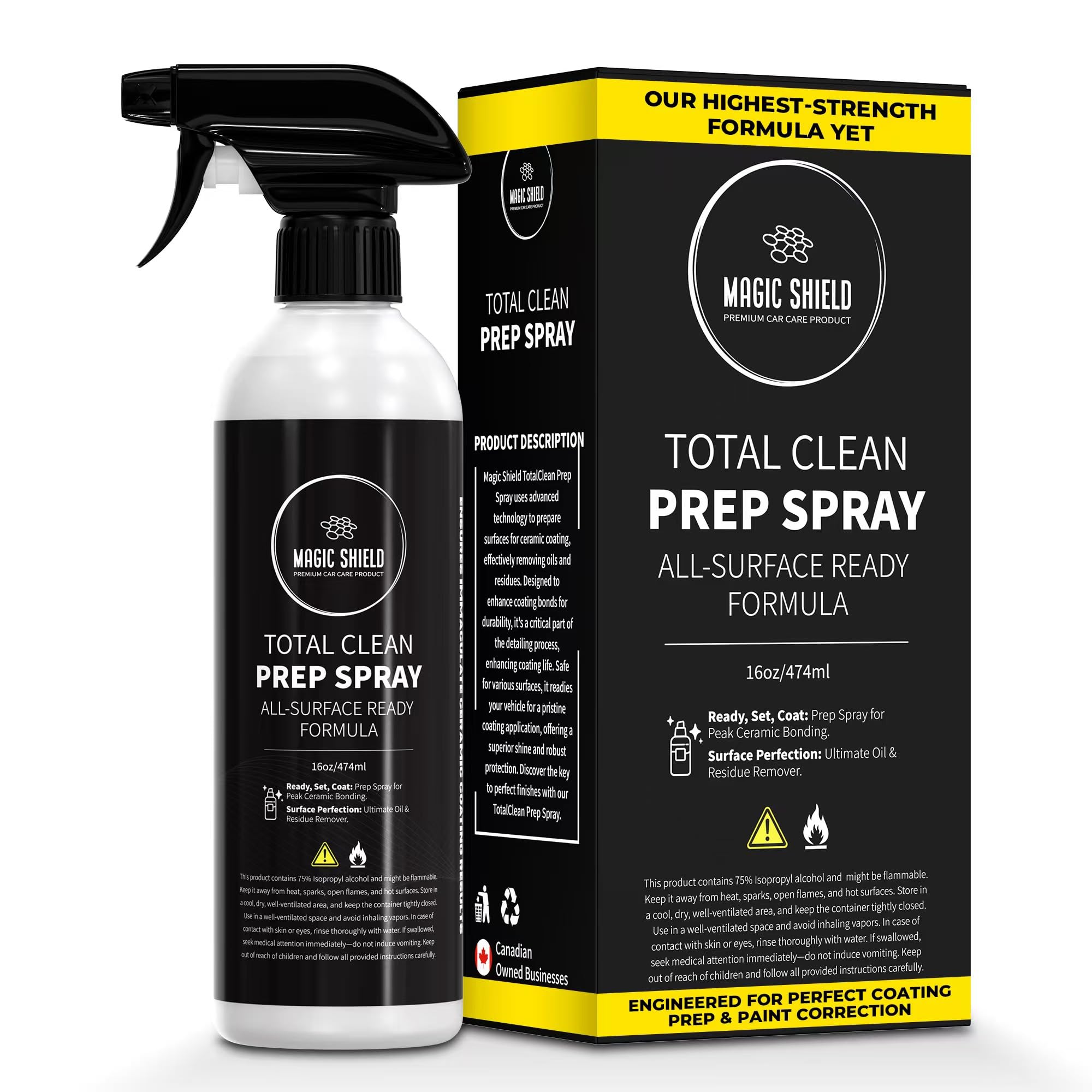
It uses a 30% IPA (isopropyl alcohol) formula to erase polishes and oils so a new ceramic coating bonds properly, but the high concentration can leave streaks if you do not wipe fast.
Magic Shield is built specifically for the step just before you apply a ceramic coating. It is a 16-ounce spray that removes polishes, oils, and wax residues from paint and glass. Shoppers say it is effective on grease and oil spots, and it comes with a microfiber cloth that owners praise as excellent.
The formula is labeled as 30% IPA (isopropyl alcohol), which is the standard concentration for a panel prep. But here is where opinions split: some buyers report significant streaking, likely because the concentration is high enough to leave its own residue if not wiped properly. One owner solved it by diluting 50/50, which eliminated the streaking. The key is to rinse or wipe thoroughly after application. For a detailer who follows the instructions precisely — spray, wipe, then do a final buff — this works well as a final prep before coating.
Why it is useful: it is a complete kit with a good sprayer and cloth, and it targets the exact contaminants that ruin coating adhesion.
Where it falls short: the high IPA concentration can cause streaks if you do not work fast and wipe completely — a few owners found it overpriced compared to a homemade IPA dilution.
Reach for this if: you are applying a ceramic coating and want a ready-to-use spray that is already mixed to the right strength.
skip it if: you prefer controlling your own IPA concentration and would rather mix a homemade solution to save money.
6. KLEAN-STRIP Prep-All Wax and Grease Remover (13.5 oz Aerosol)

A 13.5-ounce aerosol that lets you spray exactly where needed — ideal for wiping sanding dust and grease off a single panel without wasting a drop.
Klean-Strip’s Prep-All comes in a 13.5-ounce aerosol can, making it the easiest grab-and-go option for small jobs. It removes wax, grease, and road film from metal, plastic, and fiberglass. The spray format means you do not need a separate bottle or rag soak — just mist and wipe. Owners say it is “excellent at removing sanding dust” and that paint bonds better to metal after using it.
The manufacturer recommends applying it between 65ºF and 90ºF, away from direct sunlight and strong breezes. The formula is safe on multiple surfaces, but as with any solvent, a test on a hidden spot is wise. One buyer who prepped a whole C3 Corvette through multiple stages found it worked without causing fish eyes, which are the tiny craters in fresh paint caused by silicone contamination.
The standout feature: the aerosol can gives you precise control — you can spray exactly where you need it without wasting product.
The trade-off: you get only 13.5 ounces, so it is best for one or two panels, not a full-body prep.
Ideal for: quick spot-cleaning before painting a single panel or door, especially if you hate pouring liquid into a separate spray bottle.
Consider a larger can if: you are prepping an entire vehicle; you will burn through this aerosol quickly.
7. Custom Shop Panel Prep Surface Cleaner & Degreaser (18 oz Spray Can)
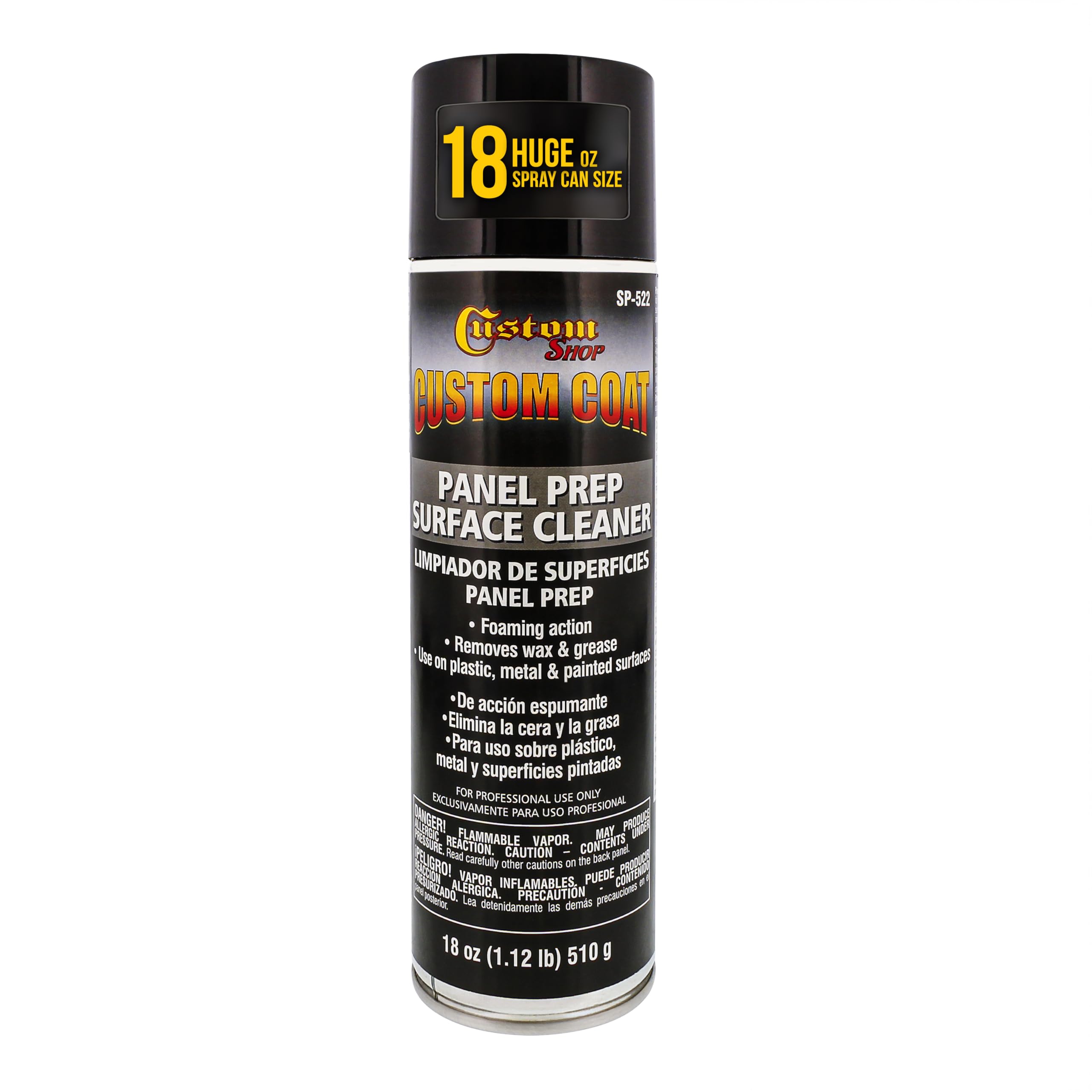
A waterborne foaming aerosol (the sibling to the KW901 gallon) that clings to vertical panels so it does not drip off a hood or door.
This Custom Shop offering is the aerosol sibling to the gallon jug above, and it shares the same professional-grade DNA. The 18-ounce can uses a waterborne formula with a foaming action that clings to vertical surfaces — a huge advantage when you are prepping a hood or door that would otherwise drip solvent onto the floor. It removes adhesive residue, oil, silicone, paint overspray, and road tar.
The flat fan nozzle gives broad coverage, and the product leaves zero residue behind. Owners say it dried fast and got them through multiple stages of epoxy, high-build primer, and sealer on a C3 Corvette without any fish eyes. The cleaning performance is the most-praised aspect, and it is made in the USA by a company that has been in the paint business since 1974.
what separates it: the foaming action and residue-free formula — it hangs well on vertical panels so you do not waste product.
The limitation: the can is not returnable, so do not buy more than you need for the current project.
Best for: a single-vehicle repaint where you want a spray that behaves predictably on upright body panels without dripping.
Pick the gallon instead if: you have multiple cars or a whole fleet to prep; the aerosol is convenient but pricier per ounce.
8. Eastwood Silicone Surface Preparation Wax Polish Grease Dirt Remover (11 oz)

An 11-ounce aerosol engineered to remove silicone — the main cause of fish eyes in fresh paint — but stick to bare metal or fully cured paint to avoid bubbling.
Silicone is the worst contaminant for fresh paint because it causes fish eyes that ruin the finish. Eastwood’s 11-ounce aerosol spray is formulated to wipe away silicone along with wax, polish, and grease. It is designed for pre-paint prep on metal surfaces, and owners say it is a “great product to clean auto paint surface before sanding and after before base coat color.”
The formula is user-friendly — just spray and wipe off — and it actively fosters paint adhesion. That said, a few buyers found that it can damage primed surfaces if over-applied, causing bubbling. The caution here is to use it specifically on bare metal or fully cured paint and not on fresh primer. The cleaning performance draws the most praise, and Eastwood is a well-known name among restoration enthusiasts.
The big reason to choose it: it is engineered to remove silicone, which many general wax removers leave behind.
The watch-out: it is not for primed surfaces — stick to bare metal or well-cured paint to avoid bubbling.
Grab this for: a bare-metal restoration project where silicone contamination is a known risk, such as painting over old silicone-based polishes.
pass on it if: you are prepping over fresh primer; a gentler waterborne formula like the Custom Shop Panel Prep is safer there.
9. McKee’s 37 Wax Remover for Plastic (22 fl. oz.)

A 22-fluid-ounce liquid formulated for rubber and plastic that erases wax residue from trim without staining it — but years-old buildup needs scrubbing and multiple passes.
This is the specialist of the group — a 22-ounce liquid designed specifically for rubber, vinyl, and plastic exterior trim. Wax overspray on black plastic is a common irritation, and McKee’s 37 dissolves that residue without harming the trim underneath. The label claims it erases 100% of trace residue from polish, compound, and wax.
Owner experiences are mixed, which matches the product’s honest purpose. For wax that has been on for years, the product struggles. The key lesson from the reviews is that patience and multiple passes matter. If spray hits paint or glass, it wipes off without damage.
Why it stands out: it is one of the few products made specifically for plastic, so you avoid the risk of staining that harsher solvents cause.
The honest limitation: it requires scrubbing and repeating for old, caked-on wax — it is not a magic one-wipe solution for years of buildup.
Perfect for: removing fresh or seasonal wax residue from black plastic bumpers, trim, and vinyl decals.
Not for: thick, years-old wax that has baked in the sun for multiple seasons — that situation may need an eraser or more aggressive method.
Understanding the Specs
Solvent Strength: Waterborne vs. Alcohol-based vs. Aerosol
The base of the formula determines how aggressive it is. Waterborne formulas (like the Custom Shop Panel Prep) are safer on plastics and have less odor, but they can cost more per ounce. Alcohol-based solvents (like Dupli-Color) are stronger on grease and silicone but can strip soft paint if scrubbed. Aerosol cans are the easiest — you point and spray — but you pay a premium for the can and propellant, and the product evaporates faster in use.
Drying Time and Working Window
A fast-drying remover saves time because you can wipe it off and paint within minutes. But the trade-off is that you cannot cover a large area before it dries, especially on a warm day. A slower-evaporating product gives you a generous working window, which is a real advantage on a whole hood or door. For most DIY projects, a balanced speed — fast enough that you are not waiting, slow enough that you can work a 2×2 foot section — is the balance.
FAQ
Can I use a car wax remover on my plastic trim?
Do I need to wash the car after using a wax remover?
How does a wax remover differ from a clay bar?
Can I use a wax remover before applying a ceramic coating?
How long does a bottle of wax remover last?
Is there a difference between a wax remover and a tar remover?
Why does my wax remover leave a white haze?
What kind of cloth should I use with a wax remover?
Can I mix a wax remover into my wash bucket?
Does a wax remover work on glass and windows?
Final Thoughts: The Verdict
If you want one dependable pick, the car wax remover winner is the Custom Shop Restoration KW901 because its 128-ounce gallon gives you the best cost per ounce and its solvent strength liquefies even silicone-based wax, consistently praised by reviewers for working on multiple surfaces. If you want the convenience of a wash-off soap that preps the whole car for a new coating, grab the {“@context”: “https://schema.org”, “@graph”: [{“@type”: “ItemList”, “name”: “9 Best Car Wax Remover”, “url”: “https://trendingcar.com/best-car-wax-remover/”, “numberOfItems”: 9, “itemListElement”: [{“@type”: “ListItem”, “position”: 1, “name”: “Custom Shop Restoration KW901 – Automotive Grease and Wax Remover (Gallon)”, “url”: “https://trendingcar.com/best-car-wax-remover/#product-1”}, {“@type”: “ListItem”, “position”: 2, “name”: “Rust-Oleum Automotive 251475 32-Ounce Wax and Tar Remover Quart”, “url”: “https://trendingcar.com/best-car-wax-remover/#product-2”}, {“@type”: “ListItem”, “position”: 3, “name”: “Adam’s Polishes Strip Car Wash Soap (16 oz)”, “url”: “https://trendingcar.com/best-car-wax-remover/#product-3”}, {“@type”: “ListItem”, “position”: 4, “name”: “Dupli-Color ECM541A Grease and Wax Remover”, “url”: “https://trendingcar.com/best-car-wax-remover/#product-4”}, {“@type”: “ListItem”, “position”: 5, “name”: “Magic Shield Prep Spray (16 oz)”, “url”: “https://trendingcar.com/best-car-wax-remover/#product-5”}, {“@type”: “ListItem”, “position”: 6, “name”: “KLEAN-STRIP Prep-All Wax and Grease Remover (13.5 oz Aerosol)”, “url”: “https://trendingcar.com/best-car-wax-remover/#product-6”}, {“@type”: “ListItem”, “position”: 7, “name”: “Custom Shop Panel Prep Surface Cleaner & Degreaser (18 oz Spray Can)”, “url”: “https://trendingcar.com/best-car-wax-remover/#product-7”}, {“@type”: “ListItem”, “position”: 8, “name”: “Eastwood Silicone Surface Preparation Wax Polish Grease Dirt Remover (11 oz)”, “url”: “https://trendingcar.com/best-car-wax-remover/#product-8”}, {“@type”: “ListItem”, “position”: 9, “name”: “McKee’s 37 Wax Remover for Plastic (22 fl. oz.)”, “url”: “https://trendingcar.com/best-car-wax-remover/#product-9”}]}, {“@type”: “Product”, “position”: 1, “name”: “Custom Shop Restoration KW901 – Automotive Grease and Wax Remover (Gallon)”, “image”: “https://m.media-amazon.com/images/I/7193uiRlCLL.jpg”, “brand”: {“@type”: “Brand”, “name”: “Custom”}, “url”: “https://www.amazon.com/dp/B00397L0DC/?tag=tcarmin-20”, “offers”: {“@type”: “Offer”, “url”: “https://www.amazon.com/dp/B00397L0DC/?tag=tcarmin-20”}}, {“@type”: “Product”, “position”: 2, “name”: “Rust-Oleum Automotive 251475 32-Ounce Wax and Tar Remover Quart”, “image”: “https://m.media-amazon.com/images/I/8102vKuh6KL.jpg”, “brand”: {“@type”: “Brand”, “name”: “Rust-Oleum”}, “url”: “https://www.amazon.com/dp/B006ZLQELW/?tag=tcarmin-20”, “offers”: {“@type”: “Offer”, “url”: “https://www.amazon.com/dp/B006ZLQELW/?tag=tcarmin-20”}}, {“@type”: “Product”, “position”: 3, “name”: “Adam’s Polishes Strip Car Wash Soap (16 oz)”, “image”: “https://m.media-amazon.com/images/I/61HrHqdZC0L.jpg”, “brand”: {“@type”: “Brand”, “name”: “Adam’s”}, “url”: “https://www.amazon.com/dp/B0BVDPKR7L/?tag=tcarmin-20”, “offers”: {“@type”: “Offer”, “url”: “https://www.amazon.com/dp/B0BVDPKR7L/?tag=tcarmin-20”}}, {“@type”: “Product”, “position”: 4, “name”: “Dupli-Color ECM541A Grease and Wax Remover”, “image”: “https://m.media-amazon.com/images/I/61ewKwRMukL.jpg”, “brand”: {“@type”: “Brand”, “name”: “Dupli-Color”}, “url”: “https://www.amazon.com/dp/B00QSP0PDI/?tag=tcarmin-20”, “offers”: {“@type”: “Offer”, “url”: “https://www.amazon.com/dp/B00QSP0PDI/?tag=tcarmin-20”}}, {“@type”: “Product”, “position”: 5, “name”: “Magic Shield Prep Spray (16 oz)”, “image”: “https://m.media-amazon.com/images/I/815B3CgvqJL.jpg”, “brand”: {“@type”: “Brand”, “name”: “Magic”}, “url”: “https://www.amazon.com/dp/B0D7MC3782/?tag=tcarmin-20”, “offers”: {“@type”: “Offer”, “url”: “https://www.amazon.com/dp/B0D7MC3782/?tag=tcarmin-20”}}, {“@type”: “Product”, “position”: 6, “name”: “KLEAN-STRIP Prep-All Wax and Grease Remover (13.5 oz Aerosol)”, “image”: “https://m.media-amazon.com/images/I/71rSxliSLfL.jpg”, “brand”: {“@type”: “Brand”, “name”: “KLEAN-STRIP”}, “url”: “https://www.amazon.com/dp/B00AZAASR0/?tag=tcarmin-20”, “offers”: {“@type”: “Offer”, “url”: “https://www.amazon.com/dp/B00AZAASR0/?tag=tcarmin-20”}}, {“@type”: “Product”, “position”: 7, “name”: “Custom Shop Panel Prep Surface Cleaner & Degreaser (18 oz Spray Can)”, “image”: “https://m.media-amazon.com/images/I/71a9+k1ZxDL.jpg”, “brand”: {“@type”: “Brand”, “name”: “Custom”}, “url”: “https://www.amazon.com/dp/B07MH5ZJY4/?tag=tcarmin-20”, “offers”: {“@type”: “Offer”, “url”: “https://www.amazon.com/dp/B07MH5ZJY4/?tag=tcarmin-20”}}, {“@type”: “Product”, “position”: 8, “name”: “Eastwood Silicone Surface Preparation Wax Polish Grease Dirt Remover (11 oz)”, “image”: “https://m.media-amazon.com/images/I/61jjlomvXWL.jpg”, “brand”: {“@type”: “Brand”, “name”: “Eastwood”}, “url”: “https://www.amazon.com/dp/B07Q5JP5CS/?tag=tcarmin-20”, “offers”: {“@type”: “Offer”, “url”: “https://www.amazon.com/dp/B07Q5JP5CS/?tag=tcarmin-20”}}, {“@type”: “Product”, “position”: 9, “name”: “McKee’s 37 Wax Remover for Plastic (22 fl. oz.)”, “image”: “https://m.media-amazon.com/images/I/61M1VusO92L.jpg”, “brand”: {“@type”: “Brand”, “name”: “McKee’s”}, “url”: “https://www.amazon.com/dp/B09GBKSVGM/?tag=tcarmin-20”, “offers”: {“@type”: “Offer”, “url”: “https://www.amazon.com/dp/B09GBKSVGM/?tag=tcarmin-20”}}, {“@type”: “FAQPage”, “mainEntity”: [{“@type”: “Question”, “name”: “Can I use a car wax remover on my plastic trim?”, “acceptedAnswer”: {“@type”: “Answer”, “text”: “Only if the bottle explicitly says it is safe for plastic. Many standard wax removers contain strong solvents that can stain or etch black plastic, so for trim you want a product like McKee’s 37 that is formulated specifically for rubber, vinyl, and plastic.”}}, {“@type”: “Question”, “name”: “Do I need to wash the car after using a wax remover?”, “acceptedAnswer”: {“@type”: “Answer”, “text”: “It depends on the product. Wash-off soaps like Adam’s Strip Wash are designed to be rinsed completely. Wipe-on solvents like the Custom Shop KW901 or Rust-Oleum leave no residue and are meant to be wiped off and painted over directly. Always check the label — some spray-on prep solutions recommend a final rinse for the best coating bond.”}}, {“@type”: “Question”, “name”: “How does a wax remover differ from a clay bar?”, “acceptedAnswer”: {“@type”: “Answer”, “text”: “A clay bar physically pulls bonded contaminants like industrial fallout and rail dust out of the paint. A wax remover chemically dissolves the layer of wax, grease, and silicone on the surface. They are complementary steps: the remover strips the wax, then the clay bar handles the embedded debris.”}}, {“@type”: “Question”, “name”: “Can I use a wax remover before applying a ceramic coating?”, “acceptedAnswer”: {“@type”: “Answer”, “text”: “Yes, and it is often a required step. Ceramic coatings bond to bare paint, and any leftover wax or sealant will prevent the coating from sticking properly. A dedicated wax remover — or a panel prep spray like Magic Shield — ensures the surface is completely clean. Some detailers follow it with an IPA (isopropyl alcohol) wipe as a final safety step.”}}, {“@type”: “Question”, “name”: “How long does a bottle of wax remover last?”, “acceptedAnswer”: {“@type”: “Answer”, “text”: “A 32-ounce quart is typically enough to prep an entire car, depending on how generously you apply it. A 128-ounce gallon can handle multiple vehicles or several large projects. Aerosol cans in the 11-18 ounce range are best for one or two panels. The type of applicator also matters — using a spray bottle vs a soaked rag changes how fast you go through the liquid.”}}, {“@type”: “Question”, “name”: “Is there a difference between a wax remover and a tar remover?”, “acceptedAnswer”: {“@type”: “Answer”, “text”: “Many products combine both, like the Rust-Oleum Wax and Tar Remover. Pure tar removers often use citrus or petroleum-based solvents that are gentler on paint but less effective on cured wax. A combined product saves you a step, but if you are dealing with only tar (like road paint or asphalt), a dedicated tar remover can be more effective and safer for the clear coat.”}}, {“@type”: “Question”, “name”: “Why does my wax remover leave a white haze?”, “acceptedAnswer”: {“@type”: “Answer”, “text”: “White haze is usually dried remover that was not wiped off in time. Fast-drying formulas, especially on a warm or breezy day, can flash-dry before you have a chance to buff them off. The fix is to work in smaller sections — about a 2×2 foot area — and wipe immediately. Using a damp cloth for the first pass and a dry one for the final buff also helps.”}}, {“@type”: “Question”, “name”: “What kind of cloth should I use with a wax remover?”, “acceptedAnswer”: {“@type”: “Answer”, “text”: “Lint-free microfiber towels are the standard. You generally need two: one wet with the remover to loosen the contaminants, and a dry one to wipe it away before it dries. Terrycloth or cotton rags can work but may leave lint behind, especially if the rag is old. Avoid paper towels — they can scratch the paint and leave fibers.”}}, {“@type”: “Question”, “name”: “Can I mix a wax remover into my wash bucket?”, “acceptedAnswer”: {“@type”: “Answer”, “text”: “Only if the product is labeled as a washable soap, like Adam’s Strip Wash. Standard wax removers are solvents and are not meant to be diluted into a wash bucket — they will strip your wax, yes, but they will also strip any protective coating and may damage rubber seals if left to dwell. Stick to using them as a direct wipe-on or a full-wash soap that is designed for that purpose.”}}, {“@type”: “Question”, “name”: “Does a wax remover work on glass and windows?”, “acceptedAnswer”: {“@type”: “Answer”, “text”: “Most wax removers are safe on glass and can actually help remove hard water stains and rain spots. Adam’s Strip Wash, for example, is noted by owners as effective on glass when used at full strength. But avoid getting strong solvents on window rubber seals or weatherstripping unless the label specifically says it is safe for rubber.”}}]}]}