
Our readers keep the lights on and my garage snacks stocked. As an Amazon Associate, I earn from qualifying purchases.
Specs are compiled from manufacturer listings and verified buyer reviews and can change over time — please confirm the key details on the product page before buying.
Upgrading your car’s sound system should not mean spending a fortune or settling for muddy audio from a generic stereo. The trick is knowing which features matter for your daily drive and which specs are just marketing hype.
I’m Min Islam — the founder and writer behind Trending Car. This guide is built by comparing the manufacturers’ published specifications and the patterns across verified customer reviews, so you get each pick’s real strengths and trade-offs instead of marketing spin.
You will find a car stereo on a budget that fits your dashboard and your playlist without emptying your wallet, if you want wireless smartphone projection, richer bass, or a simple radio that pairs instantly with your phone.
Our Picks at a Glance

How To Choose The Best Car Stereo on a Budget
Finding the right head unit at an entry-level price means ignoring flashy numbers and focusing on how you actually listen to music and navigate. Start by understanding the three core decisions: the physical size that fits your dash, the connectivity that matches your phone, and the power that drives your speakers.
Single DIN vs Double DIN: Know Your Dash
Your car’s dashboard opening decides this for you. Single DIN is the standard 7 x 2-inch slot found in most older cars, trucks, and vans. Double DIN is roughly twice as tall — about 7 x 4 inches — and often includes a large touchscreen. Measure your current radio’s height or check your car’s year and model online. A double-DIN unit will not squeeze into a single-DIN slot without a special kit, and a single-DIN unit in a double-DIN opening leaves an awkward gap.
Wireless Apple CarPlay & Android Auto vs Basic Bluetooth
This is the biggest quality-of-life upgrade you can make for a small price. Basic Bluetooth stereos stream music and handle phone calls, which works fine for many. But wireless CarPlay or Android Auto mirrors your phone’s navigation, messaging, and music apps right on the stereo’s screen, controlled by voice or touch. For a daily commute, having Google Maps or Waze on a big display without touching your phone is worth the modest premium. If you rarely use navigation and just need music, a basic Bluetooth model saves money.
Power Output: Real Watts vs Max Numbers
Manufacturers often shout a “max power” number (like 240W) that sounds huge but is measured in a lab, not in your car. What matters more is the continuous RMS power per channel — typically 50W x 4 on budget models. That 50W per channel is enough to drive most factory speakers to clean, loud levels. If you plan to add an external amplifier later, look for a stereo with at least one set of preamp RCA outputs (2.5-volt or higher).
Sound Tuning: EQ Bands and DSP
A basic treble/mid/bass adjustment is fine for casual listening. But a 13-band equalizer (EQ) or a built-in DSP (digital signal processor, an electronic brain that adjusts sound timing) lets you fix common car audio problems — like muddy bass in a trunk or harsh highs from door speakers — by adjusting specific frequency ranges. If you enjoy fine-tuning your sound, a unit with a multi-band EQ is a hidden gem at this price level.
Quick Comparison
| Model | Best For | Power Output | Connectivity | Screen Type | Amazon |
|---|---|---|---|---|---|
| Pioneer MVH-S230BT★ Best Overall | Simple reliable Bluetooth | 50W x 4 | Bluetooth, USB, AM/FM | None (mechless) | Amazon |
| Kissound 7″ Double DinBest Value Screen | Full-featured value | 240W max | Wireless CarPlay/AA, BT, USB, AUX | 7″ IPS 1024×600 | Amazon |
| JVC KD-SX27BT | Clean sound, no amp needed | 100W (50W x 2) | Bluetooth, USB, AUX, AM/FM | None (mechless) | Amazon |
| Pioneer DEH-S4220BT | CD player + Bluetooth | 50W x 4 | Bluetooth, USB, AUX, AM/FM | Dot-matrix LCD | Amazon |
| KENWOOD KMM-BT332U | Alexa + advanced EQ | 50W x 4 | Bluetooth, USB, AUX, AM/FM | Multi-color LCD | Amazon |
| SJoyBring 7″ QLED | Best QLED display + dual subs | 240W max | Wireless CarPlay/AA, BT, FM/AM | 7″ QLED 1280×720 | Amazon |
| SJoyBring 7″ QLED W021 | 4.2-channel surround + solid camera | 240W max | Wireless CarPlay/AA, BT, AM/FM | 7″ QLED 1280×720 | Amazon |
In-Depth Reviews
1. Pioneer MVH-S230BT 1-Din Digital Media Receiver
The entry-level Pioneer that does the basics perfectly — Bluetooth, USB, and clean 50W audio — for the lowest entry point in this list.
If you are on the tightest budget and just want a reliable stereo that pairs with your phone for music and calls, this Pioneer is the safe bet. It pushes 50W x 4 of real power and includes Bluetooth for hands-free calling and audio streaming, a USB port for playing MP3, WMA, AAC, and WAV files, plus AM/FM radio. The Advanced Sound Retriever feature restores audio detail lost during compression, so your Spotify streams sound clearer than you would expect from a basic unit. At 1.1 pounds and with a chassis depth under 4 inches, it installs in almost any car, truck, or RV.
Buyers consistently rate it 4.3 out of 5 stars over 637 ratings, with one long-term owner noting, “Bought this a while ago and is still working great, I wish it had aux but the bluetooth works amazingly.” The absence of an auxiliary input (a 3.5mm jack for older devices) is the main missing feature. It is a mechless receiver — no CD slot — which keeps installation shallow and simple.
The Reliable Choice
- Brand-name Pioneer quality at a very accessible price
- Advanced Sound Retriever cleans up compressed digital music
- Shallow chassis (under 4 inches) fits tight dash spaces easily
The Missing Piece
- No AUX input — you cannot connect older media players with a 3.5mm cable
- No wireless CarPlay or Android Auto — Bluetooth streaming only
- No CD player for physical media
Best for: the shopper who needs a no-drama, name-brand Bluetooth stereo at the lowest possible entry point and values reliability over extra features.
Look elsewhere if: you need an aux port for an older MP3 player or satellite radio tuner — the JVC KD-SX27BT above has one.
2. Kissound 7″ Double Din Car Stereo
This double-DIN brings wireless CarPlay and a sharp touchscreen at a price that rivals basic Bluetooth-only radios, making it the best value here.
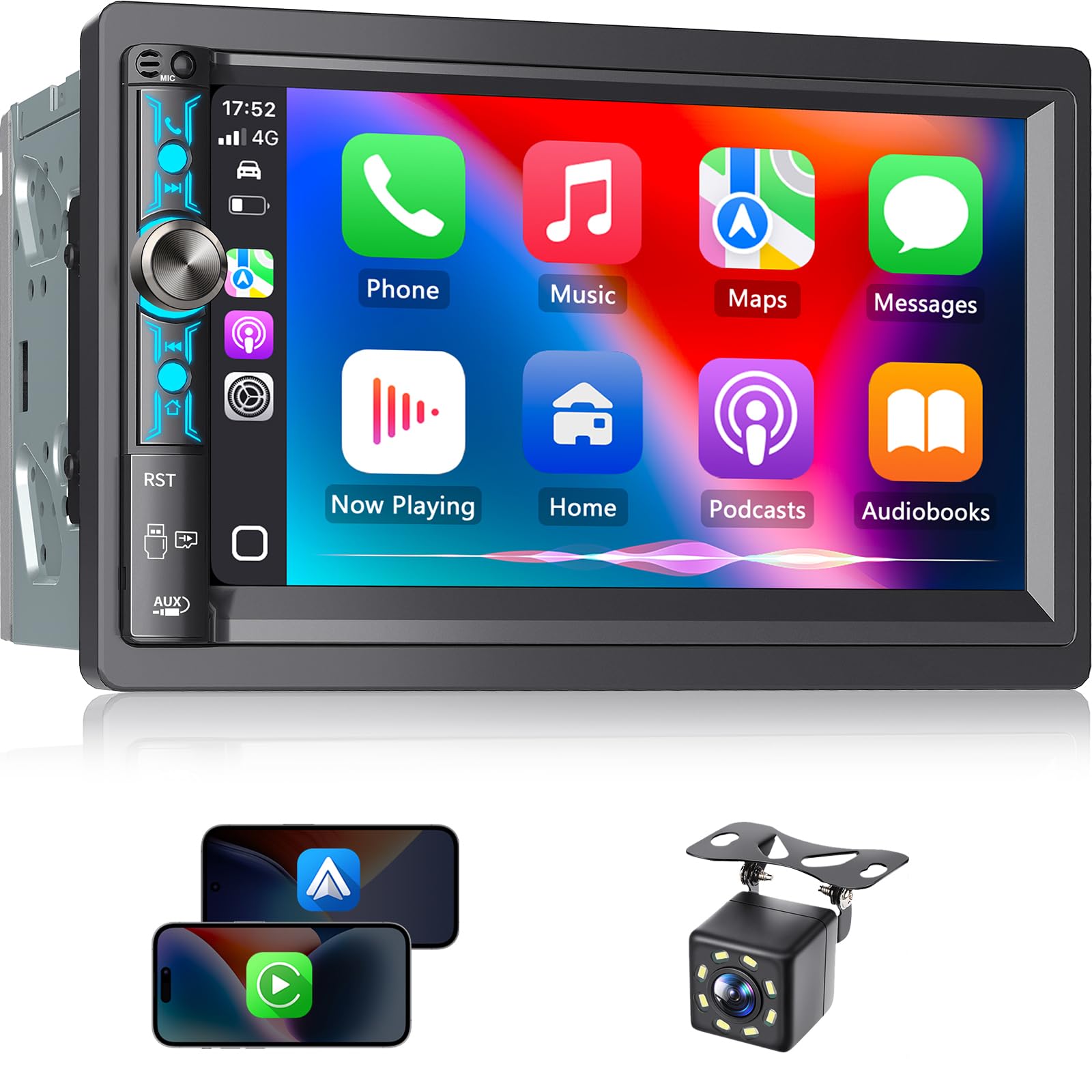
Instead of paying a premium for a name-brand screen, the Kissound unit gives you a 7-inch IPS display (IPS stands for in-plane switching, a screen technology that gives wide viewing angles) with 1024×600 resolution, responsive touch controls, and wireless Apple CarPlay and Android Auto that connect automatically when you start the car. Buyers report it was an “easy install in 2000 4Runner,” and the 240W max amplifier (4.1-channel with built-in DSP, or digital signal processor, and a 10-band EQ, or equalizer) lets you shape the sound to match your car’s acoustics, so you get crisp highs and punchy bass.
The built-in dual microphones and external mic port ensure your voice is picked up clearly at highway speeds for hands-free calling. The included backup camera (with a 19.7-foot cable) switches on automatically when you shift into reverse, making parking safer. The catch, noted by reviewers, is that the physical buttons above and below the volume knob do not light up, making them tricky to find when driving at night.
Why It Earns the Top Spot
- Wireless CarPlay/Android Auto at a near-entry-level price point
- 7-inch IPS touchscreen is bright, responsive, and easy to read in sunlight
- Built-in DSP with 10-band EQ lets you fine-tune sound without an external processor
The Real Trade-Off
- Unlit peripheral buttons make nighttime operation harder than it should be
- Dash kit, wiring adapter, or antenna adapter may be needed for your specific vehicle
- Mounting holes may not line up with older vehicles without minor modification
Best pick if: you want the full modern head-unit experience — wireless smartphone projection, a big clear screen, and a backup camera — without jumping to the premium tier.
Look elsewhere if: you need illuminated buttons for night driving and prefer the straightforward reliability of a name like Pioneer or JVC.
3. SJoyBring 7″ QLED Double Din Car Stereo

A 7-inch QLED screen with 1280×720 resolution makes maps and movies look vivid, day or night — sharper than the Kissound’s 1024×600 IPS panel.
Unlike the Kissound’s IPS display, this SJoyBring uses a QLED panel (quantum dot LED, a screen tech that produces richer colors and deeper blacks) for a noticeable boost in picture quality. It supports 1080P video playback, so movies from a USB drive look crisp. The 4.2-channel amplifier (240W max) sends power to front and rear speakers plus two separate subwoofer outputs, so you can build a bass-heavy system without needing a second amp. Wireless Apple CarPlay and Android Auto connect via Bluetooth, and built-in steering wheel control (SWC) support works with an interface module sold separately.
The included rear camera provides HD night-vision images and switches on automatically in reverse. One reviewer noted that excellent customer support helped them install a custom boot logo on their Ford Ranger. The main caveat is that the QLED panel shows significant glare from side viewing angles, especially if the sun hits the screen from the passenger window.
Screen quality star: The 1280×720 QLED panel is a clear step up from standard 1024×600 IPS displays at this price — movies and maps look noticeably sharper.
Great for: buyers who watch video content in the car or want the best possible display quality for navigation, plus the option to run two subwoofers.
Skip if: your car has wide side windows that cause direct sunlight glare — the glossy QLED panel will reflect more than a matte screen.
4. Pioneer DEH-S4220BT 1-Din CD Receiver

The classic name-brand single-DIN still plays CDs and delivers crisp, reliable Pioneer sound without compromise — a rarity among budget stereos today.
If you still own a stack of CDs or prefer a trusted major audio brand, this Pioneer unit gives you Bluetooth hands-free calling and audio streaming, a USB port for iPhone charging and playback, plus a CD slot — a feature disappearing from budget models. It pushes 50W x 4 of real RMS power (RMS stands for root mean square, a measurement of continuous power, not a burst) through its built-in amplifier. The Advanced Sound Retriever restores audio details lost during compression, so lower-bitrate MP3s sound less muddy. The Hi-Volt RCA preouts (2.5-volt) give you a clean signal path for adding an external amp later.
Buyers with over 800 ratings rate it 4.6 out of 5 stars, with one longtime Pioneer fan saying they “always come back to Pioneer” after trying Kenwood, Sony, and Alpine. The one catch: to connect via Bluetooth on this model, you need to use the Pioneer Smart Sync app, which some reviewers found an unnecessary extra step compared to simpler Bluetooth pairing.
The Pioneer Advantage
- Built-in CD player for physical media collectors
- Advanced Sound Retriever cleans up compressed audio files
- Detachable face for security against theft
The Annoying Detail
- Bluetooth requires the Pioneer Smart Sync app for initial connection
- Bluetooth range is short — you need to stay close to the unit
- No wireless CarPlay or Android Auto at this price level
Stick with it if: you want a bulletproof name-brand receiver with a CD slot and high-res FLAC playback, and you do not mind the app-based Bluetooth setup.
Reconsider if: you want a simple plug-and-play Bluetooth connection without downloading an app — the JVC below is easier for that.
5. KENWOOD KMM-BT332U Bluetooth Single DIN

A single-DIN with Amazon Alexa built in, so you can ask for weather, news, or music without touching a button — rare at this price.
This Kenwood is one of the few budget stereos with built-in Amazon Alexa, letting you control smart home devices, get news updates, or play songs by voice while driving. It also packs a 13-band equalizer with digital time alignment (a feature that adjusts the timing of each speaker so sound hits your ears at the same moment), a serious tuning toolkit normally found on higher-priced units. With a 50W x 4 amplifier, front USB with 1.5A fast charging, and the ability to control two phones simultaneously for calls, it is loaded with practical features. The Music Mix function lets up to five paired smartphones take turns streaming music during group road trips.
Reviewers praise the “clean, balanced sound” and note how well it works for hands-free calling, though one pointed out the monochrome LCD display is hard to see in direct sunlight. Unlike the Pioneer DEH-S4220BT, this unit does not play CDs, so it is a pure digital media receiver. At 1.3 pounds and roughly 4 inches deep, it fits easily into shallow dash spaces.
Tuning powerhouse: The 13-band EQ plus time alignment gives you studio-level control over your car’s soundstage — a rare find at this price.
Buy this for: the Alexa voice control and the deep EQ tuning — perfect for anyone who loves customizing their audio profile.
Pass if: you need a bright, easy-to-read display in direct sun — the monochrome LCD washes out compared to color screens.
6. JVC KD-SX27BT Car Stereo with Bluetooth

A no-fuss Bluetooth receiver with 13-band EQ and K2 technology (a circuit that reduces distortion for clearer sound) that sounds so good owners mention it works great without a separate amplifier.
While the Pioneer DEH-S4220BT outputs 50W x 4, the JVC KD-SX27BT runs a 100W built-in amplifier (50W per channel into 2 channels) with K2 technology and a 13-band EQ for detailed, time-aligned sound. Customers note it delivers “great sound with Pioneer/Kenwood speakers, no amp needed,” meaning you can upgrade your head unit and hear a real difference without adding a separate amplifier. The USB 1.5A port charges your phone quickly, and the dual phone connection keeps two phones paired at all times for calls.
The unit’s shallow chassis (under 4 inches deep, at 3.94 inches) makes it an easy fit in tight dash spaces. It supports high-res FLAC playback (a lossless audio format, meaning better quality than MP3). You can control it via the “JVC Remote” app for iOS and Android. One buyer mentioned the companion app was incompatible with their Pixel phone (older Android version), but the unit’s core functions — Bluetooth, radio, USB — work independently. It is a mechless receiver (meaning no CD slot), which keeps the price low and installation simple.
what separates it
- K2 technology delivers clean, detailed sound that rivals entry-level separates
- Shallow chassis (3.94-inch depth) fits into cramped dash areas
- 13-band EQ and Time Alignment for precise soundstage control
One Known Limitation
- Companion app may not work with newer Android phones
- No CD player — digital streaming only
- Slightly slow startup time compared to more expensive units
Ideal for: anyone who wants the cleanest possible sound from a basic Bluetooth stereo and is happy streaming from their phone.
Not for: you if your phone is a newer Android model that needs the app to work — test compatibility first.
7. SJoyBring 7″ QLED W021 Double Din

A double-DIN with a 4.2-channel surround output that connects a full speaker and dual-subwoofer setup — more channels than the SJoyBring 7″ QLED model above.
This SJoyBring model (JOY-W021) is nearly identical to product #2 but differentiates itself with a focus on multi-channel audio. The 4.2-channel output sends separate signals to front, rear, and dual subwoofers, creating a true surround effect in your car. The 7-inch QLED HD screen (1280×720) supports 1920 x 1080P video playback, and wireless Apple CarPlay and Android Auto connect quickly via Bluetooth. The included HD night-vision backup camera has a 170-degree ultra-wide viewing angle and switches on automatically in reverse.
Reviewers point out it fits older vehicles like Jeep Wranglers and Nissan Xterras well, and customer support provides firmware updates and custom boot logos. One owner of a 2008 Jeep Wrangler said they needed a dash kit and wiring harness but were “very pleased” once installed. The most common complaint is an occasional delay in app switching and CarPlay connection, plus noticeable screen glare from side angles.
Surround sound flex: The 4.2-channel architecture is a genuine differentiator — most budget stereos only offer a single subwoofer output, not two.
Choose this if: you plan to build a full audio system with front, rear, and dual subwoofers and want a single head unit that handles all the channels.
Consider the Kissound instead if: you only need one sub or prefer a brighter daytime screen with less glare.
Understanding the Specs
Power Output: RMS vs Max Watts
The most frequently misunderstood number on a budget stereo box is the “max power” rating, often listed as 240W or 300W. That figure is measured in a lab burst test, not during normal music playback. What you should compare is the continuous RMS power per channel — the amount of clean power the stereo delivers consistently. On budget models, 50W x 4 RMS is the standard and is enough to drive most factory or entry-level aftermarket speakers to satisfying volume levels without distortion. If a spec sheet only shows a max number without an RMS rating, assume the real-world output is roughly a quarter of that figure.
Wireless CarPlay and Android Auto vs Basic Bluetooth
Basic Bluetooth stereos (like the Pioneer MVH-S230BT) stream music and handle phone calls. That works fine for many. Wireless Apple CarPlay and Android Auto (found on the Kissound and SJoyBring units) go further by mirroring your phone’s navigation, messaging, and music apps directly on the stereo’s screen, controlled by touch or voice. The main difference in daily use is that CarPlay/Android Auto puts maps like Google Maps or Waze on a big display and reads texts aloud, while basic Bluetooth just routes audio. Both are useful, but the wireless projection adds a clear safety and convenience boost for navigation-heavy drivers.
FAQ
Will a double-DIN stereo fit my car if I currently have a single-DIN slot?
Do I need a separate amplifier with a 50W x 4 head unit?
What is the difference between 2-channel and 4-channel audio output?
Can I keep my factory steering wheel controls with a new stereo?
Does every double-DIN stereo come with a backup camera?
What file formats can these budget stereos play from a USB drive?
Is a detachable face necessary for security?
Will a budget stereo sound better than my 20-year-old factory radio?
Can I use a single-DIN stereo in a double-DIN dash opening?
Which of these stereos supports SiriusXM satellite radio?
Final Thoughts: The Verdict
Across the board, the car stereo on a budget winner is the Kissound 7″ Double Din because it delivers wireless Apple CarPlay and Android Auto, a crisp 7-inch IPS touchscreen, a built-in DSP, and a backup camera at a price that undercuts name-brand units by a wide margin. If you want the sharpest display for video and maps, grab the SJoyBring 7″ QLED for its 1280×720 resolution and dual subwoofer outputs. And for the no-drama, name-brand reliability that just works every time, the Pioneer MVH-S230BT is the safest entry-level pick you can make.
How We Picked
We do not accept paid placement. Every pick is matched to a real buyer and a real use-case; we do not hands-on test units.
Sources & Methodology
Specifications: manufacturer listings and product documentation. Review insights: verified customer reviews, as of July 2026. Pricing: not shown on this page (it changes often); check the current price via the retailer link.
As an Amazon Associate, Trending Car earns from qualifying purchases. This does not affect which products we feature.