
Our readers keep the lights on and my garage snacks stocked. As an Amazon Associate, I earn from qualifying purchases.
Specs are compiled from manufacturer listings and verified buyer reviews and can change over time — please confirm the key details on the product page before buying.
You turn the key, tap play, and… it sounds like the music is coming through a tin can. Factory speakers blur the bass, distort at volume, and leave you underwhelmed on every drive. A proper setup cuts through that—it turns your daily commute into a stage, your road trip into a concert hall. But with amps, subs, speakers, and receivers, knowing what actually matters can overwhelm even a motivated buyer.
I’m Min Islam — the founder and writer behind Trending Car. This guide is built by comparing the manufacturers’ published specifications and the patterns across verified customer reviews, so you get each pick’s real strengths and trade-offs instead of marketing spin.
if you want a simple receiver upgrade or a ground-up rebuild with a subwoofer, this breakdown of the best car sound systems gives you a straight answer for every budget and goal.
Our Picks at a Glance


How To Choose The Best Car Sound Systems
Building a car audio setup from scratch—or upgrading piece by piece—depends on understanding how the four main components interact: the head unit (receiver), the speakers, the amplifier, and the subwoofer. A mismatch anywhere creates weak links that hold your whole system back. Here is what to keep straight.
Head Unit: The Control Center
The receiver is the brain. It handles input sources (Bluetooth, USB, auxiliary), hands-free calling, and preamp outputs for external amplifiers. Look for at least one set of preamp outputs if you plan to add a subwoofer later. A unit with a higher preamp voltage (2.5 volts or more) sends a cleaner signal to your amp, which means less noise at high volume.
Speakers: The Voice of Your System
Component speakers (separate woofer, tweeter, and crossover) deliver better imaging and clarity than coaxial speakers (woofer and tweeter in one chassis) because you can position the tweeter higher in the door or dashboard. The woofer cone material matters—polypropylene cones resist heat and humidity inside a car better than paper cones, which degrade over time. Sensitivity rating tells you how loud the speaker will play from a given amount of power; 92dB and above is considered high sensitivity and pairs well with a lower-powered head unit.
Subwoofer & Amplifier: The Foundation
A subwoofer adds the low frequencies that door speakers cannot reproduce. The critical number is RMS (continuous power handling), not peak power, because peak wattage is a marketing number that lasts a fraction of a second. Match the sub’s RMS to an amplifier that can deliver at least that same amount. A built-in amplifier (powered sub) simplifies installation—you get the sub and amp in one box—which is the easiest way to add bass without learning how to wire a separate amp.
Quick Comparison
| Model | Best For | RMS Power Handling | Form Factor | Key Feature | Amazon |
|---|---|---|---|---|---|
| Pioneer DEH-S4220BT★ Best Overall | Single-DIN Receiver Upgrade | 50W x 4 | 1-DIN | CD Player + MIXTRAX | Amazon |
| Alpine iLX-W670Also Great | Touchscreen Receiver | — | Double-DIN | 7″ Touchscreen + CarPlay | Amazon |
| Sony XAV-AX7000Top Performer | Premium Touchscreen | 180W RMS | Double-DIN | 6.95″ Bezel-less Display | Amazon |
| KENWOOD KMM-BT332U | Budget Bluetooth Stereo | 50W x 4 | 1-DIN | Built-in Alexa | Amazon |
| JBL Club 64C | Component Speaker Upgrade | 70W RMS | 6-1/2″ Component | Plus One Woofer Cone | Amazon |
| Pioneer TS-WX1210A | Powered 12″ Sub | ~180-190W RMS (real) | 12″ Powered Sub | Built-in 300W Class D Amp | Amazon |
| Alpine PWE-S8 | Under-Seat Powered Sub | 120W RMS | 8″ Powered Sub | Ultra-Compact Fit | Amazon |
| JBL SUBBP12AM | High-Output Powered 12″ | 150W RMS | 12″ Powered Sub | Slipstream Port | Amazon |
| MTX TNP212D2 | Dual-Sub Party Pack | 400W RMS (combo) | Dual 12″ + Amp | All-in-One Sub Kit | Amazon |
In‑Depth Reviews
1. Pioneer DEH-S4220BT 1-Din CD Receiver
Our pick — over 4.5★ from 800+ verified ratings; the strongest balance of quality and price.
The classic single-DIN receiver that still plays CDs and pairs over Bluetooth instantly.
Retaining a CD slot might seem old-fashioned, but for anyone with a library of discs or a preference for physical media, the Pioneer DEH-S4220BT is the best single-DIN receiver that keeps that slot alive. It delivers 50 watts per channel, Bluetooth hands-free calling and audio streaming, plus a USB port for iPhone charging and playback. Buyers call the sound quality “excellent” and note the Bluetooth pairs quickly without the extra step of an app—though one buyer mentioned the Bluetooth connection is not possible without the Pioneer Smart Sync app, which is a quirk to know.
The MIXTRAX technology adds a real-time DJ-like effect to your music, creating smooth transitions and lighting effects synced to the beat. The Advanced Sound Retriever feature restores audio details lost during digital compression, which means your MP3s and streaming tracks sound fuller than you would expect from a basic receiver. At 10 inches deep (D), it is deeper than the Kenwood KMM-BT332U (3-15/16 inches D), so check your dash depth—older cars may have a tighter fit.
Compared to the Kenwood, the Pioneer adds a CD player and a more traditional Pioneer UI that long-time fans find easy to navigate. The trade-off is no Infinity or Alexa compatibility and the app-dependent Bluetooth pairing that some buyers find inconvenient. For a reliable, familiar, CD-capable receiver at an entry-level price, this is a safe bet.
What You Get
- CD player included—increasingly rare in modern receivers
- MIXTRAX DJ effects for dynamic listening transitions
- Advanced Sound Retriever restores compressed audio detail
What Holds It Back
- Bluetooth connection requires the Pioneer Smart Sync app
- Limited Bluetooth range; one owner reported staying close to the unit
- No wireless Android Auto or Apple CarPlay support
Reach for this if: you have a CD collection, want a reliable Bluetooth head unit, and prefer Pioneer’s simple interface.
pass on it if: you need app-free Bluetooth pairing or want smartphone projection features.
2. Alpine iLX-W670 Digital Multimedia Receiver
The one that turns your dash into a modern command center without losing sound depth.
Navigating music and maps from a single screen is the biggest quality-of-life upgrade you can make, and the Alpine iLX-W670 does it with a responsive 7-inch double-DIN touchscreen. Wired Apple CarPlay and Android Auto give you lag-free access to your phone’s apps—your messages, navigation, and playlists all appear on the display while you keep your eyes on the road.
What sets this unit apart from simpler receivers like the KENWOOD KMM-BT332U is the depth of its sound-shaping tools. You get a 13-band graphic EQ, 6-channel time correction, and individual crossovers for the front speakers, rear speakers, and subwoofer. Buyers report that the iLX-W670 powers amplifiers and subwoofers “easily,” and one owner noted the Sound Boost menu—with expanded bass and mid-bass controls—lets them fine-tune the system from the screen itself.
But for the blend of visual polish and tuning control, this is the most complete single upgrade you can make short of a full amplifier and subwoofer build.
Why It Leads the Pack
- 7-inch capacitive touchscreen is bright, glare-resistant, and quick to respond
- 13-band EQ with time alignment lets you dial in a custom soundstage
- Shallow chassis fits in tight dash spaces—buyers confirm it works in Jeeps and older SUVs with 3D-printed brackets
The Real Trade-Offs
- No built-in navigation or CD slot—relies entirely on your phone
- Requires a separate harness (–20) to open up settings while driving
- Does not support Bluetooth audio streaming; you need USB for music
Grab it if: you want a modern touchscreen interface with professional-grade EQ control and are willing to run a USB cable for your music.
Think twice if: you need Bluetooth audio streaming built in, or you want a CD player in your dash.
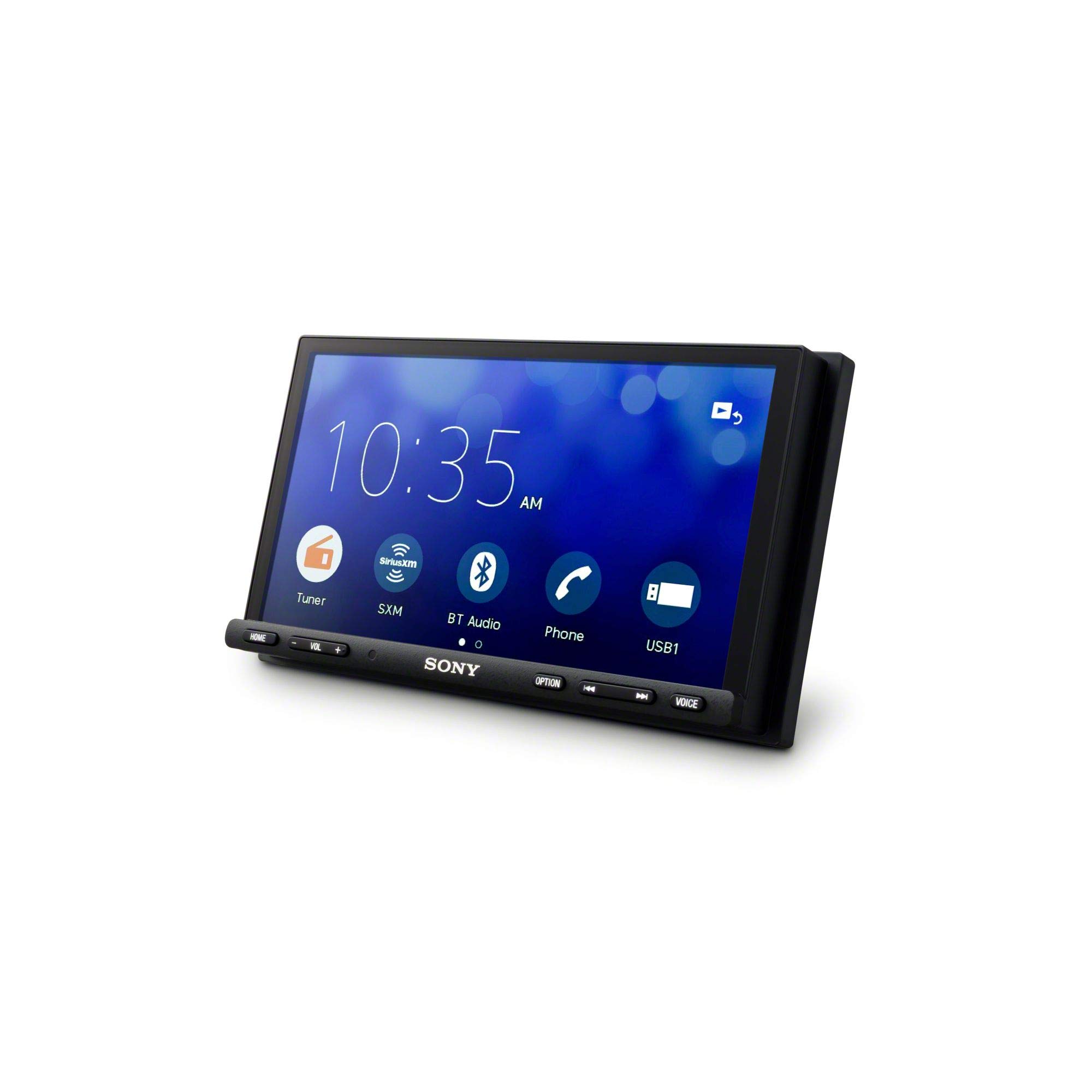
3. Sony XAV-AX7000 6.95″ Apple Carplay/Android Auto High Power Media Receiver
The high-power head unit that can drive a subwoofer without a separate amplifier.
Most receivers need an external amp to produce real bass, but the Sony XAV-AX7000 changes that with a built-in 180W RMS amplifier that is genuinely powerful. Owners mention it drives a subwoofer directly without an in-line amp, which simplifies the wiring significantly—one owner dropped it into a 2014 Subaru WRX and noticed a “sound improvement over stock head with stock speakers” immediately.
The 6.95-inch bezel-less display is the star of the interface. It is vivid, touch-friendly, and runs Apple CarPlay and Android Auto through a voice-activated function so you can oversee music, navigation, and messages without tapping around. The Dynamic Reality Amp 2 technology cuts external noise, and EXTRABASS pushes the low frequencies deeper than the Alpine iLX-W670’s standard output.
The biggest hurdle is the learning curve for installation—first-time buyers found the setup instructions better suited for experienced users, and if you are putting this in a motorcycle or a vehicle that needs a custom install kit, you will need extra hardware. At 6.30 inches deep and 7.17 inches wide, it fits most double-DIN slots, but the depth is tighter than the Alpine’s shallow chassis. Measure your dash space before ordering.
High-Output Advantage: The 180W RMS output means you skip buying a separate amplifier; you get sub-bass from the head unit alone, which makes this an efficient one-box solution for a clean, powerful daily driver setup.
The Catch: The lack of a wireless CarPlay adapter (sold separately) and the steep installation learning curve may frustrate first-timers who want a simple swap.
Perfect for: anyone who wants a premium touchscreen and enough built-in power to skip buying a separate amplifier—great for a clean, integrated setup.
Better to pass if: you are a complete beginner looking for the easiest possible plug-and-play installation.
4. Alpine 8″ Amplified Subwoofer (PWE-S8)

The subwoofer that slides under a seat and disappears—its bass does not.
Space is the number one enemy of good bass in a sedan or compact SUV, and the Alpine PWE-S8 solves it by packing a 120W RMS powered subwoofer into an 8-inch enclosure that fits under a front seat. Buyers confirm it slides under the driver’s seat of a 2015 Jetta and under the back seat of a 2000 Jeep Wrangler, delivering a “tight, controlled bass” that fills in the low end without rattling the interior.
The built-in Class D amplifier keeps the unit small and efficient—frequency response goes down to 32 Hz, which is low enough to give bass guitar and kick drums real weight. Unlike the bulkier MTX TNP212D2, which takes up the whole trunk, the PWE-S8 hides completely and installs in about 30 minutes with a basic amp wiring kit.
This is not a sub for bass-heads who want to shake license plates. The 120W RMS is modest—it delivers “more bass than expected” but stays musical rather than aggressive. If you want deep sub-30 Hz rumble, consider the JBL SUBBP12AM instead. But for a clean, space-conscious upgrade that restores the low end your factory system lost, this is the best form factor on the list.
Why It Fits
- Fits under most front seats—no trunk space lost
- 120W RMS clean, tight bass down to 32 Hz
- Remote level control for easy adjustment from the driver seat
Know Before You Buy
- Not loud enough for competition-level bass or large SUVs
- Requires a proper ground connection; some buyers had to sand to bare metal
- Cannot replace a full-size 12″ box for hardcore SPL builds
Best suited for: sedan, compact SUV, or truck owners who want to add bass without sacrificing cargo space or rear seats.
Look elsewhere if: you need mirror-rattling output—this is musical, not monstrous.
5. JBL SUBBP12AM – 12” Amplified Subwoofer

The amplified sub that brings 150W of clean, rattling power without needing a separate amp.
For the buyer who wants real, chest-thumping bass without the complexity of a separate amplifier and wiring kit, the JBL SUBBP12AM is the plug-and-play answer. It delivers 150W RMS (450W peak) through a polypropylene 12-inch woofer, and the built-in amp is precisely matched to the driver so you never worry about under-powering or clipping the signal.
The Slipstream port design is a genuine engineering upgrade—it eliminates the wind noise you hear from cheaper ported enclosures at high volume, which means the bass stays clean and distortion-free even when you push the system. Customers note it fits easily in the trunk of a 2020 Mazda 6 and a Dodge Challenger, with one owner saying it “breaks through the thick back seat” and vibrates the rearview mirror.
At 150W RMS, this sub outperforms the Pioneer TS-WX1210A in output fidelity—buyers complement saying the JBL produces a “clean loud bass” that is worth the extra cost over other amplified subs. But it is still a single 12-inch driver in a sealed-ish box. For dual-sub output like the MTX TNP212D2, you lose the easy single-box setup. If you want the simplicity of a powered sub with genuinely musical output, this is the balance.
What Makes It Worth It
- 150W RMS built-in amplifier—no extra amp or wiring complexity
- Slipstream port kills the “whoosh” noise at high volume
- Includes remote level control for easy bass adjustment from the driver’s seat
The Fine Print
- Large enclosure takes up significant trunk space
- Not competition-grade; reviewers point out it is “loud enough for a teen”
- Needs a line output converter (LOC) for factory system integration
Ideal for: anyone who wants real, clean sub-bass with minimal installation effort—buy the sub, wire it, set the level, done.
Not for you if: you have limited trunk space or need a subwoofer that can stay hidden under a seat.
6. Pioneer TS-WX1210A 12” Subwoofer – 1300W Max, Built-in Amp

The cleverly compact 12-inch sub that sneaks into tight trunk spaces and delivers clean output.
Not every 12-inch subwoofer needs a massive box that swallows your trunk. The Pioneer TS-WX1210A puts a 12-inch driver and a built-in 300-watt Class D amplifier into a sealed enclosure that buyers describe as “compact” and easy to place in small trunks and SUVs. The sealed box design keeps the bass tight and controlled rather than boomy, and shoppers say it “moves air well” in an SUV.
The flexible sound adjustment is where this powered sub shines. You get a variable low-pass filter, phase control, and a bass boost knob (0 to +12 dB between 40 Hz and 100 Hz) so you can tune the sub to match your music genre without touching the head unit. Buyers report it works great for rock kick drums and bass guitars, and one owner noted it is “good for 30Hz+” with a noticeable drop-off below 30 Hz—a common trait for sealed enclosure subs of this size.
Compared to the Alpine PWE-S8, the Pioneer is bigger and takes up trunk space, but it delivers 300W of built-in power versus the Alpine’s 120W, so you get significantly more headroom. Some buyers warn that the advertised 1300W max power is marketing—real-world RMS is closer to 180-190W, so set your gain conservatively. For a simple, one-box 12-inch bass add-on that does not require a separate amp, this is the most packable option.
Why It Works
- 300W built-in Class D amp in a compact sealed enclosure
- Bass boost knob with 0 to +12 dB adjustment on the fly
- Works with most factory or aftermarket radios via high-level inputs
What to Watch For
- Real RMS power (~180-190W) is much lower than the 1300W peak advertising
- Drops off below 30 Hz—not ideal for deep rap or EDM sub-bass
- Random cutouts reported by some buyers; may indicate a ground or gain sensitivity issue
Perfect for: rock and classic rock listeners who need tight, articulate bass from a single 12-inch box that fits in modest trunk space.
skip it if: your playlists are sub-30 Hz trap or rap—the Pioneer drops off before the lowest notes.
7. JBL Club 64C – 6-1/2″ Two-Way Component Speaker System

The component system that voicelifts your mids and highs—and asks for a sub to handle the lows.
Stock speakers in most cars are paper-cone coaxials that muddle vocals and roll off high frequencies. The JBL Club 64C fixes that with a dedicated 6-1/2-inch woofer and a separate tweeter, plus an external crossover that sends the right frequencies to each driver. The result is clarity that a coaxial speaker cannot match—vocals sound present, cymbals have shimmer, and the soundstage lifts from your footwell to ear level.
The patented Plus One woofer cone architecture (US patent #7,548,631) gives you more cone surface area than a standard 6.5-inch driver of the same size, which translates to higher sensitivity (92dB at 2.83V). That means the speakers play louder from the same amount of power. The tweeter output level control lets you choose 0dB or +3dB to adjust for installation location—particularly useful if the tweeter is buried behind a factory grille.
Buyers confirm these are a “clear upgrade from stock Lexus speakers,” but one buyer also named the weakness plainly: “clear sound but weak bass.” That is the trade-off of a component system—the 6.5-inch woofer cannot reproduce sub-bass frequencies. You will need a subwoofer like the JBL SUBBP12AM to get the low end. But for, you get audiophile-grade midrange and treble that most factory systems lack entirely.
Where It Excels
- Component design (separate woofer/tweeter/crossover) delivers superior imaging
- Plus One cone provides higher sensitivity than same-size competitors
- Starfish tweeter mounting adapters fit behind factory grilles
Where It Falls Short
- Weak factory bass; owners mention you need a dedicated subwoofer
- Shipping packaging is poor—some buyers received crushed boxes from Amazon
- Wiring between crossover and drivers can be tight depending on your vehicle
Best for: buyers who prioritize vocal clarity, instrumental separation, and a wide soundstage over deep bass.
Not for: anyone who expects a single component set to deliver both clear mids and chest-thumping low end.
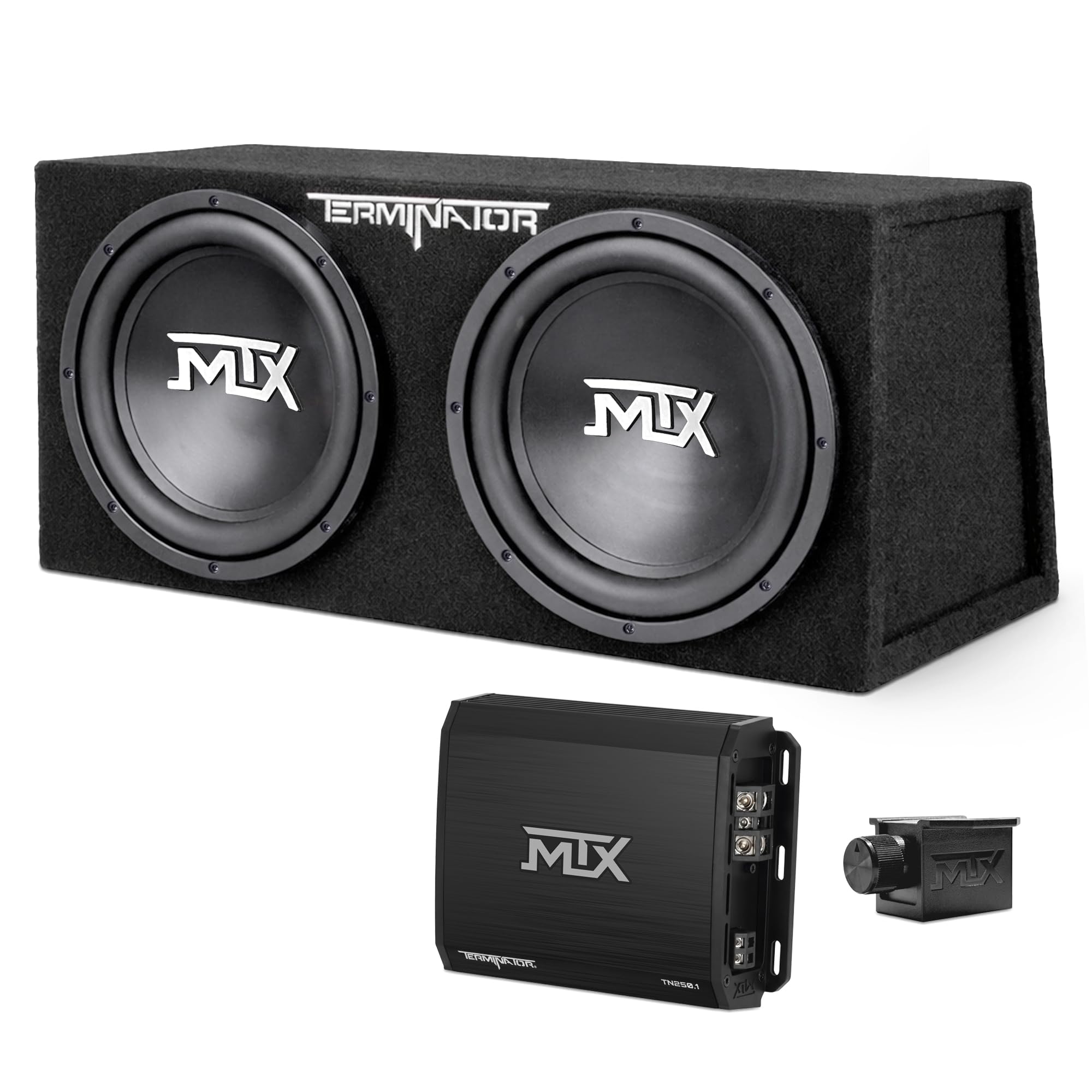
8. MTX 12″ 1200W Dual Loaded Car Subwoofer Audio with Sub Box and Amplifier, TNP212D2
The twin-12 party pack that moves enough air to change your commute into a show.
If you have the trunk space and the desire for trunk-rattling bass, the MTX TNP212D2 skips the single-sub approach by giving you two 12-inch subwoofers, a pre-loaded box, and an included 250W RMS amplifier—everything in one box. The total system runs at 400W RMS (1200W peak), and with dual 2-ohm impedance, the subs work together to produce deep, chest-punching low end that a single 12-inch sub cannot match.
The enclosure measures 13.5 x 29.63 x 14 inches, so make sure you measure your trunk before ordering—buyers confirm it fits a 1995 Honda Accord trunk but “slides around” if not secured. The included amplifier is compact (6.31 x 5.43 x 2 inches), though seasoned customers note it “gets very hot in summer” and can enter protection mode in hot trunks. The subs themselves are built well; one reviewer noted they “work great after over a year” in a 1985 Honda Civic that goes through heat and cold cycles.
Compared to the single-powered sub approaches like the Pioneer TS-WX1210A, the MTX delivers significantly more total output—dual drivers mean you move more air. But the included amplifier is the weak link; experienced buyers recommend upgrading the amp later for consistent performance. For a beginner who wants authoritative bass at a friendly entry point, the MTX package is class-leading value.
Why It Stands Out
- Dual 12-inch subs in a pre-loaded box produce serious output right away
- All-in-one kit includes sub box, subs, and amplifier—no separate amp to buy
- Surface-mount technology on the amp is vibration-resistant
Important Caveats
- Large box consumes most of your trunk space; measure before buying
- Included amplifier overheats in hot climates and may enter protection mode
- No wiring kit included—buy an 8-gauge amp wiring kit separately
Ideal for: first-time car audio enthusiasts who want maximum bass output for their budget and have the trunk space to spare.
Steer clear if: you need a compact, hidden subwoofer or require a system that performs reliably in extreme heat.
9. KENWOOD KMM-BT332U Bluetooth Single DIN Car Stereo

The affordable single-DIN that packs Alexa, a 13-band EQ, and two-phone Bluetooth.
For the price-conscious buyer who still wants modern features, the Kenwood KMM-BT332U punches well above its weight. It streams music and handles hands-free calls via Bluetooth, and the connection is among the most reliable in its class—reviewers point out that “the Bluetooth connection is stable and easy to pair, so streaming music or connecting a phone for hands-free calls works without fuss.” You can even control two phones at the same time, switching between calls and music without re-pairing.
Alexa built in is the standout feature here. You connect the Kenwood to the Alexa app, and you can get news updates, weather, and control smart home devices right from your car—no phone required on the dash. The 13-band equalizer with digital time alignment gives you sound-shaping power normally found on more expensive units. The USB 1.5A port charges devices quickly, which is handy for long drives.
This model does not play CDs, so if physical media matters, you will want the Pioneer DEH-S4220BT or another CD-compatible unit instead. At just 3-15/16 inches deep (D), it fits in shallow dashes where the Pioneer (10 inches D) might not. For a budget Bluetooth stereo that gives you Alexa hands-free control and solid sound shaping, this is the one to beat.
Why It Wins at Its Price
- Built-in Alexa integration for news, weather, and smart home control
- 13-band EQ with time alignment for custom sound tuning
- Compact 3-15/16-inch depth fits tight dash spaces
Before You Buy
- No CD player—digital media and USB only
- Preamp outputs are 2.5 volts, which is adequate but not high-end
- Face is detachable but the display is a basic multi-color LCD, not a touchscreen
Pick this if: you want a budget-friendly, Alexa-enabled stereo with a reliable Bluetooth connection and advanced EQ controls.
Look elsewhere if: you need a CD player, a large touchscreen, or wireless phone projection.
Understanding the Specs
RMS Power vs Peak Power
RMS (Root Mean Square) is the continuous power a speaker or amplifier can handle without overheating or distorting. That is the real number to use when matching speakers to an amplifier. Peak power is a marketing figure that represents a fraction-of-a-second burst—ignore it. A speaker rated 70W RMS / 210W peak will take 70 clean watts all day, but feeding it 210 watts continuously will blow the coil. Always match RMS numbers between your amp and your speakers/subwoofer.
Component vs Coaxial Speakers
Component speakers separate the woofer (for mids), the tweeter (for highs), and an external crossover (the traffic cop that sends the right frequencies to each driver). The separation lets you mount the tweeter higher in the door or dashboard, which pulls the soundstage up to ear level—the difference is night and day for vocal clarity and instrument separation. Coaxial speakers (sometimes called full-range) have the tweeter mounted in the center of the woofer, which creates phase cancellation and muddy imaging. If you can install a component set, it is always the better choice for sound quality.
FAQ
Do I need a separate amplifier for a subwoofer?
What is the difference between 1-DIN and 2-DIN (double-DIN)?
Can I replace my factory speakers myself?
Will a subwoofer drain my car battery?
Can I install a subwoofer with a factory radio?
What is preamp voltage and why does it matter?
How long does a car subwoofer normally last?
Is a 12-inch subwoofer better than a 10-inch subwoofer?
Do I need to break in a new subwoofer?
What gauge wire do I need for a subwoofer installation?
Across the board, the car sound systems winner is the Alpine iLX-W670 because it gives you a modern touchscreen interface and deep sound-shaping control in one clean package. If you want the clearest mids and highs without a subwoofer, grab the JBL Club 64C component set. And for a space-saving bass add-on that hides under a seat, the standout is the Alpine PWE-S8.
How We Picked
We do not accept paid placement. Every pick is matched to a real buyer and a real use-case; we do not hands-on test units.
Sources & Methodology
Specifications: manufacturer listings and product documentation. Review insights: verified customer reviews, as of July 2026. Pricing: not shown on this page (it changes often); check the current price via the retailer link.
As an Amazon Associate, Trending Car earns from qualifying purchases. This does not affect which products we feature.