
Our readers keep the lights on and my garage snacks stocked. As an Amazon Associate, I earn from qualifying purchases.
Specs are compiled from manufacturer listings and verified buyer reviews and can change over time — please confirm the key details on the product page before buying.
Your daily commute or road trip does not have to be a constant battle with road rumble, wind whistle, and buzzing panels. A few well-placed sheets of butyl rubber (a sticky, rubbery material that soaks up vibrations) can transform your car’s cabin from a noisy echo chamber into a quiet sanctuary, making every drive less tiring and your music sound much better. This guide compares each mat by thickness, coverage, and real-world results, so you know which one will finally quiet your ride.
I’m Min Islam — the founder and writer behind Trending Car. This guide is built by comparing the manufacturers’ published specifications and the patterns across verified customer reviews, so you get each pick’s real strengths and trade-offs instead of marketing spin.
Whether you are battling droney exhaust notes, rattling door panels, or just want a more serene cabin, the right car sound deadening mat is your single most effective upgrade for a noticeably quieter and more comfortable vehicle.
Our Picks at a Glance

How To Choose The Best Car Sound Deadening
The first thing to know is there are two main types of sound deadening: a simple butyl-and-foil mat (called a Constrained Layer Dampener, or CLD — a sandwich of rubber and foil that clamps down on metal vibrations) that stops metal panels from vibrating, and a thicker multi-layer composite that also blocks heat and low-frequency noise. Your choice depends on your goal — killing rattles for a better stereo, or quieting a noisy cabin for comfortable daily driving.
Material Thickness and Density
The most common thicknesses you will see are 80 mil (about 2 mm, where 1 mil equals 0.001 inches) and 200 mil (about 5 mm). A thicker, denser mat like the 200 mil option is more effective at absorbing deep, low-frequency road noise and blocking heat from the exhaust. The 80 mil mats are lighter and easier to work into tight spots like door panels, making them ideal for vibration control. Generally, the heavier the mat per square foot, the better the noise blocking.
Coverage Area and Your Project
You need to match the square footage to your vehicle. A single 36 sqft roll is typically enough to do all four doors and the trunk lid of a sedan. A large SUV or a van might require 50 sqft or more for full floor and panel coverage. Most experts recommend covering about 25-50% of a flat panel’s surface area to kill resonance — you do not have to cover every inch. The key is to target the large, flat metal areas that vibrate the most.
Adhesive Quality and Installation
A mat is only as good as its bond. You need a very sticky, aggressive adhesive that grabs the metal instantly and won’t let go, even in the summer heat inside a closed car. Look for reviews that mention “strong adhesion” and “no smell”. The best mats use a pressure-sensitive adhesive (a glue that bonds firmly when you push it down with a roller) that requires a roller to be fully seated. Avoid any that require extra glue or have a weak tack.
Quick Comparison
| Model | Best For | Thickness | Coverage | Type | Amazon |
|---|---|---|---|---|---|
| KILMAT 80 Mil★ Best Overall | Overall Value & Performance | 80 mil (2 mm) | 36 sqft | Butyl & Foil CLD | Amazon |
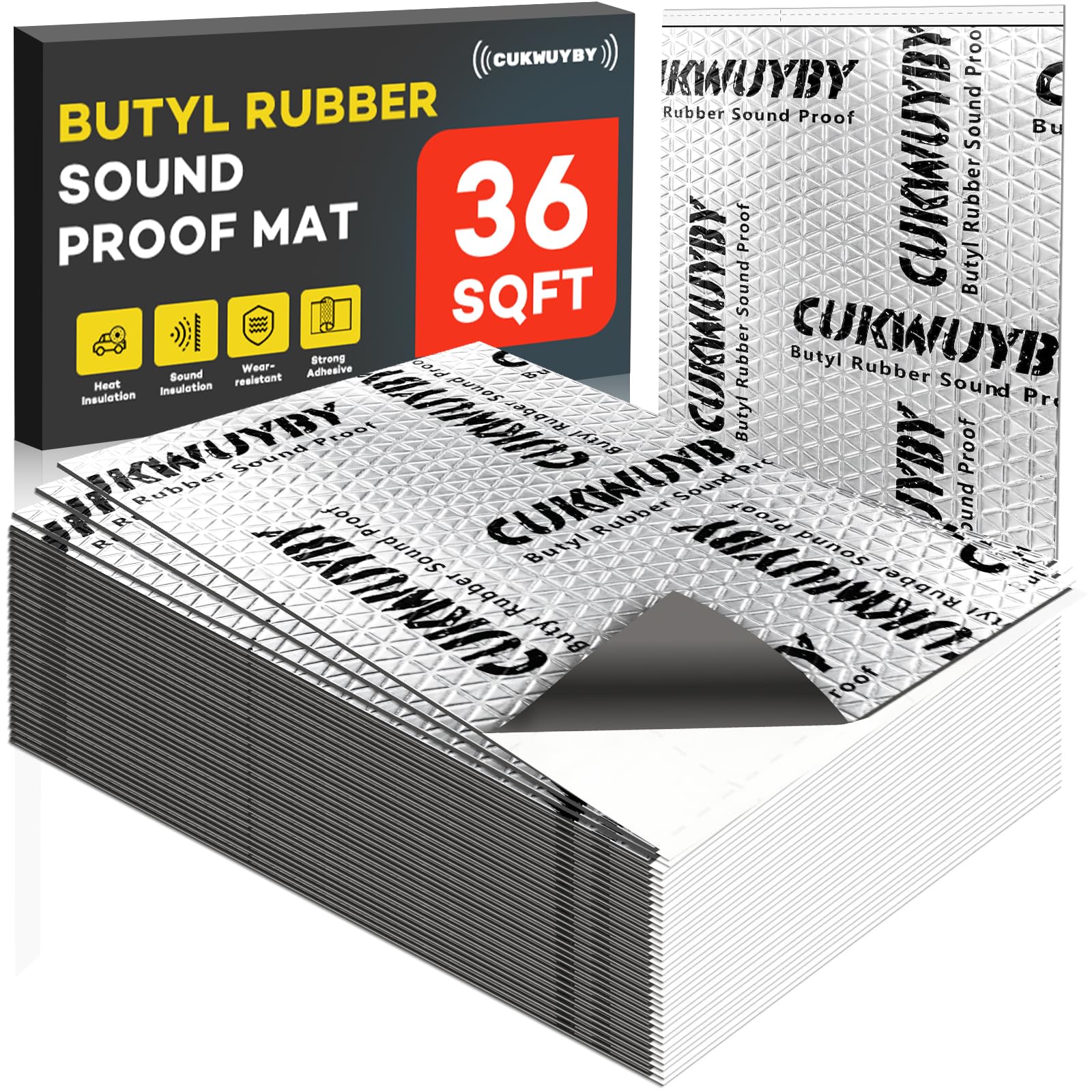
| Butyl Sound Deadening 80milBudget Champion | Budget-Friendly Doors & Trunk | 80 mil (2 mm) | 36 sqft | Butyl 3-Layer | Amazon |
| Second Skin Damplifier Pro | Professional-Grade Precision | 2 mm | 5 sqft | Butyl & Annealed Foil CLD | Amazon |
| VEVOR 200 mil | Maximum Heat & Noise Blocking | 200 mil (5.1 mm) | 25 sqft | Multi-layer Composite | Amazon |
| Zhengmy 196 mil | Large Area Coverage (Rolls) | 196 mil (5 mm) | 53.9 sqft | Closed Cell Foam Mat | Amazon |
| Siless Max 120 mil | Premium Vibration Dampening | 120 mil (3 mm) | 30 sqft | Butyl Mastic CLD | Amazon |
| Siless Hybrid 200 mil | All-in-One Noise & Heat Control | 200 mil (5 mm) | 25 sqft | 3-in-1 Composite Barrier | Amazon |
In‑Depth Reviews
1. KILMAT 80 Mil (2 mm) 36 Sqft Car Sound Deadening Mat
Our pick — over 4.5★ from 26,000+ verified ratings; the strongest balance of quality and price.
The 36 sqft roll that hits a strong balance between price and measurable results, with over 26,000 ratings averaging 4.8 stars.
You get the most straightforward upgrade here: a sticky, 80 mil (2 mm) butyl-rubber mat backed by a foil layer that simply sticks to bare metal. What makes this the top pick is its balance of coverage and performance for common cars. The 36 square feet in the box is exactly what buyers report they need for a full door-and-trunk job — one reviewer noted that 1.5 boxes covered a crew cab diesel truck. The KILMAT weighs 0.5 lbs per square foot, so it is light enough not to sag but dense enough to kill panel resonance (the vibration that makes metal panels hum). Owners mention it is noticeably thicker than basic 80 mil generic mats, and one owner measured a drop from 71 dB to about 66 dB with two layers on a 1971 Barracuda — so road noise becomes much quieter at highway speed.
At 80 mil thick, it falls on the standard end of the spectrum, which is perfectly fine for stopping door rattles and road noise. The special embossing on the foil is a clever touch — you roll it smooth to confirm a professional bond. It competes directly with the premium Second Skin but at a fraction of the cost per square foot. The main trade-off is that it prioritizes vibration control over heavy heat blocking; if your main goal is fighting engine bay or exhaust heat, you would want a thicker composite like the VEVOR 200 mil. Because this KILMAT is a vibration damper first, not a multi-layer heat barrier.
Installers love that the self-adhesive is strong enough for vertical panels on hot days — one owner said it eliminated the hollow sound on a 2020 Lexus RX350. The foil edges can be sharp, so cut to size before pulling the backing. It arrives in handy 15.7 x 9.8 inch sheets that are easy to manage in a home garage.
Why It Wins
- Strong adhesion that sticks instantly to clean metal
- 36 sqft covers most car doors and trunk with plenty to spare
- Light enough at 17 lbs total for van builds but still highly effective
- Over 26,000 ratings with a 4.8-star average confirms consistent quality
The Trade-Offs
- Thinner than premium multi-layer mats, so heat insulation is minimal
- Foil edges can cut fingers if handled carelessly during cutting
Reach for this if: you want the most proven, best-reviewed sound deadener that works for virtually any car door, floor, or trunk without breaking the budget.
Look elsewhere if: you need maximum heat rejection from a single mat; the KILMAT is a vibration damper first, not a heat barrier.
2. Butyl Sound Deadening 80mil 36sqft Mat
The budget-friendly roll that does not compromise on stickiness or sheer coverage for the price — 36 sqft for less than many brand-name alternatives.
If you are on a tight budget but still want a full 36 square feet of 80 mil (2 mm) butyl deadener, this is the mat to grab. It uses a 3-layer design: an 8-wire reinforced aluminum foil on top to reflect heat, a butyl rubber core to absorb vibrations, and a high-strength adhesive backing that, according to one buyer of a 2000 Tahoe, “will take the paint off of a service area.” That is the level of permanent bond you want. The same reviewer used about 90% of this box to do all the doors and the tailgate, proving the coverage math works for a full-size SUV.
Where it stands out is its simplicity — the manufacturer claims “no roller needed” because the high-tack adhesive sticks instantly. The mat measures 15.75 x 9.84 inches per sheet, very similar to the KILMAT, making it easy to cut into strips for tight spaces. One owner of a Toyota RAV4 used it on the entire ceiling and part of the floor, noting it got rid of that “tin can sound” when shutting doors. For an entry-level price, you get universal fit that works on doors, trunk, floor, and even a camper, as another buyer confirmed it made a “hell of a difference” on their RV.
The main compromise versus a premium brand like Siless is that the 80 mil thickness is best for vibration control, not heavy deep-frequency blocking. It also lacks the sophisticated Bmastic formulation of the Siless Max. But for killing rattles after an aftermarket audio install, like the Dodge Durango owner who said it was a “night and day difference,” this is a very smart spend. Compared to the KILMAT, it costs less per square foot but does not have the same refined adhesive feel — be careful placing it because the glue is so aggressive that a mis-placed sheet can pull paint.
One-Box Verdict: At 36 sqft for a budget price, it offers the same coverage as the top pick but with a slightly less refined adhesive feel. Perfect for your first deadening project or for a vehicle you are fixing up.
Heads Up: Be very careful with placement; the adhesive is so strong that removing a mis-placed sheet can pull paint.
Pick it for: the best raw coverage per dollar that still delivers serious vibration-killing results.
skip it if: you want a premium, low-odor formulation that professional installers rely on for high-end builds.
3. Second Skin Damplifier Pro (2mm) – 5 Sq Ft

The pro-grade tile built for extreme heat (rated for 450°F) and zero-compromise vibration damping, but only 5 sqft per pack.
This is not a budget roll; it is a precision tool for enthusiasts who need the absolute best performance in a specific area. The Damplifier Pro is a constrained layer dampener (CLD) made from a proprietary elastomeric butyl rubber and an annealed foil (foil that has been heat-treated to be more flexible and durable) that can handle 450°F — this is critical for applications near the firewall, exhaust tunnels, or hood. It comes in 12×10 inch tiles that cover 5 square feet total, which seems small, but the philosophy here is “target the problem areas,” not cover every inch. One reviewer confirmed they only needed to hit the resonant spots on a 2023 Bronco cargo area to kill the noise.
The real differentiator is the adhesive. Buyers who have used Dynamat, Stinger Roadkill, NVX, and Murdermatt all say this beats them hands down, noting the glue is much stronger and the material has no odor even when the car sits in the sun. One buyer of a 24 Honda Accord said the moment they touched it, they knew it was high quality. In terms of results, another owner reported a 65-75% reduction in noise, which is a staggering claim for just a few pieces. It is made in the USA and endorsed by West Coast Customs, so you are paying for professional-level consistency.
The catch is the coverage — 5 sqft is not enough for a full car; it is designed for targeted use on doors, wheel wells, or a single floor pan. To do a whole vehicle, you would need to buy multiple packs, which adds up quickly compared to a 36 sqft roll like the KILMAT. The 2mm thickness is standard, but the quality of the compound makes it outperform thicker mats in vibration transfer.
Professional Strengths
- 450°F heat rating makes it safe for hoods and firewalls where standard mats fail
- Industry-leading adhesive that sticks the first time with no smell
- RoHS compliant and non-toxic, safe for enclosed cabins
Size Reality
- Only 5 sqft per pack — you will need multiple packs for a full car project
- Premium price per square foot compared to bulk rolls
Grab this for: a single high-heat area like the hood or firewall, or for a small targeted project where nothing but the best will do.
Pass if: you need to cover a large area like a van or SUV floor on a budget; bulk rolls make more sense.
4. VEVOR Car Sound Deadening Mat, 200 mil 25 sqft

The thickest single-layer damper here at 200 mil (5.1 mm), built to swallow road noise and engine heat in one go — 2.5 times thicker than the KILMAT.
At 200 mil (5.1 mm), the VEVOR is one of the thickest mats you can buy — it is 2.5 times thicker than the standard 80 mil mats like the KILMAT. This is a 3-in-1 composite structure: an 80 mil butyl rubber layer for damping, a heat-resistant aluminum foil, and a 120 mil high-density foam layer for sound absorption and thermal insulation. That means it does double duty: killing vibrations while blocking the heat that comes through the floor from your exhaust. Buyers of camper vans specifically note it is effective under insulation because the 200 mil thickness gets the job done with just one layer.
The trade-off for that thickness is in how it handles. One experienced user who has tried almost every brand put it simply: “It is a little harder to work with than others, but that is because it is thicker and more dense.” They recommend putting it in the sun or using a heat gun to soften it for installation. The 25 sqft coverage (24 sheets, each 9.76 x 15.39 inches) is enough for a small car’s floor or a van’s wheel wells, but a user of a mid-roof Transit 148 found that 25 sqft was insufficient — they recommend 65 sqft for full coverage. Compared to Zhengmy’s 53.9 sqft roll, you get less area but a denser, more effective material per square inch.
On the plus side, the self-adhesive backing is strong and has no odor, even in the heat of a van in summer. Another owner used it on a Promaster camper van and noticed a clear reduction in road noise with just a center piece per panel. It also has fire resistance, adding a layer of safety.
The Hard Truth: This is not a beginner-friendly mat — the thickness makes it stiff and harder to press into complex curves. But if you want the most effective single-layer noise and heat block you can buy for a mid-range price, this is it.
Ideal for: van life conversions, large SUV floors, and anyone who wants to knock out noise and heat with one product.
Not for: intricate door panels or if you prioritize ease of installation over ultimate performance.
5. Zhengmy 53.9 Sqft 196 Mil Car Heat Sound Insulation Mat

The 53.9 sqft roll that is your only option if you are covering an entire van floor or SUV cargo area — more than double the coverage of a standard 25 sqft kit.
Most sound deadening mats come as squares, but this one arrives as a single massive roll (20 x 394 inches) of 196 mil (5 mm) high-density closed-cell foam (a foam with sealed pockets that block air and sound). That is a huge 53.9 square feet of material, which is more than double the coverage of a standard 25 sqft kit. For a project like the cab floor of a full-size truck, a van roof, or the entire interior of a Corvette, this is the only realistic option without buying multiple boxes. One Corvette owner confirmed this roll was “just about enough” for the full project, reducing highway sound by an impressive 7-10 dB — so you can hear your radio clearly at 70 mph.
It is important to understand this is a foam mat, not a butyl CLD. It is designed as a thermal insulator and sound absorber, not a vibration damper. That means it is better at stopping heat from the transmission tunnel and muffling broad road noise than it is at stopping a specific door panel from rattling. The adhesive is reported to be very strong — one buyer of a truck said “once it is down, it stays down” — and the material cuts easily with a utility knife without tearing. The package includes two different-sized rollers, which is a nice bonus you do not get with most kits.
The main downside is that it is a foam layer, so if your car has specific metal rattles, you will still need some butyl CLD mats underneath it. For pure heat and broad-spectrum noise reduction, it works great, but it is not a replacement for a traditional deadening mat. A few users also noted that while the adhesive is sticky, foam does not provide the same mass-loaded dampening as a heavy butyl mat like the VEVOR. If your goal is killing a distinct door rattle, buy a butyl mat like the KILMAT first.
Massive Coverage Advantage
- 53.9 sqft roll is class-leading for covering large areas in one go
- Includes two free rollers for easy application
- Flame retardant and effective heat barrier for van roofs
Material Limitation
- Foam does not stop metal panel vibrations as well as a butyl CLD mat
- Best used as a secondary layer over vibration-dampening mats
Best for: a full vehicle floor, van roof, or cargo area where you need to cover a huge space and block heat in one purchase.
pass on it if: you are trying to cure a specific door rattle — get a butyl mat for that job first.
6. Siless Max 120 mil (3mm) 30 sqft Car Sound Deadening Mat

The 120 mil Bmastic sheet that delivers Lexus-level quiet — one reviewer of a 10-year-old Civic said it transformed the car — and is 50% thicker than standard 80 mil mats.
Siless used its own “Bmastic” formulation for this mat — a technologically advanced sound deadening compound that is 120 mil (3 mm) thick and covers 30 square feet. This is the balance for serious enthusiasts: it is 50% thicker than the standard 80 mil mats, giving it noticeably better low-frequency absorption, but it is still pliable enough to work into door cavities without a heat gun. One reviewer with a 10-year-old Civic said it transformed the car to “Lexus-like quiet,” noting it acts as an effective thermal barrier too. The 4.8-star rating from 858 reviews backs up the consistent quality.
The key spec here is the 30 sqft coverage area, which is a smart number — it is enough for a full sedan cabin without forcing you to buy two boxes. The sheets are 15.35 x 11.81 inches, slightly wider than the KILMAT, so you cover more area per sheet. Customers note it is “super sticky” and very effective on doors. One owner of a Toyota Yaris said road and engine noise were “nearly gone” after installing it on the hood, hatchback, trunk floor, and doors. It does not have a smell and does not off-gas, which is a major plus for enclosed cabins. Compared to the KILMAT, it costs more per square foot but offers a materially thicker and more advanced damping compound.
The trade-off is that Siless does not include a roller in the package, so you will need to buy one separately to ensure a proper bond. It is also a pure CLD mat, meaning it is fantastic for vibration control but not a multi-layer heat barrier like the Siless Hybrid or VEVOR 200 mil. For a one-doors-and-floor job though, it delivers professional-grade quiet without the need for stacked layers.
One-Line Take: The 120 mil thickness is the ideal middle ground — thicker than standard for better noise blocking, but not so thick it becomes a chore to install.
Ideal for: a discerning buyer who wants professional-grade vibration control and a noticeably quieter cabin without the hassle of multi-layer mats.
Consider another if: your primary concern is blocking engine heat, not just noise; this is a sound damper first.
7. Siless Hybrid 3in1 200 mil 25 sqft Car Sound Deadening Mat

The 200 mil three-layer barrier that stops vibrations, heat, and deep bass in a single install — one buyer on a Chevy Express van saw cabin temperature drop from 110°F to 97°F.
This is the most complete single product you can apply. The Siless Hybrid is not a simple butyl mat; it is a heavy three-layer composite made of butyl mastic, PE foam, and a mass-loaded butyl membrane. At 200 mil (0.2 inches) thick and covering 25 square feet, it is engineered to solve three distinct problems: vibration damping from the butyl layers, heat blocking from the foam, and low-frequency noise absorption from the mass-loaded membrane. One buyer who used it on a Chevy Express van reported that road noise was eliminated and the interior temperature dropped from 110°F to 97°F in direct sun, proving the heat barrier works.
The installation is surprisingly user-friendly for such a thick mat. Reviewers consistently say it is soft, flexible, and cuts easily with scissors — no heat gun is required, unlike the VEVOR 200 mil. A Fiesta ST owner noted it noticeably reduces road noise and vibrations with no bad smell. The real magic is the “3-in-1” nature: you only need to buy and install one layer to get CLD dampening and heat blocking, which saves you the cost and labor of buying a separate foam layer. It pairs perfectly with the Siless Max for a two-layer ultimate treatment: Max for doors, Hybrid for the floor and trunk. In a direct head-to-head, reviewers report it beats the popular Dynamat Extreme in value and performance.
The limitation is simply the coverage. At 25 sqft, it will cover a small car’s floor or a single row of seats, but for a full van or large SUV, you will need two boxes. The adhesive is very aggressive — one buyer warned it bonds to clothing, so wear work clothes.
The Big Advantages
- Solves three problems — noise, heat, and vibration — in one install, saving labor
- Soft and flexible design cuts with scissors, no heat gun needed
- High-temperature performance dropped cabin temp by 13°F in a real-world test
The Honest Downsides
- 25 sqft is just enough for a small car; larger vehicles need two packs
- Very sticky adhesive makes mistakes messy; location and pressure matter
Choose this if: you want the absolute best all-in-one solution for a modest car, saving you from layering separate dampening and insulation mats.
Consider the VEVOR instead if: you need more coverage for less money and do not mind a stiffer, harder-to-install material.
Understanding the Specs
Thickness (Mil)
This is the single most important number. It is measured in mils, where 1 mil equals 0.001 inches. A standard 80 mil mat is about 2 mm thick and works perfectly for killing panel vibrations on doors and roofs. A 200 mil mat is more than twice as thick (about 5 mm) and provides much better thermal insulation and low-frequency noise blocking. The thicker the mat, the heavier and harder it is to mold, but the more effective it is at stopping deep road drone and engine heat.
Coverage (Square Feet)
This tells you how much area the roll or pack covers. 36 sqft is the standard balance — enough for all four doors and the trunk of a sedan. 25 sqft is common for thicker mats and covers a small car’s floor or a van’s wheel wells. Anything over 50 sqft (like the Zhengmy roll) is meant for full-floor projects on large vehicles. A quick rule: for a basic door-and-trunk job, buy 36 sqft; for a full interior, aim for 50-70 sqft.