
Our readers keep the lights on and my garage snacks stocked. As an Amazon Associate, I earn from qualifying purchases.
Specs are compiled from manufacturer listings and verified buyer reviews and can change over time — please confirm the key details on the product page before buying.
Finding a real scuff remover that actually works on car paint without damaging the clear coat feels like a gamble. This guide cuts straight through the marketing hype to show you exactly which compounds cut deep scratches, which ones handle faded paint, and which one belongs in your garage — based on the real specs and buyer experiences that matter.
I’m Min Islam — the founder and writer behind Trending Car. This guide is built by comparing the manufacturers’ published specifications and the patterns across verified customer reviews, so you get each pick’s real strengths and trade-offs instead of marketing spin.
Whether you are tackling paint transfer from a fender bender or oxidation that has dulled your car’s shine, choosing the right car scuff remover starts with knowing which grit level matches your paint condition and if you need a one-step product or a multi-stage system for a showroom finish.
Our Picks at a Glance

How To Choose The Best Car Scuff Remover
Buying a scuff remover is not just about grabbing the cheapest bottle. The chemical make-up and abrasive level dictate whether you remove scratches or accidentally strip your paint. Focus on these three factors to get it right.
Grit Level & Cutting Power
The grit number tells you how aggressive the abrasives are. A lower number (like 1000 grit) cuts faster and removes deeper scratches, but it leaves a hazy surface that needs a follow-up polish. A higher grit, like 1500 to 2000, is finer and works well for light swirls and surface scuffs without needing as much finishing work.
Application Method: Hand vs Machine
Some compounds are designed specifically for a dual-action polisher or rotary buffer and will perform poorly if you try using them by hand. Others work just fine with a microfiber cloth and some elbow grease. Check whether the formula spreads smoothly and wipes off cleanly for your preferred method.
Finish Type: One-Step vs Multi-Step
An all-in-one product combines a light abrasive cut with a wax or sealant, saving you time but offering less correction for deep defects. A multi-step system uses separate bottles for heavy cutting, medium polishing, and a final finishing polish to achieve a mirror-like gloss. Your choice depends on how much paint correction your car actually needs.
Quick Comparison
| Model | Best For | Grit Number | Item Weight | Unit Count | Amazon |
|---|---|---|---|---|---|
| Meguiar’s Mirror Glaze M105 Ultra-Cut Compound★ Best Overall | Heavy defect removal with a fine finish | 1200 | 0.6 Pounds | 8 oz | Amazon |
| Griot’s Garage BOSS Correcting CreamTop Performer | Moderate swirls & scratches on daily drivers | 120 | 16 oz | 16 oz | Amazon |
| Chemical Guys V34 Hybrid Compound | Ceramic clear coats & modern paints | 1500 | 658 Grams | 16 oz | Amazon |
| 3D Speed All-In-One Polish & Wax | Quick one-step correction & protection | — | 8 oz | 8 oz | Amazon |
| Menzerna Polishing Set (3-Step) | Full paint correction for a showroom finish | 1000 | 24 oz | 24 oz | Amazon |
| Menzerna Heavy Cut Compound 1000 | Deep scratch removal after touch-up paint | 1000 | 8 oz | 8 fl oz | Amazon |
| ABRO Rubbing Compound | Faded/oxidized paint restoration on a budget | Fine | 300 Grams | 10 oz | Amazon |
In‑Depth Reviews
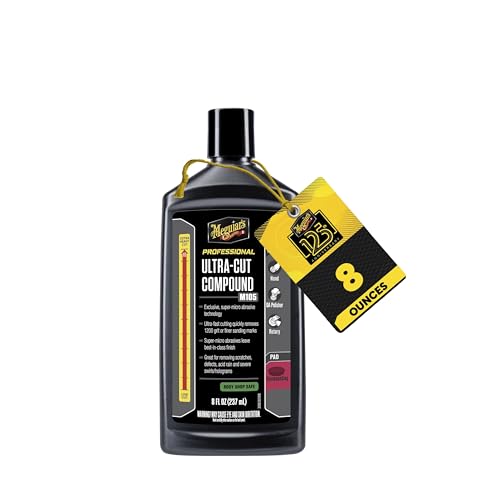
1. Meguiar’s Mirror Glaze M105 Ultra-Cut Compound
Our pick — 4.5★ from 10,500+ verified ratings; the strongest balance of quality and price.
The workhorse compound that cuts through wet sand marks and heavy scratches with precision.
This is the compound serious detailers reach for tackling moderate to heavy paint defects. It cuts through up to 1200 grit sanding marks — meaning after you wet-sand a scratch, this compound removes the sanding haze. The super micro-abrasive technology uses ultra-fine aluminum oxide particles to cut fast while minimizing further swirling, leaving a high-gloss finish that reduces the need for a separate polishing step. One buyer shared a detailed process: after wet sanding a repainted fender with 2000, 3000, 5000, and 7000 grit sandpaper, they applied the M105 by hand in circular motions with firm pressure, achieving a factory finish that matched the 12-year-old original paint.
At 0.6 pounds and measuring just 1.63 x 8.25 x 3.6 inches, the 8-ounce bottle is compact — that is a 5.1x difference in dimensions compared to the menzerna Heavy Cut 1000 (which measures 8.3 x 1.9 x 1.9 inches). The size is ideal for storage, but the 8-ounce volume means you should use it sparingly on spot repairs rather than whole-car correction unless you buy multiple bottles. Buyers also note it works great on bird dropping stains that nothing else could remove, leaving the finish perfect.
The M105 is clear coat safe on all glossy paint finishes, but it is an aggressive compound — you will need to follow with a finishing polish to remove any light haze left behind. That makes it a two-step product (compound then polish), unlike the 3D Speed All-In-One which finishes and protects in one step. However, for those who need serious cutting power, the M105 delivers faster scratch removal than the ABRO Rubbing Compound, which is better suited for light oxidation and faded paint.
Why detailers keep it
- Cuts through up to 1200 grit sanding marks — ideal after wet sanding a scratch or repainted panel
- Micro-abrasives leave a high-gloss finish that needs less follow-up polishing than typical compounds
- Versatile application by hand, dual-action polisher, or rotary buffer
Do not ignore this
- Still requires a finishing polish to eliminate light haze for a perfect mirror shine
- 8-ounce bottle is small — heavy users may need to stock multiple bottles for a full car
Ideal for: anyone who has wet-sanded a scratch or repainted a panel and needs a compound that can remove up to 1200 grit sanding marks efficiently.
Not ideal for: a quick one-step fix — you will need a finishing polish to get rid of the compound haze.
2. Griot’s Garage BOSS Correcting Cream
The daily-driver savior that wipes away swirls without leaving a dusty mess behind.
You get a rich, high-lubricity formula that stays wet longer, meaning you can work each panel longer before the compound dries out and dusts up. The correcting cream uses an aluminum-oxide abrasive rated at 120 grit (a moderately aggressive cut) and is designed to remove moderate defects like light scratches and swirl marks while adding clarity to the paint. At a full 16-ounce bottle, you get nearly double the volume of many competitors in this segment.
Buyers report that on a 12-year-old Acura MDX with black paint, the cream removed surface swirls and light scratches, restoring a dull finish to a mirror shine after four to five passes per panel with a microfiber cloth. Unlike some compounds that turn to dust if you pause, the extended buff cycle here keeps it workable. The Cream is part of the BOSS system, so you can pair it with a firmer foam pad (like the Fast Correcting Foam Pad) for deeper defects or a softer pad for lighter polishing — giving you dial-in control without switching products.
One honest trade-off: the 120-grit rating means this is a mid-level cut, not a heavy compound — deep scratches that have gone through the clear coat will still need sanding before this product can finish them. It is also 16 ounces (the same bottle size as the Chemical Guys V34), but the Chemical Guys V34 uses a 1500-grit abrasive (a 50% finer grit) and is specifically engineered for ceramic clear coats, making the Griot’s a better match for conventional paint finishes.
What makes it shine
- The extended work time prevents drying and dusting, so you can buff calmly across a whole panel without rushing
- No messy residue to wipe off — it wipes clean and leaves the paint glossy, not hazy
- Compatibility with different BOSS foam pads lets you increase or decrease cutting power from one bottle
Where it holds back
- Deep scratches that have cut through the clear coat require a heavier compound or wet sanding first
- Pairs best with a dual-action polisher; hand application works but takes more passes
Reach for this if: your daily driver has light to moderate swirl marks, water spots, or surface scratches and you want a low-dust, easy-wipe product that works with all common foam pads.
Look elsewhere if: you are tackling heavy sanding marks (1000 grit or coarser) or need a compound that works aggressively by hand with no dust at all.
3. Chemical Guys V34 Optical Grade Hybrid Compound

The clear-coat chemist that works specifically with modern high-tech paint finishes.
This compound stands out because it is engineered for scratch-resistant and ceramic clear coats — the paints on newer cars that tend to be harder than traditional finishes. The 1500-grit abrasives (compared to the menzerna Heavy Cut 1000’s 1000 grit) are 50% finer, so you get a moderate cut that removes 1500-2000 grit sanding scratches without over-aggressive cutting. At 658 grams (over twice the weight of the ABRO Rubbing Compound at 300 grams, a 2.2x weight gap), this 16-ounce bottle is substantial.
The formula contains no silicones or fillers, which is important if you plan to apply a ceramic coating or wax afterward — silicones can prevent those products from bonding correctly to the paint. It is also VOC compliant and body shop safe, so you can use it in a workshop environment without worrying about fumes. Owners mention that the extended work time gives you breathing room for larger panels, though the finer grit means you will need more passes on deeper scratches compared to an 1000-grit compound.
Unlike the 3D Speed All-In-One (which combines cut with wax in a single step), the V34 is a pure compound — you will still need a separate polish and wax to finish the job. That extra step is worth the effort if your car has a ceramic coating or you plan to apply one. The bottle shape (8.27 x 2.56 x 2.36 inches) is compact enough to store in a drawer but holds enough product for multiple full-car corrections.
Why it works
- Tailored for ceramic and hard clear coats that resist traditional compounds
- No silicones or fillers means a clean surface ready for coating or wax
- The 16oz bottle gives you plenty of product for multiple paint jobs
Where it takes longer
- Finer 1500-grit abrasive means slower cut on deeper scratches versus a 1000-grit compound
- Not a one-step product — requires a follow-up polish and wax for full gloss
Best suited for: owners of newer cars with ceramic- infused clear coats or anyone planning to apply a ceramic coating after paint correction.
Consider a heavier compound if: your paint has deep scratches, sanding marks from 1000-grit paper, or moderate to heavy oxidation.
4. 3D Speed All-In-One Polish & Wax

The weekend warrior’s shortcut that cuts light scratches and seals gloss in one pass.
If your car has minor swirl marks, light scratches, or dull paint and you want to fix it without breaking out three separate bottles, this is the one. The advanced formula uses cutting technology that corrects light imperfections while leaving a protective wax coat behind. It cuts down a 3-step process into a single application — no separate compound, then polish, then wax. Customers note that only three pea-sized drops per panel are enough, and the purple formula smells like grape while creating virtually no dust.
The key difference between this and the Griot’s Garage BOSS Correcting Cream is that the 3D Speed is an all-in-one, so the protective wax layer is baked into the product. That means you save time, but you sacrifice some correction ability — deep scratches or heavy oxidation will not get fully removed by this product. One reviewer noted they got best results after a clay bar treatment and a contact wash, which removes embedded contaminants before the polish tries to level the paint. Unlike the Meguiar’s M105 (which requires a finishing polish afterward), the 3D Speed leaves a glossy, protected surface immediately after wiping it off.
The 8-ounce bottle is small, but a little goes a long way — the same 24-year-old RV mentioned by one buyer had all swirl marks removed from its clear coat using just this product and a slow foam pad. It works on glass, painted trim, and headlights, making it more versatile than a dedicated compound. However, you should not expect it to handle deep scratches that require a heavy-cut compound like the menzerna 1000.
Why you will love it
- One bottle does the job of three — cut, polish, and protect in a single step
- Extremely low dust and easy wipe-off, perfect for beginners
- Works well by hand or with a dual-action polisher on any clear coat
What it cannot do
- Not aggressive enough for deep scratches, heavy swirls, or sanding marks
- The built-in wax may not last as long as a dedicated sealant application
Reach for this when: you need a quick, effective one-step solution for a daily driver with light defects and you want to save an afternoon of detailing.
Invest in a multi-step system if: your paint requires heavy correction, wet sanding removal, or professional-level gloss.
5. menzerna Polishing Set 3-Step System
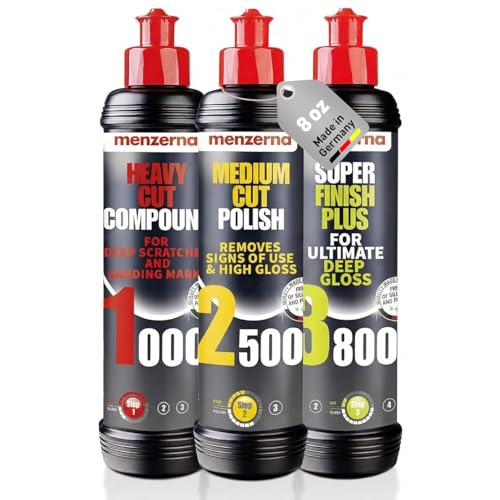
The full studio kit that walks your paint through heavy cut, medium polish, and mirror finish.
This is a three-bottle system (24 ounces total) designed for full paint correction: HCC1000 Heavy Cut Compound (1000 grit), MCC2500 Medium Cut Compound (2500 grit), and Super Finish 3800 (very fine finishing polish). The heavy cut handles deep scratches, the medium cut removes the haze left by the heavy cut, and the final finish creates a deep, radiant gloss. One buyer mentioned it knocked out door handle scratches on a black Tacoma and left a glassy look that neighbors asked about — and noted that a little product goes a long way on each panel.
The key advantage over buying individual bottles is that the abrasives are matched to each other, so you do not have to guess which polish follows which compound. The HCC1000 uses aluminum oxide abrasives similar to the standalone menzerna Heavy Cut Compound 1000, but the set includes the two follow-up steps that create a showroom-quality finish. By comparison, the Meguiar’s M105 (1200 grit) works best when followed by a finishing polish, but this kit provides that polish in the same package.
Reviewers point out that the material type (Zirconia Alumina for the final step) cuts down on sanding time and leaves a glass-like shine on epoxy resin projects, making this set versatile beyond automotive paint. The caveat: one owner reported a partially filled bottle in their set, so check each bottle when it arrives. Also, the 1000-grit heavy cut is aggressive — it requires a dual-action polisher for best results and can chew through paint if you stay in one spot too long.
What makes it a system
- Three matched steps ensure you remove scratches, then refine, then achieve a mirror-like finish without compatibility guesswork
- The 24-ounce total volume (three 8oz bottles) lasts through multiple full-car paint corrections
- Works on automotive paint, metals, plastics, and even epoxy resin projects
What to watch for
- Requires a dual-action or rotary polisher — not designed for effective hand application
- Inconsistent fill levels reported in some sets; inspect bottles on arrival
Go for this if: you want a complete professional-grade system for a full paint correction and you already own a machine polisher.
skip it if: you only need a simple spot-fix for a single scratch or you prefer to work by hand — a one-bottle compound will serve you better.
6. menzerna Heavy Cut Compound 1000
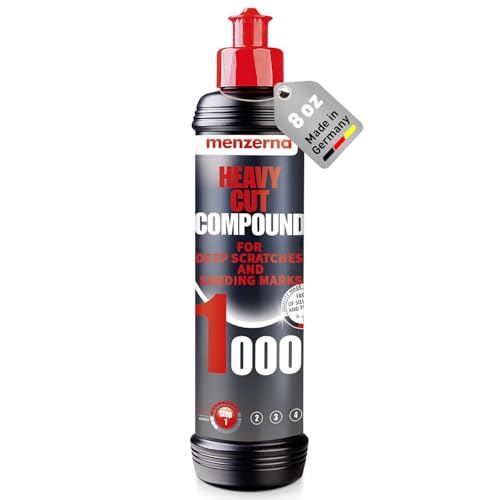
The scratch annihilator that flattened a granite scrape in minutes by hand.
If you have a deep scratch that needs aggressive cutting, this is the compound to grab. The 1000-grit aluminum oxide abrasive (compared to the Chemical Guys V34’s 1500 grit) cuts 50% more aggressively, so it removes deeper scratches in fewer passes. Shoppers say that it took out a long, deep scratch from a granite block on a car almost entirely — what remained was much lighter and barely noticeable. One user paired it with a cheap 3-inch foam buffing pad attached to a drill after wet sanding with 1500 grit paper and was impressed by the glossy, flat finish.
The bottle measures 8.3 x 1.9 x 1.9 inches (a 5.1x size difference compared to the Meguiar’s M105’s 1.63 x 8.25 x 3.6 inches). The narrow profile makes it easy to grip while squeezing out the 8-ounce (8 fl oz) content. Unlike the ABRO Rubbing Compound which dried too quickly (according to one review), the menzerna formula has a creamy consistency that spreads smoothly and does not dry into a chalky powder. It is also silicone-free, which is important if you plan to apply a ceramic coating or wax afterward.
The trade-off: an 1000-grit cut is heavy, so you should use light pressure and keep the pad moving. If you let the compound sit in one spot, it can haze the paint. The formula is beginner-friendly if you follow the criss-cross method (overlapping passes in a crosshatch pattern) but it works best with a machine polisher. For hand application, you may need to use a foam pad and work in small sections. Also, unlike the menzerna Polishing Set which includes matching medium and fine bottles, this 8-ounce bottle is just the heavy cut — you will need a separate product for finishing.
Where it excels
- The 1000-grit abrasive cuts fast, making short work of deeper scratches that finer compounds struggle with
- Silicone-free formula — safe to use before applying coatings or sealants
- The narrow bottle shape gives you a comfortable grip during use
What it leaves behind
- Aggressive cut means you need a finishing polish to restore full gloss and remove compound haze
- Not ideal for hand use on large panels — machine recommended for best results
Pick this for: deep scratches, touch-up paint overlap, or 1500-grit sanding marks that need fast removal with an 1000-grit cut.
Grab a finishing polish too: you will need it after this heavy cut to restore the mirror gloss.
7. ABRO Rubbing Compound 10 oz

The no-frills rescue for faded paint that strips oxidation without stripping your wallet.
ABRO’s rubbing compound is built for the specific problem of oxidized, dull, faded paint — the kind you see on a daily driver that has sat in the sun for years. At 300 grams (roughly 10 ounces), it is the lightest single bottle in this lineup and over twice as light as the Chemical Guys V34 at 658 grams (a 2.2x weight gap). The fine-grit formula uses aluminum oxide abrasives to cut through surface oxidation, paint transfer, and light scuffs without needing a machine polisher. One customer observed it removed a tree branch scrape after a clay bar treatment, and another said it works well on sun-faded clearcoat.
The key difference between this compound and the others is its aggressive nature at a budget price. Buyers warn that it dries quickly and has a fuel-oil smell, so work in small areas and use a damp microfiber cloth to extend the buffing time. If the product dries on the surface, you can use a little more of the compound itself to dissolve the dried patches. Unlike the 3D Speed All-In-One which combines cut with protection, the ABRO is a straight rubbing compound — you must follow with a polish and wax to protect the restored paint.
One cautious note from a buyer: the compound can remove clear coat if you let it sit in one spot, so use steady motion. The same reviewer mentioned it worked on rims and headlights, but took clear coat off a vehicle’s painted section when overused. That makes it a tool best reserved for experienced hands or for test spots before committing to a full panel. Compared to the Meguiar’s M105 which uses super micro-abrasives for a finer finish, the ABRO is more aggressive on oxidized paint but rougher on clear coats.
What it does well
- Effectively cuts through oxidation and faded paint on neglected cars
- Low price point and 10-ounce bottle offer good value for spot repairs
- Works on multiple surfaces including paint, rims, headlights, and plastic composites
Be careful with
- Dries quickly — requires a damp cloth and fast work to avoid residue patches
- Can chew through clear coat if you pause on one spot; best for experienced users
Best for: reviving the finish on an older car with oxidized, faded paint where you are comfortable with aggressive compounding and plan to polish afterward.
Look at a gentler compound if: your paint is in good shape with only light swirls or you are a beginner who does not want to risk clear coat damage.
Understanding the Specs
Grit Number & Cutting Power
The grit number on a compound bottle tells you how coarse the abrasive particles are — lower numbers (like 1000 grit) mean bigger particles that cut more aggressively but leave more haze. Higher numbers (like 1500 or 2000 grit) use finer particles that cut slower but leave a smoother surface. The spec matters because a 1000-grit compound will remove a deep scratch faster than a 1500-grit compound, but you will need to follow it with a finer polish to restore the gloss. For a car scuff remover, match the grit to the defect depth: light swirls need 1500-2000 grit, while touch-up paint sanding marks need 1000-1200 grit.
Application Method & Work Time
Not all compounds are created equal for how you apply them. Some formulas are designed for dual-action or rotary polishers and will dry out too fast if you try them by hand (the ABRO compound is a good example). Others, like the 3D Speed All-In-One, spread easily by hand because they have higher lubricity. The work time number is the window you have before the compound dries into dust — longer work times (like the Griot’s BOSS) mean you can buff larger panels without the product turning chalky. If you do not own a polisher, prioritize compounds that state they work by hand.
FAQ
Will a car scuff remover damage my clear coat?
Can I remove a scuff by hand without a machine polisher?
What is the difference between a rubbing compound and a polish?
How do I know what grit compound I need for my scratch?
Can I use a car scuff remover on plastic trim or headlights?
Do I need to wash my car before using a scuff remover?
How long does a car scuff remover take to work?
Is a multi-step polishing system better than a single compound?
Can I use a scuff remover on a freshly repainted panel?
Why does some rubbing compound smell like fuel oil?
Final Thoughts: The Verdict
For the majority of shoppers, the car scuff remover winner is the Griot’s Garage BOSS Correcting Cream because it combines a moderate cut with extended work time and low dust, making it effective and user-friendly for daily drivers with swirls and light scratches. If you want a complete showroom-grade system, grab the menzerna Polishing Set. And for a quick one-step fix on minor scuffs, the standout is the 3D Speed All-In-One Polish & Wax.
How We Picked
We do not accept paid placement. Every pick is matched to a real buyer and a real use-case; we do not hands-on test units.
Sources & Methodology
Specifications: manufacturer listings and product documentation. Review insights: verified customer reviews, as of July 2026. Pricing: not shown on this page (it changes often); check the current price via the retailer link.
As an Amazon Associate, Trending Car earns from qualifying purchases. This does not affect which products we feature.