
Our readers keep the lights on and my garage snacks stocked. As an Amazon Associate, I earn from qualifying purchases.
Specs are compiled from manufacturer listings and verified buyer reviews and can change over time — please confirm the key details on the product page before buying.
Slapping paint straight onto bare metal is a gamble. The real trick to a finish that lasts — one that doesn’t bubble, peel, or rust through in a year — is using a primer made to bite into raw steel, aluminum, or fiberglass. That is what a car primer for bare metal does: it etches the surface for grip and seals it against corrosion.
I’m Min Islam — the founder and writer behind Trending Car. This guide is built by comparing the manufacturers’ published specifications and the patterns across verified customer reviews, so you get each pick’s real strengths and trade-offs instead of marketing spin.
You will find nine primers, from self-etching aerosols to pro-grade two-part epoxy kits, and a clear breakdown of which one fits your project. This guide covers car primer for bare metal for patch repairs, full panels, and custom builds.
Our Picks at a Glance


How To Choose The Best Car Primer for Bare Metal
Not all primers are made to grab onto raw metal. A standard wood or wall primer will just flake off a steel panel. You need a formula that either chemically etches the surface (self-etching or acid-etch) or creates a tough, impermeable barrier (epoxy).
Self-Etching vs Epoxy Primer
Self-etching primers contain a mild acid that bites into the metal, creating a tight mechanical and chemical bond. They are excellent for bare steel and aluminum and can be topcoated quickly. Epoxy primers form a thicker, moisture-proof film and offer superior corrosion resistance, but they require more careful mixing and longer cure times.
Application Method: Spray Cans vs HVLP Kits
For a DIYer doing a small patch or a single panel, an aerosol can is the fastest route. Look for a “high atomization” or flat-fan nozzle for even coverage. For a full-car restoration or a project where durability is everything, a two-part epoxy primer you mix and spray through a gun gives you far better film build and a longer-lasting seal.
Coverage and Dry Time
A 12 oz can typically covers 10–16 square feet. For large panels or multiple coats, budget accordingly. Fast-drying primers can be sanded and topcoated within an hour, while 2K epoxies might need a full day or more to fully cure before sanding.
Quick Comparison
| Model | Best For | Type | Size | Dry Time | Amazon |
|---|---|---|---|---|---|
| SEM 39683 Grey Self Etching Primer★ Best Overall | Best Overall | Self-Etching | 15.5 oz | 3 hours | Amazon |
| Rust-Oleum Self Etching PrimerBudget Champion | Budget Champion | Self-Etching | 12 oz | — | Amazon |
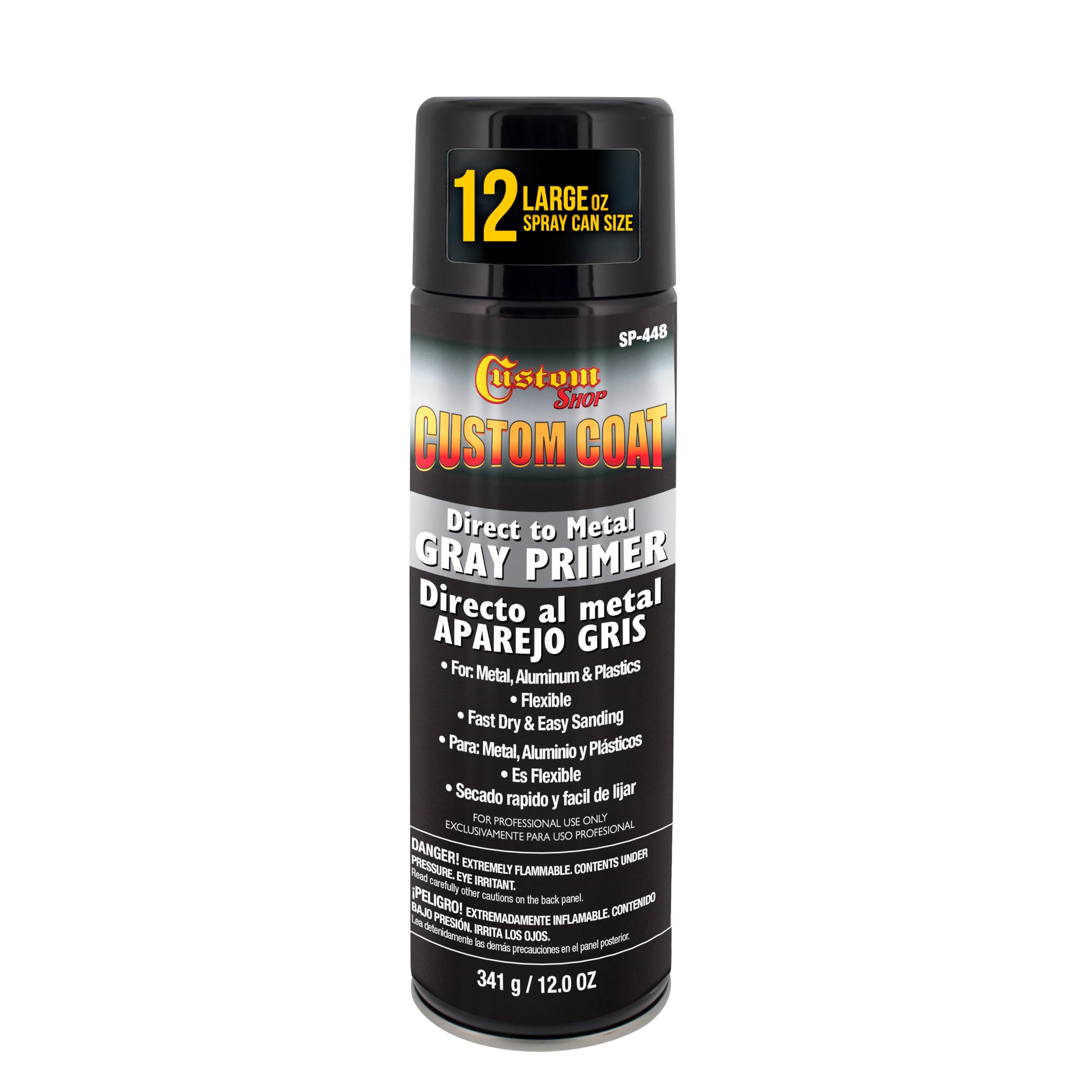
| Custom Shop 1K High Build PrimerHigh Build Filler | High Build Filler | High Build | 12 oz | — | Amazon |
| Custom Shop Self Etching Primer | No-Sand Etch | Self-Etching | 12.9 oz | — | Amazon |
| Raptor Acid Etch Primer | Heavy-Duty Adhesion | Acid Etch | 13.2 oz | 1 hour | Amazon |
| SprayMax 2K Epoxy Primer | Professional 2K | 2K Epoxy | 12.5 oz | 12 hours | Amazon |
| Eastwood 2K Epoxy Gray Primer | Premium Small Project | 2K Epoxy | 12 oz | 48 hours | Amazon |
| Custom Shop KEP Epoxy Primer | Bulk Epoxy Coverage | 2K Epoxy | 1 Quart | 1 hour dry | Amazon |
| Speedokote Epoxy Primer Kit | Full-Car Job | 2K Epoxy | 1.25 Gal | 3 days | Amazon |
In‑Depth Reviews
1. SEM 39683 Grey Self Etching Primer – 15.5 oz.
Our pick — over 4.5★ from 550+ verified ratings; the strongest balance of quality and price.
The self-etching benchmark that pro painters reach for first.
If you are restoring a classic car or fixing a rust patch on a daily driver, you want a primer that does not quit. The SEM 39683 is a self-etching formula that chemically bonds to bare metal, aluminum, and tin. It dries to the touch in about 3 hours and offers excellent coverage from its 15.5 oz can — which is roughly 20% more material than a standard 12.9 oz competitor, giving you noticeably more spray time per can.
What wins people over is the adhesion and the smooth surface it leaves behind. Owners consistently report that it creates a durable base for the topcoat, resists corrosion, and sprays on evenly without running. The crowd favorite — a 4.6-star score with over 500 ratings — backs this up. The most common trade-off is the spray nozzle itself. A small number of cans spit or sputter near the end, though as buyers report, “It did adhere though.” The consensus is clear: prepare the surface well, and this primer delivers professional results.
Why It Wins
- Superior adhesion to bare metal and aluminum
- 15.5 oz can delivers noticeably more coverage than similar primers
- Self-etching chemistry provides built-in corrosion resistance
- Quick-dry in roughly 3 hours
The Fit Note
- Occasional nozzle spitting near the end of the can
- Color is a dark grey (some owners note it appears nearly black on application)
Reach for this if: you want a proven, high-adhesion self-etching primer that works on bare steel, aluminum, and tin for restoration or repair work.
Look elsewhere if: you need a high-build filler to smooth deep scratches — this is an etching primer, not a build primer.
2. Rust-Oleum Self Etching Primer – 12 oz
The go-to budget can for boat, auto, and sign projects.
When you need a no-fuss self-etching primer for a weekend project, the Rust-Oleum 249322 is the standard pick. It is formulated to prepare bare metal, aluminum, and fiberglass for paint, and it carries a rust-resistant formula that helps stop corrosion before it starts. Owners praise the quality and its suitability for metal, with many noting it works great on surfaces like aluminum rims and outdoor signs.
The catch is consistency. About half of the feedback on adhesion and overall functionality is mixed — some cans perform flawlessly while others struggle to bond. The advice from the review pages is to lightly sand the surface first for best results. As owners mention: “Adheres beautifully to bare clean metal or painted surface if it has been lightly sanded.” This is a solid choice for light-duty repairs and small parts where the low entry point makes it worth a try.
Smart buy for: light-duty auto repairs, boat touch-ups, and metal signs where cost matters more than maximum adhesion depth.
Grab it for: the low-cost entry to self-etching technology on small metal projects.
Think twice if: you need guaranteed adhesion on a show-car panel — the mixed quality reports make it a risk for critical work.
3. Custom Shop 1K High Build Primer Spray Paint – 12 Oz Grey
The filler that turns minor scratches into a flat canvas.
This is not your standard etch primer. The Custom Shop 1K High Build formula is a “primer surfacer” designed to fill shallow scratches, sanding marks, and minor imperfections. It bonds directly to steel, aluminum, fiberglass, and urethane paints. The real selling point is the application: the high atomization nozzle lays down a wide fan pattern for even coverage, and the high-build formula lets you fine-sand it smooth once dry. As owners put it: “The high build feature allowed me to fine-sand out minor imperfections before applying base coat.”
The main risk is batch consistency. A few owners reported cans that sprayed black solids or clumps — a quality-control issue that appears to be sporadic. Most cans, however, spray smooth and do not clog. For the price, this is a strong choice when you need a primer that also acts as a light body filler.
Why You’d Want It
- High-build formula fills light scratches and minor imperfections
- Flat fan nozzle for wide, even coverage
- Direct-to-metal application with no extra prep step
- Sands easily to a smooth finish
Watch Out For
- A small number of defective cans with clumps and spatters
- Not a dedicated etching primer — use on properly prepped metal
Perfect if: you are repairing a panel with light pitting or scratches and want one product to fill and prime in one step.
skip it if: you need the deep chemical etch of an acid primer for a smooth, non-porous metal surface.
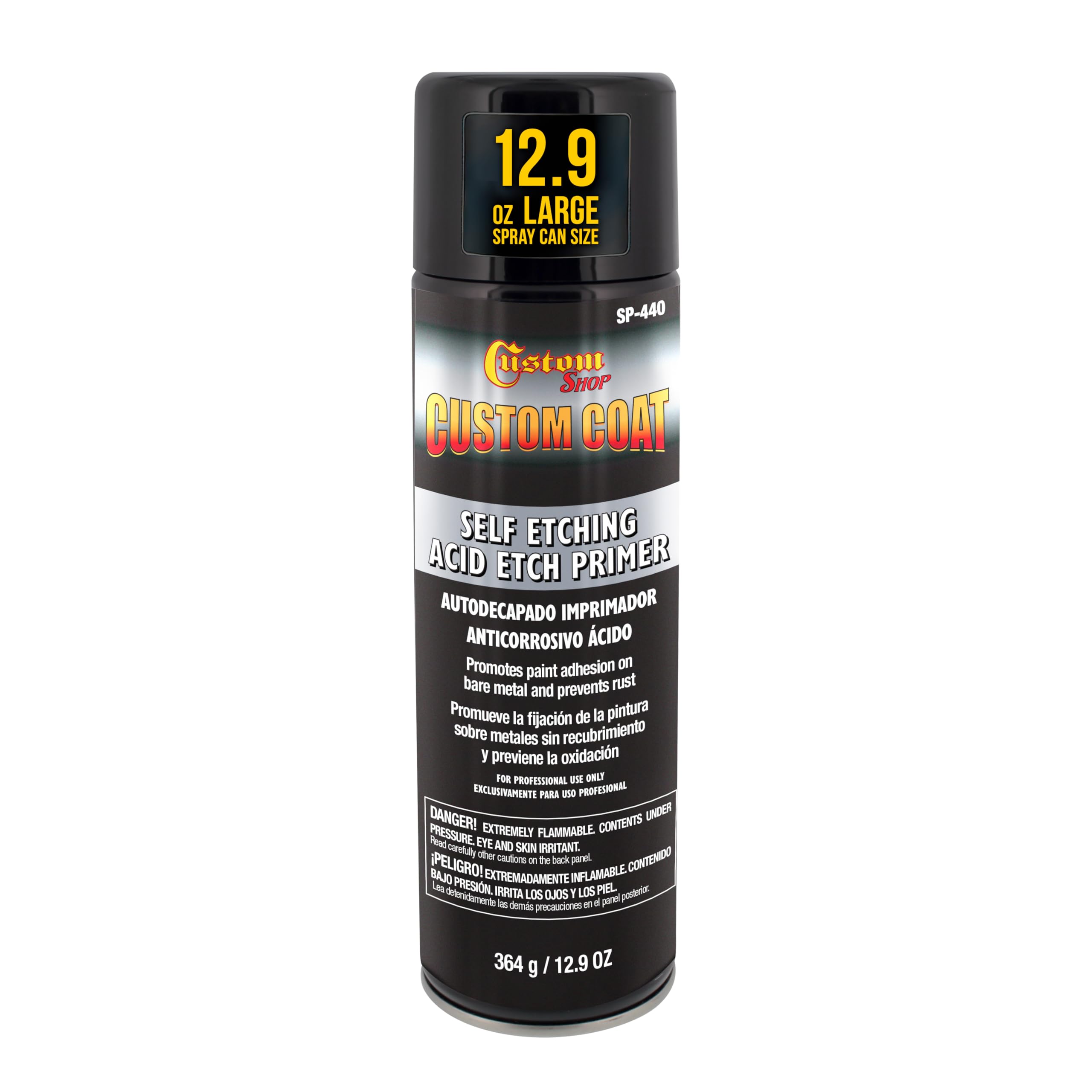
4. Custom Shop Self Etching Primer Spray – 12.9 oz Gray
A self-etching spray that skips the sanding step.
This is a dedicated acid-etch primer that uses phosphoric acid to bite into steel, aluminum, and stainless steel. The standout benefit is the “no-sand” finish — it lays down a super smooth surface that is ready for a topcoat without sanding. The high-atomization nozzle delivers a large fan pattern for consistent coverage, and it works with major bed liner brands like Raptor if you are prepping a truck bed. Owners on both steel and aluminum report excellent adhesion with a single coat, and the can goes a long way.
Quality and application are the top praises, but drying time gets mixed marks — it dries fast, but you have to spray in even passes to avoid runs on the first coat. The advice from owners who have used it: practice on a scrap piece first to get your spray consistency dialed in. For the money, this is a solid mid-range pick for anyone who wants a true self-etching primer without the extra sanding labor.
The honest trade-off: fast-drying formula requires a steady, even hand — beginners should test on scrap first to avoid runs.
Best for: someone who wants a true acid-etch primer on steel or aluminum but wants to skip wet-sanding before the topcoat.
Not ideal if: you are a first-time sprayer who prefers a slower-drying, more forgiving primer.
5. Raptor Acid Etch Primer 1K Aerosol – 13.2 oz Gray

The acid-etch staple for bumpers, rails, and hard-use metal.
Raptor is a name you see a lot in the truck and off-road world, and this acid etch primer is why. It uses a phosphoric acid ester formula to bond aggressively with tough surfaces like galvanized steel and aluminum. It etches and primes in one step, creating a rust-resistant barrier. The flat fan nozzle gives a wide, even spray pattern, and it is dry enough for a topcoat in roughly one hour. Quality control and performance are its top strengths — with hundreds of positive ratings backing it up.
The recurring gripe is the nozzle: multiple customers note that the tip clogs during use, which can ruin a coat mid-project. The workaround is to clear the nozzle immediately after each pass. Despite this, the primer itself performs well on aluminum and bare metal, with owners noting excellent coverage and long-lasting adhesion. If you are prepping running boards, bumpers, or a truck bed for a Raptor liner, this is the primer to use.
What owners love: the rust protection and adhesion on tough substrates like galvanized steel. The nozzle clogging is a real annoyance — keep a can of cleaner nearby.
Reach for it if: you are prepping metal for a Raptor bed liner or need a reliable etch primer for hard-use parts.
pass on it if: you do not want to deal with potential nozzle clogs during application.
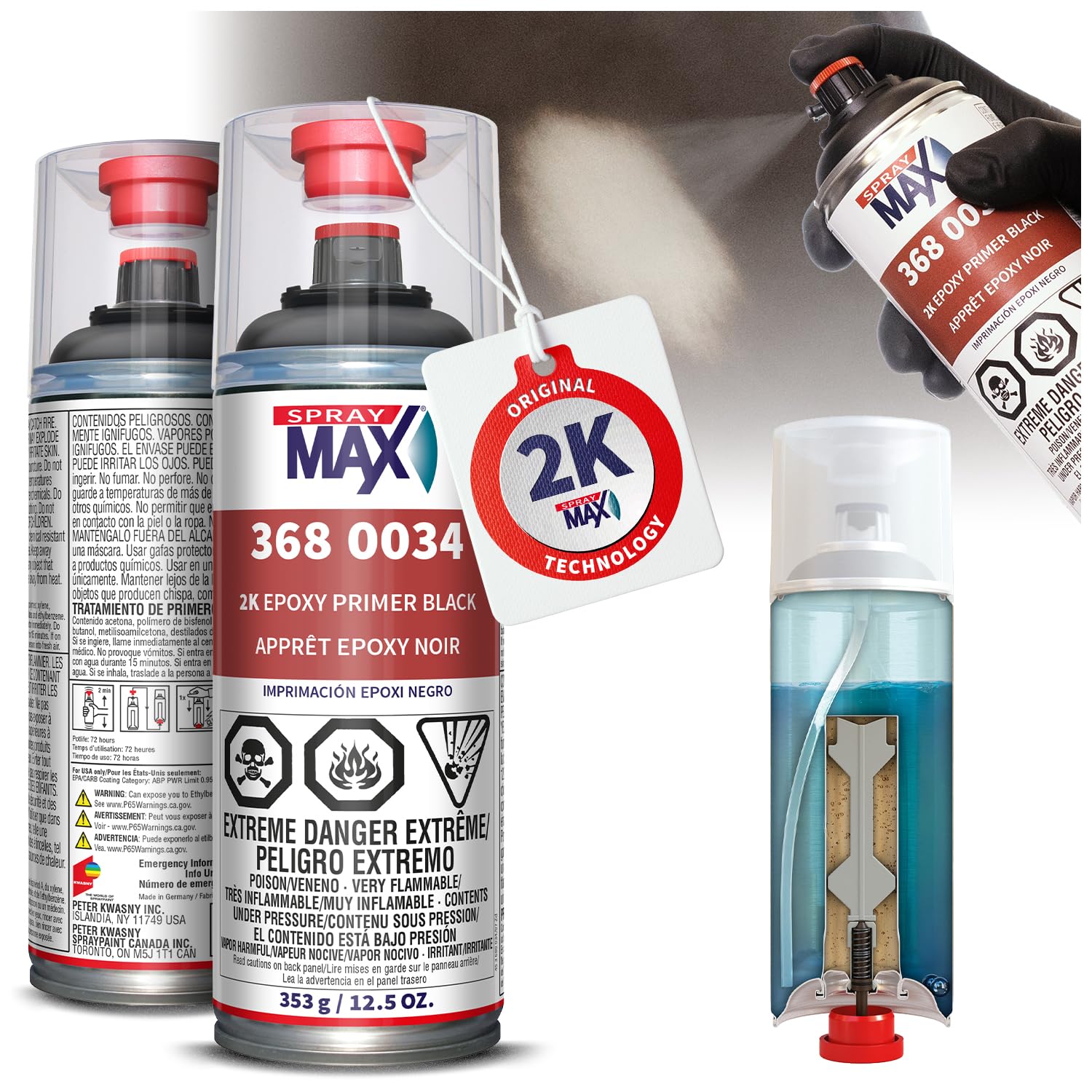
6. SprayMax 2K Epoxy Primer Black – 12.5 oz
A true 2K epoxy in a can for serious corrosion protection.
This is the step up from a single-stage self-etching primer. The SprayMax 2K Epoxy is a two-component system (the hardener is activated inside the can) that provides professional-grade bonding strength and a thick, moisture-proof seal. It excels on steel, aluminum, and galvanized metal, making it a top choice for cars, motorcycles, and full restorations. It is dust-dry in just 15 minutes and ready to sand within hours, which keeps your workflow fast. Owners who use it on motorcycle tanks and fenders praise the smooth laydown and the lack of runs or clogs.
The main caveat is that spray performance can be mixed. While many cans spray perfectly, a notable number of reviewers point out poor atomization or sputtering toward the end of the can. The coverage is also on the lighter side — one can might not cover a full car door in two coats. For the price, you are paying for 2K chemical resistance in a convenient rattle can, not for maximum square footage per dollar.
Why To Buy
- Professional 2K epoxy bonding strength in a rattle can
- Dust-dry in 15 minutes for fast recoating
- Smooth, hard finish that holds up to topcoats and weather
- Excellent for sealing fiberglass and bare metal on motorcycles
What To Know
- Coverage is less than a standard primer — budget 2-3 cans for a full panel
- Mixed reports on spray consistency from can to can
- Full cure takes 12 hours before sanding
Best for: the DIY builder who wants a 2K-quality seal on a motorcycle tank, fender, or small car part without buying a spray gun setup.
Not for: large-area work on a budget — you will need multiple cans, and the cost per square foot climbs fast.
7. Eastwood 2K Epoxy Gray Primer – 12 oz

The small-can 2K epoxy that covers a 2-foot square like a pro.
For a small patch repair or a component like a door or fender, the Eastwood 2K Epoxy Gray Primer is a precise tool. It uses a two-component formula with a 48-hour pot life once activated, meaning you can use the can over a couple of days. The specially engineered nozzle sprays in a wide fan pattern that reduces the learning curve you get with a standard rattle can. The coverage is rated for 10 to 16 square feet, which is accurate — one can is perfect for a roughly 2-foot square area.
Quality and adhesion are the top praises from owners, with the primer laying down flat and smooth. The drawback is that it is pricey per square foot compared to larger kits. The Eastwood website has helpful application guidance, but the spray performance gets mixed reviews — some users find it sprays beautifully, others report it dusts everywhere if not held at the right distance. If you are doing a single small panel and want the best chemical resistance, this is a tidy solution.
Best used for: a small 2-foot square repair, a motorcycle part, or a custom bracket where a full quart would be wasteful.
Reach for this if: you need a premium 2K epoxy for a small area and do not want to mix a full quart kit.
Look elsewhere if: you are painting a large panel — 2 cans will be needed, and the cost adds up fast.
8. Custom Shop Black Epoxy Primer/Sealer 2.1 VOC – 1 Quart Kit

A mixing-kit epoxy that seals bare metal and fiberglass for full panels.
This is the real deal for serious work. The Custom Shop KEP Series is a 2.1 VOC epoxy primer that mixes 1 part primer to 1 part hardener. It is designed for direct-to-metal application on steel, aluminum, and fiberglass. Once mixed, you have a 4-hour pot life to spray it. The formula dries to the touch in about an hour and can be topcoated in 30 minutes if you use it as a sealer with reducer. Owners who use it properly report a durable, easy-to-sand finish that seals well.
The catch is mixing. Several shoppers say stubborn solids at the bottom of the can that require aggressive mixing — a paint shaker may not be enough, and manual stirring for 10 minutes is common. A small number of cans arrived dented, making the lid seal difficult. For the price per quart, this is a cost-effective way to cover a whole car with a quality epoxy, but you need to commit to thorough preparation and the right spray equipment (HVLP gun).
What Works
- Excellent adhesion to bare metal, fiberglass, and rigid plastics
- Fast dry time — topcoat-ready in 30 minutes when used as sealer
- 1:1 mix ratio is simple and precise
- Anti-corrosive formula with good salt spray resistance
What Requires Care
- Pigment solids can settle hard — expect 10 minutes of manual mixing
- Best suited for HVLP spray gun, not beginner-friendly
- A few units arrive with damaged cans and poor seals
Best for: someone with a spray gun and a full car or boat project who wants a budget-friendly 2K epoxy with solid reviews.
it’s not for you if: you are looking for a shake-and-spray aerosol — you need proper mixing equipment.
9. Speedokote Epoxy Fast Dry 2.1 DTM Primer & Sealer Gray Gallon Kit

The gallon-sized epoxy kit for when you are painting the whole vehicle.
When a 12 oz can feels like an eyedropper, the Speedokote SMR-260G is the answer. This is a gallon kit (1.25 gallons of mixed material) of fast-dry, low-VOC epoxy primer that serves as both a primer and a sealer. It uses a 4:1 mix ratio with an optional reducer, and it lays down super smooth through an HVLP gun. The adhesion to steel, aluminum, and fiberglass is excellent, and it sands like a proper 2K primer. Owners who use it for full car projects praise the smooth spray and the coverage.
The big concern is can fill consistency — some buyers report the can is not a full gallon, leaving you short on hardener. There is also a documented case where the primer blew off bare metal after a two-week cure at 28 PSI, though the company’s customer service eventually resolved the issue. Full cure takes 3 days, so this is not a quick weekend job. If you are doing a full restoration and are comfortable with spray equipment, this kit offers the best value for your dollar.
For the serious restorer: the price per square foot is excellent for a true 2K epoxy, but checking the fill level before mixing is worth the extra step.
Ideal if: you are tackling a full-car respray or a large boat project and want professional-grade epoxy adhesion without the pro-shop price.
Avoid if: you only need a small patch repair — a gallon kit is overkill and the material has a limited shelf life once opened.
Understanding the Specs
Self-Etching vs Acid-Etch
Both terms are used interchangeably. A self-etching primer contains a mild phosphoric acid that chemically “bites” into the metal surface, creating a mechanical bond for the paint to stick to. This is the essential technology for any car primer for bare metal, because regular primer cannot bond to a smooth, non-porous metal surface.
Epoxy Primer (2K)
“2K” means two components: a primer resin and a hardener (activator) that you mix together. Once mixed, you have a limited time — called “pot life,” often 4 to 48 hours — to use it. Epoxy primers create a thick, tough, moisture-proof film that offers the best corrosion resistance. They are the standard for professional restorations.
High Build Primer
A high-build primer (or “primer surfacer”) is thicker than a standard etch primer. It is designed to fill light scratches, sanding marks, and minor pitting, creating a flat surface before your color coat. It is typically applied over an etch primer, but some formulations can go direct-to-metal.
VOC and Dry Time
VOC (Volatile Organic Compounds) is a measure of the solvents in the paint. Lower VOC (like 2.1) means fewer fumes but can affect flow-out. Dry time varies widely: a self-etching aerosol can be dry in 3 hours, while a 2K epoxy might need 12 hours to 3 days for a full cure before wet-sanding.
FAQ
Can I use a regular primer on bare metal?
Do I have to sand bare metal before applying self-etching primer?
How long does self-etching primer take to dry?
Can I apply body filler over self-etching primer?
What is the difference between a 2K epoxy primer and a 1K self-etching primer?
Is a self-etching primer the same as a rust converter?
How much primer do I need for a full car?
Can I paint over self-etching primer with any topcoat?
Does self-etching primer work on aluminum?
Can I use a self-etching primer on plastic?
Final Thoughts: The Verdict
Across the board, the car primer for bare metal winner is the SEM 39683 because it delivers reliable, professional-grade adhesion at a fair price with a generous 15.5 oz can. If you want a budget-friendly self-etching spray for light-duty projects, grab the Rust-Oleum Self Etching Primer. And for a full restoration where you need maximum rust protection, the Speedokote Epoxy Primer Kit is the one to reach for.
How We Picked
We do not accept paid placement. Every pick is matched to a real buyer and a real use-case; we do not hands-on test units.
Sources & Methodology
Specifications: manufacturer listings and product documentation. Review insights: verified customer reviews, as of July 2026. Pricing: not shown on this page (it changes often); check the current price via the retailer link.
As an Amazon Associate, Trending Car earns from qualifying purchases. This does not affect which products we feature.