
Our readers keep the lights on and my garage snacks stocked. As an Amazon Associate, I earn from qualifying purchases.
Specs are compiled from manufacturer listings and verified buyer reviews and can change over time — please confirm the key details on the product page before buying.
The fastest way to wreck a car’s paint isn’t a crash—it’s a thousand tiny swirls from bad washing. A true polish or compound physically removes a thin layer of clearcoat to level those scratches out. This guide separates the gentle finishers from the aggressive cutters so you can match the product to your paint’s actual condition.
I’m Min Islam — the founder and writer behind Trending Car. This guide is built by comparing the manufacturers’ published specifications and the patterns across verified customer reviews, so you get each pick’s real strengths and trade-offs instead of marketing spin.
To hide light swirls or cut out deep scratches, you need a car polish for scratches that matches how much paint you are willing to remove and how you plan to apply it.
Our Picks at a Glance


How To Choose The Best Car Polish for Scratches
Your first decision is severity. A light swirl or a water spot only needs a fine finishing polish. A key scratch down to the primer needs a heavy-cut compound first, then a finer polish to restore gloss. Grab the wrong grade and you either waste time or shave off more clearcoat than necessary.
Polish vs. compound — the cutting scale
Compounds contain larger abrasive particles that cut fast and leave a haze. Polishes use finer grit to refine that haze into a deep shine. Many jobs need both steps. A product like the Griot’s BOSS Correcting Cream sits in the middle, removing moderate defects while leaving enough gloss that you can often skip the second step.
Grit number and work time
The grit rating tells you how aggressive the abrasive is. Lower numbers cut harder, higher numbers finish finer. Work time matters just as much. A formula that dries out mid-pass drags on the paint and creates dust, so a longer buff cycle actually protects your clearcoat while you learn the motion.
Application method — hand vs. machine
A dual-action (DA) polisher spreads the product evenly and removes defects faster. Hand application works for small spots but tires your arm on a full panel. Some formulas are built specifically for machine use, with a “high-lubricity” body that resists drying. Check the bottle before you commit to a full day of buffing.
Quick Comparison
| Model | Best For | Cutting Grade | Size | Primary Use | Amazon |
|---|---|---|---|---|---|
| Griot’s BOSS Correcting Cream★ Best Overall | Moderate defects & swirls | Medium (Grit 120) | 16 oz | Machine polish | Amazon |
| Chemical Guys V34Premium Pick | Ceramic clear coats | Medium (Grit 1500) | 16 oz | Machine compound | Amazon |
| 3M Perfect-It EXFinishing Expert | Final ultrafine polish | Fine (Ultrafine) | 16 fl oz | Machine finish | Amazon |
| Malco Super Duty | Heavy sand scratches | Heavy (Grit 800) | 32 fl oz | Rotary & wool pad | Amazon |
| RUPES D-A Coarse | Moderate to severe defects | Coarse (Grit 1500) | 8.5 oz | DA polisher only | Amazon |
| menzerna Super Finish 3800 | Deep gloss on dark paint | Fine (Medium) | 8 oz | Machine or hand | Amazon |
| menzerna Heavy Cut 1000 | Scratches & signs of use | Heavy (Grit 1000) | 8 oz | Machine or hand | Amazon |
| Meguiar’s M06 Cleaner Wax | Light oxidation & one-step | Mild (Cleaner wax) | 16 oz | Hand or buffer | Amazon |
| ABRO Rubbing Compound | Oxidized, faded paint | Fine (Grit Clay) | 10 oz | Hand or machine | Amazon |
In‑Depth Reviews
1. Griot’s Garage BOSS Correcting Cream
Our pick — over 4.5★ from 850+ verified ratings; the strongest balance of quality and price.
A high-lubricity formula that removes moderate swirls with minimal dust.
Its extended work time and easy wipe-off win over even the most doubtful users. The high-lubricity formula keeps working up to 8 passes without drying out, so you can actually finish a panel before the product turns to powder. Buyers report taking a 12-year-old black Acura MDX from dull to a mirror finish in just 4-5 passes, with easy wipe-off and minimal dust.
The “BOSS” system (Best of Show System) lets you adjust how aggressively it cuts simply by swapping pads. Use a firmer pad for deeper defects or a softer one for light polishing. It uses Aluminum Oxide abrasives at a medium grit rating of 120, which is the balance for moderate scratches and swirls on most clearcoats.
It pairs with the BOSS Fast Correcting Foam Pad, and owners say it works fine with a standard orange pad too. The bottle design aids application, and it plays well with a ceramic wax on top. The only recurring note is that it’s not for deep gouges—those still need sandpaper first.
Why owners love it
- Extended work time means no premature drying
- Restores black paint to a mirror finish in a few passes
- Minimal dust and easy wipe-off
- Versatile across pads for different defect depths
The honest limits
- Not effective on deep scratches that need wet sanding
- Requires a machine buffer for best results
Reach for this if: you have moderate swirls and light scratches on a daily driver and want a forgiving, dust-free buffing session.
Look elsewhere if: you are chasing deep stone chips or scratches you can catch with a fingernail—that’s a heavier compound’s job.
2. Chemical Guys V34 Optical Grade Compound
Engineered for the tough ceramic clear coats that shrug off ordinary polishes.
Modern ceramic-infused clearcoats are harder than traditional paint, and standard polishes bounce right off them. The V34 is formulated specifically for those scratch-resistant surfaces, cutting through 1500-2000 grit sanding scratches with a medium 1500 grit abrasive. Owners describe it cutting through medium to fine scratches “like butter.”
The formula is silicone-free and body shop safe, so it won’t contaminate a panel before repainting. It’s VOC compliant too. Combined with the V32 and V38 from the same line, it revived a neglected car that sat 18 months and went unpainted. The extended work time keeps it from drying out mid-pass.
The trade-off is dust. Owners consistently flag significant dusting during application, which means more cleanup after each section. But the scratch-removal results—especially on a black 06 Jetta with moderate swirls—keep owners coming back. It’s a genuine two-step system: cut with this, then finish with a finer polish.
What wins people over: the scratch-removal is the headline—owners specifically call out how it handles medium to fine defects on ceramic clearcoats without leaving haze.
The catch: plan for dust. It produces a significant amount during buffing, so keep a microfiber towel handy and work in a ventilated space.
Best suited for: owners of new cars with ceramic clearcoats who need a compound that can actually bite into that hard paint.
Not the pick if: you hate cleanup—the dusting here is more than most competitors.
3. 3M Perfect-It EX Ultrafine Machine Polish
The last step that erases every trace of your earlier buffing mistakes.
If you’ve just used a heavy compound, you’ve left behind a haze of fine swirls that a regular wax can’t hide. This 3M polish is the fix. It’s 3M’s highest-performing machine polish for removing ultrafine swirl marks, and owners confirm it delivers zero swirls on black paint—the toughest color to finish clean.
The formula holds better on polishing pads, which means less sling, less mess, and less cleanup time. Its longer wet time also means technicians use less material, so a 16 fl oz bottle goes further than you’d expect. Owners mention it works brilliantly not just on cars but also on epoxy tables.
Note the label: this is for industrial and occupational use, not consumer sale. It’s a true professional product. It’s not a cutter—deep scratches need a compound first. But for the final correction step that takes a good job to a showroom-grade finish, owners call it the best finishing polish they’ve tested.
Performance is the story: owners rate this as the best final-step polish they’ve tried, with machine application maximizing gloss and removing fine halos.
The honest trade-off: it’s priced at the premium end for a smaller bottle, and it won’t remove deep scratches on its own—pair it with a cutting compound.
Grab this if: you want a flawless mirror finish on dark paint and already plan a two-step correction.
skip it if: you are looking for a single bottle to fix deep scratches—this is the refinement stage, not the cutting stage.
4. Malco Super Duty Heavy Cut Compound
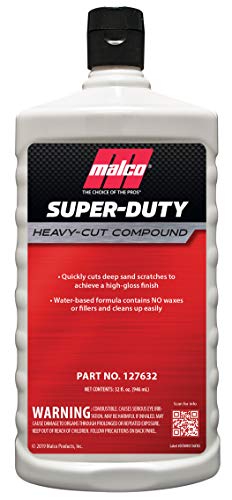
A 32-ounce workhorse that cut through a severely oxidized 2008 Honda Accord.
This is for the paint that looks beyond saving. The Malco Super Duty is a heavy-cut compound built to remove 800-grit sand scratches and heavy oxidation from clear coat, gel coat, and even marine surfaces. Owners have used it to restore severely oxidized paint on a 2008 Honda Accord with just an orbital buffer and wool pad, saving the finish entirely.
It’s made in the USA and clear coat safe, so it won’t chew through your paint if you follow the instructions. Owners note it works fast—one detailer switched from a different brand because it was “working me to death” before the Malco made the difference night and day. The 32 fl oz size is nearly double the standard bottle.
The formula is aggressive and best paired with a Malco 100% twisted white wool cutting pad. Owners warn it leaves some residue and can be hard to remove if you overwork it, and it dusts less than some competitors but still needs attention. It’s not ideal for soft clearcoats, where it can leave sand marks.
The strengths
- Huge 32 fl oz bottle for heavy projects
- Removes P1500 and finer sand scratches effectively
- Restores badly oxidized paint to a high-gloss finish
- Made in the USA
Who should pause
- Residue hardens if you overwork a section
- Better with a wool pad than a foam pad
For the patient restorer: this is the heavy artillery for oxidized paint and deep sanding marks on cars, trucks, or boats.
Think twice if: you have soft clearcoat—this can leave sand marks rather than polishing them out.
5. RUPES D-A Coarse Cut Polishing Compound
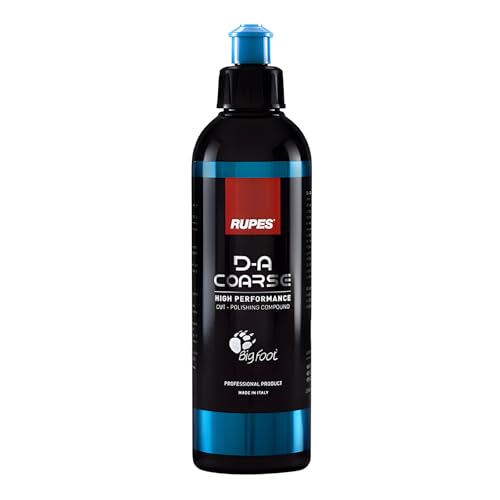
A low-dusting compound that delivers a deep, wet gloss on moderate to severe defects.
RUPES is a name that dominates professional paint correction, and this coarse compound lives up to the reputation. Owners call it “the best compound I’ve ever used” and rave about the deepest, wettest shine they’ve achieved. A few dabs on the pad makes the surface come super smooth, removing blemishes and light scratches.
It’s formulated for all dual-action polishers, including large-stroke random orbital and gear-driven types. The coarse 1500 grit is designed for moderate to severe defect removal, but the micro-abrasive technology keeps the finish surprisingly refined. It works best with the RUPES coarse blue foam pads, DA wool pads, or coarse microfiber discs.
The low-dusting formula reduces cleanup after use, a real bonus compared to dustier competitors. One owner paired it with a coarse cutting pad on a random orbital sander with impressive results. This is a single-stage product for serious correction, not a one-step for light swirls.
The buzz is real: owners consistently describe this as superior to other compounds, with the deepest gloss they’ve seen from a cutting product.
The fine print: it demands some skill and the right tools—”works perfectly if you have some skills”—so beginners should practice on a test panel first.
Best for the enthusiast: who already owns a DA polisher and wants a professional-grade cut with minimal dust.
Not for hand application: this is a machine-only compound, so pass on it if you plan to buff by hand.
6. menzerna Super Finish Plus 3800
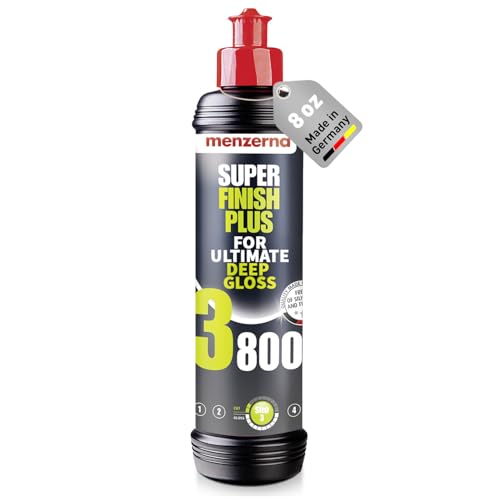
A finishing polish that makes dark paint look like a show car’s mirror.
Menzerna has been refining polishing expertise for over 130 years, and the Super Finish Plus 3800 is their finishing masterpiece. It’s a polish-glaze hybrid with no abrasives, designed to deliver the deepest possible shine on darker colored coats. Owners rave that the finish exceeds showroom sheen, with a crisp depth that’s hard to believe.
It’s particularly brilliant at removing holograms and micro-abrasions left by heavier compounds. One owner used it after a rotary polish with Meguiar’s and saw crisp results with a long working time. It’s beginner-friendly too—you can polish by hand for quick fixes or use it with the green Soft Cut Foam Pad on an orbital machine.
The formula is silicone-free and works wonders beyond cars. Owners have used it to remove scratches from a resin bathtub by hand and to give headlight lenses their final high gloss. This is a finishing polish, so it doesn’t protect—you’ll need a wax or sealant on top.
Its magic
- Delivers class-leading depth on dark and black paint
- Removes holograms and micro-scratches easily
- Long work time with easy removal
- Works by hand or machine
The limits
- No protection—you must follow with wax or sealant
- Not a cutter for deep scratches
This is the final touch: for owners who already did the heavy cutting and want a flawless, glass-like finish on dark paint.
it’s not for you if: you need scratch removal power—this refines gloss, it doesn’t cut defects.
7. menzerna Heavy Cut Compound 1000
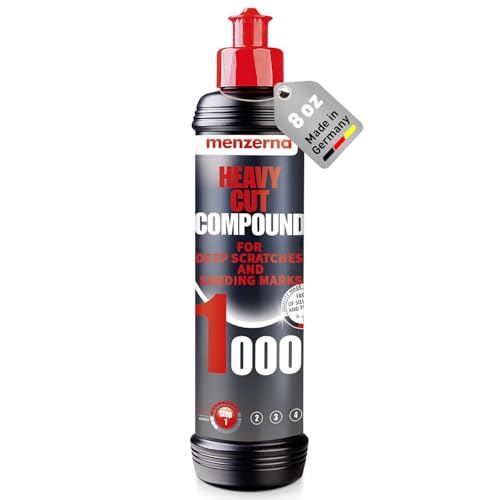
Surprisingly forgiving for a heavy cutter—even works by hand with a cloth.
Most heavy compounds demand a machine and steady hands. The menzerna Heavy Cut 1000 is different. Customers note removing scratches with just a cloth and no buffer, with almost no effort. That’s rare for a 1000-grit abrasive compound, and it makes this a genuine option for DIYers who don’t own a polisher.
It’s designed to remove scratches and signs of use, compatible with the red Heavy Cut Foam Pad for orbital or rotary machines. One owner used it with a cheap 3-inch foam pad attached to a drill after 1500-grit wet sanding and took out a lot of scratches, leaving the paint glossy and flat. A long, deep scratch from a granite block was reduced to barely noticeable.
The trade-off is the finish. Some reviewers point out it leaves a haze that needs a finishing polish to clear up, so it’s best as the first step in a two-stage correction. As a cutter, it impresses—one owner described it as “magic”—but it’s not a one-step product.
The standout quality: it cuts fast and well, impressing owners with how easily it removed scratches after touch-up paint and wet sanding.
What to know: it may leave a haze on some paints, so budget for a finishing polish afterward.
Choose this if: you want a heavy cutter that still works by hand for spot corrections.
Pair it with: a finishing polish—the haze it can leave needs a second step to reveal full gloss.
8. Meguiar’s M06 Cleaner Wax

A cleaner, polish, and wax in one bottle for the time-pressed owner.
Meguiar’s has been in the game since 1901, and the M06 Cleaner Wax distills that expertise into a single step. It cleans, polishes, and protects in one application, removing light oxidation, light swirls, and mild defects. For a daily driver that just needs a quick refresh, this is the fastest path to a glossy finish.
Owners praise its cleaning performance, noting it removes bugs from the hood and smoothes paint on an older truck. It creates a long-lasting, high-gloss finish with a reflective shine. It’s formulated for hand, rotary buffer, or DA polisher, so you can use whatever you have on hand.
The honest limit: it’s a cleaner wax, not a true polish. It won’t fix deep scratches or heavy oxidation. For those, you need a dedicated compound first. But for light swirls and everyday grime, owners find it easy to apply and remove, with beautiful long-lasting results and good value.
Why it’s so handy
- One-step clean, polish, and protect
- Removes light oxidation and mild swirls
- Works by hand or machine
- Long-lasting high-gloss finish
Its ceiling
- Not a true scratch remover for deeper defects
- Needs multiple applications on tough spots
Perfect for the maintenance wash: when you want a quick gloss boost and light swirl removal without a multi-step session.
Not enough if: your paint has visible scratches—this is a cleaner wax, not a compound.
9. ABRO Rubbing Compound

The aggressive entry-level cutter that’s excellent on sun-faded paint.
For paint that looks chalky and tired, the ABRO Rubbing Compound is a fast-cut solution that won’t break the bank. It’s designed for dull, faded, weathered, or oxidized paint that needs stronger correction than a basic polish. Shoppers say excellent results on sun-faded and oxidized clearcoat, with one calling it “excellent on hail damage with rust.”
It targets scuffs, swirls, and light scratches, plus paint transfer and stains from daily driving. It works by hand for spot correction or with a buffer for larger panels. The formula spreads smoothly and cuts efficiently, buffing off cleanly with minimal residue. It’s body shop safe and silicone-free.
The honest warnings: this is a cut compound only—it has no polish or wax built in. It’s aggressive, so owners warn not to linger on one spot, as it can cut through paint on rough areas. It also dries slightly during use, so work in small sections. Use it as the first step, then follow with polish or wax.
The biggest praise: it’s excellent on sun-faded and oxidized clearcoat, handling even hail damage with rust when other products fail.
The catch: it’s aggressive—”do not linger on one spot”—and it’s a cut-only product, so you’ll need a separate polish and wax afterward.
Reach for this if: you have a neglected car with heavy oxidation or paint transfer that needs a serious first cut on a budget.
look elsewhere if: you want a one-step product—this demands a follow-up polish and wax to finish the job.
Understanding the Specs
Grit rating and cutting power
The grit number tells you how aggressive the abrasive is. A lower number like 800 cuts harder and removes more paint, while a higher number like 1500 finishes finer. Matching the grit to your scratch depth prevents you from removing more clearcoat than necessary on light swirls.
Polishing compound vs. finishing polish
Compounds cut fast and leave a haze behind. Polishes use finer particles to turn that haze into a deep gloss. Many correction jobs need both steps: a compound to level the scratch, then a polish to restore shine. Some products, like a cleaner wax, combine light cleaning with protection but lack real cutting power.
FAQ
Will car polish remove deep scratches down to the primer?
Can I apply car polish by hand instead of with a machine buffer?
What is the difference between a rubbing compound and a polishing compound?
How do I know what grit rating my scratches need?
Why does some polish dust up and dry out during use?
Is a cleaner wax the same as a polish for scratches?
Do I need to wax after polishing my car?
Will polishing work on ceramic or scratch-resistant clear coats?
Final Thoughts: The Verdict
If you want one dependable pick, the car polish for scratches winner is the Griot’s Garage BOSS Correcting Cream because it balances impressive cutting power with a forgiving, dust-free work time that suits both beginners and pros. If you want the professional finishing step that erases every trace of buffing marks on black paint, grab the 3M Perfect-It EX. And for heavily oxidized paint that needs serious correction on a budget, the ABRO Rubbing Compound is the one to reach for. With nearly 900 owners rating it 4.8 stars, the Griot’s is a reliable first choice for serious paint restoration.
How We Picked
We do not accept paid placement. Every pick is matched to a real buyer and a real use-case; we do not hands-on test units.
Sources & Methodology
Specifications: manufacturer listings and product documentation. Review insights: verified customer reviews, as of August 2026. Pricing: not shown on this page (it changes often); check the current price via the retailer link.
As an Amazon Associate, Trending Car earns from qualifying purchases. This does not affect which products we feature.