
Our readers keep the lights on and my garage snacks stocked. As an Amazon Associate, I earn from qualifying purchases.
Specs are compiled from manufacturer listings and verified buyer reviews and can change over time — please confirm the key details on the product page before buying.
Every time you drive behind a diesel truck or through a construction zone, that stale, dusty air is pouring straight into your car’s cabin. The one part standing between your lungs and that exhaust is a humble, pleated rectangle hiding behind your glove box. This guide cuts through the spec-sheet noise to show you which replacement actually fits, which one kills odors, and which one you will never have to buy again.
I’m Min Islam — the founder and writer behind Trending Car. This guide is built by comparing the manufacturers’ published specifications and the patterns across verified customer reviews, so you get each pick’s real strengths and trade-offs instead of marketing spin.
If your AC blows musty air or you want a cleaner commute, the right car cabin air filter depends on three things: how it fits your car, what it filters with, and how often you plan to replace it.
Our Picks at a Glance

How To Choose The Best Car Cabin Air Filter
The cabin air filter is the unsung hero of your car’s HVAC system. It scrubs pollen, dust, exhaust fumes, and even mold spores out of the air before they hit your face. Choosing the right one matters because a filter that fits poorly lets unfiltered air sneak past the edges, while a cheap paper filter does nothing for the diesel smell on your commute.
Decide between plain paper, carbon, and HEPA
Standard pleated paper filters catch dust and pollen but let gases and odors pass right through. Activated carbon filters add a layer that traps smells, fumes, and harmful gases, which is why they dominate the premium end of the market. For allergy sufferers, a HEPA-rated filter traps far more microscopic particles, but it may restrict airflow slightly because the media is denser.
Know your vehicle and the replacement interval
Fit is everything. A filter that is even a fraction of an inch too long may require trimming, while one that is too small lets dirty air bypass the media entirely. Check your owner’s manual for the location, then use the vehicle fitment tools on the product page to confirm compatibility. Plan to swap it every 12 months or every 12,000 miles to keep the air fresh.
Weigh the upfront cost versus long-term value
Disposable carbon filters cost more than paper ones but handle odors far better. A washable filter costs more upfront but gets reused for the life of the vehicle, which changes the math entirely if you plan to keep the car for years. Consider how often you drive in heavy traffic, dusty roads, or wildfire-prone areas, because those conditions clog filters faster.
Quick Comparison
| Model | Best For | Filtration Media | Weight | Dimensions | Amazon |
|---|---|---|---|---|---|
| Mann-Filter CUK 2939★ Best Overall | VW/Audi OEM-grade fit | Activated Charcoal | 0.21 kg | 11.42″L x 8.66″W | Amazon |
| BOSCH 6089C HEPAAllergy Pick | Allergy relief for Kia Soul | HEPA Multi-layer | 3.2 oz | 8.46″L x 6.69″W | Amazon |
| Spearhead BE-966 | Long-lasting GM/Honda odor control | Coconut Carbon | 4.8 oz | 9.45″L x 8.07″W | Amazon |
| Purolator PBC35667 | Budget-friendly Toyota value | Paper + Carbon | 6.4 oz | 8.46″L x 7.48″W | Amazon |
| FRAM CF10285 | Baking-soda odor neutralizer | Arm & Hammer Carbon | 3.2 oz | 8.47″L x 7.64″W | Amazon |
| JOGOAUTO H436 | Subaru owners wanting HEPA | Carbon + Meltblown | — | 8.47″L x 7.32″W | Amazon |
| K&N VF1013 | Lifetime washable value | Washable Polyurethane | 10.88 oz | 11.4″L x 7.7″W | Amazon |
In‑Depth Reviews
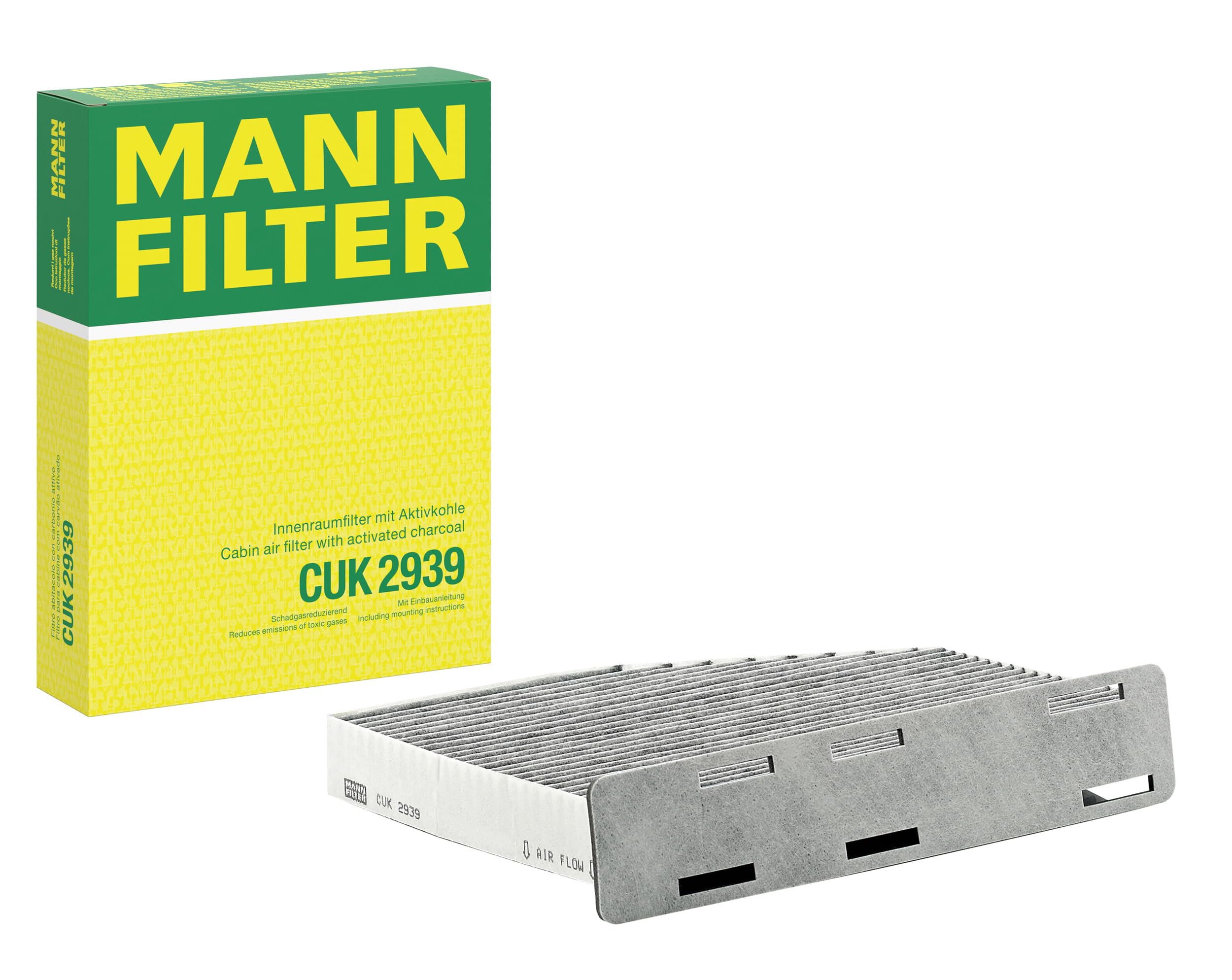
1. Mann-Filter CUK 2939 Cabin Filter With Activated Charcoal
Our pick — over 4.5★ from 9,500+ verified ratings; the strongest balance of quality and price.
The Audi and VW drop-in that ends musty-car syndrome without any trimming.
For anyone driving a VW or Audi, the biggest fear when buying a replacement filter is that it won’t seat perfectly in the factory slide-in slot. The Mann-Filter CUK 2939 removes that worry entirely — buyers report “Easy install, perfect fit” and describe it popping in exactly like the original, with no forcing. Its 11.42″L x 8.66″W frame is built to match the OEM dimensions precisely.
The activated charcoal layer is what makes the real difference in your daily drive. It filters pollen, spores, dust, and harmful gases while keeping airflow resistance low, so your AC vents still push strong air. The electrostatic and mechanical filtration combo keeps catching particles consistently across the entire service interval, not just when it’s fresh from the start.
What stands out most across owner experiences is how the charcoal handles musty smells. Multiple VW owners note it eliminated that stale odor and noticeably improved cabin air quality, with one calling it hands-down one of the best cabin air filters they’ve used. The 0.21 kg weight is typical for a carbon filter and makes it a great choice for the German-brand crowd.
What Owners Rave About
- Perfect OEM-grade fit for VW and Audi models without trimming
- Activated carbon kills musty smells and road odors
- Low airflow resistance keeps the AC blowing strong
Who Should Look Elsewhere
- Fitment is locked to VW and Audi — check compatibility first
- Paper-based frame needs careful handling during install
Reach for it if: you drive a VW or Audi and want a drop-in filter that kills odors from the start.
One real catch: it’s not a universal size, so verifying fitment for your exact model year is essential.
2. BOSCH 6089C HEPA Cabin Air Filter
The Kia Soul filter that traps 99.97% of airborne junk for allergy-prone drivers.
If spring pollen turns your commute into a sneezing fit, this Bosch is the pick that targets that specific problem. It’s a true HEPA filter — short for High Efficiency Particulate Air — rated to capture 99.97% of particles at 0.3 microns, which covers the fine dust and allergens that standard paper filters let straight through. For Kia Soul and Soul EV owners from 2014 through 2019, this is a direct, verified fit.
The build quality backs up the HEPA claim. A melt-blown electrostatic layer plus a dense media and an added static cotton layer work together to trap more particles with higher capacity. Owners mention noticeably cleaner air and a big drop in dust and pollen odors, and the filter’s structural ribs keep it stable over its lifetime so it doesn’t sag or collapse.
You can swap this one yourself in about 15 minutes—it’s a glove-box job. Customers note airflow stays strong after install, and one reviewer noted it cleared a stubborn bad smell in a 2018 Kia Soul. It weighs just 3.2 ounces, slimmer than the Spearhead’s 4.8 ounces, and its 8.46″L x 6.69″W frame is 12% smaller—so it fits your car precisely, not just the biggest option on the shelf.
Why It Wins
- HEPA-rated 99.97% capture at 0.3 microns for serious allergy relief
- Slides into the Kia Soul glove-box slot with exact fit
- Triple-layer media traps dust, pollen, and odors
The Trade-off
- Only fits select Kia Soul and Soul EV models
- A few owners found the size off — verify trim level
The verdict: a HEPA upgrade for Kia Soul drivers who feel every bit of spring pollen.
Think twice if: you don’t drive a Soul — the fitment list is narrow.
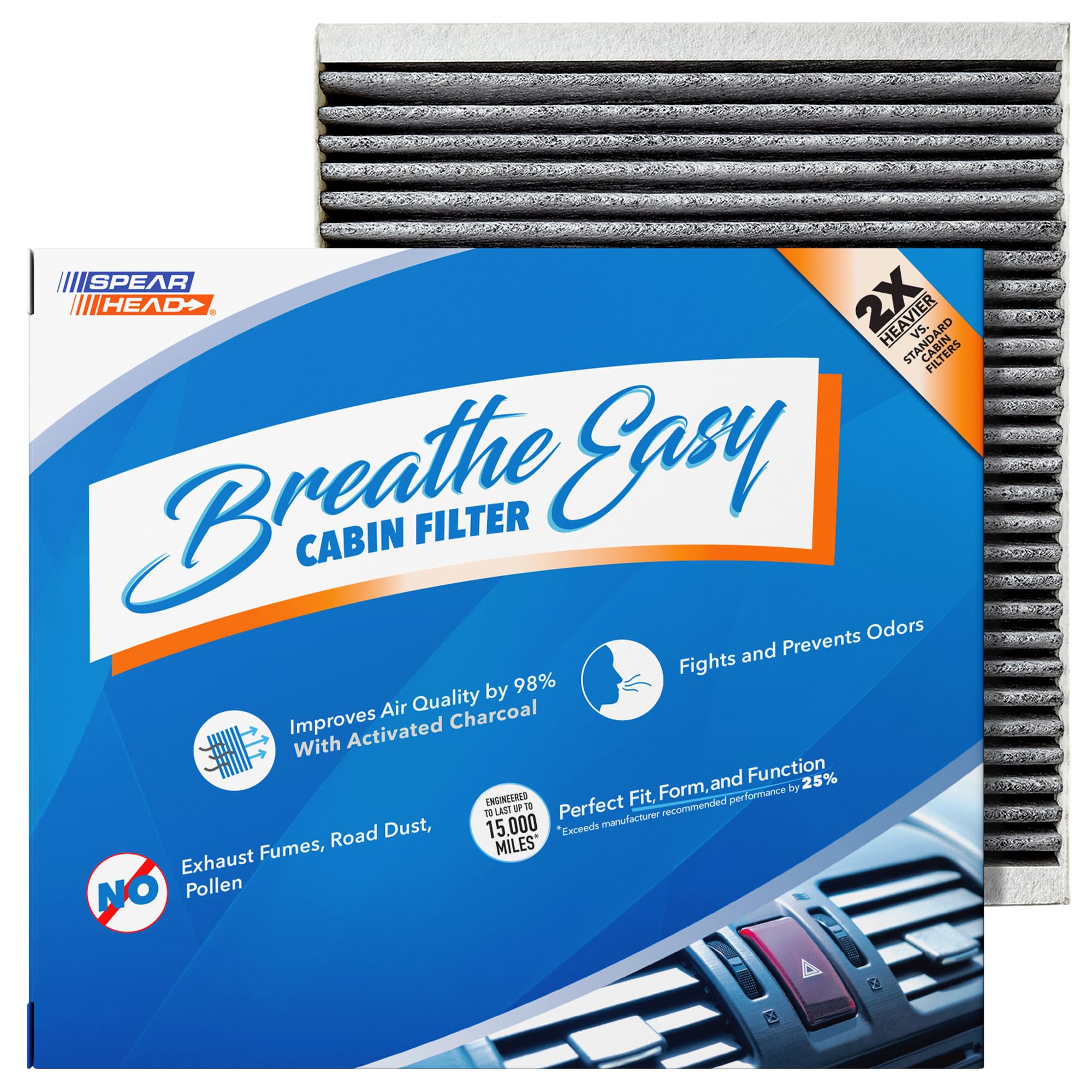
3. Spearhead Odor Defense Breathe Easy Cabin Air Filter (BE-966)
A longer-lasting carbon filter that spans GM, Honda, and Chevy models alike.
If you hate the annual reminder that your filter is due for a swap, this Spearhead stretches the time between changes. It’s engineered to last up to 15,000 miles — 25% longer than the 12,000-mile standard — thanks to a precision-woven media infused with real coconut shell activated carbon. That extra life is the headline feature, and owners consistently confirm it delivers.
The compatibility list is enormous, covering Acura, Honda, Buick, Cadillac, Chevrolet, and GMC across dozens of model years up to 2025. The media is 2X heavier than a standard cabin filter, with thick industrial-strength electrostatic layers that attract tiny particles while the densely packed carbon adsorbs gases and odors before they reach the cabin. Owners describe the result as fresher, cleaner vent air that removes musty smells.
What reviewers point out most is that it matches dealer quality at a fraction of the hassle. A 2016 Hyundai Sonata Hybrid owner noted it’s the same material as the dealer part, installs tool-free with no skills needed, and removes odors. There’s an occasional note that a specific trim ran a hair too long and needed slight trimming, so double-check fitment. At 4.8 ounces and 9.45″L x 8.07″W, it’s heavier and larger than the Bosch above, which suits its longer service life.
What Wins People Over
- Runs 15,000 miles — 25% longer than standard filters
- Massive GM, Honda, and Chevy model coverage
- Tool-free install that owners call perfect fit
Who It Isn’t For
- A rare trim fitment issue required minor trimming
- Heavier construction is overkill for short leases
Pick this if: you want maximum time between swaps across a wide range of American and Honda vehicles.
Mind this: verify your trim level, since a small share of owners needed adjustment.
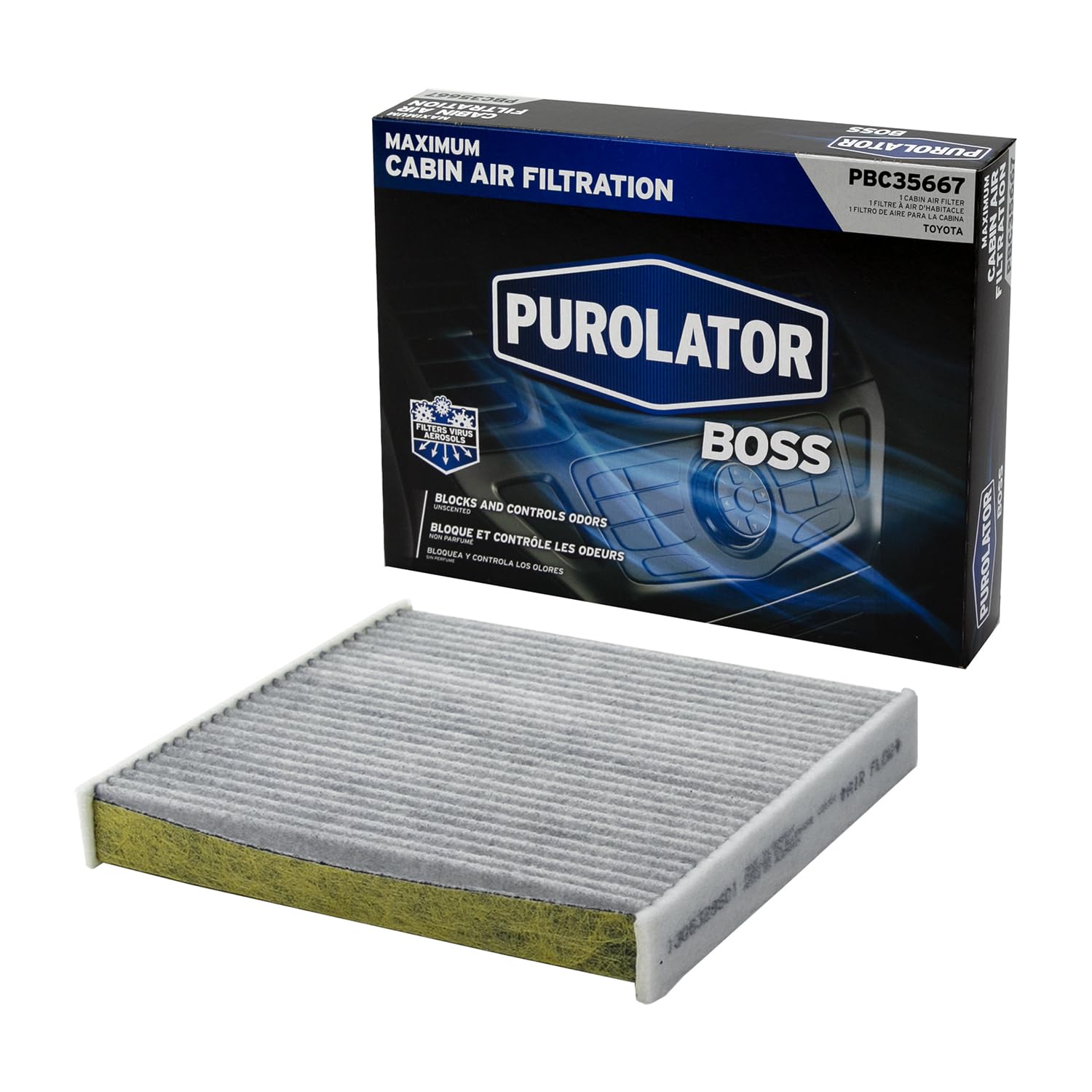
4. Purolator PBC35667 PurolatorBOSS Cabin Air Filter
The budget carbon filter that handles Toyota’s biggest sellers with room to spare.
Toyota drivers who want carbon odor control without a premium price will find this PurolatorBOSS fits the bill. It fits the 2006-2018 RAV4, 2007-2017 Camry, and 2009-2019 Corolla, among others, using electrostatically-charged micro fibers (fibers that attract particles like a magnet) to trap microscopic dust, odors, and fumes. The activated carbon layer also inhibits bacteria and mold growth on the filter surface.
The value proposition here is strong. A 2016 Corolla owner swapped it in under five minutes with no tools and called the fit perfect, while another said it’s a stronger filter than the original. The mold-fighting carbon earned praise from a truck owner whose cabin smelled musty — the smell disappeared right after the change. Buyers consistently describe it as good quality for the money.
This filter doubles as a way to protect your AC system. By limiting dirt buildup inside the HVAC, it helps prolong the system’s lifespan., and the exact OEM fit keeps filtration consistent through the full service interval. At 6.4 ounces with dimensions of 8.46″L x 7.48″W, it’s heavier than the Bosch but built for a different, Toyota-centric buyer.
Solid value play: a carbon filter for Toyota’s most common models that installs in minutes and hides no surprises.
Reality check: fitment gets mixed feedback on some trims, so confirm via the fit tool before ordering.
5. FRAM Fresh Breeze Cabin Air Filter CF10285

The only filter that bakes Arm & Hammer baking soda right into the media.
FRAM’s Fresh Breeze line stands alone because it’s the only cabin filter built with Arm & Hammer baking soda combined with carbon embedded in the pleats. That baking soda is the key to its a neat extra: neutralizing odors rather than just trapping them. Owners consistently report a clean, fresh cabin smell that persists weeks after install, without any artificial scent.
The numbers back the quality. It carries a MERV 13 rating — a scale that measures how well a filter catches airborne particles — so it handles pollen, dirt, and even wildfire smoke far better than a basic pleated filter. The compatibility list is huge, spanning Toyota, Lexus, Subaru, Scion, and even Land Rover and Jaguar models, which makes it a versatile pick for multi-car households.
Installation is genuinely easy, with most owners finishing in five minutes behind the glove box. A 2009 Camry owner saved over versus the dealer, and a 2010 Subaru Legacy owner praised the perfect fit. The only minor gripe is that no airflow arrow is printed on the filter, so first-timers may need a quick online check. At 3.2 ounces it matches the Bosch’s light weight, but the 8.47″L x 7.64″W frame fits a broader cross-section of vehicles.
Best scent control here: baking soda embedded in the media neutralizes smells that plain carbon filters miss.
The small ask: check airflow direction online before install, since the arrow isn’t printed on the frame.
6. JOGOAUTO H436 Cabin Air Filter

A HEPA-style upgrade for Outback and Crosstrek owners who want dealer-grade air.
Subaru drivers looking for better-than-stock filtration will find a lot to like here. The JOGOAUTO H436 uses a dual filtration system built from activated carbon and melt-blown fabric — the same dense media used in HEPA filters — to boost particle capture and odor reduction. Owners describe it as looking, feeling, and working better than the stock filter, with one noting it captures almost everything from outside.
The fitment list covers the popular Subaru lineup: 2020-2025 Outback, 2018-2023 Crosstrek, 2019-2025 Ascent, 2017-2023 Impreza, and 2020-2025 Legacy. A 2017 Outback owner called the fit perfect, and a 2025 Hyundai Ioniq 5 owner even confirmed it fits that EV too, noting the activated charcoal layer reduces cabin odors. The cross-brand compatibility is a bonus for households with mixed fleets.
Installation takes under five minutes, which is why owners keep pointing out the labor savings. One owner noted the dealer quoted to change the filter; this DIY swap cost just the price of the part and five minutes of effort. The 8.47″L x 7.32″W frame is sized for the Subaru slot, and the melt-blown layer gives it a denser feel than a plain paper filter.
What Stands Out
- Dual-layer carbon and melt-blown media for better capture
- Perfect fit across the modern Subaru lineup
- Sub-five-minute install that skips dealer labor costs
Keep In Mind
- Fitment is Subaru-focused despite the Ioniq 5 bonus
- Denser media may slightly reduce airflow on max fan
Grab it for: a Subaru Outback, Crosstrek, or Ascent where you want HEPA-style media without the price of a dealer part.
Consider before buying: the dense melt-blown layer trades a little airflow for better filtration.
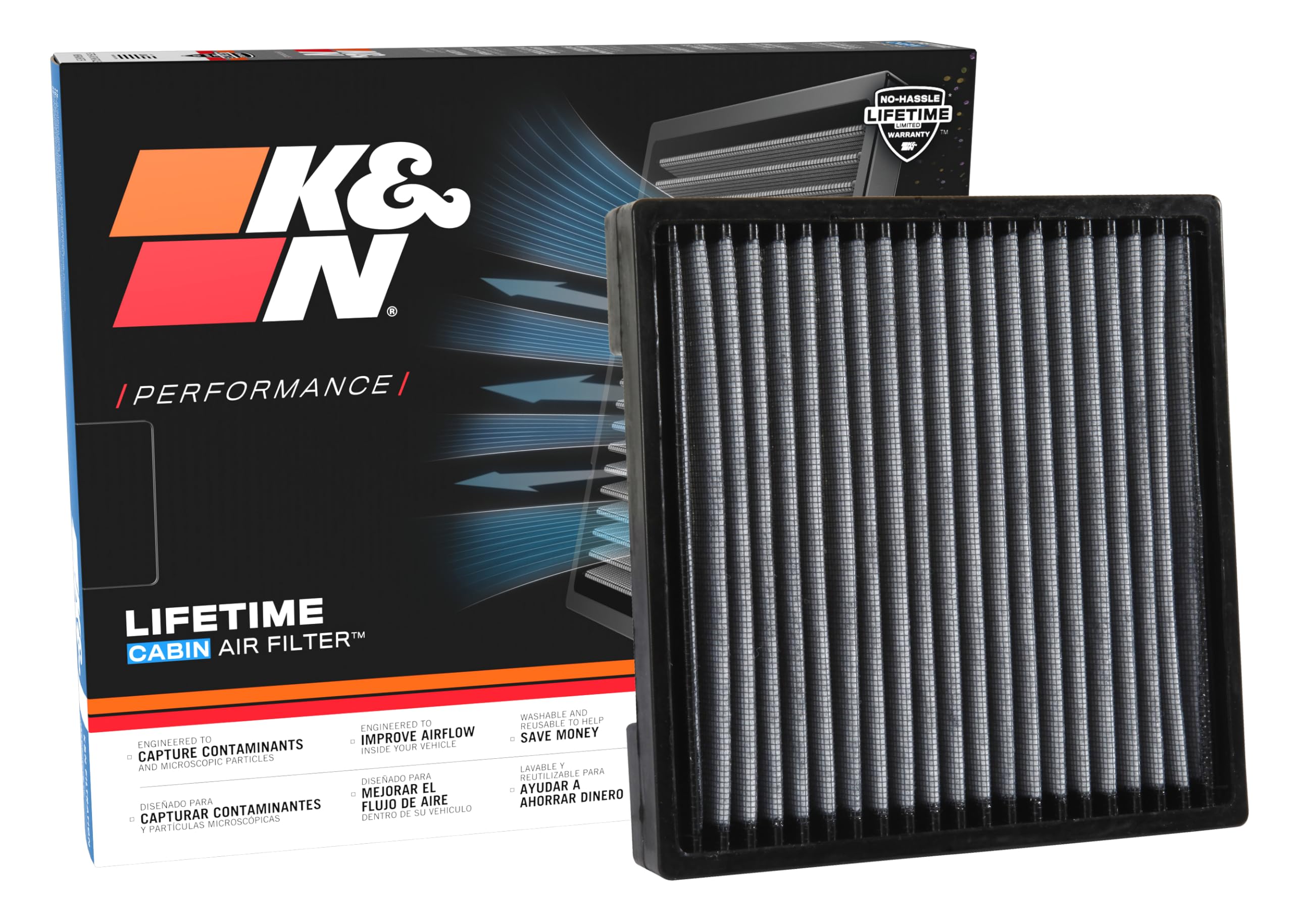
7. K&N VF1013 Lifetime Cabin Air Filter
The filter you buy once and wash for the life of the car.
This is the last cabin filter you may ever need to purchase. The K&N VF1013 is a washable, reusable filter made from polyurethane that’s engineered to last for the life of your vehicle. Instead of throwing out a clogged filter every year, you rinse it, re-oil it, and drop it back in. Shoppers say doing exactly that — one owner noted they no longer need to buy cabin filters at all.
The design focuses on airflow. K&N’s increased airflow improves heating and cooling efficiency, which means your HVAC system works less hard to push air through the cabin. The filter is pre-treated to prevent bad odors, tackling the musty smell that dirty disposables cause. Owners describe a direct fit and easy cleaning and reuse.
Compatibility covers a wide swath of Toyota, Subaru, Suzuki, and Scion models, including the 2013-2025 Subaru BRZ and 2022-2026 Toyota GR86. A 2024 GR86 owner called the fit perfect, and a 2018 Toyota 86 owner noted it’s exactly what they expected from K&N. At 10.88 ounces and 11.4″L x 7.7″W, it’s the heaviest and largest filter here — a consequence of the thick, washable media that holds its shape.
The Big Win
- Washable and reusable — no annual replacement purchases
- High airflow improves HVAC heating and cooling efficiency
- Pre-treated to fight musty odors
The Commitment
- Requires a refresher kit for periodic cleaning and re-oiling
- Higher upfront cost than any disposable on this list
Best for: long-term owners who plan to keep their Toyota or Subaru for years and want to stop buying disposables.
The catch: you must maintain the wash cycle with the refresher kit, so it’s not for set-and-forget types.
Understanding the Specs
Activated Carbon vs. Plain Paper
Standard pleated paper traps dust and pollen but lets gases and odors pass straight through. Activated carbon adds a porous layer that adsorbs fumes, exhaust, and musty smells. If you drive in traffic, near farms, or through wildfire smoke, carbon is the difference between fresh air and recycled exhaust.
HEPA and MERV Ratings
HEPA stands for High Efficiency Particulate Air, and a true HEPA filter captures 99.97% of particles at 0.3 microns. MERV is a broader scale from 1 to 16 that measures how well a filter catches airborne particles; a higher MERV rating means finer filtration. For allergy sufferers, HEPA or a high MERV rating is the target.
FAQ
How often should I replace my cabin air filter?
Will a cabin air filter fit my specific car model?
What is the difference between activated carbon and HEPA cabin filters?
Can I install a cabin air filter myself without tools?
How long does a washable cabin air filter last?
Why does my car smell musty when the AC is on?
What does the MERV rating mean on a cabin filter?
Can a cabin air filter improve my car’s AC performance?
Final Thoughts: The Verdict
For most drivers, the best car cabin air filter is the Mann-Filter CUK 2939 because it delivers OEM-grade fit and charcoal odor control for VW and Audi owners. If you want the longest time between swaps for American and Honda models, the Spearhead BE-966 stretches to 15,000 miles. And if you’re done buying disposables for good, the washable K&N VF1013 is the one-time purchase that keeps your cabin air clean for the life of the car.
How We Picked
We do not accept paid placement. Every pick is matched to a real buyer and a real use-case; we do not hands-on test units.
Sources & Methodology
Specifications: manufacturer listings and product documentation. Review insights: verified customer reviews, as of August 2026. Pricing: not shown on this page (it changes often); check the current price via the retailer link.
As an Amazon Associate, Trending Car earns from qualifying purchases. This does not affect which products we feature.