
Our readers keep the lights on and my garage snacks stocked. As an Amazon Associate, I earn from qualifying purchases.
Specs are compiled from manufacturer listings and verified buyer reviews and can change over time — please confirm the key details on the product page before buying.
A car that sits for weeks or months will kill its own battery — the alarm, the clock, the computer all sip power until there is nothing left to turn the starter. A maintainer is the simple fix: it plugs into a wall outlet, clips onto your battery, and delivers a tiny, steady electrical trickle that keeps the charge full without overdoing it. The hard part is picking one that actually works with your battery type, charges fast enough for your needs, and doesn’t itself become a fire risk or a frustrating paperweight.
I’m Min Islam — the founder and writer behind Trending Car. This guide is built by comparing the manufacturers’ published specifications and the patterns across verified customer reviews, so you get each pick’s real strengths and trade-offs instead of marketing spin.
Whether you are storing a weekend car for the winter or keeping a daily driver topped off between short trips, this breakdown of the best car battery maintainer options will help you match the right unit to the vehicle and the season.
Our Picks at a Glance

How To Choose The Best Car Battery Maintainer
A battery maintainer looks simple, but the wrong amperage or the wrong chemistry support can leave you with a dead battery — or worse, a damaged one. Here are the few specs that matter most.
Amperage: How Fast It Fills the Tank
Think of amperage as the size of the pipe delivering electricity. A 0.75-amp or 1-amp unit is fine for keeping a fully charged battery full over weeks (the “float mode” job). A 5-amp or 12-amp unit can recharge a deeply discharged battery in hours instead of days. The trade-off is speed: high amperage can also overheat a small battery if the maintainer does not have smart shut-off logic.
Battery Chemistry Support: Lead-Acid vs. Lithium
Most older maintainers are designed only for standard lead-acid, AGM (Absorbent Glass Mat — a spill-proof lead-acid variant), or gel batteries. Newer lithium-iron-phosphate (LiFePO4) batteries need a different charging profile — the voltage curve is not the same — so you need a maintainer that explicitly lists LiFePO4 compatibility. Plugging a lead-acid-only unit into a lithium battery can cause undercharging or safety issues.
Smart Features: Float Mode, Desulfation, and Safety Protections
A “smart” maintainer automatically switches from bulk charging (full power) to float mode (trickle) once the battery is full, so you can leave it connected indefinitely without risk. Desulfation (or “pulse repair”) sends small electrical pulses to break down sulfate crystals that form on a discharged battery’s lead plates — this can recover some lost capacity, but it will not revive a battery at zero volts. Look for reverse polarity protection (the unit will not spark if you hook up the clamps backward) and temperature compensation (adjusts voltage when the garage gets very hot or freezing cold).
Quick Comparison
| Model | Best For | Amperage | Chemistry | Weight | Amazon |
|---|---|---|---|---|---|
| Battery Tender Junior★ Best Overall | Long-term powersports storage | 0.75A | Lead-acid, AGM, gel | 1 lb | Amazon |
| NEXPEAK 15AFastest Charge | Fast recharging & LiFePO4 | 15A (12V) / 8A (24V) | Lead-acid + LiFePO4 | 1.09 kg | Amazon |
| CRAFTSMAN CMXCESM258 | High-speed multi-vehicle charging | 12A / 3A / 2A | Lead-acid + LiFePO4 | 3.36 lbs | Amazon |
| ECO-WORTHY 5A | LiFePO4 & lead-acid at moderate speed | 5A | Lead-acid + LiFePO4 | 0.45 kg | Amazon |
| DEWALT DXAEC2 | Basic float maintenance for 6V/12V | 2A | Lead-acid (AGM, GEL, WET) | 1.68 lbs | Amazon |
| CRAFTSMAN CMXCESM259 | Simple 3-in-1 for small vehicles | 1.5A | Lead-acid + gel + deep-cycle | 1.5 lbs | Amazon |
| NOCO GENIUS1 | Reviving deeply discharged batteries | 1A | Lead-acid + LiFePO4 | 0.95 lbs | Amazon |
In‑Depth Reviews
1. Battery Tender Junior 12V, 750mA
Our pick — over 4.5★ from 49,500+ verified ratings; the strongest balance of quality and price.
The gold-standard 0.75-amp float maintainer that has kept storage batteries alive for nearly 50,000 five-star reviews.
The Battery Tender Junior is the benchmark every other maintainer is compared to. It delivers 0.75 amps (750 mA) — a tiny, gentle trickle — and automatically switches from bulk charge to absorption to float mode once the battery is full. It will not overcharge a lead-acid, AGM, or gel cell battery, and it supports all 12V lead-acid types (flooded, AGM, gel). The 4-step charging program (Initialization, Bulk Charge, Absorption Mode, Float Mode) tune power without damage, and spark-proof circuitry prevents sparks during connection.
Reviewers point out the unit works flawlessly for years. One owner said: “Connected ring adapter, 25ft extension, plugged in. Solid red 36-42hrs, then blinking green, then solid green. Battery fully charged, maintenance mode.” Another stored a battery for 8 years on the same unit. The 12-foot output cord and included fused-ring terminal harness (for hard-to-reach batteries) make installation flexible. At 1 lb and 2.9″D x 2.15″W x 4.4″H, it is tiny — you can tuck it anywhere. The trade-off: 0.75 amps is slow. It will take roughly two days to revive a deeply discharged battery, and it cannot handle LiFePO4 (lithium) batteries. For pure maintenance of lead-acid batteries during storage, it is the most proven, reliable pick in this roundup.
The benchmark strengths
- Ultra-reliable float charging — near 50,000 ratings at 4.8 stars over years of use.
- Includes both ring terminal harness and alligator clips; 12-foot output cord for flexible mounting.
- Spark-proof circuitry and automatic reversed hook-up detection prevent dangerous mistakes.
The known limits
- 0.75-amp charge rate is very slow — expect more than 36 hours to revive a dead battery.
- No LiFePO4 support — lead-acid batteries only.
- Trouble light reading is not intuitive for some users.
The verdict: if you need a set-and-forget maintainer for a lead-acid battery that sits for weeks or months — motorcycle, ATV, classic car — this is the safe, proven choice with a 5-year warranty backing it.
The honest catch: slower than almost any other unit here and incompatible with lithium batteries; if you need speed or LiFePO4 support, look at the NOCO GENIUS1 or NEXPEAK 15A.
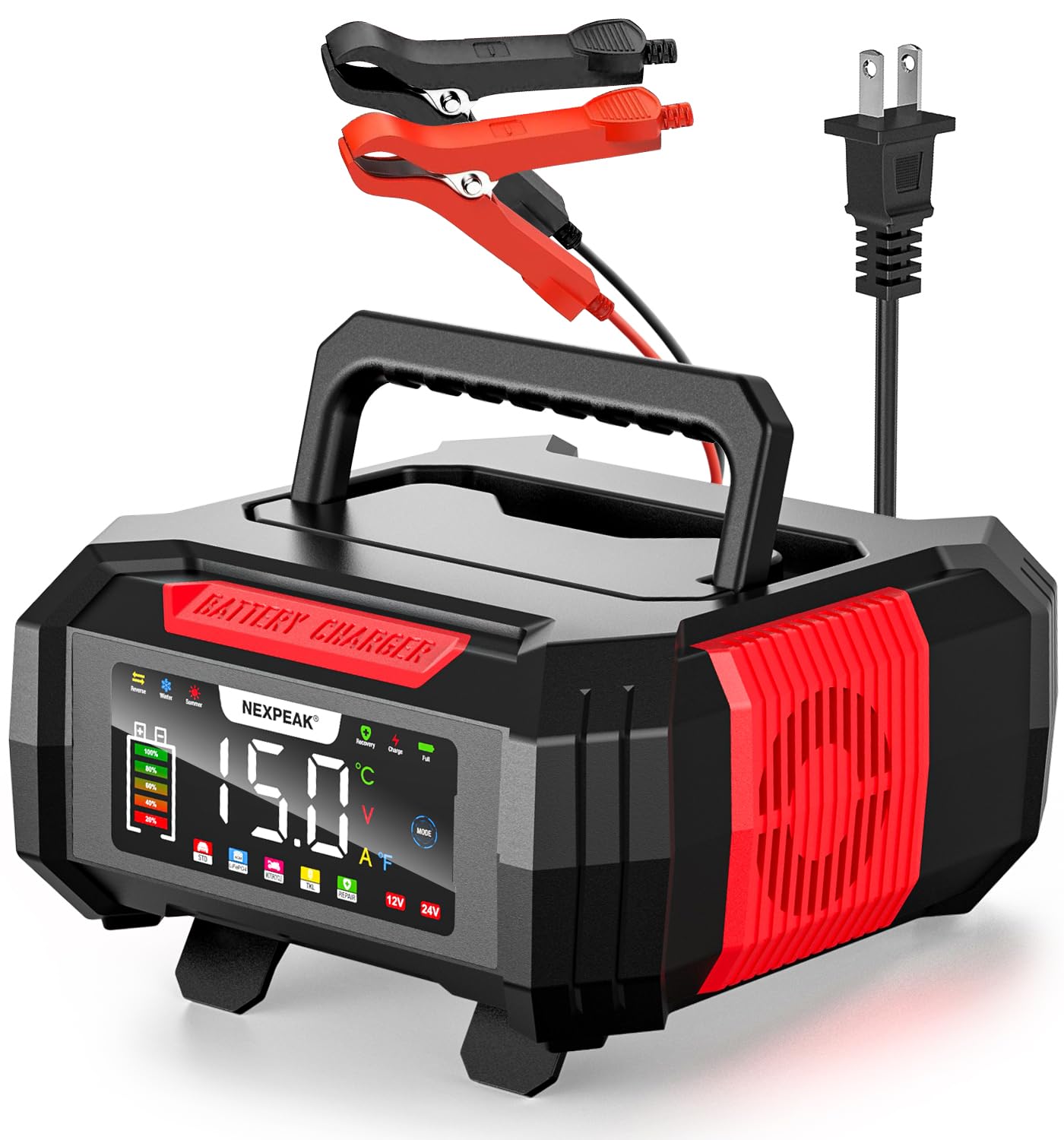
2. NEXPEAK 15A Battery Charger
The wall outlet for a deeply drained battery that needs a full tank before tomorrow.
If your battery is dead — not just low — a 0.75-amp or 1-amp unit will take days to bring it back. The NEXPEAK 15A delivers a huge 15 amps on a 12V battery, 8 amps on 24V, which means it can push a battery from 20% to full in roughly 5 hours according to the specs. That is at 15 amps versus the NOCO GENIUS1’s 1 amp and at 15 amps versus the Battery Tender Junior’s 0.75 amps — the difference between overnight and several days. It is also one of the few units here that explicitly supports LiFePO4 (lithium iron phosphate) batteries alongside standard lead-acid, AGM, GEL, and SLA types.
The LCD color screen shows voltage, current, charge percentage, and internal temperature in Fahrenheit — useful for spotting a battery that is heating up. But buyers report that the 8.9-foot charging cord (from clips to AC plug) is actually only about 4 feet, meaning you have to place the unit in the engine bay to reach. The plastic build also feels less substantial than older metal-unit chargers, according to reviews. Still, for anyone who needs to recharge a dead battery quickly rather than just keep a full one topped off, this is the fastest option here.
What stands out
- 15A charging (12V) is the highest amperage in this roundup — recharges deeply discharged batteries in hours, not days.
- Supports both lead-acid and LiFePO4 batteries, so it works with newer lithium setups.
- Large LCD displays real-time voltage, current, temperature, and charge percentage.
The trade-offs
- Cord is listed as 8.9 ft but owners mention it is roughly 4 ft, forcing you to place the unit near the battery.
- Cannot activate or charge a battery at 0V (totally dead).
- Plastic housing — some reviewers miss the durability of older metal chargers.
Reach for this if: you keep draining your battery and need the fastest possible recharge, or you have switched to a LiFePO4 battery and need a maintainer that speaks its language.
Look elsewhere if: you only need to float-charge a stored vehicle all winter — the amperage and bulk are overkill, and the cord length will be a frustration.
3. CRAFTSMAN CMXCESM258 12A Charger
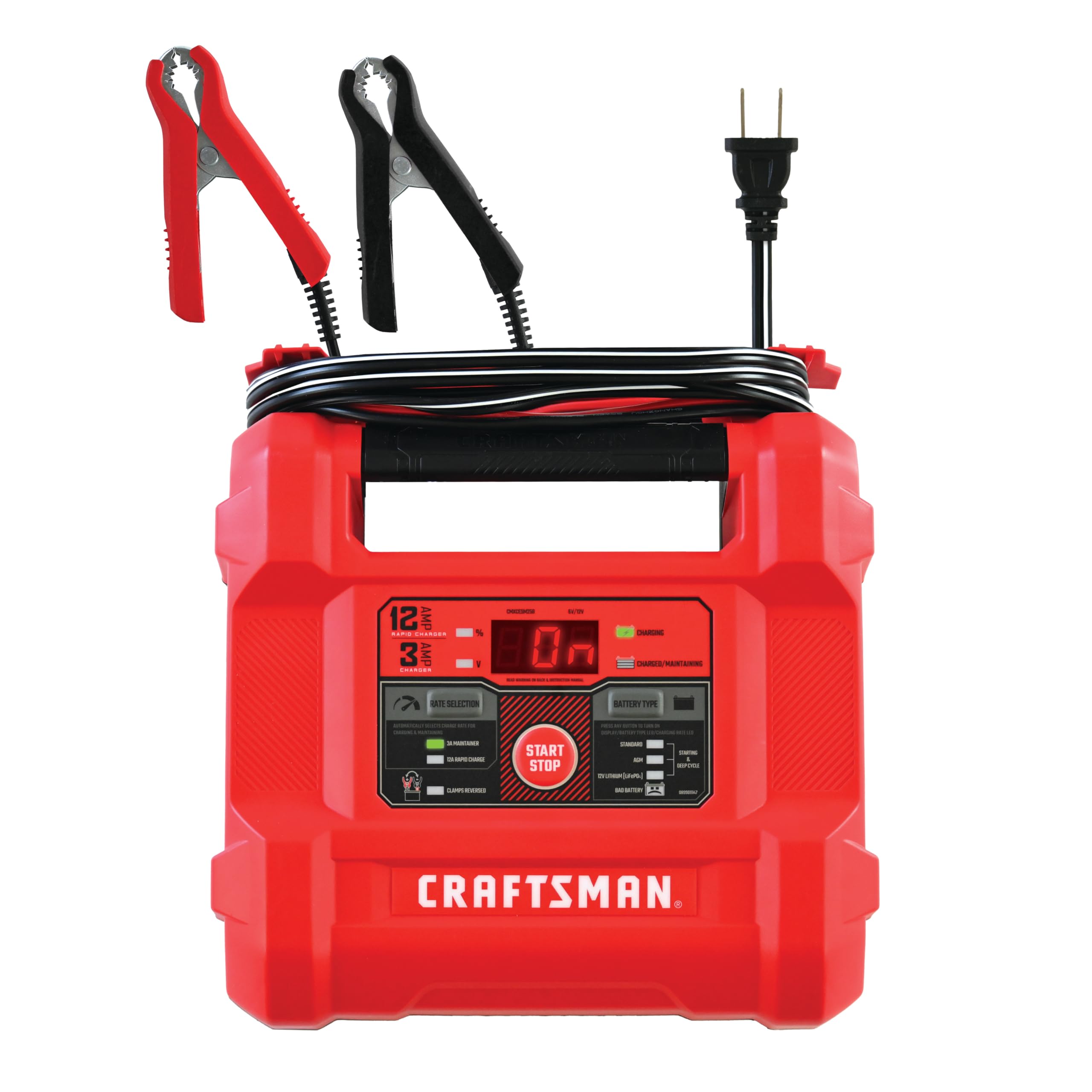
A four-in-one tool that charges, maintains, tests, and reconditions — ready for any car or truck battery.
This CRAFTSMAN unit is a 4-in-1 device, adding a built-in battery tester that is missing from almost every other pick here. It delivers 12 amps for fast 12V charging, plus a 3-amp mode for maintaining 12V batteries and a 2-amp mode for 6V batteries. That means it can bring a dead battery (one reviewer noted a car stored all winter) back to full charge in about five hours, yet switch down to a gentle maintenance trickle once it is full. It also supports LiFePO4 (lithium) batteries, unlike older units.
The desulfation mode sends pulses to break down sulfate crystals on the lead plates — a reconditioning feature that can extend a battery’s life, though it is not a guaranteed fix for a completely worn-out cell. It weighs 3.36 lbs, noticeably heavier than the 1-2 lb units here, which also makes it feel more substantial. The catch is that it is AC-powered (6-foot power cord, booster cables) and is meant to stay plugged in during use, so it is not a portable rescue tool. At this price point, it combines high charge speed, testing, and reconditioning in one box, beating the NEXPEAK on features even if it is slightly slower on raw amperage (12A vs 15A).
The strong points
- Built-in battery health tester — quickly tells you if the battery is worth saving or needs replacement.
- Three charge modes (12A, 3A, 2A) covering 6V and 12V, including LiFePO4 compatibility.
- Desulfation mode helps recover lost performance from sulfated batteries.
The limitations
- Heavier than most (3.36 lbs) — less convenient to move from car to car.
- No repair mode, which some CRAFTSMAN competitors offer on other models.
- Some users note it feels lighter-duty compared to older 30-year-old metal chargers.
Who it fits: the household with multiple vehicles — you can test each battery’s health, charge a deeply drained car fast, and still gently maintain a motorcycle or lawn mower battery.
Where it falls short: if you only need a small, permanent float charger for one stored vehicle, you are paying for tester and desulfation features you will not use.
4. ECO-WORTHY 12V 5A Smart Charger

The compact 5-amp unit that works with both lead-acid and lithium while staying affordable.
Most budget-friendly maintainers are stuck at 0.75A or 1A — fine for float charging but frustrating when you actually need to recharge. The ECO-WORTHY 5A splits the difference: it delivers 5 amps, so it can recharge a depleted battery in roughly 2 hours (compared to the Battery Tender Junior’s 0.75 amps, which would take most of a weekend). It supports both 12V lead-acid (including AGM, gel, SLA, flooded) and 12V LiFePO4 lithium batteries, with a full automatic bulk/absorption/float charging cycle.
The input voltage range is 100-240V AC, making it travel-friendly, and it comes with battery clips, O-ring terminal cables, and an SAE connector with a 10A fuse. Reviewer notes: “It gets warm during bulk charging; needs ventilation.” That is normal for a 5A charger, but the unit is small (5.83 inches wide, 2.17 inches tall) and weighs only 0.45 kg (about 1 lb). One buyer mentioned it failed to charge its own brand’s 50Ah LiFePO4 battery when a small LED light was on — it could not compensate for the draw — so this is best for float-maintaining a battery that is already mostly full or has no constant parasitic draw.
The advantages
- 5A charging is significantly faster than 0.75A or 1A units — useful for medium-speed recharging.
- True dual-chemistry support for both lead-acid and LiFePO4 lithium batteries.
- Compact and lightweight (0.45 kg), with multiple connection options (clips, ring terminals, SAE).
The downsides
- May struggle to top off a battery that has a constant small electrical load (like LED lights).
- Gets noticeably warm during bulk charging — needs air circulation around it.
- No desulfation feature found on CRAFTSMAN or NOCO units.
Best for: a DIY garage with both an old lead-acid car battery and a newer LiFePO4 camp battery — one charger does both without buying a separate unit for each chemistry.
Not ideal for: a stationary winter float-charge where you will not touch the battery for months — a 1A unit is simpler and cheaper.
5. DEWALT DXAEC2 Professional 2-Amp Charger

A no-fuss float maintainer for the 6V/12V gear you leave sitting for months.
If your use case is simple — keep a Corvette, a riding mower, or a boat battery from dying in the garage — the DEWALT DXAEC2 is a pure “float charger” that kicks in when voltage drops below roughly 12.85V and charges at 14.25-15.0V, similar to a car alternator. It is a 3-in-1 unit (charger, maintainer, trickle charger) for 6V and 12V AGM, GEL, or WET lead-acid batteries. The 2-amp rating is a modest bump over the Battery Tender Junior’s 0.75 amps, meaning it can handle a bit more recovery speed without being a fast charger.
It includes a hanging hook for mounting on a wall or in a tight engine bay, and the manual says it shuts off to prevent overcharging or reverse polarity. However, one owner reported their unit stopped working exactly one year after purchase — “dead exactly one year after purchase” — and multiple users have flagged reliability concerns. It also does not support LiFePO4 lithium batteries, so it is strictly for traditional lead-acid chemistries. For pure float-maintaining a seasonal vehicle, it works well; for reviving a deeply dead battery, it is underpowered.
What works
- Hanging hook makes it easy to mount in tight spaces or on a garage wall.
- 2-amp charge rate is slightly faster than basic 0.75-1A maintainers.
- Built-in protection against overcharging, reverse polarity, and short circuits.
What does not
- Reliability concerns — multiple reports of units failing after one year.
- No LiFePO4 support — lead-acid batteries only.
- Slower than even a 5A unit for recharging a fully dead battery.
Grab it for: a simple, brand-name solution to keep a weekend cruiser or mower battery at full charge during storage without monitoring it.
skip it if: you need long-term reliability or plan to charge deeply discharged batteries — reports of early failure and low amperage make it risky.
6. CRAFTSMAN CMXCESM259 1.5A Charger

The truly set-and-forget 3-in-1 that works on 6V and 12V without a single button to press.
Some maintainers overwhelm you with LED codes and modes. The CRAFTSMAN CMXCESM259 is the opposite: you connect the clamps (or the included quick-connect ring terminals), plug it in, and it auto-detects the battery type and voltage. It charges at 1.5 amps, then switches to a smart trickle (float mode) to keep the battery topped off without overcharging. It is a 3-in-1 device — charges, maintains, and reconditions via desulfation — for 6V and 12V standard, AGM, gel, and deep-cycle lead-acid batteries.
Customers note it works well for zero-turn mowers, motorcycles, and Camrys. One customer observed it brought a battery to full charge in three hours, which is reasonable for a 1.5-amp unit. The 6-foot power cord and 5-foot booster cables give decent reach, and the wall-mount design lets you hang it permanently near a workbench. The main limitation: at 1.5 amps, it will not recharge a deeply discharged battery fast — it is designed for topping off and maintenance, not revival. It also does not support lithium batteries, unlike the pricier CRAFTSMAN CMXCESM258.
Why it works
- Truly automatic — no buttons, no confusing modes, just clamp-and-plug.
- Includes both alligator clips and quick-connect ring terminals in the box.
- Wall-mountable, so you can install it permanently in the garage or shop.
The limits
- 1.5 amps is slow for reviving a dead battery — this is a maintainer, not a rapid charger.
- No LiFePO4 support — only works with lead-acid and gel batteries.
- Some users wish the indicator lights were more descriptive about charging status.
Ideal for: someone who wants a dead-simple plug-and-play maintainer for a summer car, a motorcycle, or a small tractor with lead-acid batteries — no learning curve.
Not for: reviving a battery that has been sitting flat for months — you will need the bigger 12A CRAFTSMAN or NEXPEAK for that job.
7. NOCO GENIUS1 1A Smart Charger

The compact 1A smart charger that can recover a battery so dead it reads zero volts.
The NOCO GENIUS1 is the only unit here that explicitly handles batteries down to 1 volt, and its Force Mode can attempt to revive batteries at zero volts. For comparison, the Battery Tender Junior (0.75A) and DEWALT DXAEC2 (2A) cannot start charging a battery below roughly 8-9 volts. The GENIUS1 also supports both 6V and 12V lead-acid (AGM, Gel, SLA, VRLA, flooded, deep-cycle) and lithium-ion (LiFePO4) batteries, making it among the most chemistry-friendly options. An integrated thermal sensor adjusts charge based on ambient temperature to prevent overcharging in heat and undercharging in cold.
Shoppers say: “1A charger revived a completely dead battery after 36 hours, but only when disconnected from the car.” That is the key: the 1-amp rate is slow — it took 1.5 days to revive a dead SUV battery per one review — and it cannot compensate for a parasitic draw from the vehicle’s electronics. The 110-inch DC cable (about 9 feet) with integrated eyelet terminals gives good reach, and the 3-year warranty is solid. The biggest complaint across reviews is the poor documentation — confusing LED modes are not explained well in the manual. At 0.95 lbs, it is very portable. It lacks the high amperage of the NEXPEAK 15A or CRAFTSMAN 12A, but for bringing a deeply discharged battery back from the brink, it is the most capable low-amp unit here.
what separates it
- Can charge batteries as low as 1V, with Force Mode for 0V batteries — best here for reviving neglected batteries.
- Supports both lead-acid and LiFePO4 lithium batteries, plus 6V and 12V.
- Temperature compensation adjusts charge voltage for hot and cold environments.
The challenges
- 1-amp charge rate is slow — expect 36+ hours to revive a deeply dead battery.
- Poor documentation — many users report confusing LED modes not explained in the manual.
- Cannot handle a parasitic electrical load while charging; disconnect battery from the vehicle.
Use this for: bringing back a neglected lead-acid or LiFePO4 battery that you thought was trash — the desulfation mode and ultra-low-voltage charging give it the best recovery odds here.
Do not use this for: fast recharging after a short trip — the 1A rate is painfully slow; stick with the NEXPEAK 15A or CRAFTSMAN 12A for speed.
Understanding the Specs
Amperage (A or mA)
This is the flow rate of electricity — how fast the maintainer can push a charge into your battery. Higher amperage means faster charging. A 0.75A (750mA) unit is a gentle trickle for keeping a full battery full over weeks. A 15A unit can recharge a dead battery in hours. But higher amperage generates more heat, which is why the NEXPEAK 15A needs ventilation and the ECO-WORTHY 5A runs warm during bulk charging. The right amperage depends on your battery size: a small motorcycle battery likes a low amperage (0.75-1A), while a big truck or SUV battery can handle 12-15A.
Float Mode (Maintenance Mode)
When a battery reaches full charge (around 12.6-12.8V for a 12V lead-acid battery), a smart maintainer drops the voltage to a safe float level — typically around 13.2-13.5V — delivering just enough current to counteract the battery’s natural self-discharge. This is the “maintenance” part of a maintainer. Units without a true float mode (older trickle chargers) keep pumping current and can overheat and damage a battery left connected for weeks. Every pick in this list has float mode, though the DEWALT DXAEC2’s transition is more of a basic on-off threshold than the smooth curve of the Battery Tender Junior or NOCO GENIUS1.
Desulfation / Pulse Repair
Sulfation happens when a lead-acid battery sits discharged: sulfur crystals form on the lead plates, blocking the chemical reaction that stores electricity. Desulfation sends short, high-voltage pulses that can break up those crystals and recover some lost capacity. The NOCO GENIUS1, CRAFTSMAN CMXCESM258, and CRAFTSMAN CMXCESM259 all include a desulfation mode. The NEXPEAK 15A has a pulse repair function as well, but notes it cannot activate or charge a 0V battery. Desulfation is not a miracle cure — it works best on batteries that have been sitting for weeks, not years.
Reverse Polarity Protection
Battery clamps have a positive (red) and negative (black) side. If you accidentally connect the red clamp to the negative battery terminal, reverse polarity protection prevents a spark or damage to the unit and your car’s electronics. Every unit here includes it, but the Battery Tender Junior explicitly mentions spark-proof circuitry and automatic reversed hook-up detection, which adds a layer of safety in a dark garage or cramped engine bay.
FAQ
Can I leave a car battery maintainer connected indefinitely?
What happens if I use a maintainer on a completely dead battery (0 volts)?
Will a 12V car battery maintainer work on a 6V battery?
Can I charge a lithium (LiFePO4) battery with any car battery maintainer?
How long does it take to fully recharge a dead car battery with a 1A maintainer?
What is the difference between a trickle charger and a battery maintainer?
Does a battery maintainer work if the battery is still connected to the car?
How do I connect a maintainer to a battery with hard-to-reach terminals?
What does the “desulfation” or “recondition” mode do?
Final Thoughts: The Verdict
For most buyers, the best car battery maintainer winner is the Battery Tender Junior 12V, 750mA because it is the most proven, reliable, and affordable option for the core job — keeping a lead-acid battery full during long-term storage with zero fuss. If you want to revive a deeply dead battery or need LiFePO4 support, grab the NOCO GENIUS1. And for the fastest possible recharge of a drained battery, the standout is the NEXPEAK 15A.
How We Picked
We do not accept paid placement. Every pick is matched to a real buyer and a real use-case; we do not hands-on test units.
Sources & Methodology
Specifications: manufacturer listings and product documentation. Review insights: verified customer reviews, as of July 2026. Pricing: not shown on this page (it changes often); check the current price via the retailer link.
As an Amazon Associate, Trending Car earns from qualifying purchases. This does not affect which products we feature.