7 Best Car Audio Speaker Cable | Cable That Carries Every Note

Our readers keep the lights on and my garage snacks stocked. As an Amazon Associate, I earn from qualifying purchases.

Specs are compiled from manufacturer listings and verified buyer reviews and can change over time — please confirm the key details on the product page before buying.

You have the amplifier and the speakers, but the wrong cable between them chokes your sound before it starts. A skinny wire with weak connectors or a stiff jacket that fights every bend can turn a crisp system into a flat, muddy mess. The fix is simple: match the gauge (wire thickness) to your power, pick a jacket that routes easily, and use clean connectors so the signal flows freely.

I’m Min Islam — the founder and writer behind Trending Car. This guide is built by comparing the manufacturers’ published specifications and the patterns across verified customer reviews, so you get each pick’s real strengths and trade-offs instead of marketing spin.

Whether you are wiring a full 4-channel system or running a simple pair of coaxials (a speaker type that combines a woofer and tweeter in one unit), choosing the right car audio speaker cable means matching the gauge to your power needs and the jacket to your install environment.

Our Picks at a Glance

InstallGear 14 Gauge Speaker Wire 100 ft
Best OverallInstallGear 14 Gauge Speaker Wire 100 ft4.8★20,210 ratingsThe 14 AWG workhorse that strikes a clean balance between cost and performance for most builds. This frosted blue-and-black spool gives you 100 ft (30.5 m) of 14-gauge CCA wire, which is the balance for a typical car audio setup.Check Price on Amazon
DS18 SW-16GA-100RB 16-Gauge Ultra Flex Speaker Wire
Budget PickDS18 SW-16GA-100RB 16-Gauge Ultra Flex Speaker Wire4.8★616 ratingsThe entry-level spool that gets basic jobs done without draining your wallet. DS18’s 16-gauge CCA wire is the most affordable option in this roundup, giving you 100 ft (30.5 m) of red-and-black conductor for simple hookups.Check Price on Amazon

How To Choose The Best Car Audio Speaker Cable

Picking speaker wire is not complicated, but a few simple rules protect you from unnecessary resistance and future rattles. Focus on gauge (wire thickness), conductor material, and jacket flexibility.

Gauge — the thickness that carries the current

Lower gauge numbers mean thicker wire and less resistance (less signal loss over distance). For car audio, 14 AWG is a solid middle ground for most mid-range systems. But if you are pushing high power or running long distances to your rear speakers, 12 AWG handles the load better. A thin 18 AWG works only for very low-power wiring like a remote turn-on lead (a small wire that signals the amplifier to turn on).

CCA or OFC — the conductor material trade-off

Copper-Clad Aluminum (CCA — an aluminum core with a thin copper coating) is lighter and cheaper. It works fine for typical car audio builds that do not demand extreme current. Oxygen-Free Copper (OFC — a purer form of copper with fewer impurities) conducts electricity better but costs more. Most of the cables here are CCA, which keeps your project budget-friendly while still delivering clean sound for everyday installs.

Jacket flexibility and polarity markings

A soft, flexible PVC jacket (a plastic outer layer) makes routing the wire through door panels and under carpets far easier, and it reduces the risk of kinking (a sharp bend that damages the conductor). Polarity markings (red and black or frosted blue and black lines on the jacket) help you keep positive and negative straight, preventing phase issues (a wiring mistake that makes speakers work against each other, weakening bass) that can weaken your bass.

Quick Comparison

Model Best For Gauge (AWG) Conductor Count Length Amazon
InstallGear 14 Gauge 100 ft★ Best Overall Balanced all-rounder 14 2 100 ft Amazon
DS18 SW-16GA-100RBBudget Pick Budget-friendly basic hookup 16 2 100 ft Amazon
Install Link 14 AWG 100 ft Clean installs with flexible routing 14 2 100 ft Amazon
DS18 SW-12GA-100RB High-power and long runs 12 2 100 ft Amazon
Recoil 20-Feet 9-Conductor Multi-channel amp wiring 18 9 20 ft Amazon
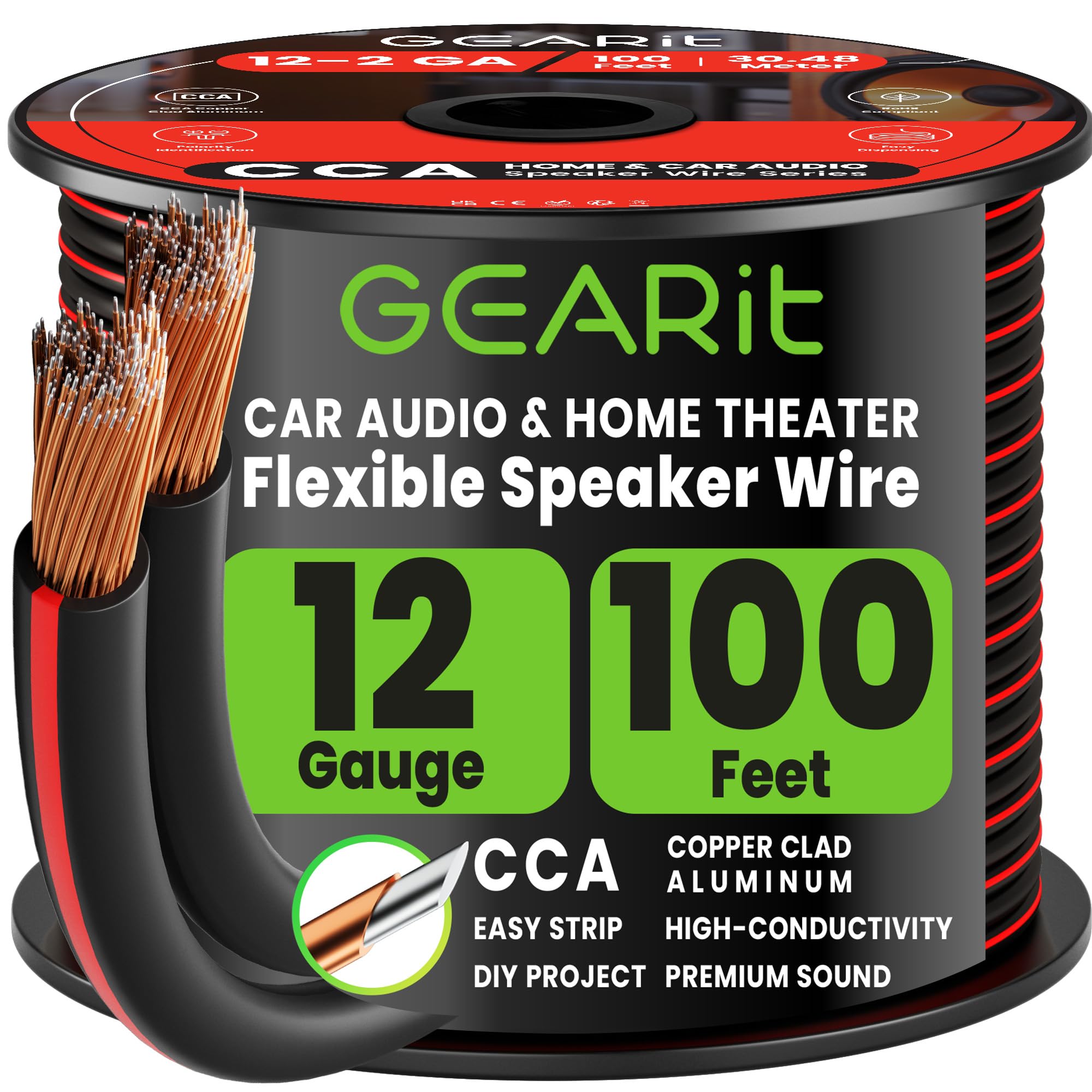
GEARit 12 Gauge 100 ft Foot-marked convenience for precise cuts 12 2 100 ft Amazon
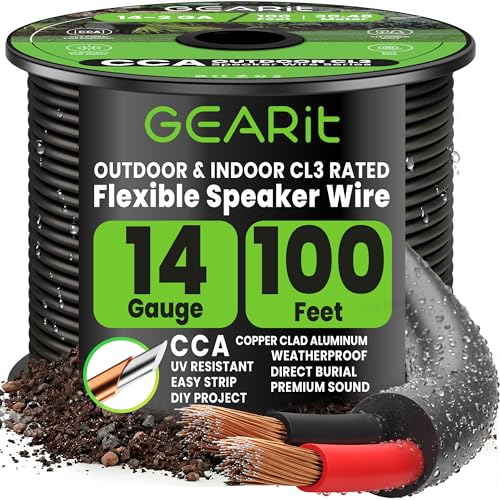
GEARit 14 Gauge CL3 100 ft Outdoor and in-wall installations 14 2 100 ft Amazon

In‑Depth Reviews

★ Best Overall

1. InstallGear 14 Gauge Speaker Wire 100 ft

Our pick — over 4.5★ from 20,000+ verified ratings; the strongest balance of quality and price.

14 AWG100 ft spool

The 14 AWG workhorse that strikes a clean balance between cost and performance for most builds.

This frosted blue-and-black spool gives you 100 ft (30.5 m) of 14-gauge CCA wire, which is the balance for a typical car audio setup. It is thick enough to keep resistance low on runs under 50 ft (15.2 m), according to buyers, without the premium cost of pure copper. The rugged PVC jacket is designed to stay flexible, so you can snake it through door channels and under carpet without fighting kinks, and the two-color jacket makes polarity identification instant.

Reviewers with over 20,000 ratings gave it top marks, calling it an “accurate gauge, thick durable sleeve, easy to strip.” That kind of consistency at nearly 20,000 purchases tells you the build quality holds up. At 14 gauge, it is notably thicker than the 18-gauge wires in the Recoil 9-conductor cable below, which means it handles more power for a standard 2-speaker or 4-speaker system without signal loss.

The material is CCA, not pure OFC, so if you are building a very high-wattage competition system you might want a thicker conductor, but for daily drivers and mid-range setups this is the most balanced roll you can buy.

Why it works

  • 14 AWG gauge is versatile for most car audio runs
  • Soft-touch jacket stays flexible in tight panels
  • Clear color coding for quick polarity
  • Massive positive reviewer consensus over 20,000 ratings

One trade-off

  • CCA conductor, not OFC — less efficient for extreme power demands

Best for everyday installs: If you are wiring a standard car stereo or a mid-power 4-channel amp, this 100 ft spool gives you everything you need with zero fuss.

Skip it for competition builds: For very high-wattage systems needing oxygen-free copper, you will want a pure OFC cable instead.

Budget Pick

2. DS18 SW-16GA-100RB 16-Gauge Ultra Flex Speaker Wire

16 AWG100 ft

The entry-level spool that gets basic jobs done without draining your wallet.

DS18’s 16-gauge CCA wire is the most affordable option in this roundup, giving you 100 ft (30.5 m) of red-and-black conductor for simple hookups. Because 16 AWG is thinner than the 14 AWG or 12 AWG cables here, it is best suited for low-power applications — think small coaxial speakers or a basic head-unit-to-speaker connection where the run is short. The flexible sheathing (outer jacket) makes routing easy, and the stranded conductors strip cleanly.

Buyers confirm it is “good quality” and a “great value,” praising the flexibility of the jacket for a tidy install. One reviewer specifically noted the flexible sheathing helps with a clean install and easy stripping. Just keep in mind that if you plan to push a high-wattage amp, the 16-gauge conductor will introduce more resistance than a thicker 12 AWG or 14 AWG cable would — save this one for lighter duty.

What you get

  • Budget-friendly price for 100 ft
  • Flexible jacket for easy routing
  • Red and black polarity markings

The limitation

  • 16 AWG is too thin for high-power amp runs

For basic wiring only: This is the right pick if you are replacing factory speaker wire or running low-power speakers on a tight budget.

Not for amplifiers: Avoid this for any subwoofer or 4-channel amp installation — the 16-gauge conductor will limit current delivery.

Flex Fit

3. Install Link 14 AWG Speaker Wire Cable 100 ft

14 AWGSoftFlex Jacket

The 14-gauge wire that wraps around turns and through conduit without fighting back.

This frosted blue-and-black 14 AWG CCA spool shares the same gauge as the InstallGear above, but the SoftFlex jacket is the standout trait here — buyers report it is “very soft, flexible silicone jacket, easy to pull through conduit.” That makes it a great choice if you have to route wire through awkward corners or tight door boots (the rubber tube between the door and the car body). It is 100 ft (30.5 m) of double-conductor stranded wire with clear polarity markings, and the CCA construction keeps the price approachable.

One buyer confirmed it is a “great value for money over going to the store or the auto parts place to buy some wiring,” noting that it spools tight, strips easily, and the copper strands are not too thin. Compared with the GEARit 14 Gauge CL3 below, this one is not rated for in-wall or outdoor use, but for pure car audio interior work the flexibility is tough to top.

Why choose this

  • Very soft jacket for easy conduit pulls
  • Strips cleanly without breaking strands
  • Clear polarity markings

One catch

  • Not CL3-rated for in-wall or outdoor use

For tight-routing installs: If you need to pull wire through door bellows or under carpets, this is the most flexible 14 AWG option you will find.

Indoors only: Skip it for outdoor speaker projects — look at a CL3-rated cable like the GEARit 14 Gauge CL3 instead.

High-Current

4. DS18 SW-12GA-100RB 12-Gauge Ultra Flex Speaker Wire

12 AWG100 ft

The thicker 12-gauge CCA wire built for high-power car audio demands.

When your system pushes serious wattage, 12 AWG is the gauge that keeps resistance minimal. This DS18 spool gives you 100 ft (30.5 m) of red-and-black 12-gauge CCA wire with a flexible jacket that a reviewer called “flexible and sufficient for multiple car speaker projects.” The thicker conductor is a significant step up from the 14 AWG and 16 AWG wires in this lineup — it handles more current without heating up, making it ideal for subwoofers or long wire runs to rear speakers.

One reviewer noted it “does not come on a spool for easy keeping,” so be prepared to coil it yourself. Still, the general consensus among 727 ratings is that it is top-quality wire at a reasonable price. The 12 AWG gauge here is thicker than the 18 AWG in the Recoil 9-conductor cable, so for pure power delivery this is a much stronger choice.

What stands out

  • 12 AWG handles high current for subs and long runs
  • Flexible jacket for easy routing
  • 100 ft length covers most builds

A minor annoyance

  • Does not come on a spool; you must coil it yourself

For high-wattage systems: If you are powering subwoofers or running long distances to rear speakers, this 12 AWG wire delivers the current you need.

Not for minimalists: If your system is low-power, the extra gauge is overkill — the InstallGear 14 AWG is a better value.

Multi-Channel

5. Recoil 20-Feet 9-Conductor Speaker Cable, 18AWG Pure OFC

18 AWG9 conductors

The 9-conductor snake that simplifies running four speaker channels and a remote wire in one pull.

This cable is an entirely different beast from the 2-conductor spools above. It bundles 8 speaker leads (four channels) plus one remote turn-on lead into a single 20-foot (6.1 m) jacket made from 18 AWG pure OFC — the only OFC cable in this list. The idea is you run one cable from the amplifier to the factory harness area instead of pulling four separate wires. The EIA color coding (a standard color system for identifying wires) makes matching each channel quick, and the ultra-flex outer jacket helps in tight spots.

One buyer gave a candid take: “wires are good quality but impractical for extracting individual wires; required full insulation removal, creating a messy rats nest.” That means this cable is best used for its intended purpose — a clean 4-channel amp-to-harness run — rather than custom rewiring where you need individual strands. At 18 AWG, the gauge is thinner than all other cables here, which is fine for signal-level runs, but note that the 2-conductor wires above offer a much thicker conductor for high-power paths.

The advantage

  • One cable replaces four separate wires for a 4-channel amp
  • Pure OFC conductor — the only one in this list
  • EIA color-coded for quick installation

The downside

  • 18 AWG is thin — not for high-power subwoofer runs
  • Difficult to extract individual wires cleanly

For 4-channel amp installs: If you are wiring four door speakers from a single amp, this 9-conductor snake saves time and clutter.

Avoid for subwoofers: The 18 AWG gauge cannot handle the current a subwoofer demands — use a 12 AWG or 14 AWG wire for that.

Measured Precision

6. GEARit Speaker Wire 12 Gauge 100 ft with Foot Markers

12 AWGFoot markers

The 12-gauge wire with foot markers printed right on the jacket for zero-guess cutting.

This spool gives you 100 ft (30.5 m) of 12 AWG CCA wire, but the real difference is the sequential foot markers printed on the jacket — no measuring tape needed, just cut where the length marker says. Polarity markings are also printed clearly, which shaves minutes off the install. The soft PVC jacket is sturdy enough to last but flexible enough to route around tight car interiors without kinking, according to buyers. It weighs 3.1 pounds (1.4 kg), making it a bit heavier than a 14 AWG spool of the same length.

A buyer noted the wire “unrolls nicely; no curling or tangling,” and the 2-year manufacturer support gives confidence. Compared to the DS18 12 AWG above, this GEARit adds the foot markers and a stronger brand warranty, which matters if you make mistakes measuring for a complex multi-speaker build.

Why it stands out

  • Foot markers on the jacket for precise cuts
  • 12 AWG handles high current for subs and long runs
  • Unrolls without curling or tangling

The trade-off

  • Premium price for foot markers and warranty

For measurement-averse installers: If you hate measuring and want to cut precisely every time, the foot markers alone justify this pick.

Value seekers look elsewhere: If you are fine using a tape measure, the DS18 12 AWG delivers the same gauge for less.

All-Weather

7. GEARit 14 Gauge Speaker Wire CL3 Rated 100 ft

14 AWGCL3 Rated

The CL3-rated 14 AWG cable that handles outdoor elements and in-wall routing safely.

This spool from GEARit is a 14 AWG CCA wire, but it carries a CL3 rating — a fire-safety standard that allows the cable to be run inside walls or outdoors without violating electrical code. The flame-retardant jacket resists fraying and environmental wear, and owners mention it is “very sturdy” and “easy to run through multiple studs without rips or frays.” It also features sequential foot markers printed on the jacket, so you get the same precision measuring as the GEARit 12 AWG above.

One reviewer used it “for an outdoor speaker project” and ran the cable “under a deck with no issues.” Another did a direct burial for outdoor speakers and said it was “easy to cut with scissors” and suitable for running under rocks or in-ground. That makes this the only cable in the list that is explicitly built for environments where moisture and abrasion are factors — car audio installs rarely need CL3, but if your system includes speakers in a truck bed, side-door, or exterior location, this is the safe choice.

Why it is useful

  • CL3 rated for in-wall and outdoor safety
  • Flame-retardant jacket resists fraying
  • Foot markers for precise cutting

The consideration

  • Overkill for standard interior car audio
  • Premium price vs non-CL3 14 AWG wires

For outdoor and in-wall projects: If you are wiring speakers in a truck bed, patio, or behind a wall plate, this CL3-rated cable is the safe and code-compliant pick.

Skip for interior-only builds: For simple door-panel wiring, a standard 14 AWG spool like the InstallGear or Install Link costs less and works just as well.

Understanding the Specs

Gauge (AWG)

American Wire Gauge (AWG — the standard measure of wire thickness) works like this: a lower number means a thicker wire that can carry more current with less resistance. For car audio, 14 AWG covers most speaker runs, 12 AWG is for high-power subwoofers or long distances, and 18 AWG works for signal-level wiring like remote turn-on leads. Always match the gauge to the amp’s power output and the length of the run.

CCA vs OFC Conductors

Copper-Clad Aluminum (CCA — an aluminum core with a copper coating) is lighter and cheaper than pure copper, and works fine for typical car audio systems. Oxygen-Free Copper (OFC — a purer metal with fewer impurities) transfers signal more efficiently, but costs more. For most daily drivers, CCA is perfectly adequate; OFC is worth the extra money only in high-wattage competition builds.

FAQ

What gauge speaker wire do I need for my car?
For most car stereo installations, 14 AWG is a safe middle ground. Use 12 AWG if you are running a high-power subwoofer or a long wire run to rear speakers. Thinner 16 AWG or 18 AWG wire is only suitable for low-power speakers or signal-level wiring like a remote turn-on lead.
Is CCA speaker wire good enough for car audio?
Yes, CCA (Copper-Clad Aluminum) is perfectly fine for typical car audio installations. It offers good conductivity at a lower cost than OFC (Oxygen-Free Copper). The main trade-off is that CCA has slightly higher resistance than pure copper, but for most daily driver builds you will not hear a difference.
How much speaker wire do I need for a car?
A 50-foot spool covers a basic 2-speaker or 4-speaker system with some slack. A 100-foot spool, like most of the options here, gives you enough for a full system including subs and rear speakers, plus extra for routing through door panels.
Can I use 12 AWG wire for all my car speakers?
Yes, but 12 AWG is thicker and heavier than needed for low-power speakers. It works perfectly well, but it is harder to route through tight spaces and costs more. For standard coaxial speakers running off a head unit, 14 AWG is more than enough.
What does CL3 rating mean on speaker wire?
CL3 is a fire-safety rating that allows the cable to be installed inside walls or in outdoor spaces in compliance with electrical codes. It means the jacket is flame-retardant and resists environmental wear. You only need CL3-rated wire if you are running cable through walls or exposed to weather.
When should I use a 9-conductor speaker cable like the Recoil?
Use a 9-conductor cable when you are wiring a 4-channel amplifier to four door speakers and want to run one single cable instead of four separate wires. It saves installation time and keeps the wire bundle tidy, but the individual conductors are typically thin (18 AWG), so they are not for subwoofer power.
Does speaker wire gauge affect sound quality?
It affects signal delivery, not quality in the sense of frequency response or clarity. A wire that is too thin for your power level will cause resistance, which reduces the volume your speakers can reach and may cause the wire to heat up. As long as the gauge matches your amp’s power output, the sound will be identical to any other wire of the same gauge.
What is the difference between 2-conductor and 9-conductor speaker wire?
A 2-conductor cable has one positive and one negative wire — it feeds one speaker. A 9-conductor cable like the Recoil has 8 speaker leads (four channels) plus a remote turn-on wire, letting you run a full 4-channel amp installation with a single cable pull. The gauge of each individual conductor is usually thinner in a multi-conductor cable.

Final Thoughts: The Verdict

Across the board, the car audio speaker cable winner is the InstallGear 14 Gauge 100 ft because it gives you a proven 14 AWG CCA build with a flexible jacket and a massive base of nearly 20,000 positive ratings at a fair price. If you want the most flexible wire for routing through tight spaces, grab the Install Link 14 AWG. And for high-power subwoofer builds, the thicker 12-gauge of the DS18 SW-12GA-100RB 12 AWG delivers the current you need.

How We Picked

We do not accept paid placement. Every pick is matched to a real buyer and a real use-case; we do not hands-on test units.

Sources & Methodology

Specifications: manufacturer listings and product documentation. Review insights: verified customer reviews, as of July 2026. Pricing: not shown on this page (it changes often); check the current price via the retailer link.

As an Amazon Associate, Trending Car earns from qualifying purchases. This does not affect which products we feature.

Related Guides

Please use a real email you check. If it's fake or mistyped, your message won't reach us and we can't reply — wrong addresses are rejected automatically.

Leave a Comment

Your email address will not be published. Required fields are marked *